Review: Saving Private Ryan (dir. by Steven Spielberg)


“Someday we might look back on this and decide that Saving Private Ryan was the one decent thing we were able to pull out of this whole godawful, shitty mess.” — Sergeant Horvath

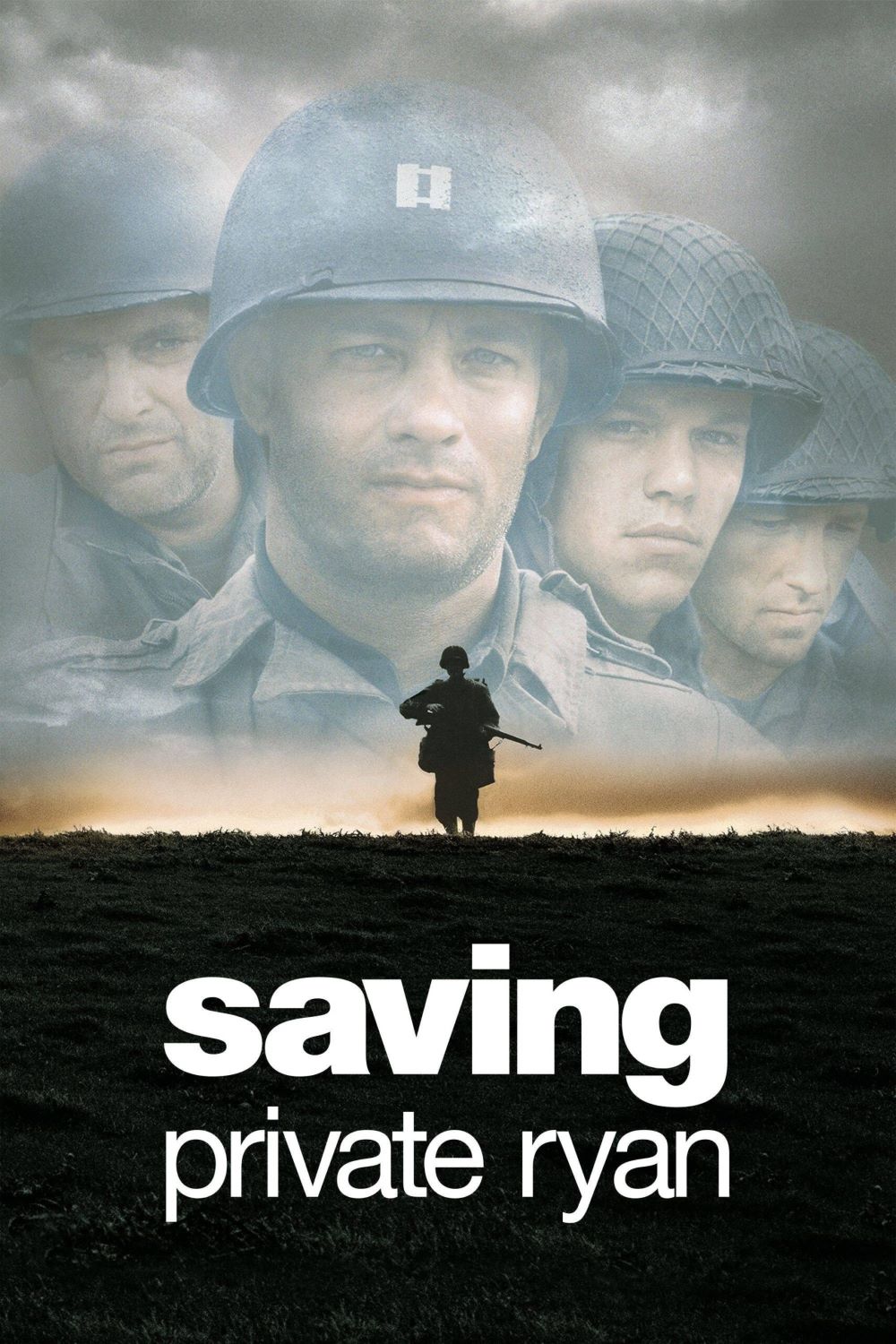
Saving Private Ryan stands as a landmark achievement in war cinema, intricately weaving immersive battle scenes, rich character dynamics, and profound moral themes into a nearly three-hour exploration of World War II’s human cost. One of its most remarkable features is the opening Omaha Beach landing sequence, a meticulously crafted, over 24-minute depiction of warfare’s brutal reality. Spielberg deploys a cinema verité style with handheld cameras capturing disorientation and chaos through the soldiers’ eyes. The sound design envelops the viewer in a sensory onslaught—gunfire, shouting, explosions—creating a visceral experience that immerses audiences directly in the terror and confusion of D-Day.

The filming process drew heavily on historical accuracy, with the production shot on the coast of County Wexford, Ireland, employing amputee actors and practical effects over computer graphics to simulate violent injuries and battlefield horrors. Muted tones evoke wartime photographs, and rapid, shaky editing conveys the disorganized, frantic environment soldiers endured. Consulting WWII veterans and historians, Spielberg created a sequence that reshaped cinematic portrayals of war, influencing how future films would approach the genre’s raw immediacy and emotional weight.

The film’s narrative follows a squad led by Captain Miller on a mission to locate and bring home Private James Ryan, whose three brothers have been killed in combat. The mission is steeped in the real-life tragedy of the five Sullivan brothers who died together aboard the USS Juneau in the Pacific, prompting military policies to prevent similar familial devastation. This historical context frames the story’s ethical heart: risking several men’s lives to save one, raising enduring questions about the value of individual sacrifice within the broader war.

In Saving Private Ryan, sacrifice is portrayed ambiguously—not as the sacrifice of a single hero but as the collective cost borne by the men tasked with rescuing one individual under perilous conditions. As the squad journeys through the war-torn French countryside, the deaths, injuries, and tensions they face underscore war’s randomness and the difficulty of weighing one life against many. The narrative refuses to romanticize or simplify, instead confronting the audience with the tragic truth that countless soldiers lose their lives without recognition or purpose, while some survive against staggering odds.

Duty and camaraderie thread throughout the film, portrayed through the soldiers’ evolving relationships and personal struggles. Each grapples with loyalty not only to their mission but to their fellow men and their own moral codes.

Integral to the film’s power is Tom Hanks’s layered performance as Captain John Miller. Hanks breathes life and emotional depth into Miller, portraying him as a man shaped by civilian life—revealed poignantly when he discloses his pre-war profession as a schoolteacher—now transformed by the relentless demands of war. He embodies an officer who is both composed and vulnerable, carrying the heavy burden of leadership with quiet dignity. Hanks’s portrayal reveals the internal struggles beneath Miller’s stoic exterior: moments of doubt, moral conflict, and fatigue subtly expressed through a trembling hand or a weary gaze. This humanity makes Miller relatable, as a man trying to maintain order and purpose amid chaos.

Hanks skillfully balances Miller’s authoritative presence with warmth and empathy, particularly evident in his paternal interactions with younger soldiers, reinforcing Miller’s role as both a leader and protector. His nuanced acting delivers the complexity of a man constantly negotiating duty and compassion. In scenes of high tension or moral quandaries, Hanks conveys the weight of command while allowing glimpses into Miller’s psychological strain, deepening the film’s emotional resonance.

Following Hanks’s Miller, a standout amongst the supporting cast is Tom Sizemore’s portrayal of Technical Sergeant Mike Horvath, Miller’s steady second-in-command. Sizemore embodies the pragmatic, battle-hardened soldier whose loyalty and experience provide emotional grounding for the squad. Sizemore portrays Horvath’s weariness and quiet commitment, adding layers of realism that deepen the exploration of how war reshapes individuals. The chemistry and shared history between Miller and Horvath are palpable, illustrating the bonds that sustain soldiers through hardship and lending emotional weight to the narrative.

The film wrestles with intense moral ambiguity throughout. The mission’s premise—to risk many lives to save one—compels both characters and viewers to confront complex questions about justice, value, and the cost of war. Scenes presenting difficult choices, such as the decision to spare or execute prisoners, dramatize these ethical dilemmas and highlight the emotional burdens borne by soldiers.

Technically, the film excels, with Janusz Kaminski’s dynamic cinematography capturing both the chaos of battle and intimate moments with evocative clarity. The immersive sound design reinforces the brutal reality, stripping warfare of glamor and confronting audiences with its daunting human costs.

Despite the overwhelming destruction and loss, Saving Private Ryan offers moments of humanity and hope. The rescue mission serves as a fragile symbol of compassion in the midst of devastation, while the film’s closing reflections on memory and legacy emphasize the lasting significance of sacrifice and survival.

Saving Private Ryan stands as a monumental achievement in the war genre, combining visceral combat realism, compelling characters, and moral complexity. Through Hanks’s deeply human Captain Miller and the nuanced supporting performances, especially Sizemore’s grounded Horvath, the film explores themes of sacrifice, duty, and brotherhood with unflinching honesty. Its enduring legacy lies in its unvarnished yet empathetic portrayal of war’s cost and the profound sacrifices made by those who lived it.

Horror Review: Ravenous (dir. by Antonia Bird)


“Morality… is the last bastion of a coward.” — Colonel Ives

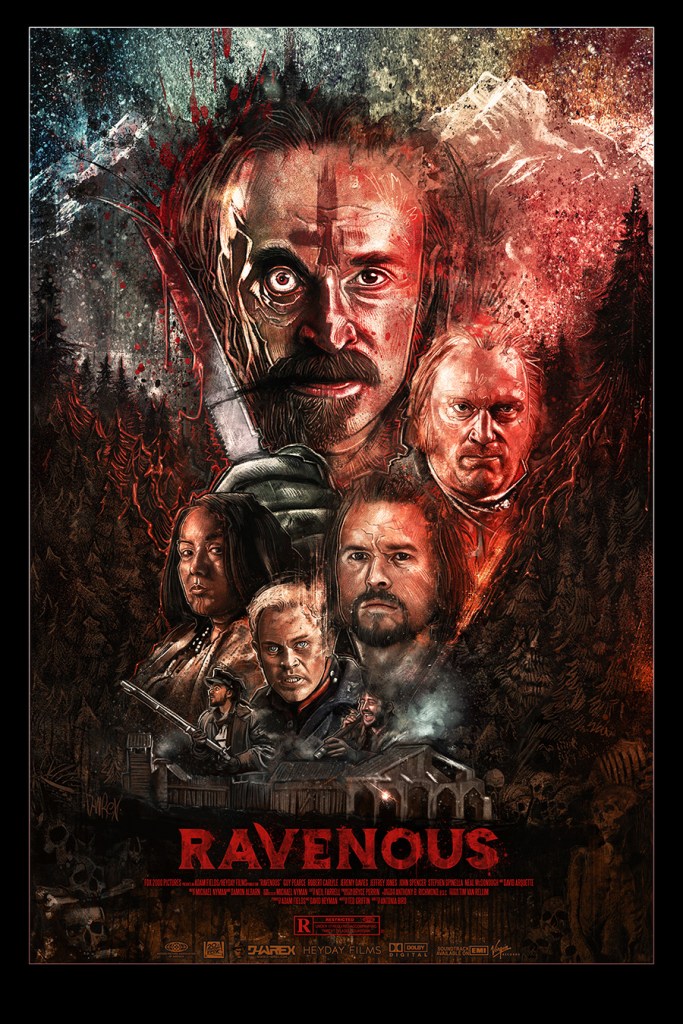
Ravenous remains one of the most fascinating and thematically daring horror films of the late 1990s—a layered meditation on hunger, morality, and the consuming appetite of empire disguised as a tale of survival. Set against the punishing winter backdrop of the Mexican-American War, the film centers on Lieutenant John Boyd, a soldier burdened by cowardice and guilt, sent to an isolated military outpost in the Sierra Nevadas. When a frostbitten stranger stumbles into camp with a horrifying tale of survival, the line between the living and the devoured—and between humanity and monstrosity—begins to blur.

At first glance, Ravenous is a dark horror film about cannibalism in a remote frontier fort. What distinguishes it is the way it transforms that premise into a meditation on civilization and consumption. The screenplay, written by Ted Griffin, draws inspiration from historical accounts such as the Donner Party and Alfred Packer—stories of pioneers who resorted to cannibalism to survive brutal winters. Griffin threads these historical horrors into a broader allegory about 19th-century American expansionism: a national hunger for land, power, and progress that consumes everything in its path, including its own humanity.

The mythological backbone of Ravenous lies in the inclusion of the wendigo, a spirit from Native American folklore. In Algonquin and Ojibwe tradition, the wendigo is born of greed and gluttony, a monstrous being that grows stronger and more grotesque with each act of consumption. The tale served as a warning against selfishness, warning that those who devour others—figuratively or literally—lose their humanity in return. Bird and Griffin seamlessly integrate this legend into the film’s themes, using the wendigo to mirror the psychological and cultural costs of empire. The story implies that the wendigo is not confined to mythic forests but lives in the blood of every nation that feeds on others to survive.

The fort where the story unfolds functions as both a stage and symbol: an outpost of civilization planted in the wilderness, claiming righteousness while sustained by exploitation. As starvation and moral decay take hold, the soldiers’ pretense of order crumbles. The isolated setting reflects the broader American project—civilization advancing through conquest yet losing its moral center in the process. The Native nations displaced and destroyed during expansion, reduced to resources or obstacles, become the unseen victims of this devouring drive. The film reframes cannibalism as a metaphor for Manifest Destiny itself—the act of consuming people, land, and spirit under the guise of progress.

That central metaphor gains power through the film’s performances. Guy Pearce delivers a subdued yet deeply expressive performance as Boyd, embodying the moral paralysis of a man trapped between guilt and survival. His silences, glances, and hesitations speak louder than any dialogue, conveying an internal conflict between virtue and instinct. Through him, the film explores how the will to endure can erode the boundaries of conscience.

Robert Carlyle, as Colonel Ives, stands in vivid contrast—charismatic, witty, and terrifyingly self-assured. He plays the role with the infectious energy of a man liberated by his own monstrosity, wearing sin as philosophy. For Ives, cannibalism is not horror but a revelation—a means to transcend weakness and embrace dominance. His eloquent justifications turn atrocity into ideology, echoing the rationalizations of expansionist politics. It is no coincidence that his confidence parallels Boyd’s doubt; the two men form mirror halves of a single corrupted ideal.

Director Antonia Bird’s touch elevates Ravenous from a historical thriller to a surreal moral fable. She handles violence and absurdity with equal precision, oscillating between grim horror and deadpan humor in a way that keeps viewers uneasy yet enthralled. Her direction never treats the horror as spectacle alone—every moment of gore carries weight, testing the limits of empathy and survival. Moments of unexpected humor punctuate the brutality, serving as a reminder that even atrocity can become ordinary when normalized by power.

While the fusion of dark comedy and horror lends the film its originality, it may also unsettle some viewers. The tonal shifts—helped by Michael Nyman and Damon Albarn’s strange, minimalist score—create an atmosphere that feels intentionally dissonant. This mix may challenge those expecting a traditional horror film, but it reinforces Bird’s vision of moral chaos. The unease generated by those shifts mirrors the absurdity of history itself: how horrors can coexist with banality, how laughter can accompany destruction.

The wendigo myth binds all these elements together. Bird portrays it less as a creature and more as a condition—one that spreads through ideology, greed, and the illusion of progress. The spirit of the wendigo thrives wherever ambition turns men into predators and justifies their violence as destiny. In this sense, every character becomes a reflection of national hunger, caught in a metaphorical cycle of consumption. The act of eating flesh becomes a stand-in for the broader devouring inherent in colonization: of land, of native culture, of moral identity.

By framing the frontier as an arena of both physical and spiritual starvation, Ravenous reimagines American history as a feast of self-destruction. It suggests that survival is often indistinguishable from conquest—both are rooted in the urge to consume. Even at its most surreal or ironic moments, the film refuses to let its viewers forget that the hunger at its center is not merely for sustenance but for dominion.

Though underappreciated upon release, Ravenous has since earned recognition as a rare film that wields gore and satire to expose deeper truths. Bird’s control of tone, Griffin’s allegorical writing, and the actors’ opposing energies fuse into something that transcends genre. The result is a story that both horrifies and compels, holding a cracked mirror to the myth of progress.

The wilderness of Ravenous is vast, beautiful, and pitiless—a perfect reflection of the American spirit it depicts. It is a land that promises renewal but demands devouring, a landscape haunted by the ghosts of all it has consumed. The film endures not simply as a parable of survival, but as a meditation on empire, appetite, and the fragile line separating civilization from savagery.

Both grotesque and profound, Ravenous gnaws not only at flesh but at the conscience, forcing us to confront what happens when hunger—whether for life, for power, or for victory—becomes the only morality left.

January True Crime: Shoot First: A Cop’s Vengeance (dir by Mel Damski)


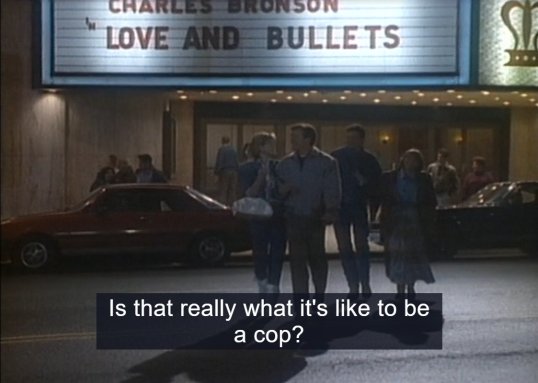
Made for television in 1991 and possessing a rather unwieldy title, Shoot First: A Cop’s Vengeance tells the story of two friends in San Antonio in the early 80s.

Farrell Tucker (Dale Midkiff) and Stephen Smith (Alex McArthur) are both cops.  They entered the police academy together, they graduated as a part of the same class, and they both hope to be partners while working to keep the streets of San Antonio safe.  Tucker is laid back and friendly and not one to worry too much about following all of the regulations.  Stephen Smith, on the other hand, is uptight and, at first, by-the-book.  He grew up in a poverty-stricken, crime-riddled neighborhood and it left a definite impression on him.  He hates crime and criminals but what he really can’t stand is a justice system that seems to be more concerned with the victimizers than with the victims.  Tucker and Smith enjoy spending their time together, drinking at the local cop bars and practicing their shooting on the weekends.  Tucker’s not much of a shot, whereas Smith is a sharpshooter who rarely misses.

At first, no one notices or even cares that some of San Antonio’s less upstanding citizens are getting gunned down in the streets.  But when Smith somehow manages to be first on the scene to a series of shootings, it gets the attention of Internal Affairs.  With Sergeant Nicholas (Terry O’Quinn) investigating the possibility of a cop-turned-vigilante and Chief Hogan (G.D. Spradlin) announcing that no one is above the law, Smith starts to get a bit paranoid and Tucker is forced to consider that his friend could very well be a murderer.

And, of course, Tucker’s right!  The first scene features Tucker confronting Smith and then the majority of the film is told in flashback.  Even if not for that narrative choice, one could guess at Smith’s guilt just from the title of the film.  When Shoot First: A Cop’s Vengeance was released on home video, the title was changed to Vigilante Cop, which made Smith’s guilt even more obvious.  Finally, some viewers will guess that Smith is guilty because the film is based on a true story.  Officer Stephen Smith actually did go on a killing spree, gunning down men who he felt had escaped the law and even sending threatening letters to his chief when the latter announced that vigilante activity would not be tolerated.  Officer Stephen Smith went from being a follower of the rules to someone who attempted to write his own rules.  It’s an interesting story for anyone who wants to google it.

As for the film, it’s adequate without being particularly memorable.  Alex McArthur and Dale Midkiff both give good performance as Tucker and Smith and the cast is full of talented people like Terry O’Quinn, G.D. Spradlin, Bruce McGill, and Lynn Lowry.  Observant viewers will even notice a long-haired Jeremy Davies, showing up for a split-second.  I liked the performance of Loryn Locklin, as the waitress who marries Smith and then discovers that her charming husband actually has some very serious issues.  The main problem with the film is that the story moves a bit too slowly for its own good and some of the Texas accents were more than a little dodgy.  If you’re looking for an action film, this won’t be for you, though the shootings are surprisingly graphic for something that was made for television.  Shoot First: A Cop’s Vengeance is a rather routine telling of an interesting story.

Retro Television Review: 1775 1.1 “The Pilot”


Welcome to Retro Television Reviews, a feature where we review some of our favorite and least favorite shows of the past!  On Thursdays, I will be reviewing 1775, which aired on CBS in 1992.  The entire show is currently streaming on YouTube!

This week, we take a trip into the past.  Welcome to 1775!

Episode 1.1 “Pilot”

(Dir by David Trainer, originally aired on September 5th, 1992)

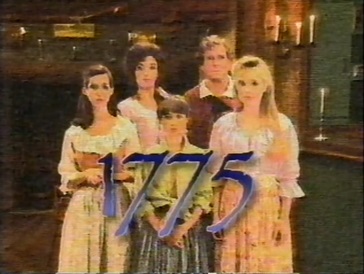
The year is 1775 and the streets of Philadelphia are awash in rumors of war and revolution.  While some prepare for war and others continue to declare their loyalty to the British Empire, Jeremy (Ryan O’Neal) and Annabelle Proctor (Lesley-Anne Down) just try to run their inn and find suitable husbands for their three daughters.  The youngest daughter (Danielle Harris, of Halloween fame) wants a horse because all of her friends have a horse.  She also wants to run off with a patriot and is offended when the pro-British Governor Massengill (Jeffrey Tambor) stops by the inn.

The Proctors know that one way to marry off their daughters would be to have them attend a fancy ball.  Unfortunately, that would require paying money that they don’t have.  Jeremy may have to ask his smug brother-in-law for cash.  His brother-in-law’s name?  George Washington.  Who plays George Washington?  Somewhat inevitably, Adam West.

Now, I know Adam West playing a smug and superficial George Washington might sound like a lot of fun but West only shows up for one scene and it’s a short one at that.  And he really doesn’t get any fun lines or really any opportunity to do any of his trademark Westing.  It’s a bit of a wasted opportunity.

Actually, the entire show feels like a wasted opportunity.  Reportedly, 1775 was an attempt to do a Blackadder for America but the pilot lacks all of Blackadder’s lacerating wit.  Instead of poking fun at American history and traditions in the way that Blackadder did to the Brits, 1775 is just a typically lame family sitcom that happens to take place in 1775.  The youngest daughter wants a horse …. BECAUSE IT’S 1775!  If it was the modern era, she would want a car.  That’s the entire joke.

As for the show’s cast, Lesley-Anne Down delivers a few snarky put-downs with elan but Ryan O’Neal appears to be lost in the main role.  Have you seen that famous clip of Ryan O’Neal saying, “Oh man, oh God,” over and over again?  Well, that’s the level of his performance here.  O’Neal sleepwalks through the show, delivering his lines in the weary voice of someone who needs the paycheck but otherwise could hardly care less.  When he gets exasperated with his daughters, he sounds numbly homicidal.  It’s not a pleasant performance and it features none of the fierce intelligence that Rowan Atkinson brought to countless incarnations of Edmund Blackadder.

Not surprisingly, only one episode of the show aired before it was canceled.  The series didn’t even reach the start of the Second Continental Congress but that’s okay.  We all know how that went.

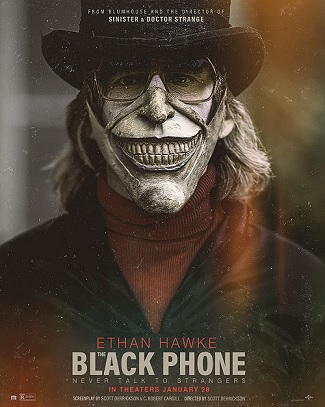
Horror Film Review: The Black Phone (dir by Scott Derrickson)


“Arm like a mint!” a character exclaims at a key moment in 2021’s The Black Phone and I’ll admit right now that, when I heard that line, I rolled my eyes so violently that I’m lucky that I didn’t lose one of them.

It’s one of those lines that reminds us that we’re watching a movie that’s based on a short story and that the dialogue that works in a piece of literature can often sound awkward and forced when heard on film.  It’s a line that, at least for a few moments, took me right out of the movie’s reality and reminded me that I was watching was indeed just a movie.

There’s actually a few moments like that in The Black Phone but, fortunately, there’s more than enough that works about this movie to make up for what doesn’t work.

Taking place in a Denver suburb in 1978, The Black Phone deals with the evil activities of a serial abducted and murderer who is known only as The Grabber (Ethan Hawke).  The Grabber (who really should demand a better nickname) has spent years grabbing children off of the street and then holding them prisoner in his basement before killing them.  The Grabber drives a van and he usually wears a mask.  The mask is creepy but it also tells us something about The Grabber’s personality.  Obviously, when he talks the kids into getting into his van (or getting close enough for him to grab them), the Grabber can’t wear his mask so he’s not wearing the mask so he won’t be identified.  Instead, he wears the mask as perhaps a way to keep his “normal” life separated from his life as The Grabber.  Maybe that’s how this middle-aged man justifies being everyone’s worst nightmare.  Perhaps he tells himself that he’s not responsible for what he does when he puts on the mask.  Once he puts on the mask, anything bad that happens is the fault of The Grabber.

The Grabber’s latest victim is Finney (Mason Thames).  While Finney waits in the basement, his father (Jeremy Davies) struggles with his own alcoholism and his sister, Gwen (Madeleine McGraw), tries to get someone — anyone — to take her psychic visions seriously.  Gwen is determined to find and rescue her brother but, early on, the audience realizes that only Finney can save himself.  Fortunately, Finney has some help in the form of the ghosts of the Grabber’s other victims, all of whom call Finney on a black phone in the basement.  They offer Finney advice on how both to survive and how to fight against The Grabber.  Some of the ghosts are angry.  Some of them are surprisingly cheerful.  All of them are understandably eager to help Finney fight their murderer.

It’s an effective film, even if it does feel a bit overlong.  The film is based on a short story and it’s hard not to feel that the story would have been better served by a 30-minute short film than an obviously extended feature film.  That said, The Grabber is a genuinely creepy villain and the film leaves you feeling as if anyone in the film could easily become his next victim if Finney doesn’t figure out a way to get out of that basement.  Interestingly, by casting the handsome Hawke as a child abducted and murderer and the nervous Jeremy Davies as an imperfect father who wants to do better, the film challenges our assumptions about both characters.  The Black Phone is a film that effectively captures the terror of everyday life.

Film Review: The House That Jack Built (dir by Lars von Trier)


(SPOILERS BELOW)

The other night, I watched 2018’s The House That Jack Built on Showtime and I have to say that, sitting here the morning afterwards, I kind of wish that I hadn’t.  It’s a well-made film and there’s a bit more going on underneath the surface that some other reviews might lead you to suspect but, at the same time, it’s also deeply unsettling and, even by the standards of Lars von Trier, disturbing.  It’s not a film to watch right before you go to bed, nor is it a film to watch at the beginning of a long week.  I’m still feeling the after effects of having watched this movie and I imagine I’ll probably be jumpy for the next few days.

The title character, Jack (Matt Dillon), is someone who loves to talk about himself.  He’s an engineer but he wishes he was an architect.  He thinks of himself as being an artist and an intellectual and he has no hesitation about informing you that he’s smarter than just about everyone else on the planet.  He’s annoyed that he’s not better-known.  He feels that his work is underappreciated.

The House that Jack Built runs two and a half hours and, as a result, we spent a lot of time listening to Jack talk.  One thing that quickly becomes apparent is that Jack knows a lot but he understand very little.  He spends a lot of time talking about Glenn Gould, Goethe, and Nazi architecture but his thoughts on them are rather shallow and predictable.  When we see flashbacks to Jack’s youth, we don’t see any signs of the intelligence that he claims to possess as an adult.  Instead, we just see a scowling country boy who used to abuse animals.  Jack may insist on calling himself “Mr. Sophistication” but there’s really nothing sophisticated about him and one gets the feeling that his faux intellectualism is something that he developed to justify the fact that he’s a sociopath and a serial killer.  Jack claims to have murdered at least 60 people and he also says that each murder was a work of art.  If art reflects the time and place in which it was made than how can we condemn Jack for reflecting the soullessness and cruelty of the real world in his own creations?  The answer, of course, is that we can very easily condemn Jack.  Jack uses the state of the world to justify his actions but that doesn’t mean we have to buy what he’s selling.

The House That Jack Built is built around a lengthy conversation between Jack and an enigmatic character named Verge (Bruno Ganz).  Jack shows Verge the “five incidents” that, over the course of 12 years, have defined who Jack is as a person and a serial killer.  The five incidents feature Jack killing everyone from a stranded motorist (Uma Thurman) and a grieving widow (Siobhan Fallon Hogan) to a terrified mother and her two sons.  Jack has a brief and toxic relationship with one of his victims (heart-breakingly played by Riley Keough) and it leads to an act of violence that’s so disturbing that I don’t even want to relive it long enough to write about it.  Throughout it all, Jack tries to justify himself while Verge continually calls him out on his bullshit.  Watching the film, I found myself very thankful for Verge.  The film would have been unbearable if it has just been Jack bragging on himself, unchallenged.  Verge not only calls out Jack but also anyone who would idolize someone like Jack.  At times, the film itself seems to be ridiculing the whole idea of the Hannibal Lecter-style serial killer.  There’s nothing suave or witty about Jack.  He’s just a loser with no soul.

Even though I was watching the R-rated version (as opposed to the unrated director’s cut), the murders were still disturbingly graphic.  But what really made the film unsettling was its peek into Jack’s nihilistic worldview.  As much as he may try to convince you otherwise, it soon becomes clear that there’s nothing going on inside of Jack’s head.  When Jack isn’t suffering from delusions of grandeur, he’s mired in self-pity.  (Listening to Jack, one is reminded of the infamous BTK Killer, who spent hours in court describing his murders without a hit of emotion but who later broke into tears when informed that he would be spending the rest of his life in prison.)  Unlike most movie serial killers, Jack doesn’t have a flamboyant origin story or any sort of trauma-related motive for his crimes.  He kills because he wants to.  Jack is capable of being superficially charming.  As a sociopath, he’s learned how to put people at ease.  But there’s nothing behind that charm.  When he performs some post-mortem surgery to give one of his victims a permanent smile, the results are grotesque because Jack has no idea what a real emotion looks like.  (Jack weakly waves at the body, as if he’s trying to teach himself how to act like a normal person.)

Throughout the film, we get a lot of stock footage.  (It’s justified by the fact that Jack is talking about art and history, two subjects about which he only has a surface knowledge.)  Interestingly enough, we also get several clips that were lifted from Von Trier’s previous films.  At one point, Jack passes a cabin that some viewers will recognize from Antichrist.  While Jack tries to dispose of a body, David Bowie’s Fame plays on the soundtrack and it’s hard not to be reminded of how Bowie’s Young Americans played over the closing credits of both Dogville and Manderlay.  We’re left to wonder if Jack is meant to be, in some way, a stand-in for Von Trier.  Much like Jack, Von Trier is often accused of using his own artistic pretensions to justify a nihilistic and misogynistic worldview.  It’s easy to imagine Verge as a stand-in for some of Von Trier’s fiercest critics.  What then are we to make of the fact that the film also portrays Verge as being correct and Jack as being (literally) bound for Hell?  Is Von Trier telling us that, as much as some people may dislike him and his work, at least he’s not a serial killer like Jack?  Is Von Trier attacking himself?  Or is Von Trier perhaps satirizing his own controversial persona?  Perhaps all three are correct.

By the film’s end, Jack is in Hell.  Interestingly enough, the portal to Hell is found in a house that’s made up of the bodies of Jack’s many victims.  Verge — short for Virgil, of course — gives him a tour.  When Jack sees a broken bridge, Virgil informs him that it once led to Heaven but it can’t be crossed now.  However, Jack is convinced that he can climb over a cliff and make his way to Heaven.  Virgil assures Jack that many have tried but none have succeeded.  Jack, of course, tries and, needless to say, he doesn’t make it.  In the end, redemption is impossible and yet you wonder how, in a world with Heaven and, one assumes, God, Jack even came to exist in the first place.  If Jack had channeled his sociopathic nature into something more productive than murder, would he have been allowed into Heaven?

As I said, it’s a well-made film but it’s also deeply unsettling.  I’m probably going to be jumping at my own shadow for at least a week or two.  At the very least, I’m not answering the door for anyone….


Film Review: Rescue Dawn (dir by Werner Herzog)


Dieter Dengler (Christian Bale) has been obsessed with flying ever since he was a child in Germany.  Towards the end of World War II, while his native country burned around him, Dieter would stare up at the skies and watch the American planes fly overhead and he knew that was not only what he wanted to do someday but also who he wanted to do it for.  Jump forward two decades, to 1966.  Dengler is now a lieutenant in the U.S. Air Force, an always smiling optimist who is considered to be something of a wild man.  When Dengler is reported as having been shot down over Loas, his fellow pilots are not only convinced that Dengler survived but that he’ll also eventually escape captivity.  Why?  Because they now Dieter Dengler is not the type to give up.

And they’re right.  Dengler not only survives the crash but he also survives in the wild.  After growing up in the rubble of Germany, Dengler is confident that he can survive anything.  Even when he’s finally captured by communist rebels, Dengler remains optimistic that he’ll make it back home.  When he’s told that he can go free if he signs a statement denouncing the United States, he refuses.  Dengler’s not going to turn on the country that allows him to fly.  Dengler soon finds himself being held in a POW camp with four other men, including two other Americans (played by Jeremy Davies and Steve Zahn).  The guards are determined to break Dengler but he’s just as determined to escape.  Hearing that it’s impossible to do so only makes Dengler more determined.

The story of Dieter Dengler and his eventual escape from captivity was originally told, by Dengler himself, in Werner Herzog’s 1997 documentary, Little Dieter Needs To Fly.  That Herzog saw Dengler as a kindred spirit is evident in the fact that, 9 years after the documentary, Herzog again told Dengler’s story in the 2006 film, Rescue Dawn.

On the face of it, a story about a group of Americans escaping from a POW camp might sound like an unlikely topic for a Werner Herzog film but it doesn’t take long for Herzog to put his own distinctive stamp on the project.  As played by Bale, Dengler is another one of Herzog’s obessessive heroes.  Dengler’s obsession is not just with flying but also with being free.  For Dengler, that’s what being an American means and that’s why he would rather be tortured than sign a simple piece of paper denying the existence of that freedom.  Much as how Grizzly Man portrayed Timothy Treadwell as being a man who would rather be eaten by a bear than live a life that’s been dictated by others, Dengler would rather suffer than betray his adopted country.

Rescue Dawn also centers around another common Herzog theme, the pitilessness of nature.  Watching Dengler trying to make his way through the jungle, we’re reminded that nature will always win in the end.  In Herzog’s world, neither nature nor the universe as a whole has any ideology.  Long after every warrior has died, the film tells us, nature will still be there.  The one thing that the POWs and their captors have in common is that they’re all at the mercy of the chaos of nature.  Just as the jungle threatens to swallow up Dengler and the other prisoners, their captors are slowly starving to death due to a drought.  As filmed by Herzog, the jungle is both beautiful and overwhelming.  Even at the film’s triumphant conclusion, it’s hard not to feel that, for all the planning, Dengler’s escape and survival was due to the random chaos of the universe.  How much can we control and how much must we simply leave up to the whim of nature?

Bale, Davies, and Zahn all give excellent performances and Herzog keeps the story moving quickly.  It’s probably one of his most emotionally accessible films and it’s impossible not to shed a tear at that final scene.  That said, I’d be remiss if I didn’t acknowledge that there’s a good deal of controversy about the way that Rescue Dawn portrays Gene DeBruin, the POW played by Jeremy Davies.  The film often contrasts Dengler with DeBruin.  If Dengler is always hopeful and determined, DeBruin is portrayed as being unstable and unreliable.  However, by most accounts — including the one given by another one of the prisoners — DeBruin was actually the exact opposite of how he was portrayed in the film.  Instead of being selfish, he was a source of strength for the POWs and he actually refused to take advantage of a previous chance to escape because it would have meant abandoning the rest of the prisoners.  Herzog has said that he wasn’t aware of DeBruin’s heroism when he wrote and directed the film and that he now regrets the way that DeBruin was portrayed.  (DeBruin’s brother has said that Herzog refused to talk to the family while the film was in poduction.)  Rescue Dawn is a well-made and wonderfully acted film and it’s one that always brings tears to my mismatched eyes but, while watching it, it’s impossible not to regret the injustice that was done to Gene DeBruin.

TV Review: Twin Peaks: The Return “Part 6” (dir by David Lynch) (SPOILERS)


It’s time to take another trip into the world Twin Peaks!  Below is my recap of the latest episode.  Along with reading my thoughts, be sure to check out Ryan’s review of the episode as well!  And, if you want to see where my mind was immediately after the end of Part 6, check out my initial thoughts here!
I have to admit that I cringed a little when Part 6 opened with Cooper/Dougie (Kyle MacLachlan, of course) still staring at that statue.  It was an image that was somehow both touching and annoying.  There’s an innocence to Cooper/Dougie that makes you want to protect him and, at the same time, it’s hard not to want the old Cooper back.  No matter what, I do have to admire David Lynch for having the courage to take the risk of maintaining such a leisurely pace when it comes to telling this story.  It goes against all conventional wisdom.

After coming across Dougie/Cooper still staring at the statue, a friendly police officer takes him home.  (Dougie/Cooper is obsessed with the officer’s badge and can still only identify his house by using the red door.)  Janey-E (Naomi Watts) has finally reached the point where she’s willing to accept that Cooper/Dougie needs to see a doctor but she still seems to be in denial about just how strange her “husband” is acting.  If anything, the Cooper/Dougie storyline demonstrates the lengths that some people will go to in order to pretend that everything’s normal.

Dougie/Cooper is sent upstairs, by Janey-E, to say goodnight to Sonny Jim (Pierce Gagnon).  This leads to a genuinely sweet scene, in which Sonny Jim and Dougie/Cooper take turns clapping their hands and making the lights go out and come back on.

However, that fun is interrupted by Janey-E.  While going through the file that Dougie/Cooper brought home from work, she comes across an unmarked brown envelope.  Inside is a picture of Dougie with Jade (Nafessa Williams).  Janey-E realizes that not only has Dougie/Cooper not paid the money that he owed the loan sharks but that he’s also been seeing a prostitute.  “You are in the dog house, mister!” she shouts.  Dougie/Cooper, on the other hand, is just happy to see a picture of Jade.

“Jade,” he smiles, remembering that she once gave him a ride to a casino.  (“Jade gave two rides,” Dougie/Cooper says, blankly.)

Suddenly, the phone (a landline!) rings.  “Maybe it’s Jade calling!” Janey-E snaps.

“Jade,” Dougie/Cooper smiles.

Janey-E answers and discovers that it’s the loan sharks calling.  They want their money.  Janey-E tells them that there’s no way that Dougie/Cooper is going to be able to pay, especially if they do the typical loan shark thing and break his legs.  (Naomi Watts, incidentally, totally kicks ass in the role of Janey-E.)  Janey-E agrees to meet with Dougie/Cooper’s “friends” the next afternoon.

“Tomorrow’s a big day!” Janey-E snaps at him.

“Big day,” Dougie/Cooper agrees.

“Yes, sweetheart,” Janey-E agrees.

Meanwhile, somewhere — perhaps in Twin Peaks — a green light turns red and there is the sound of electricity.  In the Black Lodge, One-Armed MIKE (Al Strobel) walks with his one arm raised to the air.

Suddenly, MIKE appears in Dougie/Cooper’s living room.  “You have to wake up!  Wake up!  Don’t die.  Don’t die!  Don’t die!” he tells Dougie/Cooper before vanishing.  Dougie/Cooper responds by drawing what appears to be a ladder and steps on his work files.  It’s hella creepy.

Cut to Albert Rosengfield (Miguel Ferrer) driving through the rain.  (Is he in New York?  That’s what I assumed, mostly because I assume all big, unnamed cities are meant to be New York.)  After parking his car and getting out in the rain, Albert struggles with umbrella and then shouts, “Fuck Gene Kelly!  You motherfucker!”  It’s a funny line but also a sad one, as it reminds us of the great actor we lot when we lost Miguel Ferrer.

Albert steps into a trendy bar.  He approaches a blonde woman at the bar.  “Diane?” he says.  She turns around.  OH MY GOD, IT’S LAURA DERN!

(Yes, after 25 years, we’ve finally met the Diane that Cooper always spoke of.  Even better, she’s played by the one living performer — Jack Nance, sadly, is no longer with us — who is as closely linked to David Lynch as Kyle MacLachlan.)

Laura Dern as Diane

Cut to Twin Peaks.  At a lumber yard, psycho Richard Horne (Eamon Farren) has apparently just snorted the greatest cocaine ever.  He’s at a meeting with Red (Balthazar Getty) and several heavily armed men.  Apparently, Red is the new Twin Peaks drug lord.  (I guess the Renault family has gotten out of the game.)  Red says that he’s been in town for a few weeks and he likes it.  (During Part One, we briefly saw Red at the Roadhouse, making eyes at Shelley.)

Red is a typically talkative David Lynch drug dealer.  He says that he has problems with his liver.  He wants to know if Richard has ever really studied his hand.  Red talks about how much he likes The King and I.  In between all the random comments, he worries that Richard doesn’t have his drug use under his control and then says, “I’m going to be watching you, kid.”

“Don’t call me kid,” Richard says.

Red thinks that’s the funniest thing he ever heard.  Red also explains that, if Richard screws up, he’ll saw open Richard’s head and eat his brains.  Red does an elaborate magic trick with a dime, flipping it into the air where it apparently hangs in suspended animation before briefly appearing in Richard’s mouth.  Richard pulls the dime from his mouth, just to have it disappear from his hand.  Suddenly, the dime falls into Red’s hand.  Red explains that the dime represents the two of them.  “Heads, I win,” Red explains, “tails you lose.”

(Balthazar Getty is totally and completely chilling as Red.  He’s certainly a better actor now than he was when he made Lost Highway.)

Anyway, Richard doesn’t take this well because, in the very next scene, he’s driving his pickup truck, crying, and screaming, “Fuck you, man!”

Meanwhile, at a nearby trailer park, Carl (Harry Dean Stanton) is starting his day.  (You may remember Carl as the trailer park manager from Twin Peaks: Fire Walk With Me.  Apparently, he’s moved to Twin Peaks.)  Carl, who says he’s mostly just waiting for die, is driven into town by a friend.  Accompanying them is a man (Jeremy Lindholm) who talks about his wife, Linda.  She’s in a wheel chair and the man says that it’s taken forever for the government to send them their money.

“Fucking war,” Carl says, “Fucking government.”

(Damn straight, Carl!  Also, remember in Part One, the Giant told Cooper that he needed to find Richard and Linda.  Well, we’ve already met Richard Horne and, in this episode, we learned about Linda.  But are the same Richard and Linda that Cooper needs to find?)
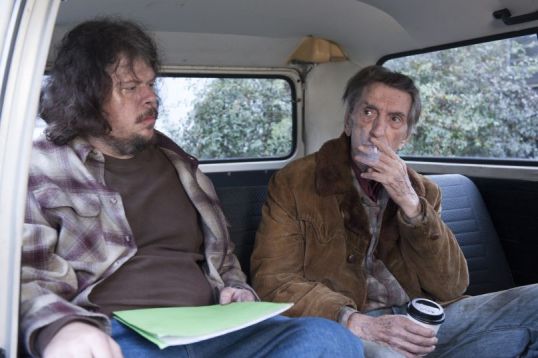
At the Double R, we discover that apparently there hasn’t been any staff turnover in 25 years.  Shelley (Madchen Amick) is ringing up customers.  The German waitress is still taking orders.  A customer named Miriam (Sarah Jean Long) says that she loves Double R coffee.  She’s a teacher.  “The kids this year are so cute!” she says.  There’s much giggling.  Surely, nothing bad could possibly be about to happen with all of this happiness going on…

Uh-oh, Richard’s still driving and yelling.  “I’ll show you a kid!” he shouts, slamming down on the accelerator.  Damn, Richard — is that any way for a Horne to behave!?

Carl sits in a park and stares up at the trees.  He watches a mother playing with her young son.  He smiles at them.  Carl appears to have calmed down considerably over the past 25 years.

Richard, being the worst human being ever, runs a stop sign.  Well, what could go wrong on such a beautiful day, right?  I mean it’s not safe but — OH SHIT, RICHARD JUST RAN OVER THE KID!  And then he keeps on driving, all the while screaming that it’s not his fault!  While he’s yelling, he suddenly realizes that Miriam — who is standing outside of the Double R — has seen his truck and his face.

Meanwhile, the mom is left cradling her dead son, while a group of onlookers stare at them.  Carl runs out to the street and sees a yellow flame (the boy’s soul, maybe?) floating into the atmosphere.  Of all the witnesses, only grizzled old Carl attempts to provide any comfort to the sobbing mother.

As the scene ends, the camera zooms in on the power lines.  We hear the crackling of electricity.  Remember how Killer BOB was always connected to electricity during the show’s initial run?

In Las Vegas, Duncan Todd (Patrick Fischler) sees a large red square on his laptop.  He gets an envelope out of a cabinet and puts it on his desk.  The envelope has a black dot on it.  (In case you’ve forgotten, Todd appeared briefly during Part 2.  He’s a Vegas business executive who apparently is in some sort of debt to some powerful and frightening people.)

At Rancho Rosa, the cops are looking over the remains of Dougie’s car, which exploded last episode.  One cops find the license plate on the roof of the house.  Meanwhile, across the street, Druggie Mom (Hailey Gates) chants, “One one nine!  One one nine!”

At a motel, a little person named Ike “The Spike” Stadtler (Christophe Zajac-Denek) sits at desk and plays with some dice.  Why is he called The Spike?  Well, we’re about to find out.  Someone slips an envelope under his door.  (It looks like the same envelope that was on Duncan’s desk.)  Inside the envelope are pictures of Dougie and Lorraine (Tammy Baird), the woman who was previously hired to kill Dougie.
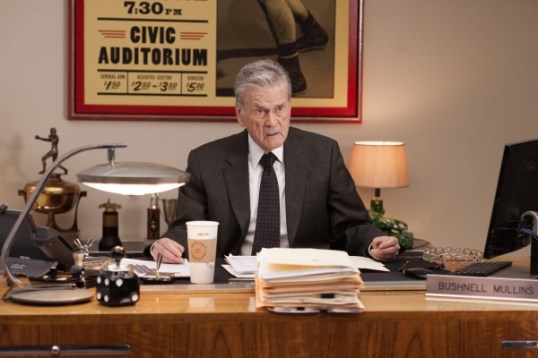
Meanwhile, Dougie/Cooper is back at work.  He’s got his big case file with him.  Unfortunately, his boss, Bushnell Mullins (Don Murray) is not impressed with Dougie/Cooper’s ladder drawing.  “Look at all of these childish scribbles,” he says, “how am I going to make any sense of this?”

“Make sense of it,” Dougie replies.

(Judging from the poster in his office, Bushnell was once a professional boxer.)

Suddenly, after looking at a few more of Dougie/Cooper’s drawings, Bushnell says, “Dougie, thank you.  I want you to keep this information to yourself.  I’ll take it from here but I may need your help again.”  Bushnell smiles.  “You’ve certainly given me a lot to think about.”

“Think about,” Dougie/Cooper replies.

“You’re an interesting fellow,” Bushnell says.

Meanwhile, Janey-E meets with the two men who claim that Dougie owes them money.  They explain that Dougie put a bet on a football game and lost.  They try to be intimidating but they don’t know who they’re dealing with.  Janey-E doesn’t have any time for their crap and she’s not afraid to let them know it.  She’s especially not impressed with their claim that Dougie owes them $52,000 when the bet was only for $20,000.

Nope, Janey-E’s not having it.

“We are not wealthy people!” Janey-E snaps, “We drive terrible cars!  We are the 99 per centers and we are shit on enough and we are certainly not going to be shit on by the likes of you!”  (If this seems surprisingly political for the normally apolitical David Lynch, it’s worth remembering that the script was co-written by Mark Frost, who is far more outspoken politically.  As a general rule, overly political stuff bores me to tears but Naomi Watts really kicks ass in his scene, totally selling every line.)  Janey-E gives them $25,000 and tells them to go away.

“What kind of a world are we living in where people can treat each other like this!?”  Janey-E says, before driving away.  “We are living in a dark, dark age.”

Meanwhile, Ike attacks Lorraine in her office and, in a disturbingly graphic scene, stabs her and at least two other women to death with a spike.  (Hence, his nickname.)

Back in Twin Peaks, Richard parks his truck in a field and tries to clean off the boy’s blood.

In the Sheriff’s Department, Deputy Hawk (Michael Horse) is in the men’s room when he sees a dime roll across the floor.  He follows the dime into a stall and, after picking it up, sees a metal sign proclaiming that the stall was built by Nez Perce Manufacturing.  And apparently, Nez Perce’s logo is a Native American chief.  Hawks sees that the top of the door is split open.  Hawk splits the door open further and finds several pieces of paper.
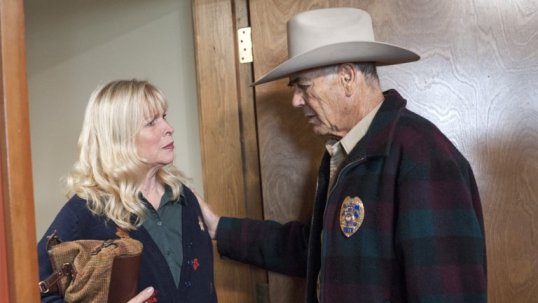
Meanwhile, Doris Truman (Candy Clark) comes by and yells at Frank (Robert Forster).  Doris is upset because her father’s car is not running right.  “Why are you always against me!?” Doris demands.  The other deputies say they wouldn’t put up with Doris but Maggie (Jodi Thelen) tells them that they don’t know what they’re talking about.  Doris, Maggie explains, changed after their son committed suicide.

“I know that,” one of the deputies says, mockingly, “he couldn’t take the pressure of being a soldier.”

(Is it possible that the death of Truman’s son — who it sounds like may have had PTSD — could be related to Linda, who — judging by Carl’s comments about the “fucking war” — may have been wounded while serving in the Army?)

And we close out with another haunting musical performance at the Roadhouse, the week courtesy of Sharon Van Etten.

Twin Peaks on TSL:

  1. Twin Peaks: In the Beginning by Jedadiah Leland
  2. TV Review: Twin Peaks 1.1 — The Pilot (dir by David Lynch) by Lisa Marie Bowman
  3. TV Review: Twin Peaks 1.2 — Traces To Nowhere (directed by Duwayne Dunham) by Jedadiah Leland
  4. TV Review: Twin Peaks 1.3 — Zen, or the Skill To Catch A Killer (dir by David Lynch) by Lisa Marie Bowman
  5. TV Review: Twin Peaks 1.4 “Rest in Pain” (dir by Tina Rathbone) by Leonard Wilson
  6. TV Review: Twin Peaks 1.5 “The One-Armed Man” (directed by Tim Hunter) by Jedadiah Leland
  7. TV Review: Twin Peaks 1.6 “Cooper’s Dreams” (directed by Lesli Linka Glatter) by Lisa Marie Bowman
  8. TV Review: Twin Peaks 1.7 “Realization Time” (directed by Caleb Deschanel) by Lisa Marie Bowman
  9. TV Review: Twin Peaks 1.8 “The Last Evening” (directed by Mark Frost) by Leonard Wilson
  10. TV Review: Twin Peaks 2.1 “May the Giant Be With You” (dir by David Lynch) by Leonard Wilson
  11. TV Review: Twin Peaks 2.2 “Coma” (directed by David Lynch) by Jedadiah Leland
  12. TV Review: Twin Peaks 2.3 “The Man Behind The Glass” (directed by Lesli Linka Glatter) by Jedadiah Leland
  13. TV Review: Twin Peaks 2.4 “Laura’s Secret Diary” (dir by Todd Holland) by Lisa Marie Bowman
  14. TV Review: Twin Peaks 2.5 “The Orchid’s Curse” (dir by Graeme Clifford) by Lisa Marie Bowman
  15. TV Review: Twin Peaks 2.6 “Demons” (dir by Lesli Linka Glatter) by Leonard Wilson
  16. TV Review: Twin Peaks 2.7 “Lonely Souls” (directed by David Lynch) by Jedadiah Leland
  17. TV Review: Twin Peaks 2.8 “Drive With A Dead Girl” (dir by Caleb Deschanel) by Lisa Marie Bowman
  18. TV Review: Twin Peaks 2.9 “Arbitrary Law” (dir by Tim Hunter) by Lisa Marie Bowman
  19. TV Review: Twin Peaks 2.10 “Dispute Between Brothers” (directed by Tina Rathbone) by Jedadiah Leland
  20. TV Review: Twin Peaks 2.11 “Masked Ball” (directed by Duwayne Dunham) by Leonard Wilson
  21. TV Review: Twin Peaks 2.12 “The Black Widow” (directed by Caleb Deschanel) by Leonard Wilson
  22. TV Review: Twin Peaks 2.13 “Checkmate” (directed by Todd Holland) by Jedadiah Leland
  23. TV Review: Twin Peaks 2.14 “Double Play” (directed by Uli Edel) by Jedadiah Leland
  24. TV Review: Twin Peaks 2.15 “Slaves and Masters” (directed by Diane Keaton) by Lisa Marie Bowman
  25. TV Review: Twin Peaks 2.16 “The Condemned Woman” (directed by Lesli Linka Glatter) by Leonard Wilson
  26. TV Review: Twin Peaks 2.17 “Wounds and Scars” (directed by James Foley) by Lisa Marie Bowman
  27. TV Review: Twin Peaks 2.18 “On The Wings of Love” (directed by Duwayne Dunham) by Jedadiah Leland
  28. TV Review: Twin Peaks 2.19 “Variations on Relations” (directed by Jonathan Sanger) by Lisa Marie Bowman
  29. TV Review: Twin Peaks 2.20 “The Path to the Black Lodge” (directed by Stephen Gyllenhaal) by Lisa Marie Bowman
  30. TV Review: Twin Peaks 2.21 “Miss Twin Peaks” (directed by Tim Hunter) by Leonard Wilson
  31. TV Review: Twin Peaks 22.2 “Beyond Life and Death” (directed by David Lynch) by Lisa Marie Bowman
  32. Film Review: Twin Peaks: Fire Walk With Me (dir by David Lynch) by Lisa Marie Bowman
  33. Here’s The Latest Teaser for Showtime’s Twin Peaks by Lisa Marie Bowman
  34. Here’s The Newest Teaser for Showtime’s Twin Peaks by Lisa Marie Bowman
  35. 12 Initial Thoughts About Twin Peaks: The Return Parts One and Two by Lisa Marie Bowman
  36. This Week’s Peaks: Parts One and Two by Ryan C. (trashfilm guru)
  37. TV Review: Twin Peaks: The Return Parts One and Two (dir by David Lynch) by Lisa Marie Bowman
  38. 4 Shots From 4 Films: Special Twin Peaks Edition by Lisa Marie Bowman
  39. This Week’s Peaks: Parts Three and Four by Ryan C. (trashfilm guru)
  40. 14 Initial Thoughts About Twin Peaks: The Return Part Three by Lisa Marie Bowman (dir by David Lynch)
  41. 10 Initial Thoughts About Twin Peaks: The Return Part Four by Lisa Marie Bowman (dir by David Lynch)
  42. TV Review: Twin Peaks: The Return Parts Three and Four (dir by David Lynch) by Lisa Marie Bowman 
  43. 18 Initial Thoughts About Twin Peaks: The Return Part 5 (dir by David Lynch) by Lisa Marie Bowman
  44. This Week’s Peaks: Part Five by Ryan C. (trashfilm guru)
  45. TV Review: Twin Peaks: The Return: Part 5 (dir by David Lynch) by Lisa Marie Bowman
  46. 14 Initial Thoughts On Twin Peaks Part 6 (dir by David Lynch) by Lisa Marie Bowman
  47. This Week’s Peaks: Part Six by Ryan C. (trashfilm guru)