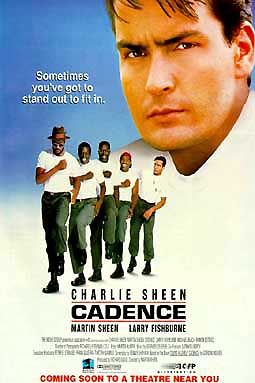
Cadence (1990, directed by Martin Sheen)


In the 1960s, druken Pvt. Franklin Fairchild Bean (Charlie Sheen) punches an MP in West Germany.  The rebellious Bean is hoping he’ll be discharged from the Army.  Instead, he’s sent to the stockade for 90 days.  The stockade is run by an alcoholic tyrant named Sgt. Otis McKinney (Martin Sheen) and, shortly after arrival, Bean discovers that he’s the only white prisoner.  With McKinney determined to break him, Bean befriends his fellow prisoners, including Roosevelt Stokes (Laurence Fishburne), and the two white corporals (James Marshall and Ramon Estevez) who try to protect the prisoners from McKinney’s erratic behavior.

Cadence is the only film to have been directed by Martin Sheen.  Considering that it co-stars two of his sons, it’s unfortunate that Cadence isn’t a better movie.  Charlie Sheen gives a one-note performance as Franklin Bean but he still does better than his father, who is such a raging monster as Sgt. McKinney that it’s difficult to take him or the movie seriously.  As a director, Martin Sheen always goes for the most ham-fisted shot and it’s hard to see what he’s really trying to say about the Army or Franklin Bean’s rebellion.

The supporting cast is better, especially James Marshall and Ramon Estevez.  Laurence Fishburne brings his trademark gravitas to the role of Stokes.  The other prisoners are played by Michael Beach, Blu Mankuma, John Toles-Bey, and Harry Stewart and they all make a good impression.  Stewart plays the most saintly and innocent of the prisoners.  Guess what happens to him.

Back in the day, this movie was an HBO mainstay.  Somehow, I always seemed to catch the end of it but never the beginning.

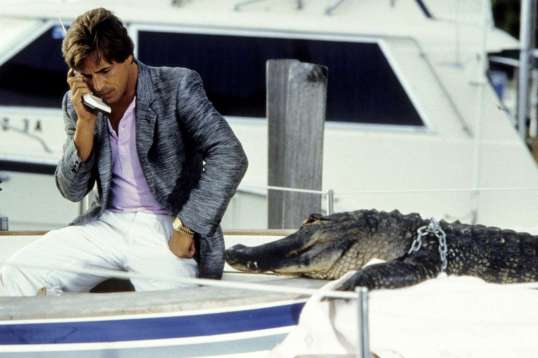
Retro Television Review: Miami Vice 5.21 “Too Much, Too Late”


Welcome to Retro Television Reviews, a feature where we review some of our favorite and least favorite shows of the past!  On Mondays, I will be reviewing Miami Vice, which ran on NBC from 1984 to 1989.  The entire show can be purchased on Prime!

This week, Miami Vice comes to a close.

Episode 5.21 “Too Much, Too Late”

(Dir by Richard Compton, originally aired on January 25th, 1990)

Tough NYPD detective Valerie Gordon (Pam Grier) returns to Miami after she learns that her friend Yvonne (CCH Pounder) has become addicted to crack cocaine and has been using her teenage daughter, Lynette (Malinda Williams), to pay her dealer, Swayne (John Toles-Bey).  Returning to Miami also allows Valerie to meet up with her former lover, Tubbs.  Tubbs is happy to see her again and even starts to think about marriage.  When Yvonne turns up dead, Valerie insists that Swayne killed her.  However, Crockett isn’t so sure.  Eventually, it turns out that Lynette murdered her own mother and that Valerie has been trying to frame Swayne for the crime.  Both Swayne and Lynette are arrested.  Valerie returns to New York where, she tells Tubbs, she is going to turn in her badge and retire from the police force.

Meanwhile, Switek tries to resist the temptation to start gambling again.  He even goes to meetings of Gamblers Anonymous but, when he’s stuck alone in his apartment and dealing with the guilt that he still feels over Zito’s death, Switek finds himself overwhelmed.  Soon, he is again placing bets.

This was not intended to be the final episode of Miami Vice.  Switek giving into his gambling addiction and Tubbs growing increasingly burned out were all plot points that were obviously designed to lead straight into Freefall.  Even Tubbs’s decision to return to New York makes a lot more sense once we know that Valerie is there.  However, NBC did not air this episode during the show’s original run because of its subject matter.  Yvonne selling her daughter for crack was considered to be too controversial.  As such, it didn’t air until the show went into syndication.  That’s a shame.  This was a strong episode, one that featured the melancholy atmosphere that made Miami Vice so memorable in the first place.

Well, that’s it for Miami Vice.  It’s a show that started out strong.  The first two seasons were consistently outstanding.  The third season was entertaining, even if it was obvious that the show was starting to run on autopilot.  The fourth season is where the show lost itself.  As for the fifth season, it had its flaws but it was a definite improvement over the fourth season.  While it was obvious that Don Johnson was eager to move on, the fifth season still provided enough good episodes that the show managed to redeem itself before it finally ended.

I’m going to miss Miami Vice.  Even at its worse, it had style to burn.

(I should mention that the whole reason I started reviewing Miami Vice back in 2023 was because I assumed Ron DeSantis would be elected President in 2024 and that people would naturally be curious about a show set in Florida.  Whoops.)

Next week, something new will premiere in this time slot.  What will it be?  I’ll let you know as soon as I know.  For now, let’s just take a moment to remember Crockett, Tubbs, and Elvis.

January True Crime: Shoot First: A Cop’s Vengeance (dir by Mel Damski)


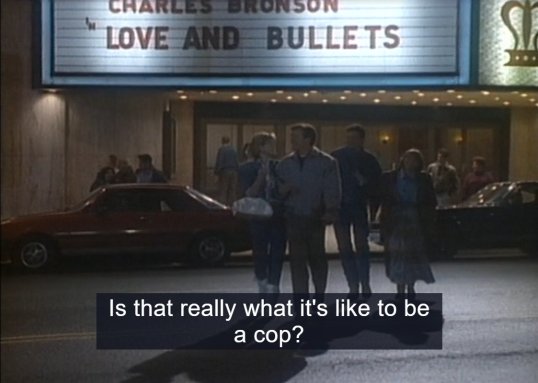
Made for television in 1991 and possessing a rather unwieldy title, Shoot First: A Cop’s Vengeance tells the story of two friends in San Antonio in the early 80s.

Farrell Tucker (Dale Midkiff) and Stephen Smith (Alex McArthur) are both cops.  They entered the police academy together, they graduated as a part of the same class, and they both hope to be partners while working to keep the streets of San Antonio safe.  Tucker is laid back and friendly and not one to worry too much about following all of the regulations.  Stephen Smith, on the other hand, is uptight and, at first, by-the-book.  He grew up in a poverty-stricken, crime-riddled neighborhood and it left a definite impression on him.  He hates crime and criminals but what he really can’t stand is a justice system that seems to be more concerned with the victimizers than with the victims.  Tucker and Smith enjoy spending their time together, drinking at the local cop bars and practicing their shooting on the weekends.  Tucker’s not much of a shot, whereas Smith is a sharpshooter who rarely misses.

At first, no one notices or even cares that some of San Antonio’s less upstanding citizens are getting gunned down in the streets.  But when Smith somehow manages to be first on the scene to a series of shootings, it gets the attention of Internal Affairs.  With Sergeant Nicholas (Terry O’Quinn) investigating the possibility of a cop-turned-vigilante and Chief Hogan (G.D. Spradlin) announcing that no one is above the law, Smith starts to get a bit paranoid and Tucker is forced to consider that his friend could very well be a murderer.

And, of course, Tucker’s right!  The first scene features Tucker confronting Smith and then the majority of the film is told in flashback.  Even if not for that narrative choice, one could guess at Smith’s guilt just from the title of the film.  When Shoot First: A Cop’s Vengeance was released on home video, the title was changed to Vigilante Cop, which made Smith’s guilt even more obvious.  Finally, some viewers will guess that Smith is guilty because the film is based on a true story.  Officer Stephen Smith actually did go on a killing spree, gunning down men who he felt had escaped the law and even sending threatening letters to his chief when the latter announced that vigilante activity would not be tolerated.  Officer Stephen Smith went from being a follower of the rules to someone who attempted to write his own rules.  It’s an interesting story for anyone who wants to google it.

As for the film, it’s adequate without being particularly memorable.  Alex McArthur and Dale Midkiff both give good performance as Tucker and Smith and the cast is full of talented people like Terry O’Quinn, G.D. Spradlin, Bruce McGill, and Lynn Lowry.  Observant viewers will even notice a long-haired Jeremy Davies, showing up for a split-second.  I liked the performance of Loryn Locklin, as the waitress who marries Smith and then discovers that her charming husband actually has some very serious issues.  The main problem with the film is that the story moves a bit too slowly for its own good and some of the Texas accents were more than a little dodgy.  If you’re looking for an action film, this won’t be for you, though the shootings are surprisingly graphic for something that was made for television.  Shoot First: A Cop’s Vengeance is a rather routine telling of an interesting story.