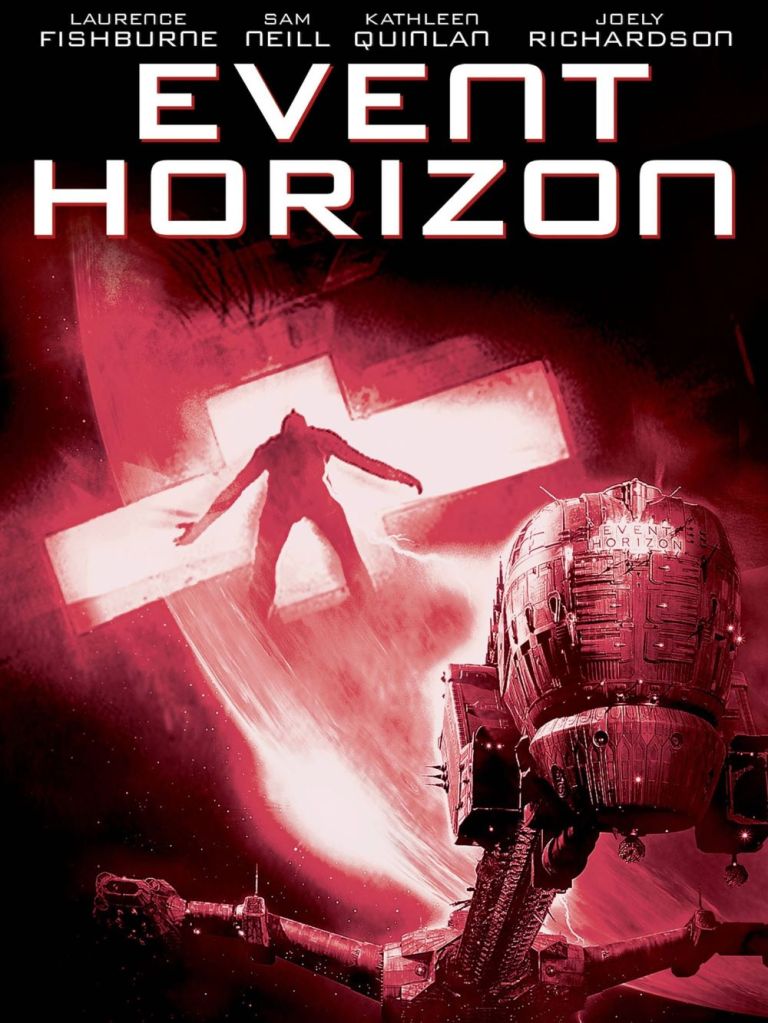
Horror Review: Event Horizon (dir. by Paul W. S. Anderson)


“You know nothing. Hell is only a word. The reality is much, much worse.” — Dr. Weir

Paul W.S. Anderson’s 1997 film Event Horizon stands out as a memorable mix of science fiction and horror, remembered for its gripping atmosphere and disturbing visuals. The story is set in 2047: a rescue crew aboard the Lewis and Clark is sent out to recover the long-missing spaceship Event Horizon, a vessel built to test a new kind of faster-than-light travel. Onboard with them is Dr. William Weir, the Event Horizon’s creator, who explains that the ship vanished after first activating its “gravity drive,” which can fold space to allow for instant travel across vast cosmic distances.

Soon after reaching the drifting Event Horizon, the crew discovers signs of mass violence and horror. They recover a disturbing audio message and realize something traumatic happened to the original crew. As they search for survivors, they experience intense and personal hallucinations—memories and fears brought to life by the ship. It becomes clear that the Event Horizon didn’t just jump through space; it traveled to a place outside reality, a nightmarish interdimensional realm resembling hell.

What makes Event Horizon particularly unique is its concept of hell as an alternate dimension that can infect and corrupt whatever or whoever crosses into it. The ship’s gravity drive doesn’t simply facilitate faster travel—it accidentally opens a gateway to this chaotic, malevolent place. This portrayal of hell as a dangerous interdimensional reality that preys on minds and bodies echoes the idea found in the massive gaming property Warhammer 40K, where hell is depicted as the Warp, a dimension of chaos that corrupts and drives people insane. Like the Warp, the film’s hell is an unpredictable, hostile realm where sanity and physical form break down, infecting and warping everything that comes into contact.

Visually, the film relies on claustrophobic corridors, flickering lights, and unsettling sounds to keep the audience off-balance. The design of the ship itself—part gothic cathedral, part industrial nightmare—adds to the sense of unease and dread throughout. The use of practical effects and detailed sets grounds the sci-fi terror in something tangible, making it all feel more immediate and believable.

Event Horizon also hints at bigger philosophical questions: how far should science go, and what happens when the drive for knowledge is unchecked by ethics or humility? The gravity drive is a technological wonder, but it’s treated with little caution by its inventor, and the catastrophic results suggest that some discoveries may be better left unexplored. The ship becomes both a literal and figurative vehicle for exploring the limits of human ambition and the dangers of pushing beyond them.

As the movie builds toward its climax, the rescue crew faces increasingly desperate odds. The possessed Dr. Weir, now an outright villain, sees the hellish dimension the gravity drive visited as the next step for humanity—a place of chaos and suffering. Multiple characters die in gruesome ways, and the survivors have to fight their own fears and the haunted ship itself. The ending is chilling and ambiguous, leaving open the possibility that the ship’s evil has not been fully contained.

At release, Event Horizon divided critics and audiences. Some found the violence and nightmare imagery too intense or the story too messy to follow. Others praised its ambition and the way it blends psychological horror with cosmic sci-fi. Over the years, the film has developed a cult reputation, frequently cited as one of the more effective and original space horror movies. Its legacy can be seen in later media, especially in video games that tackle similar haunted spaceship scenarios.

However, the film is not without flaws. Many viewers and critics point out uneven pacing, especially in the second half where tension sometimes drains away. The characters often act inconsistently or make choices that feel unrealistic for trained astronauts, which undermines the suspense. The script’s tonal shifts—from serious psychological drama to moments that unintentionally verge on camp—can jolt the viewer out of the experience. The use of jump scares is sometimes predictable, and the film’s heavy reliance on loud, chaotic sequences instead of quiet suspense can feel overwhelming. Some CGI effects haven’t aged well, contrasting with the otherwise impressive practical effects and set design. Acting performances are mixed too; while Sam Neill and Laurence Fishburne are strong, some supporting cast members lack conviction, making emotional engagement uneven.

Importantly, Event Horizon represents Paul W.S. Anderson at his most subtle and effective in directing. Compared to many of his later films, where his style often becomes frenetic and unchecked—possibly due to a lack of producer control—Event Horizon is more controlled, atmospheric, and haunting. This balance between style and substance makes it one of Anderson’s better directorial works, if not his best to date. The film showcases his interest in spatial geography, the use of negative space, and claustrophobic production design, all elements he would expand on in his later work but never as effectively deployed as here. The haunting visual touches, combined with his ability to direct actors and maintain tension, set Event Horizon apart from his more bombastic, less focused later entries.

Despite its flaws, Event Horizon remains gripping and memorable. Its strengths lie in combining deeply personal psychological horror with the vast, terrifying unknown of space and alternate realities. The film explores not just external threats, but also how guilt, fear, and trauma can be weaponized by forces beyond human understanding. For viewers seeking more than a standard haunted spaceship story, Event Horizon offers a disturbing, thought-provoking glimpse into the dark frontier of science, faith, and madness. It stands as a cult classic of sci-fi horror that continues to inspire discussion about the dangers of pushing too far into the unknown.
Film Review: The Death of Stalin (dir by Armando Iannucci)


2017’s The Death of Stalin opens in Moscow in 1953.  Joseph Stalin (Adrian McLoughlin) calls into Radio Moscow and demands that he be sent a recording of the piano concerto that has just been performed live.  The only problem is that no one bothered to record it while it was being performed.  In a panic, the head of Radio Moscow announces that no one — not the musicians, not the exhausted conductor, and certainly not the audience — is allowed to leave until the orchestra has performed again.

Indeed, one of the recurring themes of The Death of Stalin is that everyone is terrified of their beloved dictator.  The orchestra fears being executed for failing to recreate their performance.  The members of the Central Committee fear being the next person to be purged from the ranks of Stalin’s government.  The two guards that are posted outside of Stalin’s bedroom are so terrified of interrupting Stalin and getting on his bad side that they don’t investigate when they hear Stalin collapsing to the floor.  When Stalin is found unconscious, the only doctors available are young and inexperienced because Stalin recently exiled all of the good doctors from Moscow.  Even after Stalin dies from a cerebral hemorrhage, his reign of terror continues as all the members of his household staff are promptly executed to keep anyone from learning either the exact details of Stalin’s death or the way that the members of the Central Committee responded to his passing.

The Death of Stalin is a dark comedy that follows the members of the Central Committee as they scramble to protect their own positions after Stalin’s death.  The humor comes from watching historical figures like Nikita Khrushchev, Vyacheslav Molotov, Lavrenti Beria, and Georgy Malenkov act like panicked junior executives who are desperately trying to save their own jobs during a corporate takeover.  Of course, the stakes are a bit higher.  Whoever succeeds Stalin will undoubtedly want to execute every other contender for the post.  As with so many of Armando Iannucci’s works, the humor comes from watching very powerful people act in very immature and petty ways.  While Malenkov (Jeffrey Tambor) tries to convince people that he actually is in charge, the brutal Beria (Simon Russell Beale) tries to bully his way into power and the wily Khrushchev (Steve Buscemi, giving one of his best performances) waits for his moment to strike.  (Beria, it should be noted, is one of history’s greatest monsters and the film, while a comedy, does not shy away from his depravity.)  Molotov (a hilarious Michael Palin) is so loyal to the Party that he says that Stalin was absolutely correct to have his wife executed just to then have Beria show up and reveal that Molotov’s wife is still alive.  Meanwhile, Stalin’s idiot son (Rupert Friend) claims that it’s all an American plot while the rest of the Central Committee laughs at him behind his back.  Only Georgy Zhukov (Jason Isaacs) seems to have full control of his emotions and his actions and it’s not a surprise to learn that, long after the events depicted in this film, purged from the Party.  In The Death of Stalin, the leaders of Russia are obviously scared of anyone who is too competent at their job.

The Death of Stalin is not only a satiric portrayal of petty bureaucrats.  It’s also a darkly humorous look of life in a dictatorship, where everyone is at the whim of whoever happens to be in charge at any given time.  The film is full of power-hungry narcissists who use their ideology and their nationalism as a shield for their own ambitions.  Everyone wants to control someone else.  Even as mourners pass by Stalin’s coffin, they’re given orders on how to properly grieve and move.  The film ends with a series of pictures of various people either having their faces scratched or, in some cases, just vanishing.  In a free country, failure leads to humiliation.  In a dictatorship,  it leads to non-existence as the formerly prominent are suddenly erased from a history that no longer has a place for them.  Ironically, of all the original leaders of communist Russia, it was Molotov who lived the longest.  He was 96 when he died in 1986.  If not for Stalin’s sudden death, he probably would have been purged and executed at the age of 63.

On this May Day, with so many people currently trying to rehabilitate the reputations of the 20th Century’s worst dictators, The Death of Stalin is must-watch.


Guilty Pleasure No. 78: Armageddon (dir by Michael Bay)


Remember that time that Bruce Willis and a team of oil drillers saved all of humanity from a giant asteroid that was apparently the size of Texas?

Sure, you do!  Everyone remembers Armageddon!

1998’s Armageddon is a film that doesn’t get a lot of respect but which everyone remembers.  There’s been a lot of movies made about giant asteroids on a collision path with the Earth.  Ever since scientists announced that a collision with a comet or an asteroid probably killed the dinosaurs, there’s been a somewhat irrational fear that the same thing could happen to us.  Back in 1978, Sean Connery and Karl Malden tried to stop a Meteor (and failed).  In 1998, the same year that Armageddon came out, Morgan Freeman, Robert Duvall, and Elijah Wood tried to stop an asteroid from causing a Deep Impact (and failed).  Adam McKay made an entire film about everyone saying, “Don’t Look Up,” in an attempt to promote increased panic about climate change (and failed).  (“I’m so scared!” Leonardo DiCaprio shouted and audiences responded, “Oh, calm down.”)  And yet, it’s Armageddon — ridiculed by critics, endlessly parodied by other movies — that people use as their go-to source for commenting on the prospect of a mass extinction event.  Mostly because, in Armageddon, humanity didn’t fail.  Bruce Willis showed that asteroid who was boss!

Why do we love Armageddon?  A lot of it has to do with the cast.  Not only do you have Bruce Willis battling an asteroid but you’ve also got Steve Buscemi, Owen Wilson, Ben Affleck, Will Patton, Michael Clarke Duncan, Peter Stormare, William Fichtner, and a host of others working with him.  You’ve got Billy Bob Thornton working ground control.  You’ve got Liv Tyler, somehow managing to give a decent performance even while Ben Affleck attacks her with animal crackers.  It’s not just the cast is full of familiar and likable actors.  It’s that the members of the cast know exactly what type of film that they’re appearing in and they all give exactly the right type of performance for that film.  They deliver their lines with conviction while not making the mistake of taking themselves too seriously.  Bruce Willis announces that his crew will destroy that asteroid in return for never having to pay taxes again and he announces with just the slightest hint of a smirk, knowing that the audience is going to cheer that moment.

But really, the real reason why Armageddon has survived that test of time is because it’s just so utterly shameless.  Director Michael Bay will never be accused of being a subtle director but Bay instinctively understood that Armageddon was not a film that demanded subtlety.  Armageddon is a film that demands that constantly moving camera and all of those carefully composed scenes that were clearly made so they could be included in the trailer.  It’s a film about big moments and big emotions.  Unlike something like Deep Impact, it doesn’t get bogged down in trying to be better than it actually is.  Unlike Don’t Look Now, it doesn’t degenerate into a bunch of histrionic speeches.  Armageddon exists to make the audience cheer and it succeeds.  It takes guts to include a slow motion scene of a bunch of kids celebrating in front of a faded Kennedy For President poster but Bay is exactly the type of director who can pull that off.  Michael Bay’s style is not right for a lot of films.  But it was perfect for Armageddon.

As I sit here typing this, there are some people panicking because there’s speculation that a meteor is going approach the Earth in the 2030s.  It’ll probably miss us but who knows?  But you know what?  I’m not worried at all.  I’ve seen Armageddon.  So, on this International Earth Day, let’s remember the courageous men who saved this planet back in 1998.

Previous Guilty Pleasures

  1. Half-Baked
  2. Save The Last Dance
  3. Every Rose Has Its Thorns
  4. The Jeremy Kyle Show
  5. Invasion USA
  6. The Golden Child
  7. Final Destination 2
  8. Paparazzi
  9. The Principal
  10. The Substitute
  11. Terror In The Family
  12. Pandorum
  13. Lambada
  14. Fear
  15. Cocktail
  16. Keep Off The Grass
  17. Girls, Girls, Girls
  18. Class
  19. Tart
  20. King Kong vs. Godzilla
  21. Hawk the Slayer
  22. Battle Beyond the Stars
  23. Meridian
  24. Walk of Shame
  25. From Justin To Kelly
  26. Project Greenlight
  27. Sex Decoy: Love Stings
  28. Swimfan
  29. On the Line
  30. Wolfen
  31. Hail Caesar!
  32. It’s So Cold In The D
  33. In the Mix
  34. Healed By Grace
  35. Valley of the Dolls
  36. The Legend of Billie Jean
  37. Death Wish
  38. Shipping Wars
  39. Ghost Whisperer
  40. Parking Wars
  41. The Dead Are After Me
  42. Harper’s Island
  43. The Resurrection of Gavin Stone
  44. Paranormal State
  45. Utopia
  46. Bar Rescue
  47. The Powers of Matthew Star
  48. Spiker
  49. Heavenly Bodies
  50. Maid in Manhattan
  51. Rage and Honor
  52. Saved By The Bell 3. 21 “No Hope With Dope”
  53. Happy Gilmore
  54. Solarbabies
  55. The Dawn of Correction
  56. Once You Understand
  57. The Voyeurs 
  58. Robot Jox
  59. Teen Wolf
  60. The Running Man
  61. Double Dragon
  62. Backtrack
  63. Julie and Jack
  64. Karate Warrior
  65. Invaders From Mars
  66. Cloverfield
  67. Aerobicide 
  68. Blood Harvest
  69. Shocking Dark
  70. Face The Truth
  71. Submerged
  72. The Canyons
  73. Days of Thunder
  74. Van Helsing
  75. The Night Comes for Us
  76. Code of Silence
  77. Captain Ron

The TSL Grindhouse: Soldier (dir by Paul W.S. Anderson)


1998’s Soldier starts off with a brilliant seven-minute sequence.  We watch as, over the course of 17 years, a child named Todd is raised and trained to be the ultimate soldier.  From a young age, he’s learning how to fight.  He’s learning discipline.  He’s learning to follow orders without question.  We follow him as he goes on to fight in conflict after conflict.  The name of each conflict in which he fights is tattooed on his muscular arms.  Finally, a title card appears that informs us that Todd (now played by Kurt Russell) is “Between wars.”

Captain Church (Gary Busey) insists that Todd and his fellow soldiers are the greatest fighting force in the galaxy.  The autocratic Colonel Merkum (Jason Isaacs) disagrees, claiming that his genetically-engineered soldiers are superior and that Todd is now obsolete.  After a savage training exercise that leaves Todd unconscious, Merkum orders that Todd be dumped on an abandoned planet.

Of course, it turns out that the planet in question is not actually abandoned.  Instead, it’s home to a group of colonists who crash-landed on the planet years ago and who now live a life that is devoid of conflict.  When Todd approaches the colony, he is cautiously welcomed.  Todd, who rarely speaks, is extremely strong and quick and that pays off when he’s able to save Jimmy (Michael Chiklis) from being pulled into a thrasher.  However, Todd is also haunted by PTSD and he’s been bred to fight and that leaves the other colonists cautious about him.  Despite the efforts of Mace (Sean Pertwee) and his wife Sandra (Connie Nielsen), the other colonists vote to exile Todd from their colony.

Meanwhile, Merkum and his “superior” soldiers are heading towards the planet, eager to execute the colonists as a part of a training exercise.  Todd will have to use all of his training to defeat Merkum’s super soldier, Caine 607 (Jason Scott Lee), and help the colonists reach their final destination.

One of the more interesting things about Soldier is that it apparently takes place in the same cinematic universe as Blade Runner.  The wreckage of one of Blade Runner‘s flying cars is spotted on the planet and Todd is shown to have fought in some of the same battle that Roy Batty claimed to have witnessed in Ridley Scott’s classic film.  For that matter, Ridley Scott himself has said that Blade Runner also takes place in the same cinematic universe as Alien and some people insist that Predator is a part of the universe as well.  That’s a rich heritage for Soldier, which is essentially a dumb but entertaining B-movie.

I liked Soldier, almost despite myself.  It’s a silly film and there are certain scenes, mostly dealing with day-to-day life in colony, that feel a bit draggy.  But I enjoyed Kurt Russell’s performance as the ultimate super soldier.  Russell has very little dialogue in the film and his character is bit stunted emotionally but it doesn’t matter.  Ultimately, Russell’s natural charisma carries the day and his fight with Caine 607 is genuinely exciting.  As usual, Jason Isaacs makes for a wonderfully hissable villain and even Gary Busey gives what is, for him, a rather restrained and ultimately credible performance.  As is so often the case with the work of director Paul W.S. Anderson, the film is a cartoon but it’s an entertaining cartoon.

Horror Film Review: Look Away (dir by Assaf Bernstein)


Poor Maria (India Eisley)!

Maria is a 17 year-old high school student in Canada.  She goes to a school where everyone wears a uniform, everyone plays hockey, and everyone is looking forward to a prom that is going to be held on an ice skating rink!  (Personal injury attorneys love this school!)  Everyone is obsessed with living on the ice but Maria can’t even skate.  Popular hockey player Mark (John C. MacDonald) taunts Maria for not being able to maintain her balance.  Her best friend, Lily (Penelope Mitchell) offers to teach Maria how to skate but Lily turns out to be a cruel and taunting teacher, probably because she knows that Maria has a crush on her boyfriend, Sean (Harrison Gilbertson).

Maria’s life at home isn’t any better.  Her mother, Amy (Mira Sorvino), is suffering from crippling depression and often can’t even be bothered to get out of bed or off the couch.  Her father, Dan (Jason Isaacs), is a plastic surgeon who is obsessed with the idea that he can fix any flaw through surgery.  He’s the type who cruelly critiques his daughter’s looks, despite the fact that Maria is actually a very pretty girl whenever she can find the courage to actually look up from the floor.  Dan is also cheating on his wife.  Perhaps the only good thing that Dan does is that he encourages Maria to stay home from school, though his reasoning is that she doesn’t look good on that particular day and she needs to get her “beauty sleep.”

Seriously, watching this movie, your heart truly breaks for Maria.  It’s as if the whole world has been against her since the day she was born.  Everyone gives Maria a hard time for not having more confidence but how can someone be confident when all they hear is about how much of a disappointment they are?  Maria’s only friend is her reflection in the mirror.

At first, Maria freaks out when her reflection starts talking back to her.  Airam, as Maria’s reflection calls herself, may look like Maria but she initially seems to have a totally different personality.  Airam is confident in both her appearance and her sexuality.  Airam is willing to strike back at the people that have hurt her.  Airam is confident where Maria is insecure.  When Maria talks to Airam, she ends up laughing so loudly that Amy actually comes into the bathroom and asks if Maria is smoking weed.  After Maria is cruelly humiliated at prom, Maria agrees to switch places with Airam by kissing the mirror.  Suddenly, Maria is the one in the mirror and Airam is the one who is in the real world, looking for revenge against everyone who has hurt Maria.

Or is she?  Watching the film, I found myself wondering if Maria was just imagining talking to her reflection and perhaps “the switch” was all in Maria’s mind.  Perhaps Airam isn’t some malevolent force that’s brought into the world as much as she’s just Maria having been pushed too far by the cruel taunts of her classmates and her father’s refusal to show her the consideration that he shows to his mistress.  Airam is soon doing everything that Maria wishes she could do but when people start dying, Maria begs Airam to stop.  Is Maria really trapped in the mirror and begging Airam to stop or is she just imagining a conversation with her own conscience?  India Eisley’s performance keeps you guessing.

This is an intriguing film, even if is sometimes a bit too ambiguous for its own good.  (The final shot is artfully done but it still made me want to throw something at the TV.)  The film’s greatest asset is India Eisley, who is convincing whether she’s the mousy Maria or the bold Airam.  Jason Isaacs, as well, gives a strong performance, turning his plastic surgeon into one of the all-time bad fathers.  Watching Isaacs’s performance as Dan, it’s hard not to understand why Dan’s daughter would want to hide in a mirror.

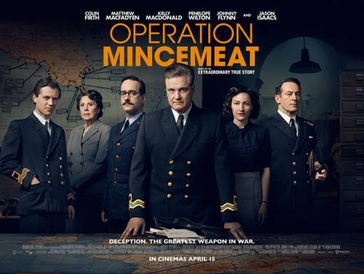
Film Review: Operation Mincemeat (dir by John Madden)


Based on a true story, Operation Mincemeat takes place in 1943, during the second World War.  The British are planning an invasion of Sicily, both to break Hitler’s hold on Europe and to also knock Italy out of the war.  The problem is that the attack on Sicily makes so much strategic sense that the Germans have spent months preparing for it and, even if successful, the invasion will cost an untold number of British lives.  Somehow, British intelligence must trick the Germans into thinking that the British are planning to invade Greece instead.

With the help of Lt. Commander Ian Fleming (Johnny Flynn), Ewen Montagu (Colin Firth) and Charles Cholmondeley (Matthew McFayden) come up with the plan to fool the Germans.  A dead body will be disguised as a British officer.  The body will be transported, via submarine, to Spain, which was technically neutral during the war.  The body will wash up on shore and, when the body is examined, a note detailing Britain’s invasion of Greece will be discovered and passed along to the Germans.  Because the Germans have been fooled by a similar trick in the past, Montagu and Cholmondeley create a fake backstory for “Maj. William Martin” and soon start to think of him as being a someone who truly did live.  Joining them to create a life for Major Martin is Jean Leslie (Kelly MacDonald), a secretary in the office who volunteers a photo of herself to be placed in Martin’s wallet.

Of course, things get complicated.  While plotting out the operation, Jean starts to fall in love with Montagu, whose marriage is currently strained by Montagu’s obsession with his work.  (Because he knows what will happen to a Jewish family in the UK if Germany invades, Montagu has sent his wife and his children to the U.S.)  Cholomondeley is in love with Jean and soon finds himself growing jealous of the man that he’s been assigned to work with.  Meanwhile, the head of British Intelligence (Jason Isaacs) wants to investigate Montagu’s brother for being a communist.  As for Ian Fleming, he keeps himself busy by writing a book.  In fact, so many members of British Intelligence are identified as being aspiring novelists that it becomes a bit of a running joke.

I have always appreciated a good World War II film and I enjoyed Operation Mincemeat.  It’s a bit of an old-fashioned film, of course.  The F-word is used exactly once (which makes this a rarity amongst modern British films) and there’s one scene in which a member of British intelligence discreetly gives an informant a handjob in return for information.  Otherwise, this is pretty much a film that you could safely show your grandma without having to worry about her getting depressed over how much movies have changed since her day.  Old-fashioned or not, it’s a well-made film, full of good performances and sharp dialogue.  It’s not a flashy film but it’s very nicely put together and it’s hard not to admire the craftsmanship responsible for it.  Operation Mincemeat is all the more interesting for being, more or less, true.  While the love triangle was invented for the film, it is true that Ian Fleming was a part of Operation Mincemeat and the film’s use of him as a character works surprisingly well.  The scene where a young Fleming tours the World War II version of Q Branch provides some nice comic relief, particularly when Flemings comes across a wristwatch that doubles as a mini-saw.

What elevates Operation Mincemeat is its theme of loss.  Almost all of the major characters have lost someone or something to the war.  Jean Leslie is a widow.  Cholomendely’s brother was killed in action and his body is still in Europe.  Montagu has had to send his family away for their own safety.  For them, the Major Martin becomes a stand-in for all of the people that they’ve lost.  The effort to make Martin into a real person allows all of them one final chance to honor their loved ones.  Major Martin becomes a stand-in for all British soldiers and civilians who sacrificed their lives to battle Hitler’s war machine.  Operation Mincemeat becomes about more than just fooling the Germans.  It becomes about being worthy of the sacrifice that it took to defeat them.

As is shown in the film, the real Major Martin was a vagrant named Glyndwr Michael, who died after eating rat poison.  The film suggests that Michael deliberately killed himself but no one will ever know for sure what led to him eating that poison.  After his death, he was given the uniform of a British officer and his pockets were filled with things that would identify him as being Major William Martin.  Though he never knew it, Glyndwr Michael become one of the greatest heroes of World War II.  Operation Mincemeat serves a worthy tribute to both Glyndwr Michael and Major William Martin.

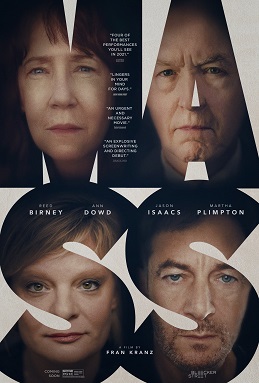
Film Review: Mass (dir by Fran Kranz)


As we all know, this year’s Sundance Film Festival started tonight.

To me, Sundance has always signified the official start of a new cinematic year.  Not only is it the first of the major festivals but it’s also when we first learn about the films that we’ll be looking forward to seeing all year.  It seems like every year, there’s at least one successful (or nearly successful) Oscar campaign that gets it start at Sundance.  Last year, for instance, Minari took Sundance by storm and it was able to ride that momentum all the way to a Best Picture nomination.  Before that, nominees like Manchester By The Sea and Brooklyn got their starts at Sundance.

And, even if their films weren’t nominated for best picture, some of the most important filmmakers of the past few decades got their first exposure at Sundance.  The Coen Brothers first won notice with Blood Simple.  Years later, Quentin Tarantino took the festival by storm with Reservoir Dogs.  Though an argument can be made that Sundance is now just as corporate as the Hollywood system to which it’s supposed to providing an alternative, one can’t deny the importance of the Festival.

For the next few days, I’m going to taking a look at a few films that made their initial splash at Sundance.  Some of these films went on to become award winners and some did not.  But they’re all worth your attention, one way or another.

Take for instance, Mass.

The first directorial effort of actor Fran Kranz (you may remember him as the clever and genre-savvy stoner from The Cabin In The Woods), Mass made its debut at least year’s Sundance Film Festival.  It was one of the more critically acclaimed films of the festival and, in a perfect world, it would currently be an Oscar front runner.  And who knows?  There’s always a chance that Mass could pick up a nomination or two.  Ann Dowd is apparently running a very energetic campaign for Best Supporting Actress and she’s said to be well-liked in the industry.  It’s probably a bit too much to expect the film to be nominated for Best Picture, though it certainly deserves some consideration.  It’s perhaps a bit too low-key for a year that’s full of bombast and big emotional moments.  It’s a film that raises interesting questions but refuses to provide easy answers.  In short, it’s the type of film that, ten years from now, people will watch it and say, “How did this not get nominated?”  Even if it’s not a Sundance film that’s destined for the Oscars, it is a Sundance film that will be remembered for heralding the arrival of a vibrant new directorial talent.

Playing out in almost real time, Mass is a film about two couples having a very emotional conversation.  Richard (Reed Birney) and Linda (Ann Dowd) are the parents of Hayden.  Jay (Jason Isaacs) and Gail (Martha Plimpton) are the parents of Evan.  Hayden and Evan went to the same high school.  Years ago, Evan was killed in a school shooting.  Hayden was the shooter.  After killing ten students, Hayden killed himself.

The two couples are meeting in a room in the back of a church.  It’s a part of therapy.  They meet and they talk about their children and the events that led to the shooting.  Jay and Gail demand answers.  Richard and Linda can’t provide them.  At first, Gail is angry and Jay is the one who tries to keep things civil but, as the conversation continues, it becomes obvious that Jay is in fact angrier than Gail. Even when Richard and Linda express obviously sincere remorse for what Hayden did, Jay cannot accept it because, in a way, he needs them to be evil or ignorant or both.  Linda and Richard struggles to reconcile their love for their son with their hatred over what he did.  Gail and Jay feel that their son was unfairly taken from them and they’re right.  Richard and Linda feel that they’re being blamed for something they couldn’t control and they’re also right.  There are no easy villains or heroes in this film.  Instead, there are just four unique and interesting characters, all trying to understand something that makes no sense.

Almost everything we learn about the characters comes from listening to them speak.  Almost the entire film takes place in that one room.  By the end of the film, not a single character is who you originally believed them to be.  Jay’s search for meaning has led to him becoming a political activist.  He insists that there has to be some sort of identifiable reason to explain why his son is dead, even though he secretly realizes that there isn’t.  Gail, who starts out as the angriest person in the room, reveals herself to be the most empathetic.  At the start of the film, Jay accuses Richard of not having any emotions but, by the end, we see that Richard’s emotions are very real.  Finally, Linda seems meek but quickly reveals herself to be perhaps the strongest and most honest person in the room.

It may sound a bit stagey, this film that takes place in one room and which is basically just four characters having a conversation.  But director Fran Kranz does a wonderful job keeping the story moving and the conversation within the room never seems to drag.  Indeed, the room itself is almost as fascinating as any of the people inside of it.  At the start the film, we watch two church employees and social worker going out of their way to make the room as safe and non-confrontational as possible.  However, their efforts have the opposite effect.  The room is so friendly that it makes it impossible not to compare its pleasantness with the issues being discussed behind the room’s closed doors.  The room itself tries so hard to avoid confrontation that it has the opposite effect.

In the end, the film suggests that there are no neat answers.  Even though the two couples come to an understanding and even a sort of peace, there’s no guarantee that peace will last more than a day.  Indeed, as soon as they leave the room, their initial awkwardness returns, a reminder that we can understand pain but we can’t necessarily vanquish it.  It’s not a film about easy answers but there’s something liberating about the film’s willingness to acknowledge that life can be difficult but that life also goes on.

The film is a masterclass of good acting, with Dowd and Isaacs getting the biggest dramatic moments while Birney and Plimpton offer fantastic support.  In a perfect Oscar world, all four of them would be nominated and so would the film itself.  Unfortunately, one of the lessons of Mass is that there is no such thing as a perfect world.

Miniseries Review: The Last Don II (dir by Graeme Clifford)


The Clericuzio saga continues and it’s sillier than ever!

The Clericuzios were the Mob family who were first introduced in a Mario Puzo novel called The Last Don.  In 1997, CBS turned The Last Don in a three-part miniseries.  The ratings were good enough that, in 1999, the network gave the world a two-episode sequel, The Last Don II.  The Last Don II was created without the input of Mario Puzo (who died shortly before the miniseries aired) but director Graeme Clifford returned, as did a few members of the cast.

For example, Danny Aiello briefly returns as the honorable but aging Don Domenico Clericuzio, talking about life in the old country and demanding to know why some of his children have yet to marry.  Under his leadership, the Clericuzios are almost totally legit and they’ve even become powerful in Hollywood.  Claudia De Lena (Michelle Burke) is in charge of the family’s film studio and has recently become engaged to a film star named Dirk Von Schelburg (Andrew Jackson, trying to do an Arnie impersonation but coming across more like Jean-Claude Van Damme).  Still, despite the fact that the Clericuzios are (slowly) abandoning organized crime, they haven’t completely cut their ties.  They still have enemies.  And when Don Clericuzio dies after dancing at his final birthday party, those enemies are set to strike.

Who can run the Clericuzio family?  Only one of the Don’s son was actively involved in the underworld aspect of the organization and he’s promptly (and, to be honest, hilariously) crushed when someone drops a shipping crate on him.  Another Clericuzio son is gunned down at his legitimate business, proving that someone is trying to take out the entire family, regardless of whether they’re a part of the family business or not.  Georgio Clericuzio (David Marciano) goes to Paris and tires to convince Claudia’s brother, Cross (Jason Gedrick), to return from exile to take things over.  Cross refuses because he’s happily married to the most famous actress in the world, the improbably named Athena Aquataine (Mo Kelso, replacing Daryl Hannah in the role).  However, Athena is subsequently blown up by a bomb that was meant for Cross and that’s all it takes to bring Cross back to America.

Now that Cross is in charge, he sets about to discover who, among the other Families, is targeting the Clericuzios.  Helping him out with this is Billy D’Angelo (James Wilder), who we are told is the the most important of the Clericuzios capos, despite the fact that he was neither seen nor mentioned in the previous Last Don.  It seems pretty obvious from the start that Billy is not to be trusted.  Everyone who has ever seen The Godfather will automatically look at Billy and say, “There’s your rat.”  But Cross is a remarkably naïve crime lord.  He’s apparently the only guy in the Mafia who has never seen a Mafia movie.

Of course, there’s more going on than just Cross trying to figure out who is targeting the Clericuzio family.  His unstable aunt, Rose Marie (Kirstie Alley), wants revenge for the murder of her son Dante but, fortunately, she’s distracted by an affair with the family’s priest (Jason Isaacs, of all people).  Disgraced former studio exec Bobby Bantz (Robert Wuhl) is plotting against Claudia.  And finally, Cross is falling in love with his stepdaughter’s nanny (Patsy Kensit) despite the fact that it’s kind of obvious that the nanny is actually an undercover FBI agent.  Remember what I said about Cross being impossibly naïve?

The Last Don was a fairly silly miniseries.  The Last Don 2 is even sillier but, for that every reason, it’s also a bit more entertaining.  If the first Last Don was held together by the rivalry between Cross and Dante, the sequel is held together by a nonstop flow of melodrama, overheated dialogue, and thoroughly unsubtle acting.  It’s as if the director looked at every over-the-top scene and said, “It’s okay but can we turn things up just a little bit more?”  As such, tt’s not enough for Danny Aiello to merely make a cameo before his character dies.  Instead, he has to deliver cryptic words of wisdom about family and and honor and he has to do one final, Zorbaesque dance of joy before his heart gives out.  Meanwhile, Kirstie Alley really throws herself into playing the insane Rose Marie and whether she’s seducing a priest or hoarsely yelling that she doesn’t know how to ice skate, her performance is always more than strange enough to be watchable.  Jason Isaacs, meanwhile, furrows his brow desperately as he tries to resist temptation.  Patsy Kensit is the world’s worst FBI agent while Kim Coates shows up as one of her colleagues.  Conrad Dunn returns as Lia, the Sicilian assassin with the world’s silliest mustache.  Even the presence of Robert Wuhl is less of a problem in the sequel.  With everyone chewing up every piece of scenery that they can get their hands on, it somehow makes sense that Robert Wuhl would show up and start yelling, “DON’T LAUGH AT ME!”  Somehow, it even seems appropriate that Joe Mantegna receives a “special appearance” credit, even though his character pretty much only appears in the archival footage used during the opening credits.  The Last Don II is just that type of miniseries.

Jason Gedrick and James Wilder are both good actors and they both do what they can with the roles of Cross and Billy.  Unfortunately, both of them were seriously miscast in The Last Don 2.  Neither one of them is the least bit Italian and Wilder was a bit too young to be convincing as the most feared capo in the family.  Compared to the classic gangster films that inspired them, both The Last Don and its sequel feels more like gangster cosplay than an actual portrait of life as a member of the Cosa Nostra.  Like the first Last Don, The Last Don II suffers from a lack of authenticity but it’s just ludicrous enough to be fun.

Lisa Marie’s Oscar Predictions for October


It’s time to take a little break from horror so that I may once against do my list of my monthly Oscar predictions!  I guess some people would consider predicting the Oscars to be a scary thing.  Personally, I have fun doing it, even if my predictions often seem to be for naught.  That said, I did manage to predict that Thomas Vinterberg would be nominated for Best Director last year so take that, haters.

Probably the biggest development this month is that I’ve lost all faith in Spielberg’s West Side Story.  It’s just not getting the type of hype that I would expect from a Spielberg Oscar movie.  In fact, it seems like everyone involved is in kind of a hurry to move on.  So, for now, I’m dropping it from my predictions.  While West Side Story goes, Dune has definitely established itself as a probable nominee.  I think the only problem that Dune will have is the possibility of people saying, “We’ll just nominate the sequel instead.”

I’ve also added C’mon C’mon and Passing to my list of Best Picture nominees.  This is almost totally due to their popularity with the Gothams.  If the other critics groups don’t duplicate the love, they’ll probably get dropped from my predictions come January.

As always, keep in mind that I don’t claim to be an expert.  The picture is a bit clearer but I don’t claim to have any inside information or anything like that.  These are just my guesses, for better or worse.  To see how my thinking has evolved,  check out my predictions for March and April and May and June and July and August and September!

Best Picture

Belfast

C’mon C’mon

CODA

Dune

The Lost Daughter

Nightmare Alley

Passing

The Power of the Dog

Spencer

The Tragedy of MacBeth

Best Director

Kenneth Branagh for Belfast

Jane Campion for The Power of the Dog

Maggie Gyllenhaal for The Lost Daughter

Guillermo del Toro for Nightmare Alley

Denis Villeneuve for Dune

Best Actor

Benedict Cumberbatch in The Power of the Dog

Peter Dinklage in Cyrano

Jude Hill in Belfast

Will Smith in King Richard

Denzel Washington in The Tragedy of MacBeth

Best Actress

Jessica Chastain in The Eyes of Tammy Faye

Olivia Colman in The Lost Daughter

Penelope Cruz in Parallel Lives

Frances McDormand in The Tragedy of MacBeth

Kristen Stewart in Spencer

Best Supporting Actor

Willem DaFoe in Nightmare Alley

Jamie Dornan in Belfast

Ciaran Hinds in Belfast

Jason Isaacs in Mass

Kodi Smit-McPhee in The Power of the Dog

Best Supporting Actress

Jessie Buckley in The Lost Daughter

Dame Judi Dench in Belfast

Ann Dowd in Mass

Kirsten Dunst in The Power of the Dog

Marlee Matlin in CODA

Lisa Marie’s Oscar Predictions for September


Well, it’s the time of the month again.

No, not that time!  That time ended two days ago.  I’m talking about the fact that it’s time for me to once again share my monthly Oscar predictions.  Thanks to the festival circuit, we’ve finally gotten some advance word on the big Oscar contenders that will be coming out over the next few months.

Belfast, as of right now, sounds like the prohibitive favorite to win it all.  At first, it seemed like the reaction to The Power of the Dog was a bit mixed but later reactions were almost overwhelmingly positive.  It sounds like the type of film that will be nominated even if it won’t necessarily win.  Maggie Gyllenhaal’s The Lost Daughter is coming on strong, as is Spencer.  For me, the biggest surprise has been the amount of acclaim that Dune has been getting.  I was a bit dismissive of its Oscar chances earlier this year but now it definitely sounds like it will be in the hunt.

West Side Story has been seen by no one but I continue to list it because it’s a Spielberg film and, with all the musicals that are being released this year and which have subsequently struggled with either critics or audiences or both, it still seems the most likely to pick up a nomination.  I’m a little bit skeptical on whether or not Nightmare Alley is going to be an “Oscar picture” but the trailer was nice to look at so I’m giving it the benefit of the doubt.  House of Gucci is three hours long and full of stars so it’s either going to be an Oscar nominee or a complete bomb.

You may notice a lack of predicted nominations for Licorice Pizza. Licorice Pizza is a film that I fully expect to love but the trailer definitely feels a bit more like Inherent Vice than The Phantom Thread.  I still think that the actors could get nominated but the rumor right now is that Bradley Cooper’s role is actually very small.  That’s why I no longer have him listed as a supporting actor nominee.

Again, keep in mind that I’m not an expert.  The picture is a bit clearer but I don’t claim to have any inside information or anything like that.  These are just my guesses, for better or worse.  To see how my thinking has evolved,  check out my predictions for March and April and May and June and July and August!

Best Picture

Belfast

CODA

Dune

House of Gucci

The Lost Daughter

Nightmare Alley

The Power of the Dog

Spencer

The Tragedy of MacBeth

West Side Story

Best Director

Kenneth Branagh for Belfast

Jane Campion for The Power of the Dog

Guillermo del Toro for Nightmare Alley

Steven Spielberg for West Side Story

Denis Villeneuve for Dune

Best Actor

Clifton Collins, Jr. in Jockey

Benedict Cumberbatch in The Power of the Dog

Peter Dinklage in Cyrano

Will Smith in King Richard

Denzel Washington in The Tragedy of MacBeth

Best Actress

Jessica Chastain in The Eyes of Tammy Faye

Olivia Colman in The Lost Daughter

Penelope Cruz in Parallel Lives

Frances McDormand in The Tragedy of MacBeth

Kristen Stewart in Spencer

Best Supporting Actor

David Alvarez in West Side Story

Willem DaFoe in Nightmare Alley

Ciaran Hinds in Belfast

Jason Isaac in Mass

Kodi Smit-McPhee in The Power of the Dog

Best Supporting Actress

Jessie Buckley in The Lost Daughter

Dame Judi Dench in Belfast

Ann Dowd in Mass

Kirsten Dunst in The Power of the Dog

Marlee Matlin in CODA