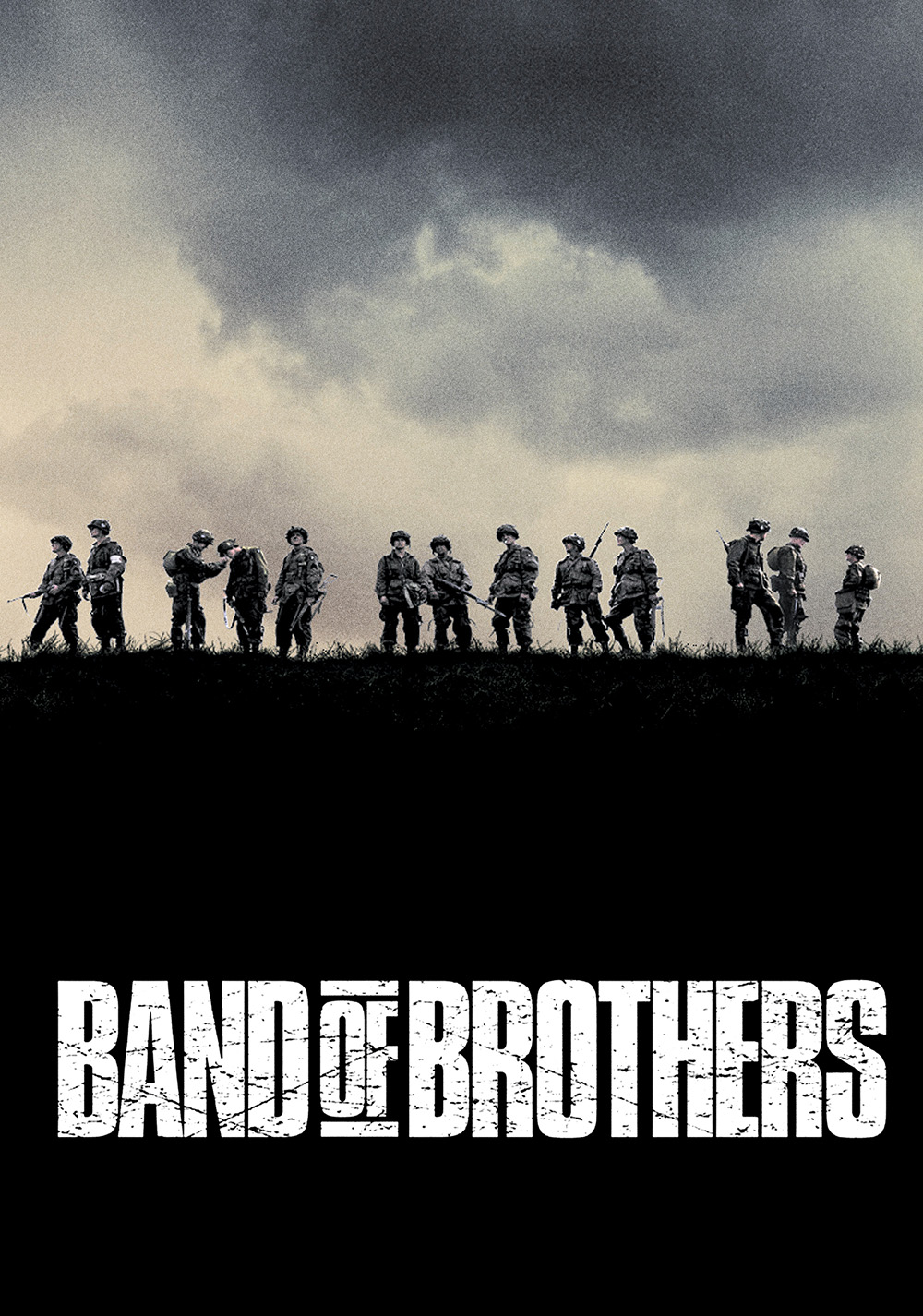
Review: Band of Brothers


“A lot of those [German] soldiers, I’ve thought about this often, that man and I might’ve been good friends. We might’ve had a lot in common. We might’ve liked to fish, you know, he might’ve liked to hunt. You never know. You know. Of course, they were doin’ what they were supposed to do, and I was tryin’ to do what I was supposed to do. But, under different circumstances we might’ve been good friends.” — Darrell “Shifty” Powers

When we look back at the landscape of modern television, it is easy to take the concept of cinematic TV for granted. We live in an era where massive budgets, sweeping orchestral scores, and A-list Hollywood talent are regularly deployed on the small screen. But if you trace this golden lineage back to its true modern genesis, all roads inevitably lead to a singular, towering achievement: the 2001 HBO mini-series Band of Brothers. Produced by Tom Hanks and Steven Spielberg, this ten-part masterpiece did not just recount the harrowing journey of Easy Company, 506th Parachute Infantry Regiment, 101st Airborne Division during World War II; it fundamentally altered the DNA of television storytelling. Watching it today, a quarter-century after its initial broadcast, the series remains as potent, heartbreaking, and visually stunning as it was when it first shocked audiences. It exists as a perfect bridge between the classical Hollywood war epics of old and the uncompromising, gritty realism of twenty-first-century media. By committing to an unprecedented budget and an absolute refusal to sanitize the psychological horrors of combat, Band of Brothers set a high-water mark that few series have ever managed to touch, let alone surpass.

To understand the visual language and visceral power of Band of Brothers, one must first look at the cinematic earthquake that preceded it three years earlier: Steven Spielberg’s 1998 masterpiece Saving Private Ryan. That film rewrote the rules of how cinema captures warfare, abandoning the steady, heroic, brightly lit panoramas of mid-century studio pictures in favor of a terrifyingly immersive, chaotic style. Spielberg utilized desaturated colors, shutter-angle manipulation to create a jittery, hyper-real sense of motion, and handheld cameras that made the audience feel like they were ducking bullets in the surf of Omaha Beach. When Hanks and Spielberg pivoted to television to adapt Stephen E. Ambrose’s non-fiction book Band of Brothers, they brought this exact aesthetic blueprint with them. The impact of Saving Private Ryan on the mini-series cannot be overstated; it acts as the structural and aesthetic godfather of the entire project. Directors like Phil Alden Robinson, Richard Loncraine, and David Nutter utilized the same bleach-bypass film processing techniques to strip away vibrant primaries, leaving a color palette dominated by icy blues, muddy browns, and sickly olive drabs. This was not just a stylistic gimmick; it was a psychological tool that pulled the viewer out of the comfort of their living rooms and dropped them into the frozen, unforgiving forests of Bastogne or the smoke-choked ruins of Carentan. The camera became a participant in the war, getting splattered with mud, shaking violently during artillery barrages, and refusing to look away from the gruesome reality of what high-explosive shrapnel does to human flesh.

Yet, while it shared a visual vocabulary with Saving Private Ryan, Band of Brothers achieved something that a two-and-a-half-hour feature film simply never could, owing entirely to the expansive canvas of the mini-series format. A film must ultimately compress its narrative arc, often relying on archetypes and rapid pacing to reach a resolution. Over the course of ten hours, Band of Brothers allows its characters to breathe, change, harden, and break. Crucially, some of the show’s most powerful, lasting stories have absolutely nothing to do with active battles, but rather unfold in the quieter moments between the chaos. We do not just see these men in the heat of a firefight; we watch them suffer through the mundane, soul-crushing basic training regime of Camp Toccoa under the tyrannical eye of Captain Sobel, played with a brilliant, tragic insecurity by David Schwimmer. We sit with them in the agonizing, silent darkness of C-47 transport planes, listening to the vomit hitting the floorboards and watching the sheer, unadulterated dread on their faces before the jump over Normandy. We freeze with them in foxholes during the long, static winter in the forests of Bastogne, sharing the psychological numbness of isolation and the simple, desperate human desire for a dry pair of socks or a warm cup of coffee. This structural patience transforms the viewing experience from simple passive entertainment into an emotional marathon. We have known these men through their triumphs and their absolute lowest points, making their losses hit with the weight of personal bereavement.

While these quiet stretches build a deep, slow-burning empathy, the absolute biggest gut punch of the entire series arrives in Episode 9, titled Why We Fight. Throughout their march across Europe, the men of Easy Company—and by extension, the audience—have become somewhat cynical and battle-weary, numbly pushing forward simply to survive and get the job done. That numbness is completely shattered when a patrol stumbles across an sub-camp in the woods near Landsberg, which itself was part of the larger Dachau concentration camp complex. Up until this point, the war had been about geopolitical strategies, territory, and survival; suddenly, the men are brought face-to-face with the industrial scale of Nazi atrocities. The direction in this sequence is devastatingly restrained. There are no swelling orchestrations or heroic monologues, only the bewildered horror of soldiers looking at skeletal survivors wandering the camp in striped uniforms. Watching tough, battle-hardened paratroopers like Captain Nixon and Major Winters reduced to breathless, disbelieving silence as they uncover the truth of the Holocaust anchors the narrative in an entirely different tier of tragedy. It is an episode that completely recontextualizes the title of the series, showing that their ultimate purpose transcended military victory; they were liberating humanity from an unimaginable nightmare.

The casting of the series is another stroke of absolute genius that looks even more miraculous in hindsight. The producers deliberately avoided casting massive, distracting superstars for the main roles, opting instead for relatively unknown British and American theater and character actors. This decision was crucial for maintaining the show’s documentary-like authenticity; if Tom Cruise or Brad Pitt had been jumping out of those planes, the illusion would have been instantly shattered. Instead, we got Damian Lewis as Major Richard Winters, delivering a performance of quiet, stoic, and deeply principled leadership that serves as the moral anchor of the entire narrative. Alongside him was Ron Livingston as Captain Lewis Nixon, embodying the weary, cynical, and battle-fatigued intellect of a man seeking refuge from the horrors of war in a bottle of Vat 69. The ensemble is a treasure trove of talent, featuring early-career appearances from actors who would go on to become household names, including Tom Hardy, Michael Fassbender, James McAvoy, Simon Pegg, and Michael Cudlitz. Because the show focuses on an entire company, the perspective shifts naturally from episode to episode. One week we are viewing the war through the eyes of a terrified replacement medic in Bastogne, and the next we are embedded with the cynical, battle-hardened sergeant Carwood Lipton in The Breaking Point. This shifting focus ensures that the series never feels like a traditional Hollywood star vehicle, but rather a collective portrait of brotherhood where the company itself is the true protagonist.

The emotional resonance of Band of Brothers is amplified tenfold by the brilliant inclusion of interviews with the actual surviving veterans of Easy Company at the beginning of each episode. Kept anonymous until the very final moments of the series, these elderly men sit in simple chairs against dark backgrounds, their voices trembling and eyes misting over as they recall events that occurred more than half a century prior. There is a heartbreaking disconnect between the frail, weathered men on screen and the vibrant, muscular young actors portraying them in the dramatization. These interviews ground the cinematic spectacle in an undeniable, sobering reality. They serve as a constant reminder that the explosions, the blood, and the impossible acts of bravery we are witnessing were not the inventions of a Hollywood writers’ room, but the actual lived experiences of ordinary boys who were plucked from small-town America and dropped into the middle of the apocalypse. When the real-life winter veteran Dick Winters quotes his friend’s letter at the end of the series—saying, “Grandpa, were you a hero in the war? And Grandpa said no, but I served in a company of heroes”—it is impossible not to be moved to tears. It is a rare instance where a piece of media successfully honors historical figures without falling into the trap of cheap, unearned sentimentality or jingoistic propaganda.

Beyond its historical and emotional triumphs, the legacy of Band of Brothers is woven directly into the fabric of what we now refer to as prestige television. Before 2001, television was largely viewed as cinema’s lesser sibling—a medium defined by low budgets, procedural structures, and compromised production values meant to fit the square dimensions of old cathode-ray tube television sets. HBO had already begun to challenge this status quo with groundbreaking dramas like The Sopranos and Oz, but Band of Brothers was the project that proved television could match, and perhaps even exceed, the scale and artistic ambition of Hollywood blockbusters. With a staggering budget of over one hundred and twenty million dollars, it was the most expensive television miniseries ever produced at the time. The immense financial gamble paid off spectacularly, demonstrating to network executives and creators alike that audiences were hungry for complex, serialized, and visually uncompromising narratives that demanded to be treated as high art. The success of the show cleared the path for future cinematic television epics, directly inspiring sister projects like The Pacific and Masters of the Air, while setting the production standards that would later allow shows like Game of Thrones, Chernobyl, and Succession to flourish. It proved that the small screen was capable of housing massive, global historical narratives without losing the intimate character dynamics that make long-form storytelling so uniquely compelling.

Ultimately, Band of Brothers stands as a definitive milestone because it perfectly balanced the macro-scale horror of global warfare with the micro-scale beauty of human connection. It stripped away the romanticized myths of World War II to expose the sheer, terrifying randomness of survival, while simultaneously validating the profound love and loyalty that can only be forged in the crucible of shared suffering. It did not glamorize combat; instead, it illuminated the heavy, permanent psychological toll extracted from those who survived it. Through its hyper-realistic visual language inherited from Saving Private Ryan, its impeccable ensemble casting, and its revolutionary impact on the medium of television, the series achieved a timeless quality. It remains a definitive piece of cultural touchstone media that demands annual rewatches from millions of viewers around the globe. It is not just a historical chronicle, nor is it merely a well-executed piece of premium television; it is a monument to the human spirit, an artistic triumph that continues to remind us of the immense sacrifices made by an ordinary generation of heroes who stood together when the world was falling apart.
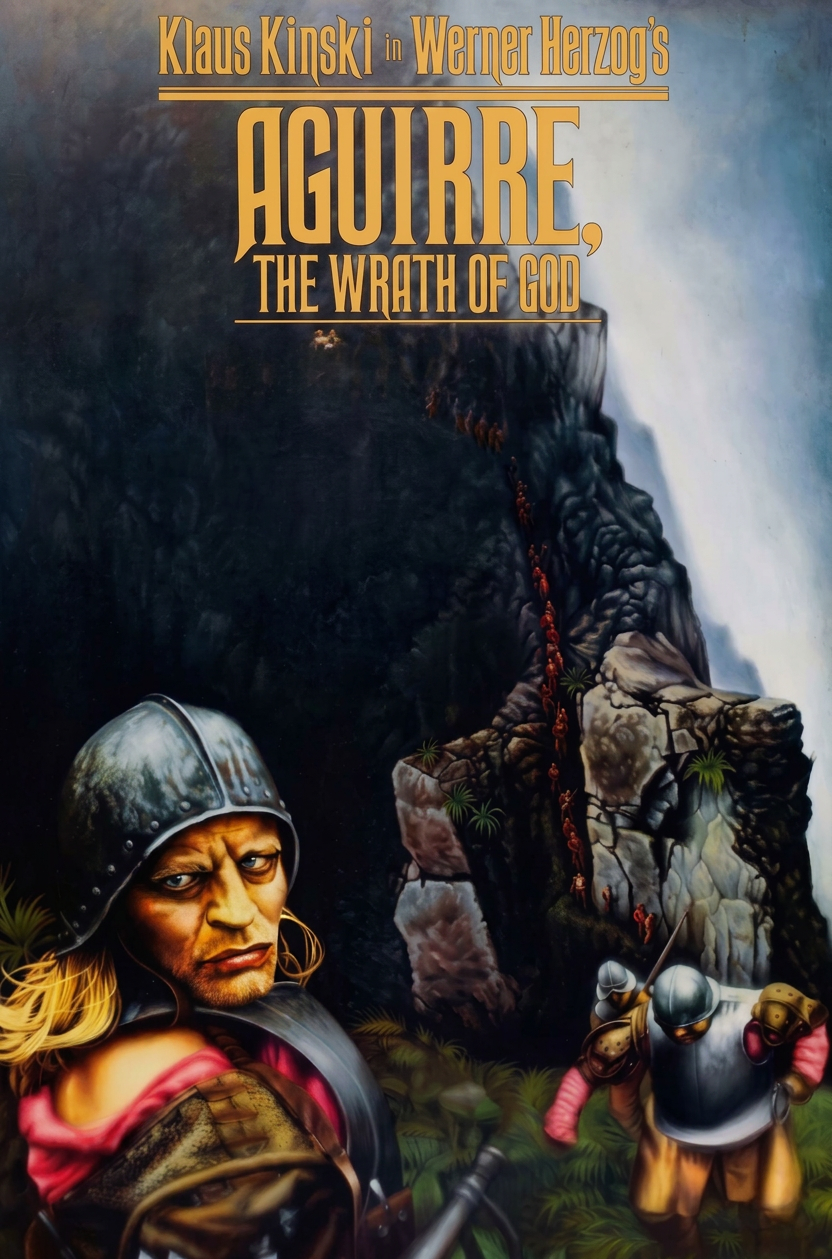
Review: Aguirre, The Wrath of God (dir. by Werner Herzog)


“For here on this river, God never finished his creation.” — Balthasar

Werner Herzog’s Aguirre, the Wrath of God opens with one of the most hypnotic sequences in cinema: a column of Spanish conquistadors and indigenous slaves snaking down a fog-shrouded Andean pass, cannon winched separately. From that first frame, you sense you’re watching not a historical adventure but a fever dream. The film is loosely based on the real-life Lope de Aguirre, a Basque mutineer who searched for El Dorado in the 1560s. But as Herzog later confirmed, historical accuracy was never the point. Aguirre is fiction—a myth sculpted from jungle heat, river currents, and one actor’s maniacal commitment. Remarkably, the production itself became a hellish mirror of the narrative: shot deep in the Peruvian rainforest under conditions so brutal that the line between making a movie and surviving an ordeal vanished.

The plot is simple. In 1560, a Spanish expedition descends into the Amazon basin, searching for the golden city of Manoa. When rapids prove too treacherous, a smaller party is sent ahead under the noble but hapless Don Pedro de Ursúa (Ruy Guerra). Among them is Aguirre (Klaus Kinski), a wiry, half-mad soldier who immediately undermines authority. After Ursúa is murdered, Aguirre seizes control, declaring himself “the Wrath of God” and proclaiming a new monarchy. What follows is not a rousing conquest but a slow hallucinatory unraveling: rafts stuck on looping rivers, starvation, arrows from invisible natives, and the collapse of every civilizing impulse. This is one man’s battle against nature and his personal crisis of faith—a crisis the production team would come to know intimately.

Herzog’s storytelling prioritizes mood over plot. The narrative drifts through long takes of jungle canopy, close-ups of Kinski’s hollow eyes, and Popol Vuh’s otherworldly score. But the film’s raw authenticity comes from its production: a near-literal trek through jungle hell. Herzog took a small cast and crew into the Peruvian rainforest with no insurance, no backup equipment, and no evacuation strategy. The Urubamba River was unpredictable, with hidden rocks and stretches local guides refused to navigate. Rafts capsized. Food spoiled. Actors began unraveling for real. When a soldier in the film announces, “We are walking in circles,” it is both scripted and a genuine observation from an extra who’d passed the same fallen tree three days running. Herzog left that take in. The boundary between fictional madness and documentary collapse dissolved completely.

And then there was Klaus Kinski. If the jungle was one monster, Kinski was another. The conflict between Herzog and his star is the stuff of legend. Kinski arrived volatile, prone to screaming fits, threatening to abandon the production. At one point, a native chief offered to kill Kinski for free. Herzog declined—he still needed the actor alive. On another occasion, Herzog reportedly held Kinski at gunpoint during an attempted walkout. Kinski stayed. That friction bleeds into every frame. Kinski’s rage and paranoid stillness aren’t simulated; they’re the genuine product of a man frayed by heat, isolation, and his own demons. That is not method acting in a safe studio. It’s a man on the edge, pointed at a director who refused to flinch.

What lifts Aguirre into high art is its philosophical dread, earned through real suffering. And at its heart is Aguirre himself, a character who feels less like a historical figure and more like a literary archetype. As played by the manic Kinski, Aguirre is a remarkable fusion: the tragic Miltonian rebel and the obsessive Melvillean monomaniac. Like Satan in Paradise Lost, Aguirre defies divine and imperial order, preferring to reign in hell than serve in heaven. His self-coronation and final soliloquy echo Milton’s antihero—magnificent in defiance, hollowed by pride. But Herzog drains the grandeur, leaving only the fall without the poetry. Simultaneously, Aguirre is pure Ahab from Moby-Dick: another obsessive dragging a reluctant crew into the void on a suicidal quest. El Dorado is his white whale, an obsession that obliterates loyalty, love, and sanity. Both are swallowed by their obsession—Ahab by the sea, Aguirre by the jungle. But where Melville gives Ahab a thunderous final confrontation, Herzog gives Aguirre a whimper: a circle of monkeys, a drifting raft, and a whispered promise of a dynasty that will never come. Kinski holds both archetypes in suspension—Satan’s pride and Ahab’s fixation—and grinds them into something unrecognizable, belonging only to Herzog’s fever dream.

In the film’s most famous scene, Aguirre stands alone on a raft littered with corpses, small monkeys crawling over his armor, and whispers, “I will be the Wrath of God. Who else is with me?” No one. The jungle has swallowed everyone. Herzog frames this as the logical end of both the Miltonian and Melvillean arcs: absolute power in absolute isolation. The scene was shot in one take—not for artistry but because the raft was about to be swept away. The monkeys were real, biting the crew and defecating on Kinski’s armor. He didn’t break character. He couldn’t afford to. That’s the difference between a film that describes madness and one that embodies it.

Visually, Aguirre is a masterclass in low-budget grandeur. Cinematographer Thomas Mauch’s handheld camera glides through the jungle like a ghost. The opening descent feels supernatural. Rivers fill the frame until you lose direction. A galleon stuck in high branches—a leftover from a previous flood—becomes the film’s central metaphor: even empire is helpless against nature’s chaos. That chaos was logistical as well as thematic.

If there’s a weakness, it’s that the pacing can feel punishing. This film doesn’t build to a climax; it decays. Characters die offscreen or vanish. There is no redemption, no final battle. Some viewers may find this anticlimactic, but that’s the point. Herzog isn’t telling a story about winning or losing. He’s documenting a psychic meltdown from the inside, and meltdowns don’t follow three-act structure. The production’s own meltdown—hunger, disease, screaming matches on muddy riverbanks—only reinforces that vision. Aguirre is not a film about a man battling nature and losing his faith. It’s a film that became that battle, in real time, with real stakes, and somehow survived.

Years after release, Herzog clarified that Aguirre bears only the loosest resemblance to the historical Lope de Aguirre. He claimed he dreamed the film during a hike in the Alps. That dream-logic explains why Aguirre feels less like a period piece than a prehistoric vision. History is just a costume; the real subject is the human capacity to mistake madness for destiny. And that destiny, filtered through Kinski, is neither strictly Miltonian nor Melvillean but a nightmare hybrid: a fallen angel who keeps hunting the whale long after the ship has sunk.

In the end, Aguirre, the Wrath of God remains a towering, unsettling achievement. It influenced everything from Apocalypse Now to Resident Evil 4, but no imitation has matched its specific, waterlogged power. Despite the leeches, dysentery, gun threats, and screaming, the film that emerged is haunting, mesmerizing—a surreal trip into one man’s battle against nature and his crisis of faith. Herzog wanted “ecstatic truth” rather than mere fact. Aguirre is ecstatic truth: a fiction that feels more real than reality, a portrait of a madman that makes you understand why sanity is fragile, and a warning about conquest that remains urgent half a century later. Watch it on the biggest screen you can find, late at night, alone. The monkeys will be waiting. And somewhere in the jungle, Herzog and Kinski are still arguing.

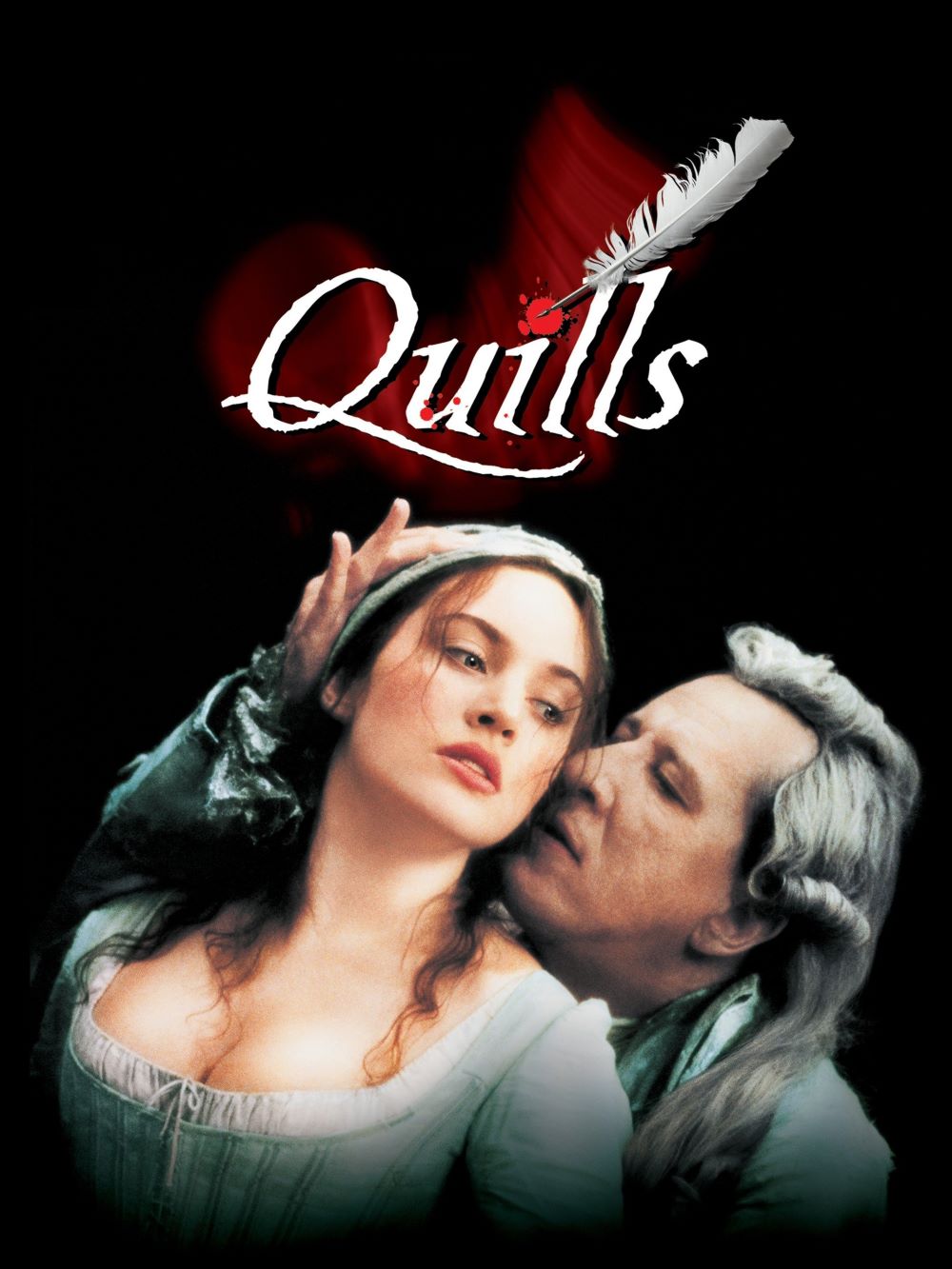
Review: Quills (dir. by Philip Kaufmann)


“In order to know virtue, we must acquaint ourselves with vice. Only then can we know the true measure of a man.” — Marquis de Sade

Quills, Philip Kaufman’s 2000 take on the infamous Marquis de Sade, dives headfirst into the messy clash between artistic freedom and societal repression. It’s a film that doesn’t shy away from the dark, provocative world of its subject, blending historical drama with a touch of theatrical flair. While it takes liberties with the facts, it captures the spirit of de Sade’s defiance in a way that’s both entertaining and thought-provoking.

Right from the start, Quills sets up its world inside the Charenton Asylum for the Insane, where the aging Marquis de Sade, played with gleeful abandon by Geoffrey Rush, is holed up under the watch of the kindly Abbé de Coulmier (Joaquin Phoenix). De Sade’s been churning out his scandalous writings—think Justine and other works that shocked 18th-century France—and smuggling them out via laundry baskets to a young laundress named Madeleine LeClerc (Kate Winslet). Napoleon’s regime isn’t thrilled, so they dispatch the stern Dr. Royer-Collard (Michael Caine) to tighten the screws and silence the madman once and for all. The stage is set for a battle of wills, with de Sade’s pen as his weapon against the forces of censorship.

Geoffrey Rush owns the screen as de Sade, turning what could have been a one-note villain into a complex, charismatic force of nature. He’s sly, unrepentant, and hilariously vulgar, spitting barbs that cut deep into hypocrisy and piety. Rush balances the man’s depravity with a genuine passion for expression, making you root for him even as his ideas repulse. It’s a performance that’s equal parts showman and philosopher, and it anchors the film’s energy. Joaquin Phoenix brings a quiet intensity to the Abbé, a man torn between his faith, his compassion, and the stirrings of forbidden desire—especially toward Madeleine. Phoenix nails the internal conflict, his wide eyes conveying a soul on the brink.

Kate Winslet shines as Madeleine, the innocent conduit for de Sade’s words, whose curiosity pulls her into his orbit. She’s got that Winslet spark—earnest yet fiery—and her scenes smuggling manuscripts or reading aloud add a layer of warmth to the asylum’s chill. Michael Caine, meanwhile, chews scenery as the pompous doctor, a hypocritical sadist in his own right, obsessed with his young bride Simone (Amelia Warner). Caine’s Royer-Collard is deliciously smarmy, a foil to de Sade who mirrors his cruelty under the guise of order. The ensemble clicks, with supporting turns like Tony Berthaud as the asylum’s rougemont adding comic relief amid the tension.

Kaufman’s direction keeps things visually striking without overwhelming the story. The asylum feels alive—claustrophobic cells contrast with grand halls where inmates stage de Sade’s plays under the Abbé’s misguided therapy. Cinematographer Rogier Stoffers bathes everything in earthy tones, with candlelit shadows that amp up the gothic vibe. The score by Angelo Badalamenti weaves eerie strings and harpsichord flourishes, underscoring the film’s blend of horror and humor. It’s not afraid to get graphic: scenes of self-mutilation and bodily fluids as writing tools push boundaries, but they’re more about desperation than shock value.

Thematically, Quills grapples with freedom of speech in a way that’s timeless. De Sade isn’t portrayed as a hero—his writings celebrate excess and cruelty—but as an indomitable spirit who won’t be silenced. Even stripped of paper, ink, clothes, and eventually his voice, he finds ways to provoke, dictating stories through inmates or scratching words into his skin. It’s a middle finger to censorship, questioning who the real monsters are: the libertine or the repressors enforcing “morality.” The Abbé represents liberal tolerance stretched to breaking, Royer-Collard conservative control gone tyrannical. Madeleine embodies the allure of forbidden ideas, her tragic arc highlighting how words can liberate or destroy.

That said, the film isn’t perfect—it’s a fictionalized riff on history, not a biopic. The real de Sade spent years at Charenton, but the timeline compresses events, amps up the drama, and softens his edges for modern tastes. He wasn’t quite the defiant artist Kaufman paints; his later years were more pathetic than poetic. Critics have noted it sanitizes Justine‘s true extremity—no orgies or murders here, just innuendo. Some see it as romanticizing a monster, turning him into a free-speech martyr rather than the predator he was. Fair point; the movie sympathizes more with his pen than his philosophy. Still, as entertainment, it works because it doesn’t pretend to be a documentary.

Humor peppers the darkness, keeping Quills from wallowing in gloom. De Sade’s quips land like punches—”There’s no sin in writing!”—and absurd moments, like inmates reenacting his tales or the doctor’s failed inventions, add levity. One standout sequence has de Sade dictating a racy novel through a chain of whispering patients, turning the asylum into a underground press. It’s One Flew Over the Cuckoo’s Nest meets Dangerous Liaisons, with inmates running wild in a riot of liberation gone wrong. The film’s pace builds masterfully to its brutal climax, where de Sade’s final “victory” leaves you unsettled, pondering if ideas can truly be killed.

Performances aside, the script by Doug Wright (adapted from his play) crackles with wit and insight. Dialogue zings without feeling stagey, and it probes hypocrisy head-on: the pious Abbé lusting after Madeleine, Royer-Collard bedding his teen bride while torturing others. Christianity takes hits—de Sade devours a crucifix, mocks scripture—but it’s broad satire, not preachy atheism. The ending, with its ironic twist on legacy, sticks with you, echoing how de Sade’s name endures despite efforts to erase him.

For fans of period dramas with bite, Quills delivers. It’s provocative without being pornographic, smart without being stuffy. At 124 minutes, it never drags, balancing spectacle and substance. Sure, it glamorizes a controversial figure, and history buffs might nitpick inaccuracies—like the Abbé’s real-life tolerance or Charenton’s theater program. But Kaufman’s track record (The Right StuffThe Unbearable Lightness of Being) shows he knows how to humanize extremes. Rated R for good reason—nudity, violence, profanity—it’s adult fare that rewards attention.

Visually, the costumes pop: de Sade’s velvet robes give way to rags, symbolizing his fall, while Madeleine’s simple smocks highlight her purity amid corruption. Production design nails early 19th-century France, from ornate asylum architecture to the doctor’s sterile gadgets. Badalamenti’s music swells during key confrontations, heightening emotional stakes without overpowering.

In the end, Quills asks tough questions about art’s power and limits. Does provocation justify excess? Can society silence dangerous minds without becoming monstrous itself? It doesn’t provide easy answers, which is its strength. Rush’s tour-de-force makes de Sade magnetic, flaws and all, while the supporting cast elevates the ensemble. Not for the faint-hearted, but if you appreciate bold cinema that stirs debate, it’s a gem. Rewatch value is high—themes resonate in our cancel-culture age. Philip Kaufman crafted a film that’s as unruly as its protagonist: unapologetic, alive, and impossible to ignore.

Outlaw King Official Trailer


Outlaw King

Who here has seen Braveheart?

I’m quite sure that a huge number of people have seen Mel Gibson’s second film as director which won him two Oscars: for Best Director and Best Film. While his career has seen it’s major up’s and down’s, he still has done some great work behind the camera as a director.

Now, what does this all mean to this new Netflix Original film coming out this year called Outlaw King? The answer is not much other than both film share a particular historical character in the Scottish king Robert the Bruce. In Gibson’s film he’s a supporting character whose motivations could be seen as very pragmatic and bordering on the villainous.

Outlaw King, by Scottish director David MacKenzie (who directed the great Hell or High Water), will tell the story of the legendary Scottish king Robert the Bruce who won Scotland’s independence from England where William Wallace ultimately failed to do.

I am going on a hunch that Outlaw King will treat Robert the Bruce in a more sympathetic light than how Gibson’s film portrayed him. This time around we have Chris Pine in the role of Robert the Bruce.

As seen in the trailer, it looks like Netflix’s several billion dollar spending spree has come not just luring prominent filmmakers and producers to the streaming site but also allow them the resources to make a film as lush and beautiful as any made under the remaining big studios.

Let’s hope Outlaw King is more on the level of Mudbound and less like Bright.

Trailer: Lincoln (dir. by Steven Spielberg)


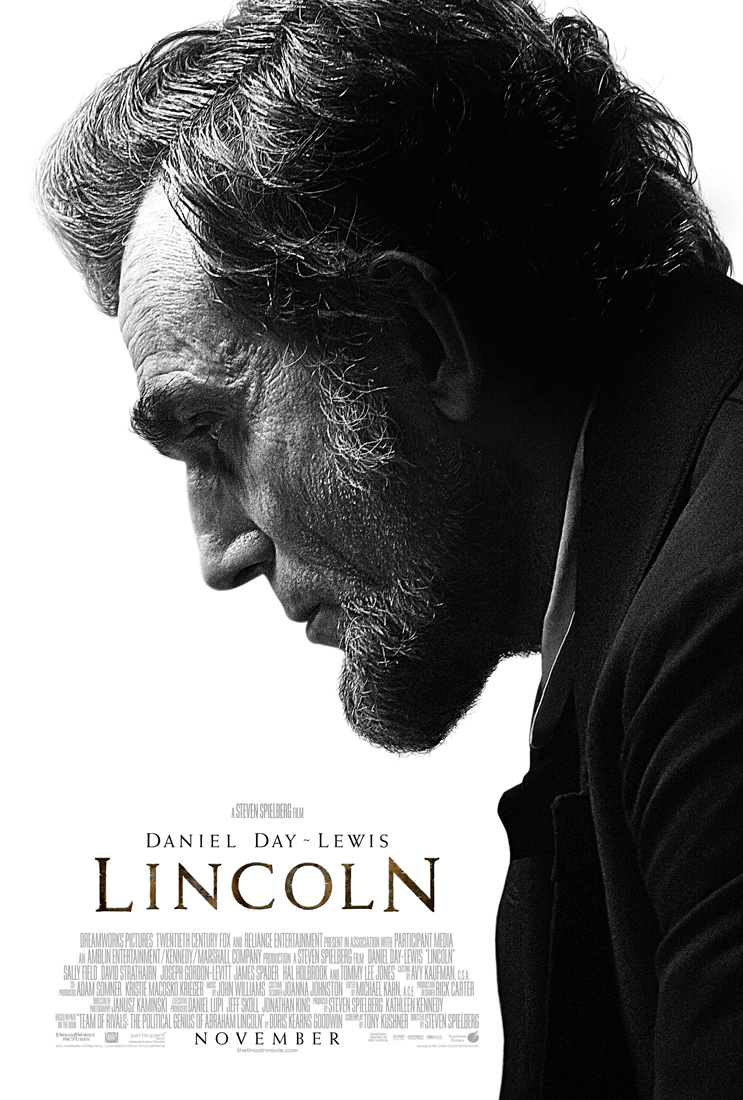
One of the films for 2012 that’s seen by many as a major player in the end of the year Awards season. Steven Spielberg’s long-delayed and gestating historical drama about Abraham Lincoln will finally make it onto the big-screen this early November. Spielberg had initially chosen Liam Neeson to play the 16th President of these United States but as the project continued to get delayed he backed out and in comes Daniel Day-Lewis to take on a very difficult role.

Lincolnis based off of Doris Kearns Goodwin’s biography of the 16th President, Team of Rivals: The Political Genius of Abraham Lincoln. With Tony Kushner tasked with finally hashing out a final draft of the screenplay the film finally went into production in 2009. The cast is an ensemble led by Day-Lewis that includes several past Academy Award and Emmy winners like Tommy Lee Jones, Sally Field and Hal Holbrook with other acting luminaries like Joseph Gordon-Levitt, Walton Goggins, David Straithairn, Jared Harris and Jackie Earle Haley.

The first trailer finally arrived today, September 13, 2012, during a Google+ hangout with Spielberg and Gordon-Levitt and reaction to the trailer seems to range from “give Daniel Day-Lewis the Oscar already” to “an Oscar-bait if there was ever one”. No matter where one sat in their reaction to this trailer it will be interesting to see if Spielberg will come out with a film that doesn’t come off as maudlin and manipulative, but deliver a film that explores and tries to explain why Lincoln became such a beloved President in his time despite making so many unpopular decisions and sitting through the worst era of American history (Civil War) and decades since his death.

Here’s to hoping that the film is less like Amistad and more like Schindler’s List in terms of tone and narrative. We know why Lincoln is seen as the greatest President we ever had. What we want to know is the why’s.

Lincoln arrives in the theaters this November 9, 2012.