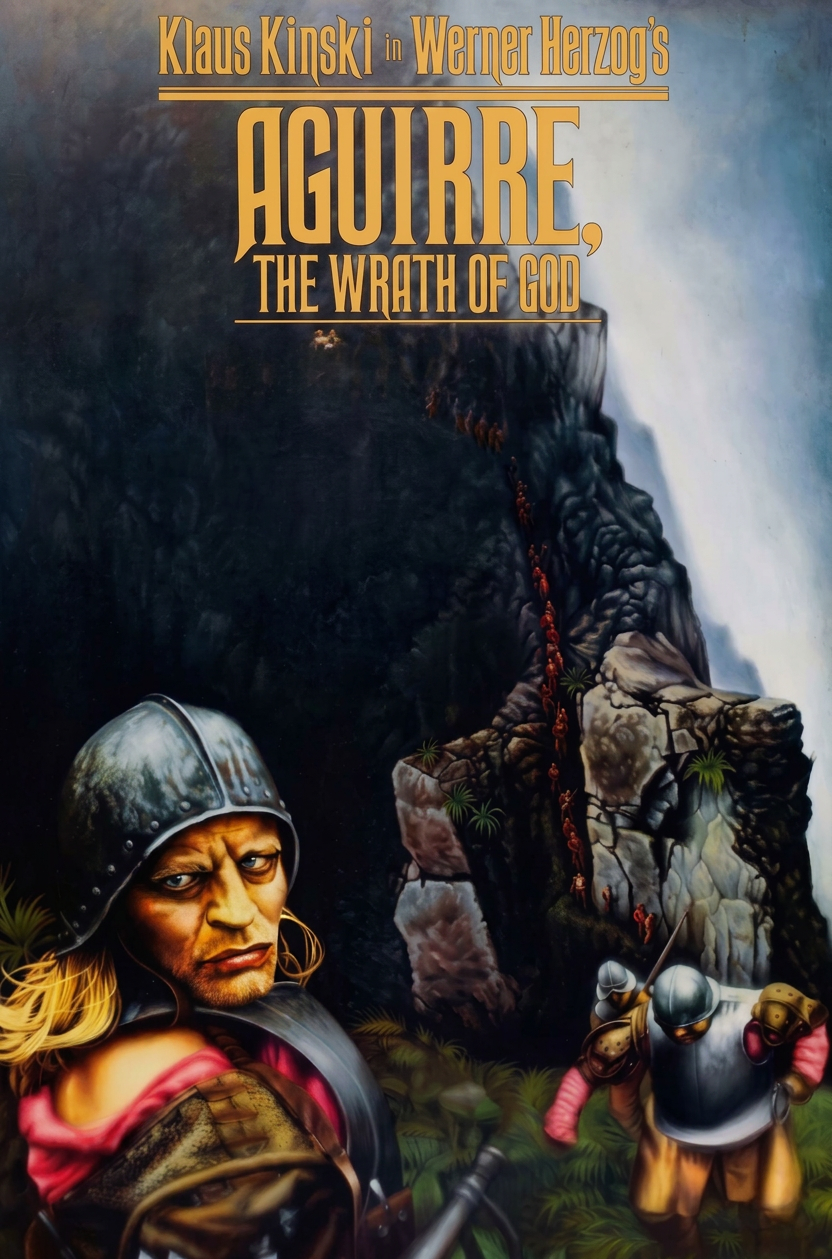
“For here on this river, God never finished his creation.” — Balthasar
Werner Herzog’s Aguirre, the Wrath of God opens with one of the most hypnotic sequences in cinema: a column of Spanish conquistadors and indigenous slaves snaking down a fog-shrouded Andean pass, cannon winched separately. From that first frame, you sense you’re watching not a historical adventure but a fever dream. The film is loosely based on the real-life Lope de Aguirre, a Basque mutineer who searched for El Dorado in the 1560s. But as Herzog later confirmed, historical accuracy was never the point. Aguirre is fiction—a myth sculpted from jungle heat, river currents, and one actor’s maniacal commitment. Remarkably, the production itself became a hellish mirror of the narrative: shot deep in the Peruvian rainforest under conditions so brutal that the line between making a movie and surviving an ordeal vanished.
The plot is simple. In 1560, a Spanish expedition descends into the Amazon basin, searching for the golden city of Manoa. When rapids prove too treacherous, a smaller party is sent ahead under the noble but hapless Don Pedro de Ursúa (Ruy Guerra). Among them is Aguirre (Klaus Kinski), a wiry, half-mad soldier who immediately undermines authority. After Ursúa is murdered, Aguirre seizes control, declaring himself “the Wrath of God” and proclaiming a new monarchy. What follows is not a rousing conquest but a slow hallucinatory unraveling: rafts stuck on looping rivers, starvation, arrows from invisible natives, and the collapse of every civilizing impulse. This is one man’s battle against nature and his personal crisis of faith—a crisis the production team would come to know intimately.
Herzog’s storytelling prioritizes mood over plot. The narrative drifts through long takes of jungle canopy, close-ups of Kinski’s hollow eyes, and Popol Vuh’s otherworldly score. But the film’s raw authenticity comes from its production: a near-literal trek through jungle hell. Herzog took a small cast and crew into the Peruvian rainforest with no insurance, no backup equipment, and no evacuation strategy. The Urubamba River was unpredictable, with hidden rocks and stretches local guides refused to navigate. Rafts capsized. Food spoiled. Actors began unraveling for real. When a soldier in the film announces, “We are walking in circles,” it is both scripted and a genuine observation from an extra who’d passed the same fallen tree three days running. Herzog left that take in. The boundary between fictional madness and documentary collapse dissolved completely.
And then there was Klaus Kinski. If the jungle was one monster, Kinski was another. The conflict between Herzog and his star is the stuff of legend. Kinski arrived volatile, prone to screaming fits, threatening to abandon the production. At one point, a native chief offered to kill Kinski for free. Herzog declined—he still needed the actor alive. On another occasion, Herzog reportedly held Kinski at gunpoint during an attempted walkout. Kinski stayed. That friction bleeds into every frame. Kinski’s rage and paranoid stillness aren’t simulated; they’re the genuine product of a man frayed by heat, isolation, and his own demons. That is not method acting in a safe studio. It’s a man on the edge, pointed at a director who refused to flinch.
What lifts Aguirre into high art is its philosophical dread, earned through real suffering. And at its heart is Aguirre himself, a character who feels less like a historical figure and more like a literary archetype. As played by the manic Kinski, Aguirre is a remarkable fusion: the tragic Miltonian rebel and the obsessive Melvillean monomaniac. Like Satan in Paradise Lost, Aguirre defies divine and imperial order, preferring to reign in hell than serve in heaven. His self-coronation and final soliloquy echo Milton’s antihero—magnificent in defiance, hollowed by pride. But Herzog drains the grandeur, leaving only the fall without the poetry. Simultaneously, Aguirre is pure Ahab from Moby-Dick: another obsessive dragging a reluctant crew into the void on a suicidal quest. El Dorado is his white whale, an obsession that obliterates loyalty, love, and sanity. Both are swallowed by their obsession—Ahab by the sea, Aguirre by the jungle. But where Melville gives Ahab a thunderous final confrontation, Herzog gives Aguirre a whimper: a circle of monkeys, a drifting raft, and a whispered promise of a dynasty that will never come. Kinski holds both archetypes in suspension—Satan’s pride and Ahab’s fixation—and grinds them into something unrecognizable, belonging only to Herzog’s fever dream.
In the film’s most famous scene, Aguirre stands alone on a raft littered with corpses, small monkeys crawling over his armor, and whispers, “I will be the Wrath of God. Who else is with me?” No one. The jungle has swallowed everyone. Herzog frames this as the logical end of both the Miltonian and Melvillean arcs: absolute power in absolute isolation. The scene was shot in one take—not for artistry but because the raft was about to be swept away. The monkeys were real, biting the crew and defecating on Kinski’s armor. He didn’t break character. He couldn’t afford to. That’s the difference between a film that describes madness and one that embodies it.
Visually, Aguirre is a masterclass in low-budget grandeur. Cinematographer Thomas Mauch’s handheld camera glides through the jungle like a ghost. The opening descent feels supernatural. Rivers fill the frame until you lose direction. A galleon stuck in high branches—a leftover from a previous flood—becomes the film’s central metaphor: even empire is helpless against nature’s chaos. That chaos was logistical as well as thematic.
If there’s a weakness, it’s that the pacing can feel punishing. This film doesn’t build to a climax; it decays. Characters die offscreen or vanish. There is no redemption, no final battle. Some viewers may find this anticlimactic, but that’s the point. Herzog isn’t telling a story about winning or losing. He’s documenting a psychic meltdown from the inside, and meltdowns don’t follow three-act structure. The production’s own meltdown—hunger, disease, screaming matches on muddy riverbanks—only reinforces that vision. Aguirre is not a film about a man battling nature and losing his faith. It’s a film that became that battle, in real time, with real stakes, and somehow survived.
Years after release, Herzog clarified that Aguirre bears only the loosest resemblance to the historical Lope de Aguirre. He claimed he dreamed the film during a hike in the Alps. That dream-logic explains why Aguirre feels less like a period piece than a prehistoric vision. History is just a costume; the real subject is the human capacity to mistake madness for destiny. And that destiny, filtered through Kinski, is neither strictly Miltonian nor Melvillean but a nightmare hybrid: a fallen angel who keeps hunting the whale long after the ship has sunk.
In the end, Aguirre, the Wrath of God remains a towering, unsettling achievement. It influenced everything from Apocalypse Now to Resident Evil 4, but no imitation has matched its specific, waterlogged power. Despite the leeches, dysentery, gun threats, and screaming, the film that emerged is haunting, mesmerizing—a surreal trip into one man’s battle against nature and his crisis of faith. Herzog wanted “ecstatic truth” rather than mere fact. Aguirre is ecstatic truth: a fiction that feels more real than reality, a portrait of a madman that makes you understand why sanity is fragile, and a warning about conquest that remains urgent half a century later. Watch it on the biggest screen you can find, late at night, alone. The monkeys will be waiting. And somewhere in the jungle, Herzog and Kinski are still arguing.
 Through the Shattered Lens