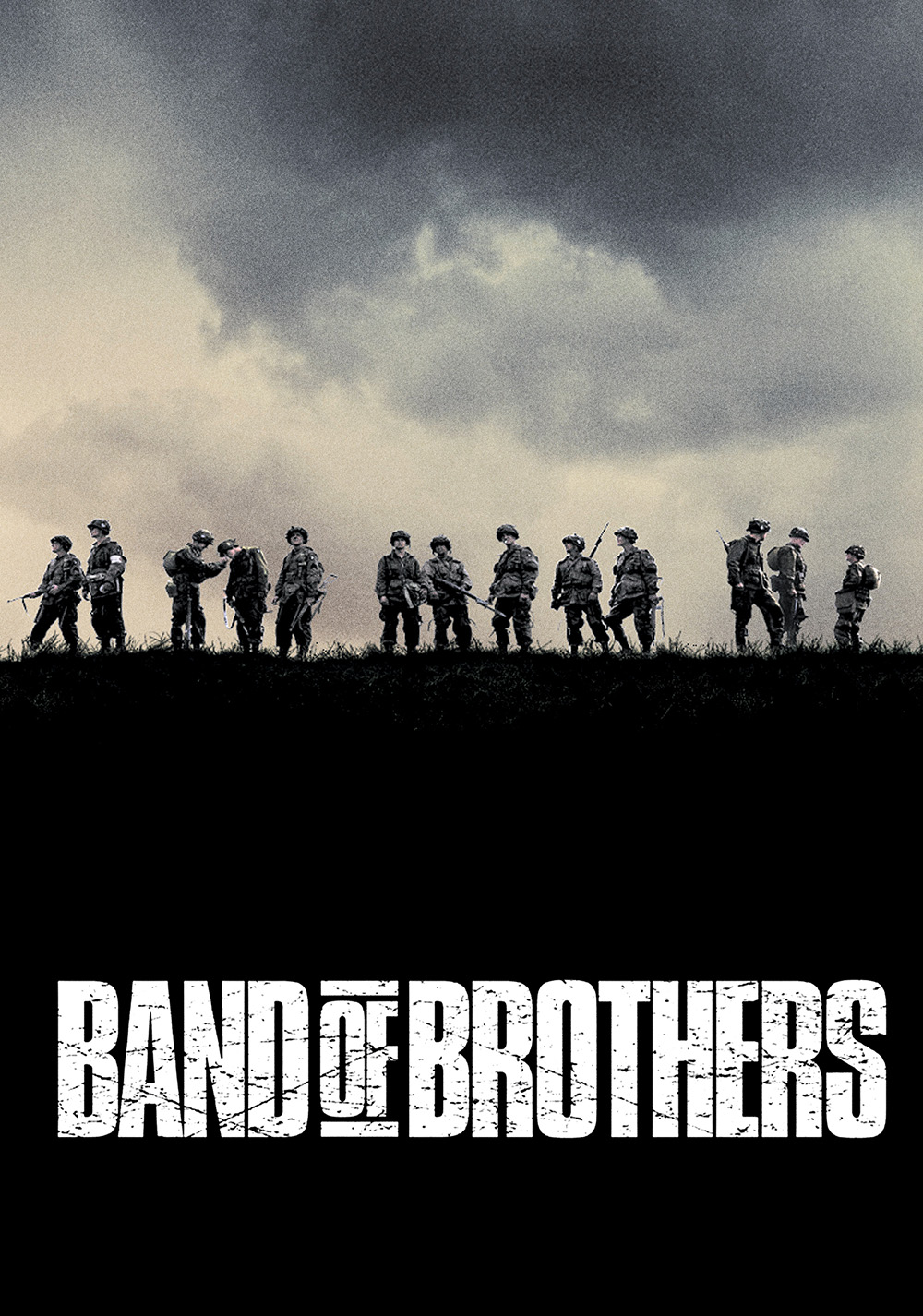
“A lot of those [German] soldiers, I’ve thought about this often, that man and I might’ve been good friends. We might’ve had a lot in common. We might’ve liked to fish, you know, he might’ve liked to hunt. You never know. You know. Of course, they were doin’ what they were supposed to do, and I was tryin’ to do what I was supposed to do. But, under different circumstances we might’ve been good friends.” — Darrell “Shifty” Powers
When we look back at the landscape of modern television, it is easy to take the concept of cinematic TV for granted. We live in an era where massive budgets, sweeping orchestral scores, and A-list Hollywood talent are regularly deployed on the small screen. But if you trace this golden lineage back to its true modern genesis, all roads inevitably lead to a singular, towering achievement: the 2001 HBO mini-series Band of Brothers. Produced by Tom Hanks and Steven Spielberg, this ten-part masterpiece did not just recount the harrowing journey of Easy Company, 506th Parachute Infantry Regiment, 101st Airborne Division during World War II; it fundamentally altered the DNA of television storytelling. Watching it today, a quarter-century after its initial broadcast, the series remains as potent, heartbreaking, and visually stunning as it was when it first shocked audiences. It exists as a perfect bridge between the classical Hollywood war epics of old and the uncompromising, gritty realism of twenty-first-century media. By committing to an unprecedented budget and an absolute refusal to sanitize the psychological horrors of combat, Band of Brothers set a high-water mark that few series have ever managed to touch, let alone surpass.
To understand the visual language and visceral power of Band of Brothers, one must first look at the cinematic earthquake that preceded it three years earlier: Steven Spielberg’s 1998 masterpiece Saving Private Ryan. That film rewrote the rules of how cinema captures warfare, abandoning the steady, heroic, brightly lit panoramas of mid-century studio pictures in favor of a terrifyingly immersive, chaotic style. Spielberg utilized desaturated colors, shutter-angle manipulation to create a jittery, hyper-real sense of motion, and handheld cameras that made the audience feel like they were ducking bullets in the surf of Omaha Beach. When Hanks and Spielberg pivoted to television to adapt Stephen E. Ambrose’s non-fiction book Band of Brothers, they brought this exact aesthetic blueprint with them. The impact of Saving Private Ryan on the mini-series cannot be overstated; it acts as the structural and aesthetic godfather of the entire project. Directors like Phil Alden Robinson, Richard Loncraine, and David Nutter utilized the same bleach-bypass film processing techniques to strip away vibrant primaries, leaving a color palette dominated by icy blues, muddy browns, and sickly olive drabs. This was not just a stylistic gimmick; it was a psychological tool that pulled the viewer out of the comfort of their living rooms and dropped them into the frozen, unforgiving forests of Bastogne or the smoke-choked ruins of Carentan. The camera became a participant in the war, getting splattered with mud, shaking violently during artillery barrages, and refusing to look away from the gruesome reality of what high-explosive shrapnel does to human flesh.
Yet, while it shared a visual vocabulary with Saving Private Ryan, Band of Brothers achieved something that a two-and-a-half-hour feature film simply never could, owing entirely to the expansive canvas of the mini-series format. A film must ultimately compress its narrative arc, often relying on archetypes and rapid pacing to reach a resolution. Over the course of ten hours, Band of Brothers allows its characters to breathe, change, harden, and break. Crucially, some of the show’s most powerful, lasting stories have absolutely nothing to do with active battles, but rather unfold in the quieter moments between the chaos. We do not just see these men in the heat of a firefight; we watch them suffer through the mundane, soul-crushing basic training regime of Camp Toccoa under the tyrannical eye of Captain Sobel, played with a brilliant, tragic insecurity by David Schwimmer. We sit with them in the agonizing, silent darkness of C-47 transport planes, listening to the vomit hitting the floorboards and watching the sheer, unadulterated dread on their faces before the jump over Normandy. We freeze with them in foxholes during the long, static winter in the forests of Bastogne, sharing the psychological numbness of isolation and the simple, desperate human desire for a dry pair of socks or a warm cup of coffee. This structural patience transforms the viewing experience from simple passive entertainment into an emotional marathon. We have known these men through their triumphs and their absolute lowest points, making their losses hit with the weight of personal bereavement.
While these quiet stretches build a deep, slow-burning empathy, the absolute biggest gut punch of the entire series arrives in Episode 9, titled Why We Fight. Throughout their march across Europe, the men of Easy Company—and by extension, the audience—have become somewhat cynical and battle-weary, numbly pushing forward simply to survive and get the job done. That numbness is completely shattered when a patrol stumbles across an sub-camp in the woods near Landsberg, which itself was part of the larger Dachau concentration camp complex. Up until this point, the war had been about geopolitical strategies, territory, and survival; suddenly, the men are brought face-to-face with the industrial scale of Nazi atrocities. The direction in this sequence is devastatingly restrained. There are no swelling orchestrations or heroic monologues, only the bewildered horror of soldiers looking at skeletal survivors wandering the camp in striped uniforms. Watching tough, battle-hardened paratroopers like Captain Nixon and Major Winters reduced to breathless, disbelieving silence as they uncover the truth of the Holocaust anchors the narrative in an entirely different tier of tragedy. It is an episode that completely recontextualizes the title of the series, showing that their ultimate purpose transcended military victory; they were liberating humanity from an unimaginable nightmare.
The casting of the series is another stroke of absolute genius that looks even more miraculous in hindsight. The producers deliberately avoided casting massive, distracting superstars for the main roles, opting instead for relatively unknown British and American theater and character actors. This decision was crucial for maintaining the show’s documentary-like authenticity; if Tom Cruise or Brad Pitt had been jumping out of those planes, the illusion would have been instantly shattered. Instead, we got Damian Lewis as Major Richard Winters, delivering a performance of quiet, stoic, and deeply principled leadership that serves as the moral anchor of the entire narrative. Alongside him was Ron Livingston as Captain Lewis Nixon, embodying the weary, cynical, and battle-fatigued intellect of a man seeking refuge from the horrors of war in a bottle of Vat 69. The ensemble is a treasure trove of talent, featuring early-career appearances from actors who would go on to become household names, including Tom Hardy, Michael Fassbender, James McAvoy, Simon Pegg, and Michael Cudlitz. Because the show focuses on an entire company, the perspective shifts naturally from episode to episode. One week we are viewing the war through the eyes of a terrified replacement medic in Bastogne, and the next we are embedded with the cynical, battle-hardened sergeant Carwood Lipton in The Breaking Point. This shifting focus ensures that the series never feels like a traditional Hollywood star vehicle, but rather a collective portrait of brotherhood where the company itself is the true protagonist.
The emotional resonance of Band of Brothers is amplified tenfold by the brilliant inclusion of interviews with the actual surviving veterans of Easy Company at the beginning of each episode. Kept anonymous until the very final moments of the series, these elderly men sit in simple chairs against dark backgrounds, their voices trembling and eyes misting over as they recall events that occurred more than half a century prior. There is a heartbreaking disconnect between the frail, weathered men on screen and the vibrant, muscular young actors portraying them in the dramatization. These interviews ground the cinematic spectacle in an undeniable, sobering reality. They serve as a constant reminder that the explosions, the blood, and the impossible acts of bravery we are witnessing were not the inventions of a Hollywood writers’ room, but the actual lived experiences of ordinary boys who were plucked from small-town America and dropped into the middle of the apocalypse. When the real-life winter veteran Dick Winters quotes his friend’s letter at the end of the series—saying, “Grandpa, were you a hero in the war? And Grandpa said no, but I served in a company of heroes”—it is impossible not to be moved to tears. It is a rare instance where a piece of media successfully honors historical figures without falling into the trap of cheap, unearned sentimentality or jingoistic propaganda.
Beyond its historical and emotional triumphs, the legacy of Band of Brothers is woven directly into the fabric of what we now refer to as prestige television. Before 2001, television was largely viewed as cinema’s lesser sibling—a medium defined by low budgets, procedural structures, and compromised production values meant to fit the square dimensions of old cathode-ray tube television sets. HBO had already begun to challenge this status quo with groundbreaking dramas like The Sopranos and Oz, but Band of Brothers was the project that proved television could match, and perhaps even exceed, the scale and artistic ambition of Hollywood blockbusters. With a staggering budget of over one hundred and twenty million dollars, it was the most expensive television miniseries ever produced at the time. The immense financial gamble paid off spectacularly, demonstrating to network executives and creators alike that audiences were hungry for complex, serialized, and visually uncompromising narratives that demanded to be treated as high art. The success of the show cleared the path for future cinematic television epics, directly inspiring sister projects like The Pacific and Masters of the Air, while setting the production standards that would later allow shows like Game of Thrones, Chernobyl, and Succession to flourish. It proved that the small screen was capable of housing massive, global historical narratives without losing the intimate character dynamics that make long-form storytelling so uniquely compelling.
Ultimately, Band of Brothers stands as a definitive milestone because it perfectly balanced the macro-scale horror of global warfare with the micro-scale beauty of human connection. It stripped away the romanticized myths of World War II to expose the sheer, terrifying randomness of survival, while simultaneously validating the profound love and loyalty that can only be forged in the crucible of shared suffering. It did not glamorize combat; instead, it illuminated the heavy, permanent psychological toll extracted from those who survived it. Through its hyper-realistic visual language inherited from Saving Private Ryan, its impeccable ensemble casting, and its revolutionary impact on the medium of television, the series achieved a timeless quality. It remains a definitive piece of cultural touchstone media that demands annual rewatches from millions of viewers around the globe. It is not just a historical chronicle, nor is it merely a well-executed piece of premium television; it is a monument to the human spirit, an artistic triumph that continues to remind us of the immense sacrifices made by an ordinary generation of heroes who stood together when the world was falling apart.
 Through the Shattered Lens