Lisa Cleans Out Her DVR: 20,000 Years in Sing Sing (dir by Michael Curtiz)


(I am currently in the process of cleaning out my DVR.  I recorded the 1932 film, 20,000 Years In Sing Sing, off of TCM on January 31st.)

I was somewhat surprised to discover that I had this 1930s prison film on my DVR.  I’m not sure what led to me deciding to record it though, if I had to guess, I’d say that it was probably the title.  I probably assumed it was about a prisoner who served a 20,000 year sentence.  I mean, that sounds interesting, right?

It turns out I was wrong though.  The film starts with a shot of a line of prisoners walking into a prison, with their sentence superimposed over their heads.  One guy is in for 7 years.  Someone else has a 50 year sentence.  Another person has a 33 year sentence.  I’m guessing that if you added all of the sentence up, you would end up with 20,000 years.

That’s a lot of angry men, all trapped in one location.  Fortunately, Sing Sing Prison has a compassionate warden.  Paul Long (Arthur Byron) is a good man, a criminal justice reformer who believe that prison should be about more than punishment.  He is tough but fair and he runs his prison on the honor system.  Break the rules and you’ll be tossed into solitary.  Respect the rules and the Warden might even let you leave the prison for a day or two.  The press and the bureaucrats may think that Warden Long is naive but prison guards love him.  “We’re behind you,” the head guard says when it appears that Long might be about to lose his job.  And the prisoners respect him, even if few of them are willing to admit it.

Tommy Connors (Spencer Tracy) is the newest prisoner.  He’s been sentenced to 5 to 30 years for robbery and assault with a deadly weapon.  Tommy’s a tough guy, the type who speaks in the rat-a-tat manner that will be familiar to anyone who has ever watched a 30s gangster film.  He’s a tough guy so he ends every sentence with “see?,” as in, “No prison is going to break me, see?” Tommy’s the type of guy who brags that, even if they send him to solitary, he can do his time standing on his head.  When he gets called into the Warden’s office, he tosses a lit cigarette on the floor.  Can the Warden reform even as rough a customer as Tommy Connors!?

It doesn’t help, of course, that Tommy has a friend named Joe Finn (Louis Calhern) and, even though Joe is on the outside, he’s constantly encouraging Tommy to break the rules.  Joe has an ulterior motive for wanting to keep Tommy in prison for as long as possible.  That motive is his desire for Fay (Bette Davis), Tommy’s loyal girlfriend.  When Fay is injured in an accident, the Warden agrees to let Tommy visit her on the condition that Tommy return in 24 hours.  However, when Tommy’s visit leads to murder, the Warden is blamed.  It gets even worse when the Warden announces that he is sure that, despite the charges against him, Tommy will honor his word and return to the prison.

Will Tommy do the right thing?  Or will he flee and destroy the Warden’s career?

20,000 Years in Sing Sing was produced by Warner Bros and it features the studio’s typical pre-code combination of a B-movie action and progressive politics.  Seen today, it’s a watchable but minor film, one that often seems dated in its view of criminal behavior.  (Even I, a huge believer in the need for criminal justice reform, thought the warden was being incredibly naive when he put the convicts on the honor system.)  That said, it’s always interesting to see Bette Davis in the days before she became the Bette Davis and was just another ingenue trying to make an impression while surviving the studio system.  As well, since Spencer Tracy eventually became best known for portraying wise, plainspoken men, it’s interesting to see him playing the cocky and disrespectful Tommy.

Still, I think there is a place for a movie about someone spending 20,000 Years in Sing Sing.

(I imagine that, after the first 10,000 years, it gets easier.)
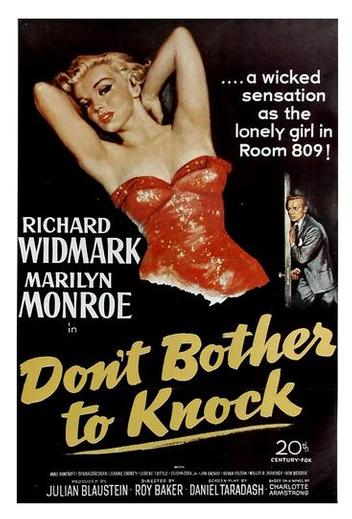
 

Lisa Cleans Out Her DVR: Don’t Bother To Knock (dir by Roy Ward Baker)


(I am currently attempting to clean out my DVR.  I recorded the 1952 film Don’t Bother To Knock off of FXM on April 3rd.)

Welcome to the McKinley Hotel in New York City!  The McKinley is a nice place, though it’s no Grand Budapest Hotel.  Presumably, the McKinley was named after the late President William McKinley.  While I’m sure that McKinley would have appreciated the gesture, I don’t know how he would feel about all the melodrama that’s occurring behind closed doors.

For instance, there’s Lyn Lesley (Anne Bancroft, making her screen debut).  Lyn sings in the hotel bar and, though she might seem to be cynical and tough, she actually has a big heart.  In fact, she cares so much about humanity that she broke up with her longtime boyfriend, Jed Towers (Richard Widmark), because he doesn’t seem to have a heart at all.  Of course, she broke up with Jed by sending him a letter.  When Jed checks into the hotel and tracks her down in the bar, he has questions about their breakup and he wants answers that won’t require any reading.  She tells him that he’s not capable of caring about anyone so why should she waste her time on him?  Then she sings a love song because that’s her job.

As for Jed, he’s kind of a jerk in the way that most men tend to be in movies from the 1950s.  He’s an airline pilot who served overseas during World War II and spent a year living in England.  He’s tough and he’s cynical and now, he’s single.  He’s also got a room in a hotel for the night.

And then there’s Peter and Ruth Jones (Jim Backus and Lurene Tuttle), who have a function to attend in the hotel ballroom but who don’t have anyone to look after their ten year-old daughter, Bunny (Donna Corcoran).  Fortunately, the hotel’s elevator operator, Eddie (Elisha Cook, Jr.), has a niece named Nell (Marilyn Monroe).  Nell is quiet and shy and needs the money.  She’ll be more than willing to babysit!

Of course, the only problem with Nell is that she’s a little unstable.  This becomes obvious when she’s left alone with Bunny and promptly says that, if Bunny isn’t careful, something bad might happen to one of her toys.  Inside the apartment, Nell is impressed by all the pretty things owned by Ruth.  She tries on her jewelry.  She sprays her perfume in the air.  She puts on Nell’s negligee and looks at herself in the mirror.  Eddie is not amused when he discovers what Nell’s been doing.  If she wants all of this stuff, he tells her, she needs to marry someone rich.  That’s not bad advice but the only problem is that Nell is currently single.  She’s been single ever since her boyfriend died in a plane crash.  In fact, Nell was so upset by his death that she even tried to commit suicide afterward.

From his room, Jed has a direct view of Nell trying on Ruth’s clothes.  When he and Nell spot each other, Nell invites him over.  She tells Jed that she’s a guest at the hotel and that Bunny is her daughter.  Jed can immediately tell that there’s something strange about Nell.  Nell, meanwhile, thinks that Jed is her dead boyfriend.  Meanwhile, Bunny is helpless in her room…

Clocking in at a brisk 72 minutes, Don’t Bother To Knock feels less like a movie and more like a one-act play or maybe even an adaptation of an old television production.  (After watching the movie, I was shocked to discover that it was based on neither.)  Seen today, it’s mostly memorable for featuring Marilyn Monroe’s first true starring role.  After appearing in small roles in several films (including All About Eve), Don’t Bother To Knock was not only Marilyn’s shot at stardom but also her first dramatic performance.  Reportedly basing her performance on her troubled mother, Marilyn is sympathetic and almost painfully vulnerable.  Her scenes with Elisha Cook, Jr. are especially charged, full of a subtext that will probably be easier for modern audiences to spot than it was for audiences in 1952.  Marilyn gave an incredibly poignant performance and she is the main reason to watch Don’t Bother To Knock.

Lisa Cleans Out Her DVR: A Deadly Affair (dir by David Bush)


(Once again, I am trying to clean out my DVR.  I recorded A Deadly Affair off of the Lifetime Movie Network on March 5th.)

At first glance, Charlie (Alan Powell) and Mary (Austin Highsmith) might look like the perfect couple.  They’re attractive.  They’re apparently in love.  They’ve got a nice house.  Charlie has a manly job as a house renovator and he even has a badass lion tattoo on his chest.

Even better, they’re best friends with another perfect couple!  Susan (Valerie Azlynn) and Trevor (Luke Edwards) are also attractive and apparently in love and they’ve got a nice house of their own!  Susan’s a lawyer and Trevor has got a sexy tattoo too!  Two perfect couples living so close to each other?  What could possibly go wrong?

Well, Mary thinks that Charlie might be cheating on her.  And Trevor says that Susan isn’t really responsive to his needs.  One night, Mary and Trevor have a bit too much to drink.  They end up sharing a kiss.  Mary freaks out and says that she can’t cheat on Charlie, especially not with the husband of her best friend.  Essentially, Mary says, “There’s no way this is going to happen.”  Trevor, being a guy, interprets that to mean, “It’ll happen later.”

Later, Mary gets a call from her husband.  He sounds like he’s in some sort of trouble.  When he doesn’t subsequently return home, Mary goes out to the house that was renovating.  Walking through the dark house, she stumbles across the dead body of her husband.  Someone’s murdered Charlie!

Well, of course, the entire town suspects that Mary killed Charlie.  Even her sister-in-law, the possibly unstable Crystal (Lorna Street Dopson), is convinced that she saw (and heard) Mary with Trevor.  It doesn’t matter how much Mary protests her innocence.  The detective (J. Terry Garces) in charge of the case thinks that she did it.  The entire town thinks that she did it.  Soon, Mary is running the risk of losing her teaching job.  The parents don’t want a murderer teaching their kids…

In fact, it appears that only one person is willing to stand up for Mary and that’s Susan!  Susan is not only Mary’s lawyer but she’s her best friend as well.  But how is Susan going to react if she finds out that Mary kissed her husband…

Towards the end of A Deadly Affair, there’s a scene where the murderer says, “Thank you for begging.  I appreciate that.”  I love that line and it pretty much sums up the reason why I enjoyed this movie.  A Deadly Affair is an enjoyably twisty and over the top murder mystery, the type of movie where characters interrupt meetings by storming into the room, shouting, “You bitch!” and then slapping someone hard.  It’s a lot of fun.

And, I don’t want to give away any spoilers but I will say that the person playing the murderer did a really good job when it came time for the big reveal.  It takes a definite skill to make the confessional monologue compelling but this person did it.

A Deadly Affair was a lot of fun.  If you enjoy over the top melodrama (and who doesn’t?), you’ll enjoy this one.

Lisa’s Too Early Oscar Predictions for May


Be sure to check out my predictions for April, March, February, and January!

Best Picture

Battles of the Sexes

Blade Runner 2049

Call Me By Your Name

Darkest Hour

The Disaster Artist

Downsizing

Dunkirk

The Glass Castle

Mudbound

Wonderstruck


Best Director

Luca Guadagnino for Call Me By Your Name

Alexander Payne for Downsizing

Dee Rees for Mudbound

Denis Villeneuve for Blade Runner 2049

Joe Wright for Darkest Hour


Best Actor

Chadwick Boseman in Marshall

Tom Cruise in American Made

Matt Damon in Downsizing

Gary Oldman in Darkest Hour

Miles Teller in Thank You For Your Service


Best Actress

Judi Dench in Victoria and Abdul

Kirsten Dunst in Woodshock

Brie Larson in The Glass Castle

Carey Mulligan in Mudbound

Emma Stone in Battle of the Sexes


Best Supporting Actor

Steve Carell in Battle of the Sexes

James Franco in The Disaster Artist

Armie Hammer in Call Me By Your Name

Woody Harrelson in The Glass Castle

Jason Mitchell in Mudbound


Best Supporting Actress

Holly Hunter in The Big Sick

Melissa Leo in Novitiate

Julianne Moore in Wonderstruck

Kristin Scott Thomas in Darkest Hour

Naomi Watts in The Glass Castle

What Else Lisa Watched Last Night #166: Seduced By A Stranger (dir by Scott Belyea)


Secrets of My Stepdaughter was not the only thing that I watched last night!  I also watched Seduced By A Stranger on the Lifetime Movie Network.

Why Was I Watching It?

When a movie is called Seduced By A Stranger, you watch it.  Seduced is one of the most powerful words in the English language.  I even tried to get Arleigh to call this site Through the Seduced Lens but he ended up going with Shattered instead.

(Which is okay because shattered is almost as powerful word as seduced.  Someday, Lifetime will realize that I’m right and commission a film called Shattered Seduction.  I’m already working on the script.)

What Was It About?

It’s about a woman who is seduced by a stranger.

Actually, there’s a little more to it than just that.  In fact, it’s actually a movie about a teenager named Dana (Cate Sproule) and her good-for-nothing (but charming) father named Martin (Steve Bacic).  Because Martin is a professional con man, Dana and Martin have never stayed in one place for too long.  Dana feels like she’s missing out on life.

So, Martin agrees to settle down in a nice little town.  Dana finally gets to enroll in high school.  She even meets a cute boy named Charlie (Madison Smith) and soon, they’re a couple.  However, Martin is also dating Charlie’s mother (Chandra West) and Dana is worried that her father is going to slip back into his old ways.

And, of course, there’s the stalker.  Sloane (Lucie Guest) lost everything to one of Martin’s cons and she’s determined to get her revenge.  Now that Martin has settled down in one place, it looks like she may finally get her chance…

What Worked?

This one was a lot of fun and actually kind of sweet in its own weird way.  Charlie and Dana were a really likable couple and you hoped that things would work out for them.  Both Cate Sproule and Madison Smith gave good performances and it was kind of nice to see a Lifetime film where, for once, the teenagers were alright and the adults were totally clueless.

Lucie Guest did a good job as crazy Sloane.  The best role in any Lifetime film is always the obsessive stalker and Guest really made the most of the opportunity.

What Did Not Work?

It all worked.  It was fun and enjoyable Lifetime film.  The only thing that kept it from being perfect was that there was no kitchen dance party.

“Oh my God!  Just like me!” Moments

When someone says that Dana has stolen Charlie’s heart, Dana instinctively responds with, “I don’t steal.”  For some reason, I related to that moment.

(I know that’s vague but identifying an “Oh my God!  Just like me!” moment is not an exact science.)

Lessons Learned

Sometimes, being seduced by a stranger is the best thing that can happen to you.

What Lisa Watched Last Night #165: Secrets of my Stepdaughter (dir by Jem Garrard)


Last night, I watched Secrets of my Stepdaughter on Lifetime!

Why Was I Watching It?

Why Not?  It was on Lifetime and Secrets of my Stepdaughter is a great title.  As our regular readers know, Jeff, Leonard, and I spent all last month watching and reviewing the first two seasons on Twin Peaks.  As soon as I saw the title of this Lifetime film, I immediately thought of that great line from the third episode of series: “She is full of secrets.”

What Was It About?

When teenager Rachel Kent (Tiera Skovbye) survives a robbery that leaves her best friend dead, she becomes a minor media celebrity.  Everyone loves Rachel but the detective (Lucia Walters) in charge of the case has suspicions.  And soon, so does Rachel’s stepmother, Cindy (Josie Davis).  Rachel is just enjoying being a celebrity too much and when Cindy catches Rachel rehearsing the story of the robbery in front of a mirror, Cindy starts to suspect that Rachel may indeed be full of secrets.

What Worked?

The film told an intriguing story.  It opened with a title card telling us that it was “based on a true story” and I’d believe it.  This is actually something that happens fairly regularly.  A victim of a crime will become a minor celebrity, just to then have it revealed that they actually committed the crime themselves.  People love the attention.  What’s interesting is that you never hear much about these people once it’s revealed that they were not victims but instead guilty.  They kind of get pushed to the side and the story gets abandoned because no one wants to admit to having been fooled.

Josie Davis gave a good performance as Cindy.  She’s appeared in several Lifetime films and it was interesting to see her finally play a sympathetic character for once.  The entire film, however, was stolen by Tiera Skovbye, who was a force of cheerfully destructive nature in the role of Rachel.

What Did Not Work?

This was yet another Lifetime film where the family pet is killed off, presumably so we don’t have any doubt that we’re dealing with a total sociopath.  Killing the dog felt so cruelly unnecessary and totally gratuitous that it made it difficult for me to enjoy the rest of the movie.  It seemed to be done for shock value but, at this point, so many pets have been killed in so many Lifetime movies that it’s no longer shocking.

Seriously, leave the pets alone!

“Oh my God!  Just like me!” Moments

“Wow, Lisa, since this movie was about a sociopathic, shoplifting teenage murderer, there were probably a lot of Oh my God!  Just like me! moments!”

Okay, you are no longer my friend.

Actually, to be honest, I did relate to Rachel at the very beginning of the movie.  When she was rehearsing in front of the mirror, I gave her the benefit of the doubt because I do that too.  But then it became obvious that she actually had killed her best friend and the family dog and I was like, “Nope, I have nothing in common with this psycho!”

Lessons Learned

It’s a lot more difficult to fake a crime than you might think.

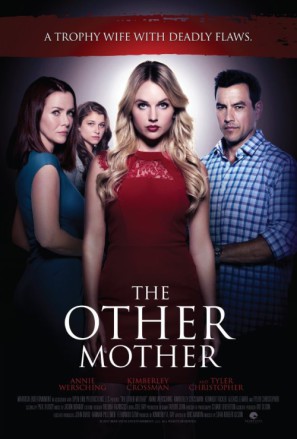
Lisa Cleans Out Her DVR: The Other Mother (dir by Sean Olson)


(Once again, I am attempting to clean out my DVR!  I recorded The Other Mother off of Lifetime on April 22nd, 2017.)

Divorce is never easy.  This is something that we all know.  A once loving couple splits up and suddenly, they are forced to figure out what type of relationship, if any, they will now have.  It’s even more difficult for the children, who often find themselves torn between two households, all the while wondering if they’re somehow responsible.  Believe me, speaking as a child of divorce, it’s never easy even if it’s often for the best.

That said, you know what I bet would make a divorce even more difficult?  When your ex-husband impulsively marries a woman who is young enough to be his daughter and then sits by while his new wife not only turns your daughter against you but also frames you so that everyone thinks you’re a totally irresponsible, abusive alcoholic.

That, of course, is exactly what happens in The Other Mother.  The title character is Tiffany (Kimberly Crossman), who is pretty, confident, fun, and a little bit psycho.  When she marries Mitch (Tyler Christopher), she immediately sets about to manipulate his teenager daughter, Brooke (Kennedy Tucker), into rejecting her biological mother, and Mitch’s ex-wife, Jackie (Annie Wersching).

It’s really not that hard because 1) Tiffany is close to Brooke’s own age and 2) Jackie is massively overprotective and strict.  Of course, Brooke has struggled to deal with the divorce.  Jackie worries that Brooke might act out or that she might even hurt herself.  Last year, Jackie caught Brooke drinking and she still hasn’t let it go.

Tiffany, at least at first, appears to take a much more laissez faire approach to life.  At dinner, she asks Brooke if she wants anything to drink.  At Brooke’s birthday party, Tiffany gives her a car and Jackie throws a fit.  When Tiffany picks up Brooke from school, they go to the mall and Tiffany shows Brooke how to pick up boys.  Brooke would much rather hang out with her stepmom and who can blame her?  Tiffany’s fun and lets her do almost anything.

Of course, Tiffany also has a long and sordid history, one that is only Google search away.  And Tiffany is willing to do anything to get Jackie out of the picture.  If that means getting Jackie drunk and then pretending that Jackie attacked her, so be it.  If that means telling lies and hacking phones in order to make it appear as if Jackie has rejected her daughter, well, that’s what you have to do.

The Other Mother is a good example of a Lifetime film designed to tap into a fear that’s probably a pretty common one among middle-aged divorcees, the fear of no longer being the fun parent but instead being viewed as the enemy.  This film provides comfort by suggesting that the new fun mom is actually not that much fun and that she’s probably crazy as well.  Beyond bitter divorcees, anyone who has ever been made to feel inadequate by an ex’s new girlfriend will be able to relate to this film.

If you’re into Lifetime films, you’ll probably enjoy The Other Mother.  If nothing else, Kimberly Crossman does a really good job playing the cheerfully psychotic Tiffany.  The movie may not hold many surprises but I definitely had fun watching it.


Lisa Cleans Out Her DVR: Girl Followed (dir by Tom Shell)


(Once again, I am trying to clean out my DVR.  I recorded Girl Followed off of the Lifetime Movie Network on April 2nd, 2017.)

Poor Regan (Emma Fuhrmann)!  She’s 14 years old and all she wants is to be as popular as her older sister, Taylor (Gianna LaPera), and her best friend, Sabine (Olivia Nikkanen), and for Austin (Jake Elliott) to like her.  Taylor and Sabine managed to get boyfriends by sending them sexy pics so why can’t she do the same thing?  Everyone else skips school, so why can’t she?  Everyone else shoplifts so why is it such a big deal when she does it?  As Regan points out, her parents (Heather McComb and Joey Lawrence) expect her to be so perfect that they always overreact to the least little mistake.

Of course, they would really freak out if they found out about Regan’s now boyfriend.  Nate (Travis Caldwell) is handsome, charming, and he drives a really nice car.  Even better, at least from my perspective, his parents own a really big house.  (If you’ve been reading my reviews for a while, you are undoubtedly aware of how much I love the big houses that always show up in Lifetime movies.)  Of course, there are some problems.  For one thing, Nate is 22 years old.  Nate has a tendency to be a little bit controlling.  Nate works with Regan’s mother, at a clinic.  (Hey, at least he’s in the medical field!  Who doesn’t want to marry a doctor?)

Oh — and Nate’s also batshit insane.  How insane is Nate?  He’s insane enough to hack into Regan’s phone and send risqué pictures of her to everyone who works with her dad.  He’s also insane enough to replace a patient’s chart, all in an attempt to make Regan’s mother look dangerously incompetent.  And, of course, there’s the whole kidnapping thing.  Nate has a sordid and dangerous history that Regan knows nothing about.

Girl Followed may sound like a typical Lifetime stalking film and, in many ways, it is.  However, Girl Followed also has a surprisingly insightful and intelligent script.  If anything, Nate and his issues are red herrings in the overall scheme of the film.  Girl Followed is more concerned with Regan and her struggle to estabblish her identity in an increasingly complex world.  Anyone who has ever been insecure or felt lost will be able to relate to what Regan’s going through and Emma Fuhrmann gives an excellent and empathetic performance in the role.  She is especially strong in the scenes where she tentatively opens up to her therapist, admitting that — on a scale of one to ten — she considers herself to be a “two.”

Of course, I related to the character because, when I was her age, I used to act out in the exact same way.  This movie features one of the most realistic shoplifting scenes that I’ve ever seen.  When her mom steps up and declares that her daughter is not a shoplifter and shames anyone who would suggest otherwise, I cringed a little and not just because I knew that Regan actually was a shoplifter.  It was a moment to which I could relate. Suddenly, I was fourteen years old again.

Girl Followed is definitely a better than average Lifetime film so keep an eye out for it.

Film Review: The Circle (dir by James Ponsoldt)


Earlier today, I got off work early and I finally saw The Circle!

The Circle is a film that I’ve been curious about for a while.  It’s based on a novel by Dave Eggers, a book that I absolutely loved when I first read it.  It stars Emma Watson, Tom Hanks, Patton Oswalt, and John Boyega.  It’s directed by James Ponsoldt, who may not be a household name but who has previously directed such beloved films as The Spectacular Now and The End of The Tour.  It sounded like a film to which everyone should have been looking forward but instead, even with Watson appearing in the blockbuster Beauty and the Beast at the same time, The Circle opened with very little fanfare.

Then the reviews came out and, with a few notable exceptions, they were all negative.  I did a little research and I discovered that, though filming was initially completed in 2015, The Circle spent a year and a half sitting on the shelf.  In January of this year, 16 months after shooting wrapped, a few scenes were refilmed.  That’s never a good sign.  One gets the feeling that, if not for John Boyega’s role in Star Wars: The Force Awakens and the excitement over Emma Watson starring in Beauty and the Beast, The Circle probably would have ended up going straight to VOD.

But here’s the thing.  I loved the book.  The book managed to put a new spin on the otherwise tired topic of how social media has changed our way of looking at the world.  The book was an Orwellian masterpiece, an homage to 1984 by a writer who, as opposed to most people who are currently claiming to appreciate the novel’s dark vision, understood what George Orwell was actually saying.

In fact, the more I thought about it, the easier it was for me to assume that most critics probably missed the point of the movie.  It was entirely possible, I decided, that the negative reaction to The Circle had to do with audiences not knowing how to deal with a movie that truly challenged their assumptions.  Naively, I assumed that the story and the themes of the novel had been brought to the screen and the critics couldn’t handle it.

Well, as I said earlier, I finally saw The Circle for myself and it turns out that I was wrong.  The Circle is an absolute mess.  Despite being co-written by Dave Eggers, this film actually has very little in common with the novel that it’s based on.  The novel was a sharply satiric portrait of a world that has become brainwashed by technology and social media.  The movie is a nagging anti-internet screed that would have felt out-of-touch in 2002.  The book ends with a powerful “and he loved Big Brother” moment.  The movie ends on a note that feels so completely false that you just know it was studio mandated.

Emma Watson plays Mae Hubbard, a recent college grad whose degree in Art History is pretty much going to waste.  (Speaking as the proud recipient of an Art History degree, I can verify that the film gets this detail absolutely right.)  Through a college friend named Annie (Karen Gillian, for once not having to disguise her Scottish accent), Mae gets a job working for The Circle, an all-powerful internet company that is pretty obviously based on Google Plus.  Through a series of silly events, Mae becomes the public face of The Circle.  The Circle wants to use technology (cameras everywhere, social media addiction, everyone carries tablet, you must have a credit card to join The Circle, oh my!) to do away with the concept of privacy.  When everyone is a member of the Circle, no one will be a stranger.  No one will have any privacy.  Anyone can be found.  Anyone can be watched.  And, of course, it’ll be easier to tell everyone what to think and who to support…

…and all of this would be shocking if The Circle had been made in a time before Twitter and Facebook.

Anyway!  The Circle was founded by three men.  Two of them (Tom Hanks, Patton Oswalt) are totally sinister.  Oswalt glowers in the background.  Hanks appears to channeling Christoph Waltz.  Meanwhile, the third man (John Boyega) has become disillusioned with The Circle.  He shows up occasionally, standing in the background and watching as Mae does stuff.

Throughout the film, Tom Hanks gives lectures to his employees.  They all applaud as he introduced the latest technology from The Circle.  These scenes are fun because it looks like Tom Hanks is appearing in a commercial for The Criterion Collection.

Anyway, Mae loves the brave new world but a few people don’t.  Her parents (Bill Paxton and Glenne Headly) are skeptical.  Though his role is small, Bill Paxton gave a good performance in this, his latest released film.  I got a bit emotional watching him, especially as he was playing a character struggling with his own poor health.  Ellar Coltrane, of Boyhood fame, plays the other voice of skepticism, Mae’s childhood friend who wants to live off the grid.  Coltrane is supposed to be the voice of reason but he gives such a strange and awkward performance that the main thing that comes across is that Luddites are weird.

Actually, with the exception of Bill Paxton and Karen Gillan, it’s hard to think of anyone who actually gives a good performance in The Circle.  (This is especially shocking when you consider that, in the past, Ponsoldt has proven himself to be an excellent director when it comes to getting noteworthy work from his cast.)  Everyone comes across like they were wishing that they were somewhere else.  Emma Watson, in particular, is bad.  That said, in her defense, Watson is also totally miscast.  Mae is meant to be someone searching for an identity in an overly complicated world but Watson plays her as just being dourly earnest.  As played by Watson, Mae’s just the boring person that you dread having to take a class with.  Neither Watson nor the film, as a whole, seems to be sure who exactly Mae is.  (In the novel, the character works because Mae isn’t meant to be likable.  The film, however, tries to have it both ways, making her both a true believer in the Circle and a sympathetic character.  It doesn’t work.)

For that matter, the film also appears to be confused as to just why exactly Hanks and Oswalt are villains.  We know that we’re supposed to distrust them because Hanks is way too quick to smile and Oswalt is always standing in the background and looking like he’s just deliberately killed all of his Sims.  But how evil are they actually supposed to be?  What are the stakes?  The film doesn’t appear to be sure.

Now, I’m not totally trashing The Circle.  There were a few moments that I did like.  I enjoyed the scenes that were meant to illustrate the cult-like atmosphere at the Circle.  There’s a hilarious scene where two enthusiastic Circle employees interrogate Mae as to why she never told them that she enjoys kayaking.  (“I enjoy kayaking!  We could have kayaked together!”)  And there’s another scene where Hanks and Oswalt talk about how, if countries allow The Circle to run their elections, they could then require everyone to join The Circle and then make voting mandatory.  Mandatory Voting is a really terrible idea, the type that is always embraced by people who should know better.  I appreciated seeing the idea exposed for being the ticket to totalitarianism that it truly is.

But, for the most part, The Circle was just a mess.  Like a lot of cautionary tales (especially ones dealing with the internet), The Circle will probably eventually become a bit of a camp classic.  But for now, everyone involved with the film has done better work in the past and, hopefully, will continue to do so in the future.

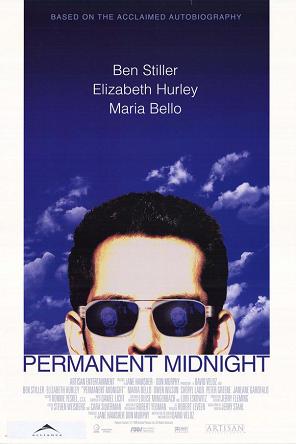
Film Review: Permanent Midnight (dir by David Veloz)


Meh.  Who cares?

That was largely my reaction to watching the 1998 film, Permanent Midnight.  In this film, Ben Stiller plays Jerry Stahl, a real-life screenwriter who had a fairly successful career going in the 80s and early 90s.  He came out to Los Angeles looking to be a serious writer but, instead, he ended up writing for silly puppet show and getting addicted to heroin.  He also married a British television executive named Sandra (Elizabeth Hurley), so that Sandra could get her green card.  When the star of a show that he writes for tells him to kick his habit or lose his job, Jerry ends up smoking crack cocaine with a new dealer (Peter Greene).  When Sandra tells him that she’s pregnant, Jerry responds by shooting up in the bedroom.  When he’s trusted to spend the day taking care of his baby daughter, he drives her around the seediest sections of Los Angeles while he searches for his drug dealer.  As the baby cries beside him, Jerry shoots heroin into his jugular.  Jerry ends up unemployable and abandoned by every friend that he had.  He works at a fast food restaurant, or at least he does until he meets another recovering addict (Maria Bello).  She’s the one to whom he tells his story, in between sex and bouts of impotence.  In the end, what’s left for Jerry Stahl to do but write a book and then a movie about his life as a junkie?

It’s a harrowing story and I guess Stahl deserves some credit for writing the screenplay for a movie that doesn’t exactly make him look good.  However, Permanent Midnight runs into the same problem that afflicts most movies about drug addiction.  With very few exceptions, drug addicts are just not that interesting.  The only thing more boring than watching someone shoot up is then having to listen to that person explain why he shoots up.  (Trainspotting is the obvious exception but Trainspotting benefits from Danny Boyle’s frenetic direction, Ewan McGregor’s explosively charismatic lead performance, a witty script, and a killer soundtrack.  These are things that Permanent Midnight lacks.)  The film attempts to build up some sympathy for Stahl by telling us about his difficult childhood, his father’s suicide, and his mother’s instability but, in the end, Jerry is a junkie who shoots up in front of his baby.  Regardless of how crappy his childhood was, it’s hard to care about whether or not he ever gets his shit together.  Mostly, you just want someone to step in and make sure he never gets near that baby again.

Permanent Midnight makes another mistake, one that is all too common when it comes to films about troubled artists.  It continually tells us that Jerry is a talented and important writer without ever showing us any evidence of that fact.  We’re supposed to feel bad that Jerry is stuck working on a sitcom called Mr. Chompers but, at no point, does the film really convince us that he deserves anything better.  Everyone says that Jerry is talented but we don’t really get to see any evidence of that fact.  It’s hard not to feel that maybe Jerry should just be happy that, unlike the majority of writers in Los Angeles, he actually has a steady job.

(Jerry does get one good line, when he appears on The Maury Povich Show to promote his book and says, “People always ask, ‘What’s the worst thing heroin drove you to do?’  I always answer, ‘showing up on Maury.'”)

Of course, for most people, the main appeal of seeing Permanent Midnight will be the chance to see Ben Stiller shooting up heroin while soaked in withdrawal sweat.  Stiller gives a serious performance, good enough that you regret that his acting career now seems to mostly consist of starring in bad movies and making cameos in even worse ones.  There’s actually a lot of familiar faces in Permanent Midnight: Elizabeth Hurley, Maria Bello, Fred Willard, Owen Wilson, Sandra Oh, Janeane Garofalo, Andy Dick, and others.  They all give good enough performance but ultimately, this is aimless and ultimately rather frustrating movie.