
Lifetime Film Review: I Am Mary Jo Buttafuoco (dir by Heather Hawthorne-Doyle)


I Am Mary Jo Buttafuoco is an example of one of the latest trends in Lifetime filmmaking.  The real Mary Jo Buttafuoco tells us her story in between scenes of it being reenacted by actors.

That’s not necessarily a bad idea.  Lifetime did something similar with Elizabeth Smart and it led to one of the most powerful films to ever appear on the network.  However, the Elizabeth Smart film benefitted from the fact that Smart is an articulate, intelligent, and insightful speaker in her own right.  She is someone who went through the worst and managed to come out of it not only stronger but also with the passion and articulateness of an genuine activist.

Mary Jo is not quite as compelling.  It brings me no joy to say that because Mary Jo really was put through Hell and, far too often, she has been treated as an afterthought in her own story.  For those who may have forgotten or who haven’t had seen any of the previous films made about what happened to her, Mary Jo Buttafuoco was the wife of Long Island mechanic Joey Buttafuoco.  She stood by Joey while he struggled with drug addiction and she supported him when he opened his own garage.  Joey rewarded her loyalty by having an affair with a teenager named Amy Fisher.  Fisher, who apparently believed that Mary Jo was the only thing standing in the way of her being with Joey forever, went to the Buttafuoco home and shot Mary Jo in the face.

The story was a media circus, with Amy Fisher being dubbed “the Long Island Lolita” and three made-for-TV movies being made, all in the same year, about the shooting.  Joey initially denied that he had ever touched Amy and Mary Jo, who miraculously survived, originally stood by Joey.  Unfortunately, in all the attention that was given to Amy and Joey (and really, the word “goombah” might as well appear with a picture of Joey in the dictionary), the fact that Mary Jo nearly died was often overlooked.  Amy Fisher and Joey Buttafuoco became odd celebrities as a result of the crime.  Mary Jo was ridiculed for both not realizing that Joey was cheating on her and continuing to stand by her man for years after she was shot by his mistress.

There’s a great movie to be made about Mary Jo Buttafuoco.  (Considering that one of three previous films was told from Joey’s point of view, it only seems appropriate that there should have been a movie from Mary Jo’s.)  Unfortunately, having Mary Jo tell her own story doesn’t work as well as one might hope.  When you really want Mary Jo to go off on Joey, she instead goes off on being raised Catholic.  If only she hadn’t been raised in a Catholic family, she seems to be saying, she never would have married and stuck with Joey Buttafuoco.  Instead of really examining her marriage to Joey Buttafuoco, she instead blames her mother and her religion.  It feels like too convenient an excuse.

The film is a bit more compelling in the flashbacks, with Chloe Lanier giving a strong performance as Mary Jo and Madelyn Grace playing Amy Fisher as not being a Lolita but instead as being a neurotic and rather stupid brat.  In the end, what matters is that Mary Jo did eventually free herself from Joey and we should all be happy for that.
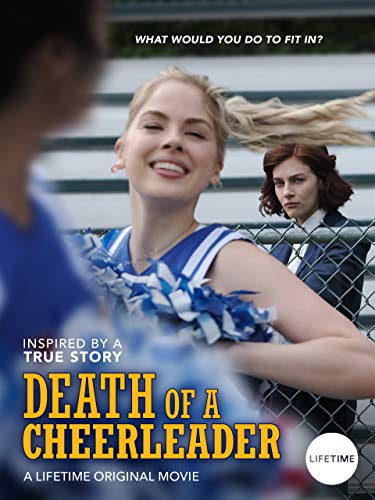
Lifetime Film Review: Death of a Cheerleader (dir by Paul Shapiro)


Kelly Locke (Sarah Dugdale) appears to have it all.  Even though everyone agrees that she can occasionally be a little bit mean with some of the things that she says, Kelly is still one of the most popular students at Hollybrook High.  She’s a cheerleader.  She’s the leader of the Bobbettes, the school’s most prestigious social group.  She gets good grades, she lives in a big house, and her family has a lot of money.

Bridget Moretti (Aubrey Peeples), on the other hand, wants to have everything.  She’s shy and desperate to fit in.  She wants to be a member of the Bobbettes.  She wants to be a cheerleader.  Even more importantly, she wants Kelly to be her best friend.  Kelly, however, thinks that Bridget’s a little bit strange.  In fact, when Bridget lies to Kelly about there being a party as an excuse to get Kelly to spend time with her, Kelly accuses Bridget of “wanting to be me.”  Kelly then says that she’s going to tell everyone at school about what a weirdo Bridget is so Bridget stabs her to death.

Now, you would think that Bridget would be the number one suspect.  After all, Bridget’s not that smart and it’s not easy to get away with murdering someone, especially when it’s an impulsive act.  However, no one suspects Bridget.  Bridget’s just too shy and nice for anyone to believe that she could possibly be a murderer.  Instead, everyone assumes that another student, Nina Miller (Morgan Taylor Campbell), is the killer.  After all, Nina used to be popular until she dyed her hair and started hanging out with the stoners.  Nina even threatened to kill Kelly once.  Nina says she was just mad and that she wasn’t being serious but that doesn’t stop strangers from calling her house and demanding that she confess….

Now, if this story sounds familiar, that’s because it’s a true story and it’s one that has been recreated on countless true crime shows, including Deadly Women, 1980s: The Deadliest Decade, and Killer Kids.  It was also turned into a made-for-TV movie in 1994, A Friend to Die For, starring Kellie Martin as the murderer and Tori Spelling as her victim.

Death of a Cheerleader is a remake of A Friend to Die For, telling the same basic story but attempting to give it a more modern spin, which in this case amounts to a lot of hand-held camerawork and a far less judgmental attitude towards casual drug use.  The remake also slightly differs in the way that it views its main characters.  If the first film was sympathetic to Bridget, the remake is a bit more ambiguous.  Bridget is portrayed as being slightly off from the beginning and far more openly bitter over Kelly’s success than in the original film.  At the same time, Kelly is portrayed a bit more sympathetically in the remake than in the original.  Tori Spelling played the role as being a straight-up bitch, whereas Sarah Dugdale instead plays her as someone who puts a lot of pressure on herself and who often doesn’t understand how cruel her comments can sometimes be.  The biggest difference between the two films is that the remake focuses for more on the wrongly accused Nina, even allowing her to narrate the story.  If anything, the film’s main message seems to be about how messed up it is that brave nonconformists like Nina are always going to be unfairly blamed for the mistakes of mousy conformists like Bridget.  That’s a good message and one that I certainly appreciated.

The remake of Death of a Cheerleader works well enough.  The hand-held camera work gets to be a bit much but Sara Dugdale, Morgan Taylor Campbell, and Aubrey Peeples all give great performances and the film actually does a better job than the original of capturing the strange culture of high school popularity.  While it may not feature any scenes as iconic as Tori Spelling melodramatically lighting up a joint, Death of a Cheerleader is still an effective Lifetime film.

What Lisa Watched Last Night #165: Secrets of my Stepdaughter (dir by Jem Garrard)


Last night, I watched Secrets of my Stepdaughter on Lifetime!

Why Was I Watching It?

Why Not?  It was on Lifetime and Secrets of my Stepdaughter is a great title.  As our regular readers know, Jeff, Leonard, and I spent all last month watching and reviewing the first two seasons on Twin Peaks.  As soon as I saw the title of this Lifetime film, I immediately thought of that great line from the third episode of series: “She is full of secrets.”

What Was It About?

When teenager Rachel Kent (Tiera Skovbye) survives a robbery that leaves her best friend dead, she becomes a minor media celebrity.  Everyone loves Rachel but the detective (Lucia Walters) in charge of the case has suspicions.  And soon, so does Rachel’s stepmother, Cindy (Josie Davis).  Rachel is just enjoying being a celebrity too much and when Cindy catches Rachel rehearsing the story of the robbery in front of a mirror, Cindy starts to suspect that Rachel may indeed be full of secrets.

What Worked?

The film told an intriguing story.  It opened with a title card telling us that it was “based on a true story” and I’d believe it.  This is actually something that happens fairly regularly.  A victim of a crime will become a minor celebrity, just to then have it revealed that they actually committed the crime themselves.  People love the attention.  What’s interesting is that you never hear much about these people once it’s revealed that they were not victims but instead guilty.  They kind of get pushed to the side and the story gets abandoned because no one wants to admit to having been fooled.

Josie Davis gave a good performance as Cindy.  She’s appeared in several Lifetime films and it was interesting to see her finally play a sympathetic character for once.  The entire film, however, was stolen by Tiera Skovbye, who was a force of cheerfully destructive nature in the role of Rachel.

What Did Not Work?

This was yet another Lifetime film where the family pet is killed off, presumably so we don’t have any doubt that we’re dealing with a total sociopath.  Killing the dog felt so cruelly unnecessary and totally gratuitous that it made it difficult for me to enjoy the rest of the movie.  It seemed to be done for shock value but, at this point, so many pets have been killed in so many Lifetime movies that it’s no longer shocking.

Seriously, leave the pets alone!

“Oh my God!  Just like me!” Moments

“Wow, Lisa, since this movie was about a sociopathic, shoplifting teenage murderer, there were probably a lot of Oh my God!  Just like me! moments!”

Okay, you are no longer my friend.

Actually, to be honest, I did relate to Rachel at the very beginning of the movie.  When she was rehearsing in front of the mirror, I gave her the benefit of the doubt because I do that too.  But then it became obvious that she actually had killed her best friend and the family dog and I was like, “Nope, I have nothing in common with this psycho!”

Lessons Learned

It’s a lot more difficult to fake a crime than you might think.