After the success Kathryn Bigelow had with her award-winning film The Hurt Locker it was just part of the norm that people began to wonder what she would do to follow-up the film which gave her the Oscar for Best Director. There was talk of her making an action thriller about the Tri-Border Region in South America that many intelligence agencies consider a major haven for global organized crime and terrorist groups of all kinds. This particular idea bounced around for months then nothing came of it. Then news came about around late-Spring to early Summer 2011 that Bigelow and The Hurt Lockerwriter and collaborator Mark Boal came upon the idea that would be Bigelow’s follow-up.
The film that the two decided upon would be an action thriller detailing the global manhunt for Osama Bin Laden. Maybe it was just a coincidence, but this decision became even more important once news broke out on May 2, 2011 that the hunt for America’s Most Wanted criminal was finally over and that Operation Neptune Spear was a success with the death of Bin Laden.
Zero Dark Thirtyis the title of Bigelow’s film about the details and backstory which led up to this special operations mission on May 2, 2011. The first trailer for the film has been released by Sony and it’s short on details other than some voice overs over satellite imagery. I’m sure there’ll be more trailers that will open up what this film will truly be about leading up to it’s December release date (just in time for awards season).
It’s going to be interesting how Bigelow will do with this follow-up to The Hurt Locker. If her history is anything to go by then it shouldn’t disappoint even if some of her detractors will be chomping at the bit to see it fail and further see her Best Director Oscar win as a fluke done to keep the award from her ex-husband James Cameron.
Zero Dark Thirtyis scheduled for a December 19, 2012 release date…just two days from the end of the world.
It was in the summer of 2002 that the superhero film genre finally entered it’s Golden Age (or Silver Age for some). X-Menhad come out two years before to positive acclaim and, most importantly, in the box-office. It wasn’t until Sam Raimi released the first in what would be his trilogy in the Spider-Manfilm franchise that superhero comic book films became the power in Hollywood it remains to this day. The first film from Raimi easily captured the pulp and campy sensibilities of the source material and for an origin story film it was done quite well in that it introduced the titular character and what made him tick. In 2004, Raimi and company released what many consider the best comic book film with Spider-Man 2. The film brought a level of Greek tragedy to the fun of the first film and it definitely brought one of the best realized comic book villains on film with Alfred Molina as Dr. Octopus. Then the franchise hit a major bump in 2007 with Raimi third entry in the franchise with the bloated Spider-Man 3.
Sony Pictures, who owned the film rights to the Spider-Manfranchise, were so quick to churn out a fourth film, but in doing so lost the filmmaker and cast that made the trilogy happen. In the studios’ thinking they needed to get a fourth film up and running in order to keep the rights to the film from reverting back to Marvel and Disney. So, out goes Sam Raimi, Tobey Maguire and Kirsten Dunst and in comes Marc Webb, Andrew Garfield and Emma Stone. Instead of getting Spider-Man 4we get The Amazing Spider-Manwhich doesn’t continue what Raimi had established with the first three films, but reboots the franchise all the way to the beginning.
Marc Webb takes the screenplay worked on by a trio of screenwriters (James Vanderbilt, Alvin Sargent, Steve Kloves) and reboots the origin story of Peter Parker’s transformation into Spider-Man. We find Peter Parker back in high school as a student and still getting bullied by Flash Thompson while remaining awkward around girls (especially one Gwen Stacy played by Emma Stone). yet, before we even get to this part of the film we get an introductory coda where we find a preadolescent Peter Parker playing hide and seek with his scientist father. These early scenes show hints that the enhanced spider thatwill bite and give eter his abilities may have had his father’s research and work written all over it.
This intro influences much of the storyline and leaves a huge impact on the character of Peter Parker which the previous three films never explored. The rest of the film has Peter investigating the circumstances of his parent’s disappearance and his adjustment to having been given the superhuman abilities by the spider that his father may or may not have been responsible in breeding.
First off, the film does a good job in re-establishing Peter Parker as a high school student. The original film spent some time in this part of Peter Parker’s life but never truly explored it. We see Peter not just the class genius, but also one who also shows an affinity for photography (something that the original trilogy never really explained other than he needed the job and money). There’s also some added layers to the character as this version of Peter Parker is more than willing to stand up to the bullies picking on the weaker students other than himself. It’s a huge departure from the meek and geeky Peter Parker of the past. We still get a geeky and smart Peter, but one who is also a sort of a well-intentioned slacker. We also get a proper introduction for Gwen Stacy (something the third film criminally mishandled)
The film introduces once again many of the characters the first film in the series had already done. From Uncle Ben (played by Martin Sheen this time around) and Aunt May (Sally Field) right up to the robber who runs into Uncle Ben and changes Peter Parker’s outlook on his role as a hero forever. Again these were character that had already been explored by the first three films and they’re scenes that had an air of familiarity to them though Sheen performance as Uncle Ben added more layers to the character who becomes Peter Parker’s moral center.
Another thing that the film did a good job with was the design of the film. It has been ten years since the first film and the technology in CGI-effects has leapfrogged exponentially since. The look of the OsCorp Tower was a beautiful piece of architectural design. The building loomed over New York City like something dark with a hint of malice. There were changes to the suit Peter wears that really harkens back to the McFarlane years of the Spider-Man comics. Even the return of the web-shooters was a nice surprise that I had some reservations when first hearing about it.
A third good thing about the film was the extended montage when Peter Parker realizes he has gained new abilities and begins to test them out. It’s familiar territory from the first film, but Marc Webb and Andrew Garfield adds a new level of youthful exuberance to the proceedings. Even the use of parkour by Peter Parker to show his growing abilities didn’t come off as silly. Garfield’s performance as Peter Parker in this montage was pretty great. One could believe at how much fun he was having at discovering each new level of abilities. Even some of the growing pains he goes through after getting bit were some of the more hilarious moments in the film that ultimately lacked much of it in the end.
Which brings us to what made this entertaining film end up becoming a failure in the end.
I admit that the film entertained me in the end, but there were things aboutThe Amazing Spider-Manwhich nagged at me throughout and afterwards. While the film was entertaining the story self and most of the characters were inconsistently written. Once one looked past the action and some of the witty dialogue in the beginning the film’s many plot-holes and head-scratching moments become too glaring to ignore.
The character of Peter Parker does get some new layers of characterization in the beginning, but as the film played out the more the Peter Parker of this film began to stray away from not just what Raimi had created and guided through the first three films but also most of the character’s decade’s long growth in the comics. Yes, we see Peter Parker as the science-genius and even moreso than the one portrayed by Tobey Maguire, but we also don’t get the awkward teen who grows into his abilities, but most importantly, one who learns through tragedy that he has a responsibility to the people around him to protect them even if it means sacrificing his wants and dreams to do so. We don’t just see Peter Parker saving people, but also one who seemed to relish beating up and abusing those who used to do the same to him and/or others. Spider-Man in this film acts more like a bully than a reluctant hero by film’s end. Even the events that should’ve taught him the lessons of self-sacrifice and heeding the needs of the many fail to make much of an impact on the teen superhero. All one has to look at as the perfect example of this darker and more selfish turn to the character was Peter’s whisper to Gwen about promises not being kept being the best ones.
Other characters get inconsistencies in how they’re written. The other big one being Dr. Curt Connors who begins the film as a scientist so intent of not just curing his disability but also helping the world. It’s a character similar in tone to Alfred Molina as Dr. Octopus, yet where that villain remained a tragic one throughout the film and we could see the path which led him to become a villain with Dr. Connors in this fourth film there’s such a huge turnabout in the character’s motivations that whatever sympathy we may have had for Connors was squandered.
Not every character fails to impress. Martin Sheen and Denis Leary as Uncle Ben and Capt. Stacy respectively were fully realized characters who become Peter Parker’s moral centers and voice of reason. In fact, both Sheen and Leary helped anchor the scenes they appeared in and thus made their characters’ fate have the sort of emotional impact that a growing hero needs to move from being reluctant to accepting of his lot in life. It’s a shame that the writers failed to capitalize on the performances of these two character actors to help make Peter Parker more a hero and less a teenager more in love with what he can do instead of realizing that he has more to offer those who are weakest.
This is not to say that the performances by the cast was bad. From Garfield and Stone right up to Ifans, Sheen, Leary and Field, the cast did a great job with an uneven and inconsistent script that was too full of themes and ideas but no focus on any one of them. It’s a wasted opportunity to build on what the previous cast of the three films had created. Even the third film which many would agree as being a huge, bloated mess actually had a singular focus. It was a story that tried to explore Peter Parker’s darker side andhow his life as a superhero negatively impacts everyone around him he cares for. With this Marc Webb production we get a Peter Parker who at times was compassionate when it came to others being bullied and then we get one who relished on doing the same to those he now sees deserving of payback. Even Parker’s hunt for his uncle’s killer which the film spent a considerable time following just got dropped without any sort of resolution. One of the most significant events in Peter’s life gets dumped to the wayside to concentrate on finally pitting Spider-Man against the film’s Lizard.
Did The Amazing Spider-Manneed to have gotten made? The answer to that would be a yes.
Did Marc Webb, the three writers in Vanderbilt, Sargent and Kloves and the new cast get the reboot correctly? I would say no.
This was a film that spent too much time reintroducing characters both comic book and film fans already knew intimately. The storyline itself shared many similarities to the second film in the series yet none of the cohesiveness which made that first sequel such an instant classic the moment it premiered in 2004. The Amazing Spider-Manspent so much time trying to come off as a grittier and edgier version of the character (I call this the Christopher Nolan-effect) that what should’ve been coming off as a fun-loving, albeit self-sacrificing hero, came off as a dick once he finally got the full costume on. The people in charge of this reboot sacrificed what was fun about the film franchise for realism that the character and his universe were never steeped in to begin with.
Gritty, edgy and realism may work for Nolan’s take on the Batman film franchise, but for Spidey it fails and just turns what could’ve been a fresh new take on the franchise into another entertaining, but ultimately forgettable entry in the series. Maybe it’s time Sony just realize that it’s just pushing this franchise downhill and let the rights revert back to Marvel who seem to have found a balance between pulpy camp and serious realism.
If there’s a film arriving this year that’s bound to be hyped up by both fanboys and critics alike it would be the latest from Quentin Tarantino. Django Unchained will be his ode to the spaghetti westerns of the 60’s and 70’s. The title of the film alone owes much to Sergio Corbucci’s own spaghetti western, Django.
The trailer first premiered simultaneously over at Fandango and Movies.com and the amount of times the trailer has been reposted over the blogosphere just shows how much people have been waiting for anything about Tarantino’s western when it was first announced. I know that pretty much most everyone here at Through the Shattered Lens have been anticipating this film especially co-founder Lisa Marie Bowman.
I’d describe the trailer itself, but it’s better just to watch it. I’m sure Lisa Marie squealed a bit when two Django’s met near the end.
We finally get the return of Britain’s deadliest and world-renowend “Double-O” agent with Sam Mendes’ Skyfall.
It’s been quite a long time since Marc Foster’s underwhelming Quantum of Solace with MGM’s subsequent bankruptcy being one of the major causes for the delay of this film being made. With the MGM bit now out of the way James Bond finally returns to the big screen with Daniel Craig once again donning the Walther and the tuxedo to play the debonair and ruthless killer agent that Ian Fleming made famous through his spy novels.
This teaser doesn’t show much other than some bits of action (one of which looks like it might’ve been lifted out of a level of Modern Warfare 3) and Bond being coldly ominous about people coming to get him and “M”. I’ve always been a huge fan of the Bond films and even when they don’t go over so well I still enjoy myself. They also tend to have a different director with each and every film which gives each film a different take on the character of Bond. This time around we have Sam Mendes in the director’s chair and it’ll be interesting to see how well he handles the thriller genre and action.
Skyfallis set for an October 26, 2012 release date.
Tonight saw the release throughout all NBC channels (both network and cable) of a 4-minute preview of Columbia Pictures’ entry in this summer’s blockbuster season: The Amazing Spider-Man.
The preview begins with new footage that shows Andrew Garfield saving a young boy from a dangling SUV held only by him as Spider-Man and his super-strong web. Once this sequence ends the rest of the preview is mostly a rehash of scenes from the last two trailers the studio has released.
With Marvel Studio and Walt Disney Pictures hitting the jackpot with the recently released superhero team film The Avengersthe other big films this summer, especially the superhero ones, have their work cut out for them. It’s going to be a tough going for this web-slinging reboot to capture the magic the original Raimi film was able to bottle when in came out in 2002, but from the looks of this preview and the trailers before it there’s a chance it could do so again.
The Amazing Spider-Manis set for a July 3, 2012 release date.
I will say it now that when I first heard that Sony was going to reboot the Spider-Manfilm franchise I wasn’t enthused by their decision not to mention saying bye to Sam Raimi as the franchise director. I saw this decision as Sony’s attempt to hold onto the licensing rights to the character. Without a new film coming out soon the rights were going to revert back to it’s parent company in Marvel Comics (something comic book fans probably hope would’ve happened). So, a new film was rushed, with a new director in Marc Webb and a new Peter Parker in Andrew Garfield.
This reboot will retell Spider-Man’s origin story once again and much more grittier than the more fun, pulpy Raimi trilogy. I think the fact that it was going to be another origin story is what made me hesitant to embrace this reboot. I’m still not fully committed to this film, but with each new trailer released my interest continues to rise. With this latest trailer we can see that the effects look to be much improved from the first three films which is understandable with advancement in CGI. We can also see in this new trailer the “grittier” aspect Sony was promising. I will say that I’m still not sold on Andrew Garfield as Peter Parker/Spider-Man, but maybe seeing the finished product will prove me wrong.
The Amazing Spider-Manis set for a July 3, 2012 release date.
Paul Verhoeven’s 1990 scifi classic, Total Recall, remains one of Arnold Schwarzenneger’s better films. The film was an adaptation of the Philip K. Dick novellete, We Can Remember It for You Wholesale, and in 2012 it will once again go up on the big-screen as a Len Wiseman remake.
Wiseman’s film looks to take the basic premise of Dick’s novellete and some of the changes made for the Verhoeven production. What looks to have been changed in this upcoming remake is the absence of Mars as the backdrop for the character Douglas Quaid who believes he is actually a secret agent working to free Mars from the tyrannical rule of one Cohagen. This time around the setting is instead a dystopian future Earth where the planet has been split into two super-factions the rule planet. There’s Euroamerica which combines the North American and European Union into one sovereign entity and it’s rival in New Shanghai which puts together the economic powerhouses of China and the nations of South East Asia.
It is in this new backdrop that Colin Farrell’s Quaid must run from the forces of Cohaagen (played by Bryan Cranston) and help the freedom fighters trying to change things for the better. The trailer itself shows less of the cheesy look of the Verhoeven film and instead goes for a much slicker art design that some people have called the Mass Effect-look. I must admit that the fully-armored forces chasing after Quaid look like Blue Suns mercenaries from that BioWare scifi rpg.
I will say that the trailer does a great job in referencing similar scenes and sequences from the original Verhoeven film while adding in new touches to give the film it’s very own unique look. For one of this summer season’s last films before fall season begins this one looks like a must-see.
Total Recallis set for an August 3, 2012 release date.
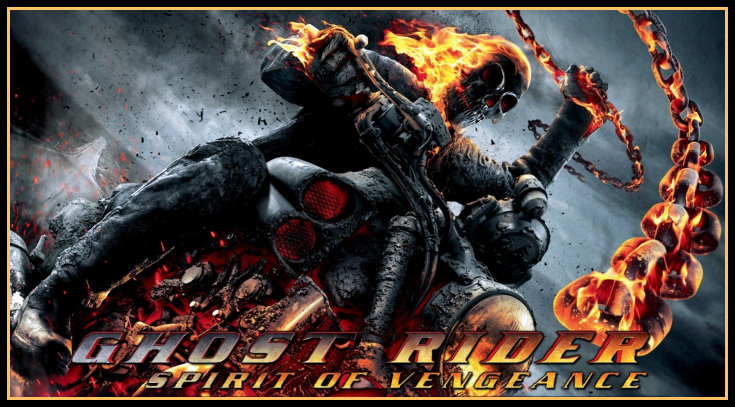
Ghost Rider has always been a niche character for Marvel Comics. The character was born out of an earlier Marvel character named Night Rider. After Marvel writers Roy Thomas and Gary Friedrich and artist Mike Ploog had rein-visioned the character into Ghost Rider during the early 70’s it has always remained on the extreme fringes of the Marvel Comics universe. This wouldn’t stop Sony (which owned the film rights to the character) to go ahead and adapt it for the big-screen. 2007’s Ghost Riderby Mark Johnson was the first and failed attempt to turn the character into a film franchise. It still made enough money despite a near-universal panning of the film by critics and audiences alike. This turn of profit is why Sony once again dipped into the Ghost Rider well and come up with 2012’s Ghost Rider: Spirit of Vengeance.
This “sort of” sequel ditches Mark Johnson and brings in the dynamic (and I’d say somewhat insane) directing duo of Mark Neveldine and Brian Taylor to helm the film. It brings back Nicolas Cage for the role of Johnny Blaze/Ghost Rider. Working from a script by Scott Gimple, Seth Hoffman and David S. Goyer one would think the film had nowhere else to go but up especially with the wacky and frenetic filming style by Neveldine/Taylor. To say that this sequel failed to do anything but finally give this film franchise a final nail in it coffin would be an understatement.
Ghost Rider: Spirit of Vengeanceditches pretty much most of what transpired with the first film and tries to retcon things for the sequel. I’d say this would’ve been a good idea seeing the first film was truly awful, but what the sequel ended up doing was confuse things even more. The film tries to turn the Ghost Rider persona from just a spirit of vengeance but an angelic being called the spirit of justice which had become corrupted. We get the Devil in the form of Roarke (played by Irish actor Ciaran Hinds) searching for the young boy Danny who is to be his perfect vessel. Johnny Blaze comes into the picture after being recruited by a drunk French warrior-monk by the name of Moreau (Idris Elba whose performance was one of the lone highlights of the film) who promises to exorcise the demon from Blaze in exchange for finding and saving Danny.
This would’ve been a good premise if it had several more drafts of it worked on. Though there’s still a chance the film would’ve still sucked in the end. Even the direction from Neveldine/Taylor (Crank, Crank: High Voltage, Gamer) failed to add any heat to the proceedings. They come up with some unique camera angles and action sequences, but gone was the hyper-realistic and frenetic style they’ve become known for. Their previous films were not stuff to write to one’s film critic circles about but they at least had a sense of fun built into them even if their stories defied any sort of logic.
Even the performances by the cast seemed to be something that barely reached the level of one-dimensional. Nicolas Cage tries to channel his inner crazy by way of Bad Lieutenant: Port of Call New Orleans, but it’s too little too late to save the film which never found any sort of footing on the side of competent. Really, the only good thing worth of note was my previous mention of Idris Elba as Moreau who chews the scenery every time he shows up on the screen like it was his last meal. This performance alone wasn’t enough to save the film or even make it somewhat entertaining.
Ghost Rider: Spirit of Vengeancewas not worth seeing in the theater (especially in 3D though that part of the film was actually quite well done despite being a post conversion) and I’d be willing to admit that it’s still not worth seeing on video unless it was for free. What could’ve been a restart to the series with the inclusion of Neveldine/Taylor instead gives this franchise it’s death-knell and most likely help Marvel get the rights back from Sony. Here’s to hoping that the flaming skull rider stays on the fringes of the Marvel Cinematic Universe for decades to come.
“Remember, Red. Hope is a good thing, maybe the best of things, and no good thing ever dies.” — Andy Dufresne
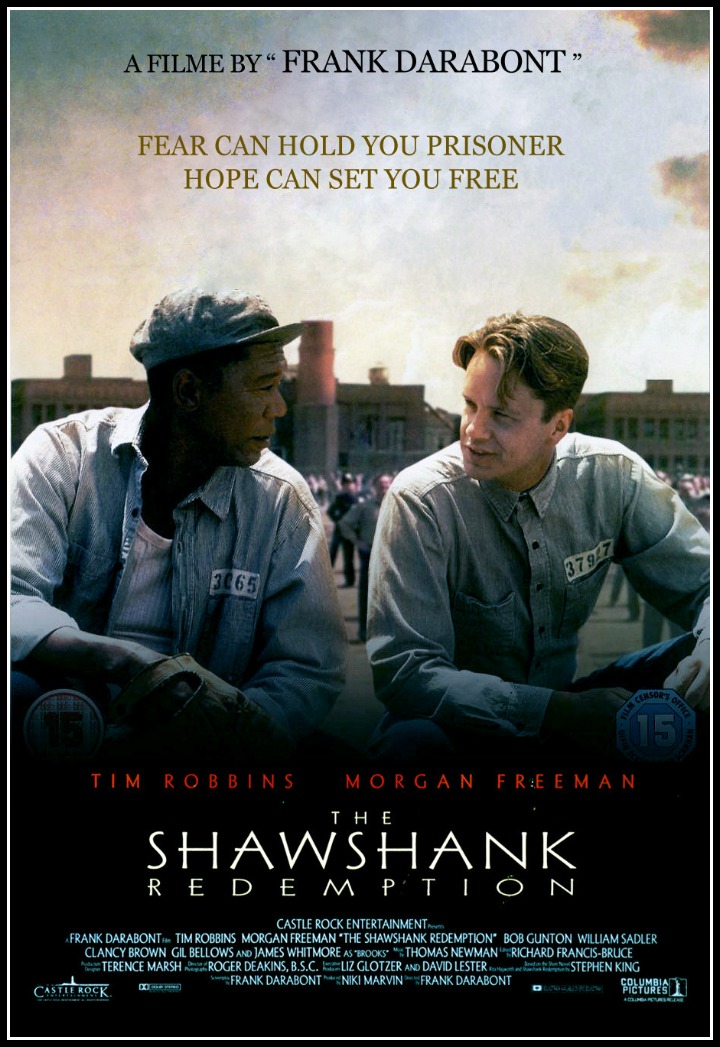
1994 was the year that men finally got their version of Fried Green Tomatoesand Beaches. We men we’re always perplexed why so many women liked those two films. Even when it was explained to us that the film was about the bond of sisterhood between female friends and how the march of time could never break it we were still scratching out heads. In comes Frank Darabont’s film adaptation of the Stephen King novella Rita Hayworth and Shawshank Redemption.
Using a script written by Darabont himself, the film just takes the latter half of the novella’s title and focuses most of the film’s story on the relationship between the lead character of Andy Dufresne (played by Tim Robbins) who gets sent to Shawshank Penitentiary for the crime of killing his wife and her lover and that of another inmate played by Morgan Freeman. The film doesn’t try to prove that Andy is innocent even though we hear him tell it to the convicts he ends up hanging around that he is. The relationship between Andy and Red becomes a great example of the very same bond of sisterhood, but this time a brotherhood who are stuck in a situation where their freedom has been taken away and hope itself becomes a rare and dangerous commodity.
Darabont has always been a filmmaker known for his love of Stephen King stories and has adapted several more since The Shawshank Redemption, but it would be this film which has become his signature work. It’s a film that’s almost elegiac in its pacing yet with hints of hope threaded in-between scenes of men clinging to sanity and normalcy in a place that looks to break them down and make them less human. It’s nothing new to see prison guards abusive towards inmates in films set in prisons, but in this film these scenes of abuse have a banality to them that shows how even the hardened criminal lives and breathes upon the mercy and generosity provided by the very people who were suppose to rehabilitate them.
While the film’s pacing could be called slow by some it does allow for the characters in the film, from the leads played by Robbins and Freeman to the large supporting cast to become fully formed characters. It doesn’t matter whether it’s Clancy Brown playing the sadistic Capt. Byron Hadley to James Whitmore as Brooks Hatlen the inmate who has spent most of his life in Shawshank and whose sudden parole begins one of the most heartbreaking sequences in the film. The whole cast did a great job in whatever role they had been chosen to play. Freeman and Robbins as Red and Andy have a chemistry together on-screen that makes their fraternal love for each other very believable that the final scenes in the film doesn’t feel too melodramatic or overly sentimental.
The Shawshank Redemptionwas a film that lost out to Forrest Gump for Best Picture, but was a film that would’ve been very deserving if it had won the top prize at the Academy Awards. It was a film that spoke of hope even at the most degrading setting and how it’s the very concept of hope and brotherhood that allows for those not free to have a sense of freedom and camaraderie. Darabont’s first feature-length film remains his best work to date and one of the best Stephen King adaptations which is a rarity considering how many of his stories have been adapted. So, while the fairer sex may have their Fried Green Tomatoes, Beachesand the like, we men will have ours in the fine film we call The Shawshank Redemption.
When one sees the name Roland Emmerich attached as the director to a film on any given year one almost has to audibly groan. He’s not on the level of Uwe Boll in terms of awful films, but he does give Michael Bay a run for the title of worst blockbuster filmmaker. It’s quite a shame to see Emmerich’s films one after the other get worse and worse. This was a filmmaker who showed some talent in the scifi-action genre with such cult classics as Universal Soldier and Stargate. He would reach his apex with the popcorn-friendly and thoroughly enjoyable Will Smith alien-invasion flick, Independence Day. Since reaching those lofty heights each successive film has been more groan-inducing and worse than the previous one. For a brief moment in 2009 this would change as he finally succeeded in destroying the world that he had only hinted at with previous films such as ID4, Godzilla and The Day After Tomorrow. The film 2012 was released in late-2009 and, while it was universally lambasted by critics and a large portion of the public, I thought it was his most fun film since ID4.
2012 literally has the world greet it’s apocalypse according to the Mayan Calendar in the year 2012. The first forty or so minutes has Emmerich explaining the details of how the world will end in 2012 either through the film’s lead scientist (played by Chiwetel Ejiofor) or through a conspiracy-theorist played with manic glee by Woody Harrelson. The bulk of this film is almost like disaster porn for film lovers who are into disaster flicks. We have earthquakes which sends the whole California coast sliding into the Pacific. Supervolcanoes erupting in what is the Yellowstone National Forest right up to mega-tsunamis that dwarf the highest mountain ranges.
The cast might be called an all-star one, but I rather think it’s more a B-list with such names as John Cusack playing a goofy everyman who must save his ex-wife and two young children right up to Danny Glover playing the lame duck of lame duck presidents (I guess Morgan Freeman was unavailable or already done with disaster films after doing Deep Impact). The performance by this cast ranged from alright to laughable, but even with the latter the sense of fun never wavered. This was a flick about the world ending and Emmerich delivered everything promised.
It’s the scenes of world devastation which made this film so enjoyable for me and has become one of my latest guilty pleasures. No matter how bad the dialogue got or how wooden some of the acting came off the sense of wonder from Emmerich destroying the world on the big-screen and on my TV made this film fun to watch. Maybe those who hated it or thought it was trash were aiming to high. I will admit that the film is trash, but in a good way that past enjoyable disaster flicks of the 70’s were fun. It took the premise serious enough, but the filmmakers involved didn’t skimp on over-the-top destruction. I mean this film’s premise means we get to see in high-definition billions of people die as the planet decides to suddenly switch things around to get a better feng shui vibe to the planet.
Scenes such as the mega-tsunamis topping over the Himalayan mountain range was awesome. But even that scene couldn’t top the super-quake which destroys Los Angeles around Cusack’s character who tries to outdrive the quake and the resulting chasms which appear to chase his limo with is family inside. Seeing Los Angeles and the bedrock it’s on upheave and slide into the Pacific was one of the best disaster porn sequences I’ve ever seen and I don’t see anything topping it in the near future.
2012 as a Roland Emmerich production already has a black mark on it because of his reputation as a filmmaker, but for once he actually made a film that was able to surpass all the glaring flaws from it’s one-note, stereotypical characters to it’s wooden dialogue. He did this by making a film with disaster scenes of such epic spectacle that one had no choice but to just sit back and enjoy the ride. It’s a bad film, but it sure was a fun ride. This is why I decided on a fan-made trailer which best exemplifies this film and not the one made by the studio.
I eagerly await the sequel I fully expect from Hollywood: 2013:Disaster Strikes Back.



 Through the Shattered Lens