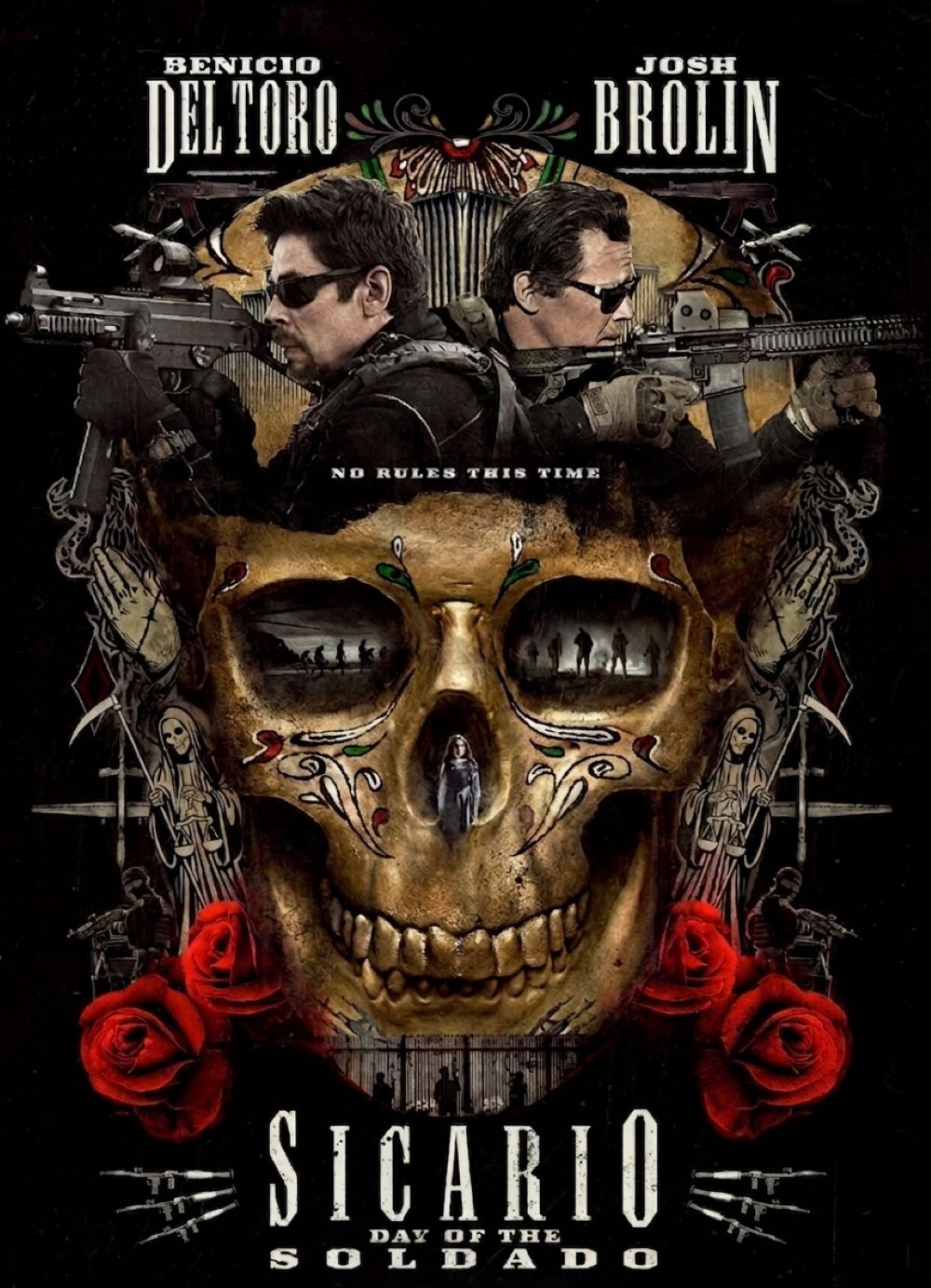
“I mean, I wouldn’t take out a cartel leader. Turn one cartel into 50. Besides, killing kings doesn’t start wars, it ends them.” — Matt Graver
Sicario: Day of the Soldado is a tense, often entertaining follow-up that never quite reaches the same level of dread, complexity, or visual identity as the first Sicario. It’s a movie that knows how to hit hard in the moment, but it doesn’t linger in the mind the same way, and a big reason for that is how much it shifts from being a layered border thriller into something more like a blunt-force crime action movie.
What stands out right away is that the film still has strong ingredients. Taylor Sheridan’s script gives Josh Brolin and Benicio Del Toro plenty of room to do what they do best, and both actors make this thing watchable even when the movie itself starts feeling thinner than it should. Brolin brings that loose, swaggering menace to Matt Graver, making him feel like the kind of guy who smiles while ordering something morally awful. Del Toro, meanwhile, gives Alejandro a cold, haunted intensity that fits the character perfectly. He doesn’t need much dialogue to sell the idea that this man is basically a weapon walking around in human form.
But that’s also where the movie’s biggest issue starts to show. For all the credit Sheridan deserves for keeping the world of Sicario alive, the absence of Denis Villeneuve in the director’s chair is obvious. The first film had this slow-burning, oppressive grip on you; every scene felt like it was pulling you deeper into a nightmare that had structure, purpose, and a real sense of moral unease. Here, that layered feeling is much weaker. The sequel becomes more interested in forward motion, shootouts, and tension-by-incident than in developing the deeper political and thematic weight that made the original so memorable.
That doesn’t mean Sicario: Day of the Soldado is empty. It just feels like it has less on its mind than the first film. The original Sicario was about systems, corruption, compromise, and the way law enforcement and criminal violence blur together until nobody gets to stay clean. This sequel touches on similar territory, but it often feels like the movie is more focused on creating a harsh atmosphere around its two lead men than on really digging into what all of it means. In that sense, it starts to feel like a vehicle for Brolin and Del Toro first, and a larger statement second.
Stefano Sollima does a solid job with the action, and to his credit, he understands that this world should feel mean, chaotic, and stripped of comfort. There’s a gritty professionalism to the violence that works well enough, and the film certainly doesn’t shy away from brutality. Still, the action doesn’t always carry the same weight as it did in the first movie because the buildup isn’t as rich. The tension is there, but the emotional and thematic buildup behind it is thinner, so some of the set pieces land more as effective genre beats than as moments that actually deepen the story.
The film’s biggest strength, beyond the performances, is its atmosphere of moral corrosion. Nobody in Day of the Soldado feels especially noble, and that’s part of what keeps it interesting. Brolin’s Graver is still the kind of operator who treats human lives like pieces on a board, while Del Toro’s Alejandro remains a deeply damaged figure who seems to exist somewhere between avenger, assassin, and ghost. Their relationship gives the movie a sharp edge, because you’re never really sure whether these guys are working together, manipulating each other, or simply following the same dark logic from different angles.
Still, the movie’s structure is less satisfying than the first one’s. It leans harder into a straightforward escalation of events, and once that happens, some of the mystery and suspense gives way to a more familiar crime-thriller rhythm. That isn’t automatically a bad thing, but it does mean the film loses some of the special quality that made Sicario feel so bracing. The sequel is darker in tone, sure, but not necessarily deeper. It’s more aggressive than observant, more kinetic than reflective.
A lot of this is why the movie works best when it keeps its focus on the two men at the center. Brolin and Del Toro are compelling enough to hold attention even when the screenplay starts feeling a little schematic. Their characters are so insulated by violence and secrecy that they almost seem to belong to a different kind of movie than everyone else around them. The downside is that this also makes the surrounding story feel less important. The first film balanced character and theme in a way that felt inseparable; this one often feels like it is using theme as a backdrop for the characters rather than letting the ideas shape the entire film.
Even so, Sicario: Day of the Soldado isn’t a failure. It’s a good-looking, well-acted, often tense sequel that knows how to stay nasty and efficient. It just doesn’t have the same confidence in its own ideas. The result is a film that is entertaining in a hard-edged, grim way, but also one that makes you think about what it could have been with a stronger directorial voice pulling everything together. Taylor Sheridan’s fingerprints are still all over it, but Villeneuve’s absence leaves a noticeable gap in the film’s pulse and perspective.
In the end, the movie feels like a solid but diminished return to a brutal world. It gives you Brolin and Del Toro doing sharp, controlled work inside a story that never fully rises to match them. That’s enough to make it worthwhile, but not enough to make it essential. Compared to the first Sicario, this one is more of a hard-nosed spin-off in spirit than a true continuation of the original’s power, and that difference is felt in almost every scene.
 Once upon a time, there were two movies about the legendary Western lawman (or outlaw, depending on who is telling the story) Wyatt Earp. One came out in 1993 and the other came out in 1994.
