Insomnia File #70: Shortcut to Happiness (dir by Alec Baldwin)


What’s an Insomnia File? You know how some times you just can’t get any sleep and, at about three in the morning, you’ll find yourself watching whatever you can find on cable or streaming? This feature is all about those insomnia-inspired discoveries!

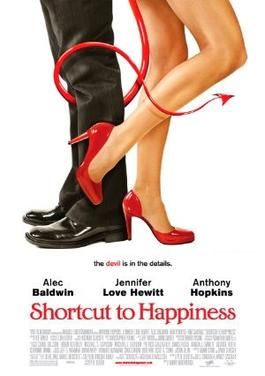
If you’re having trouble getting to sleep tonight, you can always jump over to Tubi and watch Shortcut to Happiness, a.k.a. The Devil and Daniel Webster.

When was Shortcut to Happiness released?  There’s some debate about that.  Though the film’s credited director is Harry Kirkpatrick, it was actually directed by Alec Baldwin.  (Please, no Rust jokes.)  The film was shot in 2001, in New York City.  However, shortly before filming could be completed, the film’s financiers were arrested and charged with bank fraud which led to the film ending up in limbo.  A rough cut of the movie appeared at a few film festivals in 2003.  By that point, Baldwin had started to distance himself from the film, claiming that he wasn’t given a chance to shoot all of the scenes that he needed to and that the film was taken away from him in post-production.  A newly edited version of the film was finally released in 2007, six years after filming began.

Alec Baldwin not only directed the film but starred as Jabez Stone, an aspiring writer who makes a deal with the devil (Jennifer Love Hewitt) to become a successful published author.  Stone gets his wish but it comes with a price.  In ten years, he will have to give up his soul.  Stone becomes rich and successful, writing books that have absolutely no literary merit.  He loses all of his friends and, by the time the ten year deadline rolls around, Stone is miserable.  Stone sues to keep his soul.  He’s defended by Daniel Webster (Anthony Hopkins), a man who Stone thought was just a publisher but who apparently is actually the famed 19th century statesman.  (The film is rather vague on this point.)  In one of the film’s few funny moments, the jury is revealed to be made up of deceased writers, including Ernest Hemingway and Mario Puzo.  The trial plays out and …. well, again, it’s hard to really follow any of the arguments made by either Webster or the Devil.  The film is so tonally inconsistent and poorly directed that I was often left wondering if Hopkins and Hewitt had even been on the set at the same time.

Both Hopkins and Hewitt give good performances.  The problem is that they both seem to be appearing in different films.  Hewitt gives a broadly comedic performance as the Devil, pouting whenever Webster argues with her.  Hopkins, meanwhile, seems to be recycling his dignified and very serious performance from Amistad.  Meanwhile, Baldwin the director totally miscasts Baldwin the actor.  For the film to work, Jabez needs to be young and hungry.  Instead, Baldwin comes across as someone who is already old enough to know better than to make a deal with the Devil.

It’s a true mess of a film but worth seeing just because of the story behind it.  That said, the 1941 version of The Devil and Daniel Webster remains the one to beat.

Previous Insomnia Files:

  1. Story of Mankind
  2. Stag
  3. Love Is A Gun
  4. Nina Takes A Lover
  5. Black Ice
  6. Frogs For Snakes
  7. Fair Game
  8. From The Hip
  9. Born Killers
  10. Eye For An Eye
  11. Summer Catch
  12. Beyond the Law
  13. Spring Broke
  14. Promise
  15. George Wallace
  16. Kill The Messenger
  17. The Suburbans
  18. Only The Strong
  19. Great Expectations
  20. Casual Sex?
  21. Truth
  22. Insomina
  23. Death Do Us Part
  24. A Star is Born
  25. The Winning Season
  26. Rabbit Run
  27. Remember My Name
  28. The Arrangement
  29. Day of the Animals
  30. Still of The Night
  31. Arsenal
  32. Smooth Talk
  33. The Comedian
  34. The Minus Man
  35. Donnie Brasco
  36. Punchline
  37. Evita
  38. Six: The Mark Unleashed
  39. Disclosure
  40. The Spanish Prisoner
  41. Elektra
  42. Revenge
  43. Legend
  44. Cat Run
  45. The Pyramid
  46. Enter the Ninja
  47. Downhill
  48. Malice
  49. Mystery Date
  50. Zola
  51. Ira & Abby
  52. The Next Karate Kid
  53. A Nightmare on Drug Street
  54. Jud
  55. FTA
  56. Exterminators of the Year 3000
  57. Boris Karloff: The Man Behind The Monster
  58. The Haunting of Helen Walker
  59. True Spirit
  60. Project Kill
  61. Replica
  62. Rollergator
  63. Hillbillys In A Haunted House
  64. Once Upon A Midnight Scary
  65. Girl Lost
  66. Ghosts Can’t Do It
  67. Heist
  68. Mind, Body & Soul
  69. Candy

Lisa Marie Reviews An Oscar Nominee: The Elephant Man (dir by David Lynch)


The Elephant Man (1980, dir by David Lynch, DP: Freddie Francis)

David Lynch never won a competitive Oscar.

He received an honorary award from the Academy in 2019.  He generated some minor but hopeful buzz as a possible nominee for Best Supporting Actor for his role in Steven Spielberg’s The Fabelmans.  He was nominated for Best Director three times and once for Best Adapted Screenplay.  But he never won an Oscar and indeed, even his nominations felt like they were given almost begrudgingly on the part of the Academy.  In an industry that celebrated conformity and put the box office before all other concerns, David Lynch was an iconoclastic contrarian and the Academy often didn’t do know what to make of him.  Of the many worthy films that he directed, only one David Lynch film was nominated for Best Picture and, in my opinion, it should have won.

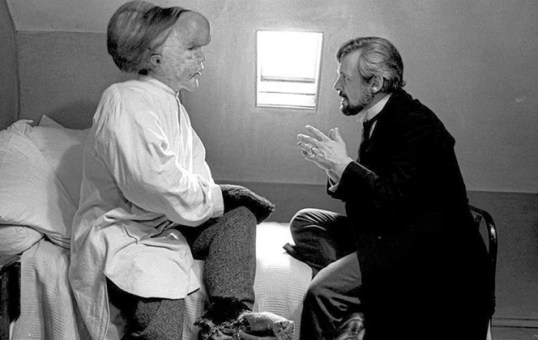
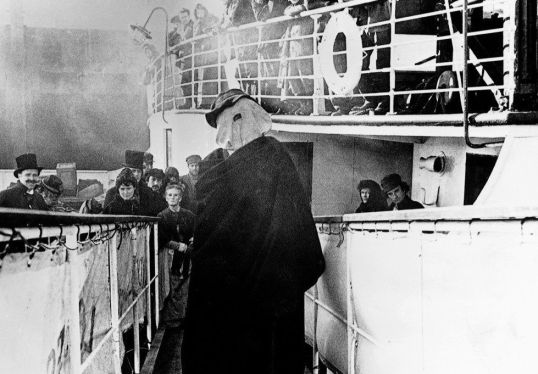
1980’s The Elephant Man is based on the true story of Joseph Merrick (renamed John for the film), a man who was horribly deformed and terribly abused until he was saved from a freak show by a surgeon named Dr. Frederick Treves.  The sensitive and intelligent Merrick went on to become a celebrity in Victorian London, visited by members of high society and allowed to live at London Hospital.  (Even members of the royal family dropped in to visit the man who had once been forced to live in a cage.)  Merrick lived to be 27 years old, ultimately dying of asphyxiation when he attempted to lie down and, in Treves’s opinion, sleep like a “normal person” despite his oversized and heavy head.  In the film, Merrick is played by John Hurt (who gives a wonderful performance that, despite Hurt acting under a ton on makeup, still perfectly communicates Merrick’s humanity) while Treves is played by Anthony Hopkins, who is equally as good as Hurt.  (Hurt was nominated for Best Actor but Hopkins was not.  Personally, I prefer Hopkins’s performance as the genuinely kind Dr. Treves to any of his more-rewarded work as Dr. Lecter.)  The rest of the cast is made up of veteran British stars, including John Gielgud, Wendy Hiller, Freddie Jones, and Kenny Baker.

Lynch’s version of The Elephant Man is only loosely based on the facts of Merrick’s life.  It opens with a disturbing fantasy sequence (one which I assume is meant to be from Merrick’s point of view) in which a herd of elephants strike down Merrick’s mother and then appear to assault her.  Shot in stark black-and-white and often featuring the sounds of droning machinery in the background (in many ways, The Elephant Man feels like it takes place in the same world as Eraserhead), the first half of The Elephant Man feels like a particularly surreal Hammer film.  (Veteran Hammer director Freddie Francis served as The Elephant Man‘s cinematographer.)  Merrick is kept off-camera and, when we finally do see his face, it’s in a split-second scene in which Merrick is as terrified as the person who sees him.  Before we really meet Merrick, we’ve already heard Treves and the hospital administrator (John Gielgud) discuss all of the clinical details of his condition.  We know why he’s deformed.  After we see him, we know how he’s deformed.  After all of that, the audience is finally ready to know Merrick the human being.  Without engaging in too much obvious sentimentality, Lynch shows us that Merrick is a kind soul, one who has been tragically mistreated by the world.  Just as with the real Merrick, almost everyone who meets the film’s John Merrick is ultimately charmed by him.  In the film, Merrick is kidnapped by his former owner, the alcoholic Bytes (Freddie Jones), who wants again puts Merrick on display in a cage.  In the end, it’s Merrick’s fellow so-called “freaks” who set him free and allow him to return to the hospital, where he has one final vision of his mother.  This vision is a much less disturbing than the one that opened the film.  The film celebrates the humanity of John Merrick but is also reveals the genius of David Lynch.  There’s so many moments when the film could have gone off the rails or become too obvious for its own good.  But Lynch’s unique style so draws you into the film’s world that even the mysterious visions of his mother somehow feel completely necessary and natural.  The Elephant Man is the David Lynch film that makes me cry.  Lynch was a surrealist with a heart.

The Elephant Man was only David Lynch’s second film.  He was hired to direct by none other than Mel Brooks, who produced the film but went uncredited to prevent people from thinking it would be a comedy.  (Lynch, however, did cast Brooks’s wife, Anne Bancroft, as an actress who visits Merrick.)  Brooks hired Lynch after seeing Eraserhead and recognizing a talent that many in Hollywood would never have had the guts to take a chance on.  (Despite the success of Eraserhead on the midnight circuit, David Lynch was working as a roofer when he was offered The Elephant Man and had nearly given up on the idea of ever making another film.)  Reportedly, Brooks stayed out of Lynch’s way and protected him from other executives who fears Lynch’s version of the story would be too strange to be a success.  Lynch and Brooks proved those doubters wrong.  Acclaimed by critics and popular with audiences, The Elephant Man was nominated for Best Picture and David Lynch was nominated for Best Director.  I like Ordinary People.  I like Raging Bull.  But The Elephant Man was the film that should have won in 1980.

The Elephant Man remains a powerful movie and an example of how an independent artist can make a mainstream movie without compromising his vision.  (Of course, I imagine it helps to have a producer who has the intelligence and faith necessary to stay out of your way.)  David Lynch may be gone but his art will live forever.  The Elephant Man will continue to make me cry for the rest of my life and for that, I’m thankful.

The Elephant Man (1980, dir by David Lynch, DP: Freddie Francis)

The Films of 2024: Rebel Moon Part 2 — The Scargiver (dir by Zack Snyder)


In some other galaxy, a bunch of annoying farmers are living on the moon of Veldt.  The evil army of the Motherworld, led by Atticus Noble (Ed Skrein), wants to conquer the moon and steal all of the grain for themselves.  A bunch of rebels — including a long-winded former general named Titus (Djimon Hounsou) and painfully dull former solider of the evil empire named Kora (Sofia Boutella) — are on the moon and help the farmers prepare for battle.  And then the battle happens and the movie ends and somehow, it takes more than two hours to tell this extremely thin story.

Admittedly, I have not seen the first Rebel Moon but I doubt it makes much of a difference.  I’ve seen enough science fiction movies and enough Zack Snyder films that I feel like I can follow this sequel without having seen the first film.  In fact, the only question that I have as a result of not seeing the first film is whether the absolutely ludicrous flashback to Kora’s past was lifted from the first film or was it specifically shot for the sequel?  The flashback reveals that Kora became a rebel after her mentor attempted to frame her for the murder of a good space emperor and his family. I have to admit that the overwrought, slow motion-heavy flashback did inspire a few chuckles on my part.  There was an orchestra playing in the background of the scene and they continued to play, even while the emperor and his family were being murdered.  You have to wonder just what exactly the musicians were thinking while all of that was going on.

As for Rebel Moon Part Two, it has some nice visuals but the story is a mess and there are some moments that simply leave you wondering whether to laugh or sigh with frustration.  There’s the fact that the fearsome imperial spaceships are apparently fueled by men shoveling coal into a furnace.  There’s the fact that fearsome imperial space laser gun takes forever to aim and fire, presumably to give the rebels time to sabotage the ship.  (That seems like a pretty big design flaw.)  There’s the fact that the evil empire turns out to be so inept that it’s hard to feel like the farmers really needed to spend as much time training as they did.  By the end of the film, I felt like I probably could have beaten up the evil empire single-handedly.  They just weren’t that impressive.

The main problem is that the farmers were kind of annoying and, even when they finally did fight the evil empire, it was still hard to feel that they still didn’t have any control over their own fate.  First, they were being ordered around the bad guys.  Then, they were being ordered around by Titus and the rebels.  Titus, himself, is one of those annoying characters who can’t ever say anything without turning it into a speech.  On the one hand, Titus insists that the farmers don’t have much time to get ready.  On the other hand, Titus continually wants to waste what little time they have by giving a monologue.  Kora, meanwhile, rarely speaks.  This has less to do with her being a strong, silent warrior and instead it’s all about her not really having much of a personality.

The majority of the film’s runtime is taken up with the battle and it’s hard not to notice that for all of the explosions and presumed death, most of the main characters somehow manage to survive.  It left me thinking about we were supposed to celebrate the survival of the Daily Planet staff at the end of Man of Steel, despite the fact that thousands of others undoubtedly died while Superman and General Zod were ripping apart Metropolis.

To be clear, there are quite a few Zack Snyder films that I really do like.  I am not, by any means, an anti-Snyder person.  I thought Sucker Punch was a masterpiece.  I admire and respect what he did with Watchmen.  I’m not a fan of his work with the DCEU but then again, with the exception of the first Wonder Woman, I’m not really a fan of anyone’s work with the DCEU.  The important thing is that I think that, with the right material, Zack Snyder can be brilliant and I love the fact that, even in his lesser films, he still goes all out to bring his vision to life.  As a director, Snyder is not scared to go over-the-top with sweeping, dramatic moments.  He’s someone who understands that movies — especially action films — should be big.  But Rebel Moon 2 never really works.  If anything, it sometimes feels like Snyder on auto pilot.  I’ll always be willing to take a chance of Zack Snyder but I hope that doesn’t mean having to watch Rebel Moon 3.

Horror Film Review: Magic (dir by Richard Attenborough)


There have been many disturbing ventriloquist’s dummies over the years but I don’t know if there’s ever been one who is quite as hateful as Fats, the dummy that is used by Corky Withers (Anthony Hopkins).

Corky and Fats are at the center of the 1978 film, Magic.  When we first meet Corky, he’s an aspiring magician without a dummy.  He’s a talented magician and it’s obvious that performing is one of the only things that brings Corky happiness.  But, from the start, there’s something off about Corky.  There’s a desperation to him and his performance.  He craves the applause of the audience just a bit too much, as if he doesn’t know who he is unless people are clapping for him.  (This performance, from a youngish Anthony Hopkins, is quite a contrast to the characters that Hopkins is today known for playing.)  Corky is told that he needs to get a “gimmick” if he’s ever going to be a success and that gimmick turns out to be Fats, a ventriloquist dummy who is as confident as Corky is insecure.  Whereas Corky often seems to be struggling to find the right thing to say, Fats always has the perfect comeback ready.

Of course, Fats is Corky.  Fats is the self-absorbed and cocky “person” that Corky wishes he could be.  When Fats tells Corky that he’s a useless loser, it’s actually Corky saying that to himself.  When Corky argues with Fats, he’s arguing with himself.  With Fats, Corky has found a way to express himself but he’s also sacrificed half of his identity as a result.  Can Corky survive without Fats?  He’s not sure but he does know that Fats is a hit with audiences.

When Corky’s agent (Burgess Meredith) announces that he has gotten Corky a network television special, Corky panics.  Corky doesn’t want to take the medical or mental exams that the network would probably require before giving him a contract.  He flees to the Catskills, where he grew up.  (Corky’s obsession with performing makes sense when one realizes that he grew up in the Catskills, a region that played home to many aspiring comedians.)

Corky visits Peggy Ann Snow (Ann-Margaret), with whom Corky went to high school and who he had a huge crush on.  (Imagining Anthony Hopkins in high school — especially an American high school — is not particularly easy.)  Peggy is unhappily married to Duke (Ed Lauter) and she soon finds herself falling in love with Corky.  Corky appears to finally have a chance for happiness but Fats has other plans.  Murder follows and it says something about how well this film is done that we think of Fats as being the mastermind behind the murders even though we know that Fats is really just Corky talking to himself.

Magic is the definitive evil ventriloquist’s dummy film, one that is beautifully shot by Richard Attenborough and which features a great performance from Anthony Hopkins.  It’s a sign of the strength of his performance that we still feel sorry for Corky, even though he ends up killing one of the most likable characters in the film.  Of course, it’s a dual performance for Hopkins because he’s playing both Corky and Fats.  He is excellent and frightening in both roles.

Anthony Hopkins Brings Tears To Your Eyes In The Trailer For One Life


In the upcoming film, One Life, Anthony Hopkins plays Sir Nicholas Winton, a stockbroker who, in the 1930s, helped to facilitate the rescue of 669 children from Czechoslovakia on the eve of World War II, in a operation that was known as Czech Kindertransport.  Winton’s action were largely unknown to the general public for 50 years, until he was invited to appear on a television program This Is Your Life.  It was then that he met many of the now-grown children whose lives he had saved.

Casting Anthony Hopkins, who has played his share of villains but who is always at his best when playing kindly men who try to do the right thing, as Nichols Winton seems like the perfect decision for the film version of this beautiful story.  Here’s the trailer.

Lisa Marie’s Way Too Early Oscar Predictions For April


Here are my Oscar predictions for April!  As always, when it’s this early in the year, I recommend taking all of these with a grain of salt.  At this point, the only thing that anyone knows for sure is that it’s safe to remove Jonathan Majors and Magazine Dreams from any list of predictions.

Check out my predictions for March by clicking here!

Best Picture

The Actor

Barbie

The Color Purple

Dumb Money

Dune: Part Two

Flint Strong

The Holdovers

Killers of the Flower Moon

Oppenheimer

Rustin

Best Director

Blitz Bazawule for The Color Purple

Rachel Morrison for Flint Strong

Christopher Nolan for Oppenheimer

Alexander Payne for The Holdovers

Martin Scorsese for Killers of the Flower Moon

Best Actor

Bradley Cooper in Maestro

Colman Domingo in Rustin

Paul Giamatti in The Holdovers

Andre Holland in The Actor

Anthony Hopkins in Freud’s Last Session

Best Actress

Fantasia Barrino in The Color Purple

Emily Blunt in Pain Brokers

Greta Lee in Past Lives

Margot Robbie in Barbie

Emma Stone in Poor Things

Best Supporting Actor

Willem DaFoe in Poor Things

Matt Damon in Oppenheimer

Brian Tyree Henry in Flint Strong

Samuel L. Jackson in The Piano Lesson

Jesse Plemons in Killers of the Flower Moon

Best Supporting Actress

Viola Davis in Air

Jodie Foster in Nyad

Lily Gladstone in Killers of the Flower Moon

Taraji P. Henson in The Color Purple

Da’Vine Joy Randolph in The Holdovers

Horror Film Review: Audrey Rose (dir by Robert Wise)


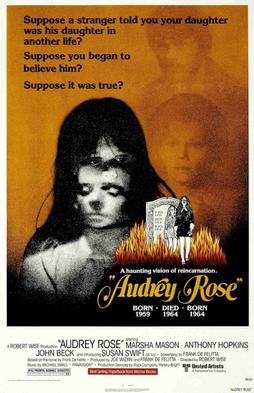
The 1977 film, Audrey Rose, tells the story of an annoying little girl named Ivy (Susan Swift), who is the daughter of annoying Janice (Marsha Mason) and annoying Bill (John Beck).  Everything seems to be perfectly normal in an annoying way until, one day, they notice that they’re being followed around by an annoying man named Elliott (Anthony Hopkins).  Elliott explains that Ivy is the reincarnation of his daughter, Audrey Rose, who was herself kind of annoying.  Whenever Elliott says, “Audrey Rose,” Ivy going into a trance and starts screaming, which gets a bit annoying after a while.  Elliott explains this is because Audrey died in a fiery car crash and was apparently reincarnated too soon after her death.  Therefore, anytime Elliott shows us, Ivy relives the crash and tries to burn herself.  Annoying!

To me, it seems like there’s a simple solution to all of this.  Elliott could just go away or, at the very least, stop saying, “Audrey Rose” every ten seconds.  Anyway, at one point, Ivy starts screaming so Elliott rushes into the apartment and makes her stop.  However, Elliott is accused of attempting to abduct Ivy, arrested, and put on trial.

Elliott’s defense is that he couldn’t abduct his own daughter so therefore, if Ivy is the reincarnation of Audrey Rose, then he’s innocent.  Somehow, this leads to the trial becoming about proving reincarnation.  Hindu holy men are called to the stand.  Elliott smirks and tells his lawyer to call Janice to the stand because he’s figured out that Janice believes him.  Meanwhile, Ivy finds herself drawn towards every fire that she sees…

Audrey Rose was directed by a legitimately great director, Robert Wise.  Unfortunately, Wise takes the material way too seriously.  Just when you think the film is going to be an over the top possessed child flick, it suddenly turns into a turgid and serious debate about reincarnation.  The movie is so busy trying to be realistic that it forgets to be fun.

There’s also a lot of yelling in Audrey Rose.  In between Ivy screaming and Elliott continually calling his dead daughter’s name and Bill arguing with Janice and random characters screaming whenever Ivy gets to close to a fire, it’s easy to get a headache while watching this film.

Mason and Beck are pretty lousy in the roles of Janice and Bill.  Hopkins brings an occasionally neurotic edge to the role of Elliott.  You never quite trust him, even though the movie wants you to.  The best performances in the film come from the performers in the minor roles, character actors like Norman Lloyd, Robert Walden, and John Hillerman.  None of them are required to pretend like they’re taking their dialogue seriously and, as such, they’re a lot more fun to watch.

All in all, Audrey Rose is a fairly silly movie.  For some reason (probably the presence of Hopkins), it does seem to show up on TCM fairly regularly but I wouldn’t recommend watching.  If you want to see a good Robert Wise horror movie, check out The Haunting.

Lisa Marie’s Early Oscar Predictions For August


It’s that time of the month again!

Here are my Oscar predictions for August.  By the end of September, the picture should be a bit clearer.  Until then, most of the predictions listed below continue to be guesses.

Be sure to check out my predictions for February, March, April, May, June, and July!

Best Picture

Babylon

Elvis

Empire of Light

Everything Everywhere All At Once

The Fabelmans

The Inspection

The Son

TAR

Till

Top Gun: Maverick

Best Director

The Daniels for Everything Everywhere All At Once

Todd Field for TAR

Baz Luhrmann for Elvis

Steven Speilberg for The Fabelmans

Florian Zeller for The Son

Best Actor

Austin Butler in Elvis

Tom Cruise in Top Gun: Maverick

Brendan Fraser in The Whale

Hugh Jackman in The Son

Harry Styles in My Policeman

Best Actress

Cate Blanchett in TAR

Olivia Colman in Empire of Light

Viola Davis in The Woman King

Danielle Deadwyler in Till

Michelle Yeoh in Everything Everywhere All At Once

Best Supporting Actor

Tom Hanks in Elvis

Anthony Hopkins in The Son

David Lynch in The Fabelmans

Tobey Maguire in Babylon

Ke Huy Quan in Everything Everywhere All At Once

Best Supporting Actress

Jamie Lee Curtis in Everything Everywhere All At Once

Laura Dern in The Son

Sally Field in Spoiler Alert

Stephanie Hsu in Everything Everywhere All At Once

Michelle Williams in The Fabelmans

Here’s The Trailer For The Son!


Look back on the 2020 Oscars, it now seems pretty obvious to me that, of the nominated films, The Father was the one that should have won Best Picture.  Of course, as far as I was concerned, The Father was actually a 2021 film but, due to the extended eligibility window, The Father was nominated for the 2020 Oscars.  Regardless of how one feels about all of that nonsense with the extended eligibility window, The Father was the best film out of the nominees and Anthony Hopkins fully deserved his second Oscar.  There are moments from The Father that were so powerful and heart-breaking that I feel as if I just watched them yesterday.  On the other hand, I can’t remember a thing about Nomadland, the film that actually won.

The Son has been described as being director Florian Zeller’s follow-up to The Father.  However, despite the return of screenwriter Christopher Hampton and the presence of Anthony Hopkins in both films (and despite the fact that Hopkins is playing a character named Anthony in both films), The Son is apparently more of a “spiritual sequel” to The Father than a direct sequel.

Well, no matter!  Sequel or not, The Son is expected to be an Oscar contender.  The teaser below doesn’t reveal too much, beyond Hugh Jackman and Laura Dern struggling to connect with their son.  Hopkins makes a brief appearance.  To be honest, the trailer feels a bit tense.  One gets the feeling that this is a movie about people who could explode at any minute.

Here’s the trailer:

Film Review: All The King’s Men (dir by Steven Zaillian)


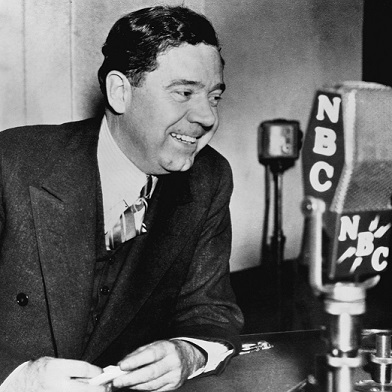
On September 10th, 1935, a Senator named Huey Long was shot and killed at the Louisiana State Capitol in Baton Rogue.

While it’s generally agreed that Carl Weiss, the son-in-law of a political opponent, approached Long, there’s still some debate as to whether or not Weiss was the one who shot Long. Did Weiss fire one shot at Long or was Long himself accidentally shot by his many bodyguards, all of whom opened fire on Weiss? (Weiss died at the scene, having been wounded at least 60 times.) There’s even some who argue that Weiss didn’t even have a gun on him when he approached Long and that Long’s bodyguards misinterpreted Weiss’s intentions. Or, as some more conspiracy-minded historians have suggested, perhaps Long’s bodyguards were themselves paid off by one of Long’s many enemies. With Huey Long, anything was possible.

Huey Long has been described as being an American dictator, a man who ran for office as a populist and who, as governor and then senator, ruled Louisiana with an iron fist. His slogan was “Every man a king,” and he promoted a platform that mixed Socialism with redneck resentment. (In modern terms, he mixed the vapid but crowd-pleasing rhetroic of AOC with the bombastic but calculated personal style of Donald Trump.) He often played the flamboyant buffoon but he also knew how to reward his friends and punish his enemies. At the time of his death, he was planning to run for President against FDR. It’s said that, in typical Long fashion, he planned to run as a third party candidate and draw away enough votes from Roosevelt to allow Republican Alf Landon to win. Then, in 1940, Long would run for the Democratic nomination and send President Landon back to Kansas.
Huey-Long-radio-3000-3x2gty-5c2934d246e0fb00012da4a1

Whether his plan was feasible or not, they came to an end with his death. However, his legacy continued as members of the Long family dominated Louisiana politics for decades to come. Huey’s brother, Earl, served as governor of Louisiana for several contentious terms. Huey’s son, Russell, spent nearly 40 years in the Senate and, as chairman of the Finance Committee, was one of the most powerful men in the country. As late at 2020, Huey’s third cousin was serving in the Louisiana Senate. In the past few years, both Donald Trump and Bernie Sanders have been compared to Huey Long. Of course, if Huey were alive today, he’d probably be very popular online. Political Twitter has never met an authoritarian that it couldn’t make excuses for.

Among those who were fascinated by the life and death of Huey Long was a Southern poet and novelist named Robert Penn Warren. Warren used Long as the basis for Willie Stark, the man at the center of the novel All The King’s Men. In the novel, Stark is a classic and tragic American archetype, the man of the people who loses his way after coming to power. Stark starts the book as an idealist who wants to make life better for the poor but who, as he works his way up the political ladder, loses sight of why he first entered politics in the first place. He goes from fighting for the people to fighting only for himself. The book was controversial but popular and won the 1947 Pulitzer Prize. In later interviews, Warren often said that All The King’s Men was never meant to be a book about politics but instead a book about two men, Willie Stark and reporter Jack Burden, losing their way during the tumult of the Great Depression.  Regardless of Warren’s intentions, most readers and critics have focused on the book as a cynical look at American politics and the authoritarian impulse.

All-the-Kings-Men-1949

Considering the book’s popularity, it’s not surprising that All The King’s Men was turned into a movie just three years after it was published.  Directed by Robert Rossen and starring a perfectly cast Broderick Crawford as Willie Stark, the film won the Oscar for Best Picture of 1949.  Just as with the book, the film was considered to be controversial.  Many claimed that the film’s cynical portrayal of American politics was the equivalent of supporting communism, despite the fact that both the novel and the original film present Stark as being the epitome of the hypocritical Marxist dictator.  Indeed, if any character would have inspired audiences in 1949 to distrust socialism, it would have been a faux populist like Willie Stark.  Still, John Wayne was so offended by the book and the script that he very publicly turned down the role of Willie Stark.  That was all the better for Broderick Crawford, who won an Oscar playing the role.  When seen today, the original All The King’s Men holds up surprisingly well, as does Crawford’s lead performance.  Filmed in harsh black-and-white and featuring a cast of cynical, tough-talking characters, it’s a political noir.

Those who found the 1949 version of All The King’s Men to be dangerously subversive obviously had no idea what was in store for them and the country over the next couple of decades.  There’s a reason why the best-known book about the downfall of Richard Nixon was called All The President’s Men.  By the start of the current century, with all of the political corruption that was happening in the real world, the flaws and crimes of Willie Stark seemed almost quaint by comparison.  In 2006, with George W. Bush serving his second term, America embroiled in two unpopular wars, and the economy looking shaky, it was decided that it was time for a new version of the story of Willie Stark.

This version was directed by Steven Zaillian, the screenwriter whose credits included Schindler’s List, Gangs of New York, Hannibal, and American Gangster.  The role of Willie Stark was played by Sean Penn, who was both an Academy Award winner and an outspoken critic of George Bush.  (And, make no mistake about it, the new version of Willie Stark would be as much based on Bush as he was on Huey Long.)  Jude Law played Jack Burden, the reporter who narrated the story of Stark’s rise and fall.  Kate Winslet, Anthony Hopkins, James Gandolfini, Patricia Clarkson, Mark Ruffalo, Jackie Earle Haley, and Kathy Baker all had supporting roles.  This was a cast full of Oscar nominees and, indeed, the film’s trailer had that portentous, “the movie is very important and award-worthy” feeling to it that studios go with whenever they’re trying to convince audiences that they have an obligation to see a film, regardless of how boring or annoying it may look.  Entertainment Weekly predicted that All The King’s Men would be an Academy Award contender. For nearly two months, one could not see a movie at the Dallas Angelika without also seeing thee trailer for All The King’s Men.  It was a movie that was due to arrive at any minute and it was coming with an awful lot of hype.

And then, the strangest thing happened.  The film itself kind of disappeared.  It arrived and then it promptly got lost.  The reviews were overwhelmingly negative.  Audiences did not turn out to see the film.  It was a box office bomb, one that pretty much ended Steven Zaillian’s career as a director.  The film played for a week in Dallas and then left the city’s movie screens.  Even if I had been planning on seeing the film when it was originally released, I wouldn’t have had the opportunity.  The Gods of cinema, politics, and Southern accents were conspiring to protect me from suffering through a bad movie and I guess I should be thankful.  There’s nothing that makes me cringe more than hearing a bad Southern accent in a movie and the trailer for All The King’s Men was full of them.

Way back in November of last year, I noticed that the 2006 version of All The King’s Men was available on Encore On Demand.  At the time, I had politics on my mind.  The Virginia and New Jersey gubernatorial elections had bee held earlier that week.  Biden’s huge infrastructure bill had passed the House on the very same night that I came across the film.  Hell, I figured, could watching Sean Penn as Willie Stark be any worse than watching Joe Biden try to give a speech from the Oval Office?  So, I decided to give the movie a chance and I quickly discovered that watching Sean Penn’s Willie Stark was a lot worse.

In All The King’s Men, Sean Penn gives the type of bad performance that can only be given by a good actor.  Penn yells and grimaces and barks out order like the villain in a badly dubbed Bollywood movie.  When he watches a dancer, he doesn’t just look at her.  Instead, he stares with all the intensity of a cartoon wolf who has just spotted Little Red Riding Hood.  There’s nothing subtle about Penn’s performance, least of all his overbaked accent.  The only thing wilder than Penn’s accent is his hair, which often seems to be standing up straight as if he’s just removed his fingers from an electrical socket.  It’s a performance that is heavy on technique but empty on substance.  In both the book and the original film, Willie Stark is flamboyant in public but cool and calculating in private.  In the remake, Penn yells and sweats and jumps around and comes across as being so desperate that it’s hard to buy into the idea that anyone would believe a word that he said.  Broderick Crawford’s Willie Stark was believable because Crawford, with his bulky build and his plain-spoken manner, came across as being a real human being.  One could imagine voters looking at Crawford and believing that he was just like them.  Sean Penn, on the other hand, comes across like a rich man’s version of a poor man.  Penn is too obviously condescending to be an effective populist.  Voters will forgive a lot but they’ll never forgive a politician who openly talks down to them.

As for the rest of the cast, they’re a very talented group but not one of them is convincingly cast.  In fact, many of them give career-worst performances.  Anthony Hopkins does his usual eccentric routine but it doesn’t add up too much because the audience never sees him as being anything other than Anthony Hopkins using a rather spotty Southern accent.  When Hopkins’s character dies, it’s not a tragedy because the character himself never feels real.  Instead, you’re juts happy that Hopkins collected a paycheck.  Kate Winslet seems to be bored with the role of Stark’s mistress.  Mark Ruffalo is dazed in the role of Winslet’s brother.  As Jack Burden, Jude Law seems as lost as anyone, which wouldn’t be problem if not for the fact that Jack is the one narrating the film.  When your narrator is lost, you’re in trouble.

There’s really only two members of the cast who escape the film unscathed.  Jackie Earle Haley is properly intimidating as Stark’s devoted bodyguard.  Haley doesn’t get many lines but one look at his disturbed eyes tells you all you need to know about how far he’ll go to protect his boss.  On the other hand, James Gandolfini gets several lines and he does such a good job of delivering them and he plays the role of a corrupt political boss with such a perfect combination of good humor and cold pragmatism that you have to wonder just how much All The King’s Men would have been improved if Gandolfini had played Willie Stark instead of Sean Penn.

Steve Zaillian’s direction involves a lot of soft-focused flashbacks and several visual references to the Nuremberg rallies.  Just as with Penn’s performance, there’s nothing subtle about Zaillian’s direction, despite the fact that the story itself is so melodramatic that it calls for the opposite of a heavy-handed approach.  One wonders what exactly Zaillian was trying to say with his version of All The King’s Men, which presents Willie Stark as being a monster but still as the audacity to end with a clip of him giving a rousing campaign speech.  Again, the problem is that we never buy into the idea that Willie Stark was ever sincere in his desire to help the common man.  Everything about both Penn’s performance and Zaillian’s direction serves to suggest that, from the start, Stark viewed them as just being a means to an end.  Ending the film with a flashback of Willie giving a campaign speech is about as moving as a friend from high school contacting you on Facebook and then trying to get you to take part in a pyramid scheme.  There’s no sincerity to be found in any of it.

In the end, it’s a film of overheated performances and meticulously shot scenes that all add up to very little.  There are a few moments where Sean Penn’s body language and his vocal inflections suggest that he’s trying to channel George W. Bush but there’s nothing particularly shocking or subversive about that.  In 2006, every movie and TV show had to find a way to take a swipe at Bush and Penn’s never been particularly reticent when it comes to broadcasting his politics.  Though All The King’s Men was executive produced by political consultant James Carville, there’s very few moment in the film that feel authentic.  It’s like a high school senior’s view of politics.

All The King’s Men came and went quickly.  Fortunately, everyone was able to move on.  Steven Zaillian has not directed another film but remains an in-demand scriptwriter.  Sean Penn, Anthony Hopkins, and Kate Winslet all won Oscars after appearing in this film (though, it should be noted, none of them won for this film).  Mark Ruffalo and Jude Law went on to join the Marvel Universe.  Jackie Earle Haley continues to be a much-respected character actor.  Tragically, James Gandolfini is no longer with us but his performance as Tony Soprano will never be forgotten.  The second version of All The King’s Men wasted a lot of talent but, fortunately, talent always finds a way to survive.