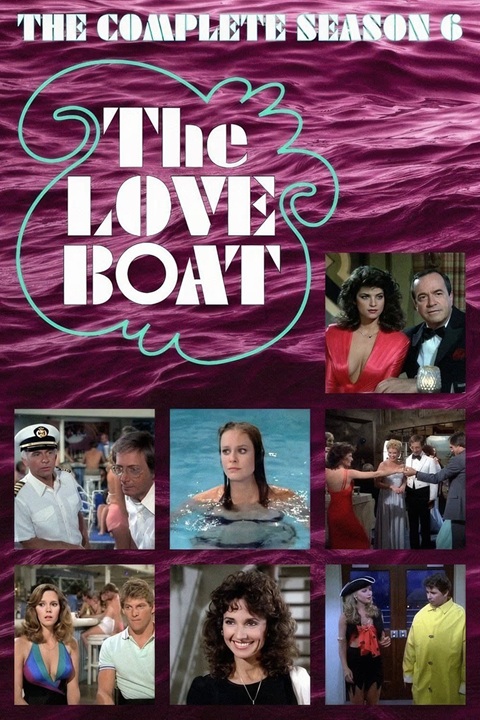
Retro Television Review: The Love Boat 6.17 “Gopher’s Daisy/Our Son, The Lawyer/Salvaged Romance”


Welcome to Retro Television Reviews, a feature where we review some of our favorite and least favorite shows of the past!  On Wednesdays, I will be reviewing the original Love Boat, which aired on ABC from 1977 to 1986!  The series can be streamed on Paramount Plus!
Come aboard!  Love is life’s sweetest reward….

Episode 6.17 “Gopher’s Daisy/Our Son, The Lawyer/Salvaged Romance”

(Dir by Richard Kinon, originally aired on January 29th, 1983)

Gopher has a new exercise machine but only he and the Captain know about it.  All through the cruise, Gopher and Stubing disappear into Gopher’s cabin, put out the “Do Not Disturb” sign and then groan and moan while using the exercise machine.

At the same, the ship has a stowaway.  As a part of her sorority initiation, Jennifer Canfield (Chanelle Lea) has to take a cruise without paying for it.  (That’s an odd initiation ritual.)  Having figured out Gopher’s schedule, Jennifer secretly stays in his room whenever he’s doing his duties.  Julie and Isaac both spot Jennifer sneaking in and out of Gopher’s cabin and they quickly decide that both Gopher and Stubing must have brought her aboard to be their — what?  Their personal sex slave?  That seems to be the implication.  Strangely, neither Isaac nor Julie seem to be too upset about that implication.  Julie has a cocaine problem so I guess I can understand her attitude but Isaac …. well, I expect more from Isaac.

Eventually, Jennifer is caught.  Instead of having her arrested, the Captain allows Julie and Isaac to pay for Jennifer’s fare on the boat.  So, does this mean that Jennifer’s not going to be allowed to join the sorority?

(Myself, I’m just considering the amount of people who have stowed away on the Love Boat over the past few seasons.  Seriously, taking a cruise without paying for it appears to be the easiest thing in the world.)

Meanwhile, James Coco and Doris Roberts play Harriet and Lou, a married couple who board the boat with their son, Jonathan (Adam Arkin).  Now that Jonathan has graduated law school and passed the bar, he thinks that it might be time for him to move into a place of his own.  Harriet is so traumatized at the thought of Jonathan moving out that she demands a divorce from Lou.  Both Harriet and Lou want to be represented by Jonathan.  Run, Jonathan, run!  In the end, the marriage is saved and everything get worked out but seriously, Jonathan needs to do more than just get an apartment of his own.  He needs to move to another state or maybe even another country.

(Also, in the past, there’s no way Julie would have ignored a handsome, single lawyer on the ship.  Unfortunately, Julie now seems to be more concerned with finding her next fix than finding a husband.)

Finally, Allison Newman (Joan Rivers) is a recently divorced woman who starts a tentative shipboard romance with passenger Max Glutovsky (Alex Rocco).  However, when Max tries teacher her how to play shuffleboard and puts his hands around her waist, Allison yells for him to leave her alone and runs away.  Max thinks that Allison is rejecting him because he’s not as rich as she is.  Max, you dumbass!  Allison has just had a mastectomy,  Her husband left her after the operation and now, she’s feeling insecure about getting close to anyone.  Of the three stories, the one worked the best, due to the performances of Rivers and Rocco.

The Rivers/Rocco story was effective.  The storyline with Roberts, Coco, and Arkin was rather shrill and left me feeling sorry for Adam Arkin’s character.  (Casting Doris Roberts as an overly possessive mother made this story feel like an unsuccessful dry run for Everybody Loves Raymond.)  Isaac and Julie thinking Gopher was sex fiend?  That was just silly.  In other words, this was a pretty uneven cruise.

Next week, hopefully things will look up with a two-hour episode set in Greece!
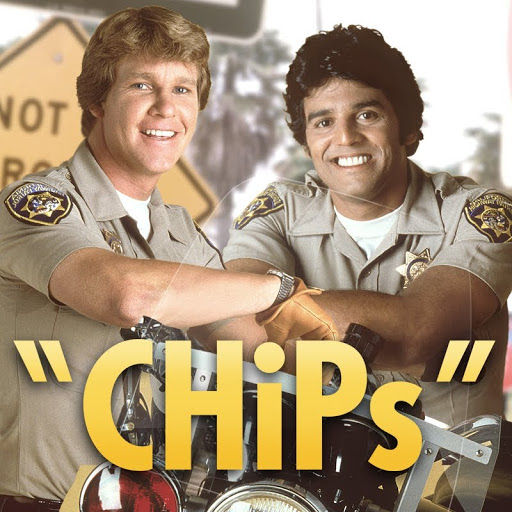
Late Night Retro Television Review: CHiPs 4.5 and 4.6 “The Great 5K Star Race and Boulder Wrap Party”


Welcome to Late Night Retro Television Reviews, a feature where we review some of our favorite and least favorite shows of the past!  On Mondays, I will be reviewing CHiPs, which ran on NBC from 1977 to 1983.  The entire show is currently streaming on Prime!

This week, we have a two-hour episode of CHiPs!

Episodes 4.5 and 4.6 “The Great 5K Star Race and Boulder Wrap Party”

(Dir by Gordon Hessler, originally aired on December 7th, 1980)

There’s a big boulder sitting on a mountain and it’s threatening to roll down onto the highway, where it could not only damage cars but also destroy the home of comedian Milton Berle.  Berle calls the cops and generally gets annoyed with everyone who comes by his house.  They all want to make jokes while the boulder hangs over him like death from above.  I would be annoyed as well!

Ponch and Baker arrange for a demolition crew to come in and try to destroy the boulder.  As Ponch is also in charge of the annual CHP charity fundraiser, Ponch recruits Berle to be a part of it.  Ponch wants a bunch of celebs to take part in a bicycle race.  Berle motions with his cigar and says he’ll play touch football instead.

This two-part episode attempts to recapture the fun of the previous season’s Roller Disco.  A lot of celebrities show up for the fundraiser and Harlan provides a breathless commentary that basically amounts to continually repeating, “There’s George Peppard talking to Johnnie Ray!  Nancy Kulp’s standing in a doorway!  There’s Robert Mandan!  Conrad Bain’s wearing an ascot!  Look at Todd Bridges get down!”  It’s not as much fun this time because there’s no roller skating and there’s no disco music.  Instead, it’s celebs playing the type of dreary games that high schools and church youth groups have used for years to build up team work.  You know that terrible game where people try to move an orange down a line without using their hands?  They play that game.  (My speech and debate coach had us play the game at a sleepover and I’ll just say that having an orange fall into your cleavage is not as much fun as it sounds, especially when you’re the only girl standing in the line.)  An ascot-wearing Conrad Bain runs around in circles while balancing a wine bottle on a tray.  The crowd loves it but I think it would be kind of boring to watch.  There’s also a dunking booth so that the celebrities can send the members of the CHP into a tub of water.  Baker does not participate but Ponch does and you better believe he flashes the biggest smile in the world after he goes down.

There are some other storylines going on, of course.  Alex Rocco and Ken Berry are two racers who supplement their income by robbing homes and trucks.  There’s a freeway pileup that features some slow motion car jumps.  Hey, that truck has “EXPLOSIVES” written on it!  Do you think it will explode!?  Baker helps a kid who needs better parents.  It’s typical CHiPs stuff but the majority of the episode is just a collection of television actors participating in silly games.  “There’s Marcia Wallace talking to Chuck Woolery, having a good time!”  It needed more disco.


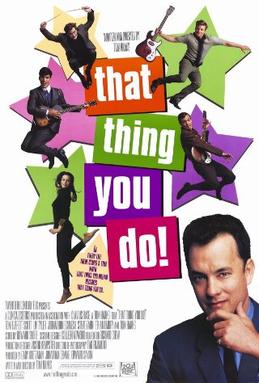
That Thing You Do! (1996, directed by Tom Hanks)


That Thing You Do! is the story of a one-hit wonder.

In 1964, an aspiring Jazz drummer named Guy (Tom Everett Scott) is a last minute addition to the a local band called the Oneders.  (It’s meant to sound like Wonders but almost everyone mispronounces it as O-Needers.)  The band’s egotistical leader, James (Jonathon Schaech) has written a slow ballad called That Thing You Do! but when Guy’s drumming causes the band to perform the song at a faster tempo, they end up with a local hit on their hands.  That local hit becomes a national hit when The Oneders are signed by Play-Tone Records.  First, Mr. White (Tom Hanks), their new manager, officially changes the name to The Wonders.  Secondly, he makes sure that every teen in America is dancing to That Thing You Do!  Third, he tells Guy to always wear sunglasses.  Fourth, he tells James that he will record and perform what Play-Tone tells him to.  Guitarist Lenny (Steven Zahn) and the unnamed Bass Player (Ethan Embry) are happy to be along for the ride but James chafes at his lack of artistic freedom.  Guy, meanwhile, falls for James’s girlfriend (Liv Tyler, at her loveliest) and dreams of meeting his idol, jazzman Del Paxton (Bill Cobbs).

That Thing You Do! was Tom Hanks’s directorial debut and, with its careful recreation of a bygone era and its collection of authentic sounding early 60s rock on the soundtrack, it was obviously a labor of love.  Considering the number of times that the song is played in the movie, it helps that it is a very good song.  That Thing You Do! is a catchy tune, one that you can’t help but tap your feet to.  At the same time, it also sounds like a one hit wonder.  It’s good but not so great as to make you expect much else from The Wonders.

Not surprisingly, Tom Hanks gets great performances from the entire ensemble cast.  Johnathon Schaech and Tom Everett Scott have never been better.  Liv Tyler is lovely and vulnerable as James’s unappreciated girlfriend.  Familiar faces like Peter Scolari, Kevin Pollak, Chris Isaak, and Clint Howard make welcome appearances.  Hanks himself is surprisingly intimidating as Mr. White.  When he says that the band will cover something the Play-Tone catalogue, it’s obvious that he’s not making a request.

The film is a tribute to being young and to loving music bit it’s also a study in the disillusionment of discovering that everything is ultimately a business.  James is frequently an arrogant jerk and he treats his girlfriend terribly but it’s hard not to sympathize with him when he says that he wants to do more than just cover songs from the Play-Tone catalogue.  To James and Guy, the Wonders are about self-expression and their love of music.  To Mr. White, the Wonders are just another band that came up with one catchy tune and who probably aren’t ever going to be heard from again.   That Thing You Do! pays tribute to all of the one-hit wonders out there, the bands who you forget about until you just happen to hear that one song on the radio or in a movie and suddenly, all the memories come flooding back.


Book and Film Review: Get Shorty (by Elmore Leonard and dir by Barry Sonnenfeld)


In 1995’s Get Shorty, John Travolta stars as Chili Palmer.

Chili is a loan shark for the mob, an effortlessly cool guy who lives in Miami and who loves to watch old movies.  Chili may work for the Mafia and he may make his living by intimidating people but he doesn’t seem like such a bad guy, especially when compared to someone like Ray “Bones” Barboni (Dennis Farina).  Bones is an uncouth and rather stupid gangster who steals Chili’s leather jacket from a restaurant.  Chili reacts by breaking Bones’s nose with just one punch.  Bones reacts by trying to shoot Chili but instead, he gets shot by Chili himself.  (The bullet only grazes his forehead.)  Chili can do all this because he’s protected by Momo (Ron Karasbatsos) but, after Momo drops dead after having to walk up several flights of stairs just to then be given a surprise birthday party, Chili suddenly finds himself working for Bones.  (This all happens in the first few minutes of this perfectly paced film.)

Bones, eager to humiliate Chili, sends him to Vegas to collect on a debt owed by a dry cleaner named Leo (David Paymer).  Leo is thought to be dead but Bones wants to collect the money from Leo’s widow.  It’s not the sort of thing that Chili likes to do so instead, he ends up going to Hollywood to collect a debt from B-movie director Harry Zimm (Gene Hackman).  Chili  happens to like Harry’s movies.  He also likes Harry’s current girlfriend and frequent co-star, actress Karen Flores (Rene Russo).

Chili ends up in Hollywood, a town where everyone has some sort of hustle going.  Chili finds himself dealing with drug dealers (Delroy Lindo), egocentric film stars (Danny DeVito), stuntmen-turned-criminals (James Gandolfini), and the widow (Bette Midler) of a screenwriter.  Chili also finds himself looking to escape from the debt collection business by becoming a film producer.  Harry has a script that he wants to make.  Chili proposes a film based on the story of Leo the dry cleaner.  Danny DeVito’s Martin Weir wants to be a “shylock” in a movie just so he can show off his intimidating stare.  (“Is this where I do the look?” he asks while listening to the pitch.)  Get Shorty is a whip-smart satire of Hollywood, one in which the gangsters want to be film people and all of the film people want to be gangsters.  It features wonderful performances from the entire cast, with Travolta epitomizing cool confidence as Chili Palmer.  Hackman, Russo, DeVito, Gandolfini, and Lindo are all excellent in their supporting roles but I have to admit my favorite performance in the film is probably given by Dennis Farina, who turns Bones Barnobi into a very believable (and a believably dangerous) buffoon.

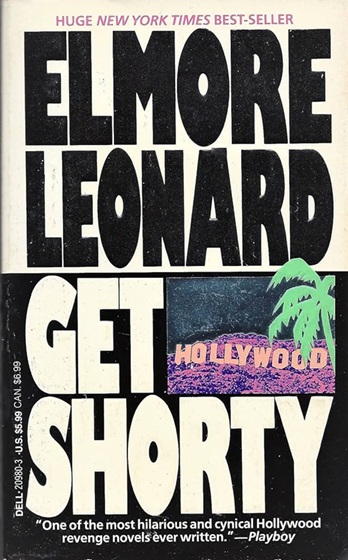
Get Shorty is based on a book by Elmore Leonard.  First published in 1990, the book is a quick and entertaining read, one that reminds us that Leonard was one of the best “genre” writers of his time.  When I read that book, I was surprised to see how closely the movie stuck to the book’s plot.  Much of the film’s dialogue is right there in the book.  It’s a book that practically shouts, “Turn me into a movie!” and fortunately, director Barry Sonnenfeld did just that.

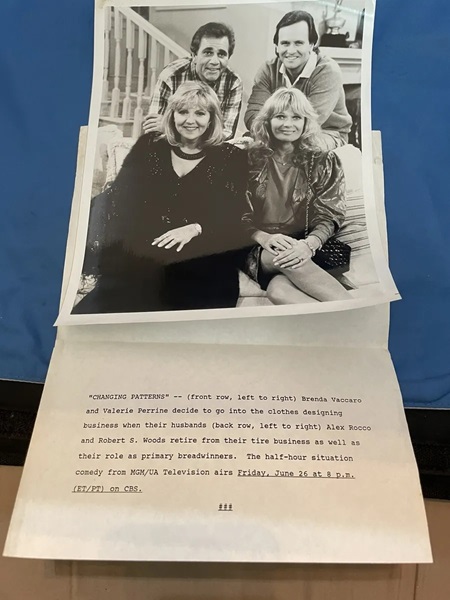
Retro Television Review: Changing Patterns 1.1 “Pilot”


Welcome to Retro Television Reviews, a feature where we review some of our favorite and least favorite shows of the past!  On Thursdays, I will be reviewing Changing Patterns, which aired on CBS in 1987.  The entire show is currently streaming on YouTube!

This week, Valerie Perrine and Brenda Vaccaro are changing patterns!

Episode 1.1 “Pilot”

(Dir by Linda Day, originally aired on June 26th, 1987)

Molly (Oscar nominee Valerie Perrine) and Maxine (Oscar nominee Brenda Vacarro) are two housewives who lives in the suburbs.  Molly’s husband (Alex Rocco) is an old friend of Maxine’s husband (Robert S. Woods).  Maxine’s husband makes smoothies in the blender.  Molly’s husband likes to play golf.  They made a fortune in the tire business but now, they’re both retired and ready to support Maxine and Molly’s dream.  What a wacky group of neighbors.

Molly and Maxine are trying to break into the fashion industry.  Since this the 80s, all of their designs feature shoulder pads and none of them look like they would, in any way, flatter the figure of anyone under the age of 57.  Despite having never sold a design and presumably having never made any money from their career, Molly and Maxine have a store in the mall and they’re able to employ a professional cutter (Eric Christmas).

When Steve Ballinger (George DelHoyo), a buyer from Sacks, steps into their store, he’s impressed with their work.  He wants to buy some of their hideous designs.  But — uh oh! — he also mentions that he would like to set Maxine up with a single friend of his.  Molly and Maxine assume that Steve is talking about himself and, eager to make a sale, they don’t reveal that Maxine is married.

Molly and Maxine lie to their husbands and then meet Steve for dinner.  Steve shows up with his wife!  And his single friend, Jim (Hugh Maguire).  When Molly and Maxine thought that Steve was interested in Maxine himself, they thought he was being sleazy.  But when they discover that Steve just wants to Maxine to hook up with his friend, they think it’s charming.  Either way, it doesn’t really seem that professional on Steve’s part.  I, honestly, was expecting Steve to be revealed to be a big liar.  I mean, do buyers of major stores really walk around the strip mall?  Not to mention that none of Molly and Maxine’s designs were actually any good or, in any way, unique.  Steve might soon be out of a job.

Anyway, Maxine reveals that she is married and everyone has a good laugh over the misunderstanding.  Then Molly and Maxine go home and have a second dinner with their husbands, who are both amazingly forgiving of the whole lying thing.  I mean, Alex Rocco was Moe Greene.  There’s just something weird about seeing him play such a wimpy character.

You can probably guess that this was the only episode of Changing Patterns.  The show had a number of problems, including a laugh track that went off even when nothing funny was happening.  The main problem, though, is that Molly and Maxine were pretty much interchangeable.  They both had the same personality, the same outlook, the same ambitions, and the same sense of humor.  That might work for a friendship but, for a television show, it means that there’s not enough conflict to keep things interesting.  For Changing Patterns to succeed, it would have needed to change its own patterns.

Scenes That I Love: Michael Corleone Visits Las Vegas In The Godfather


Today, the Shattered Lens wishes a happy birthday to the great Al Pacino.

Today’s scene that I love comes from 1972’s The Godfather, in which Al Pacino plays Michael Corleone.  In this scene, Michael, having just taken over the Corleone family, pays a visit to Vegas.  He meets his brother Fredo (John Cazale), who has certainly changed from being the meek person that he was in New York.  He meets the singer Johnny Fontana (Al Martino), who owes a favor to the Corleones.  And he meets Moe Greene (Alex Rocco), who soon discovers that the Corleones cannot be intimidated.  Most importantly, Michael proves that he is now in charge of the family.  At the end of the scene, Michael gives Fredo an important warning and sets up the tragic ending of the The Godfather Part II.

Horror on TV: Circle of Fear 1.20 “Spare Parts” (dir by Charles S. Dubin)


On tonight’s episode of Circle of Fear, Susan Oliver plays the widow of a doctor who allows his hands, eyes, and vocal chords to be used in transplants.  Unfortunately for her, the spirit of her dead husband is still inside of his donated body parts.  Because he’s convinced that she murdered him, the dead doctor seeks an elaborate revenge on his wife.

This episode originally aired on February 23rd, 1973.  It was written by Jimmy Sangster, who is best known for his work with Hammer Films.

Enjoy!

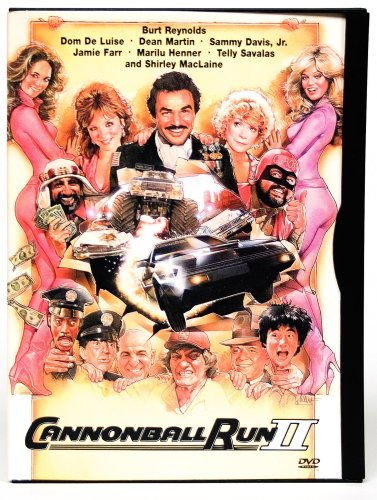
Cannonball Run II (1984, directed by Hal Needham)


In 1981, director Hal Needham and star Burt Reynolds had a surprise hit with The Cannonball Run.  Critics hated the film about a race from one end of America to the other but audiences flocked to watch Burt and a group of familiar faces ham it up while cars crashed all around them.  The original Cannonball Run is a goofy and gloriously stupid movie and it can still be fun to watch.  The sequel, on the other hand…

When the sequel begins, the Cannonball Run has been discontinued.  The film never explains why the race is no longer being run but then again, there’s a lot that the sequel doesn’t explain.  King Abdul ben Falafel (Ricardo Montalban, following up The Wrath of Khan with this) wants his son, The Sheik (Jamie Farr, returning from the first film) to win the Cannonball so he puts up a million dollars and announces that the race is back on.  Problem solved.

With the notable exceptions of Farrah Fawcett, Roger Moore, and Adrienne Barbeau, almost everyone from the first film returns to take another shot at the race.  Burt Reynolds and Dom DeLuise are back.  Jack Elam returns as the crazy doctor, though he’s riding with the Sheik this time.  Jackie Chan returns, riding with Richard “Jaws” Kiel.  Dean Martin and Sammy Davis, Jr. return, playing barely disguised versions of themselves.  They’re joined by the surviving members of the Rat Pack.  Yes, Frank Sinatra is in this thing.  He plays himself and, from the way his scenes are shot, it’s obvious they were all filmed in a day and all the shots of people reacting to his presence were shot on another day.  Shirley MacClaine also shows up, fresh from having won an Oscar.  She plays a fake nun who rides with Burt and Dom.  Burt, of course, had a previous chance to co-star with Shirley but he turned down Terms of Endearment so he could star in Stroker AceCannonball Run II finally gave the two a chance to act opposite each other, though no one would be winning any Oscars for appearing in this film.

Say what you will about Hal Needham as a director, he was obviously someone who cultivated a lot of friendships in Hollywood because this film is jam-packed with people who I guess didn’t have anything better to do that weekend.  Telly Savalas, Michael V. Gazzo, Henry Silva, Abe Vigoda, and Henry Silva all play gangsters.  Jim Nabors plays Homer Lyle, a country-fried soldier who is still only a private despite being in his 50s.  Catherine Bach and Susan Anton replace Adrienne Barbeau and Tara Buckman as the two racers who break traffic laws and hearts with impunity.  Tim Conway, Don Knotts, Foster Brooks, Sid Caesar, Arte Johnson, Mel Tillis, Doug McClure, George “Goober” Lindsey, and more; Needham found room for all of them in this movie.  He even found roles for Tony Danza and an orangutan.  (Marilu Henner is also in the movie so I guess Needham was watching both Taxi and Every Which Way But Loose while casting the film.)  Needham also came up with a role for Charles Nelson Reilly, who is cast as a mafia don in Cannonball Run II.  His name is also Don so everyone refers to him as being “Don Don.”  That’s just a typical example of the humor that runs throughout Cannonball Run II.  If you thought the humor of It’s A Mad, Mad, Mad, Mad World was too subtle and cerebral, Cannonball Run II might be right up your alley.

The main problem with Cannonball Run II is that there’s not much time spent on the race, which is strange because that’s the main reason why anyone would want to watch this movie.  The race itself doesn’t start until 45 minutes into this 108 minute film and all the racers are quickly distracted by a subplot about the Mafia trying to kidnap the Sheik.  Everyone stops racing so that Dean Martin and Sammy Davis, Jr. can disguise themselves as belly dancers to help rescue the Sheik.  By the time that’s all been taken care of, there’s only 10 minutes left for everyone to race across the country.  After a montage of driving scenes and a cartoon of an arrow stretching across the nation (the cartoon was animated by Ralph Bakshi!), we discover who won the Cannonball and then it’s time for a montage of Burt and Dom blowing their lines and giggling.  Needham always ended his films with a montage of everyone screwing up a take and it’s probably one of his most lasting cinematic contributions.  Every blooper reel that’s ever been included as a DVD or Blu-ray extra owes a debt of gratitude to Hal Needham.  Watching people blow their lines can be fun if you’ve just watched a fun movie but watching Burt and Dom amuse themselves after sitting through Cannonball Run II is just adding insult to injury.  It feels less like they’re laughing at themselves and more like they’re laughing at you for being stupid enough to sit through a movie featuring Tony Danza and an orangutan.

The dumb charm of the first Cannonball Run is nowhere to be found in this sequel and, though the film made a profit, the box office numbers were still considered to be a disappointment when compared to the other films that Reynolds and Needham collaborated on.  Along with Stroker Ace, this is considered to be one of the films that ended Reynolds’s reign as a top box office attraction.  Cannonball Run II was also the final feature film to feature Dean Martin and Frank Sinatra.  This could be considered the final Rat Pack film, though I wouldn’t say that too loudly.

Cannonball Run II is a disappointment on so many levels.  It’s hard to believe that the same director who did Smokey and the Bandit and Hooper could be responsible for the anemic stunts and chases found in this movie.  The cast may have had a good time but the audience is left bored.  Stick with the first Cannonball Run.


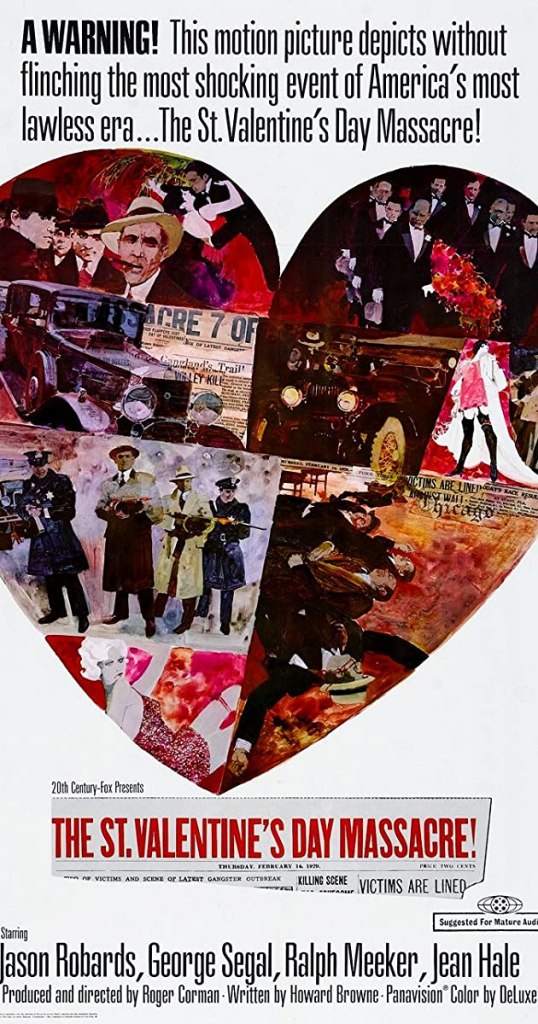
An Offer You Can’t Refuse #18: The St. Valentine’s Day Massacre (dir by Roger Corman)


On February 14th, 1929, seven men were murdered in a garage in Chicago, Illinois.  Five of the seven men were known to be associates of gangster George “Bugs” Moran.  The other two men were considered to be innocent bystanders, a mechanic and a dry cleaner who just happened to enjoy hanging out with gangsters.  Though no one was ever convicted of the crime, it was well-known that the murders were carried out on the orders of Al Capone.

In many ways, the St. Valentine’s Day Massacre was a turning point in America’s relationship with organized crime.  Before the massacre, Capone had become a bit of a folk hero.  He knew how to talk to the press and he was viewed as merely breaking a law (in this case, prohibition) that most people opposed in the first place.  However, after the murders, public opinion soured on Capone.

Some of it was the brutality of the crime.  It’s been said that over five hundred bullets were fired in that garage, all to kill seven defenseless men who were lined up against a wall.  Grisly pictures of the victims were released to the press.  Perhaps if the seven men had been carrying weapons and had been involved in a shootout with their murderers, the public’s reaction would have been different.  But this was a cold-blooded execution.

Personally, I think the fact that the killers disguised themselves as cops also played a role in the public’s outrage.  It was a very calculated move on the part of the killers and it highlighted just how much planning went into the St. Valentine’s Day Massacre.  As well, it undoubtedly made people paranoid.  If a bunch of killer could dress up like cops, who knew who else they could dress up as?

Finally, I think that Capone’s biggest mistake was carrying out the crime on Valentine’s Day.  You don’t murder people on a holiday.  Anyone should know that.  If Capone had waited until February 20th, he probably could have gotten away with it.

The 1967 film, The St. Valentine’s Day Massacre, details the rivalry between Capone and Moran, starting with them fighting for control over the Chicago rackets and ending with the title event.  Moran is played by Ralph Meeker while Jason Robards plays Capone.

Now I know what you’re probably thinking.  Perennial WASP Jason Robards as Al Capone?  That may sound like odd casting and, let’s just be honest here, it is.  However, it actually kind of works.  Robards may not be convincingly Italian but he is convincingly ruthless.  Add to that, one of the major subplots of the St. Valentine’s Day Massacre is that, even as the head of the Chicago Outfit, Capone still feels like an outsider in the world of organized crime because, while he is Italian, he isn’t Sicilian.  Capone feels as if Lucky Luciano and all of the major New York crime bosses look down on him and one reason why he’s so ruthless about taking over Chicago is that wants to show Luciano that he can be just as effective a crime lord as any Sicilian.  Capone feeling out of place in the Mafia is reflected by Robards initially seeming to be out of place in a gangster film.  By the end of the movie, of course, Capone has proven himself and so has Jason Robards.

Robards isn’t the only familiar face to be found in The St. Valentine’s Day Massacre.  Though this film was released by 20th Century Fox, it was directed by Roger Corman and Corman fills the production with members of his stock company.  Dick Miller, Jonathan Haze, and Jack Nicholson all have small roles as gunmen.  Bruce Dern plays the unlucky mechanic who enjoys hanging out with gangsters.  Buck Taylor, Leo Gordon, and Joe Turkel all have small roles.  John Agar plays Dion O’Bannon and is gunned down in his flower store.  Though not members of the Corman stock company, George Segal and David Canary plays brothers who work for Moran.  There’s a lot of characters wandering through this film but Corman makes sure that everyone gets a chance to make an impression.

It’s a good gangster film.  Though he was working with a larger budget than usual, Corman still brought his exploitation film aesthetic to the material and the end result is a violent, melodramatic gangster film that looks really impressive.  The film’s recreation of 1920s Chicago is a visual delight and looking at the well-dressed and stylish gangsters walking and driving down the vibrant city streets, you can understand why organized crime would have such a draw for some people.

The St. Valentine’s Day Massacre is a classic gangster film and a classic Corman film.  It’s an offer you can’t refuse.

Previous Offers You Can’t (or Can) Refuse:

  1. The Public Enemy
  2. Scarface
  3. The Purple Gang
  4. The Gang That Could’t Shoot Straight
  5. The Happening
  6. King of the Roaring Twenties: The Story of Arnold Rothstein 
  7. The Roaring Twenties
  8. Force of Evil
  9. Rob the Mob
  10. Gambling House
  11. Race Street
  12. Racket Girls
  13. Hoffa
  14. Contraband
  15. Bugsy Malone
  16. Love Me or Leave Me
  17. Murder, Inc.


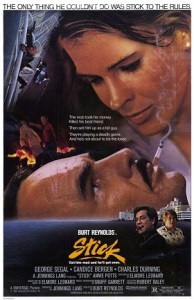
A Movie A Day #167: Stick (1985, directed by Burt Reynolds)


Stick (Burt Reynolds) is a veteran car thief who has just gotten out of prison.  No sooner has Stick arrived home in Florida then he accompanies his friend, Rainy (Jose Perez), on a drug deal that goes bad.  When Rainy is killed, Stick goes into hiding.  He manages to get a stable job, working as a chauffeur for an eccentric millionaire (George Segal).  He gets a new girlfriend (Candice Bergen) and starts to bond with his teenage daughter (Tricia Leigh Fisher).  Stick wants to go straight but, before he can, he knows that he has to confront the men who murdered Rainy.

Stick starts out strong.  The first half of the film finds Burt, who was often as underrated as a director as he was as an actor, in pure Sharky’s Machine mode, mixing the steamy Florida atmosphere with quirky character comedy and hardboiled action.  Adapting his own novel, Elmore Leonard wrote the screenplay and Stick seems like a classic Leonard hero, a criminal with his own moral code.  

But then Stick falls apart during the second half and it becomes obvious why both Reynolds and Leonard often cited this film as being one of the biggest disappointments of their careers.  Universal Studios disliked Burt’s first cut of the film and brought in a second screenwriter, who beefed up the action scenes and added the subplot with Stick’s teenage daughter.  Reynolds reshot the second half of the movie, no longer playing Stick as a tough criminal but instead as another variation on the Bandit.  The end result is a very disjointed movie, with Burt looking bored.

It does not help that the movie’s main villain is played by Charles Durning, who wears an orange fright wig and several Hawaiian shirts.  Durning was an actor who gave many great performances but never was he as miscast as when he played a drug dealer in Stick.