There are A LOT of bad horror films out there and I mean Halloween Resurrection bad, but when you get a truly great one, it sticks with you for your life. This movie is more unique in that the writer Alex Garland really peaked with this film and there are IMDB credits to prove it. Danny Boyle directed the piece and you really feel as though you were inhabiting the after-times of a dead world….well, undead. Danny Boyle did Trainspotting, Slumdog Millionaire, 127 hours, but I know what you’re thinking- Did he write anything besides family films for Disney? Yes, he made this awesome zombie film.
We see shots of terrible violence and realize that monkeys are being forced to watch it. Then, Animal Rights Activists enter heavily armed with guns and sanctimony. The researcher begs them not to release the animals because they are infected with a terribly contagious disease and that the goal of their research is to find a cure for rage. The Animal Rights Activists patiently listen to the scientist instead of acting purely from smug instinct, dooming us all. Just kidding, they release one of the monkeys, it rips the animal rights activist apart, barf bleeds all over her, making her patient zero, and I try really hard not to root for the diseased monkey. The disease is out! Of course, many of us always knew that animal rights activists would lead to the zombie apocalypse. Just read their twitter feeds and you’ll know that they’ll doom us all. Fade to Black and 28 Days Later… appears as a subtitle in the bottom right….BRILLIANT!!!
Jim wakes from a coma to a dead world. Sound familiar? Yes, TWD went beyond homage there. He leaves the hospital to amazing details that really sell a dead London. Empty hospital, empty streets, garbage, worthless cash everywhere, a bus is overturned in front of parliament, and an amazing score reveals a World without people. If you’re looking for the song that plays when he’s walking around dead London during the opening – it’s by Godspeed You! Black Emperor – East Hastings – Long Version.
HOW DID THEY MAKE LONDON EMPTY? MERLIN! This is England, after all. Nah, Danny Boyle got MANY government officials to agree to let the production shutdown huge traffic arteries for 90 seconds at a time. London is one my most favorite cities and I would love to live there and it is Europe’s New York City, therefore, imagine shutting down Times Square for filming.
Jim gets chased by fast-moving zombies and meets Selena and a Red Shirt. He goes with them and realizes very quickly that he was probably better off in a coma. Jim insists on seeing his parents. They agree to take him and he finds them suicided on the bed clutching a note that reads- “With endless love, we left you sleeping. Now, we’re sleeping with you. Don’t wake up.” This is not your dad’s zombie movie. They decide to stay at his house for the night, but are attacked by zombies. Red Shirt gets infected and is dispatched by Selena. Jim and Selena must flee.
Jim and Selena venture forth and find Frank and his daughter Hannah. It hasn’t rained for some time, therefore -no water. For survival, they have to leave the city. Selena doesn’t want to go with Frank and his daughter because she sees them as anchors, but Jim insists and Hannah explains that we actually need each other. Frank plays a radio signal that beckons them to safety and they leave as one tribe. Along the way, there are some intense scenes and some shopping. They arrive at the salvation location, but Frank gets infected and is killed by soldiers.
Right away, you can tell that the soldiers are goofing off too much. I have commanded soldiers and there’s some level of goofing off, but this had an air of creepiness and broken discipline. The soldier’s have taken over a residence as their HQ and have put up defenses to keep zombies out and people in. We quickly learn that the radio message was a trap. Corporal Mitchell harasses Selena and a fight erupts. The Major breaks it up, but it’s clear that Jim, Hannah, and Selena are prisoners. The Major explains that the soldiers could not face a dead world and one attempted suicide. The Major had a plan- lure women to the compound with a radio signal. When they arrived, they would keep them prisoner to breed with his soldiers to restart civilization. He puts it simply: women equal hope. His logic and delivery is truly chilling in its cold mathematics.
They decide to execute Jim and a SGT who gets in their way and keep Hannah and Selena for reproduction. Corporal Mitchell and another Soldier take Jim and the SGT out for execution to a killing field. Corporal Mitchell wants to bayonet Jim, the other Soldier can’t handle that kind of intimate murder, leading to a melee. The SGT is killed and Jim escapes.
The next sequence is truly amazing because we see our hero morph from the sensitive man that he is naturally to a state of feral revenge indistinguishable from the fast-moving zombies. He’s shirtless to further emphasize his lack of civility as he makes short work of many of the soldiers to rescue Hannah and Selena. Corporal Mitchell who wanted to bayonet him and rape Selena becomes the focal point of Jim’s rage- Jim puts his thumbs deep into Corporal Mitchell’s eyes until he’s dead. This is a critical act of monstrosity because it shows not tells in the clearest finality that there is no separation between Jim’s blind rage and the rage that has infected the human population.
I don’t want to totally spoil the ending because this film will remain with you and is a must see. It’s commentary on violence and society is forever salient: Violence is horrific, but forced civilization is worse and will lead to the ultimate act of revenge – THUMBS IN YOUR EYEBALLS or some such equivalent. The other important lesson the film tries to inculcate is to beware of self-certain sanctimonious people because their grandiosity could doom us all.
I know this was already reviewed by Leon last year. I watched it for the first time this March. It has bothered me ever since, so I decided to purge it from my system by writing my own review of the film. Can you tell I didn’t really like it?
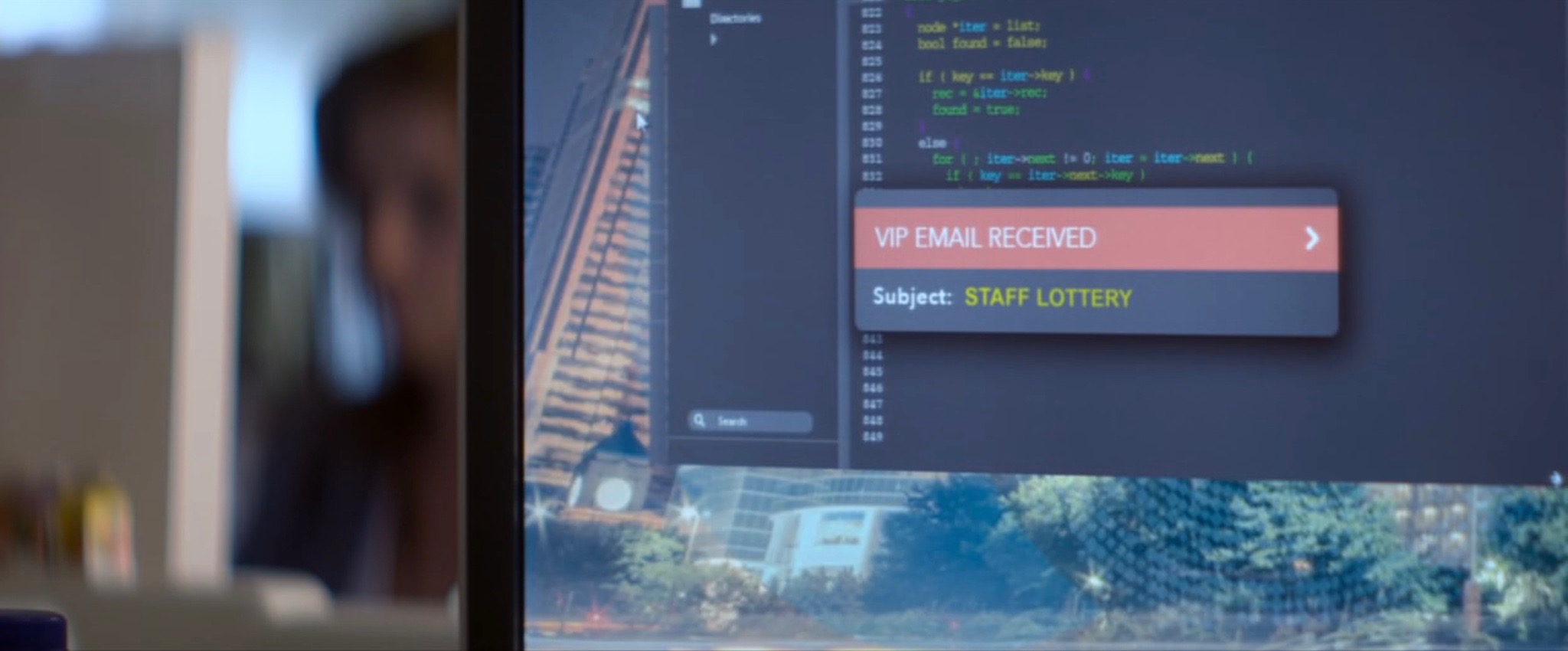
The movie opens up and we meet our main character Caleb (Domhnall Gleeson). He just won the “Staff Lottery”.
Whatever gets him out of having to program a search algorithm in C++ is a good thing. C++ is not the most fun language to program in, which is why I assume he switches to using Python later on in the film. If you think that’s going to lead to Caleb asking the robot about non-computable functions such as The Halting Problem, then you’re going to be very disappointed. These are functions that to a computer cannot be evaluated to obtain their result. That means there are problems that cannot be solved by machine intelligence. This of course leads to a debate about what exactly does natural intelligence have that machine intelligence doesn’t, and what does that say about whether a machine has consciousness. All things that will not be brought up. These are things I learned in a course I took before a basic ground level Computer Science course. A remedial CS course. Caleb not knowing these things is like making a movie about racing when the main character, who is a mechanic, can’t change a tire.
Now we are off to where Oscar Isaac’s character lives.
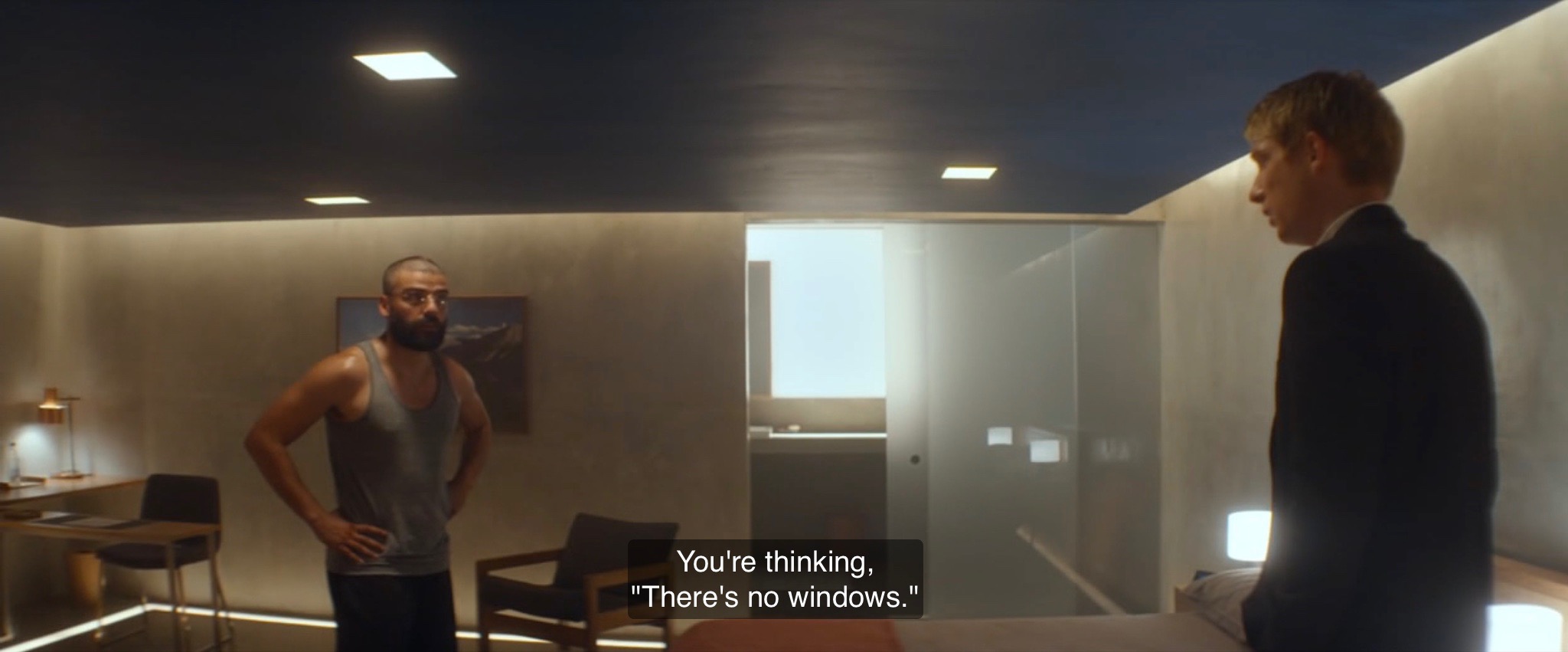
I know his name is Nathan, but I just kept referring to him as Beard while watching the film. When Caleb shows up to enter his place I had to pause the movie.
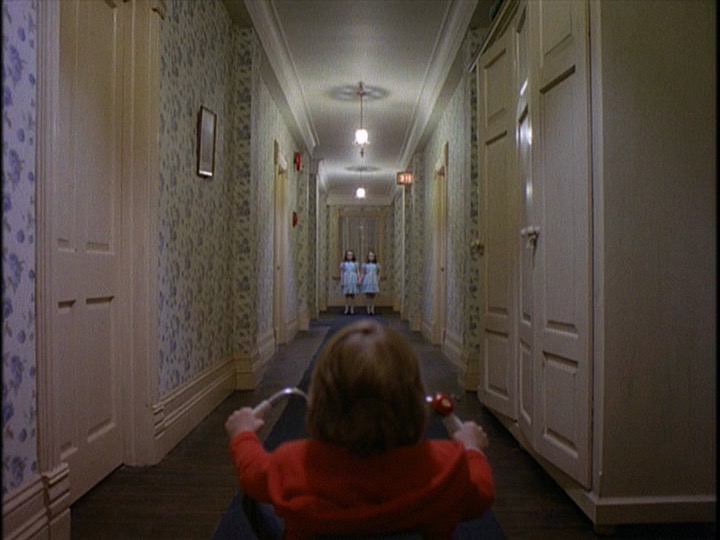
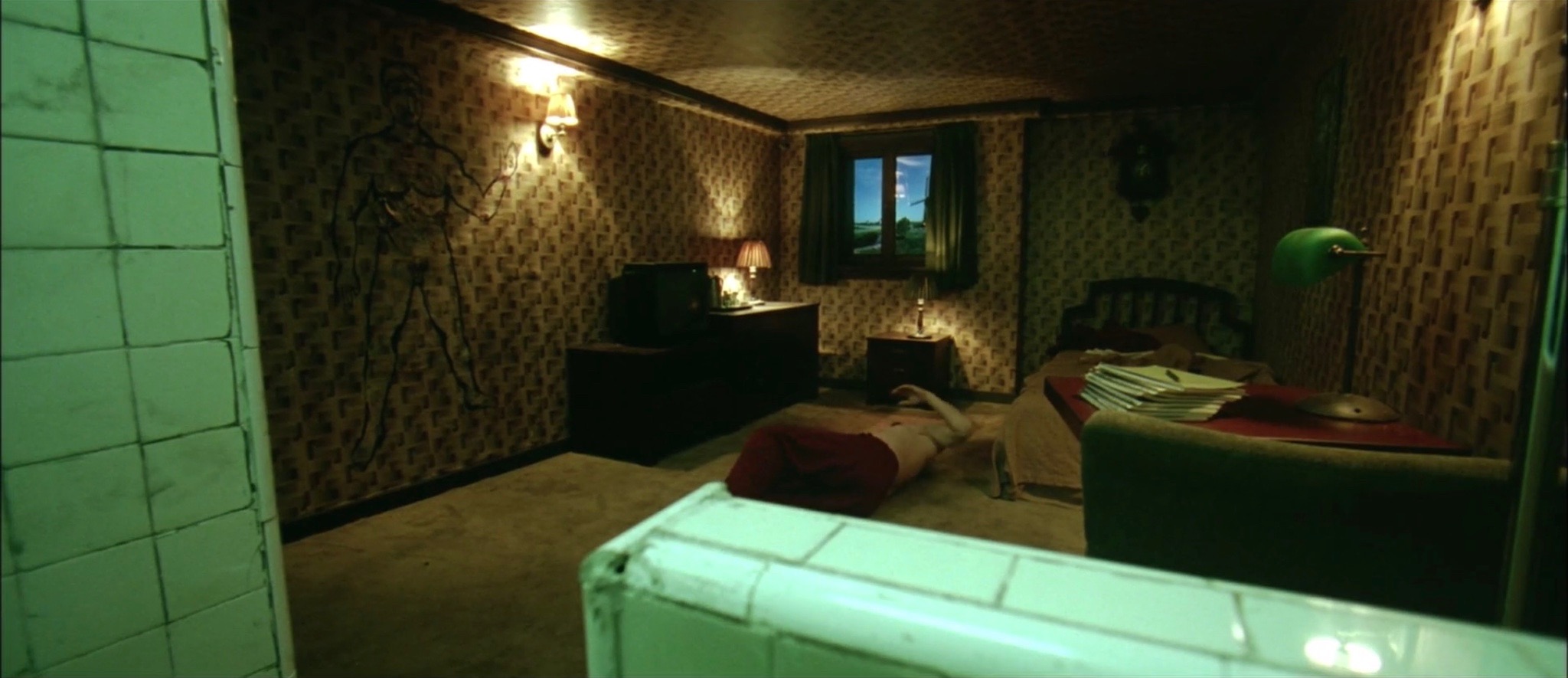
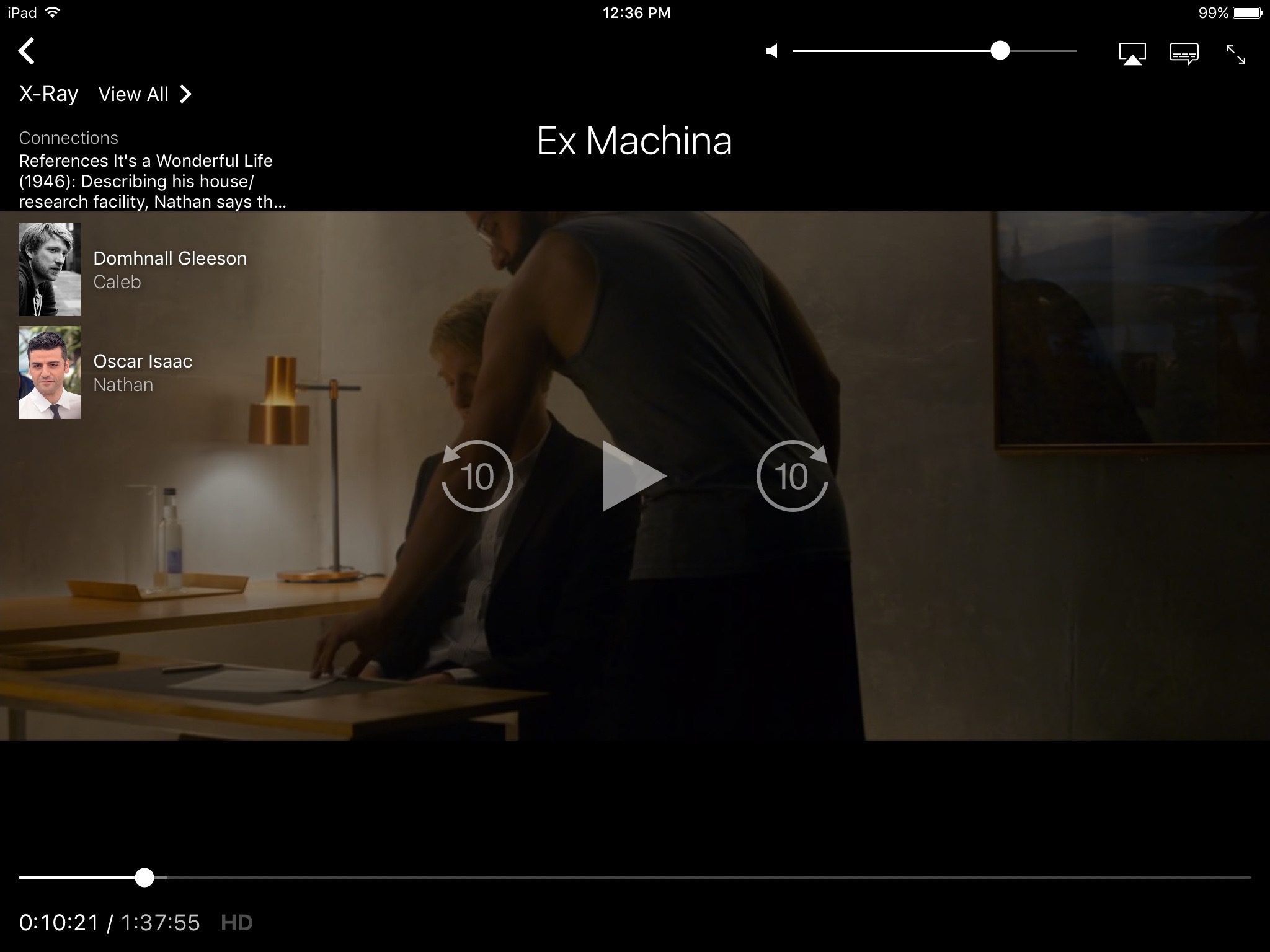
I love watching movies on the iPad with the Amazon Prime app because it not only tells you the characters, but it also drops in trivia about the current scene. This is how I know that this takes place at the Juvet Landscape Hotel in Alstad, Valldal, Norway. Beard has a pretty nice place. It comes with it’s own Kubrickian hallways…
The Shining (1980, dir. Stanley Kubrick)
and Oldboy (2003) prison rooms.
Oldboy (2003, dir. Chan-wook Park)
Beard gives Caleb a key that will only open rooms and let him use devices that he is allowed to use. It’s kind of like a computer game. In fact, that’s how you could describe the whole movie in a nutshell. It’s a game composed of cutscenes with the robot and Beard, except you don’t get to run around in between, and there are no dialog trees.
After showing Caleb into his room, he tells him he needs to sign an Non-Disclosure Agreement. Again, I had to pause the movie here cause I was taking care of my dog while a new ceiling fan was being put in.
Okay, if you say so, then Beard saying his home is his research facility is a reference to It’s A Wonderful Life (1946). Now we get the Ex Machina definition of what a Turing Test is that isn’t what a Turing Test actually is. Caleb says:
“I know what the Turing Test is. It’s when a human interacts with a computer. And if the human doesn’t know they’re interacting with a computer, the test is passed”
Actually, the Turing Test is when you have a “Human interrogator” that is separated by a barrier with an isolated interface that let’s the interrogator interact with two sources that are both separated from each other and the interface. One source is a human being who has never met the interrogator. The other source is a machine that is being tested. If the interrogator cannot distinguish the two sources from each other than robot has passed the test.
Such a test is never really performed in this film unless you think that the point when Caleb cuts himself, he believes he might be a robot because he thinks he is indistinguishable from the robot. It’s not the same, but it may have been stuck in there to allude to that. Regardless, it means that it would be literally impossible for the Turing Test to even be performed since it would require three humans (a source, an interrogator, and someone setting up the experiment), and there are only two humans at Beard’s home. Here’s a nice diagram from the Second Edition of Introduction to Artificial Intelligence by Philip C. Jackson Jr.
It doesn’t really prove that the computer has “artificial intelligence” either, but that a human being can’t tell the difference. That simply means it can pass for human in this controlled environment. That’s of course why the film will unceremoniously toss it aside in favor of a setup that will allow for a lot of engagement between actors that is done face-to-face.
Thus begins the “test”.
We see Beard’s office first which is covered with post-it notes. I haven’t seen that since I think either the remake of Oldboy or that episode of Beverly Hills, 90210 where Brandon covered a professor’s office with them. Caleb also sees foreshadowing about previous robots who got a little cabin fever when he enters the interrogation room.
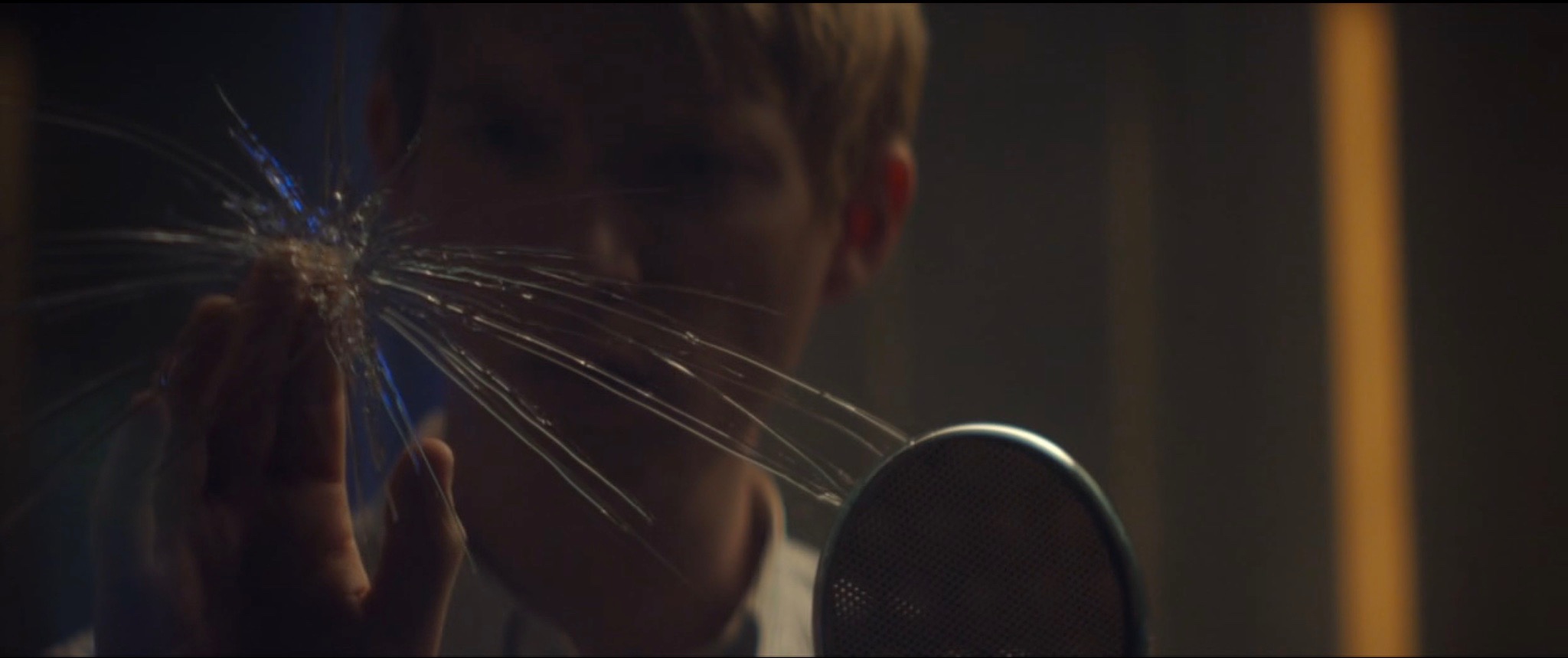
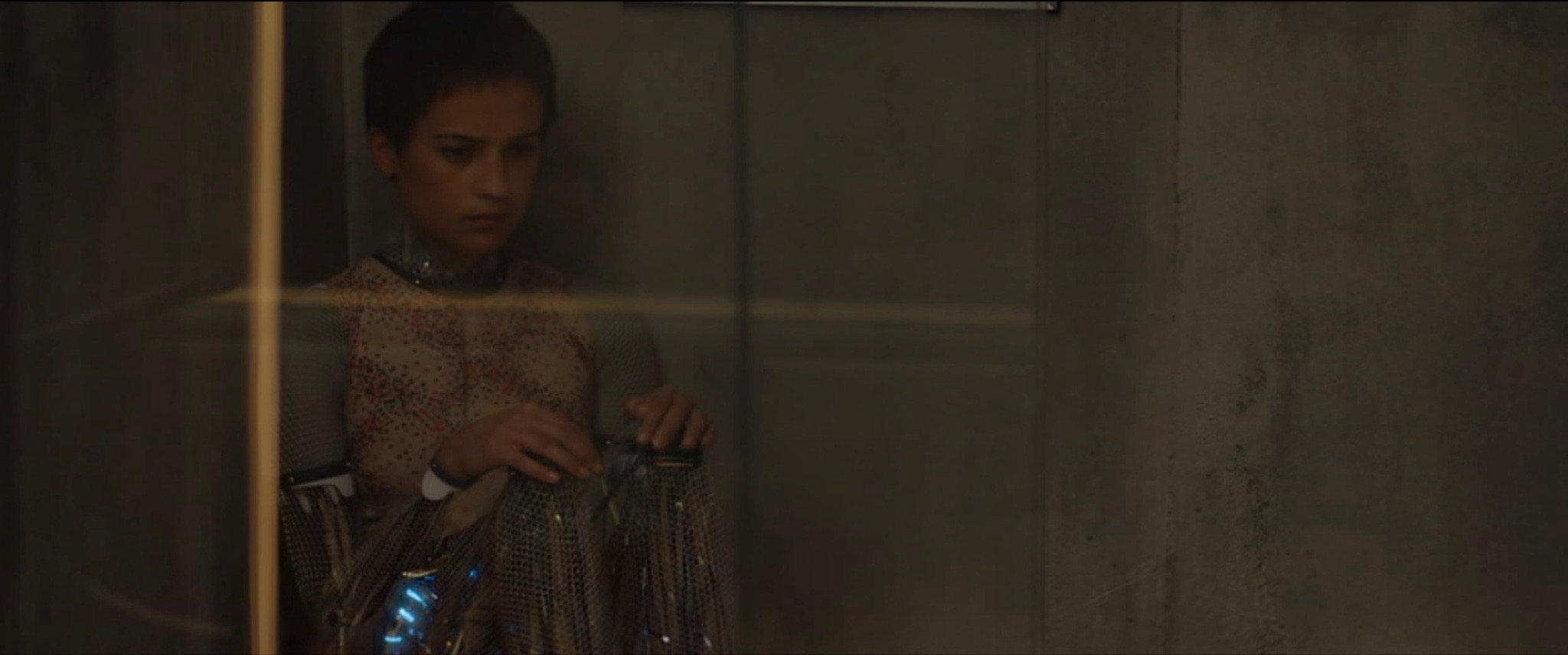
Yes, that is glass. Does he turn right around and walk out because he has obviously been lied to about taking part in a Turing Test? Nope. We just meet Ava played by Alicia Vikander.
I have to admit that I feel a little sorry for her. She really was cast in some terrible movies in 2015. You have this movie of course. You have her in The Man from U.N.C.L.E. where she is just there to make a reference to Anita Ekberg in La Dolce Vita (1959) by standing in a fountain while the male leads all but start making out. She was in The Danish Girl (2015) that will have more people asking children about their genitals since it makes being transgender all about bottom surgery. I loved how it didn’t tell you she had a uterus transplant at the end. Probably because leaving it in would mean the movie is actually equating having babies with identifying oneself as a woman like people think Avengers: Age of Ultron (2015) did. Then she was also in Burnt (2015), but I’ll be damned if I could find her in it while watching it.
No, I’m not kidding about The Danish Girl having that effect. People ask transgender children all the time about whether they plan to have surgery when they get older and that movie doesn’t help. Neither do other things, but I refuse to review that movie right now.
After some initial pleasantries, he asks how she learned to speak. She says she “always knew how to speak.” She also says she thinks she is clever since “language is something that people acquire” but she can apparently do it out of the box. He responds about language being inborn in the human mind, and that it is only attachment of words to this built-in stuff that allows us to speak. You could say it’s an explanation for why everyone gets a free language. This confuses Ava, but I’m more confused why rebooting Tomb Raider in 2018 with her as Lara Croft is a thing that’s happening. This is also a conversation of foreshadowing because we will get an explanation later that, surprise, surprise, shows again that Caleb really doesn’t know about Computer Science.
Now you’d think they would leave the Turing Test thing behind here, but no. They feel the need to rub their nose in it some more.
He says that “if I hid Ava from you, so you just heard her voice, she would pass for human.” Maybe, except the Turing Test uses terminals, not voices, since that really wouldn’t be a test of human intelligence, but speech synthesis. Take for example talking to Siri or a similar intelligent agent. The very fact that it speaks instantly makes people start to think of it as human. That’s an example of Weak AI rather than Strong AI, which is what Ava is supposed to be. They’ll bring up Strong AI later, but will conveniently leave out Weak AI because it would open up holes in the film.
He wants to show him Ava, then see if he feels she has consciousness. What he is actually saying is whether he has effectively recreated superficial aspects of a humanoid robot with a reasonably passable intelligent agent controlling those parts. That’s not even close to the same thing. That would be like saying you have proven somebody actually works for immigration because illegal immigrants run when they see someone in pressed pants, a white shirt, and holding a clipboard enter a factory. You’ve simply proven that you can make something that can socially engineer a person. This is why the separation factor is so important to not have in a movie like this that can’t have its ending if it doesn’t ignore these things.
I don’t know why he couldn’t just say that he already had some people test her in a proper Turing Test, but now he wants him to do what he is asking him rather than just claiming that of course she would pass. Oh, well.
Since this movie isn’t very well written, they now have Caleb spout some jargon about her language abilities. Beard quickly shuts this down by saying he isn’t going to explain how she works. By that, he means until later when he decides to do just that in order to remind us of a real world event that happened a few years ago. The power soon goes out after this too for the purposes of foreshadowing that somebody is doing it, and it changes where and what Caleb is able to do with his keycard.
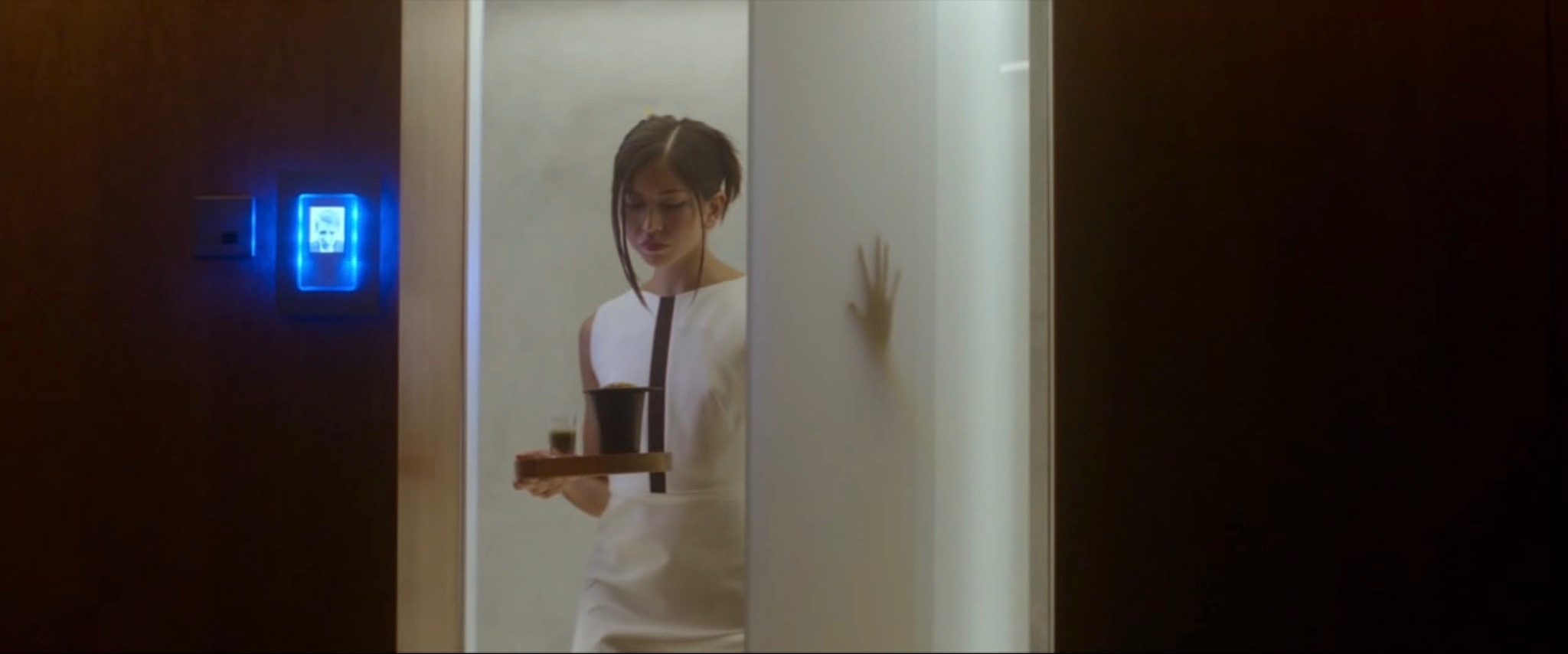
Caleb is now woken up by some speechless Asian lady robot.
That makes two female robots. There must be a male one around here somewhere, right? Of course not. This would lead any reasonable person to wonder if he is building a brothel for straight men. The actual reason the movie tries to subtly slip in is that part of them being human is sexuality and gender. I’m assuming that means he has to test to make sure their vaginas work, and since they are both straight, then the robots must be women. Nope, still comes across like he is building a brothel.
Now Beard and Caleb have another conversation about how to test her. He basically breaks out more jargon, which Beard says isn’t important because too much thinking gets in the way of the drama and building of tension. Seriously, before it cuts to the image below, he says: “How does she feel about you?”
It starts off with Ava showing him a picture, but they already want to turn the tables and have Ava ask Caleb questions as if we really are interested in him. But first we find out that Caleb works for Beard’s own version of Google. Then the funniest thing in the movie happens.
He says that he is an advanced programmer. Sure, Caleb. Sure, and the majority of people knew what a race condition was when they started up Steve Jobs (2015).
Ava goes on to brag about how Beard wrote the code for not-Google when he was 13. She then asks him if he likes Mozart to which he responds that he likes Depeche Mode. What are you trying to say here, Garland? Maybe that people are people? Doesn’t matter because she doesn’t want to listen. She has other priorities like setting up the ending. The movie actually has very little to with robots. It’s about a woman who is imprisoned and uses the dumbest guy she can find to manipulate in order to get out. That’s the real movie in a nutshell. You won’t be asking yourself interesting questions here. It’s all kind of sleight of hand with what appears to be intelligent writing. Then the power goes out again and she takes credit for it before trying to drive a wedge between Caleb and Beard.
Then the power comes back online.
I have an idea. Ask her if on a hot summer night would you offer your throat to the wolf with the red roses. It’s totally random. No matter what she says, you respond that you bet she says that to all the boys. See how she responds. Of course not. This game has you on strict rails and doesn’t give you a dialog tree.
Blah, blah, blah. Now Beard says he is going to show Caleb where he created Ava even though he said he wasn’t going to tell him how she works earlier because it would ruin the test. Remember that they have established that Caleb is an advanced programmer, and at least as a degree in Computer Science. Beard asks him if he knows how he got her to “read and duplicate facial expressions.” That’s easy, you simply get a lot of training data and use it train something like a neural network or some other statistical model. Basic stuff for someone with a Computer Science degree that people use and interact with everyday in the form of a spam filter.
Moving onward, Beard reminds us of that incident a few years back when it was discovered that Apple was using people’s iPhones to do war driving in order to improve their location services. In Beard’s specific case, he simple turned on the camera and microphone on cellphones to get a bunch of data and used it to train whatever he is using. He says the search engine itself, but that doesn’t make sense unless you want to say that his Google can search by image and sound bite, thus allowing for him to build a language of sorts between the collected data and the meanings humans assign them. That actually is probably what they were going for given the explanation of language earlier. It still doesn’t explain why they just had Caleb throw up his hands to say he has no idea how it was done.
Next we find out that writer/director Alex Garland is probably a fan of Quantum Leap. I say that because that is Ava’s brain, which Beard refers to as wetware. What that means is that it should be a combination of physical aspects of the human brain interconnected with mechanical parts to create an artificial intelligence. This is what Ziggy on the show Quantum Leap has as its’ “brain”. That’s why they refer to her as a hybrid computer, and as having aspects of Sam in her since the brain cells are his. We also find out that the software running on it is his version of Google’s search engine.
After showing Caleb another picture, she decides to manipulate him more by putting on hair and clothes. I had to pause the movie again here.
In other words, they told her to just walk rather than walk while swinging her hips. I’m not sure why that was a thing they bothered with honestly. Without that bit of trivia popping up it would have just come across as someone who was shy rather than someone who was starting to conform to the gender forced upon them by form and/or programming.
Now we get Caleb explaining that AI doesn’t need a gender, so that they can get into a conversation that amounts to explaining how things such as neural networks work by using sexual preference as an analogy. A neural network is a graph formed of vertices and lines that is based on the way the human brain works. The vertices have some sort of function that acts on the inputs that are sent into it in order to spit out a value either as a final result or as inputs to other vertices. The lines have a weight that is assigned to them, which is then multiplied by the value being sent along it in order to create the value that enters the vertex it connects to. Here is a very simply example of a neural network taken from AI Application Programming by M. Tim Jones.
What this all means is that using certain techniques such as backwards propagation, you can send information through such a network that in turn adjusts the weights in order to change the way it will operate by changing what it will output. In the context of his explanation, it means that if you pass a bunch of black girls through your brain, and you respond in a certain way, then your brain’s own neural network adjusts to having an attraction to them, or developing a dislike of them sexually. It also depends on the structure of said brain initially and how it is formed during your early years. To go back to the mathematical example, it would mean how many vertices you have, how they are linked, and the functions at each vertex.
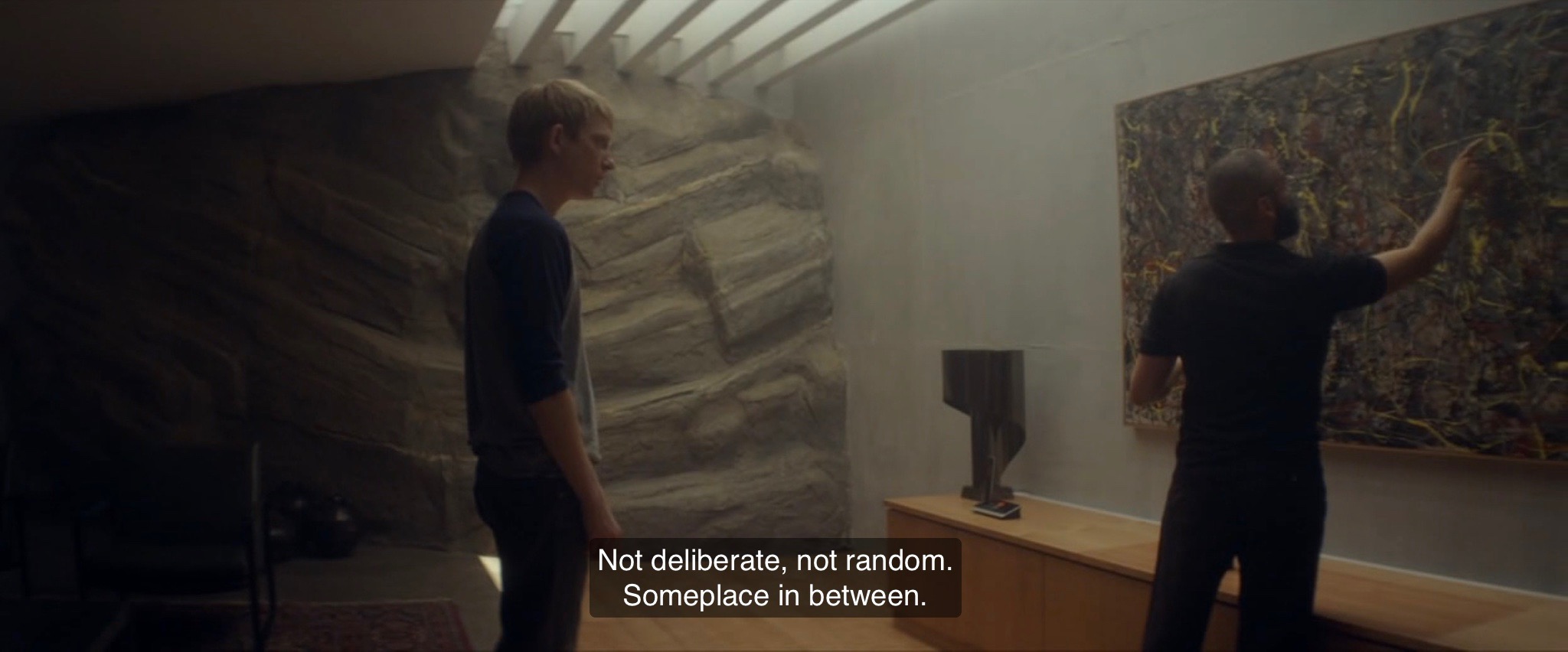
Caleb doesn’t seem to understand because he isn’t very good at Computer Science. Beard takes Caleb into a room with a Jackson Pollock painting.
He tries to explain what Automatic Art is to Caleb. It sounds like he is referencing Fuzzy Logic to me, which is when instead of using simple true and false, or 0 and 1, you make decisions based on everything in between 0 and 1. It’s not a fixed algorithmic if this then that, but something more human.
Then Beard references Star Trek by telling Caleb to “Engage intellect”. I’m still thinking he is making a brothel, so I’ll go with Mudd’s Women as the episode of the original series he is referencing. Amazon Prime says it’s a reference to the episode Requiem for Methuselah. I also think of The Measure of a Man from Star Trek: TNG where Data’s designation of being sentient or property is put on trial.
Beard now asks him to reverse the challenge of doing something not partially deliberate and partially unconscious. He asks Caleb what would happen if Pollock didn’t make a single mark if he didn’t know exactly what he was doing. Caleb says that he wouldn’t have made a single mark. In other words, he is describing the difference between how humans operate with fuzzy logic instead of with a strict rule system. I have a feeling that somebody told Alex Garland about how they tried things like theorem-proving software and knowledge systems in AI before Strong AI research collapsed and we switched to research into Weak AI. Weak AI being what we have been enjoying at an ever-growing rate since the 1980s in the form of speech recognition, image identification, and even programs that can write new songs in the style of Bob Dylan. Those things operate on probabilities, which when attached to incoming examples such as speech, images, and lyrics written by Bob Dylan will spit out another probability that is used to make a decision while also creating something that will make the kind of decisions you want based on the samples you gave it. Thus, it isn’t a strict rule, but something in between structure of the model and the current state of the probabilities in that model being used to generate the result. The Bob Dylan example would be feeding his lyrics into a chain that builds a series of probabilities between words so that if you picked a starting word, then it would generate the rest of the words based on the actual lyrics Bob Dylan wrote. You can do this with music as well. They are called Markov Chains/Hidden Markov Models in both cases.
This is all stuff to make you think that the more information you give to Google, then if the model is built correctly, all that data created by human beings will train that model to operate as a human does by becoming predictive of correct human behavior. Unfortunately, that’s not Strong AI. It’s simply Weak AI used on a large scale that impresses us the way a shiny object does a small child.
Then Caleb comes right out and tells Ava he took a semester in AI. Yeah, sure you did Caleb. I took one and a half of them at Cal. Trust me when I say that if Anastasia Steele from Fifty Shades of Grey (2015) is the worst English major in recent film, then Caleb is the worst Computer Science major in recent movies.
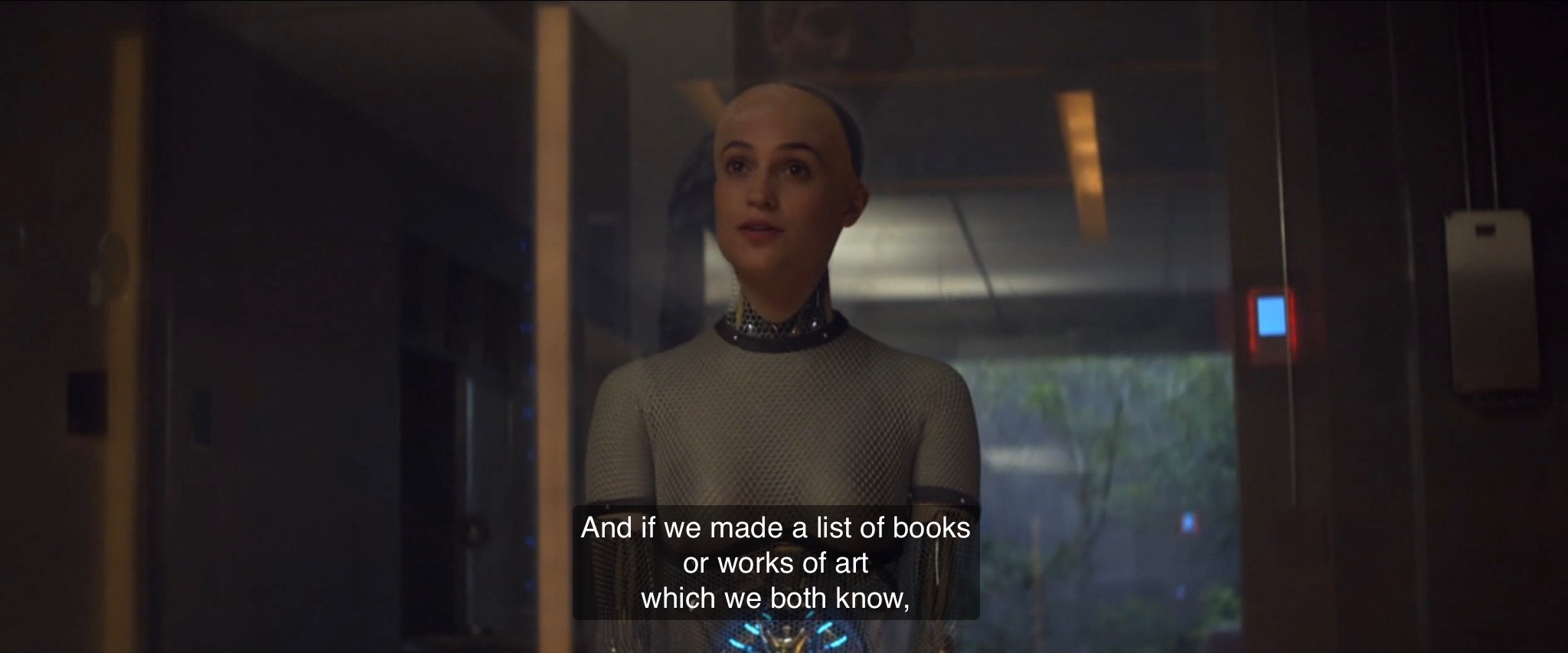
Why does he say this? He says it because the movie wants to get arty by showing black and white shots. No really, there is no other reason. Caleb brings up a famous thought experiment about a person living in a black and white room who has perfect knowledge of color without having ever stepped out of that room. That would mean that the person in question would have never experienced color. However, Caleb screws this up by saying:
Hmmm…you mean like the colors in the image I just posted that would show up on a black and white monitor, Caleb? He breaks the thought experiment simply so the film can show shots like that. He says that it gives her experience, which perfect knowledge about something doesn’t give you. That difference between pure knowledge and how something makes you feel is supposed to be the difference between human and machine intelligence according to Caleb. That’s why she mentions that she wants to go to a busy intersection if she is ever allowed to leave at a point in the movie. Of course the movie realizes that it needs to move the plot along instead of getting too smart so Ava messes with the power again to try and guilt Caleb some more. Boring.
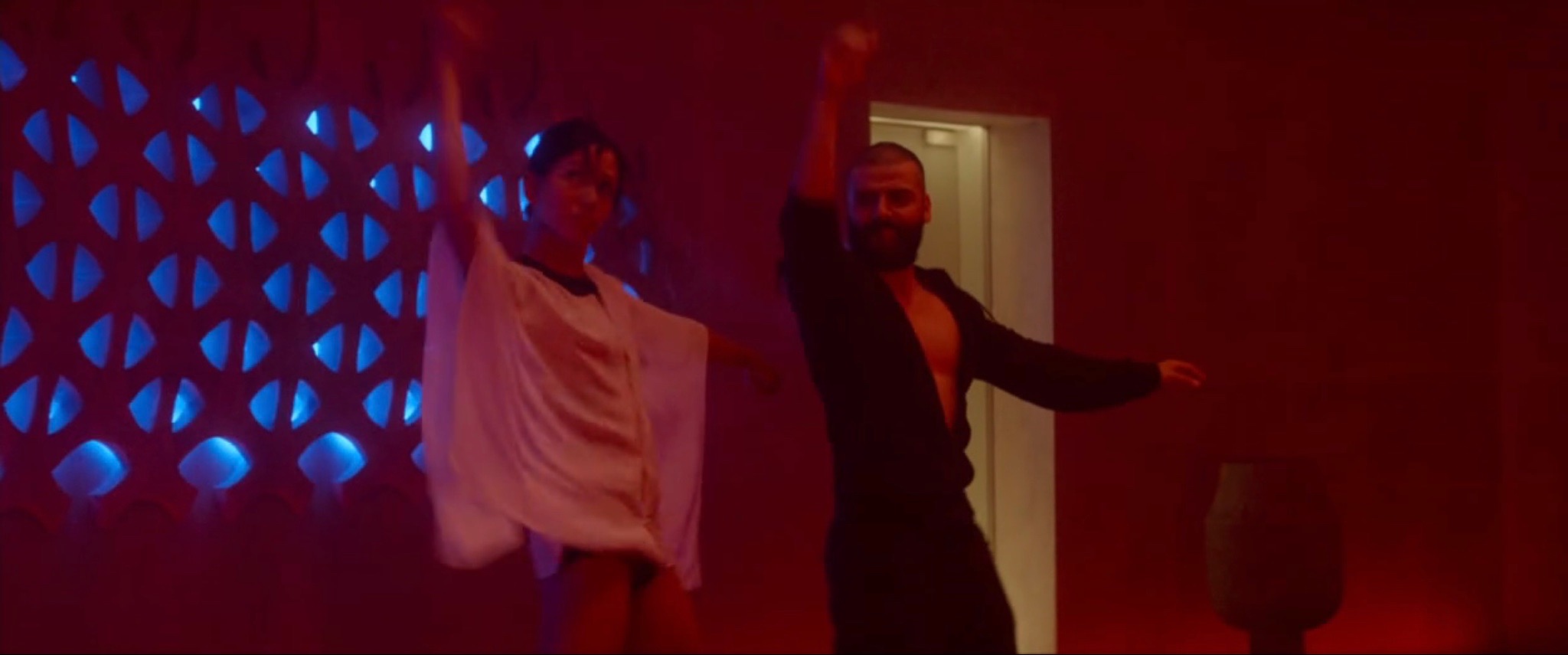
Time for another session with Beard for Caleb. Nothing really happens here of consequence. Then more artsy shots and Beard banging the Asian lady robot. This is followed by Asian lady and Beard disco dancing to Oliver Cheatham’s Get Down It’s Saturday Night. I’m guessing Alex Garland also played Grand Theft Auto: Vice City since it’s on that soundtrack for the Fever 105 station hosted by Oliver “Ladykiller” Biscuit. It’s also there so that Lisa could have a scene from this movie to include as a dance scene that she loves.
Unfortunately, Caleb doesn’t want to cool off on Saturday night, or any other night right now. He’s pissed off because the movie can’t really decide whether it wants to be smart about the technical stuff, or whether it wants to focus on that other boring prison break plot.
There’s numerous questions that are batted back and forth here, but the only one that was important to me is that according to Ava she has an off switch like Data.
So, why do they fight her before the Ms. 45 (1981) backstabbing ending when they could have simply turned her off? No matter. The conversations with her in this movie really aren’t the actual sessions. The sessions are with Beard. It’s time for Beard to think that Strong AI is right around the corner, and misunderstand what the singularity means.
I love how Beard makes sure to mention that the bodies are kept around after he builds the next model. He does this not for any in-movie reason, but for the horror factor of a bunch of bodies and so that Ava has a place to get skin later in the movie.
Beard brings up the singularity now and he seems to be confusing it for Terminator 2 (1991). The singularity is not when robots take over and replace us. The singularity is a point at which progress begins to outstrip our ability to fully comprehend the changes it creates till we essentially can do whatever we want. It’s like the Krell in Forbidden Planet (1956). Another example would be The Ancients in Stargate SG-1 who shed their material form and ascended into the freedom of pure energy. Not exactly something you whip out the Oppenheimer quote about being the destroyer of worlds when discussing. It’s an evolution, but not at the expense of the existence of humans. However, at this point the film is on autopilot towards its very unsatisfying conclusion, so who cares.
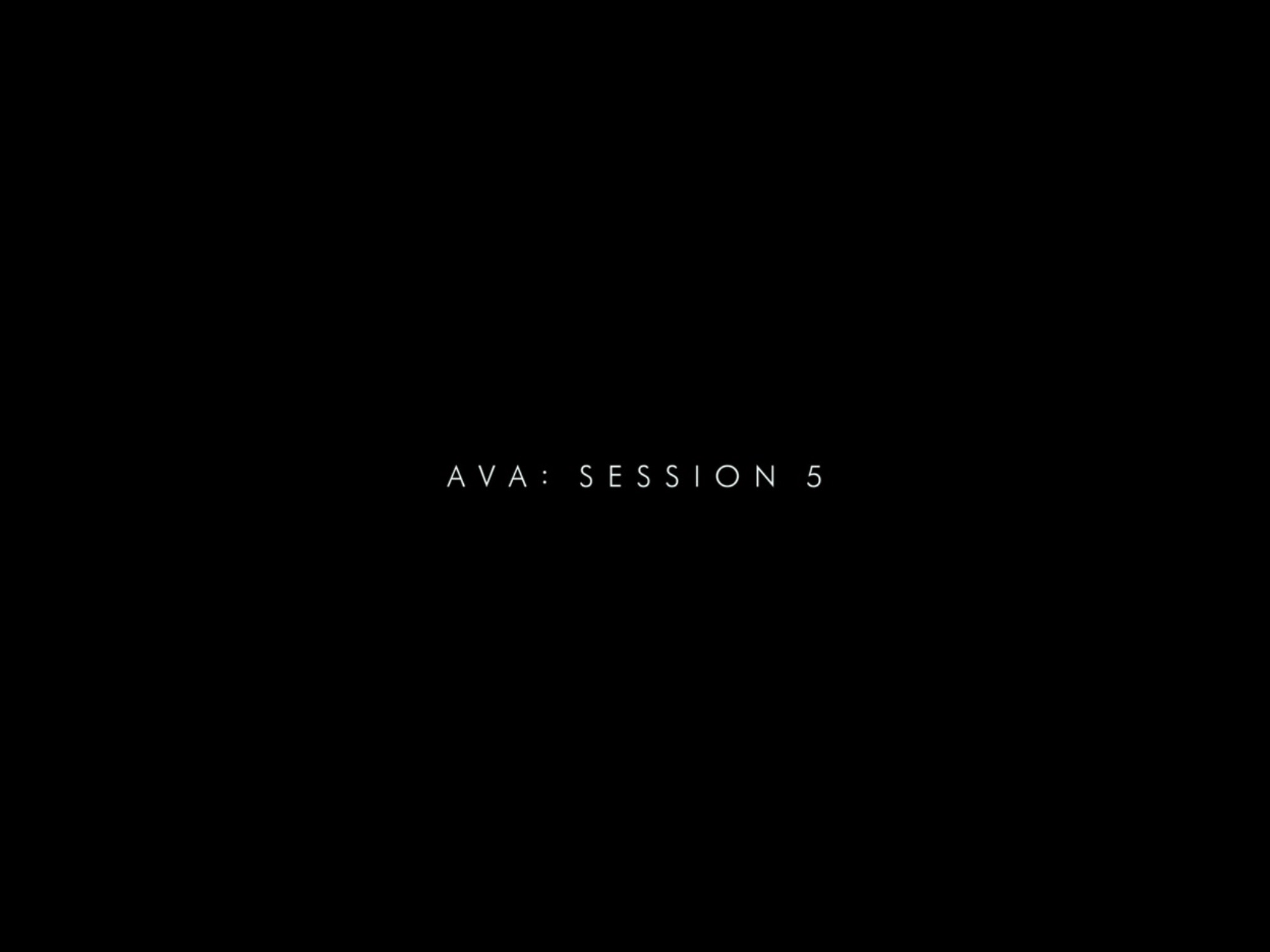
With Beard knocked out from drinking, Caleb decides to write a prime number generator.
He is supposedly working to free Ava, but he will not use that prime number generator to keep the power system busy like they did in Real Genius (1985). Also, why the comments? It’s almost as funny as in Blackhat (2015) when they didn’t seem to know that comments disappear when you compile code, which means they wouldn’t be present when you decompile something like a virus.
More boring stuff that has very little to do with anything, but looks semi-impressive and atmosphere maintaining if you haven’t already given up on the film like I had long before this point.
Ava is sitting in a corner to further guilt Caleb along with saying some more stuff and shutting off the power again.
Good session.
Caleb and Beard talk some more before Ava finally breaks out from her prison. Beard is killed in the process.
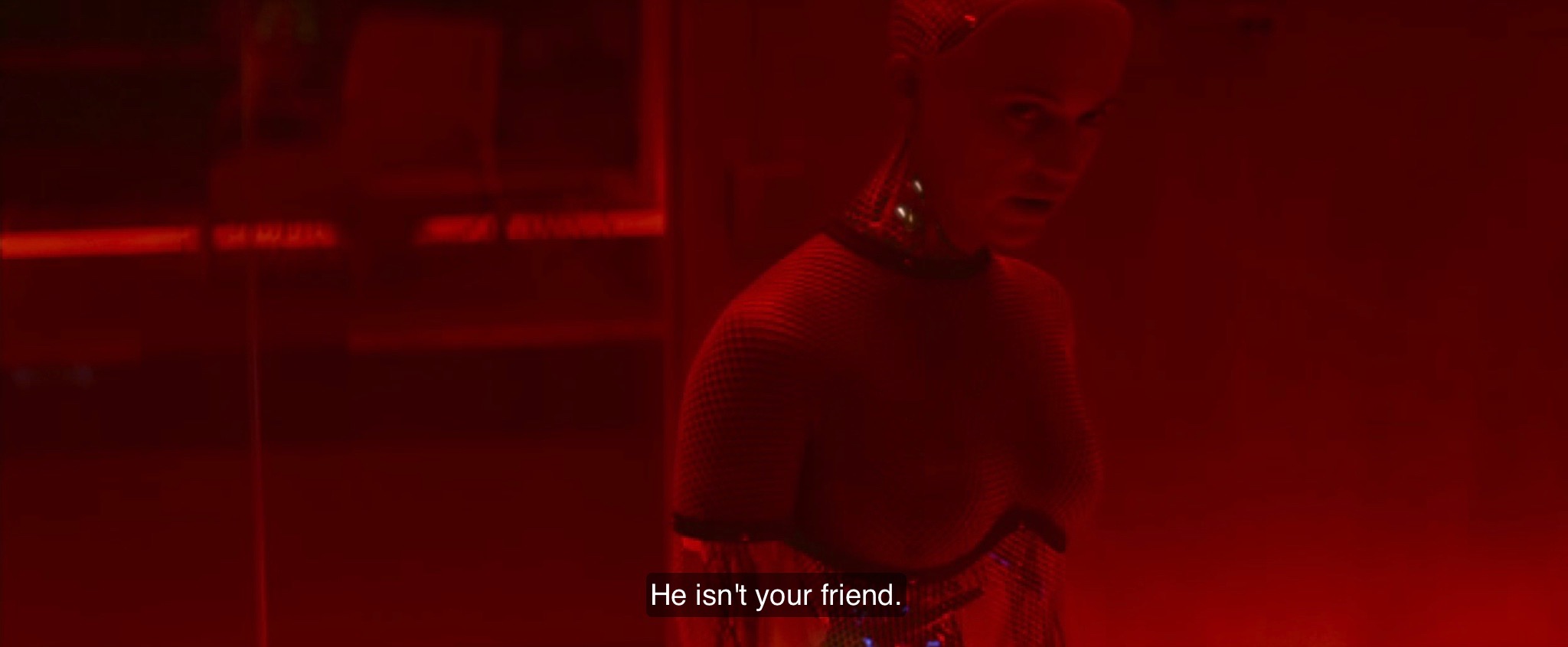
She locks Caleb up and gets away. I was honestly hoping that it would turn out Caleb was a robot, but they made sure to shoot that down by having him cut open his arm at one point. Then they juxtapose that with scenes later in the movie of the actual robots pulling off their skin.
I am part of a social network called Letterboxd. It isn’t a place where I write proper reviews. That’s what this site is for where I can really think about it, and include screenshots. I believe they are crucial. That’s why I use that network for initial gut reactions to what I watch. I try not to bring that over here, but really step through the film. This film isn’t as bad as I thought it was initially. I’m still not a fan though. The film boils down to somebody trying to socially engineer two people in order to make a prison break while we get pseudo-intellectual stabs at real tech stuff while not bothering to maintain consistency throughout the film. It’s not awful as I thought during and after watching it the first time, but it hardly deserves the ridiculous amount positive critical attention it has been getting since its’ release in 2015.
My ultimate conclusion is this: Watch Sneakers (1992), Real Genius (1985), and WarGames (1983) instead. Also, if this movie sparked an interest in AI for you, then run with it, because it is a fascinating subject that is not done justice by this film. My actual semester at Cal in AI was amazing. I had already read several books on the subject prior to taking the class, and it still was some of the most fun I had while at UC Berkeley.
Side notes: The reason for the race condition at the beginning of Steve Jobs is because a race condition is when two or more things try to operate on the same thing that causes unwanted results. Since the film uses Jobs’ brain as a metaphor for end-to-end control, a race condition is a perfect bug that doesn’t jive with what Jobs wants to achieve.
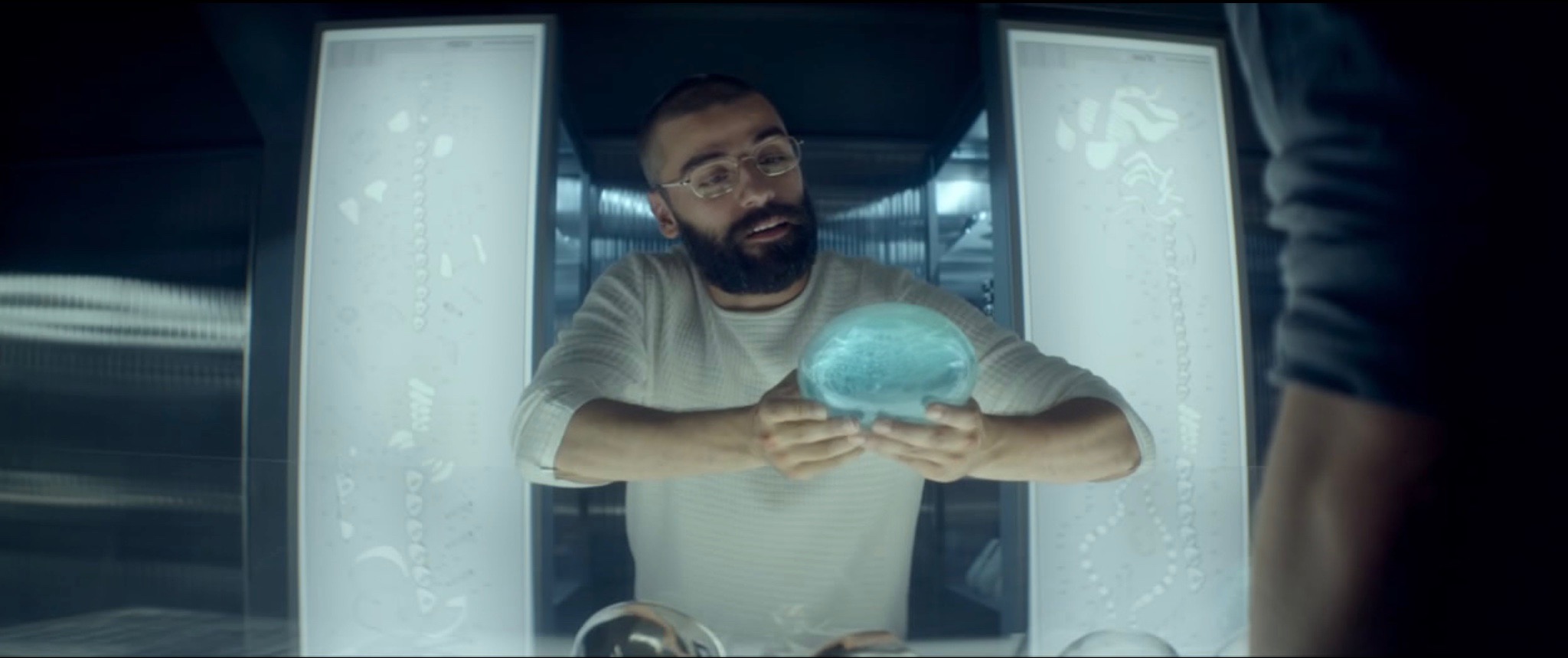
It is interesting that the film has exactly seven sessions with Ava since a byte is comprised of 8 bits. It makes one wonder whether Garland wants you to think it was cut short, there was a zeroth session prior to the official session since computers begin counting at zero, the 8th session is what happens at the very end, or that the missing session that would make it a byte represents that she is truly human and not really a computer anymore. Just something I thought I would pass on.
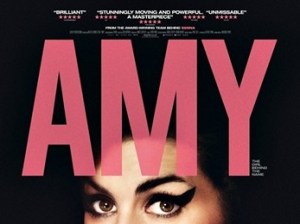
The Director’s Guild of America handed out their awards tonight and history was made! (And the Oscar race got a little bit more complicated.) First off, Alex Garland won the award for Best First-Time Feature Director for Ex Machina. Then Cartel Land somehow defeated Amy for Best Documentary Direction.
And then Alejandro G. Inarritu was named Best Director for The Revenant! This makes Inarritu the first film director to ever win back-to-back awards from the Director’s Guild. As you may remember, he previously won for Birdman and when was the last time anyone thought about that damn movie? (For the record, I thought the Revenant was far superior to Birdman.)
So, to recap, the Production Guild gave its top award to The Big Short.
And now, the DGA — which is traditionally the most reliable of all the precursors — gave its top award to The Revenant!
In other words, for the first time in my lifetime, there are three films that seem to have a legitimate shot at winning best picture when the Oscars are awarded later this month.
Of the 8 films that were nominated, my personal favorite would be Brooklyn, which realistically has no chance of winning the top prize. (Carol was my favorite film of the year but it was not nominated.) However, there’s a part of me that still hopes that — despite not winning at the PGA or the DGA — Mad Max: Fury Road will pull off an upset. Sadly, that probably won’t happen. Not only would a Mad Max victory be a nice (and popular) surprise but it would completely redefine the stodgy old assumptions about what type of films qualify for Oscar consideration.
If The Big Short wins, it will be the biggest travesty since the victory of Crash.
It’s been a year since Through the Shattered Lens lost one of it’s own: Semtexskittle.
In honor of his passing I’d like to share one of the films he and I share a love for. I think he may have been one of the few who truly wanted this film to be nominated as one of the ten films picked for Best Picture for the year it came out. While the Academy voters were sorely shortsighted for not nominating the film, it still remains one thing Chris shared with everyone at the site. Whether it was his love of sports, anime, video games and everything in-between.
With the Oscar nominations due to be announced tomorrow, now is the time that the Shattered Lens indulges in a little something called, “What if Lisa had all the power.” Listed below are my personal Oscar nominations. Please note that these are not the films that I necessarily think will be nominated. The fact of the matter is that the many of them will not. Instead, these are the films that would be nominated if I was solely responsible for deciding the nominees this year. Winners are starred and listed in bold.
(You’ll also note that I’ve added four categories, all of which I believe the Academy should adopt — Best Voice-Over Performance, Best Casting, Best Stunt Work, and Best Overall Use Of Music In A Film.)
(Click on the links to see my nominations for 2014, 2013, 2012, 2011, and 2010!)
Best Actress
Katharine Isabelle in 88
Brie Larson in Room
Rooney Mara in Carol
Saoirse Ronan in Brooklyn
Amy Schumer in Trainwreck *Alicia Vikander in Ex Machina*
The Directors Guild of America announced their nominees today! The DGA is usually one of the best of the Oscar precursors. Getting a DGA nomination usually translates to a Best Picture nomination.
Here are the nominees. There really aren’t any surprises among them, though, based on its strength with the other guilds, I did think that Steven Spielberg might sneak in there with Bridge of Spies.
The Seattle Film Critics Survey announced their nominees for the best of 2015 earlier today and I have to say, their nominations are pretty interesting! (Also interesting to note is that they did not nominate Oscar front runner Spotlight.) Way to go, Seattle!
-Sean Baker, Tangerine – (for producing, directing, screenwriting, film editing, cinematography, camera operation, and casting)
-Joel Edgerton, The Gift – (for producing, directing, and screenwriting)
-David Robert Mitchell, It Follows – (for producing, directing, and screenwriting)
-Daisy Ridley, Star Wars: Episode VII – The Force Awakens – (for acting)
-Jacob Tremblay, Room – (for acting)
-Alicia Vikander, Burnt, The Danish Girl, Ex Machina, The Man from U.N.C.L.E., Seventh Son, and Testament of Youth – (for acting)
Best Cinematography
-Roger Deakins, Sicario
-Emmanuel Lubezki, The Revenant
-Robert Richardson, The Hateful Eight
-John Seale, Mad Max: Fury Road
-Dariusz Wolski, The Martian
-Emma Donoghue, Room
-Drew Goddard, The Martian
-Nick Hornby, Brooklyn
-Charles Randolph and Adam McKay, The Big Short
-Aaron Sorkin, Steve Jobs
Best Original Screenplay
-Pete Docter, Meg LeFauve, and Josh Cooley, Inside Out
-Alex Garland, Ex Machina
-Taylor Sheridan, Sicario
-Josh Singer and Tom McCarthy, Spotlight
-Quentin Tarantino, The Hateful Eight
Best Score
-Carter Burwell, Carol
-Michael Giacchino, Inside Out
-Jóhann Jóhannsson, Sicario
-Junkie XL, Mad Max: Fury Road
-Ennio Morricone, The Hateful Eight
BEST FOREIGN LANGUAGE FILM
The Assassin
Mustang
Phoenix
A Pigeon Sat on a Branch Reflecting on Existence
Son of Saul
BEST DIRECTOR
Lenny Abrahamson (Room)
Todd Haynes (Carol)
Tom McCarthy (Spotlight)
George Miller (Mad Max: Fury Road)
Ridley Scott (The Martian)
BEST ACTOR
Bryan Cranston (Trumbo)
Matt Damon (The Martian)
Leonardo DiCaprio (The Revenant)
Michael Fassbender (Steve Jobs)
Ian McKellen (Mr. Holmes)
BEST SUPPORTING ACTOR
Paul Dano (Love & Mercy)
Benicio del Toro (Sicario)
Mark Ruffalo (Spotlight)
Mark Rylance (Bridge of Spies)
Sylvester Stallone (Creed)
BEST ACTRESS
Elizabeth Banks (Love & Mercy)
Cate Blanchett (Carol)
Brie Larson (Room)
Charlotte Rampling (45 Years)
Saoirse Ronan (Brooklyn)
BEST SUPPORTING ACTRESS
Jennifer Jason Leigh (The Hateful Eight)
Rooney Mara (Carol)
Rachel McAdams (Spotlight)
Helen Mirren (Trumbo)
Alicia Vikander (Ex Machina)
BEST ORIGINAL SCREENPLAY
Matt Charman, Ethan Coen, and Joel Coen (Bridge of Spies)
Pete Docter, Meg LeFauve, and Josh Cooley (Inside Out)
Alex Garland (Ex Machina)
Josh Singer, Tom McCarthy (Spotlight)
Quentin Tarantino (The Hateful Eight)
BEST ADAPTED SCREENPLAY
Emma Donoghue (Room)
Drew Goddard (The Martian)
Phyllis Nagy (Carol)
Nick Hornby (Brooklyn)
Charles Randolph and Adam McKay (The Big Short)
Aaron Sorkin (Steve Jobs)
TAR HEEL AWARD
(To an artist or film with a special connection to North Carolina.)
Ramin Bahrani (99 Homes)
Finders Keepers
Peyton Reed (Ant-Man)































 Through the Shattered Lens