Playing Catch-Up With The Films of 2017: Paris Can Wait (dir by Eleanor Coppola)


Anne (Diane Lane) is the wife of Michael (Alec Baldwin).  Michael is an internationally renowned film producer.  As is established early on, their marriage is not perfect.  Michael is consumed with work and, at one point, Anne spots him deep in conversation with a young actress.  Anne’s reaction tells us all we need to know about Michael’s history as a husband.  While Michael obsesses on making the latest deal, Anne takes pictures of inanimate objects.  None of the pictures are particularly good but everyone in the movie raves about them.  I imagine that has something to do with the fact that Anne is based on Eleanor Coppola, who wrote and directed Paris Can Wait.

When the film opens, Anne and Michael are at Cannes.  Michael has spent the entire festival making deals but he’s promised Anne a Paris vacation afterward.  However, the day that they’re vacation is supposed to begin, Michael gets a call!  He’s needed in Budapest!  And Anne can’t fly because she has an ear infection…

No worries!  Their friend Jacques (Arnaud Viard) is willing to drive Anne to Paris and keep her company while she waits for Michael to return.  And so, while Michael flies off to Budapest, Anne and Jacques head off for Paris.  However, Anne soon finds herself questioning Jacques’s intentions.  Is he being flirtatious or is he just French?  When he stops off at every restaurant along the way and uses Anne’s credit card to pay the exorbitant bills, is he taking advantage of her or is he just being French?  When Anne isn’t doubting Jacques’s intentions, she’s questioning her marriage.  Is Michael really in Budapest to work on a movie or is he having an affair?

One of the good things about being rich is that you occasionally get to make a movie about how difficult it is to be rich.  That certainly seems to be the case with Paris Can Wait, which was written and directed by Eleanor Coppola, the wife of Francis Ford Coppola and the mother of Sofia and Roman Coppola.  Paris Can Wait is said to be autobiographical, which would seem to suggest that Eleanor and Francis aren’t particularly interesting human beings.

There are some positive elements to the film, of course. Diane Lane gives about as good a performance as one can when you’re playing an idealized version of a film’s director.  Also, Alec Baldwin manages to make it through the entire movie without bellowing.  In fact, Baldwin’s barely in the movie and that’s not a bad thing.  The French countryside looks beautiful but, quite frankly, it’s impossible for the French countryside not to look beautiful.  On the negative side, it just doesn’t add up to much.  You never really care whether or not Michael and Anne stay together.  You’re just thankful that you’ll never get stuck beside them on an airplane.

I think the main problem is that, as a director, Eleanor Coppola doesn’t really seem to know what she’s trying to say with her film.  For instance, I could imagine Sofia Coppola taking the exact same material and creating a movie that would be achingly poignant and full of ennui.  But, with Eleanor, it’s just another travelogue to nowhere.
Here’s What Won At The Emmys Last Night!


Last night, Lisa Marie did not watch the Emmys because she says that, “I’m just not feeling TV this year.”  If Twin Peaks had been eligible to be nominated, I bet it would have been a different story!

Instead, she asked me to watch the ceremony and let everyone know what I thought.  It needed less politics and more cats.

Here’s the list of winners:

COMEDY

BEST COMEDY SERIES
“Atlanta”
“Black-ish”
“Masters of None”
“Modern Family”
“Silicon Valley”
“Unbreakable Kimmy Schmidt”
X — “Veep”

BEST COMEDY ACTRESS
Pamela Adlon, “Better Things”
Jane Fonda, “Grace and Frankie”
Allison Janney, “Mom”
Ellie Kemper, “Unbreakable Kimmy Schmidt”
X — Julia Louis-Dreyfus, “Veep”
Tracee Ellis Ross, “Black-ish”
Lily Tomlin, “Grace and Frankie”

BEST COMEDY ACTOR
Anthony Anderson, “Black-ish”
Aziz Ansari, “Master of None”
Zach Galifianaks, “Baskets”
X — Donald Glover, “Atlanta”
William H. Macy, “Shameless”
Jeffrey Tambor, “Transparent”

BEST COMEDY SUPPORTING ACTRESS
Vanessa Bayer, “Saturday Night Live”
Anna Chlumsky, “Veep”
Kathryn Hahn, “Transparent”
Leslie Jones, “Saturday Night Live”
Judith Light, “Transparent”
X — Kate McKinnon, “Saturday Night Live”

BEST COMEDY SUPPORTING ACTOR
Louie Anderson, “Baskets”
X — Alec Baldwin, “Saturday Night Live”
Tituss Burgess, “Unbreakable Kimmy Schmidt”
Ty Burrell, “Modern Family”
Tony Hale, “Veep”
Matt Walsh, “Veep”

BEST COMEDY DIRECTING
X — “Atlanta” (“B.A.N.”)
“Silicon Valley” (“Intellectual Property”)
“Silicon Valley” (“Server Error”)
“Veep” (“Justice”)
“Veep” (“Blurb”)
“Veep” (“Groundbreaking”)

BEST COMEDY WRITING
“Atlanta” (“B.A.N.”)
“Atlanta” (“Streets on Lock”)
X — “Master of None” (“Thanksgiving”)
“Silicon Valley” (“Success Failure”)
“Veep” (“Groundbreaking”)
“Veep” (“Georgia”)

DRAMA

BEST DRAMA SERIES
“Better Call Saul”
“The Crown”
X — “The Handmaid’s Tale”
“House of Cards”
“Stranger Things”
“This is Us”
“Westworld”

BEST DRAMA ACTRESS
Viola Davis, “How to Get Away with Murder”
Claire Foy, “The Crown”
X — Elisabeth Moss, “The Handmaid’s Tale”
Keri Russell, “The Americans”
Evan Rachel Wood, “Westworld”
Robin Wright, “House of Cards”

BEST DRAMA ACTOR
X — Sterling K. Brown, “This is Us”
Anthony Hopkins, “Westworld”
Bob Odenkirk, “Better Call Saul”
Matthew Rhys, “The Americans”
Liev Schreiber, “Ray Donovan”
Kevin Spacey, “House of Cards”
Milo Ventimiglia, “This is Us”

BEST DRAMA SUPPORTING ACTRESS
Uzo Aduba, “Orange is the New Black”
Millie Bobby Brown, “Stranger Things”
X — Ann Dowd, “The Handmaid’s Tale”
Chrissy Metz, “This is Us”
Thandie Newton, “Westworld”
Samira Wiley, “The Handmaid’s Tale”

BEST DRAMA SUPPORTING ACTOR
Jonathan Banks, “Better Call Saul”
David Harbour, “Stranger Things”
Ron Cephas Jones, “This is Us”
Michael Kelly, “House of Cards”
X — John Lithgow, “The Crown”
Mandy Patinkin, “Homeland”
Jeffrey Wright, “Westworld”

BEST DRAMA DIRECTING
“Better Call Saul” (“Witness”)
“The Crown” (“Hyde Park Corner”)
“The Handmaid’s Tale” (“The Bridge”)
X — “The Handmaid’s Tale” (“Offred”)
“Homeland” (“America First”)
“Stranger Things” (“Chapter One: The Vanishing of Will Byers”)
“Westworld” (“The Bicameral Mind”)

BEST DRAMA WRITING
“The Americans” (“The Soviet Division”)
“Better Call Saul” (“Chicanery”)
“The Crown” (“Assassins”)
X — “The Handmaid’s Tale” (“Offred”)
“Stranger Things” (“Chapter One: The Vanishing of Will Byers”)
“Westworld” (“The Bicameral Mind”)

MOVIE/LIMITED SERIES

BEST LIMITED SERIES
X — “Big Little Lies”
“Fargo”
“Feud: Bette and Joan”
“Genius”
“The Night Of”

BEST TV MOVIE
X — “Black Mirror: San Junipero”
“Christmas of Many Colors”
“The Immortal Life of Henrietta Lacks”
“Sherlock: The Lying Detective”
“The Wizard of Lies”

BEST MOVIE/MINI ACTRESS
Carrie Coon, “Fargo”
Felicity Huffman, “American Crime”
X — Nicole Kidman, “Big Little Lies”
Jessica Lange, “Feud: Bette and Joan”
Susan Sarandon, “Feud: Bette and Joan”
Reese Witherspoon, “Big Little Lies”

BEST MOVIE/MINI ACTOR
X — Riz Ahmed, “The Night Of”
Benedict Cumberbatch, “Sherlock: The Lying Detective”
Robert De Niro, “The Wizard of Lies”
Ewan McGregor, “Fargo”
Geoffrey Rush, “Genius”
John Turturro, “The Night Of”

BEST MOVIE/MINI SUPPORTING ACTRESS
Judy Davis, “Feud: Bette and Joan”
X — Laura Dern, “Big Little Lies”
Jackie Hoffman, “Feud: Bette and Joan”
Regina King, “American Crime”
Michelle Pfeiffer, “The Wizard of Lies”
Shailene Woodley, “Big Little Lies”

BEST MOVIE/MINI SUPPORTING ACTOR
Bill Camp, “The Night Of”
Alfred Molina, “Feud: Bette and Joan”
X — Alexander Skarsgard, “Big Little Lies”
David Thewlis, “Fargo”
Stanley Tucci, “Feud: Bette and Joan”
Michael Kenneth Williams, “The Night Of”

BEST MOVIE/MINI DIRECTING
X — “Big Little Lies”
“Fargo” (“The Law of Vacant Places”)
“Feud: Bette and Joan” (“And the Winner Is”)
“Genius” (“Einstein: Chapter One”)
“The Night Of” (“The Art of War”)
“The Night Of” (“The Beach”)

BEST MOVIE/MINI WRITING
“Big Little Lies”
X — “Black Mirror: San Junipero”
“Fargo” (“The Law of Vacant Places”)
“Feud: Bette and Joan” (“And the Winner Is”)
“Feud: Bette and Joan” (“Pilot”)
“The Night Of” (“Call of the Wild”)

VARIETY/REALITY

BEST REALITY COMPETITION PROGRAM
“The Amazing Race”
“Amercan Ninja Warrior”
“Project Runway”
“RuPaul’s Drag Race”
“Top Chef”
X — “The Voice”

BEST VARIETY TALK SERIES
“Full Frontal with Samantha Bee”
“Jimmy Kimmel Live”
X — “Last Week Tonight with John Oliver”
“Late Late Show with James Corden”
“Late Show with Stephen Colbert”
“Real Time with Bill Maher”

BEST VARIETY SKETCH SERIES
“Billy on the Street”
“Documentary Now”
“Drunk History”
“Portlandia”
X — “Saturday Night Live”
“Tracey Ullman’s Show”

BEST VARIETY SERIES DIRECTING
“Drunk History”
“Jimmy Kimmel Live”
“Last Week Tonight with John Oliver”
“Late Show with Stephen Colbert”
X — “Saturday Night Live”

BEST VARIETY SERIES WRITING
“Full Frontal with Samantha Bee”
X — “Last Week Tonight with John Oliver”
“Late Night with Seth Meyers”
“Late Show with Stephen Colbert

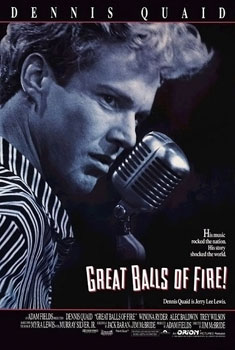
A Movie A Day #173: Great Balls of Fire! (1989, directed by Jim McBride)


In the 1950s, Jerry Lee Lewis (Dennis Quaid) plays what his cousin, Jimmy Swaggart (Alec Baldwin), calls the devil’s music.  After signing a contract with Sam Phillips (Trey Wilson), Jerry becomes a star with his wild man persona and crazed piano playing.  When Elvis is drafted, it appears that Jerry is destined to take over as the new King of Rock and Roll.  But, then, while touring England, the press discovers that Jerry is married to his 13 year-old cousin, Myra (Winona Ryder).  When Jerry refuses to apologize for his private life, his career falls apart.


The real Jerry Lew Lewis has stated many times that he hates this musical biopic and that it has very little in common with his actual life.  Jerry has a point.  Great Balls of Fire is a highly stylized film, one that greatly sanitizes both the life of Jerry Lee Lewis and the early days of rock and roll.  In the film, there’s no struggle or even hard work on the road to becoming a star.  Jerry just drops off a recording of himself playing piano and viola! He’s a star!  Soon, teenagers are dancing around his convertible, both civil rights protestors and white Southern cops start dancing whenever they see him driving down the street, the local radio DJ waves whenever he sees them, and Jerry’s sneaking into Mississippi so that he can marry his thirteen year-old cousin.

Great Balls of Fire! takes a superficially mater of fact approach to Jerry’s marriage to Myra, neither condemning nor excusing, though it does cheat by casting the 18 year-old Winona Ryder as the 13 year-old Myra.  (If the film had cast an actress who was closer to Myra’s actual age, Great Balls of Fire! would never have been released.)  Fortunately, history helped the movie out by making Jimmy Swaggart into Jerry’s main critic.  Alec Baldwin’s performance as Jimmy Swaggart makes his interpretation of Donald Trump look subtle, nuanced, and award-worthy.

Dennis Quaid, at the height of his 80s stardom, is ideally cast as Jerry Lee Lewis, giving a good if broad performance and doing a convincing job lip-syncing to the music.  Quaid has said that he was struggling with an addiction to cocaine while filming Great Balls of Fire! and that might have made him the perfect actor to play the always conflicted and always wild Jerry Lee Lewis.  The best thing about the film is that Jerry Lee Lewis provided the music, re-recording his best known songs.  While the movie may not tell the true story of Jerry Lee Lewis, it does feature enough of his music that it is obvious why Jerry Lee Lewis nearly became the king of rock and roll.


Playing Catch-Up: Aloha (dir by Cameron Crowe)


Well, Christmas is over and soon 2015 will be over as well!  And our long time readers know what that means — its time for Lisa to desperately try to get caught up on reviewing all of the films that she’s seen this year!  After all, it will soon be time for me to post my “Best of” and “Worst of” lists and who knows?  Some of these films might make a list!

Anyway, with all that in mind, let’s take a quick look at Aloha!

Say what you will about Aloha as a movie, I would have loved to have been a part of the production.  Not only is the cast full of performers that I absolutely adore (Bradley Cooper, Emma Stone, John Krasinski, Bill Murray, Rachel McAdams, and Danny McBride, just to name a few) but the film itself was shot in Hawaii, which is one of the most beautiful places on Earth.  And let’s give director Cameron Crowe some credit for capturing some truly beautiful images of Hawaii.

As for the film itself, it’s a bit of a self-indulgent chore to sit through.  Aloha feels like a dozen different films, all mashed together and the end result is something of a mess.  Bradley Cooper is Brian Gilchrest, a defense contractor who is haunted by a mistake that he made while in Afghanistan.  (It’s the equivalent of Jerry Maguire writing that memo and Orlando Bloom making those shoes in Elizabethtown.)  Disillusioned and cynical, Brian is now working for a billionaire Carson Welch (Bill Murray), who wants to build his own private space center in Hawaii.  Brian’s job is to get the support of the native Hawaiians.

Brian’s Air Force liaison is Alison Ng (Emma Stone) and she’s as idealistic as Brian is cynical.  Brian and Alison are soon falling love but, at the same time, Brian has also reconnected with his ex-girlfriend, Tracy (Rachel McAdams).  Tracy is now married to Woody (John Krasinski), an Air Force captain who has difficulty expressing his feelings.  Tracy also has a 12 year-old daughter and Brian might be the father.

That may sound like enough for any movie to deal with but Aloha also wants to be a political satire as well as a relationship dramedy.  So, of course, there’s all sorts of ethical questions about the satellite that Carson wants to launch and, as a character, Carson is so incredibly inconsistent that you’re just happy that he’s being played by Bill Murray, one of the few actors who can make inconsistency charming.

Aloha is such a frustrating film, largely because of all the talent involved.  With that cast and all the beautiful scenery, it should have at least been an enjoyable lark.  Instead, it’s a huge and self-indulgent mess.

And, naturally enough, it features Alec Baldwin.  Baldwin always seems to show up in films like this and, as I watched him bellow his way through Aloha, I found myself wondering how Alec Baldwin can be so good in some films and so amazingly awful in others.  Baldwin’s a talented actor but, when a director allows him to go overboard, he can be difficult to watch.  In Aloha, Cameron Crowe lets Alec Baldwin go totally overboard.

When Aloha was first released, there was a lot of controversy over Emma Stone playing a character who supposed to be a quarter Chinese and a quarter Hawaiian.  At the time, Cameron Crowe stated that: “As far back as 2007, Captain Allison Ng was written to be a super-proud one-quarter Hawaiian who was frustrated that, by all outward appearances, she looked nothing like one. A half-Chinese father was meant to show the surprising mix of cultures often prevalent in Hawaii. Extremely proud of her unlikely heritage, she feels personally compelled to over-explain every chance she gets. The character was based on a real-life, red-headed local who did just that.”  That’s something that I — as a pale redhead who happens to be very proud of being a fourth Spanish — could relate to so it didn’t particularly bother me that Emma Stone was playing a character named Alison Ng.

Instead, what bothered me was that Alison Ng was never really allowed to emerge as an individual character with her own hopes, dreams, and ambitions.  Her character pretty much only existed to give Brian a reason to believe in life again.  Emma Stone’s a good actress but, as a film, Aloha lets her down.

Still, at least she got to spend sometime in Hawaii!

Film Review: Mission: Impossible — Rogue Nation (dir by Christopher McQuarrie)


Rebecca FergusonEarlier tonight, Jeff and I saw Mission: Impossible — Rogue Nation and now I’m pretty sure that I’m developing huge girl crush on actress Rebecca Ferguson.

She plays Ilsa Faust, a former operative for M.I.6. who is now somehow involved with a shadowy terrorist organization known as The Syndicate.  And while Ilsa may only be a supporting character (because, after all, this is a Mission Impossible film and therefore, Tom Cruise’s Ethan Hunt is unquestionably the star), she dominates every scene that she’s in.  Whether she’s escape the scene of an attempted assassination while wearing a dress that is simply to die for or rescuing Ethan Hunt from certain death, Ilsa Faust is a woman who kicks ass, takes no prisoners, and looks great while she’s doing it.  As much as I love Scarlett Johansson as Natasha Romanoff, Ilsa Faust is my new espionage role model.

The movie attempts to suggest that there’s some sexual chemistry between Ilsa and Ethan.  Oddly enough, there’s not.  Tom Cruise looks good and he gives a confident and likable performance but, as a character, Ethan comes across as being almost asexual.  He seems to be attracted to only intrigue and danger.  And yet, that lack of authentic romantic chemistry actually works to the film’s advantage.  Ilsa is never reduced to merely being a love interest.  Instead, she’s an equal to Ethan throughout the entire film.

Of course, Ilsa has secrets of her own.  Everyone in Mission: Impossible — Rogue Nation has a secret.  The film opens with the IMF being disbanded and its operatives being absorbed into the CIA.  When the CIA director (Alec Baldwin, in full jerk mode) orders Ethan to stop investigating the Syndicate, Ethan goes underground and continues his activities in secret.  His allies (Jeremy Renner, Ving Rhames, and the great Simon Pegg) can only help him in secret.  The origins of the Syndicate turn out to be the biggest secret of all.  There are so many secrets in Rogue Nation that it’s sometimes hard to keep track of them all but, again, that works to the film’s advantage.  It keeps the audience off-balance.  You never know when someone’s going to suddenly pull out a gun and start shooting or rip off a mask and reveal themselves to be someone else.

Rogue Nation is an entertaining action film.  The stunts are spectacular and the set pieces are exciting and enjoyably over the top.  (There’s a scene where Ethan Hunt has to change out a security card while holding his breath underwater and I literally watched it through my fingers.)  I wouldn’t suggest trying to read too much into the film and yet, at the same time, Rogue Nation does capture the paranoid times in which we live. The film manages to both condemn the excesses of government while celebrating the toys that make those excesses possible.  The average film goer may not be able to do all of the things that Ilsa and Ethan can do but we all know what it’s like not to trust authority.

That’s what makes Solomon Lane, the main villain played by Sean Harris, such an interesting character.  I know that some reviewers have complained that Lane’s role was underwritten but I have to disagree.  Lane may not be as verbose as the typical spy movie villain but I appreciated the fact that he remained somewhat enigmatic up to the conclusion of the film.  He never made the mistake of over explaining his evil plan and accidentally giving the IMF team extra time in which to defeat him.  (Solomon Lane obviously learned his lesson from watching countless would-be world conquerors accidentally allow James Bond to get the better of them.)  Lane may be ruthless and evil but he’s also a revolutionary who is outraged by some of the same things that the rest of us are outraged by.  This brings a welcome hint of ambiguity to the film.

Though it never quite reaches the lunatic highs of either Kingsman or Furious Seven, Rogue Nation is still an enjoyable and effective action movie.  Undoubtedly, Ethan and the IMF team will return in another installment.  Here’s hoping that Ilsa Faust gets a spin-off of her very own.


Embracing the Melodrama Part II #100: Pearl Harbor (dir by Michael Bay)


Pearl_harbor_movie_poster

“And then all this happened…”

Nurse Evelyn Johnson (Kate Beckinsale) in Pearl Harbor (2001)

The “this” that Evelyn Johnson is referring to is the Japanese attack on Pearl Harbor.  You know, the date will live in infamy.  The attack that caused the United States to enter World War II and, as a result, eventually led to collapse of the Axis Powers.  The attack that left over 2,000 men died and 1,178 wounded.  That attack.

In the 2001 film Pearl Harbor, that attack is just one of the many complications in the romance between Danny (Ben Affleck), his best friend Rafe (Josh Hartnett), and Evelyn (Kate Beckinsale).  The other complications include Danny briefly being listed as dead, Danny being dyslexic before anyone knew what dyslexia was (and yet, later, he’s still seen reading and writing letters with absolutely no trouble, almost as if the filmmakers forgot they had made such a big deal about him not being able to do so), and the fact that Rafe really, really likes Evelyn.  Of course, the main complication to their romance is that this is a Michael Bay film and he won’t stop moving the camera long enough for anyone to have a genuine emotion.

I imagine that Pearl Harbor was an attempt to duplicate the success of Titanic, by setting an extremely predictable love story against the backdrop of a real-life historical tragedy.  Say what you will about Titanic (and there are certain lines in that film that, when I rehear them today, make me cringe), Leonardo DiCaprio and Kate Winslet had genuine chemistry.  None of that chemistry is present in Pearl Harbor.  You don’t believe, for a second, that Ben Affleck and Josh Hartnett are lifelong friends.  You don’t believe that Kate Beckinsale is torn between the two of them.  Instead, you just feel like you’re watching three actors who are struggling to give a performance when they’re being directed by a director who is more interested in blowing people up than in getting to know them.

Continuing the Titanic comparison, Pearl Harbor‘s script absolutely sucks.  Along with that line about “all this” happening, there’s also a scene where Franklin D. Roosevelt (Jon Voight) reacts to his cabinet’s skepticism by rising to his feet and announcing that if he, a man famously crippled by polio and confined to a wheelchair, can stand up, then America can win a war.

I’ve actually been to Pearl Harbor in Hawaii.  I have gone to the USS Arizona Memorial.  I have stood and stared down at the remains of the ship resting below the surface of the ocean.  It’s an awe-inspiring and humbling site, one that leaves you very aware that over a thousand men lost their lives when the Arizona sank.

I have also seen the wall which lists the name of everyone who was killed during the attack on Pearl Harbor and until you’ve actually been there and you’ve seen it with your own eyes, you really can’t understand just how overwhelming it all is.  The picture below was taken by my sister, Erin.

Pearl Harbor 2003If you want to pay tribute to those who lost their lives at Pearl Harbor, going to the Arizona Memorial is a good start.  But avoid Michael Bay’s Pearl Harbor at all costs.

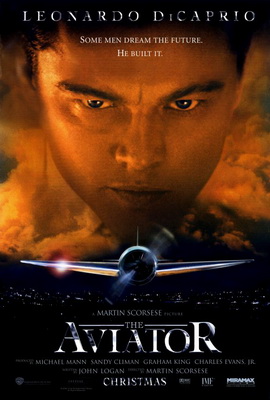
Shattered Politics #74: The Aviator (dir by Martin Scorsese)


The_Aviator_Poster

“The way of the future.” — Howard Hughes (Leonardo DiCaprio) in The Aviator (2004)

As I recently rewatched the 2004 best picture nominee, The Aviator, I realized that, in the film’s scheme of things, Ava Gardner was far more important than Katharine Hepburn.  (Or, perhaps it would be more appropriate to say that Kate Beckinsale’s Ava Gardner was far more important than Cate Blanchett’s Katharine Hepburn.)

Over the course of the film, both Hepburn and Gardner are involved with billionaire-turned aviator-turned film director Howard Hughes (Leonardo DiCaprio).  Throughout the film, Katherine is portrayed as being flighty, pretentious, and overdramatic.  There’s a lot of dark humor to the scene where Katherine breaks up with Howard, largely because Katharine is incapable of not acting as if she’s making a film.  Her every word is so carefully rehearsed that you have to agree when Howard says that she’s incapable of not giving a performance.  Ava, on the other hand, is always direct.  She has a sense of humor.  She has no trouble telling Howard off.  Whereas Katharine put on airs of being an incurable romantic, Ava tells Howard flat out that she doesn’t love him and is only using him to forward her career.

But, while Katharine Hepburn gets more screen time, it’s Ava Gardner who actually saves Howard’s business.  Towards the end of the film, after Howard has had a nervous breakdown and has locked himself in a hotel room, it’s Ava who suddenly shows up, cleans him, and dresses him.  She’s the one who gives Howard the strength to leave his room and to face down the corrupt senator (Alan Alda) who is investigating his business.

Of course, Howard Hughes is best known for once being the world’s richest recluse.  In the 1960s, Howard locked himself away in a hotel room in Las Vegas and spent the next decade laying naked in bed and watching television.  The Aviator doesn’t deal with this period of Howard’s life but it’s full of scenes where we catch glimpses of Howard’s future.  Throughout the film, we watch as Howard obsessively washes his hands.  We watch as he gives precise instructions on how even the simplest of tasks are to be accomplished.  We watch as he grows increasingly paranoid about the germ-filled outside world.  The film suggests that Howard’s obsessive compulsive disorder both served to make him a great engineer and a great filmmaker while, at the same time, ultimately destroying him.

The Aviator was the second film that DiCaprio made with Scorsese.  And, as bad as DiCaprio may have been in Gangs of New York, he’s absolutely brilliant in The Aviator.  As a character, Howard Hughes has so many quirks and tics that it would have been easy for DiCaprio to go overboard.  Instead, he gives a surprisingly subtle performance.  And, even more importantly as far as I’m concerned, he actually sounds authentically Texan when he speaks.

In many ways, much of The Aviator reminds me of Gangs of New York.  Both films are gorgeously produced period epics that try to cover a lot of material.  Both films are absolute cat nip for history nerds like me.  But, whereas Gangs of New York leaves one feeling vaguely dissatisfied, The Aviator actually improves with subsequent viewings.  Whereas the action in Gangs had no center, The Aviator revolves around Howard and the actor playing him.

While the Aviator starts off with Howard making movies and romancing Katharine Hepburn, it’s at its best when Howard appears before a committee chaired by Sen. Owen Brewster (Alan Alda) and passionately defends both himself as an engineer and a businessman and the right of innovators everywhere to freely pursue their passion.  The film suggests that Brewster was bribed by Howard’s main business rival, Juan Trippe (Alec Baldwin, in unapologetic villain mode), and it’s hard not to applaud when Howard stands up for himself.

Speaking of which, it’s odd, so soon after reviewing Alan Alda in The Seduction of Joe Tynan, to see Alda playing a far less ethical politician in The Aviator.  That said, Alda’s corrupt performance in The Aviator is a hundred times better than his cutesy work in Joe Tynan.  If anything, Alda gives a performance here that will remind everyone of why they don’t care much for their congressman.

The Aviator was nominated for best picture but it lost to the far more low-key Million Dollar Baby.  Scorsese would have to wait until the release of The Departed for one of his films to finally win best picture.

Back to School #70: Lymelife (dir by Derick Martini)


Lymelife_ver2

Lymelife is an odd but occasionally effective indie film from 2008.  Taking place in 1979, the film tells the story of two brothers living on Long Island.  The older brother, Jimmy Bartlett (Kieran Culkin) has recently graduated from high school and is preparing to enter the army.  (We hear that he’s going to be shipped off to fight in a war against Argentina, which is odd because, to the best of my knowledge, the U.S. has never been at war with Argentina.)  The younger brother is 15 year-old Scott (Rory Culkin), a gentle boy who loves Star Wars and who is doted on by his overprotective mother, Brenda (Jill Hennessy).  Scott’s relationship with his father, Mickey (Alec Baldwin), is far less positive with Mickey feeling that his youngest son is weak and Scott resenting the fact that Mickey is always cheating on Brenda.

As the film opens, a recent outbreak of Lyme Disease has got everyone in a panic.  Brenda, in particular, is terrified that Scott is going to get bitten by a tick and refuses to let him go outside unless every inch of his skin is covered and protected.  Causing Brenda even more panic is the fact that their neighbor, Charlie Bragg (Timothy Hutton), has contracted the disease and has lost his job as a result.  Now, he spends all of his time either outside trying to hunt deer or hiding down in his basement.  His wife (Cynthia Nixon) is forced to take a job from Mickey in order to support the family and soon, she and Mickey are having an affair.

In fact, the only person who doesn’t completely shun Charlie is Scott, though this is largely because Scott has, for years, had a crush on Charlie’s daughter, Adrianna (Emma Roberts).  Adrianna finally starts to return Scott’s affection but then Charlie discovers the truth about his wife’s job with Mickey and things … well, things do not end happily.

Lymelife is a strange film, one that at times almost plays like a parody of a typical indie film.  This is one of those films where a lot of things happen but you’re not always quite sure why they happened and ultimately, it’s hard not to feel like the film is essentially a collection of loosely related scenes, all looking for a stronger narrative.   But, with all that in mind, I still like Lymelife.  Director Derik Martini brings such an intense and humanistic touch to the film’s dangerously quirky storyline and it’s such an obviously personal film that it becomes fascinating in its own way.  Not surprisingly, both Alec Baldwin and Jill Hennessy overact in their roles (and considering that they have the most melodramatic lines, that’s not always a good thing) but, fortunately, Timothy Hutton, Emma Roberts, and the Culkin Brothers all give excellent performances.

Plus, the film’s ending is absolutely haunting, largely because of the wise use of the song Running Out Of Empty, which can be heard below.

http://www.youtube.com/watch?v=25FuH8uoi_s

Documentary Review: Seduced and Abandoned (dir by James Toback)


I recently watched James Toback’s 2013 Seduced and Abandoned on HBO.  This documentary failed to seduce me but it certainly left me feeling abandoned.

Seduced and Abandoned follows James Toback and Alec Baldwin as they wander around the Cannes Film Festival, interviewing filmmakers and attempting to raise money for Toback’s latest film.  That film, incidentally, is a remake of  Last Tango In Paris.  Though neither Toback nor Baldwin goes into too much detail about the film (and I’m not exactly convinced that they’re all that serious about it to begin with), we do learn that this remake would be set in Iraq.  Alec Baldwin would play a right-wing CIA agent while Neve Campbell  would play a leftist journalist.  We watch as Baldwin and Toback pitch this film to a countless number of potential producers and ask for twenty million dollars.  Without fail, every producer replies that he loves Alec Baldwin but he’s not willing to spend that type of money on him because Baldwin is not a bankable star.  As Baldwin and Toback frequently lament, nobody seems to care what the film is about.  Instead, they’re only interested in making money.

And this brings us to this documentary’s main problem.  It would be easier to agree with them about businessmen sacrificing art for greed if not for the fact that the movie that Toback and Baldwin are talking about making sounds like perhaps the worst fucking film ever pitched.  A remake of Last Tango in Paris starring Alec Baldwin, directed by James Toback, and taking place in Iraq?  Are you freaking kidding me?  I would never pay money to see a movie that sounded that pretentious.  I would never ask anyone else to buy me a ticket for this movie.  If I saw this movie on HBO, I would cancel my cable subscription.  Seriously, no way.

And yes, I do understand Baldwin and Toback’s point.  They’re arguing that a politically-themed, Iraq-set remake of Last Tango In Paris could not be made today because the system has been set up to silence the voice of artists. The industry is more concerned with making money than making an artistic statement.  I happen to agree 100% but that still doesn’t change the fact that Toback and Baldwin’s film sounds terrible.

Toback and Baldwin interview everyone from Ryan Gosling to Jessica Chastain to Martin Scorsese to Francis Ford Coppola and the one thing that every interview has in common is the sound of Toback’s braying laughter.  It’s a very forced and calculating laugh, one that seems almost as fake as Toback’s pseudo-intellectual persona.  And that’s the other big problem with Seduced and Abandoned.  Toback and Baldwin never really come across as being the rebels that they obviously believe themselves to be.  Even when Toback is talking to the financiers that he and Baldwin appear to blame for ruining the movies, it’s obvious that Toback wants us to impressed by the fact that he knows so many fabulously wealthy people.  In the end, the film feels self-congratulatory in the most undeserving of ways.

And yet, there are occasional moments where the film, almost despite itself, manages to escape from the suffocating egos of James Toback and Alec Baldwin.  The section of the film that deals with the history of Cannes Film Festival is fascinating and Martin Scorsese is such a lively and sincere artist that it’s impossible not to enjoy his interview.  (In many ways, Scorsese seems to be the anti-Toback.)  For a few seconds, Alec Baldwin stops being insufferable long enough to do a reasonably humorous impersonation of Woody Allen.  If you’re a student of Italian cinema, you’ll be happy to see a brief appearance from Mark Damon, a former actor turned producer who appears in several Italian spaghetti westerns in the late 60s.  Damon is the first producer to have to sit through Toback’s pitch and its fascinating to watch just how indifferent he is to idea of remaking Last Tango In Paris with Alec Baldwin and James Toback.

Mark Damon aside, Seduced and Abandoned is a documentary that fails to do the former and will probably inspire many viewers to do the latter.

44 Days of Paranoia #28: The Departed (dir by Martin Scorsese)


For our latest entry in the 44 Days of Paranoia, we take look at the film that the Academy named the best picture of 2006, Martin Scorsese’s The Departed.

The Departed takes the plot of the 2002 Hong Kong film Infernal Affairs and transports it to Boston.  For years, crime lord Frank Costello (Jack Nicholson) has ruled South Boston with an iron fist.  However, police Captain Queenan (Martin Sheen) and his assistant, Sgt. Dignan (Mark Wahlberg) think that they have finally found a way to take Costello down.  They recruit police academy trainee Billy Costigan (Leonardo DiCaprio) to go undercover and infiltrate Costello’s organization.  To help establish his cover, Costigan drops out of the academy and does time in prison on a fake assault charge.

Meanwhile, Costello has an agent of his own.  Years earlier, Colin Sullivan (Matt Damon) was specifically recruited and trained by Costello to become a mole inside the Massachusetts State Police.  Sullivan soon finds himself also working under Queenan.

While the amoral Sullivan finds it easy to deal with his dual role of being both a cop and a criminal, the far more emotionally unstable Costigan has a much more difficult time of it.  Not helping is the fact that Costello turns out to be a legitimate madman who spends half of his time dismembering people and the other half serving as a secret informant to the FBI.  While Sullivan smoothly works his way up the ranks, Costigan pops pills and becomes more and more paranoid.

Eventually, both Costigan and Sullivan are ordered to uncover the double agents in their respective organizations.  What they don’t realize is that, even as they both attempt to learn the other’s identity, they are both seeing the same woman, psychiatrist Madolyn (Vera Farmiga.)

In the scene below, which happens to be my favorite from the entire film, Costigan and Madolyn make love after Madolyn assures Costigan that she doesn’t have a cat.  That makes sense when you consider that Costigan is essentially a rat.

I have to admit that, as much as I did appreciate certain parts of the film, I was still disappointed the first time I saw The Departed.  It wasn’t so much that the movie itself was bad as much as it was the fact that it didn’t live up to the standard set by previous Scorsese films.  The film seemed to somehow be both conventional and overly busy at the same time, with the constantly moving camera and the propulsive soundtrack feeling more like they were more the result of a director trying to be like Scorsese than Scorsese himself.  While I appreciated the comedic relief of Alec Baldwin’s performance as Queenan’s rival on the force and I thought that Matt Damon made a compelling villain, both Leonardo DiCaprio and Martin Sheen seemed to have been bitten by the overacting bug.  It was hard not to feel somewhat disappointed that, after waiting for over three decades to be honored by the Academy, Scorsese finally won his Oscar for The Departed.

However, with subsequent viewings, The Departed has grown on me.  Once I was freed up from the expectations that come from watching a Scorsese film for the first time, I was able to enjoy The Departed for what it actually was, a very well-made and entertaining crime drama that occasionally flirted with being something more.

Watching The Departed for a second time, I was better able to appreciate the sly humor of Jack Nicholson’s performance.  As played by Nicholson, Frank Costello becomes both the devil incarnate and a somewhat pathetic relic who is incapable of understanding that his time has passed.  Watching Nicholson for a second time also led to me better appreciating Martin Sheen’s performance.  Since Nicholson and Sheen are meant to the equivalent of the angel and the devil sitting on Damon and DiCaprio’s shoulders, it was necessary for Sheen to be as virtuous as Nicholson was demonic.

By the time that I watched The Departed for the third time, it was a lot more obvious to me that the entire film was, more or less, meant to be a satire.  What Nicholson’s criminal empire and Sheen’s police force have in common is that neither one of them works the way that they’re supposed to.  If there’s anything to be learned from the film, it’s that nothing means much of anything.  (The Coen Brothers would be proud.)

Finally, after multiple viewings, it becomes obvious that The Departed is very much a Scorsese film.  Even if his direction isn’t quite as showy as viewers have come to expect, there’s still enough little touches and details that remind us that this film was made by a master.  To cite the obvious example that everyone cites, just watch for the X’s that always somehow manage to appear on the wall or the carpet before anyone in the film dies.  With multiple viewings, It also became obvious to me that even if this film was set in Boston and not New York and even if the characters were Irish and not Italian, this film was still thematically pure Scorsese, dealing with themes of guilt, identity, punishment, and martyrdom.

Like all worthwhile films, The Departed is one that grows better with subsequent viewings.

Other Entries In The 44 Days of Paranoia 

  1. Clonus
  2. Executive Action
  3. Winter Kills
  4. Interview With The Assassin
  5. The Trial of Lee Harvey Oswald
  6. JFK
  7. Beyond The Doors
  8. Three Days of the Condor
  9. They Saved Hitler’s Brain
  10. The Intruder
  11. Police, Adjective
  12. Burn After Reading
  13. Quiz Show
  14. Flying Blind
  15. God Told Me To
  16. Wag the Dog
  17. Cheaters
  18. Scream and Scream Again
  19. Capricorn One
  20. Seven Days In May
  21. Broken City
  22. Suddenly
  23. Pickup on South Street
  24. The Informer
  25. Chinatown
  26. Compliance
  27. The Lives of Others