What’s an Insomnia File? You know how some times you just can’t get any sleep and, at about three in the morning, you’ll find yourself watching whatever you can find on cable? This feature is all about those insomnia-inspired discoveries!
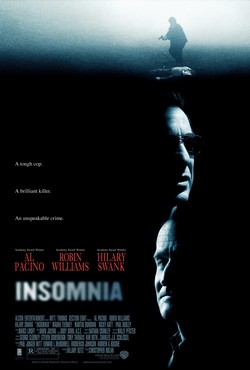
Last night, if you were up at 2 in the morning, you could have turned over to Starz and watched the atmospheric 2002 mystery, Insomnia.
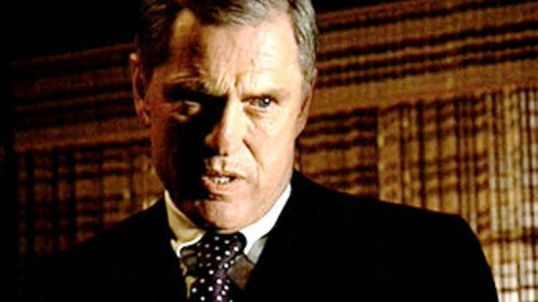
I have to admit that I’m cheating a little bit by including Insomnia in a series about obscure films that you might find on cable late at night. While Insomnia does seem to often turn up during the early morning hours, it’s hardly an obscure film. A remake of an acclaimed Norwegian film, it not only stars three Oscar winners (Al Pacino, Robin Williams, and Hilary Swank) but it was directed by Christopher Nolan. Insomnia got a lot of attention when it was first released in 2002. But, doing an insomnia file about a movie that’s actually about insomnia was just too good of an opportunity to pass up.
I should also mention that I didn’t have insomnia last night. I was up because I currently have a cold and I watched Insomnia in a feverish and congested haze. And yet I couldn’t help but feel that, somehow, that was actually the ideal way to watch Insomnia. With its ominous atmosphere and Nolan’s eye for the surreal, Insomnia plays out like a semi-lucid fever dream.
A teenage girl has been murdered in a small Alaskan fishing village. The chief of police (played by the great character actor Paul Dooley) asks his former LAPD partner, Will Dormer (Al Pacino), to come to Alaska and help with the investigation. Accompanying Dormer is his partner and friend, Hap Eckhart (Martin Donovan).
Dormer has issues that go far beyond anything happening in Alaska. He’s burned out and he’s plagued by rumors that, in the past, he was a crooked cop. He’s being investigated by Internal Affairs and, shortly after they arrive in Alaska, Eckhart admits that he’s been given immunity as part of a deal to testify against Dormer. While pursuing the suspected murderer through the Alaskan fog, Dormer fires his gun. When the fog clear, Dormer discovers that he’s killed Eckhart. Was it an accident or did Dormer intentionally shoot his partner? Not even Dormer seems to know for sure. He lies and says that the murderer shot Eckhart.
Working with a local detective (Hilary Swank), Dormer tries to solve the Alaska murder, with the knowledge that, once he does, he’ll have to return to Los Angeles and he’ll probably be indicted. Because of the midnight sun, night never falls in Alaska and, tortured by guilt, Dormer cannot sleep. Add to that, the murderer knows that Dormer shot Eckhart. And now, he’s calling Dormer and cruelly taunting him.
Who is the murderer? His name is Walter Finch. He’s a writer and, in a stroke of brilliance, he’s played by none other than Robin Williams. To me, Robin Williams’s screen presence always carried hints of narcissism and self-destruction. Even in comedic roles, there was a transparent but very solid wall between Williams the audience. When he was shouting out a thousand words a minute and rapidly switching from one character to the next, it always seemed as if it was all a technique to keep anyone from figuring out who he really was. In Insomnia (and, that same year, in One Hour Photo), Robin Williams reveals an inner darkness that he rarely showed before or after. Finch may possess Williams’s trademark eccentric smile and nervous voice but, underneath the surface, he’s an empty shell who views human beings as being as disposable as the characters in his paperback novels.
Christopher Nolan takes us directly into the heads of these two enemies, with shots of the desolate Alaskan landscape seeming to perfectly capture the inner desolation of two minds destroyed by guilt and paranoia. (Neither Finch nor Dormer is capable of connecting with the world outside of his damaged psyche.) As seen through Nolan’s lens, Alaska becomes as surreal and haunting as one of the dream landscapes from Inception.For those of us who found both The Dark Knight Rises and Interstellar to be so bombastic that they verged on self-parody, Insomnia is a nice reminder that Nolan doesn’t need a pounding Han Zimmer score to make a great movie. With Insomnia, Nolan gives us not bombast but a deceptively low-key and atmospheric journey into the heart of darkness.
Ironically, for a film about two men who cannot sleep, Insomnia will haunt your dreams.
Well, no, actually it’s not. It’s a very serious film that has a few comedic moments. Matt Damon makes a few jokes but that’s largely because he’s trying not to lose his mind and commit suicide. However, The Martian was submitted to the Golden Globes as a comedy. Why? Probably because the producers realized that it would be easier for them to win if their film was the only big-budget drama nominated in the comedy category. It’s dishonest, it’s unethical, and it totally worked. This morning, when the Golden Globe nominations were announced, The Martian was nominated for Best Picture, Comedy or Musical.
I was not a particularly huge fan of The Martian to begin with. The fact that it has now been nominated for Best Comedy while Inside Out was not does not help matters.
Anyway, as for the rest of the Golden Globe nominations … actually, I like a lot of them. Mad Max: Fury Road was nominated for Best Picture, Drama and that should help it regain whatever momentum it may have lost after not being nominated by the SAG. The Big Short was also nominated for Best Picture, Comedy so I guess I really will have to see it, despite having no desire to do so. Trumbo was not nominated for Best Picture but it did pick up nominations for Bryan Cranston and Helen Mirren. Spotlight was naturally nominated for best picture but received no acting nominations, which means that either all the actors are splitting the votes among themselves or maybe Spotlight, while remaining the front-runner, is not as universally loved as some are thinking. It’s impossible for me to say because I haven’t seen Spotlight yet but I have noticed that a lot of critics seem to be more respectful than enthusiastic about it.
(At the same time, my friend, the sportswriter Jason Tarwater, was quite enthusiastic after seeing Spotlight and I usually trust his opinion on these things.)
Anyway, here are the Golden Globe Film nominations!
Interestingly enough, New York City may be the center of wealth and politics in the United States but being Mayor of New York rarely leads to any sort of greater office. Though the Americans Elect people tried to unsuccessfully recruit Michael Bloomberg in 2012 and there’s a few deluded souls who seem to think that Bill de Blasio could run and win in 2016, only three NYC mayors have taken the plunge and actually run for President. Of the three of them, DeWitt Clinton was the most successful. He not only won the Federalist nomination but he came close to beating James Madison in the election of 1812. However, both John V. Lindsay and Rudy Giuliani were forced to end their campaigns when their electoral success in New York failed to translate into votes outside of the Northeast.
And that’s the thing really. Everyone in America knows that New York is an important city, perhaps the most important city in the United States. And they resent the Hell out of it. It’s kinda like how the rest of country hates my home state of Texas because they need our oil more than we need … well, whatever the Hell it is that the rest of the country brings to the table.
I mean, let’s face it. There’s a lot of resentment out there. And that resentment will probably keep anyone from going from Gracie Mansion to the White House.
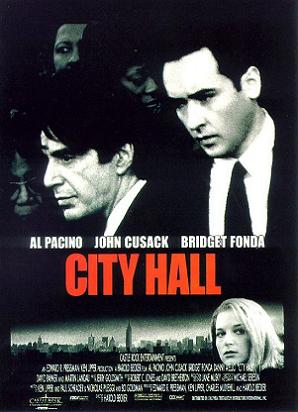
That’s one of the problems that I had with the 1996 film City Hall. In order for City Hall to work, you have to believe that Mayor John Pappas has a legitimate chance to not only be nominated for President but to win the election as well. At the start of the film, we’re informed by Deputy Mayor Kevin Calhoun (John Cusack, speaking in one of the worst attempts at a Louisiana accent that I’ve ever heard) that Pappas is the greatest mayor that New York City has ever had. I guess that might be true, even though we really don’t see any evidence of that fact. (Pappas does get to deliver a few monologues about how much he loves New York but if love is all it took, I’d be a really kick ass Prime Minister of Canada.) However, it’s because Mayor Pappas is such a product of New York City that he’d probably never be able to actually win a primary in Vermont and capture Iowa’s electoral votes. That’s one reason why it’s difficult to buy Mayor Pappas as a future President.
The other reason is that Mayor Pappas is played by Al Pacino. And we’re not talking about Godfatheror Dog Day Afternoon Al Pacino here. Instead, we’re talking about raspy voiced, constantly bellowing, thousand-yard state Al Pacino. As played by Al Pancino, it takes only one look at Mayor Pappas to imagine thousands a middle American voters running in terror away from the voting booths.
(One gets the feeling that if a large group of police officers ever turned their back on Mayor Pappas, he would immediately start jumping up and down while yelling, “YOU ARE TURNIN’ YOUR BACKS ON DA MAYOR HERE! WHAT DA FUCK IS GOIN’ ON WITH THIS SHIT HERE!?”)
That said, there’s another reason why Mayor Pappas may never be President. There’s been a shooting. An undercover cop and a drug dealer shot each other. A little boy was hit by a stray bullet. The little boy is black but, oddly enough, nobody in the film ever suggests that there was any sort of racial element involved. Instead, Mayor Pappas goes to the boy’s funeral and is enthusiastically applauded by the entirely African-American congregation.
It turns out that the drug dealer is the nephew of a mafia don. He should have been in prison at the time of the shooting but instead, he was given an early release by a seemingly incompetent judge (Martin Landau). As Calhoun and a lawyer named Marybeth Cogan (Bridget Fonda, giving a good performance in a generically written role) investigate how the dealer came to be released, they discover that local politician Frank Anselmo (Danny Aiello) may have had something to do with it. Calhoun also discovers that his idol, Mayor Pappas, may know more than he’s saying as well…
If you do happen to watch City Hall, be sure to compare Danny Aiello’s performance with Al Pacino’s. Both Aiello and Pacino are playing larger-than-life characters. And both Aiello and Pacino have a tendency to bellow and to play big. But, whereas Pacino’s performance feels forced and oddly empty, Aiello’s performance feels totally natural. You actually believe that Aiello could be elected to a citywide office whereas Pacino — or at least the version of Al Pacino that shows up for City Hall — seems like he’d have a hard time getting elected to a student council, much less Mayor of America’s largest city.
Anyway, City Hall is currently making the rounds on cable, which is how I saw it. It had the potential to be an interesting look at urban politics but, ultimately, it just doesn’t work. To a certain extent, I hate to be negative about any film that, like City Hall, has its heart in the right place but the movie just doesn’t work.
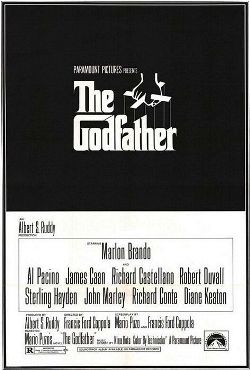
First released in 1990, The Godfather Part III was nominated for best picture (it lost to Goodfellas Dances With Wolves) but it’s got a terrible reputation. Over the past two weeks, whenever I’ve mentioned that I was planning on reviewing The Godfather and The Godfather Part IIfor this series of reviews, everyone who I talked to mentioned that they loved the first two Godfather films and that they hated the third one. Quite a few, in fact, suggested that I shouldn’t even bother reviewing the third one. In their eyes, The Godfather Part III was like that one cousin who you know exists but, because he got caught cashing your grandma’s social security check, you never send a Christmas card.
But you know what?
It was never even an option for me to skip reviewing The Godfather, Part III. First off, I’m a completist. It’s long been my goal to review every single best picture nominee and, regardless of how much some people may dislike it, that’s exactly what The Godfather Part III is.
Plus, I love the Godfather movies. I’m a fourth Italian (and, much like the Corleones, my Italian side comes from Southern Italy) and I was raised Catholic. Let’s face it — The Godfather movies were made for me. Even Part III.
So, with all that in mind, I recently sat down and rewatched The Godfather Part III. And I’m not saying that it was an easy film to watch. It’s a flawed film and those flaws are made even more obvious when you compare it to the previous two Godfathers. It’s hard to follow up on perfection. And I have to admit that, even though I had seen Part III before, I was still expecting it to be better than it actually was. I had forgotten just how many slow spots there were. I had forgotten how confusing the plot could get. I had forgotten….
Okay, I’m really starting to sound negative here and I don’t want to sound negative. Because I like The Godfather, Part III. I think it’s a good but uneven film. Some of my favorite films are good but uneven…
But this is a Godfather film that we’re talking about here!
The Godfather Part III opens in 1979, 20+ years since the end of the second film. Tom Hagen has died off-screen (booo!) and Michael (Al Pacino) is nearly 60 and looking forward to retirement. He’s handed the Corleone criminal empire over to the flamboyant Joey Zasa (Joe Mantegna). Michael has finally become a legitimate businessman but he’s lost everyone that he loved. Kay (Diane Keaton) has divorced him. His son, Anthony (Franco D’Ambrosio), knows that Michael was responsible for killing Uncle Fredo and wants nothing to do with the family business. Instead, Anthony wants to be an opera singer. Meanwhile, his daughter Mary (Sofia Coppola) is headstrong and rebellious. (Or, at least, she’s supposed to be. That’s what the audience is told, anyway. None of that really comes across on the screen.)
Now, the first two Godfather films featured their share of melodrama but neither one of them comes close to matching all of the schemes, betrayals, and plots that play out over the course of Godfather, Part III. Let’s see if I can keep all of this straight:
As the film opens, Michael is receiving an award from the Vatican. Kay, who is now married to a judge, shows up with Mary and Anthony. Michael is obviously happy to see her. Kay glares at him and says, “That ceremony was disgusting!” (Damn, I thought, Kay’s suddenly being kind of a bitch. Fortunately, later on in the movie, Kay’s dialogue was both better written and delivered.)
Then, Vincent (Andy Garcia) shows up! Vincent is one of those handsome, sexy gangsters whose every action is followed by an exclamation point! Vincent is Sonny’s illegitimate son! He wears a cool leather jacket! He openly flirts with his cousin Mary! He has sex with Bridget Fonda! He kills Joey Zasa’s thugs! He convinces Michael to mentor him!
And, as soon as Vincent enters the film, suddenly every scene starts to end with an exclamation point!
And then, Michael goes to Sicily! He gets swindled by the corrupt Archbishop Gilday (Donal Donnelly)! He gets targeted by a corrupt Italian politician! He confesses his sins to Cardinal Lamberto (Raf Vallone)! Lamberto later becomes Pope!
Meanwhile, Don Altobello (Eli Wallach) is conspiring to kill Michael! Because that’s what elderly Mafia dons do! And then Kay, Anthony, and Mary all come to Sicily! Anthony is going to be making his opera debut! And soon Vincent is sleeping with Mary, even though they’re first cousins!
And even more people want Michael dead and I’m not really sure why! Everyone goes to the opera! We sit through the entire opera! Meanwhile, enemies of the Corleones are killed! And some Corleones are killed! And it all ends tragically!
Okay, I’m starting to get snarky here and it’s probably getting a little bit hard to believe that I actually do like The Godfather, Part III. And, as much as I hate to do it, there are a few more flaws that I do need to point out. Sofia Coppola is one of my favorite directors and she has really pretty hair and we both have similar noses but …. well, let’s just say that it’s probably a good thing that Sofia pursued a career as a director and not as an actress. Reportedly, Sofia was a last minute pick for the role, cast after Winona Ryder suddenly dropped out of the production. It’s not so much that her performance is terrible as much as it’s not up to the level of the rest of the cast. Watching this Godfather, you’re acutely aware of how much of what you’re seeing on screen was determined by Sofia’s inexperience as an actress.
And then there’s that opera. Now, I know that I’m supposed to love opera because I’m a girl and I’m a fourth Italian. And I do love big emotions and big drama and all the rest. But oh my God, the opera at the end of the movie went on and on. There’s only so much entertainment you can get out of watching actors watch other actors.
But, at the same time, for every flaw, there’s a part of the film that does work. First off, the film itself is gorgeous to look at, with a lot of wonderfully baroque sets and scenes taking place against the beautiful Italian landscape. Al Pacino brings a very real gravity to the role of Michael and it’s fun to watch him trying to win back Diane Keaton. (In those brief scenes, The Godfather Part III almost becomes a romantic comedy.) Talia Shire is obviously having a lot of fun playing Connie as being a Lady MacBeth-type of character. (In fact, they needed to give Connie a film of her own where she could poison anyone who get on her nerves.) And Andy Garcia does a great job as Vincent. You watch him and you never have any doubt that he could be Sonny’s son.
The Godfather Part III may not live up to the first two Godfather films but what film could?
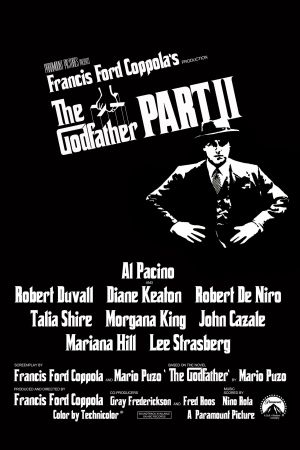
Believe it or not, The Trial of Billy Jackwas not the only lengthy sequel to be released in 1974. Francis Ford Coppola’s The Godfather Part II was released as well and it went on to become the first sequel to win an Oscar for best picture. (It was also the first, and so far, only sequel to a best picture winner to also win best picture.) Among the films that The Godfather, Part II beat: Chinatown, Coppola’s The Conversation, and The Towering Inferno. 1974 was a good year.
Whenever I think about The Godfather, Part II, I find myself wondering what the film would have been like if Richard Castellano hadn’t demanded too much money and had actually returned in the role of Clemenza, as was originally intended. In the first Godfather, Clemenza and Tessio (Abe Vigoda) were Don Corleone’s two lieutenants. Tessio was the one who betrayed Michael and was killed as a result. Meanwhile, Clemenza was the one who taught Michael how to fire a gun and who got to say, “Leave the gun. Take the cannoli.”
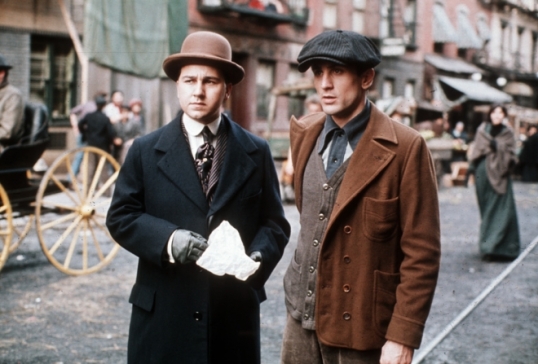
Though Castellano did not return to the role, Clemenza is present in The Godfather, Part II. The Godfather, Part II tells two separate stories: during one half of the film, young Vito Corleone comes to America, grows up to be Robert De Niro and then eventually becomes the Godfather. In the other half of the film, Vito’s successor, Michael (Al Pacino), tries to keep the family strong in the 1950s and ultimately either loses, alienates, or kills everyone that he loves.
During Vito’s half of the film, we learn how Vito first met Clemenza (played by Bruno Kirby) and Tessio (John Aprea). However, during Michael’s half of the story, Clemenza is nowhere to be seen. Instead, we’re told that Clemenza died off-screen and his successor is Frankie Pentangeli (Michael V. Gazzo). All of the characters talk about Frankie as if he’s an old friend but, as a matter of fact, Frankie was nowhere to be seen during the first film. Nor is he present in Vito’s flashbacks. This is because originally, Frankie was going to be Clemenza. But Richard Castellano demanded too much money and, as a result, he was written out of the script.
And really, it doesn’t matter. Gazzo does fine as Frankie and it’s a great film. But, once you know that Frankie was originally meant to be Clemenza, it’s impossible to watch The Godfather Part II without thinking about how perfectly it would have worked out.
If Clemenza had been around for Michael’s scenes, he would have provided a direct link between Vito’s story and Michael’s story. When Clemenza (as opposed to Frankie) betrayed Michael and went into protective custody, it would have reminded us of how much things had changed for the Corleones (and, by extension, America itself). When Tom Hagen (Robert Duvall) talked Clemenza (as opposed to Frankie) into committing suicide, it truly would have shown that the old, “honorable” Mafia no longer existed. It’s also interesting to note that, before Tessio was taken away and killed, the last person he talked to was Tom Hagen. If Castellano had returned, it once again would have fallen to Tom to let another one of his adopted father’s friends know that it was time to go.
Famously, the Godfather, Part II ends with a flashback to the day after Pearl Harbor. We watch as a young and idealistic Michael tells his family that he’s joined the army. With the exception of Michael and Tom Hagen, every character seen in the flashback has been killed over the course of the previous two films. We see Sonny (James Caan), Carlo (Gianni Russo), Fredo (John Cazale), and even Tessio (Abe Vigoda). Not present: Clemenza. (Vito doesn’t appear in the flashback either but everyone’s talking about him so he might as well be there. Poor Clemenza doesn’t even get mentioned.)
If only Richard Castellano had been willing to return.
Clemenza and Vito
But he didn’t and you know what? You really only miss him if you know that he was originally meant to be in the film. With or without Richard Castellano, The Godfather, Part II is a great film, probably one of the greatest of all time. When it comes to reviewing The Godfather, Part II, the only real question is whether it’s better than the first Godfather.
Which Godfather you prefer really depends on what you’re looking for from a movie. Even with that door getting closed in Kay’s face, the first Godfather was and is a crowd pleaser. In the first Godfather, the Corleones may have been bad but everyone else was worse. You couldn’t help but cheer them on.
The Godfather Part II is far different. In the “modern” scenes, we discover that the playful and idealistic Michael of part one is gone. Micheal is now cold and ruthless, a man who willingly orders a hit on his older brother and who has no trouble threatening Tom Hagen. If Michael spent the first film surrounded by family, he spends the second film talking to professional killers, like Al Neri (Richard Bright) and Rocco Lampone (Tom Rosqui). Whereas the first film ended with someone else closing the door on Kay, the second film features Michael doing it himself. By the end of the film, Michael Corleone is alone in his compound, a tyrant isolated in his castle.
Michael’s story provides a sharp contrast to Vito’s story. Vito’s half of the film is vibrant and colorful and fun in a way that Michael’s half is not and could never be. But every time that you’re tempted to cheer a bit too easily for Vito, the film moves forward in time and it reminds you of what the future holds for the Corleones.
So, which of the first two Godfathers do I prefer? I love them both. If I need to be entertained, I’ll watch The Godfather. If I want to watch a movie that will truly make me think and make me question all of my beliefs about morality, I’ll watch Part Two.
Finally, I can’t end this review without talking about G.D. Spradlin, the actor who plays the role of U.S. Sen. Pat Geary. The Godfather Part II is full of great acting. De Niro won an Oscar. Pacino, Gazzo, Lee Strasberg, and Talia Shire were all nominated. Diane Keaton, Robert Duvall, and John Cazale all deserved nominations. Even Joe Spinell shows up and brilliantly delivers the line, “Yeah, we had lots of buffers.” But, with each viewing of Godfather, Part II, I find myself more and more impressed with G.D. Spradlin.
Sen. Pat Geary doesn’t have a lot of time on-screen. He attends a birthday party at the Corleone Family compound, where he praises Michael in public and then condescendingly insults him in private. Later, he shows up in Cuba, where he watches a sex show with obvious interest. And, when Michael is called before a Senate committee, Geary gives a speech defending the honor of all Italian-Americans.
G.D. Spradlin as Sen. Pat Geary
But the scene that we all remember is the one where Tom Hagen meets Sen. Geary in a brothel. As Geary talks about how he passed out earlier, the camera briefly catches the sight of a dead prostitute lying on the bed behind him. What’s especially disturbing about this scene is that neither Hagen nor Geary seem to acknowledge her presence. She’s been reduced to a prop in the Corleone Family’s scheme to blackmail Sen. Geary. His voice shaken, Geary says that he doesn’t know what happened and we see the weakness and the cowardice behind his almost all-American facade.
It’s a disturbing scene that’s well-acted by both Duvall and Spradlin. Of course, what is obvious (even if it’s never explicitly stated) is that Sen. Geary has been set up and that nameless prostitute was killed by the Corleones. It’s a scene that makes us reconsider everything that we previously believed about the heroes of the Godfather.
For forcing us to reconsider and shaking us out of our complacency, The Godfather, Part II is a great film.
(Yes, it’s even better than The Trial of Billy Jack.)
“I got something for your mother and Sonny and a tie for Freddy and Tom Hagen got the Reynolds Pen…” — Kay Adams (Diane Keaton) in The Godfather (1972)
It probably seems strange that when talking about The Godfather, a film that it is generally acknowledged as being one of the best and most influential of all time, I would start with an innocuous quote about getting Tom Hagen a pen.
(And it better have been a hell of a pen because, judging from the scene where Sollozzo stops him in the street, it looked like Tom was going all out as far as gifts were concerned…)
After all, The Godfather is a film that is full of memorable quotes. “Leave the gun. Take the cannoli.” “I’m going to make him an offer he can’t refuse.” “It’s strictly business.” “I believe in America….” “That’s my family, Kay. That’s not me.”
But I went with the quote about the Reynolds pen because, quite frankly, I find an excuse to repeat it every Christmas. Every holiday season, whenever I hear friends or family talking about presents, I remind them that Tom Hagen is getting the Reynolds pen. Doubt me? Check out these tweets from the past!
But all that love also makes The Godfather a difficult film to review. What do you say about a film that everyone already knows is great?
Do you praise it by saying that Al Pacino, Robert Duvall, James Caan, Diane Keaton, Marlon Brando, John Cazale, Richard Castellano, Abe Vigoda, Alex Rocco, and Talia Shire all gave excellent performances? You can do that but everyone already knows that.
Do you talk about how well director Francis Ford Coppola told this operatic, sprawling story of crime, family, and politics? You can do that but everyone already knows that.
Maybe you can talk about how beautiful Gordon Willis’s dark and shadowy cinematography looks, regardless of whether you’re seeing it in a theater or on TV. Because it certainly does but everyone knows that.
Maybe you can mention the haunting beauty of Nina Rota’s score but again…
Well, you get the idea.
Now, if you somehow have never seen the film before, allow me to try to tell you what happens in The Godfather. I say try because The Godfather is a true epic. Because it’s also an intimate family drama and features such a dominating lead performance from Al Pacino, it’s sometimes to easy to forget just how much is actually going on in The Godfather.
The Godfather tells the story of the Corleone Family. Patriarch Vito Corleone (Marlon Brando) has done very well for himself in America, making himself into a rich and influential man. Of course, Vito is also known as both Don Corleone and the Godfather and he’s made his fortune through less-than-legal means. He may be rich and he may be influential but when his daughter gets married, the FBI shows up outside the reception and takes pictures of all the cars in the parking lot. Vito Corleone knows judges and congressmen but none of them are willing to be seen in public with him. Vito is the establishment that nobody wants to acknowledge and sometimes, this very powerful man wonders if there will ever be a “Governor Corleone” or a “Senator Corleone.”
Vito is the proud father of three children and the adopted father of one more. His oldest son, and probable successor, is Sonny (James Caan). Sonny, however, has a temper and absolutely no impulse control. While his wife is bragging about him to the other women at the wedding, Sonny is upstairs screwing a bridesmaid. When the enemies of the Corleone Family declare war, Sonny declares war back and forgets the first rule of organized crime: “It’s not personal. It’s strictly business.”
After Sonny, there’s Fredo (John Cazale). Poor, pathetic Fredo. In many ways, it’s impossible not to feel sorry for Fredo. He’s the one who ends up getting exiled to Vegas, where he lives under the protection of the crude Moe Greene (Alex Rocco). One of the film’s best moments is when a bejeweled Fredo shows up at a Vegas hotel with an entourage of prostitutes and other hangers-on. In these scenes, Fred is trying so hard but when you take one look at his shifty eyes, it’s obvious that he’s still the same guy who we first saw stumbling around drunk at his sister’s wedding.
(And, of course, it’s impossible to watch Fredo in this film without thinking about both what will happen to the character in the Godfather, Part II and how John Cazale, who brought the character to such vibrant life, would die just 6 years later.)
As a female, daughter Connie (Talia Shire) is — for the first film, at least — excluded from the family business. Instead, she marries Sonny’s friend Carlo Rizzi (Gianni Russo). And, to put it gently, it’s not a match made in heaven.
And finally, there’s Michael (Al Pacino). Michael is the son who, at the start of the film, declares that he wants nothing to do with the family business. He’s the one who wants to break with family tradition by marrying Kay Adams (Diane Keaton), who is most definitely not Italian. He’s the one who was decorated in World War II and who comes to his sister’s wedding still dressed in his uniform. (In the second Godfather film, we learn that Vito thought Michael was foolish to join the army, which makes it all the more clear that, by wearing the uniform to the wedding, Michael is attempting to declare his own identity outside of the family.) To paraphrase the third Godfather film, Michael is the one who says he wants to get out but who keeps getting dragged back in.
And finally, the adopted son is Tom Hagen (Robert Duvall). Tom is the Don’s lawyer and one reason why Tom is one of my favorite characters is because, behind his usual stone-faced facade, Tom is actually very snarky. He just hides it well.
Early on, we get a hint that Tom is more amused than he lets on when he has dinner with the crude Jack Woltz (John Marley), a film producer who doesn’t want to use Johnny Fontane (Al Martino) in a movie When Woltz shouts insults at him, Tom calmly finishes his dinner and thanks him for a lovely evening. And he does it with just the hint of a little smirk and you can practically see him thinking, “Somebody’s going to wake up with a horse tomorrow….”
However, my favorite Tom Hagen moment comes when Kay, who is searching for Michael, drops by the family compound. Tom greets her at the gate. When Kay spots a car that’s riddled with bullet holes, she asks what happened. Tom smiles and says, “Oh, that was an accident. But luckily no one was hurt!” Duvall delivers the line with just the right attitude of “That’s my story and I’m sticking to it!” How can you not kind of love Tom after that?
And, of course, the film is full of other memorable characters, all of whom are scheming and plotting. There’s Clemenza (Richard S. Catellano) and Tessio (Abe Vigoda), the two Corleone lieutenants who may or may not be plotting to betray the Don. There’s fearsome Luca Brasi (Lenny Montana), who spends an eternity practicing what he wants to say at Connie’s wedding and yet still manages to screw it up. And, of course, there’s Sollozzo (Al Lettieri, playing a role originally offered to Franco Nero), the drug dealer who reacts angrily to Vito’s refusal to help him out. Meanwhile, Capt. McCluskey (Sterling Hayden) is busy beating up young punks and Al Neri (Richard Bright) is gunning people down in front of the courthouse. And, of course, there’s poor, innocent, ill-fated Appollonia (Simonetta Stefanelli)…
The Godfather is a great Italian-American epic, one that works as both a gangster film and a family drama. Perhaps the genius of the Godfather trilogy is that the Corleone family serves as an ink blot in a cinematic rorschach test. Audiences can look at them and see whatever they want. If you want them and their crimes to serve as a metaphor for capitalism, you need only listen to Tom and Michael repeatedly state that it’s only business. If you want to see them as heroic businessmen, just consider that their enemies essentially want to regulate the Corleones out of existence. If you want the Corleones to serve as symbols of the patriarchy, you need only watch as the door to Michael’s office is shut in Kay’s face. If you want to see the Corleones as heroes, you need only consider that they — and they alone — seem to operate with any sort of honorable criminal code. (This, of course, would change over the course of the two sequels.)
And, if you’re trying to fit a review of The Godfather into a series about political films, you only have to consider that Vito is regularly spoken of as being a man who carries politicians around in his pocket. We may not see any elected officials in the first Godfather film but their presence is felt. Above all else, it’s Vito’s political influence that sets in motion all of the events that unfold over the course of the film.
The Godfather, of course, won the Oscar for best picture of 1972. And while it’s rare that I openly agree with the Academy, I’m proud to say that this one time is a definite exception.
Along with my current series of 80 Back to School reviews (48 down, 32 to go!), another one of my long time goals has been to watch and review every single film to ever be nominated for the best picture. So, imagine how happy I was to discover that by watching the 1992 film Scent of a Woman, I could make progress towards completing two goals at once! Not only was Scent of A Woman nominated for best picture of the year (losing to Unforgiven) but it also features a major subplot about life and discipline at an exclusive New England prep school! Even better, it’s been showing up on Showtime fairly regularly for the past month or so.
“Wow,” I thought as my boyfriend and I sat down to watch this movie, “could life get any easier? Or better?”
And then we watched the film.
You know how occasionally you watch a film just because you’ve heard that it was nominated (or perhaps even won) an Oscar or because it has an oddly high rating over at the imdb or maybe because someone said, “Roger Ebert loved this film so, if you don’t watch and love it, that means that, by that standard of the current online film community, you really don’t love movies?” And then you watch the movie and you’re just like, “What the Hell?”
Well, that was kind of my reaction to Scent of a Woman.
Look, the film’s not all bad. It has a few good performances. It looks great. It’s certainly better than Gigli, the film that director Martin Brest is perhaps best remembered for. It features a great scene where Al Pacino (playing a blind man) dances the tango with a woman that he’s just met. (Then again, I have a notorious weakness for dance scenes…) It’s not so much that the film is bad as much as it’s just that the movie itself is not particularly good.
Charlie Simms (Chris O’Donnell) is a scholarship student at an exclusive prep school in Massachusetts. Much like Brendan Fraser in School Ties, 1992’s other prep school melodrama, Charlie is a poor kid attending the school on a scholarship. While his rich friends prepare to go home for the Thanksgiving weekend, Charlie knows that there’s no way that he can afford to fly back to Oregon. In order to raise the money so that he can at least go back home for Christmas (how poor is this kid’s family!?), Charlie gets a temporary job for the weekend. His job? To look after Lt. Col. Frank Slade (Al Pacino), who is blind and yells a lot.
Anyway, as you can probably guess, Frank convinces Charlie to drive him to New York and they have all of the adventures that usually happen whenever a naive teenager spends the weekend with a suicidal blind man. Frank bellows a lot and tells about how, through his sense of smell, he can always tell when there’s a beautiful woman nearby. Frank also yells a lot. Did I already mention that? Because, seriously, he yells a lot.
Charlie has other problems than just Frank. It seems that a rather mild prank was pulled on the headmaster (James Rebhorn) of Charlie’s school. As a result, a bucket of paint was poured down on both the headmaster and his new car! Now, the headmaster is looking for those responsible. He just needs two witnesses. He’s already gotten one student to confess. And now, he’s blackmailing Charlie with a letter of recommendation to Harvard. All Charlie has to do is name names and his future is set…
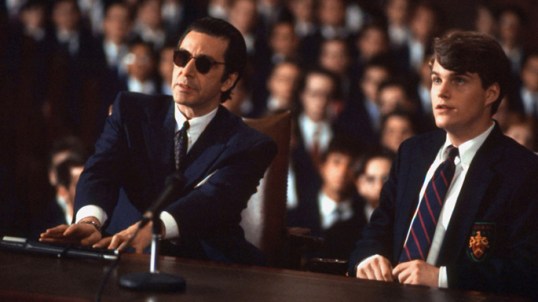
Will Charlie name names and sacrifice his honor just to get into a college that could assure him a great life? Or will Frank convince Charlie that honor is the only thing that matters? And finally, will the film end with a big hearing in front of the entire school in which the headmaster attempts to badger Charlie, just to be interrupted by a sudden appearance from bellowing Frank Slade?
Will it!?
You can probably already guess and, since we have a no spoiler policy here at the Lens, I’ll just assume that you guessed right. (Or you could just look at the picture at the top of this review…)
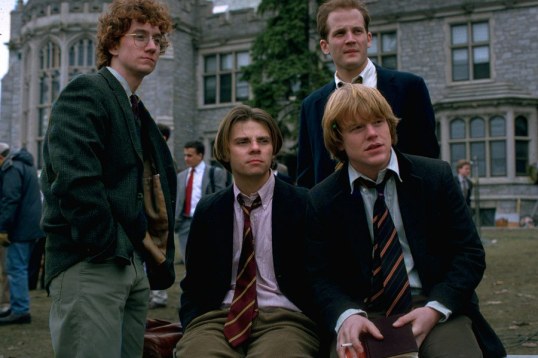
The prep school subplot pretty much just adds to the film’s already excessive running time. But it is interesting to watch because the other student — the one who names names — is played by a very young Philip Seymour Hoffman. (Or as he’s credited here, Philip S. Hoffman.) This was one of Hoffman’s first screen roles and he gives a memorable performance as an unlikable character. If you were to have seen Scent of a Woman in 1992, you would not have guessed that Philip Seymour Hoffman would eventually be an Oscar winner but you would know that he was a very talented character actor.
Otherwise, Scent of a Woman is a fairly forgettable movie. If I hadn’t known ahead of time that it was nominated for best picture, I never would have been able to guess. I’m not enough of an expert to be able to name every good 1992 film that was not nominated to make room for Scent of a Woman but I imagine that when that year’s Oscar nominations were announced, there were quite a few people left scratching their heads.
Can you figure out which one grew up to be Philip Seymour Hoffman?
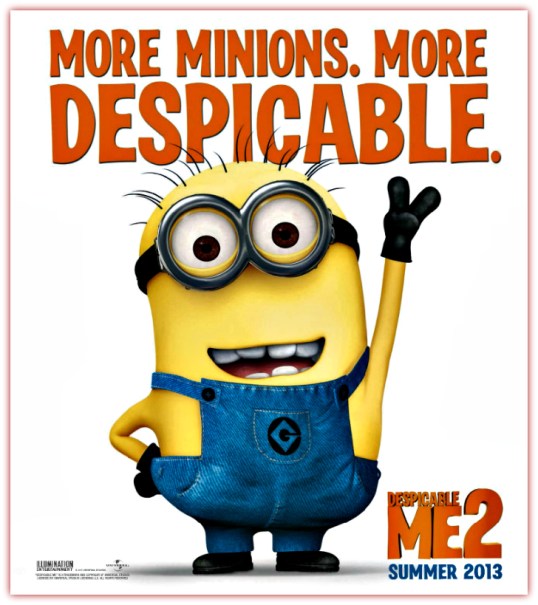
Finally, we have the first official full trailer for the sequel to 2010’s surprise animated hit Despicable Me. The first two trailers were more teasers and sort of more like Minion-centric showcases.
This official trailer now brings back the rest of the cast and actually gives us an idea as to what could be the story for the sequel. It looks like Gru has been recruited by an Anti-Villain League to take on a new villain. Oh, there’s more Minion hilarities to be seen as well.
MINIONS.
Despicable Me 2 is set for a July 3, 2013 release date.
The shootout in Michael Mann’s “Heat” (1995) remains one of the best ever filmed, in my opinion. Mann himself even tried topping it in Miami Vice (which is good in it’s own right), but this scene (which occurs some minutes in) is so loved, Rockstar Games actually developed a mission in Grand Theft Auto 4 to mimic it.
A group of bank robbers, led by Neal McCauley (Robert DeNiro) finally take down their score, only to find that the police squad out to get them has been tipped off. The video starts as the robbery begins. Vincent Hanna (Al Pacino), along with his team arrive just as the crew is coming out of the bank with the money. The rest is mayhem, with the gunfire sounds echoing all around. Elliot Goldenthal’s score for the piece sets the tone for the robbery, a piece called Force Marker (along with Brian Eno).
What I wouldn’t give to catch this in a theatre somewhere. Enjoy.
On June 20th, it was announced that the body of veteran character actor Richard Lynch had been found at his home. Richard Lynch was never a household name but, if you’re a fan of exploitation and grindhouse cinema, you’ve probably seen him at least a few times. He was the tall, blonde actor with the scarred face who was alway either killing people or having them killed. Richard Lynch was one of those actors who, as soon as he showed up on-screen, you knew he was the bad guy.
As an actor, Lynch always brought something special to even the simplest of his roles. He was always the villain who you knew would probably easily kill the hero if the two of them ever met in the real world. He was so good at being bad that you often couldn’t help but root for him.
I first became aware of Richard Lynch when I bought a movie called Premonition on DVD. This atmospheric 1976 film featured Richard Lynch in the role of a villainous yet oddly sympathetic carnival clown-turned-kidnapper. When Lynch was on-screen, I literally could not look away. Even better, the DVD included an interview with the now white-haired Richard Lynch in which he discussed his career. Imagine my surprise to discover that this rather creepy and scary-looking actor was actually a very articulate and witty man.
A few days after I saw Premonition, I watched another 1976 film on DVD. This one was Larry Cohen’s Gold Told Me To and, to my surprise, it also featured Richard Lynch. This time, he was cast as an alien messiah who inspired all sorts of mayhem in New York City. From that moment on, Richard Lynch was one of my favorite of the old exploitation actors.
After Richard Lynch’s body was found, there were several news stories that mentioned his passing. Almost all of those stories repeated the story that Lynch’s distinctive facial scars were the result of him setting himself on fire as the result of bad LSD trip in 1967. A few mentioned that he was a longtime friend of Al Pacino’s. Most of them took a rather dismissive attitude towards the majority of Lynch’s films.
In fact, it seemed like the only place that Richard Lynch got the proper amount of respect was on twitter. And that’s a shame because an actor like Richard Lynch deserved a lot more.
The sad thing is that actors like Richard Lynch are rarely appreciated because elitist (and wannabe elitist) filmgoers and critics are rarely willing to admit that it does take a certain amount of talent to be an effective and memorable villain. As an actor, Richard Lynch appeared in some good films and he also appeared in a lot of very bad films but he always gave a good performance. Unlike so many other actors, he never used subpar material as an excuse to give a subpar performance. Regardless of the films he found himself in, he always gave it his best and that’s why this super-sized edition of Lisa Marie’s Favorite Grindhouse and Exploitation Trailers is dedicated to Richard Lynch.
1) God Told Me To (1976)
Arguably, this film from director Larry Cohen was the best movie that Richard Lynch ever appeared in. Though he doesn’t get a lot of screen time in either the film or the trailer, he easily dominates both, if just for the fact that Lynch plays the God of the title.
2) Deathsport (1978)
Richard Lynch vs. David Carradine.
3) The Sword and The Sorcerer (1982)
Though I haven’t seen it, this film is a favorite of many of my fellow contributors here at the Shattered Lens.
4) Cut and Run (1985)
This film was directed by Ruggero Deodato and apparently, it gained a certain amount of fame after it was banned in several countries. I’ve seen it on DVD and all I can say is that this is one of the most misleading trailers ever made. However, this film also features one of Richard Lynch’s most intimidating performances.
5) Savage Dawn (1985)
For some reason, I doubt that the character being played by Richard Lynch is a real priest.
6) Invasion USA (1985)
Judging from the response to Richard Lynch’s death on twitter, this Chuck Norris movie might be the film that he’s best known for.
7) The Barbarians (1987)
This film, which appears to feature Richard Lynch in full villain mode, was also directed by Ruggero Deodato.
8) Bad Dreams (1988)
Richard Lynch is all sorts of creepy in this trailer. Knowing about his own true life story makes this trailer all the more odd to watch.
9) Trancers 2 (1992)
Helen Hunt’s in this?
10) Werewolf (1996)
Thisone looks like fun, to be honest.
11) Wedding Slashers (2006)
“Til death do us part…”
12) Mil Mascaras Vs. The Aztec Mummy (2006)
Finally, let’s finish things up with the trailer for this Mexican film in which Richard Lynch was cast as the President of the United States.