And finally, to wrap up today’s excursion into awards season, here are the Phoenix Film Critics Nominations! As soon as you look over these nominations and see if your favorite film made the list, be sure to go back and read Patrick’s review of Santa and the Ice Cream Bunny and Jedadiah Leland’s review of Star Wars Episode 1: The Phantom Menace!
Cate Blanchett, Carol
Marion Cotillard, Macbeth
Jennifer Lawrence, Joy
Brie Larson, Room
Saoirse Ronan, Brooklyn
BEST SUPPORTING ACTOR
Tom Hardy, The Revenant
Richard Jenkins, Bone Tomahawk
Michael Keaton, Spotlight
Mark Rylance, Bridge of Spies
Michael Shannon, 99 Homes
Sylvester Stallone, Creed
Jacob Tremblay, Room
Well, no, actually it’s not. It’s a very serious film that has a few comedic moments. Matt Damon makes a few jokes but that’s largely because he’s trying not to lose his mind and commit suicide. However, The Martian was submitted to the Golden Globes as a comedy. Why? Probably because the producers realized that it would be easier for them to win if their film was the only big-budget drama nominated in the comedy category. It’s dishonest, it’s unethical, and it totally worked. This morning, when the Golden Globe nominations were announced, The Martian was nominated for Best Picture, Comedy or Musical.
I was not a particularly huge fan of The Martian to begin with. The fact that it has now been nominated for Best Comedy while Inside Out was not does not help matters.
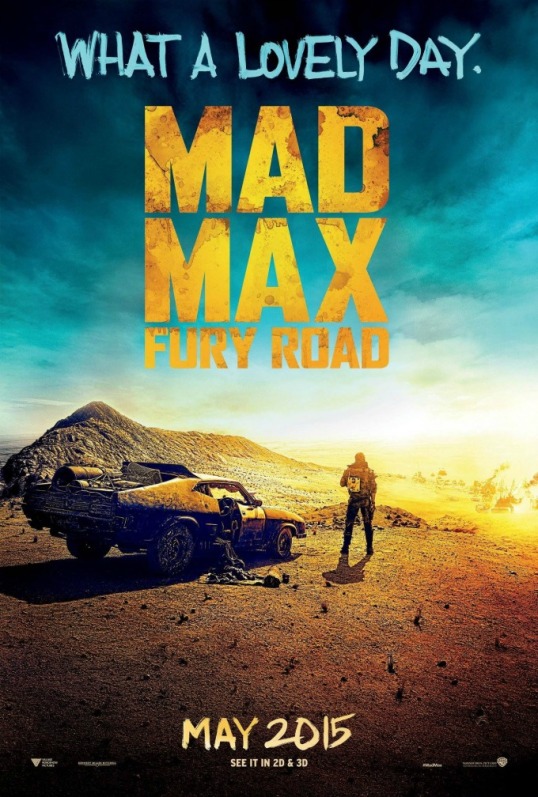
Anyway, as for the rest of the Golden Globe nominations … actually, I like a lot of them. Mad Max: Fury Road was nominated for Best Picture, Drama and that should help it regain whatever momentum it may have lost after not being nominated by the SAG. The Big Short was also nominated for Best Picture, Comedy so I guess I really will have to see it, despite having no desire to do so. Trumbo was not nominated for Best Picture but it did pick up nominations for Bryan Cranston and Helen Mirren. Spotlight was naturally nominated for best picture but received no acting nominations, which means that either all the actors are splitting the votes among themselves or maybe Spotlight, while remaining the front-runner, is not as universally loved as some are thinking. It’s impossible for me to say because I haven’t seen Spotlight yet but I have noticed that a lot of critics seem to be more respectful than enthusiastic about it.
(At the same time, my friend, the sportswriter Jason Tarwater, was quite enthusiastic after seeing Spotlight and I usually trust his opinion on these things.)
Anyway, here are the Golden Globe Film nominations!
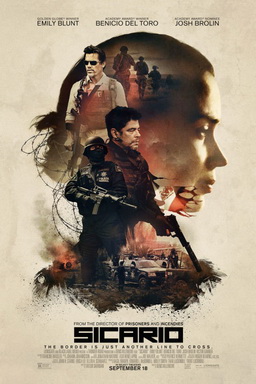
I love the Online Film Critics Society, I really do. Every year, when they announce the nominees for their end-of-the-year awards, they always seem to honor the films that truly deserve to be honored. For instance, this year, they found room to not only nominate the Academy front runners — like Spotlight, The Martian, Carol, Brooklyn, and Mad Max — but they also gave nominations to Ex Machina, Sicario, and Inside Out. Ex Machina, Sicario, and Inside Out all deserve to be in the Oscar conversation and hopefully, these nominations will help them stay there.
Here are the nominations from the Online Film Critics Society!
Best Supporting Actress:
Rooney Mara (Carol)
Cynthia Nixon (James White)
Kristen Stewart (Clouds of Sils Maria)
Alicia Vikander (The Danish Girl)
Kate Winslet (Steve Jobs)
Best Original Screenplay: Ex Machina (Alex Garland) Inside Out (Pete Docter, Ronnie Del Carmen, Meg LeFauve, Josh Cooley)
Mistress America (Greta Gerwig, Noah Baumbach) Sicario (Taylor Sheridan) Spotlight (Josh Singer, Tom McCarthy)
One good thing about Mad Max: Fury Road doing so well during award seasion is that it gives me an excuse to say that “So-and-so Is Mad About Max!” Thank you, film critics, for making my job a lot easier.
Anyway, yesterday, the Washington D.C. Area Film Critics announced their nominees for the best of 2015! And, once again, a lot of love was shown to Fury Road. However, I am even happier to see that they also gave some attention to one of my favorite films of the year, Ex Machina.
Best Original Screenplay:
Matt Charman and Ethan Coen & Joel Coen (Bridge of Spies)
Alex Garland (Ex Machina)
Pete Docter, Meg LeFauve and Josh Cooley (Original Story by Pete Docter and Ronnie Del Carmen) (Inside Out)
Tom McCarthy and Josh Singer (Spotlight)
Amy Schumer (Trainwreck)
I don’t have much to say about Steve Jobs, which has been playing here in New York in a limited release. This is how I know I didn’t care for it.
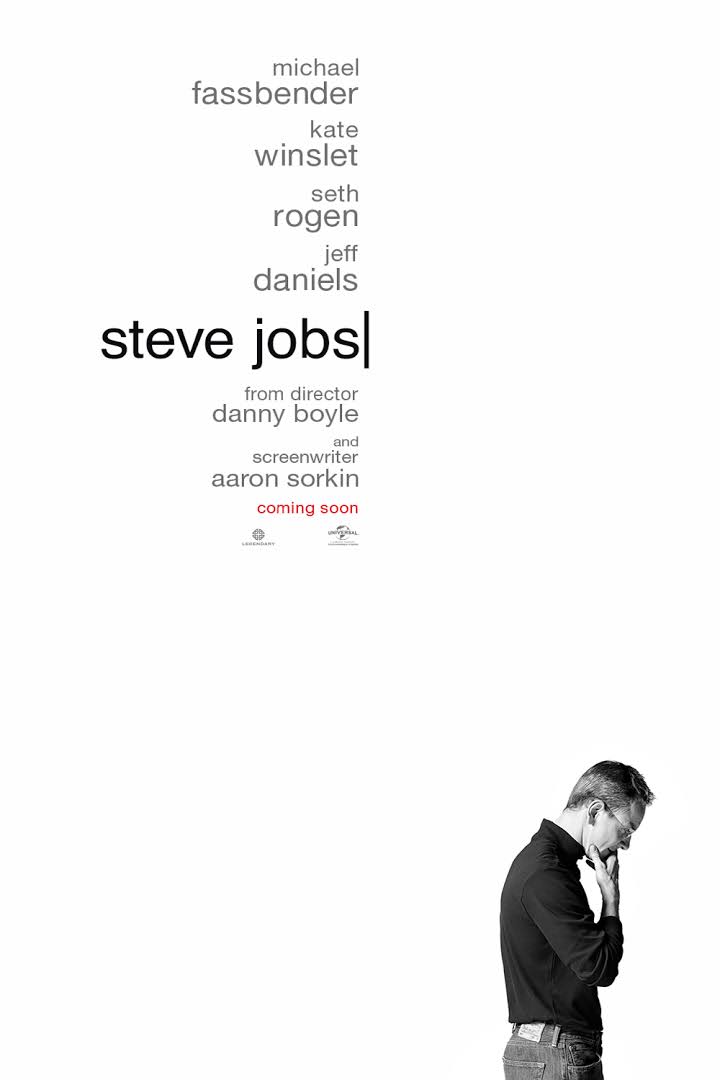
When you look at the list of people who came together to make the new movie about Steve Jobs, it’s almost impossible to think that the end result could be bad. You’ve got Academy Award Winner Danny Boyle, whose work I’ve enjoyed since Trainspotting. With a track record like 28 Days Later, The Beach, Sunshine, and Slumdog Millionaire, he’s having a wonderful run. You also have Academy Award Winner Aaron Sorkin, fresh off both The Social Network, Moneyball and The Newsroom working the screenplay. With actors like Michael Fassbender (12 Years a Slave, Slow West) and Kate Winslet (Divergent, A Little Chaos) on board , it’s almost like having the stars align.
And yet, I almost walked out on Steve Jobs. It just wasn’t for me. Maybe I was just tired.
The film focuses on three places in the Steve’s life:
– The launch of the original Macintosh just after the “1984” Super Bowl commercial.
– The launch of the NeXt system, which Jobs created after being fired by Apple.
– The launch of the first iMac, just after Jobs returned to Apple as the interim CEO.
The entire first part was really good, with arguments going back and forth over the ability to get the on stage Mac to say “Hello”. Steve also argues with Chrisann Brennan over the financial support for her daughter, Lisa Nicole. Steve simply won’t admit she is his. When asked about the name of his first computer, Jobs goes to great lengths to explain that the acronym (Local Integrated System Architecture) is just a coincidence. When Lisa amazes him with her computer usage, he decides to support her mom with a check.
Every segment after that felt like a repeat of the first one to me, almost like Run Lola Run. In the beginning, it feels fresh, witty, nice. By the end, I was fighting to simply stay awake and care. What I hoped to see was more interaction with Steve and Lisa. If they were so distanced then, and grew close later in life, what was the catalyst? Was it the cancer diagnosis Steve had in the early 2000’s? We’ll never know, because the movie stops just before that time period. Did he suddenly realize that his heart wasn’t as small as the Grinch? What about Jonny Ive, who was responsible for much of Apple’s design after Job’s return? Nope, not even so much a mention. And I think this is the overall problem I have with the film. Yes, Steve Jobs by himself was a visionary, and as the story points out, he conducts the Orchestra, but there’s no reverence whatsoever to any of the other people that helped get Apple where it is. It doesn’t make the movie terrible for not covering these angles, but there are a number of missed opportunities as a result of using such a narrow range.
Fassbender was wonderful to watch onscreen, as well as Winslet. One of the odd things is that from a performance standpoint, everyone in Steve Jobs is effective. I wouldn’t be surprised to see Fassbender get some kind of recognition come awards season. Even Seth Rogen did a good job, though his version of Wozniak was limited to constantly arguing for credit like Morrie in Goodfellas looking for his cut of the Luftansa Heist. There are points, however, where the banter just becomes a little too much.
Mind you, I loved The Social Network. I enjoyed The Newsroom. A Few Good Men is one of my favorite films. I’ve even seen the man in person once. He knows what he’s doing when it comes to having people talk. Here, it just seemed like Sorkin said…”What if I created a play about how Steve Jobs could be.” and rolled with it. Supposedly, he acknowledged that much of the writing here isn’t entirely accurate. I can accept that, but I think the structure of the film damaged it all for me. I would have preferred more of a straight A-B narrative than what I received. Is that too long to put to screen? Perhaps.
Here at the Shattered Lens, Lisa Marie and I have gone head to head regarding Aaron Sorkin, sometimes yelling from our respective offices. She’s not a fan, but I’ve liked his work. The argument is that for all of his abilities when it comes to writing, he doesn’t really handle women well. It’s true. Women haven’t always fared well in Sorkin’s world, and watching Winslet, I was almost sure I could come back here and say in his defense…”Hey, Sorkin wrote a good girl that doesn’t just exist to help the male hero to succeed or as a target for males to pick on. This isn’t Demi Moore in A Few Good Men. Aha!!” I wanted to say that. I really did…but I can’t. As good as Winslet is here, her character is almost Emily Mortimer’s from The Newsroom. She does have some great lines, and her screen time with Fassbender is nice.
I did enjoy Danny Boyle’s direction here. The approach with using the different film styles (old style camera work for the 1984 Macintosh launch, conventional film for the NeXt Launch, and HD optics for the iMac release) was interesting, and I liked how he used the environment to tell the story. I have little to complain about there.
Note that the audience did applaud the film. There were moments where a phrase or two yielded some laughs. In that sense, maybe the film accomplished something. You’ll have to see it and come to your own conclusions on how it works for you.
It just wasn’t for me, and I was really looking forward to it.
I’m kind of torn as far as the upcoming Steve Jobs films is concerned.
It’s about Steve Jobs, about whom I’m not really that interested.
But it stars Michael Fassbender, who I absolutely love.
It was written by Aaron Sorkin, whose work I usually find to be overwitten and cutesy.
But it was directed by Danny Boyle, who is one of my favorite directors.
Plus, it also features Kate Winslet, who I absolutely adore, and Seth Rogen, who I think could be an intriguing dramatic actor. As well, it looks like it’s going to be nominated for a bunch of Oscars so I’m going to have to see it whether I want to or not.
Here’s the 2nd trailer for Steve Jobs. It’s definitely better than the first trailer.
To be honest, I’m really only interesting in seeing Steve Jobs because it stars Michael Fassbender and it was directed by Danny Boyle. I do, however, think it will be interesting to see Seth Rogen in a dramatic role and I’m also curious to see if Kate Winslet can overcome the fact that screenwriter Aaron Sorkin is incapable of writing strong female characters.
(And for those of you about to go, “What about C.J. on The West Wing!?,” don’t. Just don’t. First off, everyone always cites C.J. as a strong female character in a Sorkin-penned melodrama and it’s gotten just a little bit boring. Secondly, I never watched The West Wing because I had and continue to have a life.)
Here’s the latest trailer for the very Oscar baitish Steve Jobs.
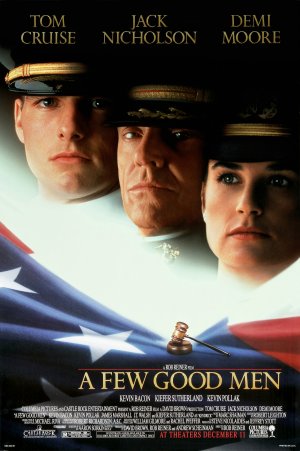
So, late Saturday night, I turned over to TCM’s 31 Days Of Oscar and I was watching the 1992 best picture nominee, A Few Good Men, and I noticed that not only was there only one woman in the entire film but she was also portrayed as being humorless and overwhelmed. While all of the male characters were allowed to speak in quippy one liners and all had at least one memorable personality trait, Lt. Commander Joanne Galloway (Demi Moore) didn’t get to do much beyond frown and struggle to keep up.
“Hmmmm…” I wondered, “why is it that the only woman in the film is portrayed as basically being a humorless scold?” Then I remembered that A Few Good Men was written by Aaron Sorkin and it all made sense. As I’ve discussed on this site before, Aaron Sorkin has no idea how to write woman and that’s certainly evident in A Few Good Men. Joanne (who goes by the masculine Jo) is the one character who doesn’t get to say anything funny or wise. Instead, she mostly serves to repeat platitudes and to be ridiculed (both subtly and not-so subtly) by her male colleagues. You can tell that Sorkin was so busy patting himself on the back for making Jo into a professional that he never actually got around to actually giving her any personality. As a result, there’s really not much for her to do, other than occasionally scowling and giving Tom Cruise a “that’s not funny” look.
(“C’mon,” Tom says at one point, “that one was pretty good.” You tell her, Aaron Tom.)
A Few Good Men, of course, is the film where Tom Cruise yells, “I want the truth!” and then Jack Nicholson yells back, “You can’t handle the truth!” At that point in the film, I was totally on Nicholson’s side and I was kinda hoping that the scene would conclude with Cruise staring down at the floor, struggling to find the perfect come back. However, this is an Aaron Sorkin script which means that the big bad military guy is never going to have a legitimate point and that the film’s hero is always going to have the perfect comeback. Fortunately, the scene took place in a courtroom so there was a wise judge present and he was able to let us know that, even if he seemed to be making the better point, Nicholson was still in the wrong.
As for the rest of the film, it’s a courtroom drama. At Guantanamo Bay, a marine (Michael DeLorenzo) has died as the result of a hazing. Two other marines (Wolfgang Bodison and James Marshall) have been accused of the murder. Daniel Kafee (Tom Cruise), Joanne Galloyway (Demi Moore), and Sam Weinberg (Kevin Pollack) have been assigned to defend them. Jack Ross (Kevin Bacon) is prosecuting them. Kafee thinks that the hazing was ordered by Col. Nathan Jessup (Jack Nicholson) and Lt. Kendrick (Kiefer Sutherland).
We know that Kendrick’s a bad guy because he speaks in a Southern accent and is religious, which is pretty much the mark of the devil in an Aaron Sorkin script. We know that Jessup is evil because he’s played by Jack Nicholson. For that matter, we also know that Kafee is cocky, arrogant, and has father issues. Why? Because he’s played by Tom Cruise, of course. And, while we’re at it, we know that Sam is going to be full of common sense wisdom because he’s played by Kevin Pollack…
What I’m saying here is that there’s absolutely nothing surprising about A Few Good Men. It may pretend to be about big issues of national security but, ultimately, it’s a very slick and somewhat hollow Hollywood production. This, after all, is a Rob Reiner film and that, above all else, means that it’s going to be a very conventional and very calculated crowd pleaser.
Which isn’t to say that A Few Good Men wasn’t enjoyable. I love courtroom dramas and, with the exception of Demi Moore, all of the actors do a good job. (And, in Demi’s defense, it’s not as if she had much to work with. It’s not her fault that Sorkin hates women.) A Few Good Men is entertaining without being particularly memorable.
I hate to say it but Charlie Wilson’s War did not do much for me.
I hate to say that because this 2007 film is fairly well-acted, well-directed, and well-written (by Aaron Sorkin, whose scripts usually get on my last nerve). And it deals with an important subject. Taking place in the 80s, the film details how a Texas congressman (Tom Hanks), working with a profane CIA agent (Philip Seymour Hoffman) and an eccentric socialite (Julia Roberts), managed to create popular and political support for giving weapons to the Afghan rebels who were fighting the Soviet invasion of their country. By doing so, Wilson helps to weaken the Soviet Union but, when his efforts to provide humanitarian aide to Afghanistan are less successful, he also contributes to the subsequent rise of the Taliban.
It should have been a film that I would normally rave about but … I don’t know.
I watched Charlie Wilson’s War. I laughed at some of Tom Hanks’s facial reactions. (Hanks is playing a womanizer here who may, or may not, have been high on cocaine when he first learned about the Soviet invasion of Afghanistan and it’s obvious that Hanks really enjoyed getting to play someone who wasn’t a traditionally upright hero.) As I watched, I again considered what a loss we suffered when the brilliant Philip Seymour Hoffman died. And, as I watched Julia Roberts, I again wonder why, despite the fact that she’s from Georgia, it is apparently impossible for Julia to sound authentically Southern.
(Of course, I’m sure some would argue that Julia wasn’t playing Southern here. She was playing a Texan. Well, I’m a Texan and I’ve never heard anyone down here sound like that. Tom Hanks, meanwhile, actually managed to come up with a decent accent. Wisely, he underplayed the accent, whereas I don’t think that Julia has ever underplayed anything in her life.)
And, at the end of Charlie Wilson’s War, I knew I had watched a good film but it was also a film that left me feeling curious detached. To be honest, I almost think the film would have been better if Hoffman’s CIA agent had been the main character, as opposed to Hanks’s congressman. Hoffman’s character, after all, is the one who nearly lost his job over his belief that the Afghan rebels should be armed. All Hanks really has to worry about is whether or not he’s going to be indicted for using cocaine in Vegas.
However, I do think that Charlie Wilson’s War does deserve praise for one very specific reason. Excluding the films made by native filmmakers like Richard Linklater and Wes Anderson, Charlie Wilson’s War is one of the few films that I’ve ever seen that actually portrays anyone from Texas in a positive light. Even more shockingly, it’s a positive portrayal of a Texas politician!
(I know it must have been tempting to change history and pretend that Charlie Wilson was originally elected from somewhere up north…)
But, overall, Charlie Wilson’s War didn’t do much for me. But, if you’re into military history and all that, you might enjoy the film more than I did.
(Plus, all you boys will probably enjoy Emily Blunt’s scenes….)
At the very least, you can watch it for Philip Seymour Hoffman.
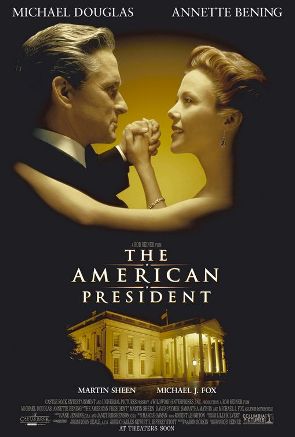
Way back in October, around the same time that I first decided that I would do a series of reviews of political films and that I would call it Lisa Gets Preachy (subsequently changed to Shattered Politics), I noticed that the 1995 film The American President was scheduled to be shown on TVLand.
“Hey,” I said, “I’ve definitely got to watch and review that!”
So, I set the DVR and I recorded The American President.
And then, I just left it there.
You have to understand that it’s rare that I ever leave anything unwatched on my DVR. Usually, within an hour of recording a program, I’ll be watching it. I have even been known to go so far as to make out very long lists of everything that I have on the DVR, just so I can make check them off after I’ve watched. As a general rule, I am way too obsessive compulsive to just leave anything sitting around.
But, for whatever reason, I could never work up any enthusiasm for the prospect of actually watching The American President. I knew that, eventually, I would have to watch it so that I could review it. Unlike those folks criticizing American Sniper on the basis of the film’s trailer, I never criticize or praise a film unless I’ve actually watched it. But I just couldn’t get excited about The American President.
Can you guess why? I’ll give you a hint. It’s two words. The first starts with A. The second starts with S.
If you guessed Aaron Sorkin, then you are correct! Yes, I do know that Sorkin has a lot of admirers. And, even more importantly, I know that it’s dangerous to cross some of those admirers. (I can still remember Ryan Adams and Sasha Stone insanely blocking anyone who dared to criticize the underwritten female characters in Sorkin’s script for The Social Network.)
But what can I say? As a writer, Aaron Sorkin bothers me. And since Sorkin is such an overpraised and powerful voice, he’s that rare scriptwriter who can actually claim auteur status. The Social Network, for instance, was not a David Fincher film. It was an Aaron Sorkin film, through and through.
And, after having to deal with three seasons of the Newroom and countless Aaron Sorkin-penned op-eds about why nobody should be allowed to criticize Aaron Sorkin, I’ve reached the point where dealing with all of Aaron Sorkin’s signature quirks is a bit like listening to the drill while strapped into a dentist’s chair. I am weary of pompous and egotistical male heroes who answer every question with a sermon. I am tired to endless scenes of male bonding. I have had enough with the quippy, quickly-delivered dialogue, all recited as characters walk down an endless hallways. I have no more sympathy for Sorkin’s nostalgic idealism or his condescending, rich, white dude version of liberalism.
Most of all, I’m sick of people making excuses for an acclaimed, award-winning, highly-paid screenwriter who is apparently incapable of writing strong female characters. I’m tired of pretending that it doesn’t matter that Aaron Sorkin is apparently incapable of viewing female characters as being anything other than potential love interests or silly distractions who need to be told to go stand in a corner while the menfolk solve all the problems of the world.
Fortunately, as a result of The Newsroom, quite a few critics are finally starting to admit what they always knew to be the truth. Aaron Sorkin is not the messiah. Instead, he’s a somewhat talented writer who doesn’t understand (or, in my opinion, particularly like) women. At his best, he’s occasionally entertaining. At his worst, he’s pompous, didactic, and preachy.
And, of course, Aaron Sorkin is the man who wrote The American President.
So, The American President just sat there until a few days ago when I sighed to myself and said, “Okay, let’s watch this thing.” As I watched it, I promised myself that I would try to see past the fact that it was an Aaron Sorkin-penned film and just try to judge the film on its merits.
But here’s the thing. It’s nearly impossible to separate one’s opinion of Sorkin from The American President. If you didn’t know that Sorkin had written The American President, you’d guess it after hearing the first few lines of dialogue. The film, itself, was directed by Rob Reiner but it’s not as if Reiner is the most interesting of directors. (What’s odd is that Reiner’s first films — This Is Spinal Tap, The Princess Bride, Stand By Me — are all so quirky and interesting and are still so watchable decades after first being released that you have to wonder how Reiner eventually became the man who directed The Bucket List.) In short, The American President is totally an Aaron Sorkin film.
President Andrew Shepherd (Michael Douglas) is a liberal Democrat who, as he prepares to run for a second term, has a 63% approval rating. However, when Shepherd decides to push through a gun control bill, he finds that approval rating threatened. And then, when he listens to environmental lobbyist Sydney Wade (Annette Bening) and tries to push through legislation to reduce carbon emissions, his approval rating is again threatened. And then, to top it all off, he starts dating Sydney. It turns out that Sydney has protested American policy in the past. And, since this is an Aaron Sorkin film, everyone outside of the Northeast is scandalized that President Shepherd is having premarital sex in the White House.
And, to top it all off, there’s an evil Republican named Bob Rumson (Richard Dreyfuss) who wants to be President and is willing to use the President’s relationship with Sydney to further his own evil Republican ambitions.
But, ultimately, it’s not just those evil Republicans who make it difficult for Sydney and the President to have a relationship. It’s also the fact that the President agrees to a watered down crime bill and that he does not hold up his end of the bargain when it comes to reducing carbon emissions.
“You’ve lost my vote!” Sydney tells him.
But — fear not! There’s still time for President Shepherd to give a speech that will be so good and so brilliant that it will, within a matter of minutes, totally change every aspect of American culture and save the day. How do we know it’s a great speech? Because it was written by Aaron Sorkin!
Actually, I’m being too hard on the film and I’ll be the first admit that it’s because I’m personally not a huge fan of Aaron Sorkin’s. But, to be honest, The American President is Aaron Sorkin-lite. This film was written before the West Wing, before the Social Network, before that Studio Whatever show, and before The Newsroom. In short, it was written before he became THE Aaron Sorkin and, as such, it’s actually a lot less preachy than some of his other work. It’s true that, much like The Newsroom, The American President is definitely Sorkin’s fantasy of how things should work but at least you don’t have to deal with Jeff Daniels throwing stuff or Emily Mortimer not knowing how to properly forward an email.
Instead, it’s a film that will probably be enjoyed by those who share its politics. (And, make no mistake, The American President is more interested in politics than it is in the love story between Andrew and Sydney.) Michael Douglas does well in the role of the President. Meanwhile, Annette Bening is so likable and natural as Sydney that it almost make up for the fact that she’s yet another Sorkin woman whose existence is largely defined by looking up to her man while inspiring him to do the right thing and forgiving him when he doesn’t. Personally, I would have been happy if the film had ended with Sydney telling the President, “Thanks for finally doing the right thing but I have a life of my own to lead.”


 Through the Shattered Lens