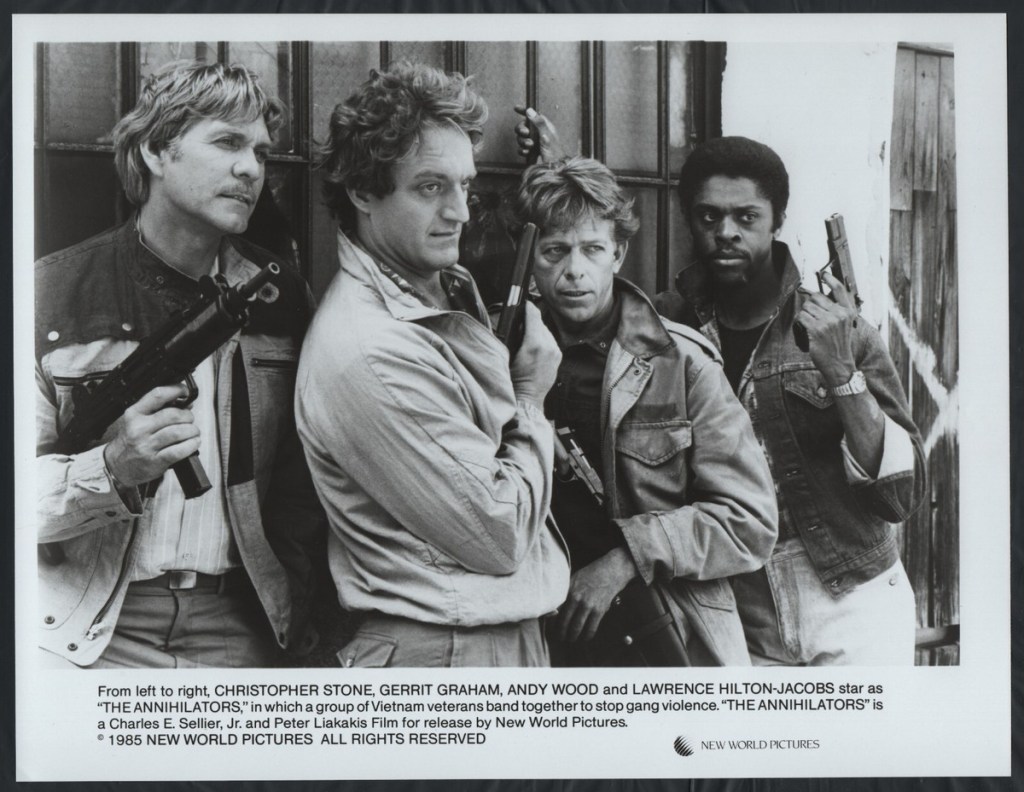
Brad takes on THE ANNIHILATORS (1985)!


It’s not often these days that I come across a low-budget 80s action film that I haven’t seen that catches my attention. I thought I’d pretty much seen them all. Today, while I was scrolling through the “This Week in Charles Bronson Podcast” Facebook page, I came across a post that was paying tribute to the recently deceased Gerrit Graham and a movie he appeared in called THE ANNIHILATORS (1985). The post made a direct comparison of the film to Charles Bronson’s DEATH WISH 3, also released in 1985, and mentioned that actor Paul Koslo was also in the movie. Paul Koslo has given very impressive “bad guy” performances in the Bronson films THE STONE KILLER and MR. MAJESTYK. That was all that I needed to read to get me to want to fire up the film immediately! Luckily for me, it’s currently streaming on Amazon Prime Video.

This film has a plot that should sound very familiar to anyone who’s watched many low-budget movies or TV shows from the 80s…. a group of Vietnam veterans (Christopher Stone, Gerrit Graham, Lawrence Hilton-Jacobs, and Andy Wood) reunite after one of their former comrades, the one who saved all their lives back in the jungle, is brutally murdered by a violent street gang in a rough section of Atlanta. The badasses decide to head to Georgia and get revenge for their friend. Once there, they learn that the street gangs are shaking down all the businesses and people in the neighborhood, so they decide to teach them to fight back. Unfortunately, the head street gang, led by the vicious Roy Boy Jagger (Paul Koslo), is also neck deep in a large heroin ring so taking them down and protecting the neighborhood will be far from easy.

THE ANNIHILATORS is not a great artistic success by any stretch of the imagination, but if you enjoy cheesy 80s action movies like I do, there’s a lot of fun to be had here. I think this film would be especially fun to watch as part of a group of like-minded movie lovers, and maybe while consuming a refreshing cold beverage. I think it could easily be described as a more adult version of something like “The A-Team.” The bad guys go much further than you might get on a TV show (attempted rape, cussing, more blood, etc.), but the camaraderie and hi-jinks of the good guys and the people of the neighborhood feel very similar. It also periodically tries to bring up some “serious issues” in typical 80s fashion, like the gang’s recruiting of some of the local, angelic-looking teenagers and one member of the team’s struggle with alcoholism, but these issues are quickly pushed aside for the low-budget action.

As far as I’m concerned, this film does have one great thing going for it, and that’s the incredible over-the-top performance of Paul Koslo as Roy Boy Jagger, the leader of the notorious Rollers. He’s just horrible on every level, which definitely includes his hair. There’s no possibility of Koslo attempting to give this character any redeemable qualities, as he enjoys torture and murder way too much. When he shows up with a flamethrower at the end, willing to burn up any elderly person or school child who gets in his way, the filmmakers had successfully led me to wish brutal vengeance upon the man and his mates.

Now back to that comparison my friend made to DEATH WISH 3. The cult Bronson film, as bonkers as it is, looks like a masterpiece in filmmaking compared to THE ANNIHILATORS. With that said, I’d still recommend this film to anyone who likes low-budget, 80’s action cheesefests. You know what you’re getting yourself into, and there are enough familiar faces and silly scenes that you just may have some nostalgia-laced fun!     
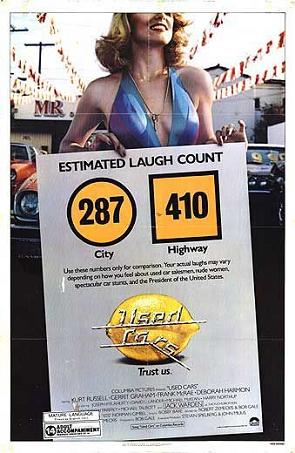
Scenes That I Love: Gerrit Graham Battles Inflation in Robert Zemeckis’s Used Cars


Today, the Shattered Lens wishes a happy birthday to director Robert Zemeckis!

Today’s scene that I love comes from Zemeckis’s 1980 comedy, Used Cars!  In this scene, used car salesman Gerrit Graham interrupts a televised presidential address so that he can demonstrate the best way to deal with inflation.

(Of course, he does the demonstration at a rival used car lot.)

Jack Warden watches as his cars blow up while Graham’s boss (Kurt Russell) tries to keep his business partner (Deborah Harmon) from noticing what is happening on the television.

“That price is too high!”

Film Review: Old Boyfriends (dir by Joan Tewkesbury)


In 1979’s Old Boyfriends, Talia Shire plays Dianne Cruise.

A sociology professor (or so she claims at one point), Dianne is struggling with an unhappy marriage and trying to recover from a recent breakdown.  After deliberately crashing her car, she leaves her husband and goes on a trip across the country.  She sets out to track down three ex-boyfriends.

Jeff Turrin (Richard Jordan) was her college boyfriend, the one who asked her to marry him three times.  Jeff is now working as a director.  When we first see him, he’s shooting a commercial for a political campaign in which Sam the Fisherman (Gerrit Graham) complains that the current governor of Colorado is a “long-hair” who gets in the way of small businessmen like himself.  Dianne shows up on the set.  Sam hits on her.  Interestingly, it takes Jeff a while before he recognizes her.  (Jeff comments that Dianne used to have longer hair but still, it seems like Jeff should be able to recognize someone to whom he proposed marriage three times.)

After having an affair with Jeff, who is in the process of getting a divorce, Dianne tracks down Eric Katz (John Belushi), the aspiring musician who humiliated her in middle school by telling everyone that she was “easy.”  Eric owns a formal wear store and he still performs with his band. (Belushi sings the Hell out of Jailhouse Rock at one point.)  He mostly performs at proms.  As he explains it to Dianne, most of his customers are teenagers looking for prom outfits so it only makes sense that he should perform for them as well as dress them.

Dianne’s third old boyfriend is Louis Van Til but, when Dianne arrives at his home, she is told that Louis died in Vietnam.  Under the watchful eye of his mother (Bethel Leslie) and his psychiatrist (John Houseman), she starts an obviously doomed relationship with Louis’s sensitive younger brother, Wayne (Keith Carradine).

While Dianne travels around the country, Jeff continues to look for her.  He even hires a private detective named Art Kopple (Buck Henry).

Old Boyfriends is a film that I had been meaning to watch for a while.  (I first read about it in a biography of John Belushi.)  A lot of talent went into making the film.  The script is by Paul and Leonard Schrader.  Director Joan Tewkesbury wrote the script for Robert Altman’s Nashville and indeed, there is an Altmanesque feel to the loose way that the film’s story unfolds.  The cast is full of talented people.  This was John Belushi’s first film after Animal House and Talia Shire’s first after Rocky.  With all that talent, you would think that the end result would be more interesting than it actually is.  The story is intriguing.  The cast is impressive.  But Old Boyfriends falls flat.

Why doesn’t the film work?  A lot of it is due to Tewkesbury’s direction.  She struggles with the film’s frequent shifts in tone and she always seems to be keeping a certain distance from the characters.  Talia Shire is in nearly every scene but the film seems to be determined to just observe her as opposed to actually allowing the viewer to get into her head.  Shire herself never seem to be particularly comfortable with the role and, as a result, none of her visits with her old boyfriends carry much of an emotional impact.  (Unfortunately, they don’t carry much of an intellectual impact either.)  Jordan, Belushi, and Carradine all give good performances but the film itself doesn’t seem to be sure what it wants to say about any of them.

It’s a disappointing film.  It’s not awful but, while watching it, it’s hard not to think about how much better it could have been.  One gets the feeling that Robert Altman, with his eye for quirky detail and his skill with improvisation, could have gotten something worthwhile out of the material.  As it is, Old Boyfriends is an intriguing idea that doesn’t quite work.

Retro Television Review: Miami Vice 4.12 “The Cows of October”


Welcome to Retro Television Reviews, a feature where we review some of our favorite and least favorite shows of the past!  On Mondays, I will be reviewing Miami Vice, which ran on NBC from 1984 to 1989.  The entire show can be purchased on Prime!

This week …. I don’t even know how to describe it.

Episode 4.12 “The Cows Of October”

(Dir by Vince Gillum, originally aired on February 5th, 1988)

A cannister of bull seamen has been stolen from a Miami lab and the feds (represented by Harry Shearer) want it back before it falls into the hands of the Cubans.  Switek assists.  Izzy shows up to broker the deal.  Gerrit Graham plays a shady person who we are told is from Texas.  (His accent is more Arizona.)  Philip Michael Thomas wears a cowboy hat.  Don Johnson is largely absent until the final scene.  One gets the feeling that Johnson hated every minute of this episode while Thomas just seemed to be having fun.

This episode was, without a doubt, the stupidest episode of Miami Vice ever filmed.  And listen, I will admit that I haven’t seen every episode.  I’ve still got a season and a half to go.  There seems to be a general online consensus that the final two seasons of Miami Vice were not good at all.  I’m sure I have many dumb episodes ahead of me.  But I cannot — as much as I try — imagine any episode that could be as a dumb as the Vice Squad abandoning the war on drugs so that they could keep the Cubans from getting their hands on a cannister of bull semen.

Miami Vice has always been as its best when its been surrealistic, cynical, and gritty.  I would argue that Miami Vice really does not need to do comedic episodes.  For the first three seasons, nearly every episode ended with an innocent person either dead or forever embittered.  At its best, Miami Vice was not a happy show.  It was a show where Crockett and Tubbs drove around in the dark, loaded their guns, and Phil Collins sang in the background.  When Collins sang, “I can feel it coming in the air tonight,” he was not talking about bull semen.  At least, I hope he wasn’t.  (Oh, Lord….)

I really don’t know what to make of season 4.  Trudy’s going to space.  Crockett’s married.  The Vice Squad is searching for bull semen.  Yet somehow, through it all, Castillo continues to just stare at the floor and speak through gritted teeth.  Like seriously, shouldn’t Castillo be concerned about all this weird stuff going on?

I didn’t care much for this episode.  Searching for bull semen is a Pacific Blue thing.  Miami Vice needs to handle real cases and leave all that other stuff for the bike cops.

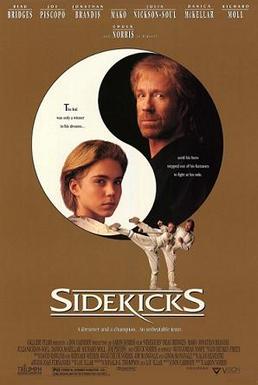
Sidekicks (1992, directed by Aaron Norris)


Barry Gabrewski (Jonathan Brandis) is a teenager living in Houston with his father (Beau Bridges).  Barry has asthma and has a hard time at school, being picked on by everyone from the school bully (John Buchanan) to the athletics coach (Richard Moll) to the clueless principal (Gerrit Graham).  Barry has only one ally and his name is Chuck Norris!  Whenever Barry is having a hard time, he imagines taking part in an exciting mission with Chuck Norris.  In his imagination, he and Chuck recreate scenes from all of Chuck’s movies even though Barry is really too young to be watching anything that violent.

Barry wants to learn karate but is turned down by an arrogant dojo owner (Joe Piscopo, channeling Martin Kove).  Barry finally finds a teacher (Mako) who uses Barry’s love of all things Chuck Norris to train him.  Barry enters the local karate tournament and wouldn’t you know it, there’s Chuck!  He’s attending as a guest and he’s hoping to see Joe Piscopo taught a lesson in humility.  When Barry and his sensei are told that they don’t have enough members for their team, Chuck volunteers to fight with them.  No one objects to the world’s most famous martial artist deciding to take part in a local, largely amateur karate tournament.  Can Barry win the tournament with the help of his hero?

Chuck Norris famously turned down a role in The Karate Kid.  Some sources say that he was offered the John Kreese role while others say that Norris was offered the sensei role that eventually become Mr. Miyagi.  Chuck has always said that his agent turned down the script and he didn’t even know it had been offered to him until years later but Sidekicks sticks so close to the Karate Kid plot that it does sometimes feel like it was made so that we could see what Karate Kid would have been like if Chuck Norris had accepted a role.  The movie follows the Karate Kid formula while lacking the edge that made Karate Kid stand out.  Karate Kid was a coming-of-age movie with a lot of karate.  Sidekicks is a blatant celebration of Chuck Norris.

Fortunately, Chuck Norris has always had the moves to back up his high self-regard and, in this film, he actually seems to be relaxed and having fun playing a version of himself.  Sidekicks is predictable and ego-driven but it has a likable energy and Chuck shows a willingness to poke fun at his earlier movies.  Whatever else you might say about Sidekicks, there were a lot of bullied kids would have loved to have had a friend like Chuck Norris.  Sidekicks is also the only place where you can see Chuck Norris fight Joe Piscopo and there’s something to be said for that.

Scenes That I Love: Gerrit Graham Battles Inflation in Robert Zemeckis’s Used Cars


Today, the Shattered Lens wishes a happy birthday to director Robert Zemeckis!

Today’s scene that I love comes from Zemeckis’s 1980 comedy, Used Cars!  In this scene, used car salesman Gerrit Graham interrupts a televised presidential address so that he can demonstrate the best way to deal with inflation.

(Of course, he does the demonstration at a rival used car lot.)

Jack Warden watches as his cars blow up while Graham’s boss (Kurt Russell) tries to keep his business partner (Deborah Harmon) from noticing what is happening on the television.

“That price is too high!”

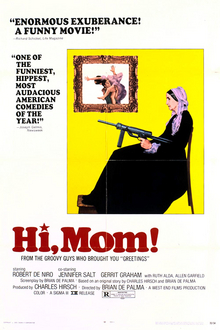
Film Review: Hi, Mom! (dir by Brian De Palma)


Released in 1970, Hi, Mom!, tells the story of Jon Rubin (played by a 26 year-old Robert De Niro).  The somewhat spacey and kind of creepy Jon has just returned to New York City from Vietnam.  After moving into a run-down apartment building and meeting the building’s superintendent (Charles Durning), Jon is hired to direct a pornographic film by producer Joe Banner (Allen Garfield).  Jon’s idea to simply point his camera at his building and to film his neighbors as they go about their day.  As quickly becomes apparent, Jon is mostly just looking for an excuse to watch and film Judy Bishop (Jennifer Salt).

Also living in the building is Gerrit Wood (Gerrit Graham), who is first seen triumphantly putting posters of Che Guevara and Malcolm X up in his apartment.  Gerrit is a freshly-minted political radical and the leader of a group of performance artists who put on a show called Be Black, Baby, in which the white audience members are forced to wear blackface and are then chased, attacked, and assaulted by black actors wearing whiteface.  (Gerrit himself is white.)  Jon is hired to play the police officer who beats and arrests the members of the audience at the end of the performance.  Of course, eventually, the real police show up….

An attempt at an episodic counter-culture comedy, Hi, Mom is definitely a product of the time in which it was made, both in its style and its thematic content.  Today, it’s best-known for being one of Brian De Palma’s early independent films and for featuring Robert De Niro in one of his first starring roles.  De Palma and De Niro aren’t exactly the first names that come to mind when one thinks about comedy and Hi, Mom shows that there’s a good reason for that.  As both a screenwriter who felt he had something important to say and a young director who was obviously eager to show off everything that he could do with a camera, Brian De Palma simply cannot get out of his own way.  Scenes are needlessly sped up.  Scenes are pointlessly slowed down.  The musical cues are obvious.  The dialogue is often so broad that it comes across as being cartoonish.  One gets the feeling that De Palma didn’t trust the audience to get the jokes so he went overboard to make sure everyone knew when to react.  All of the pointless camera trickery serves the same purpose that a laugh track would on an old sitcom.  Interestingly enough, the only sequence that really works as satire is the Be Black, Baby sequence and that’s because De Palma directs it in a semi-documentary fashion.  De Palma gets out of his own way and allow the sequence to develop a natural rhythm.  (Of course, seen today, the scene will bring to mind the upper class white liberals who pay money to have an activist lecture them about their privilege while having their friends over for dinner.)

As for Robert De Niro, he gives a typically nervy performance, one that feels like a dry run for his later work in Mean Streets, Taxi Driver, and King of Comedy.  Despite the reputation of those films, there are some genuinely funny moments to be found in all of them.  Most of them, like the classic Taxi Driver conversation between De Niro’s Travis and Peter Boyle’s Wizard, are funny because of how people react to De Niro’s obviously unhinged characters.  Both Taxi Driver and King of Comedy got mileage out of having normal people try to deal with De Niro’s unstable characters.  In Hi, Mom, everyone is equally wacky and, as such, De Niro doesn’t really have anyone to play off.  No one is really reacting to anything, De Niro-included.  (There is some spark to his scenes with Charles Durning and Allen Garfield but even those scenes seem to drag on forever.)

On the plus side, Hi, Mom! is was shot on the actual streets of New York City, guerilla-style.  (A “Re-Elect Mayor Lindsay” sign in the background confirms that the film was made on location in 1969.)  When De Palma isn’t getting in his own way with all of his fancy camera tricks, he manages to capture so memorably bleak images of New York City.  Hi, Mom! presents New York as being a dirty, crime-ridden, and menacing city but it also captures the odd grandeur of urban decay.  At its best, Hi, Mom! captures the love/hate relationship that many seem to have New York City.  The city feels both alive and dangerous at the same time.  Hi, Mom! is too uneven to work as a sustained satire but, as a documentary about New York at the end of the turbulent 60s, it’s worth watching.

I should mention that this was not the first time that De Palma and De Niro teamed up.  Indeed, De Niro was De Palma’s muse even before he met Martin Scorsese.  Hi, Mom! was a loose sequel to an earlier De Palma/De Niro film called Greetings.  (Like many of De Palma’s future films, both Greetings and Hi, Mom! were originally rated X but later re-rated R.)  De Palma and De Niro, of course, would both go onto have long Hollywood careers.  (They would later reunite for The Untouchables, a big-budget spectacle of a film that’s about as far from the grungy Hi, Mom! as one can get.)  De Palma’s career has had its ups and downs but, as of late, many of his films have been positively reevaluated.  As for De Niro, he can finally kind of play comedy.  That said, I’d rather watch Hi, Mom than Dirty Grandpa.

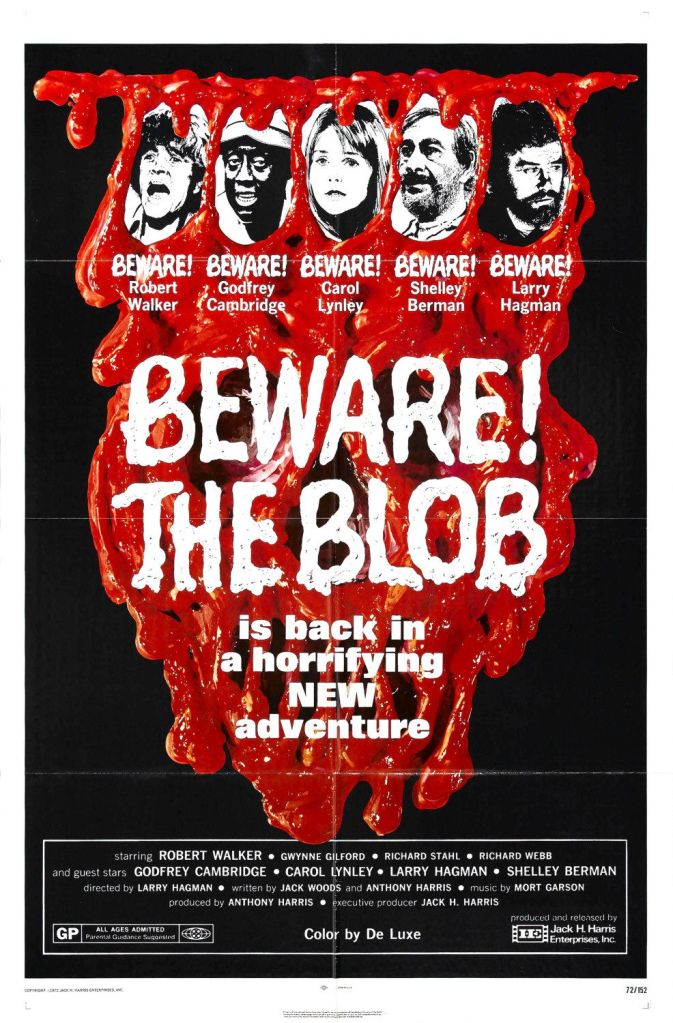
Movie Review: Beware! The Blob (by Larry Hagman)


Everyone has one movie or two that hit them so hard it caused them to develop habits. It could be shaking your shoes to confirm no spiders are in them, counting the seconds after a lightning strike for the thunder, or checking the back seat of your car before you get into it, just in case. Some movies kind of imprint themselves on you in different ways.

Beware! The Blob (or Son of The Blob in some circles) was the most terrifying film I saw as a kid. I watched it in front of my grandmother’s living room tv that had a little alarm clock on the floor beneath it. Unlike Friday the 13th and Halloween, where I could rationalize my fears, Beware! The Blob had me fearing the summer and any open crevice we had. On any visits to our local video store (in the Pre-Blockbuster days), I’d pick out video games to rent and could see the box for the film in the horror section. I’d never walk over there, even in my early teenage years.

Most consider the 1958 original a Classic, and Chuck Russell’s 1988 update often goes toe to toe with John Carpenter’s The Thing on the Best Remakes list. Beware! The Blob will probably never make that list, but it’s not a total loss, given a recent rewatch. The film’s greatest strengths are in the casting and the special effects. From a cinema history/trivia standpoint, the film marks one of the earliest credits for Cinematographer Dean Cundey. Cundey worked as a 2nd Unit Cinematographer for the film, particularly with the animal shots in the opening and later on. That might not sound like much, but Cundey would go on to be picked by Debra Hill to help out on Halloween in 1978. From there, he had The Fog, Halloween II, The Thing, Romancing the Stone, Back to the Future, Big Trouble in Little China, Who Framed Roger Rabbit?, and Jurassic Park, to name a few.

With 14 years since the first film, there were some tech upgrades to how the blob was made. A large plastic balloon was used for some scenes (particularly the bowling alley sequences). Additionally, silicone was added to a drum to allow for the “blob pov” during the bowling alley sequences. In most sequences, a red dyed powder mixed with water was used. To make sure the audience was aware the Blob was close, a high whistle would sound, giving anyone with even the slightest bit of tinnitus some cause to look over their shoulder. Academy Award Winner Tim Baar (The Time Machine) and Conrad Rothmann worked on the effects, along with Cundey.

In his film directing debut, Larry Hagman (TV’s I Dream of Jeannie, Dallas) weaves a tale of horror lurking through a town peppered with parties, hobos, a boy scout team, an angry bowling alley owner, some dune buggy aficionados and a sheriff (Richard Webb, The Phantom Stagecoach) who’s a little confused about some of the events happening in town. To his credit, it’s amazing to see who Hagman assembled here, as he called in some friends to join in on the fun. Comedian Godfrey Cambridge. Cindy Williams, just a few years shy of American Graffiti. Gerrit Graham, about two years before Phantom of the Paradise. Sid Haig (The Devil’s Rejects) is here as well. You can even spot Hagman in the film as one of three hobos squaring off with the Blob. It should be noted that the other two hobos with him are Burgess Meredith (Clash of the Titans) and Del Close (Chuck Russell’s The Blob).

The film flows like it’s namesake, with some chapters having little do to with anything – Dick Van Patten’s boy scouts, while funny, could have had one of their scenes cut for speed. It’s not incredibly terrible, but it’s exactly great, either. Most of the script, written by Anthony Harris, was tossed with ad-libbing done on set. Despite all this, it does looks like the cast enjoyed themselves making the film. It has that going for it, at least.

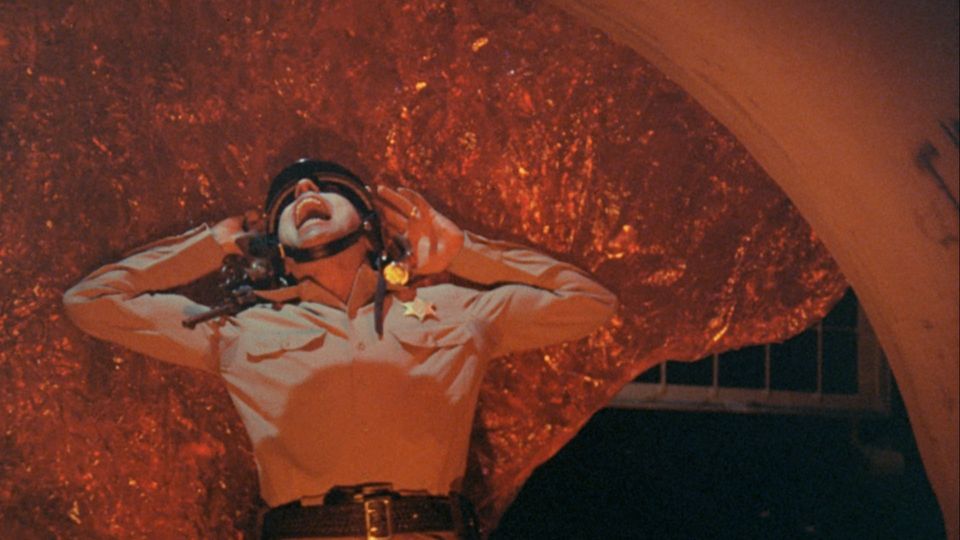
Sid Haig was caught unaware in Larry Hagman’s Beware! The Blob

Chester, A construction worker from the Arctic (Cambridge) is getting his camping gear stowed away when his wife, Marlene (Marlene Clark, The Beast Must Die) discovers a thermos in their freezer. He explains he performed some work and brought home a piece of what the found in the Arctic. Setting it on a countertop, the couple forget about the thermos, which pops open. The newly released blob absorbs a fly and a kitten before moving on to larger prey. Before we know it, Chester is having problems with his TV – which happens to be playing the original 1958 movie – as it slithers into his favorite recliner. It’s a sequence that’s burned into my mind. I always check a chair before sitting in it. Some check for thumbtacks, I check for alien goo.

When Lisa (Gwynne Gilford, Masters of the Universe & actor Chris Pine’s Mom) discovers Chester with his new friend, she dashes out and heads to her boyfriend, Bobby (Robert Walker, Easy Rider). By the time the couple return to Chester’s place, they find the house empty. Can the couple convince the cops and the town of the danger ahead before it’s too late? Most of Beware! The Blob‘s scenes are set up in a way where people are completely oblivious of it until it’s touched them, causing said individual to slip and fall into the camera. The climax of the film takes place in a bowling alley, which is actually impressive for the techniques used, but even with the casting, you might spend more time laughing than anything else. Perhaps that’s my way of rationalizing the film years later.

At the time of this writing, Beware! The Blob is currently available to watch on the Plex streaming service. We’re also labeling this an Incident – out of respect to the kitten – and returning the timer to Zero.

The TSL’s Horror Grindhouse: Chopping Mall (dir by Jim Wynorski)


This 1986 film tells the story of what happens when one local mall decides that it’s had enough of thievery and vandalism.

First off, automatic locks and shutters are installed.  What that means is that, at a certain hour, anyone who is inside the mall is going to be trapped there until the morning.  Secondly, three robots are used as a security force.  They’re called Protectors and they roll around, looking for thieves and keeping people safe.  Don’t worry about getting mistaken for a thief, of course.  As long as you’ve got a badge, the protector will just say, “Thank you and have a good day.”

It all seems perfect but …. what if the robots malfunction?  What if they ignore the badges and just start killing anyone unlucky enough to be trapped in the mall for the night?  Surely, that could never happen, right?

Of course, it does happen.  Thanks to a freak electrical storm, the Protectors come to life and set out to keep the mall safe from intruders.  First, they kill the technicians that are supposed to keeping a watch over them.  Then, they kill a janitor named Walter Paisley (played, of course, by Dick Miller).  Then, they set off after the six attractive people who were having a sleep-over in one of the stores.

So, what did I learn from Chopping Mall?

Well, I was tempted to say that I learned not to shoplift but actually, no one in the movie gets in trouble for shoplifting.  I guess the main thing I learned is not to walk around the mall in my underwear because that definitely seems to be something that will cause the Protectors to blow up your head.

I also learned that, if you’re tapped in the mall with a bunch of killer robots, the best place to go is the sporting goods store because that store not only has a lot of automatic rifles but also an unlimited supply of ammunition.  Of course, I already learned that from Dawn of the Dead but it’s always good to be reminded….

Anyway, Chopping Mall is a lot of fun.  It’s undeniably dated.  Just the fact that everyone’s life revolves around a mall tells you just how dated it is.  I guess if they made the film now, it would have to take place at an Ikea store or maybe an Amazon warehouse.  But the fact that the film is dated is a part of what makes it so much fun to watch.  Seriously, it’s amazing all of the stuff that apparently used to go on at the local mall in the 80s.

Despite the fact that they have a bad habit of killing people, the Protectors are actually kind of cute.  If nothing else, they’re unfailingly polite.  You have to love the fact that they’ll wish you a nice day even after they’ve killed you.  Surprisingly enough, the humans are just as likable as the Protectors.  For a film about killer robots, Chopping Mall is surprisingly well-acted by a likable cast.  Russell Todd, who was the best-looking man to ever be killed by Jason Voorhees, is in this film and he’s as broodingly handsome here as he was in Friday the 13th Part II.

Chopping Mall is a good mix of humor and thrills and robots and exploding heads and Dick Miller.  This is 80s mall horror at its best!