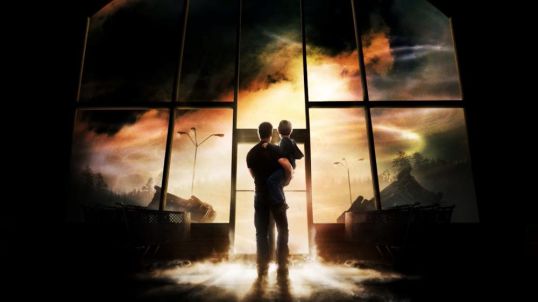
Based on a novella by Stephen King, The Mist opens the morning after a sudden thunderstorm in Maine. Artist David Drayton (Thomas Jane) steps outside and sees that a tree has crashed through one of his front windows. Meanwhile, his neighbor, attorney Brent Norton (Andre Braugher), stares at the tree that has crushed his car. Though David and Brent are not exactly on friendly terms, the storm briefly brings them together. When David says that he’s going into town to pick up supplies, Norton asks if he can come with him. David’s wife stays back at the house while David drives his son (Nathan Gamble) and Brent to the local grocery store. Before David leaves, he notices a thick mist moving over a nearby lake.
The entire town is without power and the grocery store is crowded. Three soldiers, who are picking up supplies before going on leave, are told that the leave has been abruptly canceled. Once the mist surrounds the store, it soon becomes obvious why that is. There are monsters in the mist and David, Norton, and several others find themselves trapped in the store. Going outside, as some insist on doing, only leads to death at the hands of the Lovecraftian monsters that inhabit the mist.
The Mist was first released in 2007 and I have to admit that I didn’t care much for it the first time that I saw it. I thought that some of the performances were a bit too histrionic and the film’s dark ending was almost too portentous to be credible. When I first saw it, I thought the film was almost trying too hard with the tragic conclusion. However, when I recently rewatched the film, I discovered that it had grown on me. I was better able to appreciate the fact that the monsters were both ludicrous and deadly at the same time. Performances that once seemed over-the-top in 2007 now seemed almost subtle when compared to how I’ve seen people actually behave in the real world over the past ten years. Once you’ve been yelled at for not wearing a mask while jogging, it’s a lot easier to buy the idea of a bunch of people in a grocery store losing their collective minds. Even the film’s dark ending now seemed like the only honest way the film could have ended.
The Mist is a film that plays much differently in a post-COVID world. The idea of innocent people losing their lives because of an accident at a government lab no longer seems all that unbelievable. The argument about whether or not to leave the store mirrored many of the same arguments that I heard during the COVID lockdowns. If Mrs. Carmody (Marcia Gay Harden) and her followers originally seemed like standard Stephen King religious fanatics, Carmody now brings to mind the loathsome Randi Weingarten and her insistence that the only way to defeat COVID was to sacrifice the future of the young. Even the film’s final moments of self-destruction reflected the attitude that many had in 2020, that the situation was hopeless and that there was no escape beyond waiting for the world to end. The final image of one man, driven mad and screaming, brings to mind both the fate of the typical Lovecraftian explorer and also the excesses of the COVID era. That Stephen King continues to be one of the major defenders of these excesses brings a wonderful irony to the film’s subtext.
The Mist has definitely grown on me. It still has its flaws but those flaws are less of a problem now than they were in 2007. In 2007, The Mist seemed overlong. In 2026, that 2-hour running time feels like a relief from the slow-moving miniseries that have become a signature part of the streaming age. Even Thomas Jane’s performance, which seemed rather stiff when I first saw the movie, has improved in hindsight. His tight-jawed stoicism makes his eventual breakdown all the more effective. Everyone reaches the limit, the film seems to be saying.
The Mist is a film that has aged well. It’s one of the better Stephen King adaptations, one that largely stays true to the source material while still having the courage to develop its own identity. The first time I saw it, I was wrong about The Mist. It’s a film that deserves to be remembered as one of the most relevant horror films of the past 20 years.
“No tears, please. It’s a waste of good suffering.” — Pinhead
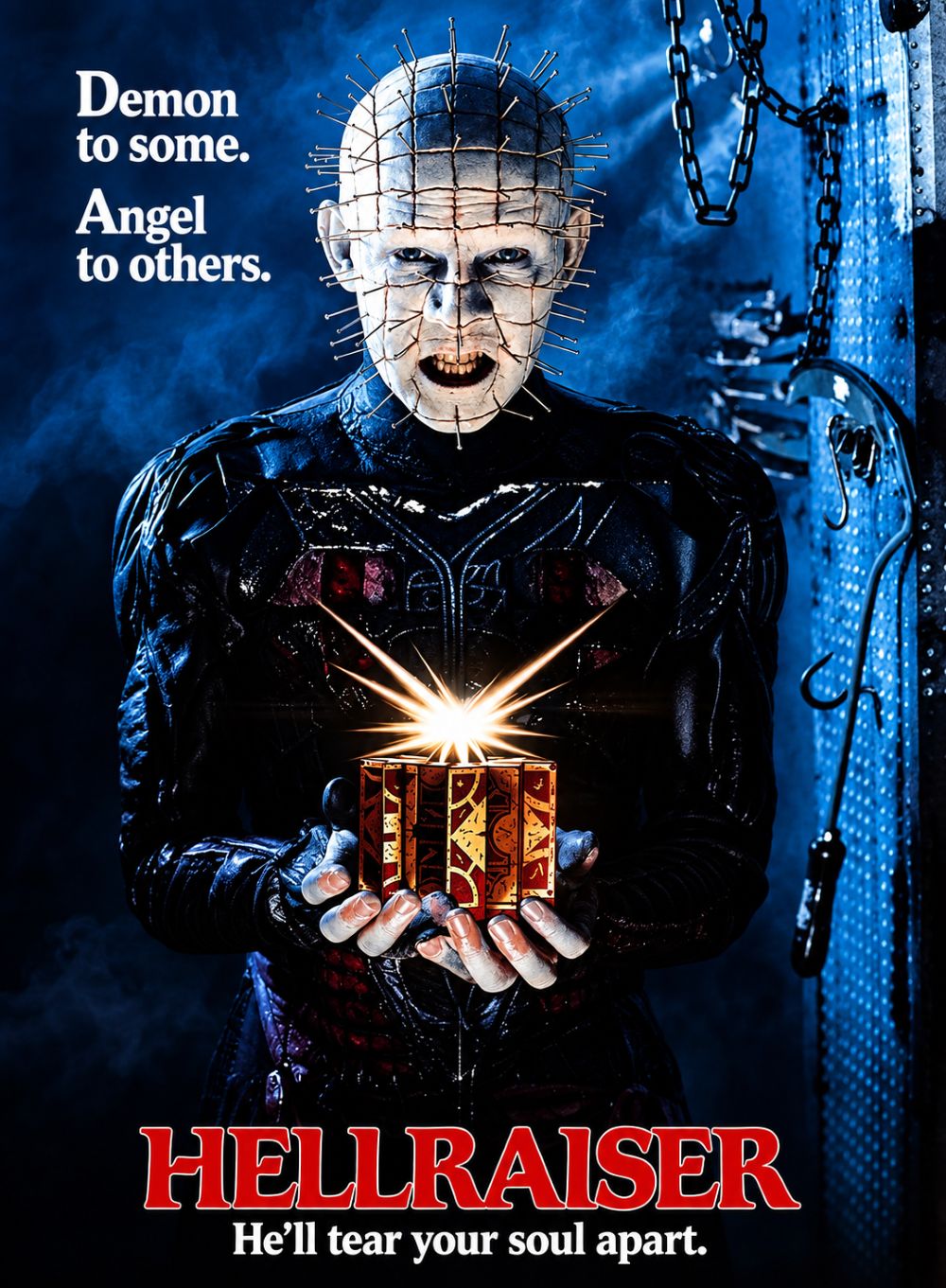
Hellraiser does not ease viewers into its nightmare; it drags them straight into a world where desire, suffering, and obsession have become impossible to separate. Written and directed by Clive Barker from his own novella The Hellbound Heart, the film is bloody, unsettling, weirdly intimate, and much more serious than its pop-culture reputation might suggest. Yes, it is the movie that introduced Pinhead and the Cenobites, but the first Hellraiser is not really a Pinhead showcase in the way later sequels became. It is a rotten little domestic nightmare about lust, betrayal, obsession, and the kind of desire that keeps going long after it should have destroyed a person.
Barker’s big strength is that he does not treat horror as something separate from human craving. In Hellraiser, pain and pleasure are tangled together from the opening scene. Frank Cotton is not some innocent fool who accidentally opens a cursed puzzle box. He actively seeks it out because normal pleasures no longer satisfy him. He wants sensation pushed past every limit, and the Lament Configuration gives him exactly that—just not in the way he expected. The Cenobites arrive with their chains, hooks, leather, scars, and ritualistic calm, offering a version of experience so extreme that it turns the body into something almost unrecognizable. That premise is memorable on its own, but Barker makes it work because Frank is already spiritually disgusting before hell ever gets involved.
The movie’s real surprise is Julia Cotton, played brilliantly by Clare Higgins. Julia could have been a standard unfaithful wife character, someone introduced merely to create tension inside the Cotton family. Instead, she becomes the dark heart of the film. Her attraction to Frank is not romantic in any healthy or even conventionally sensual sense. It is tied to resentment, boredom, humiliation, and a kind of violent need to feel alive. When Frank returns in his skinless, barely human state and needs blood to regenerate, Julia does not hesitate for long before becoming his accomplice. The scenes in which she lures men back to the abandoned house are among the movie’s most disturbing moments precisely because they are played with such cold purpose. She does not seem possessed. She is making a choice.
That decision gives Hellraiser a nasty emotional edge. Frank is obviously monstrous, but Julia is arguably scarier because she begins as an ordinary person trapped in a miserable life and willingly walks into atrocity. Higgins gives the role a detached, almost aristocratic chill. Her face barely needs to change for the audience to understand that something terrible is happening behind her eyes. The film’s central house becomes an extension of her inner life: dusty, decayed, closed off, and hiding a nightmare in the upstairs room. There is something grimly effective about the fact that the gateway to hell is not in an ancient castle or a faraway cemetery. It is in a family home where people are supposed to start over.
Andrew Robinson also deserves credit as Larry, Julia’s decent but oblivious husband. He is not the most dynamic protagonist in horror history, but that works for the story. Larry is a fundamentally ordinary man who cannot imagine the depths of corruption already moving around him. His blindness is frustrating, but it also reinforces the movie’s worldview. In Hellraiser, the people closest to us may carry desires we cannot see, and the house itself may preserve the damage left behind by old secrets. Ashley Laurence, as Larry’s daughter Kirsty, gradually becomes the film’s moral center. She is not an especially flashy final girl at first, yet Laurence gives Kirsty intelligence and genuine fear. Once she learns what the box can do, her panic feels grounded because she understands she has stumbled into something far beyond a killer with a knife.
Then there are the Cenobites, who remain some of the most striking horror creations of the decade. Doug Bradley’s Pinhead is the obvious standout, but the film wisely uses him sparingly. Pinhead is not a slasher villain who runs around collecting bodies. He is more like a supernatural official, a priest of pain carrying out a horrifying contract. Bradley’s measured voice and theatrical stillness make the character far more unsettling than a louder performance would have. The famous line, “We have such sights to show you,” works because it is delivered with calm conviction rather than rage. Pinhead is not trying to scare Kirsty for fun. He genuinely believes that torment and ecstasy are parts of the same revelation.
The other Cenobites matter too. Butterball, the Chatterer, and the Female Cenobite create the feeling that Pinhead belongs to a larger order rather than simply functioning as a lone monster. Their designs are grotesque but carefully composed, full of exposed flesh, surgical markings, and fetishistic costume details. They do not look like demons from a traditional Christian image of hell. They look like beings who have remade themselves according to an alien set of desires. That is where Barker’s imagination really separates Hellraiser from more conventional monster movies. The Cenobites are not just evil creatures. They are explorers of sensation who have gone so far beyond humanity that morality barely applies to them anymore.
The practical effects are still a major reason the film holds up. Frank’s gradual reconstruction from blood-soaked remains into a mutilated human body is disgusting in the best possible way. It has a tactile quality that CGI rarely captures. You can see the slime, the tissue, the half-formed muscles, and the painful labor involved in putting a body back together. Even when some of the effects show their age, they retain a handmade ugliness that fits the movie’s atmosphere. Nothing in Hellraiser is clean or sleek. The supernatural realm looks damp, industrial, and biological, as if hell were built out of meat, rust, chains, and bad memories.
Christopher Young’s score also does a lot of heavy lifting. It gives the movie a gothic grandeur that makes the story feel larger than its limited locations and modest budget. The film is mostly confined to a house, a hospital, a few streets, and the Cenobites’ shadowy realm, yet the music makes it feel like a grand tragedy unfolding behind the walls. That contrast is one of the movie’s best tricks. Hellraiser can be intimate and theatrical at the same time. It is essentially a chamber piece about a broken family, but it plays like a myth about forbidden knowledge.
If the film has a weakness, it is that its final stretch gets a little messy. The confrontation with Frank has some excellent makeup work and gruesome imagery, but the pacing becomes more conventional once Kirsty is forced into full survival mode. The ending also feels slightly rushed considering how carefully Barker establishes the family tension earlier on. Still, the movie earns enough goodwill through its atmosphere, performances, and imagination that these flaws do not do much damage. If anything, the roughness adds to its charm. Hellraiser feels like a filmmaker throwing every dark idea he has onto the screen and trusting the audience to follow him into the abyss.
What makes Hellraiser endure is not simply the gore, the puzzle box, or Pinhead’s instantly recognizable appearance. It lasts because it understands that horror is often rooted in the things people want but are ashamed to admit they want. Frank wants infinite sensation. Julia wants escape and emotional intensity. Kirsty wants to save her family but must confront how little of that family was worth saving. The Cenobites offer no easy moral lesson; they are simply waiting for someone foolish or desperate enough to open the door.
Casual viewers looking for a straightforward slasher might find Hellraiser slower and stranger than expected, especially if they only know the character of Pinhead through sequels, posters, and parody. But for anyone willing to meet it on its own grim terms, it remains one of the most original supernatural horror films of its era. It is gross, stylish, perverse, tragic, and surprisingly sad beneath all the blood. Barker did not just create monsters. He created a nightmare universe where desire becomes a trap—and where opening a small box can ruin everything.
Today’s horror on the lens is a true classic, 1965’s Planet of the Vampires!
Directed by the great Mario Bava, Planet of the Vampires follows a space expedition that lands on a seemingly dead planet. The members of the expedition soon discover that the undead aren’t just an Earth phenomenon. This atmospheric mix of horror and science fiction was later acknowledged as being a major inspiration for Alien.
Up until I checked the schedule to see whether or not the Big Brother finale was going to be two hours, I didn’t realize that CBS was going to be airing the second leg of The Amazing Race on Friday. Since I already had something else planned for Thursday night, I didn’t get a chance to watch the latest episode of The Amazing Race until this morning.
I was really happy about the second leg taking place in Madrid. My maternal grandmother was born in Spain and came to the United States after World War II. (Growing up, I was usually the only girl in any of my classes who knew who General Franco was.) I love Spain, even if it is currently being governed by a smug Socialist.
My sister Erin Nicole and I often joke about trying out for The Amazing Race and I think we would have done well during this leg. I would have let her do the Roadblock with the tomatoes. We definitely would have been able to tell the difference between Puerta del Sol and Puerta del Sur. I would have totally dominated the Slice of History detour. Along with the fact that our grandmother was born in Spain, I’ve got a degree in art history and I’m a big history nerd in general. I would not have needed to ask the locals who Picasso was and who Dalí was. We would have made it to the pit stop without having to use the express pass and I totally would have hugged Phil when he said that we were team number one.
I rolled my eyes a bit when Ann-Marie and Riley decided to form the Boss Lady alliance with Ali & Joanna, Jody & Jenn, and Dafina & Saran. I always cringe whenever the people on this show, Big Brother, or Survivor try to do the “all-girls alliance” thing because it always starts with everyone going, “Girl power!” and it always ends with people getting mad over the pettiest of things. We saw some of that during last night’s episode, when Ali ignored Dafina at the roadblock. I also noticed that, for all the talk of women supporting other women, they didn’t bother to invite Katie & Charlotte to join the alliance. In truth, The Amazing Race is not a game that really benefits from alliances. I can think of one season in which an alliance really worked and most of the viewers hated that season because the alliance members were all so unlikable.
(Interestingly enough, Ann-Marie and Riley also suggested that all of the players doing the Slice of Ham roadblock should work together as well. Ann-Marie’s definition of working together appears to be that everyone else should do all the work while she benefits. If I seem to have issues with Ann-Marie, it’s just because I can imagine her being the passive-aggressive HOA president from Hell. Of course, if I was actually running the Race, I would want to get Ann-Marie eliminated because there’s only room for one Marie.)
In the end, the main lesson of this week’s episode was to always make sure that you’re on the right train. Katie and Charlotte got on a train going to Puerta del Sur instead of Puerta del Sol and it basically led to their elimination.
Here are my thoughts on how each team is looking after this leg.
Coming in first were the soccer players, Ali and Joanna. Ann-Marie and Riley really want to work with the soccer players but I never really got the feeling that Ali and Joanna really wanted to work with them. Ali and Joanna are too competitive for that. I personally would not enter into an alliance with Ali. It’s hard for me to trust someone who won’t stand up for her own country’s national anthem.
Coming in second were Michelle & Matthew. Michelle and Matthew are a strong team, even if Michelle did go a little bit overboard while yelling at Matthew during the Roadblock. So far, they’ve finished 3rd and 2nd and they’ve done it without wasting an express pass.
Coming in third were Cody and Jaime. Cody and Jaime used their express pass to get out of doing Slice of Ham. They seem like a strong team and I was touched by their backstory. I’m hoping for the best for them.
Coming in fourth were Ann-Marie and Riley. Initially, I liked the mother-daughter team but, after tonight’s episode, I just see them as being the type of neighbors who smile when they visit and then make fun of your furniture when they think you’re not listening.
Jody and Jenn came in fifth. They totally wasted their express pass to get out of doing the Slice of History detour. Jody said that, as a history teacher, she was embarrassed. She should have been. Seriously, I’ve got no respect for that team now.
Daisha and Dalton used their express pass to get out of doing the Roadblock and they still only came in sixth. If I were them, I would be worried.
Erin and Javi came in seventh. I actually liked Erin and Javi more during the second leg than I did the first. They work well together.
Coming in eighth were Anuar and Andrea. My main impression of them is that Andrea is one bad leg away from having a massive meltdown.
Conner and Garrett finished in ninth place. I was a bit surprised that they finished so far back. Conner and Garrett seem like a strong team, though. I expect they’ll be around for a while.
Doug and Dylan came in tenth. I like Doug and Dylan but they’ve really struggled and they no longer have an express pass. I don’t think they’re going to be racing for much longer.
Dafina and Saran came in eleventh. They were doing well until they hit the Slice of History detour. They no longer have an express pass but I think they’re still stronger than they seemed to be last night.
Finally, Charlotte and Katie came in last and were eliminated. They got on the wrong train and it cost them.
Six express passes have been used. The express passes are only good through the sixth leg. Here’s who still has them:
Ali & Joanna
Michelle & Matthew
Ann-Marie & Riley
Anuar & Andrea
Conner & Garrett
Next week, the teams head to Morocco and discover a whole new twist!
As some of our regular readers undoubtedly know, I am involved in a few weekly watch parties. On Twitter, I host #FridayNightFlix every Friday and I co-host #ScarySocial on Saturday. On Mastodon, I am one of the five hosts of #MondayActionMovie! Every week, we get together. We watch a movie. We tweet our way through it.
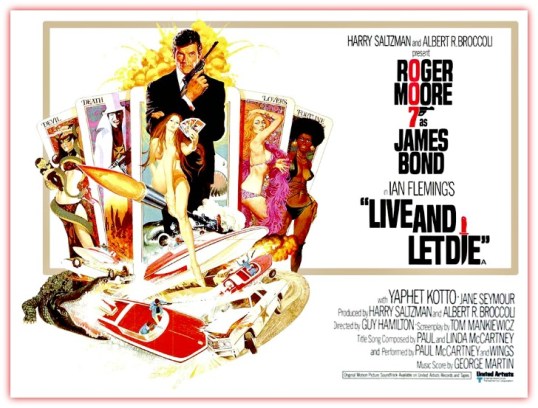
Tonight, at 10 pm et, I will be hosting #FridayNightFlix! We will be welcoming October with a mix of James Bond and voodoo! Join us for Live and Let Die!
If you want to join us this Friday, just hop onto twitter, find Live and Let Die on Prime, start the movie at 10 pm et, and use the #FridayNightFlix hashtag! I’ll be there happily tweeting. It’s a friendly group and welcoming of newcomers so don’t be shy.
Today’s song of the day comes from the soundtrack of 1973’s The Wicker Man.
Composed by Paul Giovanni, Willow’s Song was based on several songs that screenwriter Anthony Shaffer claimed to have heard at various spring pagan festivals. Magnet, who is credited with performing the song, was a band of sessions players that were brought together specifically to record the film’s score. According to Giovanni, the woman singing was Rachel Verney and not, as some people claimed, jazz performer Annie Ross.
Today would have been the 97th birthday of British director Robin Hardy.
Hardy was best-known for directing the original The Wicker Man. Indeed, his subsequent films — including the long-delayed sequel — achieved nowhere near the acclaim as 1973’s Wicker Man. A film in which a Christian detective (Edward Woodward) is lured to an island so that he can be tricked into becoming a pagan sacrifice, The Wicker Man is remembered for Christopher Lee’s chilling performance of Lord Summerisle and, of course, the burning man.
At the risk of being accused of heresy, I’ve always found The Wicker Man to be good but a bit overrated. Woodward’s detective is portrayed as being such a fool that the film’s ending is nowhere near as shocking as it should be. (The Wicker Man was written by Anthony Shaffer who, just as he would later do with 1978’s Absolution, lets his own issues with religion bleed a bit too heavily into the film.) That said, the film is full of wonderfully creepy scenes, like the one below.
“Chop! Chop!” the villagers say and it may seem like it’s all good fun but the look of relief on some of the people’s faces clue us into the fact that the blades have not always remained motionless. It’s the supreme act of trust on an island where no one really has any reason to trust anyone.
4 Or More Shots From 4 Or More Films is just what it says it is, 4 shots from 4 of our favorite films. As opposed to the reviews and recaps that we usually post, 4 Shots From 4 Films lets the visuals do the talking!
4 Shots From 4 Horror Films
The Wicker Man (1973, dir by Robin Hardy, DP: Harry Waxman)
Ticket to Heaven (1981, dir by Ralph L. Thomas, DP: Richard Lieterman)
Split Image (1982. dir by Ted Kotcheff, DP: Robert C. Jessup)
Midsommar (2019, dir by Ari Aster, DP: Pawel Pogorzelski)
A silent film from 1926, The Bells stars Lionel Barrymore as Mathias, a businessman who lives in a small Austrian village during the 19th Century.
Mathias is the owner of the inn, the bar, and the local mill. He’s a popular man around town, specifically because he gives away drinks and meals on credit but he rarely bothers to collect. He’s hoping that his generosity will lead to him being elected burgomaster. Instead, it’s left him in debt to Frantz (Gustav von Seyffertitz), who threatens to take away everything that Mathias owns unless Mathias agrees to allow Frantz to marry his daughter, Annette (Lola Todd). Annette, however, is in love with Christian (Eddie Phillips).
On one snowy Christmas night, a traveler from Poland (E. Alyn Warren) enters the bar. Mathias befriends the man but, when he sees that the man is carrying a lot of gold, Mathias’s desperation takes over. He follows the man outside and stabs him. As the man dies, he shakes a set of horse bells at the man.
Mathias is soon out-of-debt and he is also elected burgomaster. His daughter is free to marry Christian. However, Mathias finds himself consumed with guilt. The ghost of the dead man continually appears to him and stares at him without saying a word. Mathias is haunted by the sound of the ringing bells. Soon, the man’s identical twin brother arrives in town, looking for the murderer. Accompanying him is a mesmerist (Boris Karloff) who claims that he can always get the guilty to confess.
The Bells is a surprisingly effective film. It’s a silent film so we don’t actually hear the sound of the bells. But we do see Mathias reacting to what he hears and we see him seeing the bells ringing and what we imagine is undoubtedly scarier than anything that a sound film could recreate. Meanwhile, the silence of the dead man’s ghost is far more ominous than if the ghost had spoken accusingly. Because the ghost does not speak, Mathias doesn’t know what it wants and neither do we. The Ghost itself never reacts to Mathias’s words. Instead, it just stares at him. We’re left to wonder if the ghost is real or if Mathias’s guilt-stricken mind is playing tricks on him. It’s also impossible not to notice that, though Frantz was the one who was causing Mathias so much worry, Mathias take his anger out on a stranger, on someone who he probably presumed wouldn’t be missed. In the film, it’s made clear that the traveler was also Jewish. He was an outsider, a Jew who came to an inn on Christmas and was murdered because someone else wanted to take his possessions. The film is not just about the guilt of one man but it’s also a portrait of the institutional anti-Semitism that has historically defined so much of Europe.
Lionel Barrymore gives a strong performance as Mathias. Since the film was made at a time when actors could not be heard, Barrymore uses his eyes and the tilt of his head to show us what Mathias is thinking and he does a great job showing us Mathias growing increasingly more and more desperate. Mathias is never portrayed as being a simple villain. Instead, he’s a man who lost control for one terrible moment and now has to live with the consequences of his actions. The film also makes good use of Boris Karloff’s imposing physical presence. Just as with the ghost, the film leaves it up to the viewer to decide whether the mesmerist has any powers or not. Karloff plays him as being a intimidating enigma.
Considering the limits of the era in which it wad made, The Bells holds up well. Director James Young emphasizes the story’s ominous atmosphere. His direction of the snowstorm and the murder is especially impressive. The sight of the victim’s blood falling onto the snow remains a haunting one. One hundred years after it was released, The Bells remains a memorable look at the haunting power of guilt.
Every Horrorthon, I like to bring out an old favorite of mine. Lisa Marie’s Favorite Grindhouse and Exploitation Film Trailers used to be a regular feature here on the Shattered Lens. Every week, I would share some of my favorite grindhouse and exploitation film trailers. Unfortunately, it turned out that YouTube only had a limited amount of good trailers and I soon found myself having to reuse trailers to keep the series going. As a result, this feature went from being a weekly thing to a holiday thing.
Well, it’s the holidays!
Here are six of my favorite horror trailers! I will definitely be watching all six of these this October!
(Be warned, some of the trailers are not safe for work and feature quite a bit of blood and violence.)