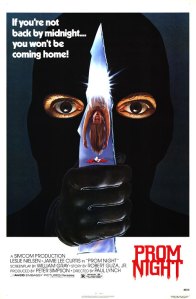
As I mentioned in another post, my sister Erin and I spent Tuesday night watching the Killer Party Marathon on Chiller. One of the movies we saw was the original 1980 Prom Night, starring Jamie Lee Curtis and directed by Paul Lynch. Prom Night, of course, was remade two years ago with cross-eyed dumbfug Brittany Snow as the star. If, like me before Tuesday night, you’re only familiar with the tepid and bland remake than the original Prom Night is a surprise indeed.
The original Prom Night is an old school slasher film, one of the many that came out in the two years immediately after Halloween. It even stars the star of Halloween, Jamie Lee Curtis. Prom Night also stars a lot of Canadians because it was one of the many low-budget B-movies that was made in Canada in the early 80s. Apparently, Canada was offering tax breaks to film companies willing to shoot up north. Several web sites have said that the setting is obviously Canadian but I couldn’t really tell. Of course, I’m from Texas. Anything above Arkansas looks like Canada to me.
Plotwise, the film is pretty much your traditional old school slasher film. There’s a terrible tragedy in the past, an innocent man is blamed for it, and ten years later, teenagers end up getting killed at some communal event. In this case, the tragedy is the death of a young girl who is killed during a truly demonic game of tag. The children responsible for her death lie about what happened and a disfigured drifter is convicted and imprisoned for her murder. As for the communal event, in this case, it’s prom night. The killer stalks the prom, which is what I suggested my classmates call our prom way back when. They disagreed and that’s their loss. The Killer Stalks The Prom would have been a story to remember.
Anyway, here’s a few random thoughts about the original Prom:
1) As with all old school slasher films, it’s interesting to see just how much of the early products of this all-American genre borrowed from the Italian giallo genre. Everything from the elaborate, past tragedy to the black gloves worn by the killer to the attempts to keep audiences guessing who the killer actually is to even the supporting character of the burned out cop simply screams giallo. The main thing that the Americans brought to the giallo format was the idea of having the murders revolve around a previously innocent gathering or holiday.
2) Especially when compared to recent “slasher” films, Prom Night is a relentlessly grim film. Prom Night’s killer doesn’t waste any time with comic relief or one-liners. He’s too busy savagely killing people. And our victims aren’t the usual collection of bimbos and soulless jocks. No, this is the type of movie where even the token virgin ends up getting her throat ripped out with a gigantic shard of glass. There’s not a lot of deaths in Prom Night, just six. But they all hurt.
3) I usually just think of Jamie Lee Curtis as the crazy woman selling Activia on Lifetime but this movie shows that she’s actually a pretty good actress. Even working with a script that isn’t exactly full of brilliant dialogue or multi-faceted characters, Curtis is a sympathetic, likable, and most of all, believable heroine (which is all the more remarkable when you consider that she, like everyone else in this film, appears to be far-too old to still be worrying about the prom). She even manages to make the film’s ending rather touching and even poignant. And how many slasher films can you say that about?
4) Prom Night is as much about tacky — yet insanely catchy — disco music as it is about spilling blood. Seriously, if I owned the soundtrack to this film, I would listen to it 24/7 for two years straight. I’d force all of my friends to listen to it too and eventually we’d all go insane and just spend the rest of our lives wandering around going, “Prom night! Everything is alright!”
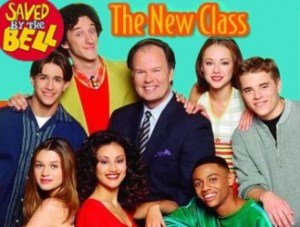
5) One last thing — Prom Night showcases what has to be the most believable, cheap, and tasteless prom ever put on film. The theme is Disco Madness and the students are all very chic in that way that even they know will be painfully dated in another two years. Indeed, this is one of the rare films that understands that the perfect prom is nothing less than an unintentional camp spectacular. For someone like me who, as the result of seeing too many episodes of Saved By The Bell: The New Class, grew up with an unrealistic expectation of what the senior prom would be, the original Prom Night remains a refreshing breath of fresh air even 30 years after it was made.
And always remember: “Prom Night! Everything is all right…”
Yesterday, as part of my ongoing struggle with insomnia, I watched the 1967 Hollywood expose, Valley of the Dolls. This is one of the most legendary so-bad-it’s-good films of all time but I have to admit that the main reason I started watching it was because I had been told that the movie was also extremely dull. I was hoping it might put me to sleep.
No such luck.
I am not ashamed to admit that I loved Valley of the Dolls in all of its over-the-top, ludicrous glory. I’m also not ashamed to admit that I now have a new life’s ambition. And that ambition is to play the iconic role of talented, neurotic, and unstable pill popper, Neely O’Hara in a modern-day remake of Valley of the Dolls (which, hopefully, will be directed by Arleigh who I’m sure could help me get in touch with my inner Neely).
In the original Valley, Neely was played by Patty Duke who sang, screamed, and doped as if the world depended on it. Below is my favorite scene of Neely mayhem, the one in which Neely gets into a catfight with an aging rival (played by Susan Hayward).
(Much like the rest of the movie, this scene starts out slow and requires a little bit of patience on the part of the viewer but, in the end, that patience will be rewarded.)
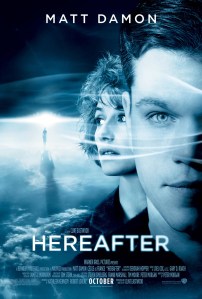
Hereafter is a very serious film about a very serious topic, death. Following three separate but ultimately connected stories, the film attempts to explore death and the question of what happens after death from three different angles — intellectually, emotionally, and spiritually. I really wanted Hereafter to be a great film. So did the film’s makers, which is precisely why Hereafter fails.
The intellectual consideration of death is represented by the character of Marie (Cecile De France), a French journalist who, at the start of the film, drowns in a tsunami and is, for a few minutes, clinically dead. Before she is eventually revived, she has a classic near-death experience: the bright light, the people waiting to greet her, the whole deal. After this experience, Marie is compelled to investigate whether or not there truly is such a thing as an afterlife. As she does so, Marie finds herself shunned by her resolutely secular friends and grows increasingly distant from her skeptical (and rather condescending) boyfriend.
The emotional response to death is represented in the story of twin brothers, Marcus and Jason (played by Frankie and George McLaren). The two boys live in London with their drug-addicted mother and share a strong (and, to be honest, kinda creepy) bond. Jason, while simply trying to return home with some drugs for his detoxing mother, is roughed up by some bullies and ends up running out into the middle of the street. Naturally, since this is a movie, Jason is hit by a truck as soon as he steps off the curb. Jason is killed and Marcus is taken away by social services and put into a foster home. Marcus continues to carry Jason’s cap with him and soon starts tracking down local English psychics in an attempt to talk to his brother again.
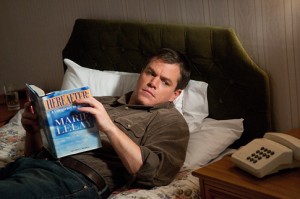
Finally, the spiritual aspect is detailed in the film’s most interesting story. This story features Matt Damon as George Lonegan, a psychic who can speak with the dead. After years of being a minor celebrity, George burned out and went into a self-imposed exile. He now works at a factory while his brother (Jay Mohr, who looks incredibly puffy in this movie) keeps trying to find ways to convince George to get back into the business of talking to dead for fun and profit. After George reluctantly gives a reading to Richard Kind, he finds himself being dragged back into his old life.
A lot of viewers and critics have compared Hereafter to Alejandro González Iñárritu’s 2006 masterpiece, Babel. Both films follow three separate but connecting stories and both films are concerned with the theme of death and how it connects us all. As well, Babel featured Brad Pitt in a serious role and Hereafter features Matt Damon. The main difference, however, is that Babel was a great film but Hereafter is basically an uneven mess.
Whereas Babel featured three strong stories, Hereafter features 1 compelling story (that would be Damon’s) which is compelling solely because Matt Damon is a talented enough actor that he can apparently perform miracles. He’s probably about as likable as he’s ever been in the role of George but he also wisely plays the role as being just a little bit off. Even though the film makes the mistake of never really going into the details of just what exactly caused George to give up being a psychic, Damon is so good in the role that you’re willing to take him at his word that he had a good reason. Probably the highlight of the film (and one of the few sections to really inspire any sort of real emotional response) is an extended sequence where Damon befriends and the manages to alienate an insecure, single woman played by Bryce Dallas Howard. Damon and Howard have a scene that involves eating while blind-folded that manages to be both powerfully erotic and wonderfully romantic at the same time. If the entire film had been about them, Hereafter would have been a much better movie.
Unfortunately, we’ve got to slog through two other stories.
Cecile La France gives an excellent performance as Marie and the opening tsunami scene is truly terrifying. For someone like me, who cannot swim and risks having a panic attack if she even stands near the deep end of a swimming pool, the tsunami scene was almost impossible to watch. I had to put my hands in front of my eyes and watch the scene through my fingers. However, once she drowns, Marie sees a vision of the afterlife that — as a harbinger of things to come — is rather dull. I mean, with everything that can supposedly be done in movies today, the best that Hereafter can give us is a bland white light. Once Marie returns to Paris and starts her investigation, La France remains a sympathetic presence and the film actually does a pretty good job of showing just how condescending most supposedly “liberal” men are whenever a woman starts to stray from the established orthodoxy. But, unfortunately, her story is just never that interesting. Marie decides to write a book about the afterlife. As a writer myself, I have to say that there is nothing more boring than watching someone else write.
As for Marcus, I was shocked just how little I cared about him or his attempts to contact his brother. I come from a very close family and I have a very strong bond with all three of my sisters and, among them, I am notorious for crying at any movie that deals with that sort of sibling bonding. Yet I sat through the saga of Marcus and Jason without shedding a tear and I felt terrible about it. I really wanted to cry. I really wanted to have some sort of emotional response to the story but I just never believed it. I hate to say this but honestly, a lot of this was due to the fact that the McLaren twins are such bad actors. Director Clint Eastwood has said that he specifically cast them because they weren’t professional actors and therefore, they wouldn’t introduce any false “sentimentality” into the mix. But dammit, it was a sentimental story. Sentiment is not necessarily a bad thing and just because something is sentimental, that doesn’t make it false.
So, what exactly went wrong with Hereafter? The film opens strongly with a terrifying tsunami and the final 30 minutes are also undeniably touching (if also a bit contrived). It’s everything that happens in between those two points that ruins Hereafter. Director Eastwood, obviously looking to avoid that dreaded curse of being sentimental, keeps the whole film very low-key and realistic. Other than the opening tsunami, there are no big wow moments but to be honest, isn’t that what movies are for? If you’re going to make a movie that specifically shuns the wow moment, you better have something compelling (a perfect script or an entire cast giving a compelling performance as opposed to just a handful of them) to take its place. Hereafter doesn’t and, as a result, the movie drags. This, honestly, has got to be one of the slowest, most boring movies I’ve ever seen. If director Eastwood’s westerns and actions films can all be seen as homages to Sergio Leone and Don Siegel, I think Hereafter must be an homage to some of Andy Warhol’s intentionally dull films. Whereas Warhol, at the very least, gave us Joe Dallesandro to look at, Eastwood gives us Jay Mohr. It’s not a fair trade.
I don’t know how much of Hereafter should be blamed on Eastwood and how much should be blamed on the script written by Peter Morgan. Here’s a quote from Morgan that appeared in The Hollywood Reporter:
“It’s quite spiritual material, and quite romantic, too. It’s the sort of piece that’s not easy to describe and in the hands of different filmmakers could end up as wildly different films. Quite unlike some of my other material, which I think there were only certain ways that you could shoot it. It’s really not just another boring Hollywood movie with the same old boring Hollywood actors, although I see the point that the public and sick of paying $10.00 to see a movie with same old faces and the same gramma of story telling.”
And to that, all I can say is “Shut up, Peter Morgan!”
This is not spiritual material as much as it’s just a bunch of vaguely New Age platitudes being delivered by a mainstream screenwriter who apparently doesn’t have the guts to come down either firmly for or against an afterlife. This is the type of feel-good BS that leads to thousands of people every year giving up their life savings to some fraud who claims he can deliver messages from beyond. Morgan’s script goes out of its way not to actually define the afterlife. Is it heaven or is it Hell? Is there a God? Do the worthy go to Heaven? Are souls saved? Or are they just ghosts who are waiting for us to be willing to let them go? These are all questions that would have been considered by a good film but Hereafter doesn’t consider them. Oh, don’t get me wrong. It pretends to bring them up but only so the movie can shrug and go, “I guess nobody knows.” And to that I say, either take a position or don’t expect everyone else to pay money just to listen to you duck the question because you’re too scared of alienating mainstream critics or audiences.
(Myself, I do believe that those who love us are always with us in some way even if I don’t believe in a literal afterlife. And while I know that answer might seem vague, you should also consider that I’m not the one spending millions of dollars to make a movie celebrating that vagueness.)
Morgan’s script also make its a point to incorporate real-life events into his contrived narrative. As a result, the London Subway bombings and the Thailand Tsunami are both used as convenient plot points in much the same way that The Curious Case of Benjamin Button used Hurricane Katrina. I felt it was ghoulish when Button did it and, the more I think about it, it’s equally ghoulish in Hereafter. It’s hard not to feel that the film’s saying, “Too bad all those real people died but what’s important is how these events impacted the lives of a bunch of fictional characters.”
Hereafter’s main problem is that it simply tries too hard to be great. You get the feeling that every scene and line has been calculated to make you go, “Wow, what genius!” As a result, even the scenes that work still somehow feel very dishonest. The end result is a very insincere film about some very sincere concerns.
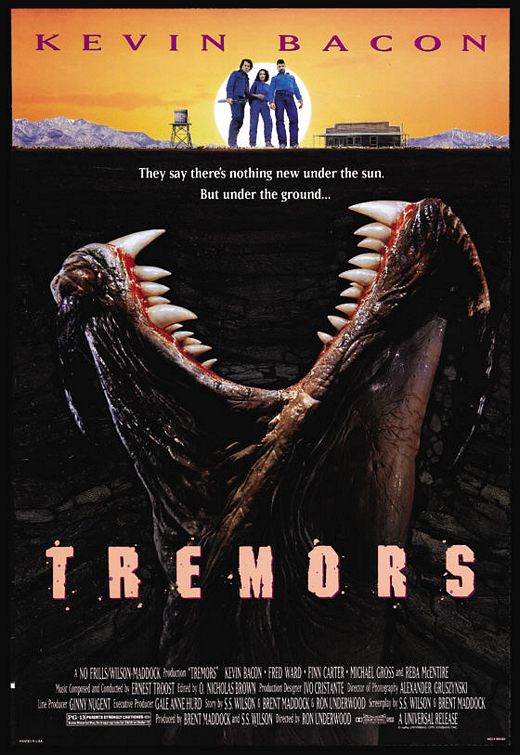
I just happened to catch one of my favorite creature-feature films on cable this morning and I had forgotten just how much fun this film was and is to still watch. I am talking about 1990’s horror-comedy Tremors by director Ron Underwood (who would follow it up with the very successful and funny City Slickers a year later) and starring the comedic duo of Kevin Bacon and Fred Ward. I was still in high school when I saw this in the theaters and even then this film had me from the get-go.
Tremors is a throwback to all the Saturday matinee creature-features and monster mash films that were huge during the 50’s and through the 60’s. It’s plot was simple enough that even a little kid could keep up with what was going on. We had a small, rundown mining town in the middle of nowhere (it always happens to be one of those small desert or valley towns which dotted the landscape once the national interstate was completed) whose fortunes have seen better days, hell better decades from the looks of it. The town has its cast of characters with Fred Ward and Kevin Bacon’s roles of Earl and Val the two main leads. We even get long-time genre actor Victor Wong in a supporting role as the town’s only store owner and also it’s two-bit hustler always looking to find a new way to make a buck. One of the funniest roles goes to Michael Gross (the dad in the 80’s hit family show Family Ties) who, with Reba McEntire as his wife, play some crazy-ass survivalists who try fighting off the creatures of this feature the giant, underground worms the survivors have dubbed “Graboids” for their propensity to grab people and animals with prehensile tentacle like appendages which shoot out from their mouths.
No, Tremors wasn’t some live-action version of the ever popular hentai, though I wouldn’t be surprised if the writers of the film were subconsconsciously influenced by them. What the film ended up being was one of the funnier horror comedies which ended the 80’s and announced the 90’s. It was also one of the last few great non-CGI creature features to come out of Hollywood. The Graboids were definitely animatronic and rubber-suited props, but they moved and looked real that one didn’t question whether they were real or not. It would be these creatures who would end up the stars and highlight of this film (the ensemble cast a good second) and follow-up sequels would and could never live up to it. It didn’t help that the sequels ended up using too much CGI which just ruined the illusion built-up by the original.
So, if you ever feel bored and suddenly see that one of the many basic cable channels are showing this little horror-comedy gem from the 1990’s I recommend you watch it with snacks and drinks on hand. There are many ways to make one stop being bored by watching something on the “Tele” and I say Tremors is one of those ways.
At the same time, it’s not, as so many are rabidly insisting, a great film either.
It’s a good film that takes a lot of liberty with the truth and, in the process of telling the “story” about the founding of Facebook, reveals that screenwriter Aaron Sorkin doesn’t really get the whole Internet thing.
David Fincher directs like a man who still can’t believe he didn’t get an Oscar for The Curious Case of Benjamin Button. In other words, he doesn’t do anything that might be too far out of the mainstream. Face it, folks. The man who directed Fight Club has grown up. And, as they say, when you grow up, your heart dies.
The main problem with The Social Network is that it is essentially a very mainstream movie being made about a grindhouse topic. Hackers, like the best grindhouse directors, do what they do because 1) they can and 2) it’s a way of telling the rest of the mainstream world to fuck off. Unfortunately, both Sorkin and Fincher are members of that mainstream world so instead of celebrating Facebook and the Internet as a revolution, they instead try to convince us that the only reason Facebook exists is because the founder’s heart was broken by his ex-girlfriend.
That ex-girlfriend is portrayed by Rooney Mara, who will be playing Fincher’s version of the girl with the dragon tattoo. The film presents her as being a shallow bitch but then again, the film presents every woman in the world as being a shallow bitch. Then again, this is a mainstream movie and the mainstream hates women who actually think for themselves. Certainly, that’s been the case with everything else that Aaron Sorkin has ever written.
Still, Mara is presented as just being insensitive and not evil or crazy. If the movie has a villain, it’s Sean Parker (played by Justin Timberlake) who is presented as being the evil Iago-like figure who ruined Facebook. If anything, the film mostly seems to hate him because Parker co-founded Napster and therefore cost the mainstream media a good deal of money.
Admittedly, it’s a well-acted movie. Both Jesse Eisenberg and Andrew Garfield are excellent as the soon to be estranged founders of Facebook. Armie Hammer actually plays two characters — twin brothers — and he creates two unforgettable and unique characters. Justin Timberlake is a bit less convincing as Sean Parker but then again, by the film’s logic, Parker is less a human being and more a demon sent from Hell to keep David Geffen from getting another few thousand. Finally, Rooney Mara does what she can with a demeaning and insulting role. I didn’t see any signs of Lisbeth Salander in her performance but then again, this isn’t a film about strong women. It’s a movie about weak little boys.
Anyway, to return to my original point, the Social Network is a good film. It’s well-acted, it looks pretty, the story moves quickly, and Trent Reznor’s score is excellent. Unfortunately, the movie’s being presented to us as a great film and anyone who disagrees is running the risk of being lynched by the same obnoxious fascists who, last year, demanded that everyone bathe in their own cum while watching Avatar. The main reason these people are so over-the-moon about this movie is that it’s the epitome of the type of film that pats the viewer on the back for being so smart without actually requiring that viewer to prove it.
So, if you watch this movie, realize that you keep your mind open at your own risk.
Scott Stewart’s film about the Biblical Apocalypse was one film that I was very hyped to see in the first weeks of 2010. I had heard some very good buzz about it when a red band sizzle reel was shown in at 2009 San Diego Comic-Con. This was Stewart’s first major work (he had made a smaller film in 2000 called What We Talk About When We Talk About Love) and with his background in the special effects industry I thought that this film of his would at least be a feast for the eyes. I knew going in what to expect from something about God, Angels, the Apocalypse and uneding amounts of guns and ammo. So, it was with a profound disappointment when I finally saw Legion and, despite my low expectations, was roundly disappointed with everything about it.
Legion is about God deciding that he’s had enough of humanity’s bullshit and shenanigans (a term I would put on this film) and turned his angelic hosts loose upon the world to start things new. This was God’s version of shaking the Etch-a-Sketch that is the world. He has his two favorite Archangels in Michael and Gabriel leading the vanguard of this Apocalypse with Michael tasked with making sure a baby doesn’t get born before the divine enema has been completed. Well, Michael being the introspective sone decides that he still has faith in humanity and refuses to do God’s bidding. We see Michael go through removing his wings (which also unlocks the very BDSM God collar all the angels wear) then find a huge cache of weapons inside a toy company warehouse. Seems removing the wings makes him human and minus all the cool angelic powers. He says something about the Apocalypse having started then makes off towards Bethle…I mean the diner out in the Nevada desert to protect the prophesized baby who will save humanity.
Yeah, the premise for Legion sounds awesome on paper. Militant angels led by badass Archangels like Gabriel about to go “Terminator” on mankind. The story itself was like a mish-mash of some of the best cult fantasy/horror of the past. There’s some of the cool Christopher Walken film Prophecy in the plot and, of course, one cannot but see some parallels with Cameron’s Terminator. Plus, we have a humanized Archangel Michael with guns and guns and guns to battle his former brethren with his coterie of human sidekicks to help out. The trailer for this was very cool and full of action. A trailer which pretty much had all the cool parts in this film. One can watch the trailer and actually enjoy Legion more than when they watch the film itself.
For a filmmaker with a special effects background the film looked pretty lifeless with action sequences that lacked any sort of memorable action. The dialogue wasn’t awful, but everyone’s performance made it sound worse than it really was. Even Bettany in the lead role of Michael looked tired and bored with his role (a sign the film was going downhill and downhill fast). The possessed humans who made up the bulk of the opposing force against the good guys were uninteresting with the exception of Doug Jones’ “Ice Cream Man” character shown in the trailer. A scene the trailer pretty much showed almost in its entirety. That character was on the screen for less than two minutes then gone.
I actually think that people should just watch the trailer for Legion then pop into their dvd player Prophecy and Terminator. Doing that will pretty much give them the whole story of Legion and have a kick-ass time doing so. This was a film that looked good to great on paper, but once they actually started writing the script and started filming went down the septic tank. It’s films like these that makes one shout “shenanigans” at all those involved in its making. I think Kyle Broflowski would agree with me.
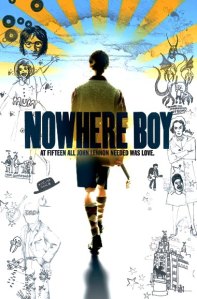
At first glance, Sam Taylor-Wood’s Nowhere Man sounds just a little bit too cutesy. The movie, which covers the youth of John Lennon, starts with the death of John’s Uncle George, covers both his attempts to reconcile with his mother Julia (portrayed here as being bipolar) and his troubles relationship with the aunt who actually raised him, details how John came to form his own band (The Quarrymen) and first met Paul McCartney and George Harrison, and ends with John preparing to leave for Germany. Yet the movie works surprisingly well and, by the end, is actually quite touching regardless of whether you idolize John Lennon or if you think Imagine is one of the most overrated songs of all time. By refusing to indulge in any easy sentimentality about either John Lennon or the iconic figure he would eventually become (the word “Beatles” is never uttered at any point in the film), Taylor-Wood crafts a touching coming-of-age story about an alienated teenager trying to find peace with his dysfunctional existence. The fact that the teen is going to grow up to be the John Lennon is secondary to the plot.
The film works mostly because of the cast. The young John Lennon is played by Aaron Johnson who, earlier this year, was the lead in Kick-Ass. I have to admit that I didn’t care much for Johnson in Kick-Ass. His performance seemed generic and bland and he was overshadowed by Nicolas Cage, Chloe Grace Moretz, Mark Strong, Christopher Mintz-Plasse, and just about everyone else in the movie. Here, however, Johnson gives a strong, sympathetic performance as a character who often comes across as being neither. He both manages to capture the young Lennon’s sensitivity as well as his anger and cocky arrogance.
However, the movie truly belongs to the two actresses playing Lennon’s aunt and mother, Kristen Scott Thomas and Anne-Marie Duff. Scott Thomas has an especially difficult job as her character is far less flamboyant and, at first sight, a lot less interesting as Duff’s. However, as the film progresses, Scott Thomas starts to subtly reveal the dry humor that lies underneath her character’s serious expression. As for Duff, she dominates the film as surely as Julia dominated her son’s life. Duff doesn’t resort to any of the easy (and insulting) clichés that are usually used to represent bipolar disorder on film. Instead, she captures both the exhilarating high of being manic along with the constant fear of the depressive episode that we always know is destined to follow. It’s a spot-on performance that elevates this film above the standard coming-of-age story.
Wisely, neither the director nor her actors ever get caught up in the fact that their film is about the John Lennon. There’s no portentous foreshadowing or awkwardly staged moments designed to specifically make you go, “Hey, that’s John Lennon!” Even the first time that Lennon meets Paul McCartney and, later, George Harrison is handled in a casual, off-hand manner. Taylor-Wood has enough faith in her audience to believe that we’ll be able to understand the importance of John being introduced to a younger guitar player named Paul without bashing us over the head with the fact that this is the Paul McCartney. As such, while you’re always aware that this is a movie about John Lennon, you can also see the movie as simply being the story of an alienated teenager who finds salvation through music.
While the goth ballerina side of me will always have a special place in my heart for Suspiria and its two sequels, I think that 1982’s Tenebraemay very well be director Dario Argento’s best film. Certainly, it was (to date) his last truly great film before he entered the current, frustratingly uneven stage of his career.
Tenebrae was a return to Argento’s giallo roots after the supernatural-themed horror of Suspiria, Zombi, and Inferno. It was also the work of an audaciously confident director. That confidence is fully on display in the scene below in which the film’s killer menaces a journalist and her lover. Featuring a truly impressive tracking shot in which the camera appears to literally swoop in, out, and over a journalists house without a single cut, the scene ends with one of Argento’s more memorable murders.
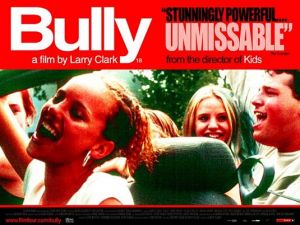
Bullying has been in the news a lot lately. The fact that some people are bullies is hardly a new development, it’s just that now people are actually paying attention to the possible consequences of cruelty. Tragically, it appears it takes people killing themselves for the rest of the world to consider that “Hey, maybe concentrated, socially accepted sadism isn’t a harmless thing.” With so many people finally admitting what they had to have known was true all along, now seems like a good time to reconsider Larry Clark’s controversial and much-maligned 2001 film, Bully.
I can still remember the night, five years ago, that I first saw Bully. I was at a party with a group of friends. Nine of us ended up in a random bedroom, drinking, smoking, and going through all the closets and dressers. I might add, we found some very interesting things while searching. Anyway, someone eventually turned on the TV and there was Bully, playing on one of the movie stations. Since we knew Bully was supposed to be a very explicit, very controversial movie, we left the TV playing and hung out in a stranger’s bedroom for two more hours. There was, obviously, a lot going on in that room and I have to admit that I only paid attention to bits and pieces of the movie. But what I saw stuck with me enough that the next chance I got, I bought the movie on DVD so I could actually devote my full attention to it. In the years since, Bully is not a film that I revisit frequently because, to be honest, it’s the type of movie that makes you take a shower after watching it. It’s also an unusually powerful and disturbing film that sticks with you for a long time after it ends. It’s not a film that I would recommend anyone watch a hundred times. But it’s definitely worth viewing at least once (or maybe even four times if you’re like me).
The bully of the title is 20 year-old Bobby Kent (played by Nick Stahl). Bobby’s “best friend” is passive, blank-faced Marty Puccio (Brad Renfro). Despite being physically stronger, Marty allows himself to be totally dominated by Bobby. Marty accepts Bobby’s constant insults and physical abuse with the meek acceptance of a battered spouse. Bobby, who is on the verge of starting college and presumably making a life for himself that high school dropout Marty could never dream of, even forces Marty to moonlight as a male stripper and to take part in making cheap, gay-themed porn videos. (Bobby insists that he’s not gay himself and, like most guys in denial, goes out of his way to act as much like an insensitive asshole as possible as if to scream to the world, “I’m straight!” despite all the evidence to the contrary.)
As the film begins, Ali (Bijou Philips) and her friend Lisa Marie Connelly (Rachel Miner) step into sandwich shop where both Bobby and Marty work. (Bobby, of course, is the boss.) Apparently, they are appropriately impressed by the sight of Bobby slamming Marty’s head against a refrigerator because soon, all four of them are going out on a double date. While Ali’s content to just give Bobby a blow job, the far more insecure Lisa decides that Marty is the love of her life and starts a relationship with him that the ever-passive Marty simple accepts. However, what Lisa has failed to take into account, is that Marty is already in a relationship and Bobby isn’t ready to just let go. Bobby expresses this by walking in on Marty and Lisa while they’re having sex, beating Marty up, and then (unlike everything else in this movie, this is never explicitly shown) raping Lisa. After this, Lisa discovers that she’s pregnant but she doesn’t know if the baby’s father is the man she claims to love or the man who raped her.
(One thing that surprised me, that night I first watched Bully out of the corner of my eye while me and my friends searched through a stranger’s lingerie, was just how little sympathy most of my friends had for Lisa. While I wasn’t surprised that the majority of guys in the room seemed to feel that Lisa was somehow to blame for disrupting all that precious male bonding, it was the reaction of some of the other girls that truly caught my off guard. While none of them went as far as to say that Lisa deserved to be raped by Bobby, quite a few of them took the attitude that she either brought it on herself or she was lying. Unlike the boys, these girls also felt the need to make several snide remarks about Rachel Miner’s physical appearance. At the time, their attitude really bothered me and I have to admit that I wasn’t as close to any of them afterward.)
(Of course, we Lisa Maries have to stick together…)
Despite having raped his girlfriend, Bobby still considers himself to be Marty’s best friend and Marty — again like an addicted spouse — proves himself to be incapable to simply cut off all ties with Bobby even as the abuse gets worse and Bobby grows increasingly unstable. In one of the film’s more controversial scenes, Bobby and Ali are about to have sex when Bobby decides that the only thing the scene is missing is a gay porn video playing in the background. Ali finds the idea to be disgusting and insinuates that Bobby must be gay. Bobby responds by raping Ali.
Finally, Lisa tells Marty and Ali that they have little choice but to murder Bobby. While this starts out as a somewhat innocent suggestion of the “I wish he was dead,” kind, Lisa soon begins to insist that Bobby must die. Ali recruits her friend Heather (Kelli Garner) and an ex-boyfriend named Donny (a truly scary Michael Pitt) into the conspiracy. (Heather and Donny both agree that Bobby must die though neither one has ever met him.) Lisa, meanwhile, brings in her cousin, video-game geek Derek. Finally, and most fatefully, they decide to get some pointers from the neighborhood hitman (Leo Fitzpatrick).
That’s right. The neighborhood hitman. He’s actually a pretty familiar figure in the suburbs. He’s the 17 year-old white boy who tries to stare out at the world with hateful eyes. He brags to you about how he’s a member of a gang. He tries to rap and speaks in dialogue lifted from Grand Theft Auto. In short, he’s the guy that everyone laughs at whenever he’s not around. His lies should be obvious to anyone with a brain which is exactly why Lisa, Marty, and Ali all assume that he’s an actual hitman. The Hitman agrees to direct their murder and help them kill a person who (like almost everyone else now involved in the conspiracy) he has never actually met.
It all climaxes in one of the most disturbingly graphic and harrowing murder scenes I’ve ever seen, one that manages to snap the audience back into reality after the (needed) comic relief of Fitzpatrick’s absurd wannabe gangster. As he’s repeatedly attacked by this group of made up of bumbling strangers and his “best” friend, Bobby proves himself to be not quite as powerful a figure as everyone had assumed. Instead, he’s revealed as a pathetic, frightened teenager who begs Marty to forgive him (for “whatever I did”) even as Marty savagely stabs him to death.
Unlike the standard rape-revenge flick (and have no doubt, that’s what Bully essentially is), the film’s climatic act of violence doesn’t provide any sort of satisfaction or wish-fulfillment empowerment. Instead, it just sets up the chain of events that leads to the film’s inevitable and disturbing conclusion.
When it first came out, Bully was controversial because of its explicit sex and violence. As a director, Clark employs his customary documentary approach while, at the same time, allowing his camera to frequently linger over the frequently naked bodies of his cast. More than one reviewer has referred to Clark as “a dirty old man” while reviewing this film. (More on that in a minute.) What those critics often seem to fail to notice is that, as explicit as the movie is, some of the most powerful and disturbing elements (like Bobby’s repressed homosexuality) are never explicitly stated.
After seeing this movie a few more times, the thing that gets me is that — in the end — the film’s nominal villains — Bobby and Lisa — are also the only two compelling characters in the entire movie. While all the other characters are essentially passive, Bobby and Lisa are the only ones actually capable of instigating any type of action. As such, they become — almost by default — the heroes of the movie. On repeat viewings, it’s apparent that Bobby and Lisa are really two sides of the same coin. The film’s title could refer to either one of them. They are both insecure, unhappy with who they are, and both of them seem to find a personal redemption by dominating Marty. One of the great ironies of the film is that Bobby and Lisa are essentially fighting a war for the soul of a guy who is eventually revealed to be empty inside. For his part, Marty simply shifts his “forbidden” relationship with Bobby over to Lisa, a relationship that is just as exploitive and destructive as his friendship with Bobby but which is also more socially acceptable because it’s so heterosexual in nature that he’s even knocked up his girlfriend. When Marty finally does kill Bobby, he’s not only killing a bully but he’s attempting to kill of his own doubts about his sexual identity. It’s his way of letting the world know that he’s a “real” man. As for the other characters — Ali, Donny, Heather, and even the swaggering hitman — they are all defined by their utter shallowness. While its clear that none of them are murderous on their own, it also becomes clear that none of them have enough of an individual identity to resist the Bobbys and Lisas of the world.
Despite playing shallow characters, nobody in the cast gives a shallow performance. Down to the smallest role, the actors are all believable in their roles. Whether it’s Michael Pitt’s blank-faced aggression or Leo Fitzpatrick’s comedic swagger, all of the actors inhabit these characters and give performances that are disturbingly authentic. The late Brad Renfro gave one of his best performances as Marty, just hinting at the anger boiling below the abused surface. However, the film belongs to Miner and Stahl. Stahl displays a sordid charm that makes his character likable if never sympathetic while Miner manages to do something even more difficult. She makes Lisa into a character who is sympathetic yet never quite likable. When Bully first came out, critics spent so much time fixating on the fact that Miner’s frequently naked on the film that they forgot to mention that she also proves herself to be an excellent actress.
As I stated, Bully is not a universally beloved film. Most of the reviews out there are negative with a few of the more self-righteous critics accusing the film of being “pornographic” as if the whole thing was filled with close-up money shots of Brad Renfro ejaculating on Rachel Miner’s ass. Strangely enough, you can find hundreds of critics complaining that Clark filmed full frontal nudity but next to none complaining that Clark filmed a brutal and realistic murder scene.
The two most frequent criticisms of Bully are that 1) it plays fast and loose with the true story that it’s based on and 2) that the film is exploitive.
Both criticisms are valid but the first one is the only one that would really bother me. I have to admit that I don’t really know much about the real life murder of Bobby Kent. I just know the version presented in this movie and in the Jim Schultze book that the movie was based on. Of course, everyone arrested and convicted for Kent’s murder has been quick to claim that the movie makes them look more guilty than they actually are. That’s to be expected. However, the main difference between the film and the reality — for me — was that, in reality, victim Bobby Kent did not look a thing like Nick Stahl. Whereas Stahl is clearly no physical match for any of the characters in the film (and hence, it’s easier to feel sorry for him when everyone attacks him at once), pictures of the real-life Bobby Kent reveal an intimidating, muscular, young man who few people would probably ever chose to mess with. Stahl’s Bobby is a bully because everyone else in the film is too passive to stand up to him. The real Bobby could probably get away with being a bully because he literally looked like he could rip another man’s arm off.
The other criticism is that this movie — with its combination of tits and blood — is essentially just an “exploitation” film. Well, it is. But as I’ve explained elsewhere, just because a film is exploitive, that doesn’t mean that it’s not a good movie. Art and exploitation, more often than not, are clandestine lovers and not bitter enemies. Yes, all of the characters — male and female — do spend a good deal of time showing off their bodies but then again, what else would these otherwise empty characters do? Their surface appearance is really all they have. Yes, the camera does linger over all the exposed flesh but then again, so do most people. If anything, critics attempted to punish Clark for openly acknowledging that majority of his audience is waiting to either see Bijou Phillips’ twat or Nick Stahl’s dick. Yes, Bully is exploitation but it’s exploitation in the best grindhouse tradition. It’s a film that’s honest specifically because it is so sordid and exploitive.
When all is said and done, Bully is the epitome of a movie that is too sordid to ever be corrupted.
In 2008 a little film from Sweden swept through the film festivals and earned a rightful and well-deserved place in many film critics and film circles “best of 2008” and “top ten” lists. This was Swedish filmmaker’s film adaptation of the John Ajvide Lindqvist vampire novel, Let The Right One In. It was a vampire film that appealed not just to horror genre fans hungry for a vampire film that was the polar opposite of the current “Twilight” vampire craze. Horror fans wanted something that wasn’t watered down and emasculated to better appeal to the tween girl set. So, Alfredson’s vampire film was embraced by these horror fans and when news came that the rights to the novel was licensed by British-studio Hammer Film and an American-remake was set for production the reaction was decisively negative.
Fans of the original Swedish film were quite protective of the film and saw any plans to remake it for the North American audience as a cynical cash-grab. Their argument was that the original film was such a great one that there should be no need to remake it. Why fix something that wasn’t broken was another point made. It didn’t help the side of those supporting the remake that Matt Reeves was chosen to direct the remake. Reeves was better known as J. J. Abrams friend (some would say Reeves owes his success to Abrams and that he was coattailing the successful producer-director) and the director of the POV monster film, Cloverfield.
As strident fans of the original continued to vent and complain about the remake already failing (despite not an inch of film being shot) the producers were gradually filling the roles in the remake with some very interesting names. Fresh off her break-out performance in Kick-Ass was Chloe Grace Moretz taking on the role of Abby (the vampire child in the original was named Eli) with Kodi-Smit McPhee (The Road) taking on the role of the young boy Owen who befriends her. One name after the other filled out the cast with some very good veteran actors from Elias Koteas to Richard Jenkins (taking on the role of Abby’s Renfield).
Matt Reeeves’ version of Lindqvist novel from Alfredson comes from using the novel itself as the base for the screenplay Reeves himself wrote for the remake. While Let Me In shares many similarities in characters and situations from the original Swedish film, Reeves film does use more of the themes and details from the novel than Alfredson did for his adaptation. Let Me In definitely has enough about it which will distinguish itself from its Swedish counterpart and stand on its own.
The film switches locales from a suburb of in Sweden to a snowy Los Alamos, New Mexico (yes, it does snow in New Mexico). We learn quickly that Owen has become quite the loner due to the constant bullying by classmates. He spends time alone in the plaza area of the apartment complex he lives in with his mother (played by Carla Buono who we never fully see). He fantasizes of getting back at those who have and still bullying him even to the point that he buys a small pocketknife and practices his retribution on one of the trees in the plaza. It’s during one of his nighttime practices with the pocketknife that he first encounters Abby. There’s a certain wariness during their encounter with Abby proclaiming that Owen will not become a friend. But in time the two do become friends with Abby becoming quite protective of Owen once learning about the bullying he has to endure on a daily basis.
The change in Abby’s relationship with Owen doesn’t sit well with Abby’s Renfield. He asks Abby never to see Owen again as he goes out to procure Abby more fresh blood (a previous attempt goes awry forcing Abby to go out into the night to hunt). It’s in the scenes between Abby and Jenkins character that we see more of the duo’s relationship mirroring the novel’s. The novel explores the theme of pedophilia and while Reeves adaptation wasn’t quite obvious about it there are clues and small character interactions which hint at this pedophilic relationship which the Swedish original never really touched upon.
It’s in these small character interactions that Reeves’ film begins to differentiate itself from Alfredson’s version. The narrative between the two films still remain the same, but Reeves’ version explores the darker themes in the novel source while Alfredson concentrates more on the growing relationship between the two primary characters. These differences could be seen in how Reeves films Abby’s attacks while hunting her prey to be more animalistic (though at times the CGI seems too apparent when Abby attacks) and Abby’s subtle manipulation of Owen. I say manipulation because Abby seems very intent on trying to befriend and put Owen at ease despite the earlier comment that they will never be friends. Not to mention her Renfield admitting to Abby that he has gotten tired of what he has done to keep Abby safe and that maybe he wants to get caught to just end it all.
The film moves along quite leisurely but with a sense of growing dread not just between Owen and his bullies, but between Abby, her Renfield and those suspecting the duo. Owen gets caught in the lives of these two newcomers and soon gets confronted by Abby’s true nature and his own reaction to this. It’s a reaction that at first shows Owen fearing Abby and wanting to escape the growing bond between the two of them, but seeing how Abby’s been nothing but helpful to Owen he chooses to remain at her side. Abby rewards Owen’s protective nature by saving Owen from a near-deadly encounter with the school bullies at the school swimming pool.
This is the one sequence in Reeves’ film which many fans scrutinized to no end. The original film shot the scene with an almost arthouse eye despite the obvious violence involved. It was a scene where Alfredson filmed it as “less is more” and let the audience’s imagination run wild. Reeves’ does the same but adds his own stylistic touches to the sequence. not too much to make it so different from Alfredson’s version, but enough that it’s not a shot-for-shot copy. Again Reeves’ chose to show Abby’s violent predator aspect in this scene, but still keeps the focus of the scene on Owen as he struggles underwater. It’s only once he is out that we see — just as he does — the aftermath of Abby’s promise to protect Owen.
The question remains whether this American-remake stands up to the original. In terms of storytelling it more than holds it own from the original film and at times actually surpasses Alfredson’s version. This Reeves version journeys through the darkside more than the original film. It definitely strips away much of the arthouse sensibilities of Alfredson’s film which made it such a beauty to watch even if at times the narrative became more than too slow to keep one’s attention. Reeves’ adaptation doesn’t ramp up the pacing of the film, but keeps it moving forward even if at a gradual pace. When violence does occur in the remake it happens quickly and with a sense of brutality that the original film fails to deliver. The remake doesn’t linger on the gore and violence, but does show enough of it to remind everyone in the audience that this is a horror film first and foremost.
If there was one quibble to be made about this remake its that Reeves relies too much on CGI to show Abby at her most dangerous. Each attack made by Abby was shot at a wide-angle and we see every move but with each move done using CGI which gives it too much of an artificial look to it. It’s a testament to Moretz’ performance as she switches from a friendly Abby when interacting with Owen during their time together at night to one of a predator older than anyone in the film doing what was necessary to attain the blood needed to survive. Reeves could definitely have used less CGI and went for a more natural approach using sudden edits to show the ferocious nature of Abby’s attacks.
The film’s cast does a great job with the roles given to them. While it was Moretz’s and McPhee’s performances as Abby and Owen that keeps the audience’s attention and keeps it from wavering it’s the supporting cast around them which provides the glue. Koteas as the detective who begins to suspect Abby as having to do more with the attacks than previously mentioned was very good, but in the end it was Richard Jenkins in the Renfield role who would steal every scene he’s in. His character’s fatalistic acceptance of his role when it came to Abby was palpable. We watch him do horrible things to people and to himself, but we also get a sense that he couldn’t stop on his own if he wanted to. He has been doing the role of blood procurer for Abby for so long that he doesn’t know what else to do. I will say that Jenkin’s with the garbage bag mask when out hunting for victims will be the images that will stick to people’s minds long after they’ve left the theater. Some will even unconsciously check the back seat of their cars at night before getting in.
In the end, this remake of Let The Right One In doesn’t feel, look and sound like the cash-grab that cynical fans of the original have proclaimed it to be. Matt Reeves does a great job in adapting more of the novel in his version and using some of the darker themes in that source to allow his film to stand on its own when compared next to Alfredson’s version. The performances by everyone involved was wonderful and keeps the story’s slow pacing from losing the audience. While this remake doesn’t have the arthouse quality of the original film it does have a certain grittiness to its look which lends quite well in pointing out how brutal the narrative really was not just in physical violence but in how one of the two leads manipulates the situation to benefit it’s survival even if there was some genuine affection between Abby and Owen. In the end, Abby gets everything and continues to exist for another boy’s lifetime.
Fans so vocal of their negative attitudes towards this film will not have their minds changed, but those keeping an open-mind will be rewarded with one of the better horror films of the year. If the original Swedish adaptation never existed I’m quite sure that all the accolades heaped on Tomas Alfredson’s film would be given to Matt Reeves instead. A remake should never be discounted because its one of an original that’s already lauded for its quality. There’s been bad remakes but thankfully Let Me In is not one of them.