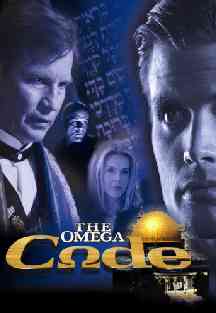
What Lisa Marie Watched Last Night #91: The Omega Code (dir by Robert Marcarelli)


Early this morning, after waking up and walking into a wall, I watched The Omega Code, an evangelically-themed film from 1999.

Why Was I Watching It?

Earlier this year, my friend Evelyn and I watched a film called Megiddo: The Omega Code 2.  We were both oddly amused by Megiddo so, when I saw that the first Omega Code film was going to be on one of the religious stations, I set the DVR to record it and made plans to watch it at some point in the future.

Last night, I happened to wake up around 3 in the morning.  I got out of bed, I took a few steps forward, and I walked straight into a wall.  After that, I turned on the lights and I was relieved to discover that my nose had protected the rest of my face from the wall.

So there I was at 3 in the morning with my red nose and my bruised pride and, despite my best efforts, I couldn’t get back to sleep.  What’s a girl to do, right?  So, I decided that since I was awake anyway, I would go ahead and watch The Omega Code.

What Was It About?

The world is ending.  People are starving.  Nations are going to war.  Fortunately, the President of the European Union, Stone Alexander (Michael York) has a plan to save us all.  Unfortunately, Stone Alexander also happens to be the Antichrist.

In order to get all of humanity to accept his plan, Stone recruits the world’s most famous motivational speaker (Casper Van Dien).  However, Van Dien find out about the Omega Code, a secret code that uses the bible to predict the future.  And, as Van Dien discovers, the future looks positively apocalyptic….

What Worked?

When I reviewed Megiddo: Omega Code 2, I mentioned that if you’ve got a naturally villainous name like Stone Alexander, you might as well be evil.  The same remains true of The Omega Code.  Stone Alexander is so evil and Michael York is obviously having so much fun playing him that the fun is almost contagious.

Michael Ironside plays Dominic, Stone Alexander’s henchman.  In a rather offensive moment, Alexander reveals that Dominic is both gay and a former priest and the implication (which was probably popular with the film’s target audience) is that Dominic’s villainy is the direct result of both his Catholicism and his sexuality.  But, regardless, Ironside gives a memorably menacing performance.

It’s interesting how the villains in religious films are often more compelling than the heroes…

What Did Not Work?

Though I didn’t realize it at the time, I was spoiled by getting the chance to see the 2nd Omega Code before I saw the first one.  Omega Code 2 was the epitome of a so-bad-that-it’s-good type of film but the first Omega Code was just bad.  Not even the combined villainy of Michaels York and Ironside could make The Omega Code entertaining.

(Add to that, Megiddo: Omega Code 2 featured cameos from both Franco Nero and Udo Kier, while The Omega Code featured … well, no one.)

No review of The Omega Code would be complete without mentioning that, in the lead role, Casper Van Dien gives perhaps one of the worst performances ever captured on film.  It’s oddly fascinating to watch and try to figure out how anybody could give such an incompetent performance.

As I watched the film, one question kept nagging at me.   The Omega Code makes the argument that biblical prophecy should be taken literally.  Therefore, if the bible is itself a literal document that tells you everything that you need to know  than why hide a secret code between the lines?  And, if you’re going to go through all the trouble to come up with a secret code, why use that code to then hide cryptic phrases that could literally be translated to mean anything?  It just seems a bit overly complicated.

(That, incidentally, is the same reason why I don’t have much use for anything that Dan Brown has ever written.)

“Oh my God!  Just like me!” Moments

None.  Seriously, there was not a single moment in this film to which I could relate.  Some of that may be because this film was obviously made to appeal to an evangelical audience, as opposed to a free-thinking fallen Catholic like me.

Then again, it could also be that The Omega Code just wasn’t a very good movie.

Lessons Learned

I really didn’t learn anything.  Sorry, not sorry.
omegacode

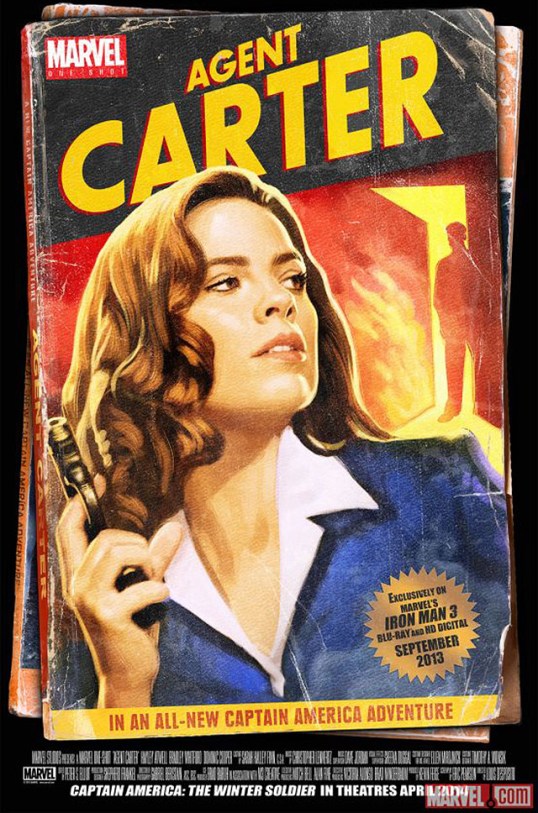
Review: Marvel One-Shot “Agent Carter”


AgentCarterEver since Thor was released on video (DVD/Blu-Ray) the people over at Marvel Studios have added as a special bonus to the video’s extras a small short film they’ve dubbed “Marvel On-Shot”. So far, they’ve either been about the adventures of fan-favorite SHIELD agent Phil Coulson or a brief look at a post-Avengers New York. The short films were cute, but nothing to really write home about.

With the release of Iron Man 3 on DVD and Blu-Ray we get a new Marvel One-Shot and it looks like the creative minds at Marvel Studios have decided to work a tad harder on making this new short film much better. It’s a flashback moment to one Agent Peggy Carter who is still grieving a year after Captain America (aka Steve Rogers) supposedly died trying to save New York from a HYDRA bomber full of tesseract-fueled bombs.

We see how she’s been relegated to doing paper work and kept from doing the field work she’s more adept at. This one-shot film actually shows in it’s short running time how even someone as skilled and heroic as Peggy Carter must still navigate and deal with a male-chauvinistic society that dismisses whatever accomplishments she’s earned in the past and seen more as a sort of “affirmative action” hire.

The film doesn’t try to force-feed this theme, but instead tries (and does so successfully) to blow-up the damsel-in-distress stereotype by showing Agent Carter at her best. And what she does best is doing the sort of field work that earned her not just the respect of the soldiers she worked with during WWII in Europe, but those of Captain America himself.

“Agent Carter” stars the original Peggy Carter in the form of British actress Hayley Atwell and she does a fine job of helping continue her character’s growth. She continues to show that she’s just as useful and skilled as Captain America which she showed in the film of the same name. In this one-shot we’re reminded of it and it also does an interesting thing in making it plausible to create a spin-off around her character.

Marvel has intimated that it’s something they’d be interested in doing and if the quality of this one-shot is anything to go by then a series (tv or web-based) starring Ms. Atwell as Agent Carter would be well-received by fans everywhere. This short film also showed that Marvel Studios has a new secret weapon to keep DC at bay. This was the first one-shot that truly belonged as a prologue to a feature-length Marvel film on the big-screen. Here’s to hoping that attaching future one-shots to full-length features not on video but in the theaters becomes an idea that Marvel Studios allow to happen.

Guilty Pleasure No. 13: Lambada (dir by Joel Silberg)


Last year, I was doing a search for dance scenes on YouTube and I came across a handful of scenes from a film called Lambada.  The scenes all had an undeniably cheap look to them and featured a rather stiff dancer who was wearing one dangling earring.  The scenes were so memorably bad that I promised myself that, if I ever got the chance, I would watch this Lambada.

Well, I got that chance last night when Lambada turned up on NUVOtv.  I forced my BFF Evelyn to watch the movie with me because I thought I might want to use the movie for one of my What Evelyn and Lisa Watched Last Night reviews.  However, as we watched Lambada, I realized that the only way to review this movie was to consider it as a guilty pleasure.

First released way back in 1990, Lambada tells the story of Mr. Laird (J. Eddie Peck), an idealistic math teacher in Beverly Hills by day and a sexy dancer at night.  Did I mention that when Mr. Laird dances, he calls himself Blade?  Because he so does!

However, Blade isn’t just dancing for fun or to deal with what appears to be a split personality.  Instead, he uses dance skills to impress the poor kids at the clubs so that he can then lure them into a backroom where he helps them prepare to take the GED.

He’s a dancer with a conscience and who doesn’t love that, right?

However, eventually Mr. Laird is spotted dancing by Sandy (Melora Hardin, a decade and a half before playing Jan on The Office), one of his students from Beverly Hills.  When he doesn’t respond to her crush, she reveals his secret and — for reasons that are never quite clear — this puts his job in jeopardy.

Why did Lambada turn out to be such a guilty pleasure?

Just consider the following:

1) Cast in the key role of “Blade” Laird, J. Eddie Peck looks good but gives a performance that almost epitomizes the concept of anti-charisma.  When he’s teaching in Beverly Hills, he wears sexy glasses.  When he’s dancing in the barrio, he loses the glasses and instead wears one dangling earring.  When a female student in Beverly Hills hits on him, he awkwardly smiles.  When he dances, he moves so stiffly that he resembles a mannequin on a treadmill.  That’s about the extent of Peck’s performance.

2) Melora Hardin, on the other hand, is completely natural and likable in the role of Sandy but, even though this film was made 16 years before the premiere of the Office, Hardin has already picked up a lot of the techniques that she would use to make Jan Levinson-Gould such a memorable character.  Every time that Sandy smiles nervously or looks annoyed by another character, it’s impossible not to be reminded of Jan struggling to manage Michael Scott.    As Nathan Rabin pointed out in his review of this film over at the A.V. Club, Lambada really does feel like Jan Levinson: The Early Years.

3) If Lambada was made today, it would be  called Twerking and, while watching, it was hard not to imagine Melora Hardin chasing J. Eddie Peck with a big foam finger.

4) An aggressively forgettable song called Set The Night On Fire is played about a hundred times over the course of the film.  The song is so generic and forced, and everyone in the film has to pretend to be so in love with it, that it becomes  oddly fascinating.

5) The club that Blade dances at has an upside down police car hanging from the ceiling.  The club, itself, gives off a definite human trafficking vibe but that police car is pretty neat.

6) One of Mr. Laird’s Beverly Hills students is named Egghead.  Naturally, he’s the smartest student and he’s obsessed with computers.  Evelyn and I both found ourselves wondering if Egghead was just a nickname or if his parents actually named him that in order to force him to grow up to be intelligent.  (Even Mr. Laird calls him Egghead, which — if that’s not the student’s name — seems a bit unprofessional for a teacher.)  It may not sound like much but it provided us with hours of amusement.

7) There’s a scene where Egghead uses his computer to inspire an entire classroom to spontaneously start dancing.  What makes this scene especially memorable is that the computer dances along with them.

8) Whenever Blade is teaching his GED class, the students respond to almost everything he says by cheering.  If nothing else, I’m sure many teachers have fantasized about being as irrationally loved by their students as Blade.

9) Eventually, Blade’s GED students compete with the Beverly Hills students.  No, it’s not a dance-off.  It’s a math-off!  That’s right — they’re competing to see who can correctly answer the most math questions.  And, believe it or not, the future of Blade’s career depends on whether or not his GED students can win.  Apparently, this is how the California educational system worked back in 1990.

10) Finally, the ultimate reason that Lambada is a guilty pleasure is because — regardless of how silly and ludicrous the film may seem to us today — it was actually produced and released into theaters.  That means that, somewhere out there, there are people who actually paid money to see this movie.  They may not admit it but they’re out there.

They’re out there.

Blade

Guilty Pleasure No. 12: Pandorum (dir. Christian Alvart)


pandorum_posterSometimes a really bad film just does enough to push my buttons to actually make me like it. One such film was 2009’s scifi=thriller Pandorum.

The film was one of those that had some hype behind it prior to the film’s release. It had a nice marketing angle which included some very disturbing biomechanical imagery that harkened back to classic H.R. Giger artwork from both Alien and Dune. The film even had an interesting premise which was about a mental affliction caused by long exposure to space travel called “Pandorum”.

When the film finally came out to say that it bombed would be quite an understatement. While the ideas behind the film were interesting enough the overall execution of said ideas were haphazard at best and unimaginative at it’s worst. There’s nothing worst than a B-movie trying to stand out from the dregs and failing because it’s dull and boring. Yet, despite all that I’ve been fascinated by Pandorum ever since I’ve caught it on video.

German director Christian Alvart might be lacking some style in his direction of the film, but the cast itself manages to work their damnedest to make the film work. Ben Foster does his usual twitching performance where we don’t know if he’s about to go psycho on everyone around him or just curl up in the corner and start sobbing like a newborn. Dennis Quaid chews the scenery so much in every scene he’s in that his work in the film almost comes off as performance art.

Even the idea that people who were gentically-enhanced to adapt and evolve to their surroundings was a new one. The film even goes further by making the foundation of rapid evolution come from the ship itself. All the cannibalism involved just added that grindhouse touch to the proceedings.

The one thing that really brings me back to watching this film as one of my many guilty pleasure’s was this was the first film that introduced the world to Antje Traue. She’s better known as one of the few good things to come out of Man of Steel. Even in this first feature film for Antje Traue we already see examples of how much a badass she can be. It’s a shame that the film around her wasn’t better.

Pandorum never improves with each repeat viewing, but it doesn’t get worst either. It just straddles that fine line where one or two things changed for the better would’ve made it a good film. But for the life of me I have no idea why I like it and continue to watch it. Sometimes even bad films will push enough of the requisite buttons for people to like it and this film certainly pushed the right ones from me.

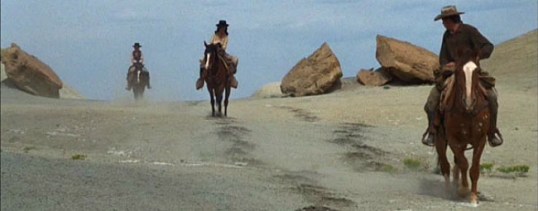
Film Review: The Shooting (dir by Monte Hellman)


I have to admit that I’m not a huge Western fan.  In fact, I can probably count the number of westerns that I’ve actually enjoyed on one hand.  However, at the same time, those westerns that I did enjoy also happen to be some of my favorite films of all time.  When done poorly, a western can be nearly unwatchable.  When done right, however, nothing beats a good western.

Case in point: 1966’s The Shooting.

The Shooting tells the story of Willett Gashade (played by Warren Oates), a former bounty hunter who now makes his living a miner.  At the start of the film, he returns to his camp after being gone for several days.  At the camp, he discovers one man dead, one man missing, and one sole survivor, the good-natured by simple-minded Coley (Will Hutchins).  The panicky Coley explains that the camp was attacked by an unseen gunman and says that it was because the missing man had apparently ridden down “a man and a little person” in a nearby town.  How any of this relates to the rest of the film is open to interpretation.

For that matter, the entire film is open to interpretation.  That’s one reason why I love it.

The next day, an unnamed, black-clad woman (Millie Perkins) appears at the camp.  She hires Gashade and Coley to lead her to a town that lies some distance away, on the other side of an inhospitable desert.  Gashade is suspicious of the haughty woman but the far more trusting Coley takes a liking to her immediately.

As Gashade and Coley lead the Woman across the desert, there are hints both obvious and subtle that all is not as it seems.  The Woman, at one point, demands to be led in the wrong direction.  At another point, the woman suddenly shoots and kills her horse.  Eventually, the three of them are joined by Billy Spears (played by a young but already sardonic Jack Nicholson), a well-dressed gunman whose sinister smile does little to hide an obvious sadistic streak and who takes a cruel enjoyment out of taunting and bullying Coley.  It all leads to a shockingly violent and deliberately enigmatic conclusion that raises more questions than it answers.

As directed by Monte Hellman (one of the best directors of the 60s and 70s), the film is less concerned with conforming to the rigid expectations of the western genre and, instead, uses the genre as a way to explore the American culture of violence.  With its cynical dialogue and its stark imagery of a harsh journey through a seemingly endless desert, it’s little surprise that The Shooting is considered to be an existential western.

Fortunately, The Shooting contains a quartet of fine performances that hold the viewer’s interest, even when the story runs the risk of becoming incoherent.  Millie Perkins, who made her film debut playing the title role in 1959’s The Diary of Anne Frank, brings an air of genuine menace to the role of the Woman while Will Hutchins provides the movie with a much-needed heart.  The main appeal of the film, of course, is to see two iconic actors performing opposite each other and neither Warren Oates nor Jack Nicholson disappoints.  Of the two, Nicholson (who co-produced the film with Hellman) has the showier role and he is obviously having a lot of fun playing such an unrepentant villain.  Meanwhile, Warren Oates comes across like a hard-boiled film noir hero who has somehow found himself trapped in a western.

Needless to say, with its deliberately obscure storyline and its refusal to provide a traditional conclusion, The Shooting is not a movie for everyone.  However, for those willing to take a chance, The Shooting can be a very rewarding film.

CA-The-Shooting

In Honor of Alice Guy Blaché: Fallen Leaves (dir by Alice Guy-Blaché)


Alice Guy Blache

When we talk about the pioneers of silent film, we usually end up talking about men like D.W. Griffith, Rex Ingram, Fritz Lang, Cecil B. DeMille, Charles Chaplin, and William Desmond Taylor.  And it is true that these men were essential to creating the language through which future filmmakers would tell stories of their own.

However, for every important silent filmmaker who continues to be celebrated, there are hundreds of just as important directors who are no longer remembered.  When you combine the tendency of the public to automatically dismiss any film made before the advent of sound with the fact that many of the best silent films are now lost films, it’s both understandable and unfortunate that several pioneering directors have been forgotten.

Alice Guy-Blaché may be a forgotten director but, in her way, she is just as important to the development of film as Griffith and DeMille.  The French-born Alice Guy directed her first film in 1896, when she was only 23 years old.  She is considered, by most film historians, to be the first female director and she was also one of the first directors to experiment with ways to use film to tell a narrative story.  (Narrative is something that we now take for granted but, when the movies were still in their infancy as an art form, the idea of using the techniques of filmmaking to tell a story was truly revolutionary.)

Alice Guy married Herbert Blaché in 1907 and moved with him to the United States.  It was here that she made the majority of her films.  She eventually founded the New York-based Solax Company, which was the largest film studio in pre-Hollywood America.  As of this writing, she remains the first and only woman to have owned her own film studio.

Below, you’ll find Alice Guy Blaché’s 1912 film, Fallen Leaves.  With a running time of 11 minutes, Fallen Leaves tells the story of a young woman stricken with tuberculosis and her younger sister’s desperate attempts to save her life.  This is one of my favorite silent films because it is just such an incredibly emotional and sweet-natured story.  Tears come to my eyes whenever I see the little sister starting to gather up her leaves.  So, put on some properly dramatic music and enjoy Fallen Leaves.

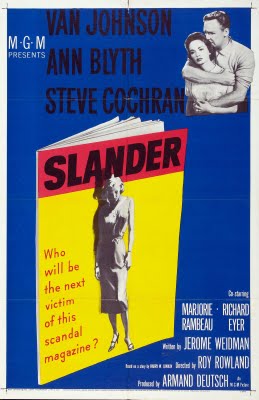
Film Review: Slander (dir by Roy Rowland)


slander poster

Slander, much like A Cry In The Night, is a B-movie from the 1950s that I recently discovered via Turner Classic Movies.  It’s appropriate that both of these relatively obscure films recently aired on TCM because both Slander and A Cry In The Night serve as interesting time capsules of the decade in which they were made.

To truly appreciate Slander, you have to know that, during the 1950s, Hollywood was terrified of magazines with names like Confidential, Exposed, and Private Affairs.  These were the magazines that claimed to tell the “sordid” truth about Hollywood.  In the 1950s, image was everything and one well-placed story that suggested that an actor or actress was a drug user, a former criminal, a communist, or — gasp! — gay, could end a career.  In the 50s, Hollywood filmmakers viewed the tabloids with the same loathing that they currently feel towards the paparazzi.  Slander was Hollywood’s attempt to expose the tabloids.  Perhaps that’s why it’s appropriate that Slander, in many ways, feels like a 50s version of Paparazzi.

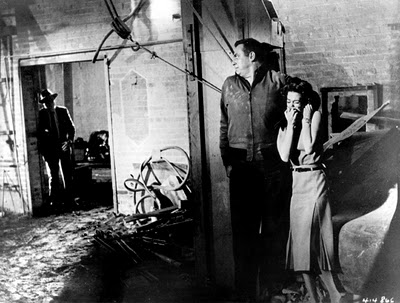
Slander opens with tabloid magazine editor H.R. Manley (Steve Cochran) looking over him empire of scandal and searching for someone to destroy.  From the minute that we see Steve Cochran with his slicked back hair and hear him delivering his lines through permanently clenched teeth, we know that H.R. Manley is a bad guy.  Indeed, Cochran was best known for playing gangsters and that’s how he plays H.R. Manley.  It’s not subtle but it’s definitely entertaining.

Manley wants to destroy Mary Sawyer, an actress who is never seen but who we are assured is America’s sweetheart (or, as Manley puts it, “Everyone thinks she’s practically a nun, right?”) .  Manley becomes convinced that children’s entertainer Scott Martin (Van Johnson) has some damaging information on Mary.  When Scott refuses to betray his friend, Manley sets out to destroy Scott by revealing that, before he become America’s most beloved puppeteer, Scott served time in prison on an armed robbery conviction.

(To understand just how ludicrous this revelation is, you have to understand that Scott is played by Van Johnson who was pretty much the epitome of the fresh-faced, likeable, All-American optimist in the 50s.)

Despite the pleas of his wife (played by Ann Blyth), Scott refuses to give into blackmail.  Soon, Scott Martin is on the cover of the Manley’s magazine.  In the great tradition of the 50s social problem film, this leads to the most melodramatic conclusion possible.

Watch, in amazement, as Scott’s son reacts to the scandal of his father being a former criminal by running out in the middle of the street and getting hit by a car.

Try to look away as Manley’s drunken mother (played by Marjorie Rambeau) considers killing her own son in order to end the evil of the tabloid press.

Listen, in shock and regret, as Scott goes on television and gives an overwrought speech in which he tells us that if we’ve ever read a tabloid magazine then we are responsible for his son’s death.

Or, as one extra says when he spots Scott and his wife walking down the street, “Maybe people will stop reading those tabloids…”

It’s a bit too overwrought for its own good but I have to say, as someone who looks forward to going to the doctor specifically so she can read the copies of US Weekly that he keeps in the waiting room, I enjoyed Slander.  The film is melodramatic and totally over-the-top and, as a result, it’s also a lot of fun.  If for no other reason, the film is worth watching just for the chance to enjoy Steve Cochran’s incredibly sleazy portrayal of the apparently soulless tabloid editor.

Slander shows up on TCM occasionally but it’s also available for viewing on YouTube.  Or, if you’ve got 81 minutes to kill, you can watch it below.

Dying Is Easy, Comedy is Hard: Freeloaders (dir by Dan Rosen)


Supposedly, the great comedic character actor Edmund Gwenn once said, “Dying is easy.  Comedy is hard.”

I have to agree because I’ve seen a lot of comedies in 2013.  A few of them — like This Is The End and The World’s End — have worked.  However, the majority of them have not only been bad but they’ve been so bad that they’ve invited audiences to wonder if comedy is a dying art form.  For every genuinely clever comedy, it seems like we’ve had to sit through a dozen Movie 43s.  These are movies where genuinely funny people get together and proceed to prove that they can be just as unfunny as the obnoxious cousin that everyone avoids at the family reunion.

Case in point: Freeloaders.

Even Movie 43 made me laugh once.  That’s one laugh more than I got out of Freeloaders.  Freeloaders is quite possibly the least funny comedy that I’ve ever seen.  Freeloaders almost feels like a social experiment, a test to see what would happen if an audience, expecting to see a silly and crude comedy, instead found themselves trapped in a laugh-repellent environment for 80 minutes.

Freeloaders tells the story of a group of stereotypes who have spent the last six years living in a mansion owned by “rock star” Adam Duritz.  It turns out that one of them is a childhood friend of Duritz’s and, since Duritz has been out touring for the past decade, he’s allowed his friends to occupy his home rent-free.  However, Duritz is getting married and planning on moving to New York City and, as a result, he’s selling his mansion.  The freeloaders are told that they have a week to get out of the mansion.  Well, since everyone in this film is basically a total and complete dumbass, nobody can figure out how to rent an apartment.  So, instead, they come up with some painfully wacky schemes to raise the money to buy the mansion themselves.  Standing in their way is Adam’s real estate agent who …. well, it’s never really all that clear why she’s standing in their way.  Presumably, it’s because there wouldn’t be a film unless she was standing in their way and then we would have all missed out on the chance to watch Freeloaders.

Why doesn’t Freeloaders work?

Well, let’s start by considering the fact that Adam Duritz plays himself.  I actually had to go on Wikipedia to remind myself who Adam Duritz is and I discovered that he’ was apparently a big deal back in the 90s and that he’s responsible for that painfully annoying cover of Big Yellow Taxi that was playing everywhere back in the summer of 2003.   Unfortunately, as both an actor and as a “fictional” character, Adam Duritz is so bland that his character serves mostly as a distraction.  The use of a real celebrity (if Adam Duritz can legitimately be called a celebrity) should have provided the filmmakers with a lot of comedic opportunity but that opportunity is pretty much wasted because Freeloaders seems to be obsessed with letting us know that Adam Duritz is a really great guy.

(That might be because Adam Duritz was one of the film’s producers.)

While I doubt that Adam Duritz has ever been a funny guy, Freeloaders is filled with other actors who have proven themselves to be funny in the past.  I, for one, was excited to see the name Nat Faxon in the opening credits because, while he might not be a household name, anyone who has ever seen Nat Faxon in a movie knows just how funny he can be.  However, both Mr. Faxon and the rest of cast struggle with the fact that they’re playing a collection of one-dimensional stereotypes.  Everyone has one overly defining, predictable trait to help us keep them straight.  There’s the nice guy, the stoner, the womanizer, the nice girl, the hoodlum, and the girl who will inspire some in the audience to say, “Is that Olivia Munn?,” largely because she is Olivia Munn.  Since they’re never allowed to become individual characters, all of their attempts at humor fall painfully flat.  It doesn’t help that director Dan Rosen directs without any hint of timing or originality.

Freeloaders was produced by Broken Lizard, the comedy troupe that’s developed a large cult following as the result of films like Super Troopers and Club Dread.  However, the members of Broken Lizard did not write or direct the film and they only appear in a rather brief cameo where they parody Boogie Nights.

The Boogie Nights parody is actually fairly clever but it also highlights this film’s biggest problem.  Freeloaders was originally filmed in 2009 and then sat on the shelf until it finally got a very limited theatrical release earlier this year.  (Perhaps that’s why one of the film’s characters worries about getting sent to Iraq if he joins the army.)  However, the script feels like it was written back in the 90s.  Everything from the premise of slacker stoners being forced to raise money to Adam Duritz being described as a world-famous star to Broken Lizard parodying a film that came out in 1997 serves to make this film feel as if it was made about 14 years too late.

I love a good comedy but, by that same regard, there’s nothing a i hate more than a really bad comedy.  However, as a film lover, I will always be willing to take chance on comedy.  Comedy may be hard but the rewards are great.

Sometimes, you end up with something really special.

Sometimes, you just end up with Freeloaders.

freeloaders

Film Review: A Cry In The Night (dir by Frank Tuttle)


cryinthenight01f

Thanks to TCM, I’ve gotten the chance to discover a lot of old films that I, otherwise, would have probably never even heard about.  One of those films is A Cry In The Night, a low-budget, 1956 crime story that I randomly came across last month.

Harold Loftus (Raymond Burr) has issues.  He lives in a shack, he’s totally dominated by his overbearing mother, and he spend most of his time secretly peeping at couples who are parked at the local lover’s lane.  When he comes across Liz (Natalie Wood) and her boyfriend Owen (RIchard Anderson), he overpowers Owen and kidnaps Liz.  Now, Owen must work with Liz’s overprotective policeman father, Dan (Edmond O’Brien), to track down Harold and Liz.  Making things difficult is the fact that Dan blames Owen for the kidnapping and simply cannot bring himself to accept that his daughter was actually “one of those girls” who spent her Saturday night sitting in a car and sharing chaste kisses with her boyfriend.

(Seriously, the film made it sound like this was the worst possible thing that a girl could do with her time.  I’m not sure if Dan was supposed to come across like a reactionary or if this was just a case of the film having been made in 1956.  Personally, if that’s what the 50s were like, I’m glad I wasn’t born until the 80s.)

As directed by Frank Tuttle, A Cry In The Night tells its story in a stark, no-nonsense, semi-documentary manner.  (There’s even narration at the beginning and end of the film.)  O’Brien bellows his way through the role and Anderson’s colorless performance does little to make Owen seem like any less of a wimp.  However, Raymond Burr makes for a disturbingly plausible pervert and Natalie Wood is well-cast as Liz.  The film came out a year after Rebel Without A Cause and, watching her performance in A Cry In the Night, you can tell why Natalie Wood was Hollywood’s favorite vulnerable teenager.

I have to admit that I love films like A Cry In The Night, not so much because they’re great films (and, while always watchable, A Cry In The Night is certainly not a great film), but because they’re totally a product of their time.  As opposed to the big budget extravaganzas that were churned out by the Hollywood studio system during the 50s and 60s, low-budget B-movies like A Cry In The Night were designed to exploit contemporary headlines and contemporary concerns and, therefore, provide a lot of insight into what was going on with the American psyche at the time.

A Cry In The Night combines several themes that ran through the majority of the films of the period.  In the role of Harold, Raymond Burr is the epitome of the 1950s weirdo.  As opposed to the normal, all-American boys who make out with their girls in cars, Harold can only bring himself to lurk about and attempt to catch a peek of what normal society does on Saturday night.  When he kidnaps Liz, he’s not only threatening Natalie Wood, he is by extension attacking America itself.  Meanwhile, Liz’s boyfriend comes across like the type of intellectual liberal who probably cast two ballots for Adlai Stevenson while her father is definitely an Eisenhower man.   Boyfriend and father do not get along at first but what’s important is that they set aside their difference so that they can vanquish the other.  By the end of the film, the father is willing to invite the boyfriend to dinner and the boyfriend has learned that sometimes, you have to be willing to fight.

For those of you who keep crying about how the solution for all of America’s problems lie in bipartisan compromise, A Cry In The Night is the film for you!

For the rest of us, A Cry In The Night is an occasionally entertaining time capsule.

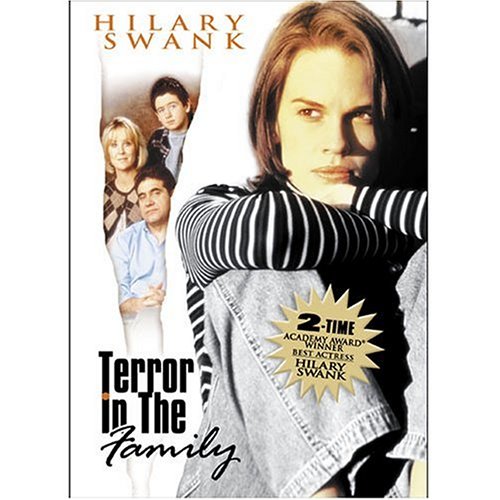
Guilty Pleasure No. 11: Terror In The Family (dir by Gregory Goodell)


51TW3J9B92L

For my latest guilty pleasure, I want to take a look at Terror In The Family, a well-intentioned, out-of-control youth film from 1996.

Certain moments of Terror in the Family felt painfully familiar because, much like the film’s main character, Deena Marten (played by — yes, it’s true — Hilary Swank), I went through a period, when I was teenage, where I was seriously out-of-control.  Much like Deena, I would sneak out of the house, I would hook up with guys who were obvious trouble, I had absolutely no impulse control, and I said and did a lot of hurtful and self-destructive things that I still would do anything to take back.  I was 16 while, in the movie, Deena is portrayed as being 15.  The main difference between me and Deena is that I was out-of-control because I was having an undiagnosed manic episode.  Deena, however, is out-of-control because she comes from one of the most dysfunctional family in the history of dysfunctional families.

And that’s why, despite the fact that I can relate to the painful subject matter, Terror In The Family amuses me more than it disturbs me.  Seriously, anything that can be wrong with a family is wrong with this family.

Consider this:

Father Todd Marten (Dan Lauria) spends all of his time down in the basement, making wooden bowls and then taking pictures of them.  Usually, he avoids his family but when he’s finally forced to confront Deena, she ends up smashing his fingers with her bedroom door.  “HOW CAN I WORK NOW!?” he bellows while holding up his bandaged hand.

Mother Cynthia Marten (Joanna Kerns) is an alcoholic who spends her spare time standing in front of a mirror and rehearsing being a disciplinarian.  When Deena flees the house, Cynthia attempts to win her back by bringing her a huge, home-made pizza.  “I made your favorite!” Cynthia drunkenly cries before accidentally dropping the pizza on the floor.

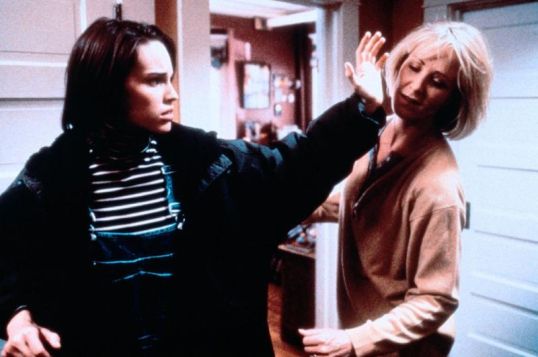
Grandmother Ivy (Nan Martin) is, without a doubt, one of the most evil and unpleasant characters that I have ever seen in a movie.  When Cynthia tries to tell her about the difficulties of raising Deena, Ivy responds by literally punching her in the face.

Deena’s younger brother, Adam (Adam Hendershott), is a talented pianist who deals with his family by playing video games and literally sleeping with a bottle of vodka in his bed.

Finally, there’s Aunt Judith (Kathleen Wilhoite).  Judith seems to be the only stable person in Deena’s family.  That’s mostly because Judith left home when she was young and was apparently some sort of groupie for several years.

With this family, is it any wonder that Deena is spending all of her time with Garrett (Andy Kavovit), her 17 year-old boyfriend who, along with introducing her to drugs and sex, also speaks wistfully of killing his mother and her boyfriend?  Garrett, not surprisingly, has a band and Deena soon finds herself staying out past curfew so she can perform with him at various seedy clubs.  The film blames a lot of Deena’s bad behavior on Garrett but you know what?  Back when I was 15, I would have been totally in love with Garrett too.

Seriously, Deena, you go girl!

swank-terror-in-the-family

Anyway, with all of this going on, can we really be shocked that Deena eventually ends up swinging a landline phone at her parents and demanding that they stay away?

Terror In The Family shows up on Lifetime occasionally and recently, for reasons that I don’t quite understand, it even turned up on Showtime, playing in between showings of Dexter and The Seduction of Misty Mundae.  It’s worth watching because it really is the perfect marriage of good intentions, over-the-top melodrama, and intense cluelessness.  For the most part, future Oscar winner Hilary Swank gives a good performance as Deena but the best parts of the films are the parts where she joins the rest of the cast in going totally and completely overboard.

The mix of melodrama and hindsight combine to make Terror In The Family into a true guilty pleasure.