Film Review: Fruitvale Station (dir by Ryan Coogler)


On January 1st, 2009, a young man named Oscar Grant was executed in Oakland, California.  Grant was returning home from celebrating the New Year’s in San Francisco when he and several other young black man were pulled off a train by the Bay Area Rapid Transit Police.  According to the police, Grant had been involved in a fight on the train.  In a moment that was recorded by several cell phones (and later broadcast across the world), Grant was shot in the back by a BART policeman.  According to the police, Grant had been resisting arrest and his executioner had meant to use his taser but had grabbed his gun by mistake.

The death of Oscar Grant made the news even down here in Texas and I can still remember discussing it with my friends.  As a bunch of good, white liberals (and yes, believe it or not, I was once a little bit liberal, though even back then I was, at heart, more of a civil libertarian than anything else), we were all properly outraged by what happened.  At one point, I declared that this proved that police hide behind the power of their tasers.  We all agreed that it was a terrible thing that had happened and that the cop involved needed to be held responsible.

Only recently did I realize that, even as fashionably outraged as me and my friend were and even though we did feel that this was a classic case of police overreactions, we also automatically assumed that the cop was telling the truth when he said that he meant to grab for his taser.  For all of our righteous indignation, we — as a bunch of white people who had spent most of our time living in white neighborhoods and white towns — still had a hard time accepting the idea that a white police officer had intentionally executed a black man.  As outraged as we were, we were assumed that we were angry about an aberration.  As such, we assumed that the shooter would be held responsible and we went on with our comfortably sheltered lives.  Needless to say, we were incredibly naive.  While the death of Oscar Grant made national news, it made far less news when the man who shot him was eventually sentenced to only two years in prison.  (He was paroled after 8 months.)

I’ve been thinking about Oscar Grant (and the way that my friends and I initially reacted to the news reports of his death) ever since I saw Fruitvale Station, a devastating independent film that also marks the directorial debut of Ryan Coogler.

Starting in the early morning hours and ending in the first hours of 2009, Fruitvale Station follows Oscar Grant (played, in an award-worthy performance by Michael B. Jordan) as he lives the final day of his life.  In between doing such every day things as buying a birthday card for his mother (played, in a luminous performance, by the great Octavia Spencer) and picking up his daughter from daycare, Oscar worries about how he’s going to pay his rent and struggles against the temptation to return to his former life of dealing drugs.

While we watch the film knowing what Oscar doesn’t — that this is the last day of his life — the film itself manages to be a lot more than just a recreation of a tragic event.  There’s a vibrancy and sense of hope to the scenes where Oscar drives through Oakland or hangs out with his family.  That vibrancy makes the film’s inevitable conclusion all the more powerful and devastating.

As for the actual shooting, Fruitvale Station leaves it to the audience to decide whether Oscar was intentionally executed or if he was shot by a cop who thought he was holding a taser.  As the cop who shot Oscar, Chad Michael Murray is only on-screen for a split second.  As the other cop on the scene, Kevin Durand (who played Martin Keamy on Lost) shouts and bullies as only Kevin Durand can do.  If the film leaves it ambiguous about whether or not Oscar was intentionally shot, it’s not ambiguous about the fact that Oscar was killed because, as a black man, he was automatically viewed as being a potential threat by the white police officers.  Whether the intention was to tase him or to shoot him, the ultimate goal was to reassert the authority of the police.

As Fruitvale Station makes clear, the shooting was both an individual tragedy and a piece of the larger tragedy that’s still being played out across this country.   The film’s triumph is that it makes Oscar Grant into both a compelling individual and a powerful symbol of the struggle that many Americans face as they try to survive under a system that’s been designed to keep them down.

So, have you seen Fruitvale Station?  If you haven’t, you need to.  It’s one of the best films of 2013.

What Lisa and the Snarkalecs Watched Last #88: Ghost Shark (directed by Griff Furst)


Last night, before going on vacation, I watched the SyFy original movie, Ghost Shark.

Why Was I Watching It?

Every Saturday night, I watch and live tweet a SyFy movie with the Snarkalecs.  Last night, we watched Ghost Shark.  Seeing as Ghost Shark was going to be my last SyFy film to watch before going on vacation, I knew that both the film and the snarkiness would have to keep me satisfied for the next two weeks.  Fortunately, both Ghost Shark and the Snarkalecs came through brilliantly!

What Was It About?

One of my huge problems with Sharknado is that, despite the title, there really wasn’t much tornado action.  However, Ghost Shark lives up to its title.  It’s called Ghost Shark and, by God, that’s what it’s about!

In short, a shark is killed by a bunch of rednecks who look like they’ve wandered over from an unaired episode of Duck Dynasty.  However, the shark comes back and, as you might guess, it’s looking for vengeance.  As a ghost, the shark has the ability to manifest itself out of any body of water and soon, it’s popping up in toilets, swimming pools, sinks, water slides, and an open fire hydrant.  (As the film’s brilliant tagline put it — “If you get wet, you die.”  Seriously, I would be so dead.)  It’s up to Ava (Mackenzie Rosman) and the town drunk (Richard Moll) to figure out how to stop the Ghost Shark!

What Worked?

Even if I hadn’t known beforehand, I would have guessed that Griff Furst had directed Ghost Shark.  Of all the directors who regularly direct films for the SyFy network, Furst is one of the best.  Along with making good use of his trademark Louisiana locations, Furst also knows how to maintain the perfect balance of excitement and humor.

It should also be noted that Ghost Shark is one of the few films where you really can’t predict who is going to survive and who is going to end up as sharkbait.  One reason why the ghost shark is an effective monster is because he will literally eat anyone, even characters who — in other films — would automatically be spared of any danger.

On a personal note, I have to say that the Snarkalecs were on fire last night.  Kelly Thul, in particular, earned a spot in the hall of fame for commenting, about two characters who had just gotten the upper halves of their bodies chomped off by the ghost shark, “They’re waisted!”

What Did Not Work?

It all worked.  Seriously, this was the best SyFy film since End of the World.  And, in case you were curious, it’s a hundred times better than Sharknado.

“Oh my God!” Just Like Me Moments

At one point, one future victim said, “It’s too hot to be a virgin” and if I had a dollar for every time I’ve used those exact same words, I would be one rich redhead.

Also, I related to the scene where the sprinklers go off in the local museum and end up soaking every character there.  Museums always get me wet too.  What can I say?  I love history.

Lessons Learned

Sometimes, it’s better just to stay dry.

Film Review: You’re Next (dir by Adam Wingard)


If Luis Buñuel had ever made a slasher film, it would probably have been a lot like You’re Next.

You’re Next tells the story of the ill-fated Davison clan.  Paul (Rob Moran) has recently retired from his job as a defense contractor and now, he and his wife, Aubrey (Barbara Crampton) are looking forward to celebrating their anniversary at their isolated vacation home.  Soon after they arrive at the house, Aubrey is convinced that she can hear someone else in the house.  However, since the frail Aubrey is obviously emotionally unstable, Paul dismisses her concerns.

Over the course of the day, Paul and Aubrey’s children arrive at the house.  Though, in the best tradition of all troubled families, the Davisons attempt to maintain a facade of peace and harmony, it quickly becomes clear that each member of the family is dealing with his or her own issues and petty jealousies.

For instance, oldest son Drake (Joe Swanberg) obviously feels that he’s superior to his siblings.  His wife, Kelly (Margaret Laney), is just as obviously unhappy with their marriage.

Crispian (A.J. Bowen) is a neurotic academic who is struggling financially and is viewed as being a weakling by the rest of his family.  His girlfriend, Erin (Sharni Vinson) has a secret in her past that will become unexpectedly important as the day progresses.

Daughter Aimee (played by Amy Seimetz, who was so good earlier this year in Upstream Color) tries so hard to be cheerful that you know that she has to be secretly be on the verge of having a nervous breakdown.  Her boyfriend, Tariq (Ti West), is a struggling filmmaker who is scandalized to discover that Drake prefers to watch commercials as opposed to documentaries.

Finally, there’s the youngest son, Felix (Nicholas Tucci).  Felix appears to be the most well-adjusted of all of the Davison children but his quiet girlfriend Zee (Wendy Glenn) is a different story.

Once the family has gathered together for the anniversary dinner, the bickering begins.  What the family don’t realize is that a group of men (all of whom wear animal masks) have previously slaughtered the neighbors and have now surrounded the Davison house.  The bickering is interrupted by a brutal attack that leaves one dead, one seriously injured, and the rest of the family fighting for their lives.

You’re Next starts out as an effective but rather standard home invasion film (think of The Strangers or even Michael Haneke’s Funny Games) but the film features two twists which set it apart.

The first twist is that Erin turns out to be as effective and determined a killer as the men laying siege to the house.  I’ve sat through a lot of horror movies and I love movies where women get to kick ass and I can tell you, without fear of contradiction, that there’s probably no other horror heroine who kicks as much ass as Erin.  As played by Sharni Vinson, Erin is destined to become an iconic character in the history of horror.

youre-next-sharni-vinson

The other twist is one that I can’t tell you about because it’s this twist that literally turns the entire film upside down.  What I can tell you is that this twist forces you to reconsider everything that you’ve seen up until that point.  Most impressively, director Adam Wingard reveals this twist to us long before he reveals it to the film’s characters.  As such, just when the viewer is getting used to the idea of You’re Next being just another home invasion film, a whole new element of suspense is added to the story.

Some reviewers have referred to You’re Next as being a comedy.  I disagree, if just because the film’s violence is too brutal and the gore is too graphic for this film to be considered anything other than primarily a horror film.  That said, there is a strain of dark humor that runs through the film and occasionally provides a much needed relief from the nonstop tension onscreen.  A good deal of the film’s humor comes from just how incredibly screwed-up the Davison family is, even before they find themselves under attack.  This is a family of people who, even while they’re trying to plot their escape from the house, can not resist getting into argument about who can run the fastest.

Ultimately, You’re Next works as both a brutally effective horror film and as a satirical portrait of an All-American family that’s secretly so dysfunctional that — even if they weren’t being attacked by masked men with crossbows — they probably would have eventually ended up killing each other anyway.  It’s a genre film that manages to transcend the rules of genre even while embracing them.  In a year that, so far, has been dominated by surprisingly intelligent and effective horror films, You’re Next is one of the best.

youre-next-movie-image-05

An Appreciation of It


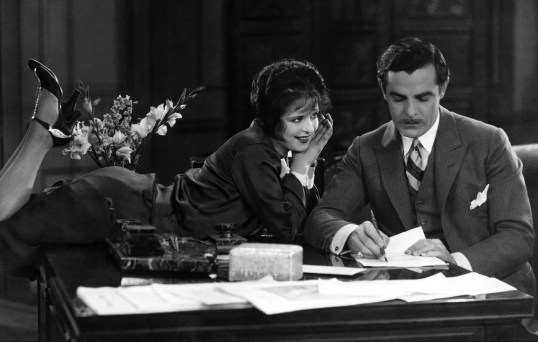
Annex - Bow, Clara (IT)_01

(Spoilers below)

If I could be any character from a silent film, I would want to be Betty Lou Spence, the heroine of the classic 1927 film, It.

As played by the beautiful Clara Bow, Betty has It.  What is It, you may ask?  That’s the question that this film sets out to answer.  The movie starts out with a title card that read, “That quality possessed by some which draws all others with its magnetic force. With ‘It’ you win all men if you are a woman and all women if you are a man. ‘It’ can be a quality of the mind as well as a physical attraction.”  Throughout the film, every man who sets his eyes on Betty automatically says that she has “it.”   Though the film never explicitly says so, it’s pretty obvious that “It” is a combination of sensuality, intelligence, and inner strength.

It is sex.

And yes, since she’s played by Clara Bow, Betty Lou Spencer definitely has ‘it’ and she knows what to do with it as well.

However, one thing that Betty doesn’t have is a lot of money.  Instead, she’s a proud and poor shopgirl who sets her sights on her wealthy and handsome employer, Cyrus Waltham (played by Antonio Moreno).  Realizing that the uptight Cyrus will never notice her while at work, Betty accepts a date with Cyrus’s irresponsible best friend Monty (William Austin).  Knowing that Cyrus and his girlfriend will also be there, Betty asks Monty to take her to a fancy restaurant.  While Monty orders their food, Betty stares shocked at the high prices on the menu.  Why just the appetizers cost $2.00!

Ah, 1927.

Eventually, Betty does manage to get Cyrus’s attention.  After spending a day slumming with her down on Coney Island, Cyrus attempts to kiss Betty.  Betty responds by slapping him and telling him, “So, you’re one of those minute men — the minute you meet a girl, you think you can kiss her!”

The next day, things get a bit more complicated when Betty discovers that two social workers have shown up at the apartment of her best friend, Molly (Priscilla Bonner).  Molly is a single mother and the social workers have shown up to take away her baby.  Betty boldly steps forward, claiming that she is the baby’s true mother and that, since she has a job, the social works have no reason to take away her baby.

One of the snooty social workers (who, needless to say, does not have it) stares down here nose at Betty and asks, “And where is your husband?”

Betty stares straight back at her and replies, “That’s none of your business.”

Seriously, nobody tells Betty Lou Spence what to do.

Since this movie was made in 1927, everyone is scandalized.  Cyrus, obviously miffed that he couldn’t even get a kiss from an unwed mother, dumps her.  Betty responds by quitting her job.  A title card informs us that Betty may have needed the money but her pride was far more important to her.  What makes this movie unique, especially when compared to even some contemporary films, is that Betty is not punished for putting her pride before money or romance.  Instead, the film celebrates her independence.

The rest of the film deals with her getting her own brand of vengeance on Cyrus.  In the end, Betty gets her man but she gets him on her own terms.  Again, take a minute to consider that this film, made nearly 90 years ago, not only features a liberated woman but celebrates her as well.

After this film, Clara Bow became known as the “It Girl,” and it’s easy to see why.  In the role of Betty Lou Spence, Bow epitomizes the perfect combination of outward sensuality and inward strength.  Whether she’s sarcastically telling off a rude customer, defending her best friend, or saving the life of her romantic rival, Clara Bow epitomizes both sex and independence.  In the end, she pursues her man not out of obligation but out of desire.  When she does find her happy ending, she finds it on her own terms.

Those of us in 2013 have a lot to learn from the It Girl of 1927.

Film Review: Lovelace (dir by Rob Epstein and Jeffrey Friedman)


About halfway through the new biopic Lovelace, there’s a scene where former porno actress Linda Lovelace (played by Amanda Seyfried) is hooked up to a lie detector.  The polygraph examiner explains that he’s going to ask Linda a few test questions to get a reading.

“Is your name Linda Lovelace?” he asks.

Visibly nervous, Linda replies, “Can you ask something simpler?”

It’s a great scene because it establishes the central mystery of both the film and the title character.

Just who exactly was Linda Lovelace?

A girl whose main talent was apparently giving head, Lovelace became a star in the 70s when she starred in Deep Throat, the first (and perhaps only) hardcore film to become a legitimate mainstream hit.  For a brief while, Lovelace was the face of the American sex industry.  However, her attempts to have a mainstream film career failed and Lovelace retreated into obscurity.

Several years later, she wrote a book called Ordeal.  In Ordeal, Lovelace claimed that she was forced, by her abusive husband, to perform in Deep Throat.  Whereas Lovelace, during her brief stardom, originally claimed to simply be a sexual adventurer who performed on camera because it was liberating, the post-stardom Lovelace presented herself as being a brainwashed victim.  Or, as Lovelace herself put it, “When you watch Deep Throat, you’re watching me getting raped.”  While several people disputed the authenticity of Ordeal, Lovelace herself passed a polygraph examination.  Lovelace then became an anti-pornography activist before, once again, descending into obscurity and eventually dying in an automotive accident in 2002.

Lovelace deals with the issue of figuring out just who Linda Lovelace was by basically telling her story twice.

During the first 45 minutes of the film, we see how young Linda Boreman first meets Chuck Traynor (Peter Sarsgaard).  Everything about Chuck — from his mustache to his perm to his flashy clothes — practically screams sleaze but, since he’s played by Peter Sarsgaard, he also has an undeniable charm.  (With this film and An Education, Sarsgaard has proven himself to be the definitive older man who your parents warned you about.)  Chuck and Linda eventually marry and, when they need money, Linda turns to “acting” in order to pay the bills.

Under the watchful eye of producers Bobby Cannavale and Chris Noth, director Hank Azaria, and co-star Adam Brody, Linda stars in Deep Throat and becomes the face of the sexual revolution.  While there are occasional hints that things might not be perfect (bruises are often visible on Linda’s arms and legs), Linda seems to truly love the spotlight.  Even Hugh Hefner (played by James Franco, who is way too hot to only have a cameo) says she’s going to be a huge star.

And then, rather abruptly, we jump forward six years.  Linda is now writing Ordeal and we once again see how she first married Chuck Traynor, starred in Deep Throat, and came to be a star..  However, we now see the story through her eyes.  We see that Chuck wasn’t just controlling but that he was also an abusive psychopath who would hold a gun to her head in order to get a performance out of her.  We see that, during the shooting of Deep Throat, she was regularly beaten by her husband.  We see Linda attempting to reconnect with her strict and tradition parents (played by Sharon Stone and Robert Patrick).  We see the ugliness that was hidden underneath the glamour.

Considering the subject matter and the talent involved, Lovelace should have been one of the most interesting films of 2013 but, unfortunately, the two separate halves of the film just don’t come together.  While the first half of the film does a good job of capturing the absurdity of sudden fame, the second half of the film falls apart.

Oddly enough, Chuck Traynor and Linda Lovelace only come across as real human beings during the superficial first half of the film.  During the second half of the film, both Chuck and Linda come across as one-dimensional ciphers.  Linda becomes such a total victim and Chuck becomes such a melodramatic villain that neither one of them is all that compelling as a character.  Instead of being disturbing and revealing, the second half of the film just feels like another generic film about the price of fame.

Most of what I know about Linda Lovelace and Chuck Traynor comes from two sources — the 2005 documentary Inside Deep Throat and Legs McNiel’s and Jennifer Osborne’s book The Other Hollywood.  In both the book and the documentary, Lovelace comes across as being a rather pathetic figure who was exploited by both the adult film industry and the anti-pornography activists who used her as a symbol.  Both the industry and the activists abandoned Linda once her novelty was gone.  Ironically, even though both the documentary and the book are rather critical of her, it is there that she comes across as a far more interesting, sympathetic, and ultimately tragic figure than she does in this biopic.

With all that in mind, Lovelace is not necessarily a failure as a film.  The 70s are convincingly recreated and there’s a few scenes that hint at the type of film that this could have been if the filmmakers had been willing to take a few more risks.

The film is also full of excellent performances.  Seyfried is sympathetic and believable as Linda and, up until the second half of the film requires him to abandon all shades of ambiguity, Sarsgaard perfectly captures the sleazy charm that someone like Chuck Traynor would need to survive.  As Linda’s strict mother, Sharon Stone  is surprisingly strong.  Just watch the scene where Linda’s mom explains to her that she has to go back to abusive husband because that’s what marriage is all about and you’ll see an example of great acting.  Even better is Robert Patrick, who brings a poignant sadness to the role of Linda’s father.  The scene where he tells Linda that he saw her on film is heartbreaking.

Lovelace is a film of hits and misses.  Sadly, it misses the big picture but a few individual parts and performances are strong enough to justify sacrificing spending 93 minutes to watch it.

It Came From The Public Domain: Indestructible Man (dir by Jack Pollexfen)


(SPOILERS BELOW)

First released in 1956, Indestructible Man is a low-budget B-movie that, as a result of being in the public domain, has been released on DVD by several different companies and seems to be included in just about every other compilation box set released by the folks at Mill Creek.  Perhaps because it stars Lon Chaney, Jr., it also seems to turn up on TCM fairly regularly.  That’s how I first saw it.

Whenever anyone mentions the film Indestructible Man to me, I always think about … well, actually no one ever mentions Indestructible Man to me.  But if they did, I would probably always remember one scene in particular.  It comes towards the end of the film.  Detective Dick Chasen (Max Showalter) has managed to solve the mystery of the Indestructible Man.  He celebrates by going out with his new girlfriend, a burlesque dancer played by Marian Carr.  Sitting there in the car, illuminated by the romantic glow of the moon, Detective Chasen informs her that he’s gotten her fired from her job because she’s going to be way too busy being his wife to have a career.  “Even if I wanted to, I couldn’t say no!” his girlfriend responds.

Don’t believe me?  Watch for yourself.  From Indestructible Man, here’s one of the most sexist scenes in film history…

Up until that ending, Indestructible Man tells the story of Charles “Butcher” Benson (Lon Chaney, Jr).   As you might guess from his nickname, Butcher isn’t a nice guy.  In fact, he’s a career criminal who is sitting on death row in California.  He’s been double-crossed by his criminal partners (who include both a lawyer and a guy named Squeamy, so you know they’re bad) and, from his prison cell, he swears that he will have his revenge.

And then he’s promptly executed.

However, his body is donated to science.  Scientist Robert Shaye is investigating whether or not massive electrical shock can be utilized to cure cancer.  When he and his assistant (Joe Flynn) shock the Butcher’s corpse, the Butcher comes back to life and starts to wander around the laboratory.  Shaye attempts to give him a shot but the hypodermic needle snaps when pressed against the Butcher’s skin.  The Butcher proceeds to strangle both the scientist and his assistant…

What’s going on?  Well, fortunately, this film is narrated by Detective Dick Chasen (and yes, that is the character’s name and that’s all I’m going to say about it).  Dick Chasen explains to us that 1) the electrical shock fried Butcher’s vocal chords and rendered him mute and that 2) the shock caused Butcher’s cells to multiply at such a rate that he is now …. INDESTRUCTIBLE!

Anyway, Butcher proceeds to spend the rest of the movie tracking down and murdering his former criminal associates.  Even before you reach the most sexist ending in the history of American cinema, it’s all rather silly.  It’s also rather slow.  The film lasts 70 minutes and I would say that 20 of those minutes consist of pure padding.

However, as often happened with B-movies, the low budget occasionally works to the film’s advantage.  The flat black-and-white and the stark sets may have been an unintentional consequence of economic reality but, at the same time, they give the film a much needed edge.

Much as the low budget accidentally worked to the film’s advantage, so to did the personal demons of Lon Chaney, Jr. contribute to making him into a surprisingly effective and disturbingly believable killer.  Though he’s best remembered for playing the handsome and soulful Larry Talbot in the original Wolf Man, by the time Lon Chaney, Jr. made Indestructible Man, years of drinking, smoking, and self-destructive behavior had caught up with the former matinée idol.  Chaney’s ravaged face, marked by deep lines and sporting a permanently grim expression, makes him perfect for this role.  The highest praise that I can pay to Chaney’s performance is that you look at him and you truly believe that his character would be nicknamed Butcher.

As I stated at the start of this review, Indestructible Man is in the public domain and it’s fairly easy to track down.  For that matter, you can always watch it below.

And just remember … you’re not supposed to say no to a detective…

What Lisa Watched Last Night #87: Invasion Roswell


Last night, I forever lost 2 hours of my life because I watched the latest SyFy “original” film, Invasion Roswell, with my friends, the Snarkalecs.

Why Was I Watching It?

When I first heard the title of the latest SyFy film, I thought to myself, “Roswell!?  I kinda remember that show!”  However, I quickly realized that — other than taking place in New Mexico and featuring aliens — Invasion Roswell had nothing to do with Katherine Heigl’s old TV show.

Invasion Roswell was actually broadcast on Thursday night.  As we’ve been doing ever since SyFy stopped showing original films on Saturday, the Snarkalecs dvred Invasion Roswell when it first premiered and then we actually watched (and live-tweeted) it on Saturday.

Why did we do this?

Because that’s what we do.

It’s an existential thing.

What Was It About?

This film was a combination Red and about every single alien invasion film that’s even been made.  Aliens invade the Earth and naturally, they chose to destroy large parts of London and Paris (take that, Europe!), as well as Washington D.C.  (take that, IRS!).  It turns out that the only people who can defeat this threat are a bunch of old alien hunters who have been previously forced to retire by a random corporate guy in a suit.

So, while Patrick (Greg Evigan) and Linda (Denise Crosby) attempt to get the old gang of gun-wielding geezers back together again, the aliens continue to progressively conquer every inch of the planet.

(Except for Canada, of course.  Canada’s tough!)

What Worked?

The aliens themselves were effective, especially when compared to some of the invaders who have populated previous SyFy films.  Clad in black armor and firing blue laser beams, the aliens managed to be intimidating and campy at the same time.

The Snarkalecs managed to get Invasion Roswell trending on twitter during the entire two hours we spent watching it.  It was fun to watch non-snarkalecs try to figure out why Invasion Roswell was trending.  “Have we been invaded?!” one random dumbfug toadsucker tweeted.  Seriously, some people are stupid.

What Did Not Work?

Invasion Roswell was literally one of the slowest movies that I have ever seen on SyFy.  A typical SyFy film accomplishes more in 10 minutes than Invasion Roswell did in 85 minutes.  Between the slow pace, the predictable storyline, and the uninteresting characters, there really weren’t many opportunities for Invasion Roswell to actually be entertaining.

As a result, my tweets suffered.  Usually, I think I’m a pretty lively force when it comes to live-tweeting SyFy films but, when it came to Invasion Roswell, I found myself struggling to stay awake.

To put it another way, I thought Heebie Jeebies was bad until I saw Invasion Roswell.

“Oh my God!  Just like me!” Moments

When I was little, my family very briefly lived in New Mexico.  However, we were in Carlsbad and, as a result, I don’t think we ever met any aliens.  Then again, we were citizens of New Mexico for only a few months so maybe we could have met some aliens if we had just stuck around long enough.  I guess that’s just going to have to be one of life’s mysteries.

Otherwise, there were no “Oh my God!  Just like me!” moments in Invasion Roswell. Maybe someday, when I’m as old as Denise Crosby, I’ll be able to relate to this film.

Lessons Learned

I can forgive a lot of things but I cannot forgive dullness.

Quick Review: Elysium (dir. by Neill Blomkamp)


elysium-firstposter-full2In 2009, director Neill Blomkamp gave us District 9, a quiet film that amazed with its visuals of an Earth populated by refugee aliens from space. Produced by Peter Jackson and Carolynne Cunningham, the film was a great success in some ways for both the director and its lead, Sharlto Copley. Both Copley and Blomkamp reunite in Elysium, also adding Matt Damon, Jodie Foster, Alice Braga, William Fichtner & Diego Luna.

I’ll admit that on seeing the film, I was impressed by the visuals, but my hype machine was cranked just a little too high. Any disappointments with the film are the result of my expectations after seeing the trailer. I thought I was going to see something similar to the upcoming game Watch Dogs, where maybe Matt Damon’s character would be able to hack & control a whole network, using it as he saw fit.  He’d flip cars, crash planes and cause all sorts of interesting mayhem. The kid in me jumped in his seat at the thought of that.

What I got, however, wasn’t quite that. It came off feeling like a cooler, much better written version of 1995’s Johnny Mnemonic. This isn’t a bad thing by any means. The first hour of the film was very solid, but the second half shifted gears somewhat (at least for me, anyway).

Elysium is the tale of Max Da Costa (Damon), a former car thief who lives and works on Earth in the year 2154. The world is divided into an even greater scale of the Have’s and Have-Not’s. Most live on the overpopulated planet under horrid working conditions, run down pavelas and broken down roads. Those who can afford it can buy a ticket to live on Elysium, a large habitat orbiting the planet, filled with Mansions and other luxury homes. The houses also contain medical systems that can cure any ailment. When Max suffers an accident on the job that leaves him with only 5 days left to live, his immediate goal is to get to Elysium to cure himself. With the help of his friend Julio, Max meets up with a former associate from his crime days for a job that could give him what he needs. In order to complete his mission, Max is outfitted with an exosuit that makes him stronger. Considering that most of his enemies are robot sentries, the suit becomes a necessary asset.

Elysium is protected by Delacourt (Foster), who makes sure that any unauthorized ship is diverted. When Max’s job directly intervenes with plans of her own, she enlists the aid of Kruger (Copley), a somewhat unstable mercenary to clean things up. Will Max be able to heal himself? That’s what you’ll need to see to find out.

Visually, the movie is pretty good. Elysium itself is a marvel. If there was ever a Mass Effect movie to be made, effects makers wouldn’t have any problems recreating the Citadel space station, based on what you see here. Robot Police using futuristic weapons are well rendered, though they don’t really have the cool factor of something like say, I, Robot or Total Recall. It’s minimal in some ways, but effective. For a budget of just $115 Million, Blomkamp and his crew knew where to put the money.

Musically speaking, I did a bit of searching and found that supposedly the score comes from newcomer Ryan Amon, who Blomkamp found on YouTube. The music does the film some justice, though it isn’t anything sweeping and grand. It does what it needs to for the film, at least that’s how I felt. I hope to see more in the future from Amon, actually.

Cast wise, Damon is effective as always and I’ll admit that I liked Jodie Foster in this one, though she didn’t seem like she was given too much to do. The same almost applies to Alice Braga, who plays Da Costa’s childhood friend, Frey. Both Diego Luna and Wagner Moura (as Spider, Max’s former associate) had some interesting moments. The standout by far is Sharlto Copley. His Afrikaans accent is pretty strong, and almost makes it hard for you to catch what he’s saying, but he’s creepy. If the Simpsons’ Groundskeeper Willy somehow caught rabies, his mannerisms would probably be what you get from Copley in this film. Very wild stuff there. He and the effects are the best parts of the film for me.

On the second half of the film, I felt as if the film shifted from a drama to an action film, but I don’t know. There was something odd about it. It wasn’t new for me – District 9 did the same thing in it’s 2nd half, but Elysium seemed as if with all the robots and all the guards, some of the events occurred just too easily and without their intervention. I didn’t get a feeling that there was danger around every corner, but that’s just me and it’s a very minor gripe on my part. There weren’t too many cheer moments for me (and by “cheer moments”, I refer to those scenes where you want to yell something but keep yourself in check – or forget to do so and yell anyway like with Pacific Rim). It was a little generic for me, despite the original and fresh elements leading up to it in the setting and Da Costa’s sense of purpose.

Overall, Elysium gives the audience an interesting situation, and populates it with at least 2 good characters (in Kruger and Da Costa). See it for the visuals and the solid first half, but don’t expect the story to be the best thing in the world. Just enjoy it for the escapism.

A Quickie With Lisa Marie: Big Jim McLain (dir by Edward Ludwig)


During my sophomore year of college, I was acquainted with a bearded sociology major who would tell anyone that he met that he was a communist.  He also insisted that he was a revolutionary in the tradition of Che Guevara though, for the most part, he never seemed to do much more than hang out in the lobby of Bruce Hall and yell at the top of his lungs.   When he wasn’t attacking George W. Bush and Dick Cheney, he was busy quoting Karl Marx and telling people about how communism would fix all of America’s problems.  He would also get very upset if you called him a socialist.  “No,” he would say, “I’m a communist and I’m proud of it!”

I have to admit that I usually went out of my way to avoid him and I would cringe whenever I would hear him shouting my name and inviting me to come sit down next to him so he could attempt to give me my daily indoctrination while he stared at my breasts.  I could never summon up much enthusiasm for his ideology or his idolization of Hugo Chavez.  It all sounded rather dreary and boring to me.

I recently found myself thinking about those days in Bruce Hall lobby after I watched the 1952 anti-communist melodrama, Big Jim McLain.

Produced by and starring John Wayne, Big Jim McLain was made at the height of the red scare.  Produced in full cooperation with the infamous House Un-American Activities Committee, Big Jim McLain was meant to be an answer to all those weak-willed liberal types who claimed that the committee was going too far in its hunt for communist subversives.

Big Jim McLain starts out with a thunderstorm.  While stock footage of lightning illuminates the screen, a medley of patriotic songs play on the soundtrack and a somber-voiced narrator quotes The Devil Vs. Daniel Webster.  

Suddenly, the scene changes.  We’re in Washington D.C. and we’re watching a meeting of the House Un-American Activities Committee.  A shifty little man with a beard is being interrogated by the members of the committee.  They ask him if he’s ever been a communist.  He takes the fifth amendment.  He’s asked if he would ever take up arms against the United States.  Again, he pleads the fifth.

The camera pans back to reveal two remarkably tall men listening to the man’s testimony.  They both share the same look of disgust, a look that leaves no doubt how they feel about this sleazy little subversive and his constitutional rights.  They are Big Jim McLain (John Wayne) and his partner, Mal Baxter (James Arness) and they fight communists.

Suddenly, we hear the familiar sound of John Wayne’s determined drawl on the soundtrack and we realize that Big Jim McLain was using multiple voice-overs long before Terrence Malick even made his first film.

Wayne, speaking in character as Big Jim, explains that he and Mal have spent the last few months proving that the witness is a communist.  And now, they have no choice but to watch as he hides behind the constitution.  We’re told that this communist will be able to return to his position of teaching economics at an unnamed “north eastern college.”

That opening scene pretty much tells you everything that you need to know about the ideological outlook of Big Jim McLain.  The government is looking out for our best interests, outsiders are dangerous, and good men know the importance of following orders.

HUAC sends Big Jim and Mal to “the territory of Hawaii,” where they hand out a lot of subpoenas, conduct a smattering of illegal wiretaps, and try to figure out who is actually in charge of the local communist party.  Along the way, Big Jim meets and romances a naive secretary named Nancy (played by Nancy Olson).  Nancy just happens to work for a communist doctor but we know that she’s okay because she’s the widow of a serviceman.

Big Jim McLain is a real curiosity piece, a true product of its time.  Perhaps not surprisingly, the film really does feel like a time capsule.  Full of simplistic characters and nonstop speech-making from John Wayne, it’s easy to laugh at and dismiss a film like this.

Then again, the main idea behind Big Jim McLain seems to be that the government is justified in doing anything to fight its enemies and that anyone who openly questions or disagrees our leaders most be either evil or mentally incompetent.  Just how much has our culture changed since then?  How different is anti-communist crusader Big Jim McLain from those who today continually assure us that we have nothing to fear from the NSA?  One gets the feeling that if this film were made today, Big Jim would be hunting down Edward Snowden and directing drone strikes against America’s enemies.

Perhaps for obvious reasons, Big Jim McLain is a fairly obscure film.   I first found out about it from reading J. Hoberman’s Army of Phantoms.  Oddly enough, within a day or two of my reading about it, Big Jim McLain turned up on TCM.  It’s not a very good film but, in the best exploitation tradition, it is a document of its time and therefore, worth seeing as a piece of history.

As for the communist of Bruce Hall, he ended up dropping out at the end of the semester and, apparently, he later turned up in New York doing the whole Occupy Wall Street thing.  I’ve been told that he was recently spotted in Austin, still wearing his Che Guevara t-shirt.

One thing’s for sure.

Big Jim McLain would have taken him out with one solidly placed right hook.

Guilty Pleasure No. 10: The Substitute (dir. by Robert Mandel)


the-substitute-movie-poster-1996-1020204941

The most recent entry in the Guilty Pleasure series had Lisa Marie waxing poetically about the idealistic teacher in the “jungle” film The Principal. I counter and follow this up with a similar-themed film called The Substitute that came and went very quickly in the theaters (I’m not even sure if it did or just went straight to video) in 1996.

The Substitute stars veteran actor Tom Berenger (you may remember him in such films as Platoon, Major League and Sniper) as a Vietnam vet mercenary who ends up substituting as the substitute teacher for his girlfriend’s high school class as she recovers from an attack that has left her unable to teach. The girlfriend was played by one Diane Venora who in the very same year was in another little film called Heat by Michael Mann. These two polar opposite films in terms of their “quality” just shows you that when it comes to acting, unless one was a recognizable name then any role is a good role it seems.

Getting back to the film, Berenger’s character is the titular substitute in one of Miami’s worst inner-city high schools where, as the film’s tagline proudly proclaims, the most dangerous things about it was the students. That is until Berenger’s character shows up to find out who attacked his girlfriend and bring down the wrath of God himself (or at least Berenger’s character and members of his old mercenary team).

The film isn’t what one would call very subtle. We clearly see either two types of teachers in this school. There’s Berenger and his girlfriend who care for the young teens (the former woth tough love and the latter going about it in a more liberal sense) and then there are those who have given up on the school and just cashing in on a paycheck. This goes to the extreme with the school’s principal (played by Ernie Hudson) who begins to suspect that the new substitute might be more than he appears.

It’s the passive-aggressive interaction between the two roles played by Berenger and Hudson that made for some of the more hilarious sequences in the film.

Oh, another thing the film also involves a dangerous high school gang that uses the school as if it’s their own little fiefdom and the local drug kingpin using it as a way station to move heroin into the Miami inner-city school system. Oh, did I happen to mention that Marc Anthony plays the leader of the high school gang, because he sure does.

The Substitute almost plays out like how a teacher fed up with the inattentiveness of his students and the stress of doing a thankless job imagines the perfect scenario to “clean-up” the high school. It’s not through coddling and talking things out with the students. It’s about using military tactics to take out the dangers of gangs and drug dealers and tough love on those who are still worth saving.

Some have called the film as blatantly racist while others have pointed out how it is just an extreme version of the longstanding storyline of the educated and civilized white man saving the “natives” from themselves. What this film has over other school films of similar themes is how it doesn’t try to sugarcoat and hide behind ideals when it comes to it’s story. Plus, it’s such a guilty pleasure to see a typical 80’s action flick dressed up to be a late 90’s film. They really don’t make films like this anymore.