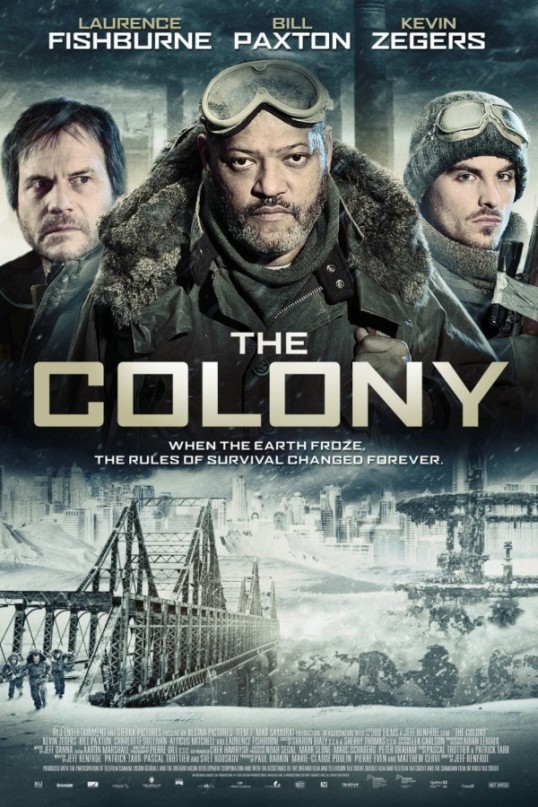
Horror Review: The Colony (dir. by Jeff Renfroe)


TheColony

“You’re going to need every bullet.”

The Colony was this little-seen horror film that came out in early 2013. From the trailers shown it looked like it was going to be a decent looking post-apocalyptic, scifi-horror that looked to evoke the sort of icy desolation and paranoia that Carpenter’s The Thing did so perfectly. Under Canadian-filmmaker Jeff Renfroe’s command the film’s high, lofty horror goals didn’t exactly come to fruition.

The film itself wasn’t awful by any stretch of the imagination, but it does suffer a lot from having it look like it was one of those mid-2000 SyFy film productions. At times some of the sequences even looked like it was copied off from one of those the SyFy “New Ice Age” disaster flicks starring Dean Cain. Yet, there’s some genuine tense moments in The Colony that should make this film a look-see if there’s nothing else to see.

Yes, the film is about the planet going through a sort of artificially-created Ice Age due to weather tampering. It’s a story that could’ve been lifted from early Twilight Zone episodes. Humanity barely survives inside spread out colonies using former factories and government bunkers. These colonies don’t just have the danger or dwindling supplies, simple diseases and the cold weather to deal with, but as we soon find out there’s now a new danger that’s much closer to home.

The Colony’s ad campaign and trailers have focused on it’s two American stars in Laurence Fishburne and Bill Paxton to sell the film. Both actors do some workman-like performances which helps anchor the ensemble cast’s performance. It’s the cast’s performances that elevates The Colony above it’s SyFy counterparts and one of it’s few saving graces. The other being the filmmakers’ success in creating a sense of freezing isolation through the use of arctic-like location shoots and some very well-done CGI icy landscapes.

The horror part of the film comes from the so-called “other” survivors who have adjusted to the scarcity of food by turning on the only abundant source of nourishment left in a world where there are no more growing things. Yes, The Colony tries to revive that old horror staple of the late 70’s and early 80’s which we know of as the cannibal-subgenre.

Cannibal films never truly went away but they remained mostly in the very outer fringes of the horror scene. They tended to be quite awful affairs that went for extreme shocks to bring in the horror crowd, but that only works when there’s a semblance of a narrative to explain things. With The Colony the film does a good enough job to try and explain why some have turned to a diet of the so-called other “white meat”. To add a new wrinkle to these feral antagonists the filmmakers they decided to update them for the modern audiences by giving them free-running skills that makes them seem more than human once they enter the screen. If the film has any sort of lesson to impart it could be that eating “long pig” might just give one parkour-like abilities.

The Colony definitely tried to be one of those scifi-horror that wanted to elevate itself to something beyond it’s grindhouse and exploitation roots, but it’s trying to be somethng it wasn’t meant to be that became it’s biggest flaw. The set-up of an Ice Age created by man is a time-tested story and the reintroduction of the cannibal thread to the film’s storyline was ripe for a grandg uignol-like production that could’ve been done using practical effects. But the filmmakers tried to mimic the CGI-smorgasbord of the Roland Emmerich-style, but they just barely distinguished themselves from what amounted to be an enhanced SyFy-production.

It’s a film that has enough entertaining moments, but overall it was a nice try that that just failed short of it’s goals.
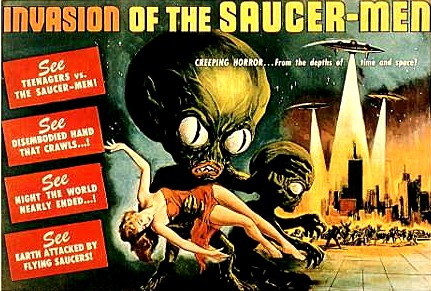
Horror On The Lens: Invasion of the Saucer Men (dir by Edward Cahn)


Invasion of The Saucer Men

The poster above pretty much epitomizes everything that I love about old B-movies.  Between the aliens and the poster’s promise that we’re being given the chance to “SEE (the) night the world nearly ended…!,” it’s hard to resist the temptation to give Invasion of the Saucer Men a chance.

First released in 1957, Invasion of the Saucer Men is, in many ways, a standard alien invasion film.  Aliens land in a small town and cause a lot of inconvenience for a bunch of all-American teenagers who are just looking for a place to make out.  What sets Invasion of the Saucer Men apart is that it’s meant to intentionally humorous and the aliens totally kick ass.

So, here is today’s edition of Horror On The Lens: Invasion of the Saucer Men!

Horror On The Lens: The Werewolf of Washington (dir by Milton Moses Ginsberg)


Werewolf of Washington (1973)

Since this October began, we have featured ghosts, vampires, a sadist, and some Cambodian zombies.  Therefore, it makes sense that, for our latest horror film on the Lens, we should feature a werewolf.

In The Werewolf of Washington, a manic Dean Stockwell plays an aide to the President of the United States who, during an assignment in Hungary, meets some gypsies, and ends up getting attacked by a werewolf.  Soon, Stockwell is back in Washington and turning into a wolf under the glow of the full moon…

The Werewolf of Washington features a memorable performance from Stockwell and the werewolf effects are fairly effective.  However, The Werewolf of Washington is mostly memorable as a document of its time.  The film was first released in 1973 and it’s meant to be a social and political satire along with being a traditional werewolf movie.   Admittedly, this is a low-budget and frequently uneven film but it’s worth seeing just for the scene where Stockwell gets his finger stuck in a bowling ball.

Horror On The Lens: Revolt of the Zombies (dir by Victor Halperin)


revolt-of-the-zombies-hostile-native

Today’s horror movie is an early take on one of the most iconic of all monsters.  First released in 1936, Revolt of the Zombies tells the story of what happens when the French discover that the secret to creating zombies is located in Cambodia.  Naturally, they organize an expedition to track down that secret and destroy it.

Simple, right?

Unfortunately, when it comes to the French and zombies, nothing is ever simple…

Revolt of the Zombies was directed by Victor Halperin, who had previously directed the atmospheric classic White Zombie.  Unfortunately, Revolt of the Zombies is hardly a classic.  However, I still find the movie interesting as an example of what a Hollywood zombie film looked like before George Romero revolutionized the genre with Night of the Living Dead.  The zombies in Revolt of the Zombies are not the undead cannibals that we’ve all been conditioned to expect.  Instead, they’re closer to the original zombies: brainwashed servants without a will of their own.

One final note: the eyes that are frequently superimposed over the action belong to Bela Lugosi.

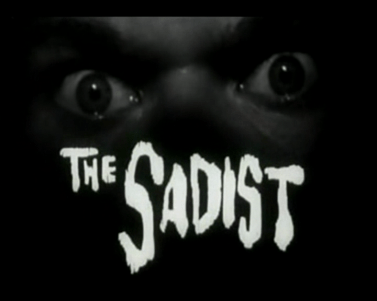
Horror On The Lens: The Sadist (dir by James Landis)


Sadist-picture

As scary as all the stories of zombies and vampires may be, the most frightening monsters in the world are the ones that walk among us.  I may look away when a monster shows up halfway through a movie but what truly scares me is what my fellow human beings have proven themselves capable of doing.

Today’s movie is all about man-made horror.  Released in 1963, The Sadist is a dark and rather brutal film about what happens when three teachers have car trouble and find themselves wandering around a seemingly deserted junkyard.  They quickly discover that they’re not alone.  Watching them and eventually terrorizing them is Charlie (Arch Hall, Jr.), an inartciulate sociopath who quickly proves himself to be a lot more clever than his smugly complacent hostages.  This bleak film is memorable for both its starkly effective cinematography and Hall’s disturbingly plausible portrayal of the title character.

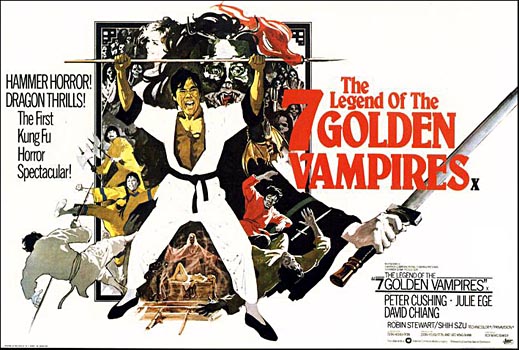
Horror On The Lens: The Legend of the 7 Golden Vampires (dir by Roy Ward Baker)


Legend_of_the_7_golden_vampires

Today’s horror movie is from Hammer films and, needless to say, it’s lot of fun.  In The Legend of the 7 Golden Vampires, an ennui-stricken Count Dracula (James Forbes-Robertson) leaves his castle and travels all the way to China.  Once in China, he resurrects the legendary 7 golden vampires and uses them to raid a nearby village.  One villager (played by David Chiang) goes to the legendary Prof. Van Helsing (Peter Cushing, of course) for help.  Van Helsing, along with his son (Robin Stewart) and a wealthy widow (Julie Ege, who decorated several Hammer films), goes to the village to battle the vampires.  Providing protecting for Van Helsing’s group is Chiang’s sister (Szu Shih) and six other brothers.

First released in 1974, The Legend of the 7 Vampires was Hammer’s attempt to revive the failing fortunes of their most iconic monster by collaborating with Hong Kong film producer Sir Run Run Shaw.  The result is an entertaining hybrid of a traditional Hammer vampire film and a Hong Kong kung fu movie.  While James Forbes-Robertson makes for a poor replacement for Christopher Lee, Cushing is perfect as always.

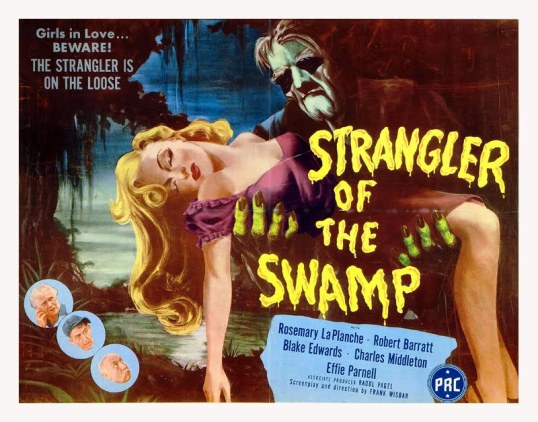
Horror On The Lens: Strangler Of The Swamp (dir by Frank Wisbar)


strangler_of_swamp_poster_02

Traditionally, October is a very special month here at the Shattered Lens.  October is the month that we devote the majority of our attention to the horror genre.  This month, along with all of the reviews that you’ve come to expect from the Shattered Lens, I will also be attempting to share a horror movie a day with all of our wonderful readers.

Let’s start things off with an odd little B-movie from 1946, Strangler Of The Swamp, a story of love, revenge, and ghosts.  A group of swamp men hanged an innocent man.  Now, the ghost of that man is having his revenge by strangling the descendents of the people who killed him.  One of those descendents is Chris Sanders (played by future director Blake Edwards) who just happens to be in love with Maria (Rosemary La Planche), the granddaughter of the vengeful ghost.

Clocking in at little less than an hour, Strangler Of The Swamp tells a familiar story but it’s still worth watching.  Charles Middleton is effective as the strangler and the German-born director Frank Wisbar deals with the restrictions imposed by a minsicule budget by emphasizing the film’s expressionistic atmosphere.  While it would be a mistake to call Strangler Of The Swamp a lost masterpiece (as some critics have done), it’s still an interesting example of low-budget, B-filmmaking.

Review: Metallica: Through the Never (dir. by Nimrod Antal)


MetallicaThroughtheNever

“And the road becomes my bride”

Concerts have been a major part of a teenager’s transition into adulthood. Often have we begged our parents to get us tickets to our favorite band’s concert as they toured straight into our hometowns. We’d beg, cajole, promise whatever just to be able to attend that big show that we thought everyone we knew would be attending. Rock concerts have been a huge part of this coming-of-age journey. It’s the show that our parents dreaded (especially the metal shows) and the ones that pulled in the outcasts kids.

We would either outgrow this youthful event because it’s not something that interests us, but most often it’s just because we either do not have the time to attend rock concerts due to work and other adult responsibilities. While we would still go to a concert of our favorite band when time and money affords for it in the end it’s something that’s become more of a past-time to reminisce about.

Metallica: Through the Never is the latest concert film that could change all that. Filmed during Metallica’s latest world tour, the film was directed by Nimrod Antal (Armored, Predators) and turns what could’ve been just your typical concert film into a surreal mixture of excellent concert footage and an apocalyptic narrative involving one of the band’s roadies. The latter felt like an extended music video and the lack of dialogue by the film’s narrative lead in Dane DeHaan does give this part of the film it’s surreal vibe. This part of the film could easily come off as one of Metallica’s music videos. It has mayhem involving nameless rioters battling an equal number of police right up to a nameless, gas-masked horseman who ends up paying particular attention to our beleaguered roadie.

Yet, while this apocalyptic-like narrative makes for a nice sideshow the main reason to see Metallica: Through the Never is the concert footage. While Antal does a good job with the story going outside the concert it’s inside where he shines. Making use of over 20 cameras on cranes, dollies and handhelds, Antal is able to make the concert footage feel like one was actually at the show. He uses every trick in the book from close-ups of each band member to sweeping crane shots that gives a bird’s-eye view of the concert.

It’s this part of the film that may just be one way for those of us who grew up going to concerts but have lost the time to return to such events to finally experience them again. It helps that the 3D used helps give the feel of not just being there but an enhanced experience that one may not find while actually attending the show live. But it doesn’t end in just the visuals.

A concert film can only go so far on how it looks. In the end, if the film doesn’t do a great job capturing the audio of the event then why even bother watching. Metallica: Through the Never doesn’t skimp on the audio assault. It is just exactly what I mean when I say audio assault. The audio in this film brought me back to attending past metal shows from my youth in near-perfect volume and clarity.

Metallica: Through the Never needs to be experienced in as big a screen as possible and if one’s able to see it on IMAX then I recommend they do so, but if that’s not possible then I still say go out and see this unique take on the ubiquitous concert film. It might not be the same as attending a Metallica concert, but it’s the next best thing to actually attending one.

What Lisa Watched Last Night #92: The Cheating Pact (dir by Doug Campbell)


Late last night, I watched an original Lifetime movie called The Cheating Pact.

the-cheating-pact-premiere-lifetime-thumb-315xauto-66775

Why Was I Watching It?

It was on Lifetime.  How could I not watch it?

What Was It About?

The Cheating Pact is yet another Lifetime movie about upper middle class high school girls murdering each other.  The girls also refuse to appreciate or listen to the advice offered up by their mothers and, in typical Lifetime fashion, the movie doesn’t seem to be certain whether it’s worse to be a murderer or a spoiled brat.

(Personally, I was occasionally accused of being a spoiled brat when I was in high school and I turned out just fine…)

Heather (Daniela Bobadilla) and Kylie (Laura Ashley Samuels) are both feeling pressured to get high scores on the College Entrance Test.  Fortunately, Heather’s former best friend Meredith (Laura Wiggins) is a genius.  (Just in case anyone is doubting Meredith’s intelligence, she wears glasses.  So there.)  Meredith agrees to take their tests for them and soon, she’s getting paid thousands of dollars to help her peers get into college.

However, Kylie isn’t happy with her score and feels that Meredith deliberately did poorly on the test.  And so, as often happens in these films, Kylie shoves Meredith to her death and then tries to frame Heather for the murder,

What Worked?

Whenever you watch a Lifetime movie about a teenage girl doing something wrong and then not going to her mom for advice (or, even worse, ignoring her mom’s advice), you always know that the worst possible thing is going to happen as a result.  In these uncertain times, a film like The Cheating Pact is so predictable that it’s actually rather comforting.

I also love how Lifetime movies always present high school as being ruled by an erratic matriarchal society that’s dominated by secret organizations and melodramatic conspiracies,  If anything, I think Lifetime movies probably offer the most realistic depictions of high school that I’ve ever seen.

What Did Not Work?

Hey, it was a Lifetime movie.  Therefore, it all worked.

“Oh my God!  Just like me!” Moments

Much like Kylie, I once accidentally shoved someone over a stairway railing.  But shhhhhh …. don’t tell anyone.

Lessons Learned

I missed the opportunity to make a lot of easy money in high school.

Film Review: Rush (dir by Ron Howard)


rush-poster-2013

Rush, the latest film from Ron Howard, is the type of film that I usually hate.

It’s big, bombastic, and so extremely mainstream that it actually features Chris Hemsworth uttering the line, “This is what I was born to do,” without a hint of irony.  This is a film about rich boys playing with expensive toys and the movie’s portrayal of women manages to make Aaron Sorkin look enlightened by comparison.  Finally, the film is about a sport that I previously knew nothing about and, after having spent two hours watching this film, I still know very little  about.

And yet, I didn’t hate Rush.  In fact, I really enjoyed it and I think the reason why comes down to one thing.

I have a weakness for hot guys who drive fast cars.

Rush tells the true story about the rivalry between two Formula One racers, the flamboyant Englishman James Hunt (Chris Hemsworth) and the extroverted German Niki Lauda (Daniel Bruhl).  The film follows them from their first meeting in 1970 until they both find themselves competing for the Formula One championship in 1976.  Along the way, we watch how both of them deal with the temptations that went along with being a rich celebrity in the 1970s.  (Lauda resists the majority of them.  Hunt does not.)  Along the way, one of them struggles to recover after a horrifying accident and both of them try to maintain a balance between their personal lives and the fact that each race they run could potentially be their last.  (In one of the film’s best scenes, Niki explains that he’s prepared to accept a 20% chance of dying during a race but not a point more.)

Plotwise, Rush is pretty much a standard sports film, full of men talking about the importance of being men while women stare up at them with adoration.  Inspirational speeches are delivered and everything comes down to one final race.  If, like me, you’re not into Formula 1 racing, the film can occasionally be difficult to follow.  During one extended montage of cars racing across the world and occasionally crashing, I found myself seriously wondering how many races could possibly be run in a Formula One season.  As the film reached its conclusion, James and Niki started talking about which racers have the most points.  Their conversation would have undoubtedly been easy to follow for someone who was into Formula One but for me, it took a few minutes to figure out what they were going on about.

However, none of that matters.

Rush works.

There’s a lot of reasons why Rush works.  The film’s glossy recreation of the 1970s (in all of its frequently tacky glory) is enjoyable to watch and Hans Zimmer’s score is properly loud and majestic.  Both Hemsworth and Bruhl give good performances, with Hemsworth coming across as properly flamboyant and Bruhl bringing some much-needed humor to a character who, in the hands of a lesser actor, could have been insufferable.  Both Olivia Wilde and Alexandra Maria Lara do good work bringing seriously underwritten characters to life.

However, the film’s ultimate success belongs to director Ron Howard.

Ever since Frost/Nixon prevented The Dark Knight from getting a best picture nomination in 2009, there has been a certain loud element of the online film  community that has used Ron Howard as a go-to example of a safe and thoroughly commercial director.  He is often dismissed as being the epitome of a mainstream, conventional filmmaker.

However, as mainstream as Howard’s sensibility may be, Rush proves that he still knows how to craft an exciting scene.  I may have occasionally had trouble keeping track of who was and wasn’t in each car but that didn’t make the races any less thrilling or the accidents any less horrifying.  During the film’s best sequences, you feel the thrill of being in control of the uncontrollable and you understand why Niki and James are willing to risk death just so they can experience being alive.