Today’s horror scene that I love is, much like The Haunted Castle and The Monster, less a scene and more an entire movie.
In 1910, Thomas Edison produced what is thought to be the first ever film version of Mary Shelley’s Frankenstein! Clocking in at 12 minutes and 41 seconds, this film was directed by J. Searle Dawley and stars Charles Ogle as the monster.
Admittedly, the surviving prints of this 107 year-old movie are not in the greatest condition. But I still think it’s effectively surreal and, in its way, quite creepy. While it always takes a while for modern audiences to get used to the more theatrical acting styles of the silent films, Charles Ogle still makes for a very memorable monster. I especially enjoy the tinted scenes where the monster comes to life. In the video below, it start around the 2:18 mark and it’s truly a scene that I love!
For today’s horror on the lens, we have a 1975 made-for-television movie called The Dead Don’t Die!
The Dead Don’t Die takes place in Chicago during the 1930s. George Hamilton is a sailor who comes home just in time to witness his brother being executed for a crime that he swears he didn’t commit. Hamilton is convinced that his brother was innocent so he decides to launch an investigation of his own. This eventually leads to Hamilton not only being attacked by dead people but also discovering a plot involving a mysterious voodoo priest!
Featuring atmospheric direction for Curtis Harrington and a witty script by Robert Bloch, The Dead Don’t Die is an enjoyable horror mystery. Along with George Hamilton, the cast includes such luminaries of “old” Hollywood as Ray Milland, Ralph Meeker, Reggie Nalder, and Joan Blondell. (Admittedly, George Hamilton is not the most convincing sailor to ever appear in a movie but even his miscasting seems to work in a strange way.)
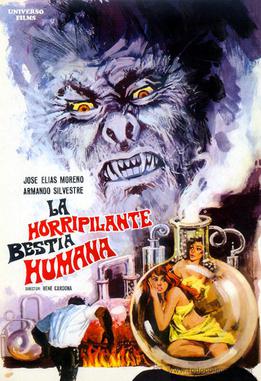
Before I tell you too much about it, I do need to provide a few caveats. In 1969, Mexican director Rene Cardona released a film called La Horripilante bestia humana. When that film was released in the United States in 1972, it was retitled Night of the Bloody Apes. The film was also badly dubbed into English. The version that I watched was Night of the Bloody Apes, the dubbed version. This editing in this version was notably ragged. I don’t know if that was the result of the American distributors cutting scenes or if the Mexican version was just as bad. American distributors were notorious for roughly editing foreign-language films but then again, director Rene Cardona was notorious for not exactly being the world’s most competent filmmaker.
I guess what I’m saying is that, for all I know, La Horripilante bestia humana could have been the greatest monster movie ever made before it was transformed into Night of the Bloody Apes. However, I kind of doubt it.
Night of the Bloody Apes opens, like so many of Rene Cardona’s films, with a wrestling match. Lucy Osorio (Norma Lazareno) is a famous wrestler who, during a match, seriously injures her opponent. This leads to Lucy having a crisis of conscience. Her boyfriend, Lt. Martinez (Armando Silvestre) tells her not to worry about it. Her opponent will be fine and everyone understands that injuries are just a part of wrestling. But Lucy isn’t so sure. Is the fame worth it if it means hurting other people?
WELL, IS IT!?
Don’t worry too much about Lucy, though. Immediately after providing Lucy with a huge subplot, the film pretty much abandons her. Once Lt. Martienz encourages her not to give up, Lucy only appears occasionally throughout film, usually while naked in her dressing room. Whatever inner conflicts she was dealing with, she apparently resolved them while no one was looking. (This is one reason why I suspect that the film was re-edited by its American distributor.)
The film moves on to another plot. Dr. Krallman (José Elías Moreno) is desperately trying to save his son’s life. His angelic and kind of annoying son, who never says an unkind word about anything, is dying of leukemia. Dr. Krallman thinks that he can save him by removing his defective heart and replacing it with the strong, healthy heart of gorilla.
Sure, why not?
Working in secret with the help of his deformed assistant, Dr. Krallman performs the operation. (Cardona splices in footage of actual open heart surgery.) His son survives but at what cost? As a result of having a gorilla’s heart, Dr. Krallman’s son transforms into a body builder wearing a caveman mask. His son is no longer a sweet, angelic, and dying. Now, he’s a monosyllabic brute who runs around the city at night, attacking and killing women. Lt. Martinez is assigned to the case but that doesn’t mean much because Lt. Matinez is kind of an idiot.
So, yes, Night of the Bloody Apes is one strange movie. Actually, it’s more of a random collection of scenes than a movie. It’s a mix of totally gratuitous nudity, over-the-top gore, random wrestling footage, actual open heart surgery footage, and scenes of the man-ape running through the city. The film never seems to be quite sure whether the monster is actually an ape or some sort of hybrid. Sometimes, he runs like an ape. Sometimes, he staggers like Lon Chaney, Jr. playing the Wolfman after having had a drink or two. It’s a very odd film.
And it’s the oddness of it all that makes the film watchable. Some things are so weird that you just have to watch them once and that’s a fairly accurate description of Night of the Bloody Apes. You probably won’t watch it a second time though. It may be weird enough to sit through once but it’s never as compulsively rewatchable as an Ed Wood film or something like The Horror of Party Beach. Once is enough.
There’s a long tradition of venerable horror franchises claiming that their latest installment is “the final chapter.” The Friday the 13th franchise declared that the fourth part would be the final chapter and then promptly announced that part five would be a new beginning. As long as a franchise is still making a profit, nothing truly ends. Resident Evil: The Final Chapter basically admits that at the end of its final chapter, when one of the surviving characters literally announces that the mission is not over.
Anyway, Resident Evil: The Not-So Final Chapter will probably seem totally incoherent to anyone who has not watched the previous film. To be honest, even though I’ve seen the other Resident Evil films, I always have a hard time working my way through the franchise’s dense mythology. There are times when I suspect that, much like the Underworld films, the Resident Evil films were specifically designed to mess with my ADD. That said, the Resident Evil franchise has never made a secret about being more concerned with spectacle and action than with narrative coherence. If you’re the type who obsesses of the lack of logic and plausibility in a horror-action film based on a video game, then you’re not the right audience for Resident Evil.
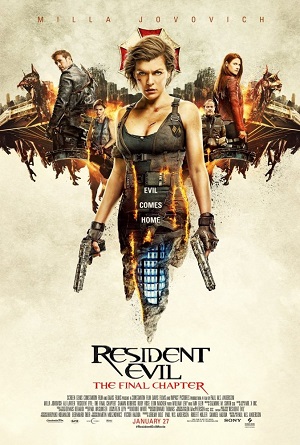
The Final Chapter finds Alice (Milla Jovovich) right where the previous Resident Evil film left her, in the ruins of the White House. The world is still zombiefied and monsterfied, all as a result of the nefarious work of the Umbrella Corporation. Alice is contacted by the Red Queen (Ever Gabo Anderson), who explains that Alice needs to return to Raccoon City and invade the Hive before Umbrella releases yet another virus. Alice travels back the Hive, which leads to several of Resident Evil‘s trademark, over-the-top action sequences. Along the way, a lot of familiar faces pop up. Alice is reunited with Claire (Ali Larter). Dr. Alexander Isaacs (Iain Glen) shows up, explaining that the Isaacs who Alice killed a few movies ago was actually just a clone. (No one ever dies in Resident Evil. Instead, they just get cloned.)
Of course, Albert Wesker returns as well. Ever since Resident Evil: Afterlife, Wesker has been played by a Canadian actor named Shawn Roberts. Watching The Final Chapter, it took me only a few seconds to realize that Shawn Roberts also played Dean the Rapist in five episodes of Degrassi: The Next Generation. That storyline, in which Dean raped Paige and it then took two years (and two seasons) for the case to go to trial just to end with Dean getting acquitted and smirking at Paige as he left the courtroom, remains one of Degrassi‘s most powerful storylines. Roberts uses that same smirk while playing Wesker.
Paul W. S. Anderson returns to direct The Final Chapter. Though Anderson seems to be destined to be best known as “that other director named Paul Anderson,” he’s actually pretty good when it comes to directing nonstop action. (For the record, I thought Anderson’s Pompeii was a sadly underrated film.) The Final Chapter is fun and silly as long as you don’t waste any time to thinking about it and Anderson keeps the action coming so quickly that you literally don’t have time to worry about whether or not the movie makes any sense. The film’s prologue, in which a boy gets zombiefied on a cable car, was actually pretty exciting and a reminder of the visceral horror that it is at the heart of all zombie films.
Resident Evil: The Final Chapter was released in January and, despite some decidedly mixed review, it became the highest grossing film in the franchise. In other words, this is definitely not the final chapter…
Lou Cherney (Robert Forster) was a top police detective until a perp with a shotgun shattered his leg. Now, Lou’s a private investigator with a limp, a girlfriend (Caren Kaye), and a learning disabled son named Joey (Philip Glasser). When Lou is hired to track down a missing girl, he discovers that she is now the lover of Nicole St. James (Lydie Denier), the head of a modeling agency. Nicole seduces Lou within minutes of meeting him but, when Lou attempts to return the missing girl to her family, Nicole reveals that she is actually an ancient demon and she possesses Joey. Soon, Joey is carrying an ice pick and throwing people out of windows.
An example of the type of movies that Robert Forster was stuck making before Quentin Tarantino engineered his comeback with Jackie Brown, Satan’s Princess is also noteworthy for having been directed by Bert I. Gordon. Gordon is best known for making cheesy giant monster movies, like The Amazing Colossal Man, Beginning of the End, and Empire the Ants. There are not any giant monsters in Satan’s Princess, which instead emphasizes lesbian sex scenes, possessed children, and Robert Forster using a blowtorch to take on a demon. Satan’s Princess also features the spectacle of a demon fleeing the scene of a crime by stealing a car. Why a demon who can possess people and do almost anything would need to steal car in order to make escape is a question that Satan’s Princess never answers.
Satan’s Princess is even dumber than it sounds but Robert Forster delivers. There is no real reason for Lou to be crippled so I like to think that, one day, Forster announced that if he was not allowed to carry a cane in all of his scenes, he wouldn’t do the movie. Watching Forster give a good performance in even a piece of dreck like Satan’s Princess makes me all the more grateful that Tarantino cast him in Jackie Brown and allowed Forster the chance to once again appear in movie worthy of his talents.
Bert I. Gordon’s career as a filmmaker began in 1954. Satan’s Princess was his 23rd movie and, for over 20 years, it was also his last. In 2014, Gordon finally returned to directing with Secrets of a Psychopath.
The Monster is 2-minute silent film from 1903. Directed by the pioneering French filmmaker, Georges Méliès, The Monster tells the story of an Egyptian prince who brings the dead body of his wife to a sorcerer who apparently likes to hang out in front of The Sphinx. The sorcerer attempts to bring her back to life and, as so often happens in any film directed by Georges Méliès, things don’t quite go as planned.
In my opinion, this is one of the most charming of Georges Méliès’s surviving films. From the simple but crudely effective camera trickery to the nicely surreal Sphinx in the background, The Monster is a chaotic delight.
Seriously, I’ve seen all five of the Underworld films and I’m still not quite sure what’s going on. That’s odd because, in every film, Selene (Kate Beckinsale) spends a good deal of time explaining what has happened and why it’s happened. And yet, every time I try to listen, I’m usually left even more confused than usual. I can’t help it. As soon as I hear someone say, “The war between lycans and vampires,” I zone out.
So, I’ll admit it. I’m the person who, after the movie, is always asking, “Is Selene still a vampire? Why are the lycans and the vampires at war? Oh, wait — that was Selene’s daughter? Why would they want to create a hybrid? So, are they in the real world or are they in an alternate world? Is this movie taking place in the past or the future? Why can’t they just call them werewolves? Wait — that character died? When did that happen?”
What’s funny is that, even though I can never understand what exactly is going on, I still tend to enjoy the Underworld films. It’s not that I think they’re great movies and, to be honest, I tend to forget about them within a day or two of watching them. But, that being said, the Underworld films typically have style to burn and Kate Beckinsale always kicks ass as Selene. Every time I watch an Underworld film, I find myself trying to do slow-motion spin kicks. The Underworld franchise has led to me spraining my ankle more than a few times.
Underworld: Blood Wars, the latest installment in the franchise, was released in January and it played for a few weeks before vanishing from theaters and most people’s minds. It says something about the way the Underworld films are perceived that the latest installments are almost always released in January, a month when most movie goers are more concerned with getting caught up with the Oscar nominees as opposed to seeing new releases. Obviously, the Underworld franchise has made enough money to justify five films. (A sixth installment is currently in pre-production.) But, at the same time, no one will ever mistake this franchise for the MCU. Indeed, in most franchises, the challenge is to make each film bigger and more extravagant than the last. The Underworld movies tend to take the opposite approach. Even by Underworld standards, Blood Wars looks cheap. The entire film takes place in darkness, in castles that look like they’ve been constructed for a community theater production of The Lion in Winter.
Blood Wars starts out with Selene narrating a lengthy recap of the story so far. I tried to pay attention to the recap but as soon as Selene said, “lycans and vampires,” my ADD kicked in and I started playing with my phone. As far as I can tell, in Blood Wars, a member of the Vampire Council named Semira (Laura Pulver) offers to give Selene clemency if Selene will come to her castle and train a new generation of Death Dealers. However, it’s all a trick because Semira actually just wants to drink Selene’s blood and gain all of her powers. Meanwhile, the lycans want to get Selene because they’re trying to track down Selene’s daughter because apparently, they can use her to create some sort of hybrid creature that will allow them to finally destroy the vampires. Meanwhile, there’s a bunch of Nordic vampires running around and they’re all blonde because they’re Nordic. (I do have to admit that part of the film made me laugh. It’s as if the filmmakers said, “What can we do to make sure everyone knows that these are Nordic vampires? Wait a minute! Scandinavia. Blonde hair. I’m getting something here!” If it had been an Irish coven, I assume they all would have had red hair. And if it had been a Texas coven, they all would have been wearing cowboy hats.) As usual, the whole thing leads to a big vampire/lycan battle. Blood spurts. Heads are ripped off of bodies. All in all, it’s a typical Underworld film.
The film is largely forgettable and the plot is borderline incoherent but Kate Beckinsale still gives a remarkably committed performance. As opposed to Daniel Craig in the latest Bond film, Kate Beckinsale still seems to be somewhat invested in her most famous role. In typical Underworld fashion, Blood Wars doesn’t offer anything new but, at the same time, it also doesn’t demand much from the audience.
“Sit back and relax,” the film says, “nothing really matters anyway.”
Today’s horror film is a true classic of its kind, the 1953 science fiction epic Robot Monster.
Now, I should admit that this is not the first time that I’ve shared Robot Monster in October. I share it every year and, every year, YouTube seems to pull the video down in November. That sucks because Robot Monster is one of those weird films that everyone should see. So, I’m going to share it again. And, hopefully, YouTube will let the video stay up for a while.
As for what Robot Monster is about…
What happens with the Earth is attacked by aliens? Well, first off, dinosaurs come back to life. All of humanity is killed, except for one annoying family. Finally, the fearsome Ro-Man is sent down to the planet to make sure that it’s ready for colonization. (Or something like that. To be honest, Ro-Man’s exact goal remains a bit vague.)
Why is Ro-Man so fearsome? Well, he lives in a cave for one thing. He also owns a bubble machine. And finally, perhaps most horrifically, he’s a gorilla wearing a diver’s helmet. However, Ro-Man is not just a one-dimensional bad guy. No, he actually gets to have a monologue about halfway through the film in which he considers the existential issues inherent in being a gorilla wearing a diver’s helmet.
Can humanity defeat Ro-Man? Will Ro-Man ever get his intergalactic supervisor to appreciate him? And finally, why are the dinosaurs there?
All of those questions, and more, are cheerfully left unanswered but that’s a large part of this odd, zero-budget film’s considerable charm. If you’ve never seen it before, you owe it to yourself to set aside an hour and two minutes in order to watch it.
(Lisa is not just devoting all of her time to horror movies this month! She is also trying to clean out her DVR. She has recorded over 170 movies this year and she needs to watch all of them before January 1st! Will she make it? Keep checking this site to find out! Lisa recorded The Wrong Bed: Naked Pursuit off of the Lifetime Movie Network on June 2nd.)
Now, this is just frustrating!
When you sit down to watch a movie called The Wrong Bed: Naked Pursuit, I think you’re justified in thinking that the majority of the movie is going to take place in a bed (perhaps even the wrong bed, which I guess would mean that it has a lumpy mattress or a lice-infected pillow something). I think you’re also justified in expecting that everyone’s going to be naked for the majority of the movie. As for the pursuit — well, pursuit can mean anything. Maybe the two naked people in the wrong bed are pursuing pleasure or enlightenment. Maybe they’re pursuing the ultimate high of sexually decadent ennui. Who knows?
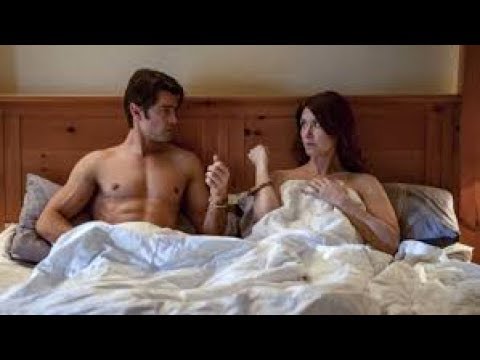
Well, The Wrong Bed: Naked Pursuit does open with Stella (Jewel Statie) and Owen (Corey Sevier) waking up naked in bed and handcuffed together. However, it’s not the wrong bed. It’s just a hotel bed and it looks like a pretty nice hotel, too! Both Owen and Stella are naked but that only lasts for about ten minutes. Eventually, they get out of bed and manage to get partially dressed. And while I appreciate the fact that the film is honest about the difficult of putting on a bra while handcuffed to another person (because, seriously, it’s not as easy as the movie’s usually make it look), that still doesn’t change the fact that the title specifically promised us a naked pursuit in the wrong bed.
Now, I should admit that the title is honest about the pursuit part. When Owen and Stella wake up, they have no memory of how they met or eventually ended up in bed together. However, they do know that someone is chasing them. They spend the entire movie running around Canada, trying not to get caught by the usual collection of men in suits and uniforms. Occasionally, Stella has flashes of memory. She sees herself strapped down to a gurney with a scientist named Larissa (Lisa Berry) preparing to give her a shot. She realizes that she and her best friend tried to earn some extra money by taking part in some sort of clinical study. However, something went wrong…
Stella and Owen try to retrace their steps. It turns out that they both got pretty wild the night before they woke up in the not-so wrong bed. They ever started a riot at a bowling alley. Even more importantly, they find the time to stop by Owen’s house. Owen, who says that he’s a fireman, lives in an impressively big house. That’s Lifetime, though. Everyone gets a mansion, regardless of what they do for a living.
Anyway, once I got over the misleading title, The Wrong Bed turned out to be a pretty entertaining little movie. It was directed by Monika Mitchell, who has done several Lifetime movies and who can always be depended on to keep the action moving quickly. Things got a little bit silly once Owen and Stella discovered why they were being pursued but no matter! Jewel Statie and Corey Sevier had chemistry and Sevier looked good without his shirt on.
There are several lessons that can be learned from watching horror films. One that is often overlooked is the importance of staying out of trailer parks. Seriously, I have lost track of how many horror films have taken place within the confines of a trailer park. Once you see someone surrounded by RVs and mobile homes, you know that they’re probably doomed.
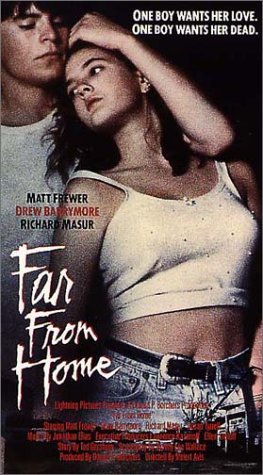
Take 1989’s Far From Home, for instance.
Far From Home is set in perhaps the sleaziest trailer park in America. This place sits in the middle of the Nevada desert and is run by chain-smoking Agnes Reed (Susan Tyrrell), who has a voice like a bullfrog, a daughter (Stephanie Walski) who is obsessed with watching TV and eating fishsticks, and a delinquent teenage son named Jimmy (Andras Jones).
The only law is provided by Sheriff Bill Childers (Dick Miller), who has a squad car but apparently no deputies. Childers is gruff but not that bad of a guy once you get to know him. However, he’s also played by Dick Miller and we all know better than to depend on Dick Miller to maintain the peace.
There’s a gas station nearby. A mellow Vietnam vet named Duckett (Richard Masur) owns it. Duckett is always willing to be helpful but he rarely has any gas. This is one of those small towns where the gas truck apparently only rolls in every two months or so. Still, Duckett’s a nice guy and he’s full of stories about how the government used to do atomic bomb tests in the surrounding desert.
(The scenes where Duckett drives around the desert feel somewhat out of place but they’re still enjoyable, due to Masur’s eccentric performance.)
Living in the trailer park, there’s a lot of odd people. Some of them are permanent residents while some of them are just temporarily stranded. 14 year-old Pinky (Anthony Rapp, who would go on to appear in Dazed and Confused and Rent) lives with his mother and is a permanent resident. His mother is rarely seen, though occasionally she can be glimpsed through a window, propped up in front of the TV. Pinky says that, when he was a kid, he and Jimmy were best friends. But now, Jimmy and Pinky are enemies.
And then there’s Amy (Jennifer Tilly) and Louise (Karen Austin), who are just waiting for enough gas to come in to be able to get Amy’s car to start running again. Louise is intelligent and responsible. Amy is flighty and undependable. As soon as one of them accidentally pulls the handle off the driver’s side door, you just know one of them is going to end up getting trapped in that car at a bad moment.
When Far From Home opens, two newcomers have moved into the trailer park. Writer, divorced father, and self-described “former angry young man” Charlie Cox (Matt Frewer) has just spent a month with his 13 year-old daughter, Joleen (Drew Barrymore, who was 14 when she made Far From Home). It hasn’t exactly been a great vacation and it doesn’t get any better when Charlie’s car runs out of gas. Joleen is about to turn fourteen and she doesn’t want to spend her birthday in a crummy trailer park with her incredibly dorky dad.
However, both Jimmy and Pinky are happy that Joleen will be spending at least a day or two at the trailer park. At first, Joleen crushes on Jimmy and then, after Jimmy reveals himself to be aggressive and unstable, she crushes on Pinky, who protects her from Jimmy. One of the two boys is so obsessed with Joleen that he is willing to commit murder to keep her from leaving the trailer park. But which one?
(It’s actually pretty obvious but you probably already guessed that.)
Far From Home is a film about which I have mixed feelings. On the one hand, the movie’s totally predictable. Characters do dumb things for no real reason beyond needing to move the plot forward. Charlie’s parenting abilities change drastically from scene to scene. A traumatized character goes from catatonic to recovered to catatonic again with no real explanation.
One of my main issues with the film is that there’s no real surprise about who the killer turns out to be. Even worse, once the killer’s identity is revealed, the killer suddenly turns into one of those psychos who can come up with a dozen one-liners while trying to kill someone. I mean, seriously, who does that? Are movie psychos required to take a year’s worth of improv clubs and do an apprenticeship with the Upright Citizens Brigade before they’re allowed to pick up a knife? If I was the type to commit murder (and I’m not but let’s just say that I was), I would be too busy trying to make sure everyone was dead to be witty. I’d save the jokes until I was safely on a beach somewhere, drinking pink lemonade and keeping an eye out for Ben Gardner’s boat. That’s just me, I guess.
And yet, there’s a part of me that really likes this stupid, stupid movie. It’s a surprisingly well-directed film, full of artfully composed shots. The trailer park really does take on a life of its own and the film also makes good use of a nearby abandoned apartment building. It’s a great location and, occasionally, it lends the film a dash of surrealism. (Of course, I guess you could legitimately ask who would build an apartment complex in the middle of the desert, especially one that’s still humming with radiation from the Atomic bomb tests, but let’s not.) Richard Masur, Dick Miller, and Susan Tyrrell all give good performances. For that matter, the same is true of Anthony Rapp and Andras Jones. Neither Rapp nor Jones are to blame for the fact that they were let down by a weak script.
Though I doubt either one of them would describe Far From Home as being their proudest cinematic achievement, Matt Frewer and Drew Barrymore are totally believable as father and daughter. In the end, that’s why I like this movie. Whenever I’ve watched Far From Home, I’ve always been able to relate to Joleen. When I was thirteen, I basically was Joleen.
Fortunately, though, I was never found myself stranded in a trailer park full of homicidal maniacs.
 Lou Cherney (Robert Forster) was a top police detective until a perp with a shotgun shattered his leg. Now, Lou’s a private investigator with a limp, a girlfriend (Caren Kaye), and a learning disabled son named Joey (Philip Glasser). When Lou is hired to track down a missing girl, he discovers that she is now the lover of Nicole St. James (Lydie Denier), the head of a modeling agency. Nicole seduces Lou within minutes of meeting him but, when Lou attempts to return the missing girl to her family, Nicole reveals that she is actually an ancient demon and she possesses Joey. Soon, Joey is carrying an ice pick and throwing people out of windows.