Horror Film Review: The Belko Experiment (dir by Greg McLean)


How far would you go if all you had to do was follow orders?  That is the question posed by The Belko Experiment.

A violent and disturbingly plausible social satire/horror film, The Belko Experiment was released into theaters on March 17th.  It was one of the best films of the first half of 2017 but, as so often happens whenever a genre film subverts the traditional narrative, The Belko Experiment is also one of the most overlooked films of 2017.  It got mixed reviews, with most critics focusing on the fact that the script was written by James Gunn.  (Though Gunn may be best known for directing Guardians of the Galaxy, his non-MCU work has always  been distinguished by a subversive, often transgressive sensibility.)  A few critics dismissed it as being just another lurid celebration of violence, showing once again that you can always count on certain mainstream critics to unfairly categorize any film that doesn’t neatly fit into their preconceptions.  Yes, The Belko Experiment is violent.  And yes, it is gory and sometimes hard to watch.  However, to dismiss The Belko Experiment as merely being that latest entry in the torture porn genre is to totally miss the point.

Mike Milch (John Gallagher, Jr.) is one of the many employees of Belko Industries.  He’s a nice enough guy.  In fact, if I worked for Belko Industries, Mike would probably be one of my favorite co-workers.  He’s friendly.  He’s funny.  He’s not unattractive.  He’s kind of a less smirky version of The Office‘s Jim Halpert.  I’d want to be his friend.  Since Belko’s offices are located in a remote area of Colombia, I would want to make all the friends that I could.

(Early on in the film, we’re informed that every employee of Belko Industries has been required to get a tracking device implanted at the base of their skull.  They’re told that this is because there’s always the risk that one of them will be kidnapped by drug traffickers.  Of course, as the film plays out, we discover that it’s actually for a totally different reason.)

When The Belko Experiment begins, it’s a day like any other.  People show up for work. Some people actually do work.  Some people slack off.  Everyone tries to look busy whenever the boss, Barry Norris (Tony Goldwyn), wanders by.  The maintenance workers (Michael Rooker and David Dastmalchian) do their thing.  A few employees sneak up to the roof of the office building and get high.  Everyone tries to avoid Wendell Dukes (John C. McGinely), a pervy executive.  The security guard (James Earl) watches the door.  The newest employee (Melonie Diaz) learns about her new job and coworkers.

Of course, there are a few strange things.  Some new security guards have shown up and they don’t appear to be particularly friendly.  They turn away all of the locals who work at the office, only allowing in the American employees.  Everyone agrees that it’s strange but, instead of thinking about it too much, they just keep going about their day.

Then, the steel shutters slam down, effectively sealing the building off.

Then a voice (Gregg Henry) demands that they select two co-workers to die.  When the employees of Belko Industries refuse (with several dismissing the whole thing as being a tasteless prank), tracking devices start to randomly explode until four employees are dead.  The voice goes on to say that, unless 30 employees are killed in the next two hours, 60 people will be randomly killed…

Some of the co-workers refuse to kill their friends but many more do not.  And soon, even those who refused to take part in the murders, are forced to start killing just to keep from being killed themselves…

The Belko Experiment wastes no time in establishing that anyone can die at any moment.  It doesn’t matter how funny you were a few seconds ago or how likable you may be.  If the unseen voice decides to flip your switch, that “tracking device” will explode and it’ll take your head with it.  And, even if the unseen voice doesn’t get you, your coworkers might.

That, by itself, would be disturbing enough.  However, The Belko Experiment ultimately succeeds as a work of horror because it illustrates a truth that many people would prefer to ignore.  When the employees of Belko Industries start to kill each other, it feels all too plausible.  Culturally, human beings are conditioned to follow orders.  We like to have an authoritarian around to tell us what to do.  It’s a good way of avoiding responsibility for our own actions.  (“I was following orders.”  “I was following protocol.”  “I’m just doing my job.”)  As The Belko Experiment demonstrates, most people would never dream of hurting someone else … unless they were ordered to do so.  The characters in The Belko Experiment start the movie as individuals but, as the experiment unfolds, all quirks and differences vanish.  All that is left are drones who slavishly do what they’re told.

Making the nightmare scenario feel all the more believable is a large and strong cast of familiar faces.  As the closest thing that this film has to a hero, John Gallagher, Jr. is likable and you find yourself hoping that he’ll somehow manage to survive all of this with his humanity intact.  Tony Goldwyn brings some interesting shades to his role while John C. McGinley is memorably creepy as Wendell.  Micheal Rooker, Abraham Benrubi, Sean Gunn, Josh Brener, Melonie Diaz, Brent Sexton, and Adria Arjone all shine in smaller roles.  To be honest, you really don’t want to see any of these people suffer, which makes their inevitable fate all the more disturbing.

The Belko Experiment is ultimately a portrait of how easily people can be persuaded (or ordered) to surrender their humanity.  It’s the exact mentality that we currently see everyday, with people willingly becoming slaves to one ideology or another and then tossing around terms like “treason” whenever anyone dares to do something other than obey.  It’s the exact mentality that leads to people accusing you of being “selfish” when you refuse to surrender your right to self-determination.  Our real-life Belko Experiment has been going on for several years now and it doesn’t appear to be ending anytime soon.  This movie is frightening because it’s real.

A Movie A Day #266: Possessed by the Night (1994, directed by Fred Olen Ray)


Howard Hansen (Ted Prior) is a best-selling horror writer who is suffering from writer’s block.  With his agent, Murray (Frank Sivero), pressuring him to get something written, Howard decides to seek inspiration in Chinatown.  When he steps into a curio shop and sees a grotesque, one-eyed blob floating in a jar of formaldehyde, Howard buys it.  He hopes that the blob will give him an idea for a great book but instead, it just causes him to have nightmares and violent sex with his wife, Peggy (Sandahl Bergman).
Meanwhile, Murray is in debt with loan shark Scott Lindsey (Henry Silva) and Scott’s number one debt collector, Gus (Chad McQueen).  Murray needs money and he needs it quickly.  Murray sends his “secretary,” Carol (Shannon Tweed), to live with the Hansens and steal an unpublished romance novel that Howard wrote when he was just starting out as a writer.  However, the one-eyed blob possesses Carol and she is soon climbing onto both Howard’s workout equipment and Howard!  Soon everyone is under the influence of the one-eyed blob, Carol is forcing Howard and Peggy to make love while she holds the gun on them, and both Gus and Murray are sneaking around the house, trying to find the manuscript.

A movie that was once very popular on late night Cinemax, Possessed By The Night is a sometimes awkward but frequently entertaining horror/thriller hybrid from B-auteur Fred Olen Ray.  Along with giving Frank Sivero a rare leading role (Sivero is best known for playing Frankie in Goodfellas and providing the inspiration for the Simpsons character of the same name), Possessed By The Night proves that no movie can be that bad when featuring both Sandahl Bergman and Shannon Tweed.  When you watch a Fred Olen Ray/Shannon Tweed collaboration from 1994, you know what you’re getting and Possessed By The Night delivers.

Horror Scenes That I Love: Georges Méliès’s The Haunted Castle


Technically, today’s scene that I love isn’t so much a scene as it’s an entire movie!

Below, you’ll find The Haunted Castle, a 3-minute silent from the great French director, Georges Méliès.  This film was made in 1896 and is considered, along with The Execution of Mary Stuart, to be one of the very first horror films!

Needless to say, The Haunted Castle is going to look primitive to modern eyes but so what?  There’s a lot of charm to be found in these three minutes.  Imagine seeing this in 1896, at a time before everyone was knowledgeable (and a bit cynical) about special effects and film trickery.

After you watch this piece of film history, please be sure to watch Martin Scorsese’s Hugo.  Just be prepared to cry.

Enjoy!

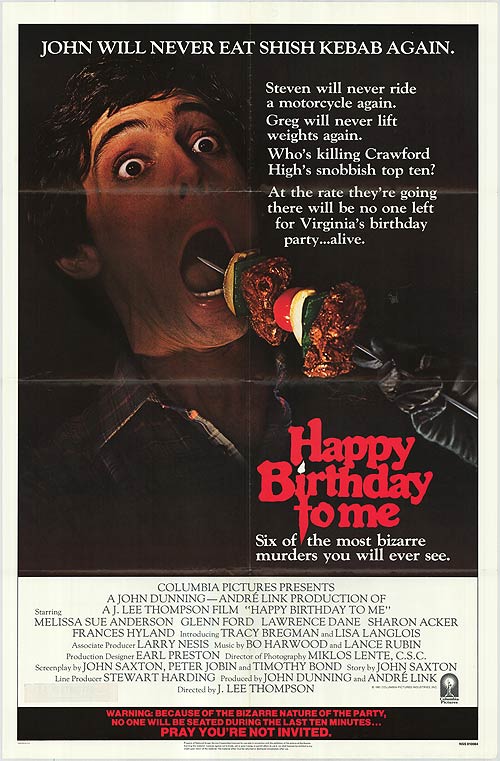
Horror Film Review: Happy Birthday To Me (dir by J. Lee Thompson)


“John will never eat shish kebab again!” announces the poster for the 1981 Canadian slasher film, Happy Birthday To Me.  

Happy Birthday To Me is famous for three things.  One of those things is the poster above, which was apparently so controversial that it actually led to the film being banned in some countries.  That said, it’s a brilliant poster, one that probably belongs in the Film Poster Hall of Fame.  If I had been alive and old enough to sneak into the movies in 1981, that poster would have drawn me into the theater.

The other interesting thing about the poster is that no one in the movie is named John.  There is a shish kebab scene, of course.  But it happens to a guy named Steven, not to anyone named John.  Of course, the poster also says that Steven likes to ride a motorcycle but, in the movie, the motorcycle rider is a pervy French-Canadian named Etienne.  Maybe the film’s producers feared that American audiences would not be willing to watch a movie featuring a character named Etienne.  (They were probably right, by the way.  Happy Birthday To Me came out decades before Degrassi: The Next Generation taught America that it has nothing to fear from the Canadians.)

As for what else Happy Birthday To Me is famous for — well, first of all, there’s the actual shish kebab scene itself.  As cringe-inducing as it may appear to be on the poster, it’s even more disturbing in the actual film.  Interestingly enough, there’s not a lot of blood in the scene.  In fact, it’s one of the few scenes in Happy Birthday To Me to not be drenched in blood.  However, there is a lot of gagging and gurgling and the sounds are all the more disturbing because they’re taking place off-camera.  Making it even more unsettling is that Steven (played by Matt Craven, who has since become a distinguished character actor) is one of the few likable characters in the movie.  In a movie full of snobs, pervs, and weirdos, Steven is the guy who is always encouraging people to stop fighting, make love, and gamble.

Finally, Happy Birthday To Me is famous for not making a damn bit of sense.

Actually, to be fair, the movie does make sense up until the final ten minutes or so.  Up until that point, it’s simply been a well-made slasher film, albeit an above average example of the genre.  There’s a killer on the loose, killing students at Crawford Academy.  All of the victims are members of the Top Ten, an exclusive clique of rich and spoiled teens.  (Interestingly enough, not every member of the Top Ten is killed.  In fact, some of the people who you are sure are due to be killed somehow manage to survive.)  One member of the Top Ten, Ginny (Melissa Sue Anderson), should be excited about her upcoming birthday party but instead, she is haunted by flashbacks to a car accident and the brain surgery that she was forced to undergo afterward.  (Footage of actual brain surgery was used in the film.)  Her father (Lawrence Dane) is clueless.  Her therapist (Glenn Ford) insists that Ginny needs to move on with her life.  But Ginny can’t escape the feeling that something is not right, especially when all of her friends start to disappear.

As I said, it all makes sense up until the final ten minutes or so of the film.  That’s when the film produces a twist that is so out-of-nowhere and nonsensical that you cannot help but admire the film’s audacity.  I’m not going to spoil the twist, other than to say that it makes no sense and I absolutely loved it.  From what I’ve read, it appears that the twist ending was almost literally made up on the spot and it’s just so weird that it elevates the entire movie.

Of the many slasher films that came out in the early 1980s, Happy Birthday To Me is one of the best.  It’s a classic that need not ever be remade.  (I doubt any remake could match the audacity of the original’s finale.)  Nicely acted, intelligently directed, and batshit insane when it needed to be, Happy Birthday To Me is an October essential!

Horror on the Lens: Baffled! (dir by Philip Leacock)


Hi there and welcome to the October Horrorthon!

This is our favorite time of the year here at the Shattered Lens because October is horror month.  For the past five years, we have celebrated every October by reviewing and sharing some of our favorite horror movies, shows, books, and music!

A part of the tradition of Horrorthon is that we begin every day in October by sharing a free movie.  Now, I should warn you that most of these movies will come from YouTube and you know how YouTube is about yanking down videos.  So, if you’re reading this in 2024 and wondering where the promised movie disappeared to … well, you should have watched it in 2017!

Let’s start this October off with Baffled!, an entertaining little made-for-TV movie from 1973.  Leonard Nimoy plays a race car driver who suddenly starts to have psychic visions of a woman who lives in what appears to be a gothic manor.  The woman is in some sort of danger.  Nimoy, of course, would rather just race cars but a parapsychologist (Susan Hampshire) convinces him that he has to figure out what his visions mean.

Now, to be honest, Baffled! is not a particularly scary movie.  Some of Nimoy’s visions are spooky but there’s nothing in this movie that’s going to give you nightmares.  Though it may not be horrifying, Baffled! is a lot of fun.  Apparently, it was meant to be a pilot for a TV series.  If it had been picked up, I guess Nimoy and Hampshire would have been helping out a new guest star every week.  Nimoy seems to be having a lot of fun playing a psychic race car driver and he and Susan Hampshire have a really sweet and enjoyable chemistry.

I watched Baffled! with the TSL’s own Patrick Smith and the other members of the Late Night Movie Gang.  We all really enjoyed it and I hope you will too:


Cleaning Out The DVR: Nanny Nightmare (directed by Brian Herzlinger)


(Along with everything else that she’s trying to get done this month, Lisa is also trying to make some progress in getting her DVR cleaned out!  She has currently got over 170 things recorded and they’re all going to be erased on January 1st, regardless of whether she’s watched all of them or not.  That’s just the way things work in the Bowman household.  Will she manage to watch everything before the year ends?  Keep checking here to find out!  Anyway, she recorded 2017’s Nightmare Nanny off of the Lifetime Movie Network on June 16th.)

If there’s anything that I’ve learned from watching Lifetime movies, it’s that anyone who actually wants to spend time with children (especially babies) is a fucking psycho.

Seriously, I’ve lost track of the number of Lifetime films that have dealt with a crazy babysitter, nanny, teacher, step-parent, foster child, or an obsessed neighbor.  They all tend to start out the same way, with a large and tastefully decorated house.  Inside the house, a woman thinks that she can have it all: a career, a family, and an outspoken, take-no-bullshit best friend who likes to drink wine.  Sometimes, the woman is a single mother.  If she’s divorced or separated, her husband is still not quite out of the picture.  If she’s widowed, then she still has to deal with a pushy in-law who doesn’t think that she’s spending enough time at home.  If she’s still married, her husband is a jerk who spends all of his time at the office with his attractive administrative assistant.

Married, divorced, or widowed, she has at least two children to take care of.  It’s not easy trying to balance it all.  But then suddenly, someone shows up.  Sometimes, it’s a neighbor who is just a little too friendly.  Sometimes, it’s a nanny who has been hired because of “impeccable” (and forged) credentials.  Whoever it is, they always say that they love children.  They imagine it probably has something to do with their own dysfunctional childhood.  They just want to find a place to belong.  And so, this stranger is hired and entrusted with the safety of the household.

It’s always a mistake.  No one is every truly helpful in a Lifetime movie and the more perfect someone seems to be, the more likely that person is going to turn out to be a raving psycho.  Unfortunately, the characters in Lifetime movies appear to have never watched television.  If they had, they would know better than to trust anyone who claims to love children.

Seriously, children are the worst.

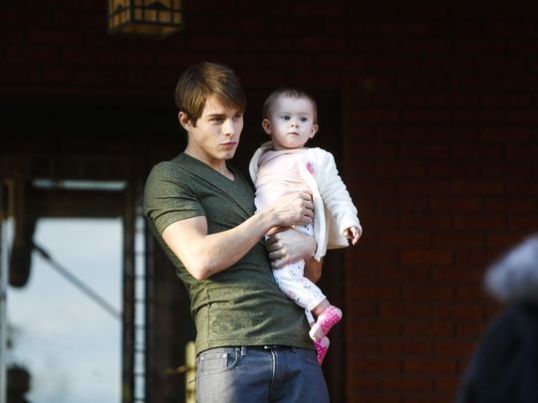
Take Nanny Nightmare, for instance.  Nanny Nightmare follows the formula without deviation and it’s hard not to feel that, if only Lauren (Erin Cahill) had watched a Lifetime movie or two, she could have avoided a lot of drama.  She would have known that her husband (Brady Smith) was being framed when she found pictures of his half-naked assistant on his phone.  She also would have known better than to trust her neighbor, Owen (Jake Manley), when he said that he loved children.

But she did trust him and, before you know it, Owen is installing spy cameras all over the house and trying to trick Lauren into falling in love with him.  Owen has finally found a family and he’s determined to never let them go!  (Hell. he’s even get a candle-lit altar that’s decorated with pictures of Lauren.  That’s determination.)

As I said, it’s pretty much a standard Lifetime movie but I did like Jake Manley’s performance as Owen.  I liked the fact that Owen was obviously psychotic and yet, no one seemed to notice.  Even when he attacks the neighbor’s lawn mower with a baseball bat, no one seems to be particularly perturbed.  Then again, isn’t that the way things usually work in real life?  If you have to choose between asking someone if they’re crazy or just trying to ignore the weirdness all around you, most people will go for the latter option.

That’s one reason to keep an eye out for evidence of a psychotic disposition before you invite someone to come live in your house.  Seriously, if anyone says that they enjoy being around children, get out of there.

Thank you, Lifetime, for reminding us to stay vigilant.

A Movie A Day #265: Hoodlum (1997, directed by Bill Duke)


1930s.  New York City.  For years, Stephanie St. Clair (Cicely Tyson) has been the benevolent queen of the Harlem underworld, running a successful numbers game and protecting her community from outsiders.  However, psychotic crime boss Dutch Schultz (Tim Roth) is determined to move into Harlem and take over the rackets for himself.  With the weary support of Lucky Luciano (Andy Garcia), Schultz thinks that he is unstoppable but he did not count on the intervention of Bumpy Johnson (Laurence Fishburne).  Just paroled from Sing Sing, Bumpy is determined to do whatever has to be done to keep Schultz out of Harlem.

When I reviewed The Cotton Club yesterday, I knew that I would have to do Hoodlum today.  Hoodlum and The Cotton Club are based on the same historic events and both of them feature Laurence Fishburne in the role of Bumpy Johnson.  Of the two, Hoodlum is the more straightforward film, without any of the operatic flourishes that Coppola brought to The Cotton Club.  Fisburne is surprisingly dull as Bumpy Johnson but Tim Roth goes all in as Dutch Schultz and Andy Garcia is memorably oily as the Machiavellian Luciano.  Hoodlum is about forty minutes too long but the gangster action scenes are staged well.  Bumpy Johnson lived a fascinating life and it is unfortunate that no film has yet to really do him justice, though Clarence Williams III came close with his brief cameo in American Gangster.  (Interestingly enough, Williams is also in Hoodlum, playing one of Shultz’s lieutenants.)

One final note: Hoodlum features William Atherton in the role of District Attorney Thomas E. Dewey.  Atherton plays Dewey as being a corrupt and sleazy politician on Luciano’s payroll.  In real life, Dewey was known for being so honest that Dutch Schultz actually put a contract out on his life after he discovered that Dewey could not be bribed.  I am not sure why Hoodlum decided to slander the subject of one of America’s most famous headlines but it seems unnecessary.

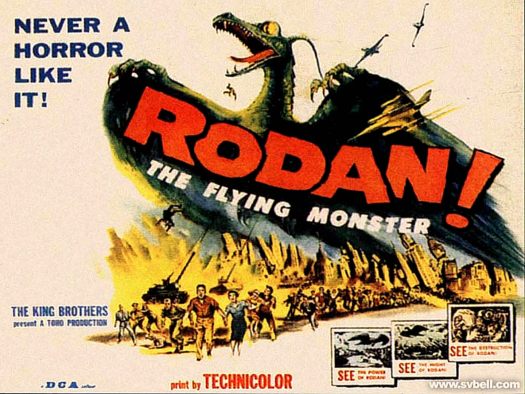
Creature Double Feature 4: RODAN (Toho 1957) and MOTHRA (Toho 1961)


gary loggins's avatarcracked rear viewer

Let’s begin “Halloween Havoc!” season a day early by taking a trip to the Land of the Rising Sun for a pair of kaiju eiga films from Japan’s Toho Studios. Both were directed by GODZILLA’s Godfather Ishiro Honda, have special effects from Eiji Tsuurya, and feature the late Haru Nakajima donning the rubber monster suits. But the similarities end there, for while RODAN is a genuinely scary piece of giant monster terror, MOTHRA is a delightfully bizarre change-of-pace fantasy that began Toho’s turn toward more kid-friendly fare.

RODAN was filmed in 1956, and released in America a year later by DCA (the folks who brought you PLAN 9 FROM OUTER SPACE! ) under the aegis of The King Brothers . There’s more A-Bomb testing in the South Pacific, as Americanized stock footage tells us before the movie proper begins. Miners digging deep into the Earth’s crust are trapped by flooding…

View original post 781 more words

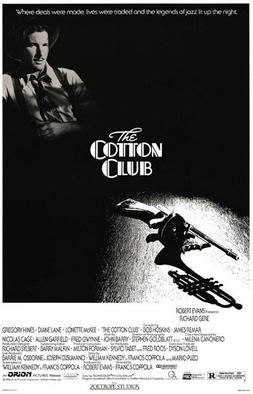
A Movie A Day #264: The Cotton Club (1984, directed by Francis Ford Coppola)


The time is the 1930s and the place is New York City.  Everyone wants to get into the Cotton Club.  Owned by British gangster Owney Madden (Bob Hoskins), the Cotton Club is a place where the stage is exclusively reserved for black performers and the audience is exclusively rich and white.  Everyone from gangsters to film stars comes to the Cotton Club.
It is at the Cotton Club that Dixie Dwyer (Richard Gere) meets everyone from Dutch Shultz (James Remar) to Gloria Swanson (Diane Venora).  Shultz hires Dixie to look after his girlfriend, Vera (Diane Lane).  Swanson arranges for Dixie to become a movie star.  Meanwhile, Dixie’s crazy brother, Vincent (Nicolas Cage), rises up through the New York underworld.  Meanwhile, dancing brothers Sandman and Clay Williams (played by real-life brothers Gregory and Maurice Hines) are stars on stage but face discrimination off, at least until Harlem gangster Bumpy Rhodes (Laurence Fishburne) comes to their aid.

The Cotton Club was a dream project of the legendary producer, Robert Evans, who was looking to make a comeback after being famously charged with cocaine trafficking in 1980.  Having commissioned a screenplay by his former Godfather collaborators, Mario Puzo and Francis Ford Coppola, Evans originally planned to direct the film himself.  At the last minute, Evans changes his mind and asked Coppola to direct the film.  After working with him on The Godfather, Coppola had sworn that he would never work with Evans again. (When he won an Oscar for The Godfather‘s screenplay, Coppola pointedly thanked everyone but Robert Evans.)  However, by 1984, a series of box office flops had damaged Coppola’s standing in Hollywood.  Needing the money, Coppola agreed to direct The Cotton Club.

Evans raised the film’s $58 million budget from a number of investors, including Roy Radin.  Roy Radin was best known for putting together Vaudeville reunions in the 70s and being accused of raping an actress in 1980.  Radin and Evans were introduced to each other by a drug dealer named Lanie Jacobs, who was hoping to remake herself as a film producer.  During the production of The Cotton Club, Radin was murdered by a contract killer who was hired by Jacobs, who apparently felt that Radin was trying to muscle her out of the film production.

While all of this was going on, Coppola fell into his familiar pattern of going overbudget and falling behind schedule.  This led to another investor filing a lawsuit against Orion Pictures and two other investors, claiming fraud and breach of contract.  When the film was finally released, it received mixed reviews, struggled at the box office, and only received two Oscar nominations.

With all of the murder and drama that was occurring offscreen, it is not surprising that the film itself was overshadowed.  The Cotton Club is a disjointed mix of gangster drama and big production numbers.  As always with post-Apocalypse Now Coppola, there are flashes of brilliance in The Cotton Club.  Some of the production numbers are impressive and visually, this movie has got style to burn.   However, among the leads, neither Richard Gere nor Diane Lane seem to be invested in their characters while the talented Hines brothers are underused.  The supporting cast is full of good character actors who are all in a search of a better script.  A few do manage to make an impression: James Remar, Bob Hoskins and Fred Gwynne as veteran gangsters, Nicolas Cage as the film’s stand-in for Mad Dog Coll, and Joe Dallesandro as Lucky Luciano.  The Cotton Club is sometimes boring and sometimes exciting but the onscreen story is never as interesting as what happened behind the scenes.


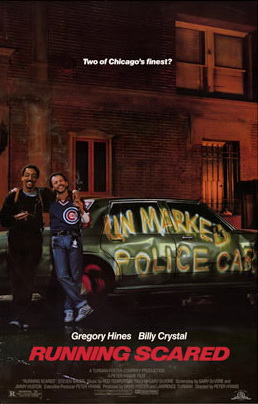
A Movie A Day #263: Running Scared (1986, directed by Peter Hyams)


Running Scared is weird but good.

Ray Hughes (Gregory Hines!) and Danny Costanzo (Billy Crystal!!!) are two tough detectives in Chicago.  All they want to do is three things: retire, open a bar in Florida, and bust Chicago’s most ruthless drug dealer, Julio Gonzalez (Jimmy Smits).  Their captain (Dan Hedaya) wants them to leave for Florida as soon as possible but they are determined to take down Julio first.’

There are two strange things about this otherwise formulaic crime film.  First off, the two tough cops are played by Gregory Hines and Billy Crystal.  According to the film’s Wikipedia page, director Peter Hyams realized that Running Scared‘s plot was nothing special so he decided that the only way to make the movie stand out was by doing it “with two actors you would not normally expect to see in an action movie.”  The other strange thing is that Hyams’s gambit worked.  Gregory Hines may have been best known as a dancer and Billy Crystal as a comedian but both of them were surprisingly believable as Chicago cops.  Running Scared is actually one of Billy Crystal’s best performances.  For once, he’s believable as being someone other than a version of himself.  Even his frequent one liners seem like something that a detective would say instead of Crystal recycling punch lines from his act.  Whether they are chasing down perps and firing their guns at a moving vehicle, Hines and Crystal are never less than credible as action stars.  Lorenzo Lamas has got nothing on the team of Hines and Crystal.

Predictable though it may be, Running Scared is one of the better late 80s cop films.  The action scenes are exciting and Hyams does a good job capturing the grittiness of Chicago.  Jimmy Smits is a good villain and Joe Pantoliano, Steven Bauer, and Jon Gries all shine in supporting roles.  Keep an eye out for the always underrated Darlanne Fluegel, playing Danny’s ex-wife.