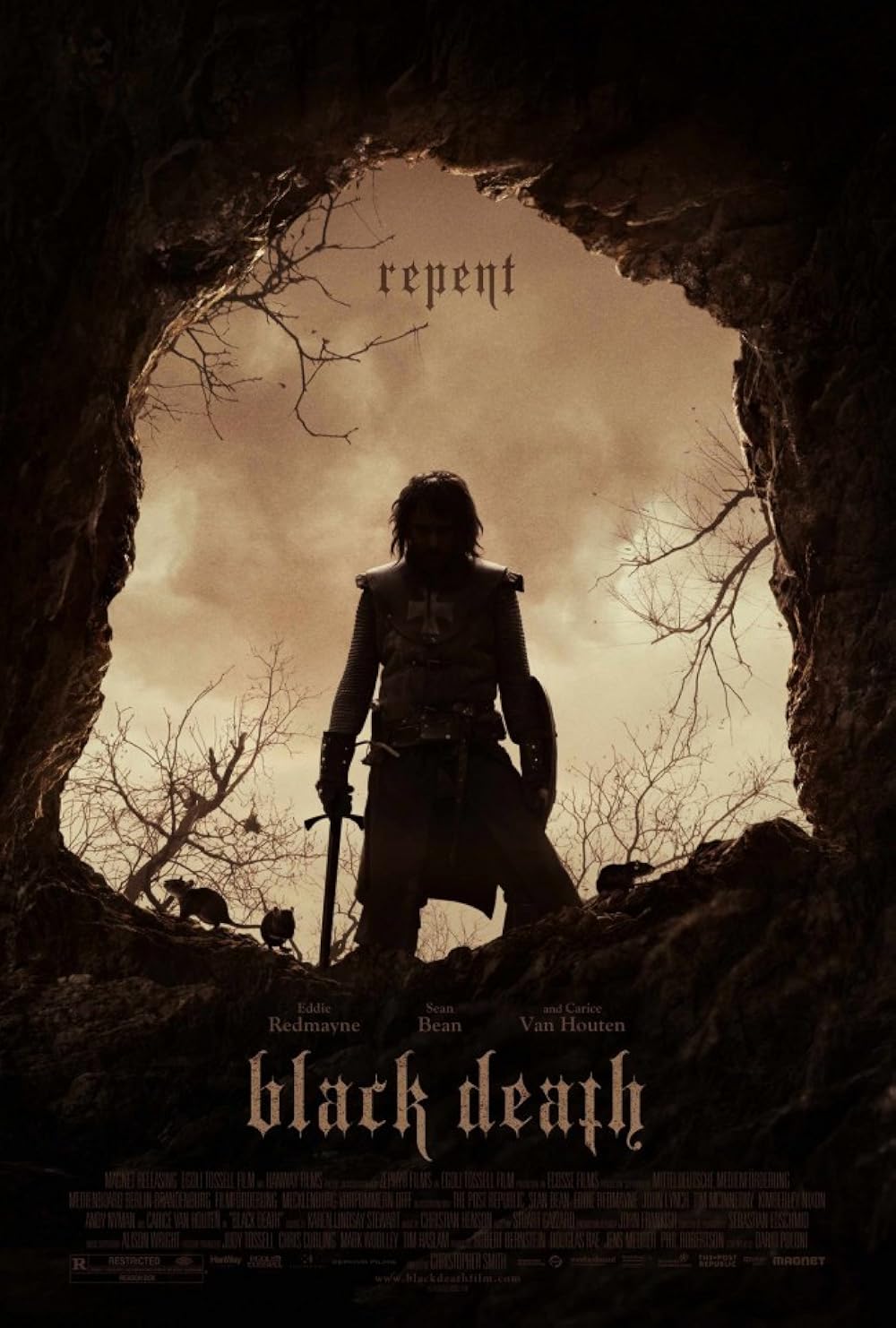
Review: Black Death (dir. by Christopher Smith)


“I believe hunting necromancers and demons serves men more than it serves God.” — Osmund

British filmmaker Christopher Smith has always been something of an under-the-radar presence, steadily putting out films that show flashes of talent without quite breaking into the mainstream. By the time Black Death arrived in 2011 (after its 2010 UK debut), Smith had already built a modest body of work that hinted at a filmmaker sharpening his voice. Looking back now, though, Black Death feels less like a stepping stone and more like a high-water mark—arguably the point where his growth as a director peaked before his later efforts settled into something more pedestrian or simply passable.

Set in 1348 England during the height of the plague, the film follows Osmund, a young monk caught between his religious vows and his love for a woman named Avrill. It’s a familiar internal conflict, but one that Black Death treats with a surprising amount of weight. Osmund’s indecision isn’t just romantic hesitation—it’s a crisis of identity, faith, and fear in a world that feels like it’s actively collapsing. When Avrill gives him a week to choose, that ticking clock hangs over everything that follows, even as the narrative shifts into something darker.

Enter Ulric (Sean Bean), a hardened knight tasked with investigating a remote village rumored to be untouched by the plague—and possibly harboring a necromancer. Osmund volunteers to guide Ulric and his men through the marshes, seeing the journey as both an escape and a test. What follows is less a traditional quest and more a gradual stripping away of certainty, as each step toward the village drags the characters deeper into moral ambiguity.

The journey itself is marked by violence, disease, and small but telling moments of cruelty. One of the film’s most effective scenes involves a woman accused of witchcraft. Ulric appears, at first, to intervene with compassion, only to execute her himself in the name of expediency. It’s a cold, efficient act that encapsulates the film’s worldview—belief, in any form, can justify brutality when it’s held too tightly.

Once the group reaches the village, Black Death shifts gears into something more unsettling. The horror here isn’t loud or overt; it’s quiet, controlled, and deeply psychological. The village’s apparent immunity to the plague raises more questions than it answers, and Smith resists the urge to provide easy explanations. Instead, the film leans into ambiguity, letting tension build through implication rather than spectacle.

At its core, the film is less about the plague itself and more about how people interpret it. Is it divine punishment? A test of faith? Or something else entirely? Smith, working from Dario Poloni’s script, explores how both religious and secular authorities manipulate these interpretations to maintain control. The result is a world where truth becomes secondary to belief—and where belief itself becomes a weapon.

Osmund stands at the center of this conflict, pulled between Ulric’s rigid, punitive worldview and the village’s more enigmatic philosophy. Eddie Redmayne plays him with a quiet restraint that borders on opacity in the first half, but that pays off once the story reaches its turning point. As Osmund begins to unravel, Redmayne lets more complexity seep in, turning what initially feels like a passive character into something far more unstable and unpredictable.

Sean Bean, as expected, delivers a commanding performance. His Ulric is not a cartoonish zealot, but a man whose certainty makes him dangerous. He believes completely in what he’s doing, and that conviction gives his actions a disturbing legitimacy. It’s one of those performances where the lack of doubt is what makes the character so unsettling.

Visually, Black Death commits fully to its bleakness. The mud-soaked landscapes, the gray skies, the ever-present sense of decay—it all reinforces the film’s oppressive tone. Smith’s direction here is notably controlled, favoring atmosphere and tension over flashy technique. The violence, rendered with practical effects, is harsh and immediate without feeling gratuitous, adding to the film’s grounded realism.

There’s an unmistakable echo of Witchfinder General in how the film approaches its themes, particularly in its refusal to draw clean moral lines. Like that earlier classic, Black Death presents a world where righteousness and cruelty often occupy the same space, and where faith can be both a source of strength and a tool of destruction.

What makes Black Death stand out within Smith’s filmography—especially in hindsight—is how confidently it balances all of these elements. The thematic ambition, the performances, the atmosphere, the restraint in its storytelling—it all comes together in a way that his later films haven’t quite matched. Where Black Death feels deliberate and probing, much of his subsequent work has leaned more toward the functional, lacking the same sense of purpose or depth.

That’s not to say Smith lost his technical ability, but the edge—the sense that he was really digging into something uncomfortable and meaningful—feels dulled in comparison. Black Death captures a moment where everything aligned: a strong script, a committed cast, and a director pushing himself beyond straightforward genre conventions.

The result is a film that works on multiple levels. It’s a grim historical horror piece, a character study, and a meditation on faith and control, all wrapped in a stark, unforgiving atmosphere. More importantly, it stands as a reminder of what Christopher Smith was capable of at his peak—even if that peak, in retrospect, came earlier than expected.
Film Review: The Commuter (dir by Jaume Collet-Sera)


It’s January, which means that it’s time for another silly action movie starring Liam Neeson.  Ever since Taken was first released way back in 2008, Liam has been a regular fixture during the first few months of each new year, either killing terrorists or killing gangsters.  Regardless of the film, he’s always a world-weary guy who loves his family and who has a unique set of skills.  The specific skills may change from film to film but they all pretty much have to do with killing people.

For instance, in the latest Liam Neeson action film, The Commuter, Liam plays Michael MacCauley.  Michael may currently sell life insurance but he used to be a detective with the NYPD.  Judging by some of the things that Michael does over the course of this film, being a detective in New York City apparently requires you to have a set of skills that one would normally associate with James Bond or Jason Bourne.  However, Michael left all of that behind.  Sure, he might still get together with his former partner (Patrick Wilson) for a beer and he still complains about his former captain (Sam Neill).  But Michael’s in the insurance game now.  As he explains it, he’s nearly 60, he’s got a teenage son getting ready for college, and he has two mortgages to pay off.  Michael and his family still haven’t recovered from the recession.  Don’t get him started on Goldman Sachs…

It sure is a good thing that Michael has that good job!

Except, of course, he doesn’t.  One day, Michael arrives at the office, is given a rather weak severance package, and is told that his services will no longer be needed.  Wondering how he’s going to tell his wife and son that their lives are pretty much over, Michael wanders around New York, gets a little drunk, and then eventually boards the train that will take him back home.

Michael is a regular on the train.  As is quickly made clear, he knows all of the other regular commuters, like grizzled old Walt (Jonathan Banks) and neurotic Tony (Andy Nyman).  He’s also still enough of a cop that he notices people who are riding the train for the first time.  For instance, there’s Joanna (Vera Farmiga).  Joanna sits down in front of him and strikes up a conversation.  She asks him what he would do if she told him that there was a bag full of money in one of the air conditioning vents but that, if he takes the money, he’s agreeing to do something for her.  When Joanna gets off at the next stop, Michael checks the vent.  The money’s there and now, so is the task.  Michael has to find and identify one passenger on the train.  If he doesn’t, his family dies…

Even by the standards of a Liam Neeson action film, The Commuter is a deeply silly movie.  However, that very silliness is the key to the film’s appeal.  After getting off to a strong start with a witty montage of Michael repeatedly waking up and leaving for work day-after-day, The Commuter settles down and it seems as if it’s going to be a typical Liam Neeson action film.  However, as the film progresses, things get just more and more bizarre.  Suddenly, Michael is getting into brutal fist fights in empty train cars.  No one in the movie ever seems to care that, every time they see Michael, he’s a little bit more beaten up than he was the last time.  Suddenly, out of nowhere, trains are careening out of control, people are getting shoved in front of buses, and men with snakes tattooed on their neck are giving Michael the side eye.  At one point, Michael nearly gets crushed underneath the train and then has to run and leap to get back on.  You find yourself wondering how a 60 year-old insurance salesman is managing to do all of this.  (The answer, of course, is that he’s Liam Neeson and Liam Neeson can do anything…)

A little over an hour into the film, The Commuter hits an operatic level of silliness, one that will probably never be equaled by any other movie that Liam Neeson ever makes.  If you stop too long to think about any of it, the movie will fall apart.  To be honest, very little of what Michael does make sense but the conspiracy that’s taking advantage of him makes even less sense.  The bad guys are either incredibly stupid or incredibly brilliant, depending on what the story requires from scene to scene.

But no matter!  This is the fourth film that director Jaume Collet-Sera has made with Liam Neeson.  None of their collaborations make much sense but all of them are entertaining as long as you’re willing to sit back, relax, and don’t overthink the logic of what you’re watching.  Much as he did with The Shallows, Collet-Sera makes good use of the film’s limited setting and Neeson is his usual grizzled but charismatic self.  The Commuter is about as silly as can be but it’s an undeniably entertaining thrill ride.


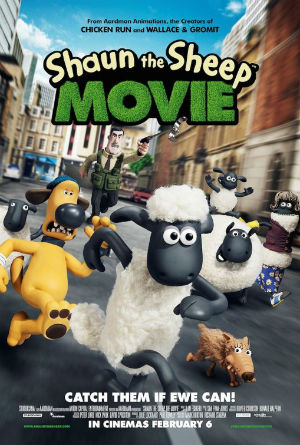
Film Review: Shaun The Sheep (dir by Richard Starzak and Mark Burton)


Shaun_the_Sheep_MoviePosterIf you want to see a film that will truly make you happy and actually give you a reason to feel optimistic about the future of civilization, then you simply must see Shaun The Sheep, the new stop-motion animated film from Aardman Animations, the same people behind Wallace and Gromit.

The film tells the story of Shaun, a sheep who lives on Mossy Bottom Farm.  Though Shaun and the other sheep have a good relationship with both the farmer and the farmer’s dog, Bitzer, Shaun still finds himself growing bored with the monotonous routine of life on the farm.  He wants to take a day off and go down to the Big City.  (It’s even identified as being the “Big City” on a nearby road sign.)  Shaun comes up with a plan.  He and his fellow sheep trick the farmer into watching as they jump over a fence.  The farmer falls asleep.  They put the farmer in a trailer, the inside of which they’ve disguised to look like the farmer’s bedroom.  The farmer will sleep through the day and, by the time he awakens, Shaun will have returned from the Big City.

And it’s actually a pretty good plan but we all know what they say about the best laid plans of sheep and men.  The trailer ends up rolling away, eventually reaching the city.  Once the farmer wakes up, he gets a blow to head that causes him to develop amnesia.  However, despite not knowing who he is, the farmer has enough vague memories of shearing the sheep that he quickly finds work as a hair stylist.  Working under the name “Mr. X,” the farmer is soon a minor celebrity himself.

Discovering what the sheep have done, Bitzer goes to the city to search for the farmer.  When he doesn’t return, Shaun and the other sheep come to realize how much they actually did like life with the farmer.  They go to the city themselves, searching for both the farmer and Bitzer.  However, once they arrive, they find themselves being stalked by A. Trumper, a fanatical animal control worker.

(Shaun the Sheep is a remarkably good-natured film, with almost every human and animal being kind at heart.  Trumper is the only exception.)

Can Shaun protect the other sheep from Trumper?  Can they track down Bitzer and the farmer?  Will the farmer ever remember the simple joys of country life or will he live the rest of his life as Mr. X, hair stylist to the stars?  You’ll have to watch Shaun the Sheep to find out!

And you really should watch it!  Shaun the Sheep is one of the most delightful films that I’ve seen in a long time.  It’s the perfect movie for kids but, at the same time, it’s smart enough that adults will be able to enjoy it as well.  Yes, a huge part of the film’s appeal is that Shaun is just so cute!  But, at the same time, this cheerful animated film also manages to work in homages to everything from The Great Escape to Silence of the Lambs.  My personal favorite of the film’s many in-jokes was a nod to The Night of the Hunter and no, I’m not going to spoil it for you here.  Why?  Because I want you to see this movie and I want you to have the same joy of discover that I did!

This is a movie that will make you laugh and yes, it will make you cry.  Most of all, Shaun the Sheep is a delightful film!  See it!

Trailer: Kick-Ass 2 (Extended Red Band)


KickAss2

This past week saw the largest collection of nerd, geek and comic book fandom gathered in one magical place. The place in question is San Diego and the event is called San Diego Comic-Con or simply just uttered in awed whispers as Comic-Con. It is a place that many outsiders have shunned as a place that has no place in good, normal society yet they continue to arrive in larger numbers to ply their products to those they shun. Even this blog has it’s shamers and ignorant individuals who spew insults yet they too continue to visit because deep in their subconscious they know, like those who ridicule Comic-Con and those who attend them with a passion, that they’re the ones out of step with whats not accepted in society.

What does this mean when it comes to the latest trailer for Kick-Ass 2 that just came out of Comic-Con?

Absolutely nothing other than the trailer and the film itself is just another weird meeting of the two cultures. It’s a film that celebrates the ridiculousness and absurdity of the comic book culture, yet it’s one that’s funded by the very same people who insulted the scene just a decade ago.

The first film was a revelation and helped introduced the world to one Chloe Grace Moretz, but it also showed that comic books and films made from them didn’t have to be PG or even PG-13. There was a place for ultra-violence in our comic book films. It also helped bring the name of Matthew Vaughn into the forefront of comic book fandom. While he’s not directing this sequel (he elected to go with X-Men: First Class and we’re all the better for it), he did help in bringing it to life and hand-picked his successor in Jeff Wadlow.

While Kick-Ass 2 is not getting the same sort of buzz from Comic-Con the original film did it is still one film I’m quite interested in seeing just to find out what has happened to our young superheroes and vigilante crime fighters since the last film. Plus, it’s main villain likes to call himself “Motherfucker”.

Trailer: Kick-Ass 2 (Red Band)


KickAss2

2010’s Kick-Ass was one of those films that you either loved or hated. It was a film adapted from the Mark Millar and John Romita, Jr. comic book of the same name that also had a similar reputation of having extreme opposites in regards to how people perceived it.

I, for one, loved the film despite just being “meh” when it came to the comic. Where the film by Matthew Vaughn was a darkly comic deconstruction of the superhero story the comic book that gave birth to it was just an exercise in shocking the readers without working for it. Yet, despite that the film was a hit with both the fans of the comic book and those who didn’t even know it was a comic book. That popularity allowed the film to make enough profit that a sequel was greenlit even before a second volume of the comic book was even started by Millar and Romita, Jr.

Kick-Ass 2 sees the return of both Hit-Girl and Kick-Ass with Red Mist now calling himself The Motherfucker and the film’s main antagonist. The sequel sees Matthew Vaughn return as producer with Jeff Wadlow stepping in as director.

Kick-Ass 2 is set for an August 16, 2013 North American release date with the film premiering earlier on July 19, 2013 in the UK.

Black Death: Trailer


There’s a film called Black Death that came out sometime around 2010 that seems to have fallen below the radar of most everyone. It’s a British historical horror film from upcoming genre filmmaker Christopher Smith. The film stars Sean Bean in the role of a knight during the Black Death era of Europe.

From what I’ve seen of the trailer and read about the film it seems to be a horror film that looks at the Black Death era of history with a slightly supernatural bent to it. Even the trailer gives gives the film a certain Wicker Man vibe to it. Holy warriors of the Christian faith coming into a village untouched by the Black Death. A village whose inhabitants might be dabbling with powers from a much older and earthy religion to keep the village safe. It definitely sounds like this film might have been influenced by that classic horror film starring Edward Woodward.

I like the look of the film as seen through the trailer. It almost looks black and white with splashes of vibrant colors here and there. Black Death hasn’t been announced as having a North American theatrical release date so this film looks like it will be a blu-ray release for me to finally see it.