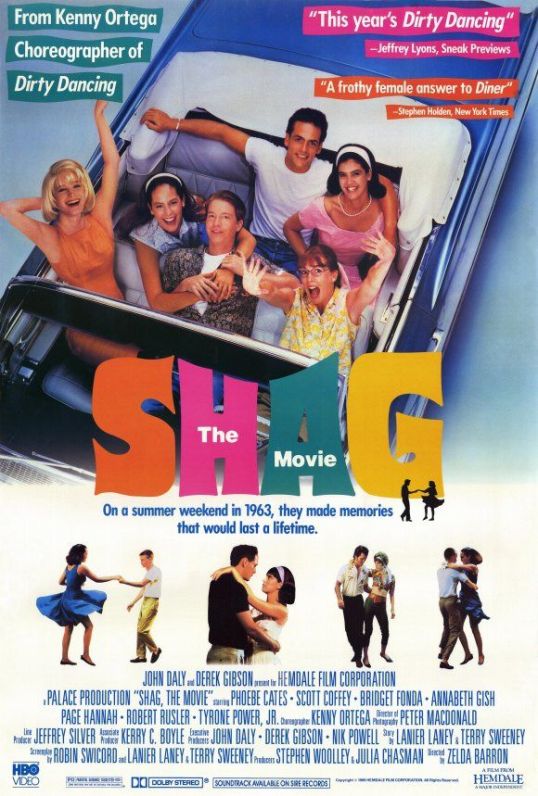
Welcome to Myrtle Beach, South Carolina, the setting of the 1989 film, Shag: The Movie!
We know that we’re in South Carolina because everyone is speaking with the type of overbaked Southern accents that you only hear in the movies. And you know it’s the beach because of all the sand, the bathing suits, and the spring breakers. Everyone’s listening to that rock and roll music. Everyone’s dancing. There’s a lot of Confederate flags around, mostly because the movie was made in the 80s and it’s taking place in the South. If the movie were made today, it would probably take place in New Jersey and everyone would be debating whether or not Christopher Columbus was a hero or not.
Though the movie was made in 1989, it takes place in 1963. We know that the movie takes place in 1963 because everyone in the movie keeps mentioning how it’s 1963. One character mentions having sexual fantasies about President Kennedy, which scandalizes all of her friends. Another character won’t stop talking about how much he enjoyed Paul Newman’s performance in The Hustler. (The Hustler came out in 1961, though, so I think the dude needs to get with the times and watch Tom Jones.) Everyone’s dancing the Shag. Of course, since this is a film about how innocent the world was in 1963, there’s no talk of the growing American presence in Vietnam or anything like that. This is the 1963 of the popular imagination, the 1963 that one visualizes after watching a hundred movies about spring break in the early 60s.
Anyway, Shag follows four friends as they have a wild week in Myrtle Beach. They’re recent high school graduates. Melaina (Bridget Fonda) is the wild preacher’s daughter. Louanne (Paige Hannah) is the responsible one, who wears horn-rimmed glasses. Pudge (Annabeth Gish) is the friend who needs better friends or, at the very least, friends who won’t give her a cruel nickname. Carson (Phoebe Cates) is the responsible girl who is about to marry the level-headed Harley (Tyrone Power, Jr.) After telling their parents that their going to Ft. Sumter to learn about the Civil War, they instead head down to Myrtle Beach. Melania enters a beauty contest. Pudge enters a shag contest with Chip (Scott Coffey). Carson finds herself tempted by Chip’s friend, the Yale-bound Buzz (Robert Rusler). And Louanne is tempted by Harley, who eventually comes to Myrtle Beach himself to try to understand why Carson is being so irresponsible.
There aren’t really many surprising moments to be found in Shag. From the minute that we first see Carson trying on her wedding dress, we know that there’s no way she’s still going to be engaged by the time the movie comes to its conclusion. By that same token, we also know that Melaina is not going to be as wild as she tries to present herself as being and that Pudge is going to find her confidence and that Louanne is eventually going to let her hair down, if just for a few minutes. It’s a predictable movie but the cast is likable and there’s a lot of dancing, which is always a plus as far as I’m concerned. Admittedly, Cates and Rusler are a bit bland as the main couple. Instead, Annabeth Gish and Scott Coffey are the cast stand-outs. I also have to say that I really liked the performance of Tyrone Power, Jr. Harley is kind of a thankless role but Power manages to make him at least a little sympathetic. At the very least, Carson doesn’t come across like a fool for considering him as a possible husband.
Shag is a likeable film, even if it’s not exactly groundbreaking. And did I mention that there’s dancing?
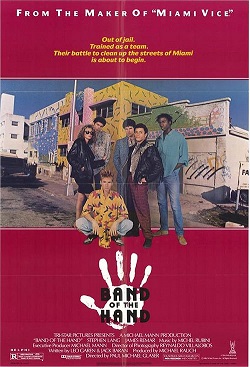
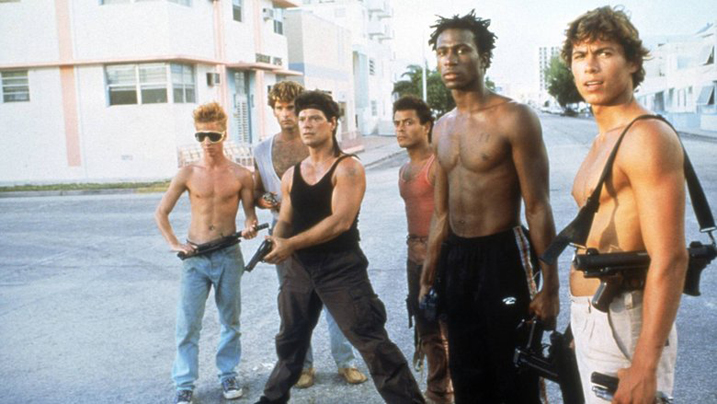
This place is Florida. The time is the 80s. Five juvenile delinquents have been given a chance to earn their freedom. All they have to do is go down to the Everglades and train with Indian Joe (Stephen Lang), a no-nonsense Vietnam veteran who is determined to teach them not only survival sills but also how to work together as a team. But Joe is interested in more than just reforming a group of youthful troublemakers. He wants to turn them into a crime-fighting team who can help clean up the most dangerous neighborhood in Miami. When Joe and delinquents move into and refurbish a previously condemned building, they get the attention of both the local drug kingpin (James Remar) and his main enforcer (Laurence Fishburne).
Band of the Hand is very much a film of its time, not only in its fashion and music choices but also in its full-on embrace of the war on drugs and the idea that the best way to clean up the streets is for vigilantes to do it on their own. The film was produced by Michael Mann and, as directed by former Starsky and Hutch star Paul Michael Glaser, the film has the look of an episode of Miami Vice. That might be because the film itself was originally meant to be a pilot for a television show. When the networks passed on it, it was released to theaters instead and advertised as being “from the maker of Miami Vice.” The movie never escapes its television origins. Things start strong in the Everglades, with Lang proving himself to be a master of glowering and the young delinquents struggling to not only survive Lang’s training but also resist the temptation to kill each other. It’s less interesting once the action moves to Miami and it becomes Death Wish 3 without the blood or Charles Bronson. The scenes with the young men goofing around are an awkward fit with the scenes of Remar and Fishburne terrorizing the neighborhood.
Band of the Hand is still worth watching if you want to see some familiar faces early in their careers. John Cameron Mitchell and Leon both score early roles as two of the delinquents-turned-crime fighters and Lauren Holly plays the romantic interest who is inevitably ends up with the bag guys. James Remar was always a good villain and Laurence Fishburne channels both his previous performance in Death Wish II and his future performance in King of New York. It’s a good cast, even if no one really breaks free from the production’s television origins.
The idea of creating a show about a special unit of young crime fighters who battle drug pushers was one that Mann didn’t abandon. The final episode of Miami Vice was essentially an unsold pilot that followed many of the same plot beats as Band Of the Hand. (It also didn’t lead to a television series, though some might argue that 21 Jump Street took the same idea and ran with it.) As for director Paul Michael Glaser, he would later do a much better job with The Running Man.
This 2003 film tells the story of 16 good-looking and not particularly intelligent college students who go to Cancun for spring break. For 8 days, they all live in the same beach house and they get to know each other. They drink. They flirt. A few of them hook up but perhaps not as many as you would expect. The dorky virgin dude says that he just wants to see “boobies” and then gets drunk off of one shot. Two platonic friends debate whether they should take their relationship to the next level. The women wear bikinis. The men wear speedos. There are bare boobs and behinds galore. Snoop Dogg makes a special guest appearance. One spring breaker get stung by a jelly fish so her new roommate pours a cup of urine on her ankle. Good thing he had already had ten beers that morning! What fun!
If this sounds like a typical spring break film, that’s because it is a typical spring break film but with one big difference. It was produced by the people behind MTV’s The Real World and, as such, the 16 spring breakers are sold as being real people who are spontaneously acting like a bunch of movie characters. In 2003, reality tv was still a relatively exotic concept and this film was an attempt to take the genre’s cheap aesthetic to the cinematic level. Even more importantly, it was an attempt to duplicate the success of Girls Gone Wild, without actually admitting to being inspired by that sleazy enterprise. As such, there’s a lot of nudity but there’s a strange lack of actual sex. There’s a lot of drinking but there’s not much drunkenness. It’s an oddly tame look at spring break, one that promises debauchery but which doesn’t deliver anything that would have kept the film out of theaters or off the cable networks. I got more wild on my spring breaks than anyone in this film and I don’t even drink.
The film’s “stars” are all pretty bland and it’s not a surprise that, with one exception, none of them have appeared in anything other than The Real Cancun. (That one exception is Laura Ramsey, who went on to have a somewhat busy acting career after appearing as herself in this film.) The film manages to make nudity boring. Seen today, The Real Cancun works best as a time capsule, largely because it was filmed at a time when there was no social media and, even more importantly, no phones. Everyone is attracted to the crew and their bulky film cameras because there aren’t any other cameras around to record them and make them famous. Today, anyone can make their own Real Cancun and post it to YouTube. In 2003, if you wanted a shot at that type of fame, you had to audition and be selected to appear in a “documentary.”
Apparently, The Real Cancun was meant to be the first part of a Real World cinematic franchise. The first Jackass film had come out the previous year so MTV was enthusiastic about producing cheap reality movies. However, The Real Cancun was such a huge flop at the box office that it killed those plans. There would be other Jackass films, of course. But the Real World Cinematic Universe imploded as soon as it began. And for that, we should probably be thankful.
I slept on it before writing this, to let the euphoria pass.
Matt Reeves’ The Batman surprised me in a number of ways, some of which can’t be mentioned without throwing spoilers. I’ll perhaps write a second piece on this, but for now, understand that this film has effectively pushed The Dark Knight to the side as my favorite live-action Batman film (The Lego Batman Movie stands on a pedestal all it’s own above all the rest). My favorite Batman stories are the detective tales. Gotham by Gaslight. The Long Halloween. Hush.
On film, the Caped Crusader has moments of investigation, but they often took a backseat either to the action or the resolution came as quickly as a Batcomputer search. For me, The Batman had closer ties to films like David Fincher’s Seven, Alan J. Pakula’s Klute, Bruce Malmuth’s Nighthawks, and even Shane Black’s The Nice Guys to some degree. It does all this legwork while finding a way to avoid giving us the same clip of the Monarch Shooting of the Waynes. That alone is worth it for me. This is Batman. After more than 9 films, you’d be hard pressed to find anyone on the planet younger than maybe six who doesn’t know how he got that way.
Living in NYC, I can relate to Gotham City. On the surface, it’s beautiful. For those who can afford it, there are tons of amenities available to its citizens. Peel back that layer, though, and you’ll always have Crime in a city holding 9 million people. It’s a constant as rain. Gotham City is on the verge of breakdown. Looking at the torn poster filled streets and I was reminded of a cross between Walter Hill’s Streets of Fire and Alex Proyas’ The Crow .and the way most of Manhattan looks now with it’s closed down stores. The city almost serves as a character itself in The Batman. It’s a throwback to some of the classic black and white detective movies my parents grew up on like 1947’s Kiss of Death. For all his gadgets and resources, there’s an argument suggesting the Batman can never really save his beloved city, though we love his efforts.
“Forget it, Bruce. It’s Gotham.” one might as well say.
Visually, the movie is a little dark, but that makes sense given the tone of the film. Cinematographer Greig Fraser (Dune, Zero Dark Thirty) is somewhat new to me, but I’m liking his work, which felt a little like Janusz Kaminski’s Lost Souls. It wasn’t dark to the point where I couldn’t make out elements (and I was sitting in the front row, far left side in my theatre), I’ll say that much. I’ll keep an eye on him in the future.
The Batman takes place in our hero’s second to third year, according to an early narration (much like Blade Runner). Batman has a good rapport with Lt. James Gordon (Jeffrey Wright, No Time to Die) and his butler, Alfred (Andy Serkis, reuniting with Reeves since Dawn of the Planet of the Apes), for the most part, there are some results. Criminals flee when the bat symbol shines in the night sky, because no one really knows where The Dark Knight will strike. A new murder brings both Gordon and the Batman into play, as his opponent leaves various riddles for them to solve. The mystery brings Batman into various circles, including those of Selina Kyle (Zoe Kravitz, Kimi), crime boss Carmine Falcone (John Turturro, The Big Lebowski) and Oz (Colin Farrell, The Gentlemen). They all bring in great performances, including Peter Sarsgaard (Green Lantern), but it’s Paul Dano (Ruby Sparks, There Will Be Blood) who really runs away with things as The Riddler. I’ve never considered The Riddler to be a creepy villain, but this was quite dark, even for DC’s standards. I can’t imagine how it would have turned out if this was a Rated R film. I’m really curious to know.
Lt. James Gordon (Jeffrey Wright) and The Batman (Robert Pattinson) do some Detective work in Matt Reeves’ The Batman
Bruce Wayne has never been an easy character to handle on screen.
There are whole books written on the Psychology of the Batman. Here you have an individual who witnessed his parents being murdered as a kid and grows up in a near empty mansion with butlers and maids. The individual decides to dedicate his life (and vast resources) to studying criminal investigation techniques, martial arts and even Ninjitsu for a singular focus: To rid Gotham City of Crime. Add to this the concept of instilling fear in one’s enemies, and dressing up like a Bat to pummel thugs with fists and gadgets just adds to Wayne’s madness. Pattinson honed in on this and turns Bruce Wayne into a pretty isolated and brooding individual. For someone with nearly unlimited resources, he doesn’t seem happy with any of it at all. At least Keaton pretended to party and Clooney’s Wayne truly did party. Bale’s Wayne let Fox focus on research and development. Hell, even Affleck’s Wayne recognized he was rich and flaunted it like a superpower all its own. Pattinson’s Batman is lean and really looks like the kind of guy you might find stepping out of the shadows just past Wall Street late at night. No offense to Affleck’s Batman, who for some is the pinnacle of what the character should be, but I’ve always associated that look with the older, fresh out of retirement Batman of Frank Miller’s The Dark Knight Returns.
Together, Pattinson and Kravitz’ chemistry was really nice on screen. I’ll admit, I enjoyed the romance between the two. Both characters accept tha they’re Creatures of the Night, and there’s this sweet give and take between the two as they nudge each other. Selina doesn’t have to do crime, and Batman doesn’t have to be the spirit of Vengeance, but they’re caught up in what works best for them. I enjoyed that aspect.
At first listen (about a week ago), I thought Michael Giacchino’s theme needed something outside of the four note motif it had. Hearing the music with the movie is a different beast, and I have to say, it works really well here. In some places, it’s as minimalistic as Hans Zimmer’s Nolan scores.
Now, a little Devil’s Advocate. The main problem I had with The Batman was the same I had with Spider-Man: No Way Home. I understand DC & Warner Bros. want to draw people into the theatre, but in this age where every element of a trailer is scanned and studied, I’d argue that 40% of the action you watched on screen were already somewhat spoiled by the trailer (or trailers, if you watched every one the Warners released). I’m not saying one should refrain from watching trailers – I only watched the teaser and the main trailer – but I would have liked if they held some scenes back. One might also argue The Batman was lighter on action than the other films, but it’s the detective work and the character performances that make up for it.
There’s also a lot of rain. Almost too much. Remember the sequence in Jurassic Park with the first appearance of the T-Rex? I would say that most of The Batman is set under somewhat similar conditions. It felt like it either just rained, was about to, or you were in the middle of a downpour. Then again, so did The Crow. Perhaps that’s just a nitpick on my part.
Also, clocking in at 2 hours and 56 minutes, it’s a long film. You might not really notice it, but I’d go so far to say that the time didn’t feel wasted. I noticed 3 or 4 people who left for the restroom in my showing, if that’s any indication.
Overall, The Batman was a wonderful surprise from the DC side of things, and I’m liking the direction it’s going. It might not be a completely connected universe like Marvel’s lineup, but they’re proving they can still weave some amazing stories with the characters they have.
Now streaming on Shudder, The Scary of Sixty-First is a weird little movie.
Two friends who don’t really seem to like each other that much, Noelle (Madeline Quinn) and Addie (Betsey Brown), move into a fully furnished Manhattan apartment. The apartment, they are told, has been uninhabited for a few years. The realtor asks them not to play the piano. One of the mattresses is stained with blood. Hidden amongst the surprisingly ornate furniture are mystical books and mysterious cards. It’s kind of a creepy place but it’s also in Manhattan and it’s affordable.
Addie, we’re told, has a history of mental instability and a difficult relationship with her family. (Noelle, at one point, refers to Addie’s father as being a pedophile.) Addie also has an idiot boyfriend named Gary (Mark Rapaport, who also produced the film). Gary may be a little bit slow but he has his standards and when Addie starts to speak in a strange voice and ask him to take part in some truly perverse role play, he freaks out.
Meanwhile, Noelle meets a mysterious person who is only referred to as being The Girl (played by the film’s director, Dasha Nekrasova). The Girl is hooked on speed and conspiracy theories. The Girl explains that Noelle and Addie’s apartment was once used by Jeffrey Epstein and Ghislaine Maxwell. The Girl says that she’s investigating their crimes but her investigation mostly seems to consist of watching YouTube videos and walking around New York. Within hours of meeting each other, Noelle and the Girl are lovers but when The Girl tries to demonstrate why Epstein couldn’t possibly have hanged himself, Noelle appears to deliberately hesitate before saving the Girl’s life. Later, as they walk around New York, the Girl spots a woman who she claims is Ghislaine Maxwell.
As for Addie, she’s having nightmares and when she’s not dreaming, she’s sleepwalking and doing even more. She’s also becoming obsessed with the British Royal Family. She’s especially interested in Prince Andrew….
“Epstein didn’t kill himself,” as the saying goes and one reason why people are still saying that years after Jeffrey Epstein’s death is because it’s obvious that, whether he killed himself or not, he still took a lot of secrets with him to the grave. I’m a student of conspiracy theories but I wouldn’t call myself a believer. I tend to assume that most of what happens in the world is due to random fate as opposed to the unseen hand of some secret organization. That said, I totally accept that there’s a very good chance that Jeffrey Epstein was murdered on the orders of the rich and powerful people who he previously flew to his private island. One reason why The Scary of Sixty-First works is because, as bizarre as the film gets, it’s still dealing with a conspiracy theory that even most skeptics find to be plausible.
And indeed, it’s a bizarre film, one that plays out like a filmed dream. Little about the film makes sense and, at the end of it, you’re still left with a lot of unanswered questions but then again, that’s a feeling that will be familiar to anyone who has ever gone down a conspiracy rabbit hole. Are Noelle and Addie truly being possessed by evil auras of Epstein and Maxwell or are they just allowing their own paranoia to drive them mad? Much like a dream, the answers are there but they’re hidden. It’s a film that many people will find to be distasteful but, at its best, it captures the speed-fueled logic of the modern conspiracy theorist. It’s a jolt of psychosis captured on a film. The apartment becomes a metaphor for both the sins of the past and the uncertainty of the present.
Understandably, many will find the film to be distasteful and it often is. But, at the same time, The Scary on Sixty-First captures the atmosphere and the paranoia of our current cultural moment. After all, Epstein didn’t kill himself.
“First time in Croatia?” asks handsome taxi driver Zain (Ziad Bakri).
As soon as Beth (Leighton Meester) answers in the affirmative, we know that she’s in trouble. If you’ve seen enough thrillers, you know that any trip to another country is going to lead to trouble. Beth may think that she’s just going to be spending a week or two with her wild best friend, Kate (Christina Wolfe), but we know that something bad is going to down. And the minute that Kate insists that Beth dress up and go to a club with her, we know that someone is going to end up missing.
The next morning, Beth wakes up with a hangover, a cluttered villa, and an absent best friend. Where is Kate? Kate and Beth were supposed to go on bicycle tour but now, Kate is nowhere to be found! More than one person suggests that maybe she didn’t want to do the whole cycling thing. I don’t blame her. You go, Kate! Don’t let your friend guilt you into doing something that lame!
However, Beth starts to have flashbacks to the night at the bar. It turns out that Beth is almost as much of a lightweight as I am when it comes to drinking because a glass of wine has totally wrecked her memory. When Kate’s landlord mentions that Kate brought two men back to the villa with them, Beth starts to think that something terrible has happened to Kate! The police soon agree with her but they think that Beth is the culprit!
Teaming up with Zain, Beth starts to investigate on her own. Her husband (Luke Norris) is not happy to learn that, while he’s in London with their baby, his wife is running around Croatia with a sensitive and widowed taxi driver, Needless to say, it soon turns out that just about everyone involved has a secret that they’re trying to hide.
The Weekend Away is the latest Netflix original thriller. It starts out on a good note, with Kate and Beth catching up on their lives in Croatia. Leighton Meester and Christina Wolfe are convincing as old friends who have followed different life paths and Croatia itself looks both inviting and ominous at the same time. Unfortunately, once Kate disappears, the film gets a bit uneven and some of the characters do some things that don’t really make sense and the actors themselves sometimes seem to be struggling to find a way to make their dialogue sound credible. The film starts with a lot of promise but the mystery itself turn out to not be as interesting as one might hope. That’s my long-winded way of saying that you’ll figure out what happened long before anyone else in the film does.
Again, it’s an uneven film but I do like to focus on the positive so I will say that the film was nice to look at. The scenes in the club were well-directed and captured both the chaos and the fun of discovering an exciting city for the first time. Leighton Meester and Christina Wolfe were convincing as friends and Luke Norris kept you guessing as Beth’s husband. It’s the Netflix equivalent of fast food. It’s the type of film that you enjoy for what it is and then you forget about it a few hours later.
Lawrence Phillips could have been one of the greatest professional football running backs of all time but he couldn’t outrun his demons.
Phillips was a great high school and college player. He led the University of Nebraska to victory in the 1995 Orange Bowl and the 1996 Fiesta Bowl. But even when he was playing under the legendary coach Tom Osborne at Nebraska, there were signs of the issues that would eventually end his professional career. In 1995, he was arrested for breaking into an apartment, grabbing his ex-girlfriend, dragging her down three flights of stairs by her hair and then smashing her head into a mailbox. At first, he was suspended from playing football but he was eventually reinstated by Coach Osborne. At the time, Osborne said that football was perhaps the only thing in Phillips’s life that could keep him on track.
The assault may have kept Phillips from winning the Heisman Trophy that he had been widely considered a favorite to receive but it didn’t keep him out of the NFL. In the 1996 Draft, the Rams selected him as the 6th overall pick. Phillips proved himself to be a talented running back but his life off the field continued to be erratic. When he showed up drunk for a pre-game practice, Phillips was cut from the team.
Phillips went to Miami, where he played two games for the Dolphins before he was arrested and charged with assaulting a woman in a nightclub. Again cut from the team, Phillips eventually ended up in NFL Europe, where he set records and proved that he could still play. Returning to America in 1999, Phillips was signed by the 49ers but he was cut after refusing to practice and missing a block that led to quarterback Steve Young suffering a season (and career) ending concussion.
With no future in the NFL, Phillips signed with the Arena Football League but was cut when he failed to show up for practice. He then went to Canada, where he had one good season with Montreal Alouettes before again getting cut after being charged with a sexual assault. The last team he played for was the Calgary Stampede. He was cut for arguing with the coach.
Phillips was 30 years old and washed up as an athlete. After his then-girlfriend tried to break-up with him, he grab her by the throat and nearly strangled her. A few days later, while driving around Los Angeles, he spotted three teenagers playing a pick-up football game. He joined their game but, after he became convinced one of them had stolen some money from him, Phillips ran the teen over with his car. Convicted of both domestic abuse and attempted murder, Phillips was sentenced to a total of 31 years in prison.
In prison, he originally kept his head down, refused to join any of the prison gangs, and stayed out of trouble. But, in 2015, Phillips’s cellmate was found strangled to death in their cell. Phillips claimed that he had accidentally killed him in self-defense. Charged with murder and facing the death penalty, Lawrence Phillips was found hanging in his cell. The official ruling was suicide.
What happened to Lawrence Phillips? How did he go from being one of the best players in the game to being an inmate in the California penal system? That’s the question that’s considered by the documentary, Running For His Life. Featuring interviews with his friends, coaches, teammates, and one of his victims, Running For His Life follows Phillips from his abusive childhood to his final days in prison. Almost everyone who is interviewed describes Phillips as being outwardly intelligent, friendly, and talented, except for when he was angry. That was when the other Lawrence would come out. Most of the people interviewed still seem to be shocked that Phillips’s life derailed the way that it did. Tom Osborne comes across as being particularly troubled that he wasn’t able to do more to help Phillips overcome his demons. The majority of the people interviewed say that Phillips’s problems were the result of growing up in group homes and spending his childhood being abused by the people who were supposed to be looking out for him.
It’s a compelling argument but Running For His Life could have used a greater variety of voices. Almost everyone who is interviewed was a friend of Phillips’s and, even though they acknowledge his crimes, it still seems that they are sometimes too quick to make excuses for him. Many of the women who he victimized were not interviewed and, as a result, the documentary feels incomplete. His victims deserved more than just a cursory mention. It may be a tragedy that Lawrence Phillips never lived up to his potential but the far greater tragedy is that so many people were hurt by his actions.
The Wrong Blind Date is the latest of the Lifetime “Wrong” films. Like all of the “Wrong” films, it was directed by David DeCoteau and it features Vivica A. Fox delivering the film’s title. It may seem somewhat silly to those who don’t regularly watch these films but, if you’re a fan of the “Wrong” series, you will literally sit through just about anything just for the chance to hear Vivica A. Fox say the movie’s name. The film’s realize this too. Lifetime films, at their best, are very self-aware. None are as self-aware as the “Wrong” films.
In this one, Fox has a supporting role. She plays Beth, who works as a therapist. One of her patients is Laura (Meredith Thomas). Laura has got a lot to deal with. Her daughter, Hannah (Sofia Masson), has just started going to college and is dating Noah (Rainer Dawn). Laura and her friend, Angela (Lesli Kay), are trying to launch their own design firm. Laura is also in the process of getting a divorce from her husband, an abusive ex-cop named Michael (Clark Moore). Michael is controlling and temperamental and he’s also determined to convince Laura not to go through with the divorce.
When Laura puts her profile on a dating website, she’s shocked by the number of replies that she gets. One of those replies is from Kevin (Matthew Pohlkamp). Kevin is handsome and charming and he lives in Beverly Hills. He lists his job as investment banking. Kevin has money and he’s so interested in Laura that he even finds a way to contact her after she deletes her dating profile! At first, Laura thinks that Kevin’s behavior is a little stalkerish but then she agrees to go on one date with him. And that one date leads to another and then another and then….
But wait a minute! This is a Lifetime film! Even more importantly, this is a “Wrong” film. Those of us who have spent years viewing these movies know better than to trust any perfect man who claims to be wealthy. Laura may not realize that there’s obviously something sinister about Kevin but we do! Unfortunately, Laura is so used to her husband acting like a jerk that she’s overly impressed when Kevin does things like refuse to pick a fight with an obnoxious drunk. It’s only after Laura leaves that Kevin returns to the bar and beats the man up.
Yes, Kevin has some problems. He’s the wrong blind date. And it soon becomes apparent that he’s lying about who he is, where he lives, and what he even does for a living. It’s not a spoiler to tell you that Michael has hired Kevin to fool his wife, all as a part of a rather silly plan to convince Laura to take him back. But when Kevin starts to become obsessed with Laura, not even Michael can stand in his way.
These films are predictable but fun. We all know better than to trust Kevin but that doesn’t make it any less enjoyable to watch as Hannah vainly tries to convince her mother that she needs to do a little more research into her new boyfriend’s background. And, of course, there’s the murders. There’s always a murder or two in a Lifetime film. Mereidth Thomas and Sofia Masson are convincing as mother and daughter and Matthew Pohlkamp is credible whether being charming or unhinged. And, of course, Vivica A. Fox says the name of the movie. It’s Lifetime, what’s not to enjoy?
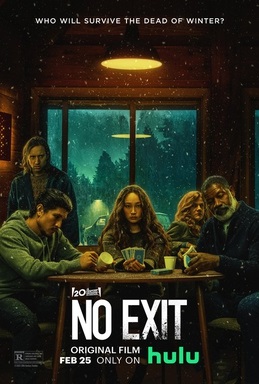
After she learns that her mother is in the hospital and possibly on the verge of death, Darby (Hannah Rose Liu) breaks out of drug rehab, steals a car, and starts driving to Salt Lake City. However, what Darby doesn’t know is that she’s also driving straight into a blizzard. Soon, Darby is forced to take shelter at a nearby state park visitors center.
Darby isn’t the only person seeking shelter that night. There’s a married couple, Ed (Dennis Haysbert) and Sandi (Dale Dickey). Ed is a veteran of the Marine Corp while Sandi is a nurse. There’s Ash (Danny Ramirez), who has the friendliest smile to ever be seen in the middle of a blizzard. And then there’s Lars (David Rysdahl), who is distinguished by his long hair and his nervous mannerisms. When Darby first enters the visitors center, Lars is curled up in a corner and loudly snoring.
And then there’s Jay (Mila Harris). Jay is a child who happens to be bound and gagged in one of the vehicles parked outside. When Darby discovers her, she has to not only save the child’s life but also figure out which one of the people in the visitors center is responsible for kidnapping her.
Clocking in at a brisk 90 minutes, No Exit is full of twists and turns. I’ll do my best to keep spoilers to a minimum in this review. Not all of the film’s twists work, of course. There’s a few moments that, in hindsight, didn’t exactly make sense. After watching the film, you could spend hours debating why certain characters did the things that they did, assuming that you were so inclined and that you could actually find anyone else willing to sit through your analysis. However, the film itself is so quickly paced and well-directed that it doesn’t matter that the story itself is occasionally a bit implausible. From the minute Darcy breaks out of that rehab, the film captures the viewer’s attention and it doesn’t let go until the final credits start to roll up the screen. This is an entertaining B-movie, one that makes good use of its isolated location and its talented cast. Havana Rose Liu especially deserves a lot of credit for her sympathetic lead performance as Darby. Darby is a cynic and a survivor but she still has enough humanity inside of her to risk her life for a stranger.
The film looks great, with its scenes of cars driving through the raging snow storm and the film’s cast gathered in the somewhat tacky visitors center. All of the snow falling reminded me of i’m thinking of ending things and I have to admit that a part of me kept expecting there to be some sort of a metaphysical twist towards the end of the film. I found myself wondering if the visitors center would be revealed to be Hell, which wasn’t a totally outlandish idea when one considers that the film shares the same name as Sartre’s famous play. But no, No Exit is a thriller that deals with concerns that are very much earthbound. It’s an well-executed thriller and an entertaining way to spend 90 minutes. It can currently be viewed on Hulu.
Don’t Kill Me, an Italian film that is currently available on Netflix, opens with two teenagers in a car. Robin (Rocca Fasano) is driving. His girlfriend, Mirta (Alice Pagani), is in the passenger’s seat. Robin is driving fast and erratically. In fact, he nearly crashes the car more than a few times. This is because Robin is driving with his eyes closed, forcing Mirta to shout directions at him. It’s almost as if Robin wants Mirta to come to a violent end.
Eventually, they end up in a quarry. Having taken a break from attempting to crash the car, Robin wants Mirta to take a drug with him. Mirta’s never tried the drug before. She’s nervous, even though Robin assures her that it will be a wonderful experience. Mirta finally agrees but requests, “Please don’t kill me.”
Yeah, good luck with that.
Of course, Mirta dies. Mirta’s body is sealed up in her family’s vault. A few hours after the funeral, a very confused and angry Mirta smashs her way out of the vault. Dazed, she wanders back to her old house. She’s definitely not alive but she’s not completely dead either. Instead, she is one of what the film calls “the Overdead.” She’s nearly immortal. At one point, she gets shot several times and, while it’s not a pleasant experience, it also doesn’t come anywhere close to killing her. She still has her memories of what life was like before she died and, to judge from the other members of the Overdead who she meets, it appears that she won’t ever age. Unfortunately, being one of the Overdead also means that if she doesn’t regularly drink the blood of the living, she’ll start to decay. Starvation is the only way to destroy a member of the Overdead. There’s a secret group of men who have spent centuries tracking down and starving the Overdead. Those men are soon chasing after Mirta.
Don’t Kill Me is at its strongest during its first half, when the film skips through time and the emphasis is on atmosphere and ennui. The scene where Mirta breaks through the crypt carries hints of Jean Rollin’s Living Dead Girl and, much like Rollin’s best films, the first half of Don’t Kill Me often focuses on both the importance and the mystery of how we recall things. Meanwhile, the scenes of Mirta wandering through the countryside and prowling the clubs for food are reminiscent of Jess Franco’s Female Vampire. The first half of the film feels like a tribute to the wonderful Eurohorror of the past. Unfortunately, the film starts to lose its way once Mirta is captured by the secret society that’s trying to destroy her. In its second half, it just becomes another film about escaping from a military base. Don’t Kill Me is based on a YA novel and it’s obviously meant to be the first in a series of films about Mirta’s life as one of the Overdead. As a result, the film’s ending is a bit unsatisfactory. For all the build-up, it sputters to a “to be continued” style conclusion.
That said, there was enough that worked about Don’t Kill Me that I’m willing to forgive what didn’t work. I may be alone in that as most of the online reactions that I’ve seen towards this film have been overwhelmingly negative. Well, so be it. There was enough atmosphere to keep me interested. Alice Pagani gave a pretty good and sympathetic performance as the conflicted Mirta and Fabrizio Ferracane, as the man determined to capture and starve her, was enjoyably villainous. Don’t Kill Me may not be for everyone but it worked for me.