October Positivity: The Ground Beneath Our Feet (dir by Lauren Havel)


In The Ground Beneath Our Feet, Emma Bryant (Elliana McKean) is a teenager who feels lost.  Her school has drab lighting and is full of teachers who don’t seem to care and bullies who terrorize the hallways.  When she gets cast in the school musical, it turns out that it’s a sacrilegious dirge written by a drama teacher who obviously has issues of her own.  (“Thank God I don’t need God!” a typical song goes.)  Her grandparents aren’t going to be happy about that!  For that matter, they also probably wouldn’t approve of her crush on simple-minded football star Aiden (Cooper Southfield).

Hidden away in the corners of her grandparents’ home is a diary that was written by Emma’s great-aunt Evelyn.  Reading it, she learns about how, in the 1950s, Evelyn (Mirabelle Bishaw) watched as her sister Mary (Ruby Eisenberg) fell under the influence of a no-good boyfriend named Roy (Eric Johnson) and a Math teacher who rarely taught about Math and instead would spend the entire class talking about his atheism.

The film flashes back and forth, from the 50s to 2024.  There’s even a brief stopover in the 70s.  That’s actually an intriguing premise and the film does make an effort to show how history repeats itself.  The alienation that Mary felt in the 50s is much like the alienation that Emma feels in 2024.  Unfortunately, the film itself really doesn’t have the budget to convincingly recreate the 50s, beyond featuring a few vintage cars.  Indeed, the film’s version of the 50s feels almost like a parody.  All of the dialogue has the sound of a writer trying to duplicate the rhythms of an era that they don’t know much about beyond what they’ve seen on television or in other movies.  And while Mirabelle Bishaw, Ruby Eisenberg, and Eric Johnson all do a good job in the 50s scenes, the actors playing their friends and acquaintances deliver their lines almost robotically.  It’s a bit disconcerting to listen to some of them.

The main theme running through this film is that people are very easily led.  That’s not necessarily a bad theme.  The truth of the matter is the most people are easily manipulated, especially by authority figures like teachers.  (Myself, I tend to assume that everyone is wrong except for me.  And while that may be preferable to being easily influences, it still comes with its own set of difficulties.)  In the modern scenes, Emma listens as a friend of her grandmother’s explains that her granddaughter has fallen away from the church because she read a set of “fantasy book” that led to her becoming an occultist.  That’s something that often seems to happen in faith-based films but I have to say that I don’t buy it.  Don’t blame the books just because your granddaughter apparently can’t think for herself.  People are responsible for their own decisions, regardless of how easily led they may be.

This film was definitely better-made than the average faith-based film.  The movie actually looked like a real movie.  Elliana McKean was sympathetic and likable as Emma.  The story was a bit difficult to follow.  The nonlinear style of storytelling has become very popular nowadays but it really does require a fine eye for detail to truly make it work.  I doubt it will convert anyone but at least the film felt like a professional production.
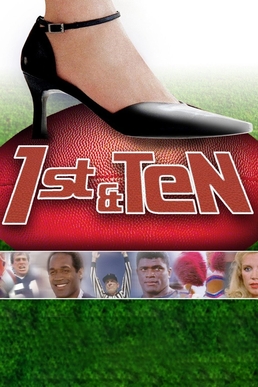
Late Night Retro Television Review: 1st & Ten 5.6 “Clean and Sober”


Welcome to Late Night Retro Television Reviews, a feature where we review some of our favorite and least favorite shows of the past! On Wednesdays, I will be reviewing 1st and Ten, which aired in syndication from 1984 to 1991. The entire series is streaming on Tubi.

This week, Billy Cooper gets in trouble.

Episode 5.6 “Clean and Sober”

(Dir by Stan Lathan, originally aired on November 15th, 1989)

This week’s episode features three storylines.

The simplest of the storylines features Denardo’s ex-wife (Arlene Golonka) showing up at his house and saying that she’s hiding from a stalker.  She even changes Denardo’s phone number.  It turns out that her stalker is actually her current husband and they’re just having a minor argument.  They’re reunited while Denardo stands in the background and smiles.

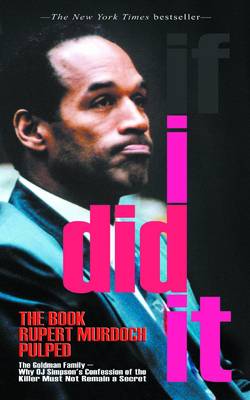
The comedic storyline features an ex-player named Wes (Bob Chandler) asking Dr. Death and Jethro to serve as his bodyguards for a week.  Wes, who left football and got the lead role on a cop show, says that he’s going to have to testify against a mob boss.  Dr. Death and Jethro agree to keep an eye on him.  For instance, they bring him to practice.  They also freak out when someone tosses an unlit stick of dynamite at them.  Eventually, it turns out that Wes set them up to be the victims on a television prank show.  This storyline also featured Zagred begging Wes to put him on his show.  Even TD Parker (OJ Simpson) got in on the spirit, asking Wes if he could help him pitch a television show about a football manager who solves murders.  Uhmm, yeah, that sounds like a great idea, OJ….

The dramatic storyline features Billy getting into an accident while driving drunk.  His companion for the night is nearly killed.  Billy is sentenced to 90 days of alcohol rehab.  The member of the Bulls are not supportive of Billy’s attempt to get sober.  Johnny Gunn resents that he spent six years in prison for something that he did while drunk but Billy is apparently going to get away with just a slap on the wrist.  Billy stops drinking and starts popping pills.

TD is upset to see that Billy is not making a real effort to get sober.  When TD hears an commentator refer to Billy as being a “true professional,” TD replies, “Not in my book.”

Really, OJ?

This episode was all over the place, as is usually the case with 1st & Ten.  I actually found the storyline about Wes to be amusing but it didn’t feel like it belonged on an episode where Billy was trying and failing to get sober.  That said, this episode’s portrayal of Billy as being too rich and too famous to be held responsible for his mistakes was probably pretty close to the truth when it comes to celebrity addicts.  Billy may hate himself but he’s got enough cash to soothe the pain.

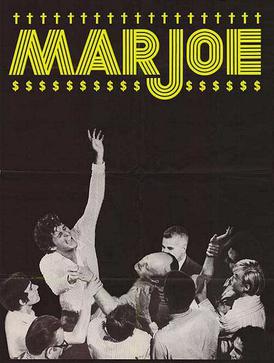
Documentary Review: Marjoe (dir by Howard Smith and Sarah Kernochan)


Before Marjoe Gortner was an actor, he was a preacher.

Actually, that might be a bit too glib on my part. According to Marjoe, he was never more of an actor than when he was standing under a tent and preaching.

The 1972 documentary Marjoe opens with footage of a four-year-old Marjoe Gortner wearing a white button-down shirt and a bow tie and preaching about how all the sinners are going to burn in Hell. We watch as young Marjoe performs a marriage. We see his parents beaming as Marjoe delivers a fire-breathing sermon. In a voice-over, an adult Marjoe Gortner explains that he was named after Mary and Joseph and that both of his parents were active on the Pentecostal revival circuit. His father was a preacher. At four years old, Marjoe became the world’s youngest ordained preacher. Marjoe talks about how the novelty of a child preacher drew in crowds. By the time he was 14, he had brought in over four million dollars to his family’s ministry. When crowds turned out to be less interested in a teenage preacher than they had been in a child preacher, Marjoe’s father left the family and took the money with him.

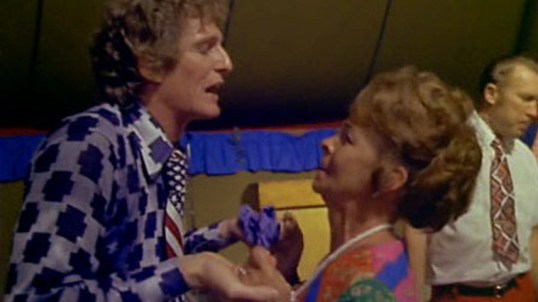
We cut to Marjoe Gortner at 27. He’s tall, a little bit gawky. He has curly hair and a beak-like nose. He’s not exactly handsome, but when he speaks, he still has the charisma that once made him a superstar in evangelical circles. He’s talking to a documentary crew who are about to follow him on what he says will be his final revival tour. Marjoe claims that, even as a child, he never really believed or even understood what he was preaching. He was raised to perform, and that’s what he did. Now, Marjoe says that he’s had a crisis of conscience. In public, he’s still a fire-and-brimstone preacher who claims to be able to heal the sick and whose rhythmic sermons cause people to dance, speak in tongues, and give away their money. (The money, Marjoe explains, is the important part.) He preaches against drugs and sin and anyone who believes differently than he does. In private, Marjoe is a pot-smoking beatnik (and indeed, beatnik would be the right term to use because Marjoe’s a bit too cynical to be considered a hippie) who enjoys hanging out with the same people that he condemns from the stage.

The documentary features a lot of footage of Marjoe at various revival meetings, preaching and showing off the moves that he says he copied from Mick Jagger. We watch as Marjoe has an awkward reunion with his estranged father, who shows up to preach under the same tent as his son. We watch as Marjoe repeatedly counts his money. Marjoe revels in being a showman and admits that he still loves the feeling of holding the emotions of his audience in the palm of his hand. As creepy as the footage sometimes is, there’s a definite elitism to the documentary crew, of which they don’t really seem to be aware. Of course, the film seems to be saying, this would happen in the South. We Northerners are too smart to fall for Marjoe’s act. And yet, just the fact that they’re filming him shows that they have fallen for his act. They just don’t realize it.

While the revival footage is indeed fascinating (one can really feel the audience getting swept up in Marjoe’s sermons), the film’s most interesting moments are when we see Marjoe talking to the documentarians. For all the talk about how he wants to finally be himself, Marjoe never stops performing. Even when he’s confessing and claiming to be telling the truth, Marjoe is acting. One gets the feeling that performing is all that Marjoe ever knew, and certainly it makes it easy to understand why, in the years following this documentary, he found success as a character actor. There’s never a moment in the documentary in which Marjoe isn’t “on.” In the end, one gets the feeling that he’s conning the documentarians just as easily as he’s conning the faithful. When Marjoe says that he is “bad but not evil,” it ultimately feels like another performance. Marjoe spends the documentary taking viewers behind the scenes, and yet he’s as much of an enigma at the end of the documentary as he was at the beginning. He’s a fascinating character, if only because it’s impossible to tell how much of anything is real to him.

(Indeed, watching Marjoe, I was reminded of Elizabeth Holmes’s disturbingly empty smile in the trailer for the upcoming documentary You Can See Everything.)

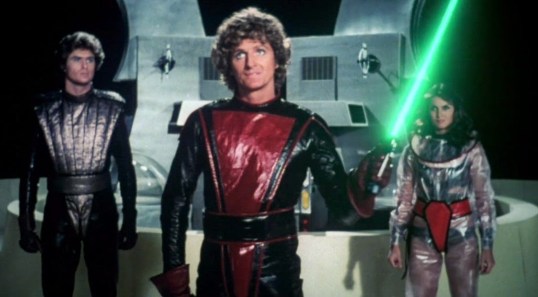
Released in 1972, Marjoe won the Oscar for Best Documentary. Marjoe Gortner, who passed away last week at the age of 82, had a lengthy acting career, one in which he often played con men and other outlaws. His final role was in 1995’s Wild Bill. He played a preacher.  My favorite Gortner role will always be as Akton in 1978’s Starcrash.

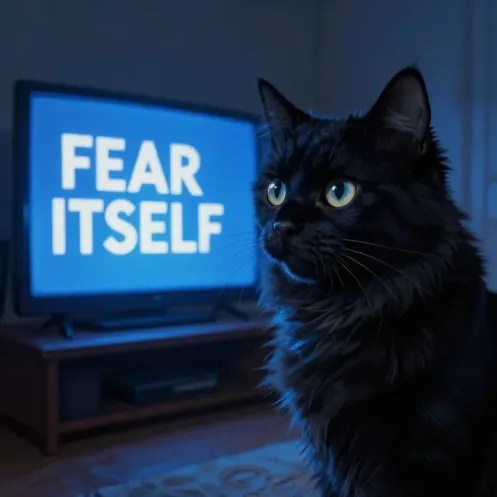
Horror On TV: Fear Itself 1.7 “Community” (dir by Mary Harron)


In tonight’s episode of Fear Itself, Bobby (Brandon Routh) and Tracy (Shiri Appleby) are a young couple who move to a gated community and learn that there are consequences to upsetting the HOA.  The story is familiar but Mary Harron does a good job of combining satire with chills.  Watching how Bobby and Tracy are pressured to conform to the rules of the community, it was hard not to be reminded of the excesses of the COVID era.

(Of course, the truly interesting thing about the COVID era was seeing how many self-styled nonconformists revealed their true selves once they were actually put in a position where taking a stand could have had consequences.  They know who they are.)

This episode originally aired on July 24th, 2008.  Mary Harron, of course, is best known for directing American Psycho.

The TSL Horror Grindhouse: House of the Damned (dir by Maury Dexter)


1963’s House of the Damned tells the story of an isolated mansion.  It’s a place that many people have tried to live in but no one has ever been willing to stick around for too long.  There are rumors that the mansion is haunted.  In fact, you could even make the claim that the mansion is a house of the damned!  Of course, we all know that there’s no such thing as ghosts, right?
Joseph Schiller (Richard Crane), the new owner of the mansion, calls architect Scott Campbell (Rob Foster) and tells him to go up to the house and check the place out.  Scott points out that he was planning on celebrating his anniversary with his wife, Nancy (Merry Anders).  Joseph say that there is no better way to celebrate an anniversary than to visit a house that might be haunted.  Scott and Nancy (who  is amazingly understanding) head for the house, where all sorts of strange things happen.

What type of strange things?  Keys disappear.  There are weird noises.  Sometimes, it seems like something or someone might be lurking in the shadows.  Could the house be haunted?  While Scott and Nancy try to figure out what’s going on, Joseph shows up with his wife, Loy (Erika Peters).  When Loy disappears, it becomes obvious that something is happening in the house of the damned!

House of the Damned is a briskly paced and occasionally effective haunted house story.  It was directed by Maury Dexter, who was a director who was so fast and so capable of stretching a low budget that, at his best, he gave Roger Corman a run for his money.  House of the Damned is only 63 minutes long and the film’s story isn’t particularly complex but Dexter still manages to create a properly ominous atmosphere and he does keep you guessing as to whether or not the house is actually haunted.  The house itself was the former estate of infamous gangster Bugsy Siegel.  Dexter reportedly spent ten days filming the movie at the Spiegel estate.  Hopefully, he was not bothered by Bugsy’s ghost.

None of the characters are particularly well-developed but they are well-cast and the actors are all likable.  The best performance comes from Erika Peters, who plays Loy as being slightly self-absorbed but ultimately good-hearted.  She also gets to wear a bathing suit that is simply to die for.  This film also features a very early performance from the great Richard Kiel, playing “The Giant.”  It’s always nice to see Richard Kiel in a movie.  Shortly before he passed away in 2014, Kiel visited my Alamo Drafthouse for a showing of The Spy Who Loved Me.  Though it was obvious that he wasn’t in great health, he still took time to answer questions and to show off a rather charming smile.  When a certain redhead told him that she loved him in a beloved 90s golf comedy, he smiled and said, “I believe that jacket belongs to Mr. Gilmore.”

House of the Damned was a nice surprise.  We need more 62-minute films.

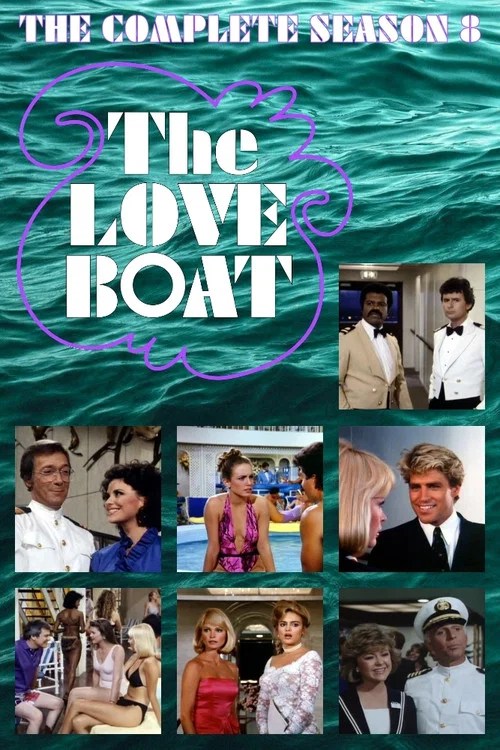
Retro Television Review: The Love Boat 8.15 “Santa, Santa, Santa/Another Dog Gone Christmas/Noel’s Christmas Carol”


Welcome to Retro Television Reviews, a feature where we review some of our favorite and least favorite shows of the past!  On Wednesdays, I will be reviewing the original Love Boat, which aired on ABC from 1977 to 1986!  The series can be streamed on Paramount Plus!

Merry Christmas!

Episode 8.15 “Santa, Santa, Santa/Another Dog Gone Christmas/Noel’s Christmas Carol”

(Dir by Richard Kinon, originally aired on December 15th, 1984)

It’s time for the Christmas voyage!

Assigned to hire a Santa Claus for the trip, Judy McCoy has finally managed to find one in the surprisingly thin form of Max Phelps (Ray Waltson).  Uh-oh!  Apparently, Gopher didn’t get the memo and he hired a Santa Claus of his own, Patrick Turney (Avery Schreiber).  Well, this is awkward but surely …. wait a minute, who is that with Isaac?  Isaac also hired a Santa Claus, in this case Shakespearean actor Malcolm (Scatman Crothers)!

How did this happen and I mean that sincerely.  I guess I can understand Gopher having the power to hire a Santa Claus because he is the ship’s pursuer.  But why is Isaac hiring people?  How does the Captain not know who is and who isn’t being hired for his ship?  And why didn’t either Gopher or Isaac tell Judy that they hired a Santa Claus?

These are legitimate questions but they really don’t matter.  The three Santa Clauses are all wonderful in their roles and watching them try to outdo each other is actually pretty entertaining.  This is a storyline that worked better than it had any right to, largely because there wasn’t a hint of cynicism to be found on The Love Boat.  Most modern sitcoms would have made the Santa Clauses angry or bitter.  But, on The Love Boat, three Santas are always better than one!

As for the other stories, Carol Kelsey (Kim Lankford) lies to her mother (Anne Francis) and tells her that Ace is her fiancé.  Carol is just trying to get her mother off of her back.  But when Carol falls for Ace’s friend, Noel Kane (Shea Farrell), Carol’s mother fears that her daughter is cheating on Ace.  No worries!  What can go wrong when you fall in love with someone named Noel on Christmas?  Again, this is another episode that worked specifically because of The Love Boat’s utter and complete earnestness.  It was goofy and it was perfect for a Christmas voyage.

Finally, Vicki is sailing with her dog, Tundra (played by the adorable Tundra The Wonder Dog).  Because Vicki’s aunt and uncle can no longer look after Tundra and a boat is no place for a dog to live, she gives Tundra to a down-on-his luck stand-up comedian (Howard Morris).  This was such a sweet story that it brought tears to my eyes.  Tundra was adorable and he brought a lot of cheer to the entire boat.

Wow, Christmas in October!  Happy holidays everyone!

Horror On The Lens: Robot Monster (dir by Phil Tucker)


I love this movie!

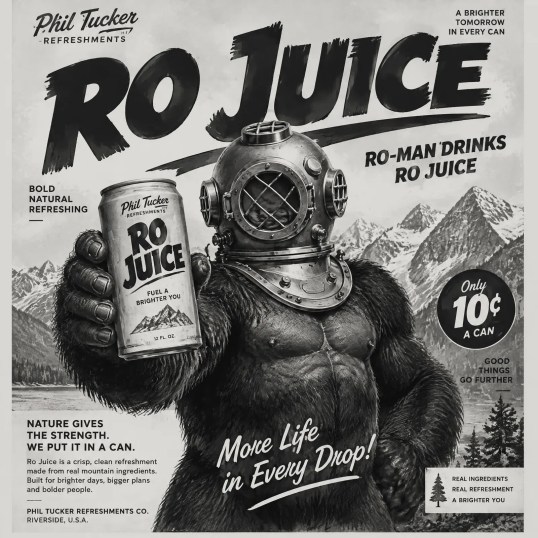
In this 1953 film, a gorilla wearing a diving helmet uses the Calcinator Death Ray to wipe out almost all human life on Earth.  Only 8 people survive, among them a professor, his family, and Roy (future Eurospy star, George Nader).  Ro-Man (George Barrows) is hounded by his superior to track down and destroy the survivors.  Ro-Man does his best, though the humans prove to be …. well, they’re not really that resourceful.  In fact, they’re pretty dumb.  But Ro-Man is pretty dumb himself.

Regularly (and incorrectly) cited as being one of the worst films ever made, Robot Monster is an enjoyably absurd hybrid of horror and science fiction.  Earth is destroyed through a combination of bad lighting effects and stock footage and the arguments between Ro-Man and his superior have to be heard to be believed.  Robot Monster is actually a bit more self-aware than a lot of people realize.  This is a low-budget Z-movie that realizes that it’s a low-budget Z-movie and which cheerfully embraces its identity.  Robot Monster is a personal favorite and it’s a bit of Halloween tradition around these parts.

And now, enjoy Robot Monster in all of its black-and-white glory!


Horror Song of the Day: Buio Omega by Goblin


Today’s horror song of the day comes from the 1979 film, Beyond The Darkness.

This film’s theme song, courtesy of Goblin, was so acclaimed that it later turned up in several other Italian horror film, usually without anyone bothering to credit Goblin.  In this video below, it’s performed by the members of Goblin Reborn, who should not be confused with the members of Claudio Simonetti’s Goblin or Goblin Legacy.

(I swear, the members of prog rock bands are almost as difficult to keep track of as the minor members of European royalty.)

As for the image behind the band, that is Cinzia Monreale, who played two roles in Beyond The Darkness.

Horror Scenes That I Love: Cheatin’ Harry Gets Grabbed In Attack of the 50 Foot Woman


From 1958’s Attack of the 50 Foot Woman, Harry discovers that cheaters never get away with it.  Especially when they’re cheating on someone who is 50 feet tell….

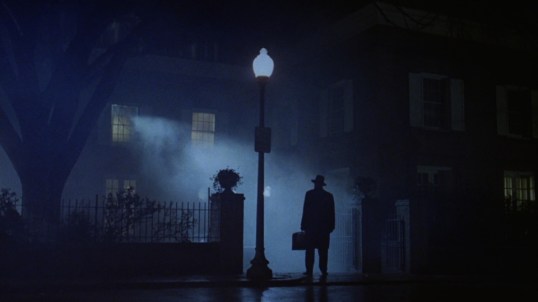
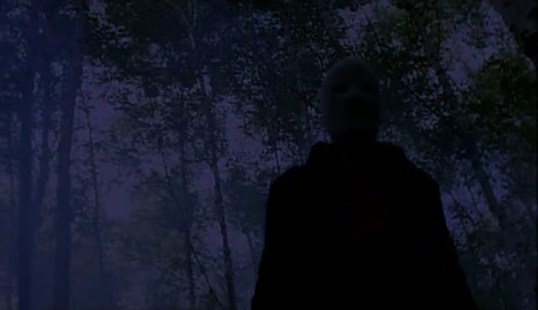
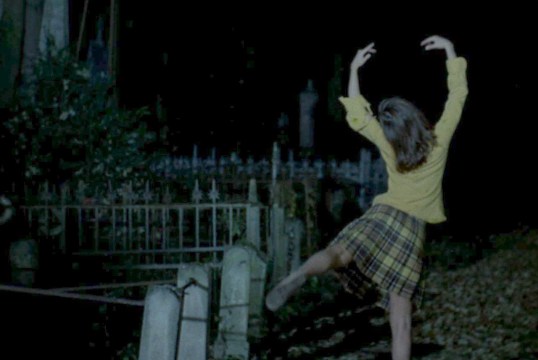
4 Shots From 4 Horror Films: October 7th


4 Or More Shots From 4 Or More Films is just what it says it is, 4 shots from 4 of our favorite films. As opposed to the reviews and recaps that we usually post, 4 Shots From 4 Films lets the visuals do the talking!

4 Shots From 4 Horror Films

The Exorcist (1973, dir by William Friedkin)

Torso (1973, directed by Sergio Martino)

The Iron Rose (1973, dir by Jean Rollin)

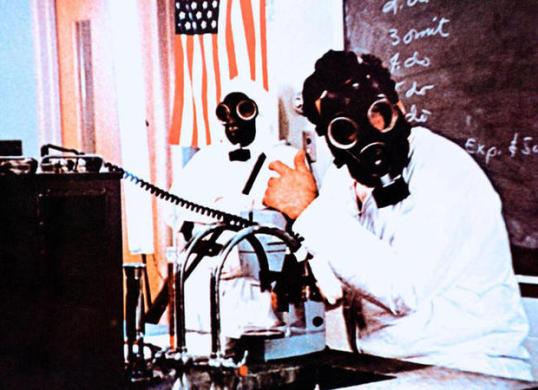
The Crazies (1973, dir by George Romero)