For today’s music video of the day, we have Kim Wilde performing Kids in America. This was her first single and one of two of Wilde’s singles to chart in the United States, the other one being her cover of The Supremes’s You Keep Me Hangin’ On. (Wilde found more success in her home country, with 25 singles charting on the UK charts.) The song was written by Wilde’s father and her older brother, both of whom were fascinated by American youth culture.
The video, which finds Kim Wilde literally looking out a “dirty old window,” was directed by Brian Grant, who was one of the busiest music video directors of the 1980s. He also did videos for The Human League, Squeeze, Queen, and Tina Turner.
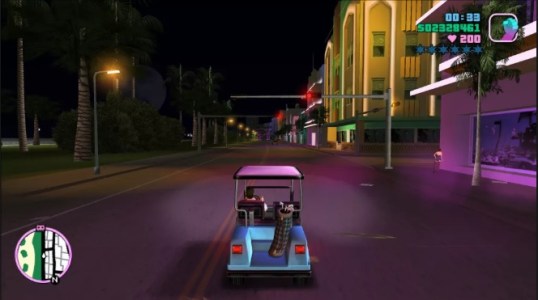
Myself, I will always associate this song with stealing cars in Vice City.
The only thing better than stealing a golf cart is stealing a golf cart while listening to Kim Wilde sing Kids in America!
I may be going to Hell in a bucket but at least I’m enjoying the ride
The members of the Grateful Dead didn’t do many music videos. I think Hell In A Bucket was their second video, following the surprise hit that they had with A Touch of Grey. From what I’ve read, it was the band’s record label that insisted that the band make some videos to help promote their 12th studio album, In the Dark. Some members of the band were concerned that agreeing to do music videos would mean that they were “selling out.”
The video for Hell In A Bucket feels like it could be a parody of the type of videos that were popular on MTV. With his Miami Vice-Style outfit and the way he mugs for the camera, Bob Weir almost seems like he could be Huey Lewis’s coked-out older brother. The video opens in a biker bar, populated with the type of rough characters who most bands would never dream of featuring in a video. While Jerry Garcia keeps his distance, Bob Weir sings a song of rock and roll decadence that seems to be saying, “This is what it’s all really about.”
No, I don’t know why there’s a duck at the bar. It’s just there. Jerry daughter’s Trixie is also in the video. She plays one of the dancing devils.
For this music video, director Mark Romanek was inspired by both Midnight Cowboy and The 400 Blows. Beck, wandering through New York City with his cowboy hat and his radio, was meant to be a modern-day Joe Buck while the freeze frames were inspired by the end of Truffaut’s portrait of alienated youth.
Two of the videos most memorable moments were accidental. When the car nearly runs over Beck, it is meant to recall the “I’m walking here!” scene from Midnight Cowboy but the car’s driver didn’t hit the brakes soon enough and Beck was actually hit by the car and injured his leg as a result. The other unplanned scene was when the pigeons took flight just as Beck approached them.
The video for Devil’s Haircut would go on to win two MTV Music Video Awards, one for Best Editing and one for Best Male Video.
Once In A Lifetime has since become one of the signature tunes of the ’80s but, when the song was first released in 1981, it didn’t even manage to break the top 100 on the US charts, peaking at 103. (The song did find more success in the UK, where it reached #13.) At the time, the song was not considered to be “radio friendly.” Not even the fact that the video was put into heavy rotation during the early days of MTV could change the minds of stubborn programmers who were convinced that the sound of David Byrne considering his life would lead to listeners switching the channel.
The video, which features multiple David Byrnes performing against a white backdrop, was directed by Byrne and the famous dancer/choreographer Toni Basil. (Basil, of course, had her own hit around the same time with her video for Mickey.) In the book, MTV Ruled the World – The Early Years of Music Video, Basil discussed making the video with Byrne:
“He wanted to research movement, but he wanted to research movement more as an actor, as does David Bowie, as does Mick Jagger. They come to movement in another way, not as a trained dancer. Or not really interested in dance steps. He wanted to research people in trances – different trances in church and different trances with snakes. So we went over to UCLA and USC, and we viewed a lot of footage of documentaries on that subject. And then he took the ideas, and he ‘physicalized’ the ideas from these documentary-style films … David kind of choreographed himself. I set up the camera, put him in front of it and asked him to absorb those ideas. Then I left the room so he could be alone with himself. I came back, looked at the videotape, and we chose physical moves that worked with the music. I just helped to stylize his moves a little.”
As for the song, Byrne has said that he came up with most of the lyrics while listening to radio evangelists and the song’s plaintive cry of “How did I get here?” should sound familiar to anyone who has ever heard any of the old style preachers going at it. The song’s signature bassline was developed by Tina Weymouth, who has said that she based it on the sound of her husband (and Talking Heads drummer) Chris Frantz yelling.
As for the song, it may not have charted but it has gone on to become one of the defining songs of the 80s. The song would also be one of the highlights of the greatest concert film ever made, Stop Making Sense.
A man drives through the desert in a Thunderbird. A hawk perches in a church. An unknown couple dance the tango. The beach awaits. Yes, this is the video for Mr. Mister’s Broken Wings.
The video was directed by Oley Sassone, who later directed episodes of Hercules and Xena.. According to Sassone, “The subtext of the story and what I wanted the audience to feel was our hero’s own backstory in his mind. The tango dancers, juxtaposed with the images of him getting lost while driving, tossing a map and instead following the hawk overhead was, symbolically, his own soul, his own voice deep inside telling him to carry on – to lead him to a new path, a new beginning.” Personally, I have always thought this song was about someone struggling to recover from a bad breakup.
Broken Wings is a song that epitomizes the mid-1980s so it’s not surprising that it’s also included on the Vice City: Grand Theft Auto soundtrack. Getting chased the a police helicopter while listening to Mr. Mister is a surreal experience.
Information Society was formed, in Minneapolis, by Paul Robb in 1982. Despite a small but devoted fan base, the band initially struggled to achieve mainstream success, which led to several lineup changes during the group’s early years. It wouldn’t be until 1985 that Information Society would have their first minor hit and then it would be another three years before they released their two best known songs, What’s On Your Mind (Pure Energy) and Walking Away.
According to Paul Robb, Walking Away was written while he was thinking about all of the people who had recently left the band. In Robb’s own words, “So if you listen to the lyrics of ‘Walking Away,‘ it’s basically just someone complaining about people who left. That’s because that’s exactly what it is.” Though Walking Away was not as big a hit as What’s On Your Mind, it still charted at #9 and there’s a good chance of hearing it played at any 80s night.
Just as Pure Energy sampled Leonard Nimoy, Walking Away opens with William Shatner saying, “It is useless to resist us.” Leonard’s son, Adam Nimoy, was a huge fan of the band and was instrumental in winning the band permission to use the audio samples in their songs.
Mark Pellington also directed the video for the band’s first hit, What’s On Your Mind.
Leonard Nimoy saying, “Pure energy” was taken from the Star Trek episode Errand of Mercy. Both the sound of Nimoy’s voice and this energetic video led to this song becoming a surprise hit. One radio station in Boston played the song on a continuous loop for 25 hours straight, leading people to call the station because they thought “Pure Energy” was a warning that something had gone wrong in the DJ booth.
Mark Pellington was one of those directors who did videos for just about everyone during the first decade of the MTV-era. He has also directed feature films like Arlington Road and The Mothman Prophecies.
In 1995, Duran Duran released an album of cover tunes. The one that got the most attention was this cover of Grand Master Melle Mel’s anti-cocaine anthem, White Lines. Listen as Duran Duran raps! The 90s were a wondrous time that we will never know again.