The Adventures of a History Nerd: Candidates ’72


1972!  Now, that’s a presidential election that I’m sorry I wasn’t around to witness!

1972, of course, was the year that the Democrats nominated George McGovern and President Richard Nixon went on to win 49 states.  McGovern was considered to be one of the most left-wing presidential candidates of all time.  He started out as a dark horse but ultimately won the Democratic nomination after the more moderate Edmund Muskie’s campaign turned to be not as strong as people assumed and after Governor George Wallace’s campaign was ended by gunfire in Maryland.  (Wallace survived being shot but spent the rest of his life in wheelchair.)  McGovern’s campaign knew how to win a primary but had no idea how to win a general election.  He ended up getting around 37% of the popular vote.  He carried Massachusetts but he lost his home state of South Dakota.

Today, it’s usually assumed that Nixon’s victory was a foregone conclusion but that’s not true.  The Republicans had a weak midterm in 1970.  The Vietnam War was unpopular.  Nixon, himself, had managed to upset both the conservative and the liberal wings of the Republican Party with some of his policies.  Much as in 2020, a record number of candidates threw their hat into the ring to take on the incumbent President.  1972 is a great “What if” election.  What if the Democrats had nominated Edmund Muskie or Hubert Humphrey?  What if the Watergate burglars hadn’t been arrested?  What if George McGovern hadn’t picked Thomas Eagleton for Vice President or later asked him to step down as his running mate?  Would history be different today?

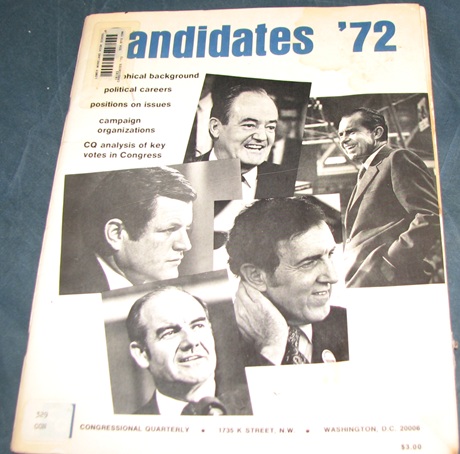
That’s why I’m glad that I have a copy of Candidates ’72.

Candidates ’72 was published, in 1971, by Congressional Quarterly.  It featured profiles of the many men and women who ended up running for President in 1972.  It not only detailed their backgrounds and their political stances but it also analyzed their chances of winning their party’s nomination.  For a history nerd like me, this book is wonderful because it was written without the benefit of hindsight.  It’s a chance to see what people were actually saying about the election of 1972 while it was going on.  Often times, it’s quite different from the biased analysis that was written about the election after it had already happened.

The other reason why I like Candidates ’72 is because so many memorable people ran for the Presidency in that year.  George McGovern, New York Mayor John Lindsay, U.S. Rep. Shirley Chisholm, Hubert Humphrey, Eugene McCarthy, Los Angles Mayor “Mad Sam” Yorty, George Wallace, Dr. Benjamin Spock, they are just some of the candidates profiled here.  Reading the profiles really does reveal that America was at a crossroads in the early 70s.  Much like today, a lot of people assumed that radicalism was ascendant while failing to consider just how serious the backlash would eventually become.  Some of the other Democrats running actually made George McGovern look like a moderate.  Meanwhile, on the Republican side, Nixon was challenged by an anti-war congressman named Pete McCloskey.  McCloskey eventually lost his house seat in the 80s but briefly reemerged in 2006 as an environmentalist and anti-war activist.  He was also a Holocaust denier so let’s be happy that he never got anywhere near the White House.

(It’s probably a sign of just how chaotic the 1972 election was that a few candidates — John Ashbrook, Terry Sanford — did not get profiled in Candidates ’72, presumably because they jumped into the fray after the book went to the presses.)

Here are the candidates and potential candidates who are profiled in Candidates ’72.

Republicans:

  1. Vice President Spiro Agnew of Maryland (elected Vice President in the General Election)
  2. Treasury Secretary John Connally of Texas (declined to run)
  3. Lobbyist John Gardner (declined to run)
  4. U.S. Rep. Pete McCloskey of California (suspended campaign during the primaries)
  5. President Richard M. Nixon of California (won the general election)

Democrats:

  1. U.S. Rep. William Anderson of Tennessee (dropped out before the primaries)
  2. Sen. Birch Bayh of Indiana (dropped out before the primaries)
  3. U.S. Rep. Shirley Chisholm of New York (defeated at the Democratic Convention)
  4. Former Attorney General Ramsey Clark of New York (declined to run)
  5. Sen. Fred Harris of Oklahoma (dropped out before the primaries)
  6. U.S. Sen. Vance Hartke of Indiana (withdrew during the primaries)
  7. Sen. Howard Hughes of Iowa (dropped out before the primaries)
  8. Sen. Hubert Humphrey of Minnesota (defeated at the Democratic Convention)
  9. Sen. Henry Jackson of Washington (defeated at the Democratic Convention)
  10. U.S. Sen. Edward M. Kennedy of Massachusetts (declined to run)
  11. New York Mayor John V. Lindsay (withdrew during the primaries)
  12. Lt. Gov. Lester Maddox of Georgia (withdrew during the primaries)
  13. Fmr. Sen. Eugene McCarthy of Minnesota (withdrew during the primaries)
  14. Sen. George McGovern of South Dakota (defeated in the General Election)
  15. U.S. Rep. Wilbur Mills of Arkansas (withdrew during the primaries)
  16. U.S. Rep. Patsy T. Mink of Hawaii (withdrew during the primaries)
  17. U.S. Sen. Walter Mondale of Minnesota (declined to run)
  18. Sen. Edmund Muskie of Maine (suspended campaign during the primaries)
  19. Sen. William Proxmire of Wisconsin (dropped out before the primaries)
  20. R. Sargent Shriver of Maryland (nominated for vice president, lost the general election)
  21. Gov. George Wallace of Alabama (suspended campaign after being shot in Maryland)
  22. Los Angeles Mayor Sam Yorty (withdrew during the primaries)

Independents:

  1. Ralph Nader (declined to run)
  2. Dr. Benjamin Spock (lost the general election)

Ran, but not profiled:

  1. U.S. Rep. John Ashbrook (R-OH)
  2. U.S. Sen. Thomas Eagleton (D-MO, nominated for Vice President but stepped down from the ticket and was replaced by Sargent Shriver)
  3. State Rep. Sissy Farenthold (D-TX, ran for the Vice Presidency at the Democratic Convention)
  4. U.S. Rep. Walter Fauntroy (D-DC)
  5. U.S. Sen. Mike Gravel of Alaska (D-Alaska, run for the Vice Presidency at the Democratic Convention)
  6. U.S. Rep. Wayne Hays (D-OH)
  7. Former Governor Endicott Peabody (D-Massachusetts, ran in the nonbinding Vice Presidential primary)
  8. Former Governor Terry Sanford (D-NC)
  9. U.S. Rep. John G. Schmitz (R-CA, ran as the candidate of the American Party)
  10. Cleveland Mayor Carl Stokes (D-OH)

I ordered my copy of Candidates ’72 shortly after I ordered Candidates ’76.  Sadly, my copy of Candidates ’72 is not in the best condition and I doubt I’ll ever find another copy.  As a proud history nerd, though, I’m still happy to have it.
 

Icarus File No. 30: Here (dir by Robert Zemeckis)


I really wanted to like Here.

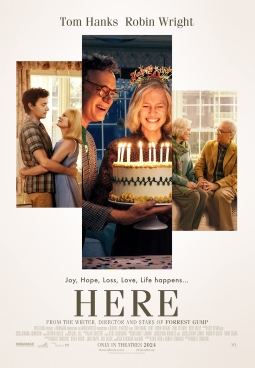
Released in 2024, Here is the type of movie that I usually would like.  It’s ambitious.  It’s experimental.  It’s about history and how certain patterns will always repeat themselves no matter what.  It features Tom Hanks and Paul Bettany, two of my favorite actors.  Also, unlike a lot of people, I haven’t turned on Robert Zemeckis.  For the most part, I usually enjoy his movies, including the more recent ones.  (Of course, when I say more recent, I’m thinking of The Walk, which came out eleven years ago.  But still….)

Here has an intriguing concept.  Over the course of 104 minutes, Here covers several thousand years of history.  The stationary camera focuses on a single plot of land, which goes from being an area dominated by dinosaurs to being the road outside of Colonial Governor William Franklin’s house during the American Revolution to eventually becoming the living room of a house that is occupied by several different families.  The story plays out in a nonlinear fashion with the marriage of Richard and Margaret Young (played by Tom Hanks and Robin Wright) ultimately dominating the narrative.  We watch as people fall in love, sometimes fall out of love, and eventually die.  With the exception of one key moment, the camera never moves.  Instead, we watch as life plays out in front of the camera and it’s often left to our imagination as to what’s happening on the other side of the lens.  When Margaret, at one point, complains about how she can’t stand to keep looking at the same couch day-after-day, we know exactly how she feels.

As I said, I really wanted to like this movie but, unfortunately, it just fell flat.  We meet a lot of characters but no one really feels human.  Instead, all of the dialogue and the action has the shallow snappiness of an old sitcom.  It’s easy to imagine this film being aired with a laugh track and an audience going, “Awwww!” after every emotional moment.  As a result, watching Here feels less like witnessing history unfold and more like flipping around the nostalgia channels and trying to pick which old sitcom you want to watch.  Do you want to watch the show about Ben Franklin not liking his son or the show that features Paul Bettany as a veteran dealing with PSTD?  Do you want a show about a pilot who dies during the Spanish Flu epidemic or about a masked-up husband during the COVID lockdowns?  One of the film’s final scenes features a character who is suffering from Alzheimer’s visiting the house and suddenly announcing that they remember everything about living there.  It’s a moment that is meant to be heartfelt but, instead, it feels insulting to anyone who has ever taken care of a loved one with dementia.  Alzheimer’s is never cutesy, regardless of what the movies may tell us.  In the end, very little of the film’s vision of humanity feels authentic.

The other big problem is that the film occasionally uses digital de-aging to try to convince us that Tom Hanks and Robin Wright are both teenagers and it just doesn’t work.  Hanks is playing Paul Bettany’s son but, whenever the two actors appear at the same time, it’s obvious that Hanks is considerably older than his screen father.  Unlike The Irishman, which had a strong story and enough good performances to convince the viewer to suspend their disbelief and accept the imperfect de-aging technology, the de-aging in Here just emphasizes how inauthentic the film’s story feels.

As I said earlier, this film had potential but, unfortunately, most of that potential goes unrealized.

And that really is a shame.

Previous Icarus Files:

  1. Cloud Atlas
  2. Maximum Overdrive
  3. Glass
  4. Captive State
  5. Mother!
  6. The Man Who Killed Don Quixote
  7. Last Days
  8. Plan 9 From Outer Space
  9. The Last Movie
  10. 88
  11. The Bonfire of the Vanities
  12. Birdemic
  13. Birdemic 2: The Resurrection 
  14. Last Exit To Brooklyn
  15. Glen or Glenda
  16. The Assassination of Trotsky
  17. Che!
  18. Brewster McCloud
  19. American Traitor: The Trial of Axis Sally
  20. Tough Guys Don’t Dance
  21. Reach Me
  22. Revolution
  23. The Last Tycoon
  24. Express to Terror 
  25. 1941
  26. The Teheran Incident
  27. Con Man
  28. Looker
  29. 1776

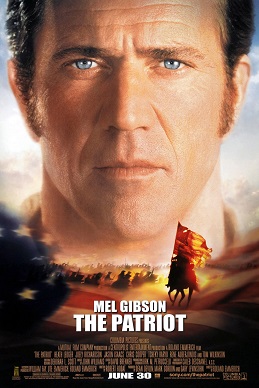
Film Review: The Patriot (dir by Roland Emmerich)


First released in the year 2000, The Patriot stars Mel Gibson (back before the arrests and scandals) as Benjamin Martin.

Benjamin Martin is a planter living in colonial-era South Carolina.  When he was younger, he fought in the French/Indian War and was infamous for his ferocity as a combatant.  However, in the year 1776, he is devoted to working the land and peacefully caring for his children.  When, as a member of the South Carolina General Assembly, he is called upon to cast a vote for or against independence, he abstains.  He’s no fan of the British but he’s also seen the harsh reality of war and doesn’t want his sons to have any part of it.  However, the Assembly still votes for Independence and Martin’s oldest son, Gabriel (Heath Ledger), is among the first to enlist in the army.

Four years later, the British come to the Martin farm and demand that Benjamin had over a wounded Gabriel to them.  When Benjamin resists, the arrogant Col. Tavington (Jason Isaacs) kills one of Benjamin’s other sons.  After Tavington has Gabriel arrested, Benjamin and two of his remaining sons track down the British convoy transporting him.  While his two youngest sons look on in horror, Benjamin savagely shoots and hacks to death all of the British soldiers and rescues Gabriel.

The Patriot may be a film about the American Revolution but it’s also definitely a Mel Gibson film.  That means that Benjamin is man driven as much be revenge as by a desire to win his country’s independence.  The British killed his son and burned down his house.  Benjamin responds by grabbing his musket and packing his axe and soon, it’s more common than not to see Benjamin covered in blood.  Benjamin attacks like a feral beast who is determined to dominate anyone and anything that would invade his territory.  Two of his sons go from being honored to be asked to come along to being terrified at the sight of their father murdering soldier after soldier.  It’s probably the most emotionally honest moment you’ll ever find in a Roland Emmerich film.  Of course, whether Emmerich meant for it to be so is open to debate.

And indeed, it should be noted that The Patriot is very much a Roland Emmerich film.  The running time is an epic 165 minutes.  The battle scenes are long and loud and carefully choreographed.  Gibson was still rugged and handsome when he played Benjamin Martin.  (Both before his downfall and after, Gibson has always been best cast as people who just want to be left alone and who finally snap once it becomes obvious that’s not going to happen.)  Heath Ledger almost appears beatific in his scenes.  The film looks great without ever quite looking authentic.  It’s like a fever dream that is less about how the American Revolution was actually fought and more about how we imagine it was fought.

And you know what?

The film works for me.  This is one of Emmerich’s best films, which admittedly is not a high bar to clear.  Yes, it’s a bit simplistic.  Yes, it’s not historically accurate.  Yes, all of the British are portrayed as being one-dimensional villains.  Who cares?  Whether he realizes it or not, Roland Emmerich has always been a B-movie maker at heart and The Patriot is effective in much the same way that many crude but shameless B-movies are.  The mix of Mel Gibson’s madness, Heath Ledger’s beatific earnestness, and Jason Isaac’s arrogance transforms The Patriot into a triumph of the pulp imagination.  Much like America itself, The Patriot is big and loud and it makes absolutely no apologies.

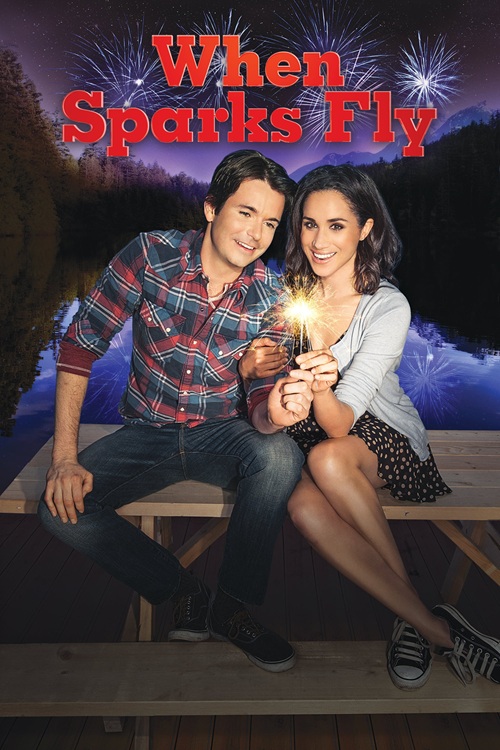
We Watched When Sparks Fly (2014, Dir. by Gary Yates)


Growing in the small town of Lakeview, Amy Petersen (Meghan Markle, before she became a part of the Royal Family) helped her family run their fireworks store.  She also fell in love with Hank (Christopher Jacot).  But she left Hank and her family so that she could go to the big city and try to be a big time print journalist.  Now, she’s dating Phil (Lochlyn Munro), who always wears a suit and likes to dine at exclusive French restaurants.

When her editor finds out that Amy is an expert in fireworks, he tells her to go back home for the 4th of July and to write a story about it.  Amy’s family is struggling to keep the fireworks business going and when the town announces that it won’t be able to put on a fireworks show on the 4th, it looks like the business is going to close unless Amy can come up with a way to save the day.  Amy has another reason for returning to Lakeview.  Her best friend Sammie (Kristina Pesic) is getting married and Amy is going to the maid of honor!  The only problem is that Sammie is marrying Hank and, as soon as she sees him, Amy starts to wonder if she made the right decision leaving home.

This is a Hallmark film so you already know everything that is going to happen.  I watched this movie with my sisters and we spent the entire time wondering when they were finally going to get to the fireworks.  It takes nearly the entire movie to reach the 4th and then it ends before the fireworks show even really got going.  I was disappointed.  I really wanted to watch the sky light up.

I know what you really want to know, though.  How was the performance of the Duchess of Sussex?  It’s hard to really Meghan Markle’s performance because Amy isn’t that likable of a character.  It’s hard to really cheer for someone who would ruin their best friend’s wedding just because they dated the groom in high school.  Everyone in the film is very forgiving of Amy, no matter how self-asborbed she is.  Even Phil is strangely unbothered by her being in love with someone else.  Almost the entire film is just Amy and Hank being the two most self-centered people in the world and no one holding it against them.  As for Meghan Markle’s performance, the best description that I can come up with is boring.

I was disappointed with When Sparks Fly.  At least I know that, later tonight, I’ll get to watch a full fireworks show.

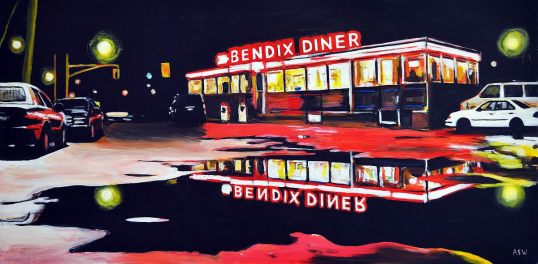
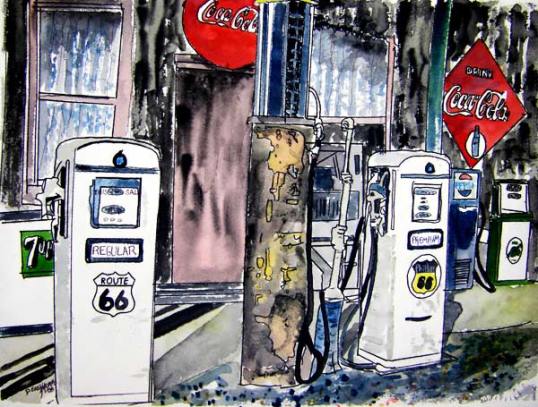
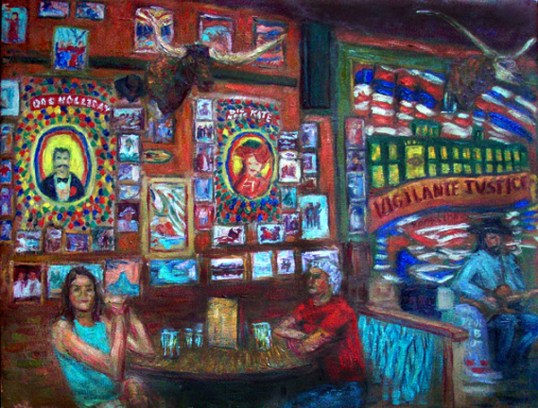
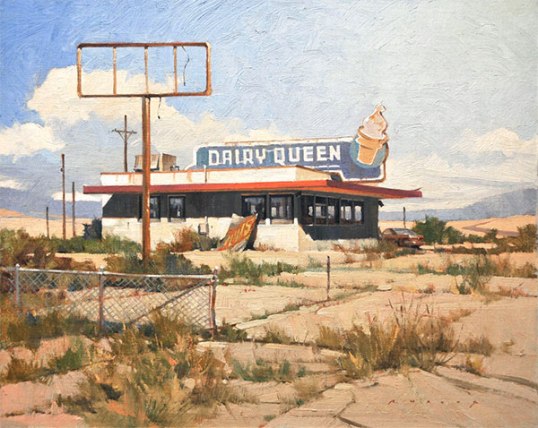
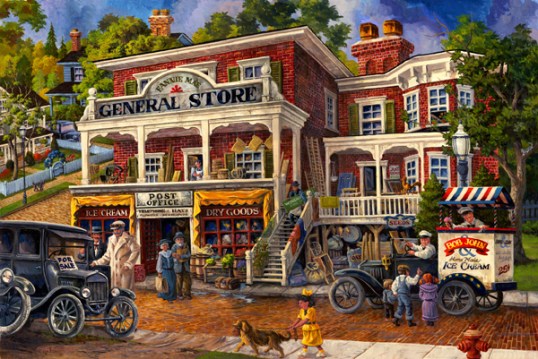
American Images, Part Five


 Happy birthday, America!

by Angela Wakefield

by Dan D’Amico

by Derek McCrea

by Diane Knott

by Jeffrey Nuemann

By John Baeder

by Linda Nelson Stocks

By Paul Berenson

by Robert Watts

by Tom Antonishak

By Tom Brown

By Tom Cannady


Live Tweet Alert: Watch Attack of the Giant Leeches With #ScarySocial!


As some of our regular readers undoubtedly know, I am involved in a few weekly live tweets on twitter.  I host #FridayNightFlix every Friday, I co-host #ScarySocial on Saturday, and I am one of the five hosts of #MondayActionMovie!  Every week, we get together.  We watch a movie.  We tweet our way through it.

Tonight, for #ScarySocial, I will be hosting Attack of the Giant Leeches!  It’s only an hour long so you watch it and still enjoy the fireworks!

If you want to join us on Saturday night, just hop onto twitter, start the film at 9 pm et, and use the #ScarySocial hashtag!  The film is available on Prime and Youtube!   I’ll be there co-hosting and I imagine some other members of the TSL Crew will be there as well.  It’s a friendly group and welcoming of newcomers so don’t be shy!


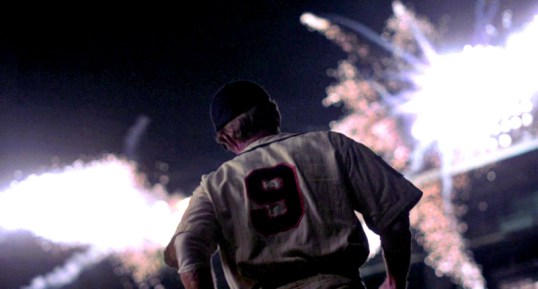
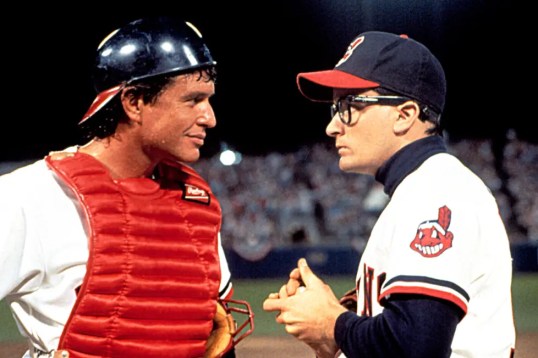
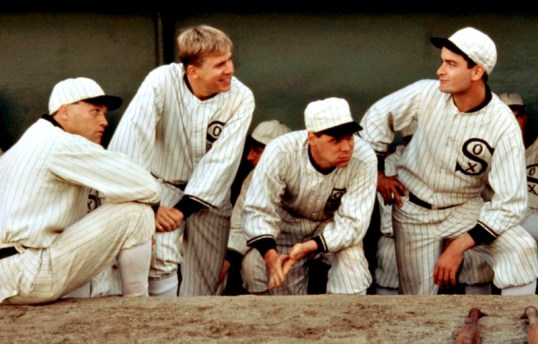
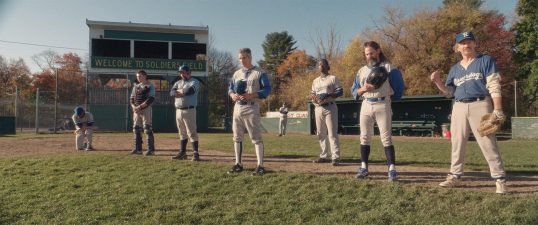
4 Shots From 4 Films: America’s Game


4 Or More Shots From 4 Or More Films is just what it says it is, 4 shots from 4 of our favorite films. As opposed to the reviews and recaps that we usually post, 4 Shots From 4 Films lets the visuals do the talking!

Today, for America’s birthday, I want to celebrate America’s game!

4 Shots From 4 Films

The Natural (1984, Dir. by Barry Levinson)

Major League (1989, Dir. by David Ward)

Eight Men Out (Dir. by John Sayles)

Eephus (2024, Dir. by Carson Lund)

A Scene that I Love: Snoopy Plays The National Anthem in A Boy Named Charlie Brown


A Boy Named Charlie Brown was the first Peanuts movie.  It was released in 1969 and, in this scene, Snoopy gets the Little League season off to the right start with the national anthem.

I hope everyone’s having a great 4th of July!