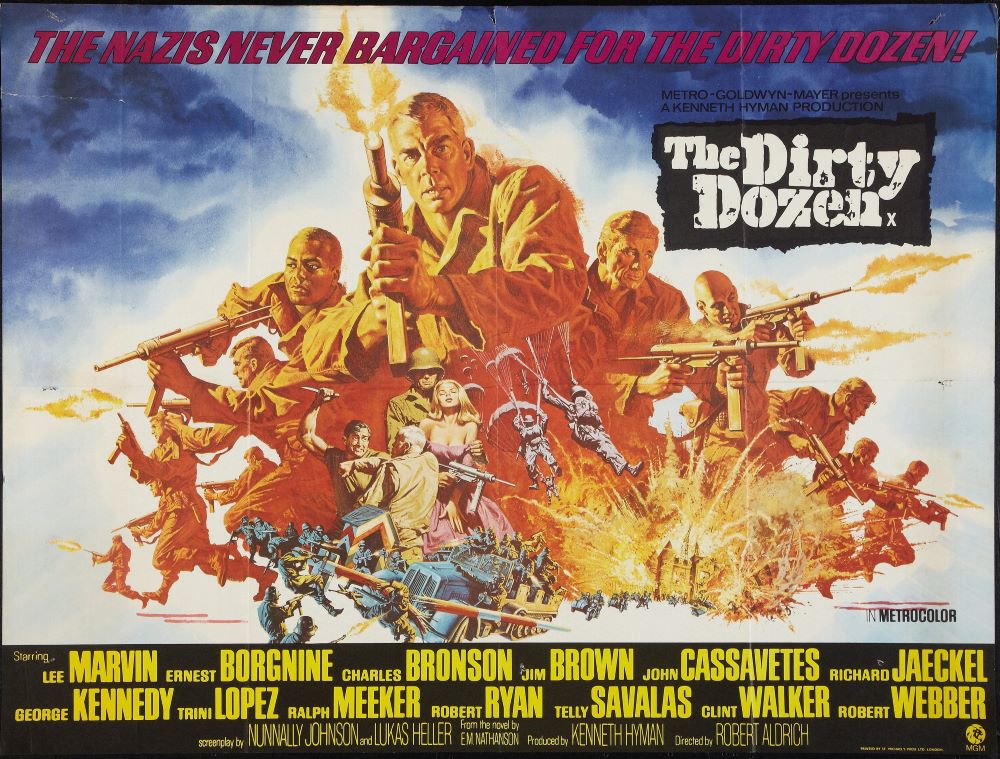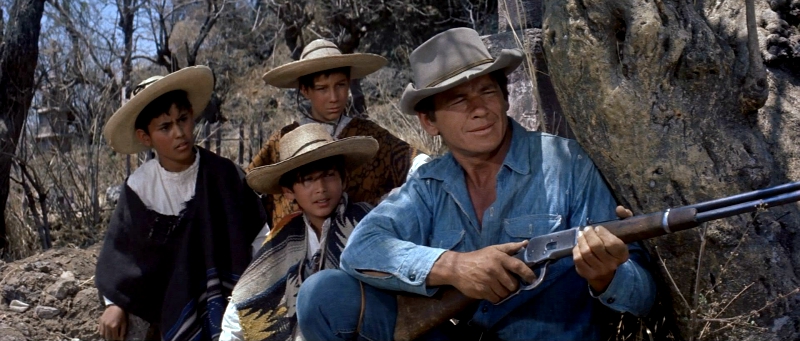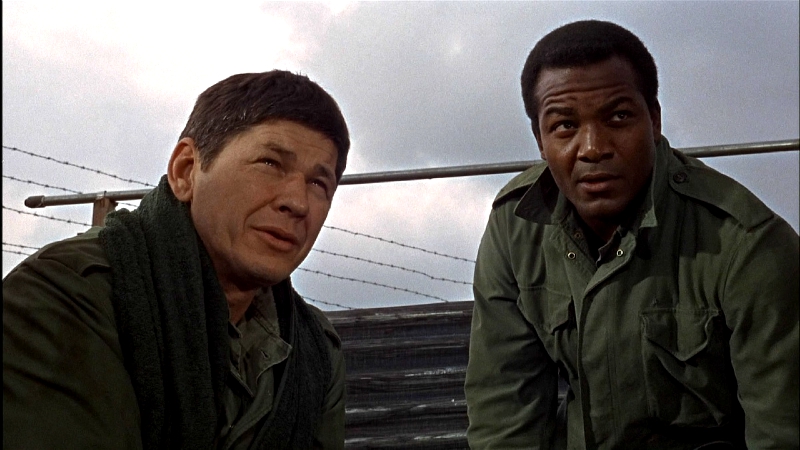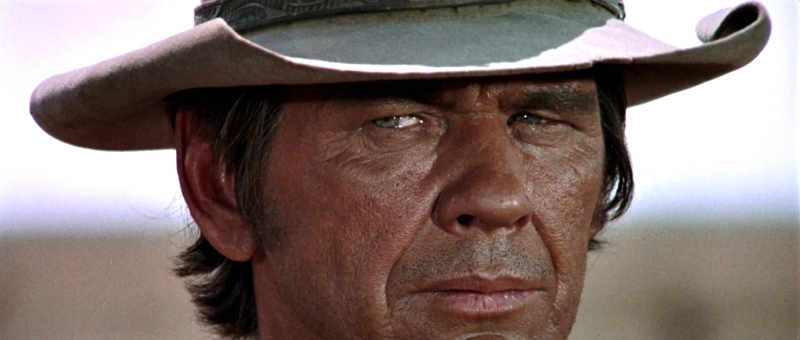
4 Shots From 4 Films: Charles Bronson Edition


I think it’s becoming a sort of unofficial tradition to celebrate a particular film legend’s birthday using the 4 Shots From 4 Films series as platform to showcase these individuals best and lesser-known films.

Today, we focus and celebrate what would’ve been the 93rd birthday of one Charles Dennis Buchinsky. That name may not resonate to the csual film fans, but I’m sure his chosen professional moniker will: Charles Bronson.

Charles Bronson was part of that group of actors during the 60’s and 70’s who epitomized the macho and badass personality on the big-screen. Bronson’s legacy has lived on through such classic films as The Magnificent Seven, The Dirty Dozen and Once Upon A Time In America right up to his more lesser-known films such as Hard Times, Telefon and Death Hunt.

4 shots from 4 films

The Magnificent Seven (dir. by John Sturges)

The Magnificent Seven (dir. by John Sturges)

TheDirtyDozen

The Dirty Dozen (dir. by Robert Aldrich)

Once Upon A Time In the West (dir. by Sergio Leone)

Once Upon A Time In the West (dir. by Sergio Leone)

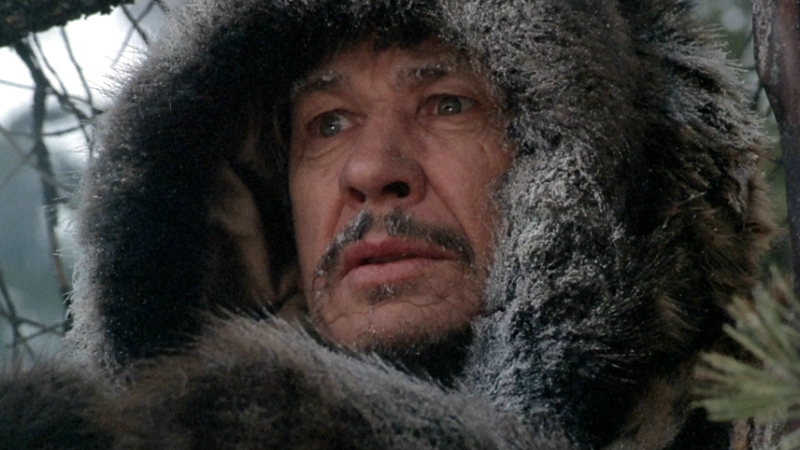
Death Hunt (dir. by Peter R. Hunt)

Death Hunt (dir. by Peter R. Hunt)

Scenes I Love: Saving Private Ryan


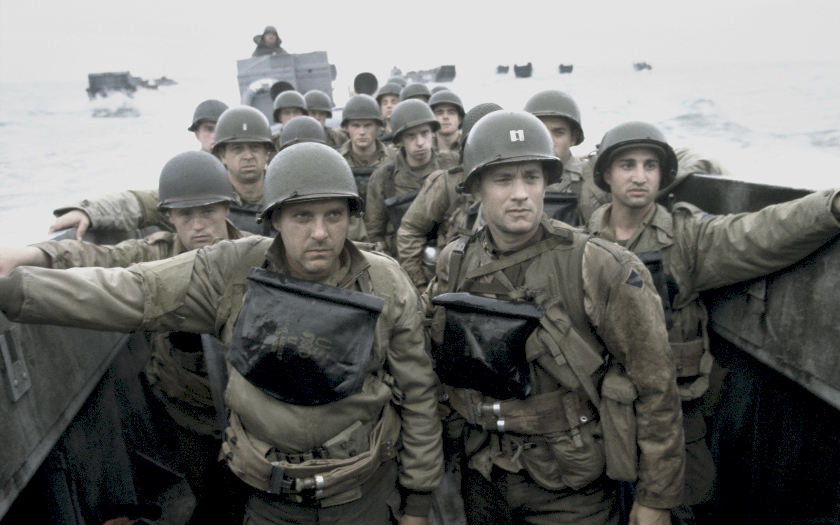
SavingPrivateRyan

Today marks the 71st Anniversary of the Normandy Landings on D-Day. As the day winds down I thought it best to share one of my favorite scenes from a film that tried to capture the chaos and death of the fateful day on June 6, 1944. The film in question is Steven Spielberg’s Saving Private Ryan. This is the film which won him his second Best Director Oscar (I still think the film should’ve won Best Picture over Shakespeare In Love) and the film which helped redefine not just how war films were shot from 1998 on, but also de-glorify World War II on film.

This scene showed the opening moments of the D-Day Landings on Omaha Beach in Normandy, France. It’s a scene that’s over 22-minutes in length and shows the utter chaos and destruction heaped on American troops as they attempted to land on the beach to take their objectives. While there have been war film before Saving Private Ryan that depicted war as the hell it truly is they were mostly about the Vietnam War. Rarely did we ever get a World War II-based war film which showed war in realistic fashion. Spielberg broke that taboo by making the battle scenes in his film — especially this extended opening sequence — done as realistic as possible without actually having people killed for real on-screen.

When this film first came out in the summer of 1998 no one knew what to make of it. This opening sequence became the talk of everyone who went to see the film. To say that they were shocked by what they saw was an understatement. Even now with over a decade since the film was released and people having seen this scene over and over again it still retain it’s impact. It’s not even the grand scale of the production required to film this action sequence which made this scene so memorable. It were the little things. Like a mortally wounded American GI crying out to his mother while trying to keep his blown out insides from spilling out. Then there’s the scene of another young soldier praying furiously with his rosary beads as men around him die by the score.

This scene also showed what most World War II films of the past failed to do. It showed both sides behaving barbarically. In the past, only the Germans were shown in a bad light. In Saving Private Ryan, we see that American soldiers were also prone at shooting surrendering troops and/or not mercy-killing enemy soldiers being burned alive (actions that have been well-documented by historians). This scene also showed just how courageous the young men of this generation which Tom Brokaw has called “The Greatest Generation”. Men who went off to war not for material gains, but for an idea that they had to stop evil (Nazi and Hitler) from taking all of Europe and, maybe, the world itself.

There’s a reason why Saving Private Ryan is in my list for greatest films of all-time and why this scene remains one of my all-time favorites.

Review: Fury (dir. by David Ayer)


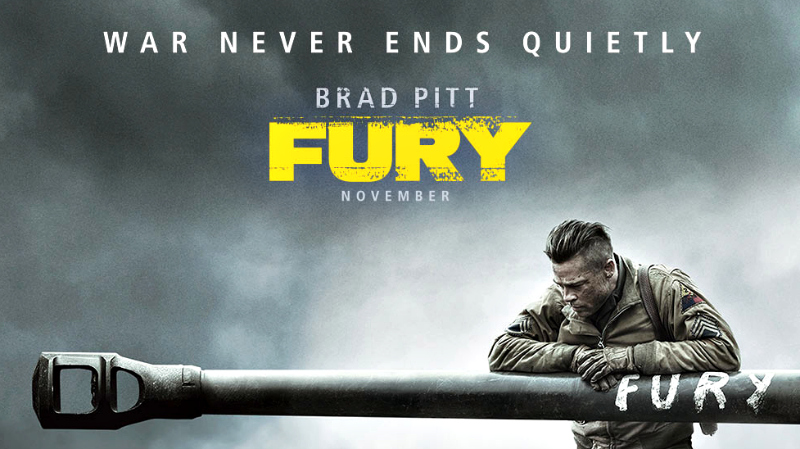
Fury

“Ideals are peaceful. History is violent.”

1998 saw the release of Steven Spielberg’s Saving Private Ryan.

Prior to this most films depicted World War II as a noble endeavor that needed to be done to help rid the world of Hitler and the horror he was inflicting upon Europe (beyond if given the chance). It gave birth to the “Greatest Generation” that people still look up to even to this day. These were young men who volunteered for a conflict that would change history and for the millions involved. Yet, World War II films were always cut and dried. It was always the good guys (American, British, Canadian, etc…) fighting against the nameless and efficient Nazi war machine.

In time, so many of these films followed the same formula that character stereotypes came about. We always had the cynical, older veteran who becomes a sort of father figure to a hodge-podge group of young, untested soldiers. What these films also had in common was the fact that they remain bloodless despite the nature of the story being told. Some filmmakers would try to buck this time-tested formula (Sam Fuller being the most prominent), but it would take 1998’s Saving Private Ryan to set a shift in how we saw World War II.

Spielberg lifted the rose-colored glasses from the audience and dared to show that while noble, World War II was still war and it still had the horror and brutality that all wars have. 2014’s Fury by David Ayer would continue this exploration of the last “Good War” in it’s most gritty and blood-soaked detail.

The film shows the last gasp of the German war machine as Hitler gives one of his final orders for the German people to repel the invading Allies. It was to be a scorched earth defense. Whether by choice or forced into this desperate tactic, every man, woman and child was to take up arms to their last breath to defend the Fatherland. It’s in this nightmare scenario that we find the veteran Sherman tank crew led by Don “Wardaddy” Collier trying to survive these final days til war’s end. Their home for the last two and a half years since North Africa has been a modified Sherman tank they call Fury. It’s a crew that’s been battle tested from the sands of North Africa, the maze-like hedgerows of France’s bocage and now the countryside of Germany itself.

We can see right from the start that this crew has been through hell and back many times and already resigned to going through hell many more times before they can eveb think of getting back home. It’s a crew that’s already lost one of it’s own minutes into the film. Wardaddy (Brad Pitt) looms over his crew like a weary father figure. This ragtag group consists of Bible (Shia LaBeouf) as the born-again Christian who sees their survival battle after battle as a sign that God’s grace is upon Fury and her crew. Then we have Gordo (Michael Peña) who has been so traumatized by the war and what he has had to do to survive that he has numbed himself from these memories by being in a constant state of drunkenness. Lastly, we have the tank’s loader Grady (Jon Bernthal) whose misanthropic attitude comes as a crude and brutish counterpoint to Bible’s religious fervor. Into this misanthropic soup of a crew comes in the replacement to their recently killed comrade.

Logan Lerman’s character, the young and naive clerk typist Norman Ellison, becomes the audience’s eyes in the brutal world of Fury and her crew. We’re meant to see the war’s brutality and horror not through the jaded and cynical eyes of Wardaddy and his men, but through a young man who has never killed an enemy or even fired a weapon in anger. Norman becomes the surrogate through which we determine and decide whether there is such a thing a nobility and honor in war.

Honor and nobility have always been used by those always willing to go to war to convince the young and impressionable to follow them into the breach. Fury takes these two words and what they represent and muddies them through the muck and gore left behind with each passing battle and tries to see if they remain unchanged on the other side. Norman is a literal babe in the woods as he must adapt or die in a war nearing it’s end but also becoming even more deadly and dangerous than ever. His very naivete quickly becomes a hindrance and a real danger to Wardaddy and his crew. He’s not meant for this world but has had it thrust upon him.

The film treats Norman’s humanity as a liability in a war that strips it from everyone given enough time. We see Wardaddy attempt to speed up the process during a tense sequence where Norman’s being forced to shoot a German prisoner. It’s a sequence of events that’s both unnerving and disturbing as we see the veteran soldiers encircling Norman and Wardaddy cheering or looking on with indifference in their eyes. They’ve all been in something similar and one can only imagine what they had to do to make it this far.

Fury straddles a fine line between showing and explaining it’s themes to the audience. It’s to David Ayer’s skill as a writer that the film’s able to use some finely choreographed scenes both violent and peaceful to make a point about war’s effect on it’s participants both physically and mentally. Whether it’s through several well-choreographed battle scenes to a sequence of tense and quiet serenity in the apartment of two German women that bring back the plantation segment from Coppola’s Apocalypse Now Redux, the film does a great job in showing how even when stripped down close to the bone, Wardaddy and his veteran crew still has semblance of humanity and the honor and nobility they all began the war with.

As a war film, Fury brings a type of combat to the bigscreen that has rarely been explored and never in such a realistic fashion as we watch tank warfare at it’s most tactical and most horrific. Ayer doesn’t fall for the jump cut style that many filmmakers nowadays sees as a way to convey the chaos of battle. Ayer and cinematographer Roman Vasnayov have planned every sequence to allow the audience to keep track of the two opposing sides and their place in the battle’s geography. And just like Spielberg’s own Saving Private Ryan, Fury shows the very ugly and bloody side of World War II. There’s a lot of bodies being blown apart and torn to chunks of meat yet they never seem to come off as gratuitous. Every bloody moment makes a point on the horrors of war and the level of inhumanity that another man inflicts on another man.

If there’s something that Fury does lag behind on it would be some of the narrative choices dealing with Norman’s character. The film takes place literally over a day’s time and the quick change in Norman’s mentality about the war seem very sudden and abrupt. While this day in the life of Fury and her crew worked well in Ayer’s past films (both as writer or director) here it puts Ayer stuck in a corner that made it difficult to fully justify Norman’s sudden change of heart from babe in the woods to hardened Nazi-killer. We can see throughout the film that the war is affecting him in ways that could lead up to this change, but to have it happen in just under a day really stretches it’s believability to the breaking point.

Yet, despite this the film is able to stay on course and recover from this misstep on the strength of Ayer’s direction and the performances of the ensemble cast. Brad Pitt has been the focus of the media campaign leading up to the release of Fury, but every actor who comprises the crew of Fury leave their own mark in the film. Shia Labeouf has had a tough past year both professionally and personally, but one has to admit that performances like the one he had in Fury is a reminder that he’s a damn fine good actor. Whether this film has become the path to his redemption in the eyes of the public is irrelevant. One doesn’t need to like the man to respect the talent he’s able to put up on the screen.

Awards season is in full swing as Fall 2014 arrives and Fury makes it’s case known that genre films (and make no mistake this is a genre film) can more than hold it’s own with the more dramatic life-exploring films that critics tend to put on the pedestal as examples of great filmmaking. While Fury is not perfect it is a very good film full of great performances that just misses being great.


Trailer: Fury (International)


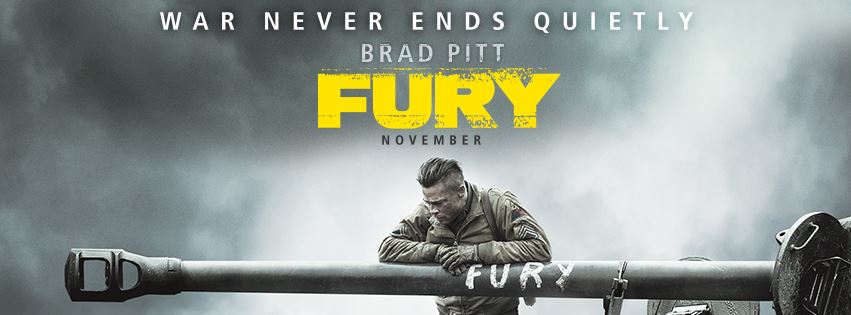
Fury-2014-Movie-Banner-Poster

I must admit that World War II films are a favorite of mine. Even bad ones I tend to enjoy. Whether it’s alternate fantasy fares like Tarantino’s Inglourious Basterds or something that combines historical accuracy with dramatic license like Spielberg’s Saving Private Ryan, the World War II genre always manage to hit straight and true to my film wheelhouse.

This October there looks to be another World War II film that seems almost tailor-fit for me. I’m talking about David Ayer’s follow-up to his underappreciated film End of Watch. This follow-up is Fury and tells the story of an American tank crew in the waning days of World War II in Europe. Just from the two trailer released I already know that I’m seeing this. Ayer looks to be exploring the bond of a tank crew that has seen war from the deserts of Africa and now to the urban and forested landscapes of Germany.

The film is already getting major buzz as a major contender for the upcoming awards season and I, for one, hope that it’s a well-deserved buzz. Even with Shia LaBeouf being part of the cast is not dampening my excitement for this film. Even if it doesn’t live up to the hype I know that I’ll probably still end up enjoying it.

This trailer looks to be selling the utter brutality and carnage of World War II’s final days in Europe when German forces were literally fighting for their homeland and that makes for a desperate enemy (who still had weapons and soldiers that were still hands down better than what the Allies had one-on-one).

On a side note, I like the fact that the tracers in the film actually look like tracers which means they look like freakin’ laser blasts. That’s how tracers behave.

Fury is set to hit theaters on October 17, 2014 in the United States and October 22, 2014 internationally.

Trailer: Battleship (Super Bowl Spot)


Battleship is going to be the latest film to come out of that film blockbuster factory called Hasbro Studios. Like them or hate them their Transformers franchise by way of Michael Bay has been anything but flops. They’ve made truckloads of money for all involve despite each successive film in the franchise getting worse and worse. The latest Hasbro property to make it’s way onto the bigscreen will be a big-budget production of that classic naval war boardgame kids of all eras just simply called Battleship.

We’ve seen several trailers of the film now and this Super Bowl Sunday we see a new tv spot trailer which shows more of the alien invasion aspect of the film with more aliens in scifi-looking battle armor being seen. We still don’t know what causes this invasion to occur, but then again most of those who will see this film may not really care as long as the action comes fast and furious with enough of a story to keep things from becoming a huge jumbled mess.

Battleship is still set for a May 18, 2012 release date.

Source: Battleship the Movie

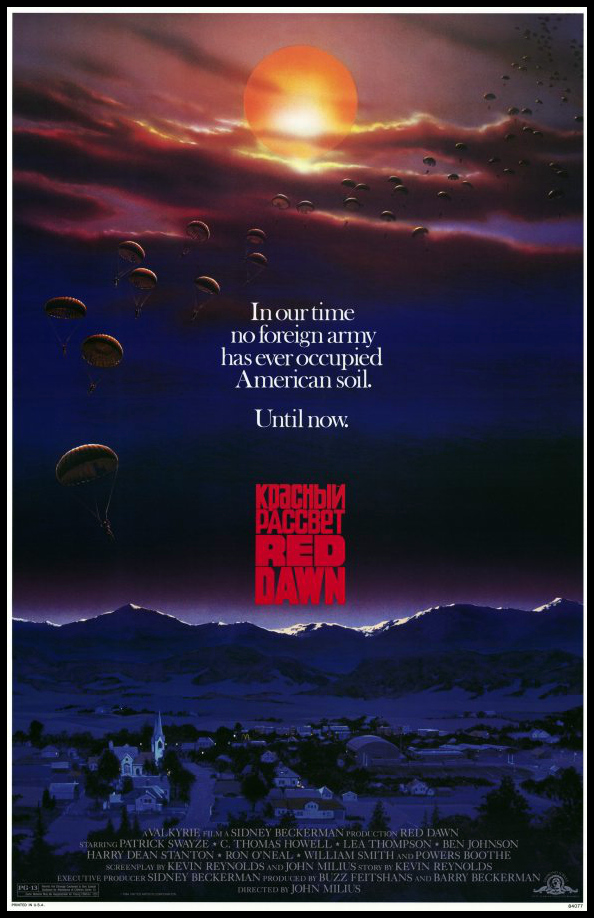
Review: Red Dawn (dir. by John Milius)


“I don’t know. Two toughest kids on the block I guess. Sooner or later they’re going to fight.”

[guilty pleasure]

Anyone who grew up during the 1980’s would say that some of the best action films were made and release during this decade. I won’t disagree with them and probably would agree to a certain point. This was the decade when action films evolved from the realism of the 70’s to the excess and ultra-violence of the 80’s. This was the decade which ushered in such action heroes as Schwarzenegger, Stallone and Willis. It was also the decade which released one of the most violent films ever released by a major motion picture studio. It’s a film that has been remembered through the prism of nostalgia. I speak of the 1984 war film by John Milius simply titled Red Dawn.

John Milius is one of those filmmakers who never conformed to the stereotype of liberal Hollywood. He was an unabashed Republican (though he considers himself more of a Zen anarchist) in a liberal studio system who happened to have written some of the most revered films of the 1970’s (Jeremiah Johnson, Apocalypse Now, Dirty Harry). He came up with a follow-up to his hugely successful Conan the Barbarian in the form of a war film set in current times (mid-80’s) America that he called Red Dawn. It was a story which takes an alternate history of the Cold War where Soviet forces and it’s allies launch a successful preemptive invasion of the United States. Before people think that this was the idea born of a conservative, warmongering mind it’s been documented that Milius’ inspiration for this film was a real Pentagon hypothetical exercise of what would happen if the Soviet Union conducted a conventional invasion of the United States and how the government and it’s population would react and resist such an occupying force. The  story would finally get it’s final treatment with major input from screenwrtier Kevin Reynolds’ own story which added a certain Lord of the Flies vibe to the group of teenagers who form the bulk of the film’s cast.

The film actually starts off with an impressive sequence of your typical Midwestern high school day with students seated in their classrooms. One moment this Rockwellian image gets a surprise from soldiers parachuting in the field outside the school. Thus we have the beginning of the Soviet invasion with one of the teachers being gunned down for trying to peacefully interact with the airborne troopers. The rest of the film is about a group of highschoolers led by senior Jed Eckert (Patrick Swayze) and his younger brother Matt (Charlie Sheen) as they flee with a handful of their classmates the massacre at their school and soon their whole town as well.

Red Dawn uses the first half of the film to show the confusion and chaos created by the sudden appearance of foreign soldiers on America soil attacking civilians and, soon enough, whatever American military response that manages to react in the area. We’re put in the shoes of Jed and his band of teenagers as they try to survive the roving bands of Soviet and Cuban soldiers patrolling the plains and countryside surrounding their hometown of Calumet, Colorado. We see American civilians packed into re-education camps and rumors of KGB secret police making certain troublemakers disappear and worst. It’s the America Cold War nightmare scenario where the Soviet Evil Empire has taken a foothold on US soil and the government and military nowhere in sight to help it’s population.

The second half of the film solves this scenario by arming the teenagers led by Jed into a sort of teen guerrila force using their school’s mascot as their rallying cry. It’s the shouts of “Wolverines!” which has become part of American pop-culture as we get to see these teenagers conduct hit-and-run strikes on enemy patrols and forward bases while at the same time arming those they free from camps. It’s during this part of the film where the violence gets ramped up to an almost ridiculous level. It’s no wonder that for almost two decades this film would be considered by Guinness World Records as the most violent film ever put on the big-screen. Milius and his filmmaking crew do not skimp on the use of blood squibs as Jed and his ragtag band of teen fighters gun down Soviets, Nicaraguans and Cuban soldiers by the score every minute during a long montage in the middle of the film.

Red Dawn in terms of storytelling is actually quite good in the grand scheme of the narrative being told, but even through the prism of nostalgia and rose-tinted glasses the characters in the film get the short-end of the stick. With the exception of Swayze’s eldest teen Jed as leader of the Wolverines the rest of the band’s teenage characters look like your typical casting call stereotypes who fill in the required roles in any ensemble cast. There’s Darren Dalton as the high school class president jealous of the group’s leader Jed, but unable to act on it. We have C. Thomas Howell as Robert the mousy one when the film begins who becomes a hardened and cold-hearted killer as the film goes on. Everyone fits in neatly to their assigned role and noen of the young actors (at the time) bring much to their characters.

This film continues to be remembered fondly by it’s fans both new and old because of the “what-if” scenario being played out on the screen. I would say that if there ever was a pure American film I would think Red Dawn manages to fit the bill. It’s a film which highlights the so-called individualism and can-do attitude Americans see for themselves. How it’s up to each individual to fight to protect their loved ones and for what is theirs. Some have called this film as a conservative’s wet-dream, but I rather think it’s a film that should appeal more to Libertarians as it focuses on individual liberties and self-preservation when the government and military tasked to protect them have failed.

John Milius has always been a maverick in Hollywood and his unpopular political beliefs have kept him from doing more work in the film industry, but one cannot deny the fact that he made one of the most iconic films of the 1980’s. Whether one agreed with the film’s politics and thought it to be a good film or not was irrelevent. Red Dawn has become part of American pop-culture and will continue to be a major example of the excess of 80’s action filmmaking for good or ill. Plus, even the most liberal people I know find the basic story of fighting to protect the nation from invaders something that feeds their innermost fantasy of playing the good guys fighting the good fight. Red Dawn is a great example of the underdog film that just happens to have teenagers kicking Soviet military ass.

Trailer: Battleship (dir. by Peter Berg) Teaser


It was just going to take before someone in one of the major Hollywood studios decided to tap into the board game market and pick one to adapt into a big-budget blockbuster. It worked wonders for Dreamworks and their bottom line with the Transformers trilogy. This time around we have Universal Pictures ready and set to release in the summer of 2012 their very own board game turned film in the Peter Berg-helmed Battleship.

Yes, you heard it right. That classic naval warfare game that made long road trips both easier to handle and also ripe for arguments has now been made into a film. There’s not much else to say other than watch the trailer. I will say that Liam Neeson must need a new mansion.

Scenes I Love: Rambo


Watching Ninja Assassin made me think about how much film and special effects technology has advanced to the point that the ways people can die in a film really is only limited by the imagination of the filmmakers involved. My new choice for “Scenes I Love” may make me come across as some gorehound, violence-loving neanderthal (the first two are actually correct but the third is false since I’m homo sapiens), but I love this scene I have chosen because it’s so over-the-top yet holds many truths to the events happening therein.

Rambo was Sylvester Stallone’s attempt to restart the Rambo franchise and to a certain extent he does so. The film was better than the third one and in terms of storytelling was equal to the second one and just a tad short of the original film. It’s a film one will not write to the Academy about, but Stallone brings back the franchise to what made it popular in the first place. He brought the character of John Rambo back to being the self-destructive, self-loathing, war-scarred veteran who just wants to be left alone to live his miserable life, but always gets dragged into one good-intentioned crusade after another.

This scene happens right at the very end and one could say it’s the film’s climactic eruption of testosterone. Rambo literally explodes Burmese soldiers’ bodies through his effective use of a .50 caliber heavy machine gun (and those who think the gun’s effect on people’s bodies was over-the-top…those people would be wrong. That is exactly what a .50 caliber round does to a body. It doesn’t do a body good) and some help from the people he’s trying to rescue. It’s hard not cheer Rambo in this scene after watching these very same soldiers massacre an entire Burmese village, raping captured young women and bayonet little kids before throwing them into a hut’s raging fire.

This scene also shows why the Rambo films have been labeled as nothing but mindless violence trying to make itself to be something profound (he is killing the bad people and trying to save those who are defenseless). I always though this franchise was just about one very angry guy who may or may not be right in the head, but who definitely has a weird sense of right and wrong. Not to mention very good at killing massive amounts of people in very messy ways.

There’s a part halfway in this scene where the higher-than-though leader of the Christian missionary group (who had earlier in the film lectured Rambo for being too violent in saving his and his people’s lives) played by Paul Schulze sees the carnage happening all around him and decides to go all caveman on one soldier who killed one of his congregation. A part of me actually smirked at this part. I knew that no matter how well-intentioned, principled and civilized a man thinks he is there’s something primal deep down inside that wants to commit violence.

Review: Battle: Los Angeles (dir. by Jonathan Liebesman)


The last couple years have seen the return of an old trend from the 50’s and and 60’s. Those decades were what one would call the Golden Age of alien invasion films and stories. We had alien invasion films both serious and comedic. They ranged from classics like The Day the Earth Stood Still and The Thing to the awful like Plan 9 From Outer Space and tons of titles I could barely put down. In 2009 we had an alien-themed film which one could call the return of the genre back to the forefront. District 9 by South African filmmaker Neil Blompkamp was universally hailed as one of the best scifi films of the decade and even got nominated for an Academy Best Picture.

Then there’s the other alien-invasion film from 2010 which covers the low-end of the equation. The Strause Brothers’ own Skyline was universally panned by critics and audiences alike. While some did enjoy the film for it’s “so bad, it’s good” quality (I use that term as loosely as redlight hooker). This film was everything that was opposite of District 9. While I did enjoy that film because it was bad I don’t look back at it too fondly.

The latest film in this alien-invasion resurgence is from another South African filmmaker and one whose body of work is mostly genre films of the low-budget variety. Jonathan Liebesman’s own entry into this scifi genre is Battle: Los Angeles and it lands smack  dab between District 9 and Skyline in regards to overall execution. It’s a workman-like film which takes an epic alien invasion war and brings it down into the pavement. We see the film through the eyes of a rifle squad of Marines and that’s where the film really becomes a really fun experience.

Battle: Los Angeles begins in medias rea with the war between the unknown alien invaders already having made their initial surprise landings and the U.S. military making it’s countermoves. We learn from a hasty news conference held by a military commander that the alien forces have landed at over a dozen or so coastal cities around the world have begun to move inland. I was somewhat discouraged to find out that San Francisco didn’t even last half a day and was lost. With Los Angeles the last major coastal city on the west coast that still had a viable military presence we hear one of the film’s tagline in that they cannot lose Los Angeles.

After this brief intro we go back 24 hours before the battle begins to get the character introductions sorted out. We see the Marines who will make up the squad the audience will follow through the rest of the film get their brief time to get introduced with some basic backstory to give them some personality. The one which stood out from all the war film archetype characters was Aaron Eckhart’s grizzled and retiring Staff Sgt. Nantz. He becomes the anchor that holds all the players into a cohesive unit and who also keeps the film from spiraling out into Skyline territory. Some of the cookie-cutter characters we meet would be the commanding officer straight out of Officer Training School who has never seen combat but is eager to lead his men and sees the combat-experienced SSgt. Nantz as someone who might usurp his authority. We also get the Marine whose previous combat tour has left him psychologically damaged and tries to earn his mind back into fighting state. We even get the young Marine who everyone sees as the little brother and who also happens to be a virgin.

To say that the characters in Battle: Los Angeles looked like they came out of old-school World War 2 war film casting call would be an understatement. The film just gives these characters (outside of Eckhart’s veteran noncom) enough personality that we’re able to distinguish one jarhead from another. Characterization is not one of this film’s strong suit, but once the bullets and alien stuff begin to start flying the need to get more character moments from these individuals really go out the window and the audience just holds on as they follow this Marine rifle squad into combat with an enemy force better equipped.

The film borrows much from battle sequences from Ridley Scott’s Black Hawk Down and Spielberg’s Saving Private Ryan as director Liebesman opts to use a cinema verite style to give the audience a documentary, imbedded reporter look to the whole proceeding. The shaky cam look this filmmaking style uses may turn off some people, but the way the action sequences (which pretty much takes up close to 3/5’s of the film’s running time) were edited actually keeps the shaky cam from becoming too overwhelming. The film actually does a very good job of showing the confusing nature of battle, but also the fog of war for the grunts on the ground.

Before I get to what about this film really worked for me I will have to admit that the film’s screenplay is it’s biggest weakness. It’s a major weakness that for some viewers will sink the whole film no matter whatever bright points it might have. The film’s core story was actually pretty good. A story about an alien invasion told from the point of view of human soldiers on the ground trying to repel the invaders was a concept that hasn’t really been explored in this type of film. While that foundation for the film is strong the dialogue and how the characters were written left much to be desired. I put the onus on the flimsiness of most of the characters on the screenplay more than the characters themselves. Spielberg and Scott were able to use the very same war film character archetypes and make them work in their film, but that was possible due to much stronger screenplays.

In this film the dialogue’s very hokeyness doesn’t inspire as much as it makes for some wince inducing moments. I can’t say that all of the dialogue was bad. They’re no worse than most war films both good and bad. The dialogue just didn’t seem to have any energy to them and sounded as if it was still being read from an earlier and much rougher draft. I do believe that if the screenplay had been given a couple of doctoring by competent, veteran screenwriters the film would’ve benefitted greatly from it. Instead, the film ended up having to have a strong veteran actor in Aaron Eckhart deliver these average lines with enough conviction and gravitas to keep the film from becoming a parody of a war film. The fact that the film still manages to hold together despite the weaknesses in the screenplay is a testament to one actor performing the hell out of that script. I won’t even go into some people’s issues about the science or battle tactics in the film since I believe the film was consciously built to keep those vague. The film is not about the who or what about this invasion and why the aliens are here, but about that rifle squad from the 2/5 Marines.

Now, what really worked for me about this film is the battle itself. For a fan of both alien invasion and war films this one combined the two and succeeding in delivering what the filmmakers promised. Battle: Los Angeles gave a visceral look into the trials and tribulations of a squad of Marines as they do their part on the ground to fight off a much more advanced enemy. There’s a scene when the Marines are flying over Santa Monica on their way to their Forward Operation Base and we see a running battle on the gorund below between human defenders and the aliens who have moved up from the beach. Even the firefights Nantz and his squad were in once they entered the battle behind enemy lines looked to be influenced with the many battle footage of American forces conducting ground war in Iraq and Afghanistan.

The special effects both CGI and practical to make Los Angeles look like a wartorn urban battleground was done very well. The aliens and their machines were given a look that wasn’t sleek and shiny but utilitarian and efficient. Some have said that the design of the aliens and their machines looked lazy, but I actually believe that if the filmmakers had fallen back on traditional advanced futuristic designs that would have been lazy. These aliens looked like they were design with only one thing in mind and that was to wage war on a people.

The score to the film by Brian Tyler was good and serviceable as his own modern riff on the old-school World War 2 film score, but I thought what this film needed was a veteran composer who knows how to bring out the machismo, gung-ho and esprit de corps of the Marines the audience followed throughout the film. It’s a shame that film composer passed away several years ago because he definitely would’ve given Battle: Los Angeles the kind of score which would’ve elevated the film from a thrilling war film into an epic one.

In the end, Jonathan Liebesman’s first foray into a bigger budget production hit more than it miss though one of those misses many of it’s detractors have seen as a fatal flaw in the film. Battle: Los Angeles doesn’t reinvent the alien invasion film, but just takes a new angle on the whole proceedings. It’s a film that shows influences from better war films by better filmmakers, but also gives hints that this young South African filmmaker has shown glimpses of talent that could take him places that his compatriot Neil Blompkamp has reached with his own alien-themed film. Battle: Los Angeles is just an old-school war film dressed up with modern fatigues and arrived onto the screen with all the positives and negatives of those very same traditional war films people love and hate since film as entertainment was created. It’s not on the same level as District 9 but it is definitely heads and shoulders above the very laughable Skyline of 2010.

As an aside, while I was watching the film I was struck by how this film looked like a preview of what Blompkamp’s potential sequel to his District 9 would look if and when Christopher Johnson came back to Earth with an armada of very pissed off Prawns…and speaking of pissed off Prawn: pig cannon.