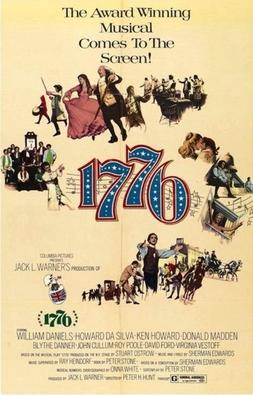
Icarus File No. 29: 1776 (dir by Peter R. Hunt)


The year is 1776.  The British have landed in Canada and are now marching towards New York with the intention of putting down a revolultion that has sprung up over issues like unfair taxation.  In Philadelphia, John Adams (William Daniels) is frustrated by the refusal the second Continental Congress to take up debate on whether or not the 13 North American colonies should announce their official independence from Britian.  Every day, Adams steps into the chamber and demands that the Congress take some action.  And, every day, his fellow deletates sing, “Sit down, John!”

Yes, you read that correctly.  They sing it.

Based on a 1969 Broadway musical, 1776 features a lot of singing, a lot talking, and not much else.  This is a film about the debate surrounding the writing of the Declaraiton of Independence that sometimes feels as if it’s telling its story in real time.  It’s no shock when Benjaming Franklin (Howard Da Silva) continually falls asleep at his desk or when Thomas Jefferson (Ken Howard) sings that he’d rather be home.  This is a nearly 3-hour film that feels like 3 months.  Some films about the Revolutionary War emphasize the brilliance of the Founding Fathers.  Some films emphazie the struggle to be free.  Other films emphasize the daily violence of serving in the army.  1776 captures the monotony of being trapped in a room full of cranky middle-aged men who will not stop talking.  The film dutifully captures every debate and controversy.  When John Adams shouts at everyone to get on with it, it’s hard not to sympathize until you realize that Adams himself is a huge reason why nothing ever seems to get done.  There’s only so many hours in the day that can be devoted to singing songs.

Perhaps the most shocking thing about 1776 is that it was realsed in 1972.  Nothing about 1776 suggests that it’s a product of the same era in which Bob Fosse was redefining the musical with Caberet and Francis Ford Coppola was refefining the historial epic with The Godfather and John Boorman was risking the lives of Burt Reynolds and Jon Voight to capture a weekend rafting trip.  There’s nothing about Peter R. Hunt’s direction to suggest that this film was made in the same era that saw Robert Altman playfully reinventing genres ranging from the service comedy to the detective film to the ensemble musical.  At a time when American directors were rebelling against convention and experimenting with new ways to tell stories, 1776 is a lengthy, dramatically inert and stagebound Broadway adaptation.  In style and look, it feels like a cinematic product of the 1950s or the early 60s, a film that was made when Hollywood’s only competition was from television.  Even Thomas Jefferson’s longing for his wife (Blythe Danner) is played discreetly.  When she finally does show up in Philadelphia, Jefferson closes the shudders.  When John Adams and Benjamin Franklin notice that the shudders are still closed hours later, it’s treated as a moment for everyone in the audience to turn red as they try not to giggle.  They’re having sex, the audience is meant to think, Good thing they’re married!  It’s a moment that feels as natural and human as Sandra Dee looking over her shoulder and winking as she goes off with Troy Donahue.

The key to understanding 1776 is to be found in the opening credits.  “Produced by Jack Warner.”  By the time 1776 went into production, Warner had been a Hollywood mogul for 54 years.  He started his career in the silent era and he built Warner Brothers into one of Hollywood’s most successful studios.  When he was younger, he was the one breaking the rules, making gangster movies and turning actor like James Cagney, Humphrey Bogart, and Edward G. Robinson into stars.  However, by the time he made 1776, Warner was the last of a dying breed.  Despite having greenlit Bonnie and Clyde, one of the seminal “Now Hollywood” productions, the older Jack Warner had little use for the Hollywood counterculture.  1776 was reportedly a pet project for Jack Warner, a film that he took a strong hand in producting and which he expected would sweep the box office and the Oscars.  Warner recruited the majority of the show’s Broadway cast to appear in the film.  Warner personally ordered the remove of a musical number that seemed to discreetly critcize the Vietnam War.  Warner even went on TV to promote the film.  During an interview on the Merv Griffin Show, Warner launched into a triade about “pinko commies.”  I imagine Warner had a point about the communists but it still was probably not the right way to promote the film in the 1970s.  While other films invited the counterculture into Hollywood, 1776 was essentially Jack Warner shouting, “Stay off my lawn!” with the voice of William Daniels.

1776 was a last attempt to hold onto the old way of making movies.  It was a film about a revolution that was desgined to thwart another revolution.  The Continental Congress was menaced by the British.  Jack Warner was menaced by the shadows of Coppola, Scorsese, and Friedkin.  It would be Jack Warner’s final film as a producer.  He died in 1974, still one of the towering figures in the history of Hollywood.  Of the old time moguls, only Adolph Zuker and Darryl F. Zanuck outlasted Jack Warner.

When Hamilon first came out in 2025, it was often described as being the antidote to 1776Hamilton was entertaining where 1776 was stodgy.  Well, maybe.  1776 may lack great songs but it doesn’t really have any truly bad ones either.  Instead, it’s just a very middle-of-the-road show, inoffensive and designed to keep the tourits happy.  Hamilton was viewed as being revolutionary when it was released but now it feels a bit gimmicky, with both the show and the almost religious initial enthusiasm for it feeling like somewhat embarassing artifacts from a different era.  (From the coverage during the Hamilton’s heyday, you would think no one but Lin-Manuel Miranda had ever written about Alexander Hamilton or Aaron Burr before.)  There is a great film to be made about the Continental Congress but it probably doesn’t invovle any singing.

As for 1776, William Daniels is amusing when he gets frusrated and Blythe Danner is far prettier than the real Martha Jefferson and the film itself is a forgettable tribute to the great men who foudned a great country.
Previous Icarus Files:

  1. Cloud Atlas
  2. Maximum Overdrive
  3. Glass
  4. Captive State
  5. Mother!
  6. The Man Who Killed Don Quixote
  7. Last Days
  8. Plan 9 From Outer Space
  9. The Last Movie
  10. 88
  11. The Bonfire of the Vanities
  12. Birdemic
  13. Birdemic 2: The Resurrection 
  14. Last Exit To Brooklyn
  15. Glen or Glenda
  16. The Assassination of Trotsky
  17. Che!
  18. Brewster McCloud
  19. American Traitor: The Trial of Axis Sally
  20. Tough Guys Don’t Dance
  21. Reach Me
  22. Revolution
  23. The Last Tycoon
  24. Express to Terror 
  25. 1941
  26. The Teheran Incident
  27. Con Man
  28. Looker

Brad reviews DEATH HUNT (1981), starring Charles Bronson, Lee Marvin, Carl Weathers, and Andrew Stevens! 


Today is actor Andrew Stevens’ 70th birthday. I grew up watching Stevens in the Charles Bronson films 10 TO MIDNIGHT (1983) and DEATH HUNT (1981), the movie I’m reviewing today. I also enjoyed watching him in Brian De Palma’s THE FURY (1978). Later in his career he stepped behind the camera where he produces and directs mostly low budget films. As of this writing, he’s still going strong, and he’s built quite a nice career. And for me, my appreciation all started because he worked with Charles Bronson when he was in his twenties!

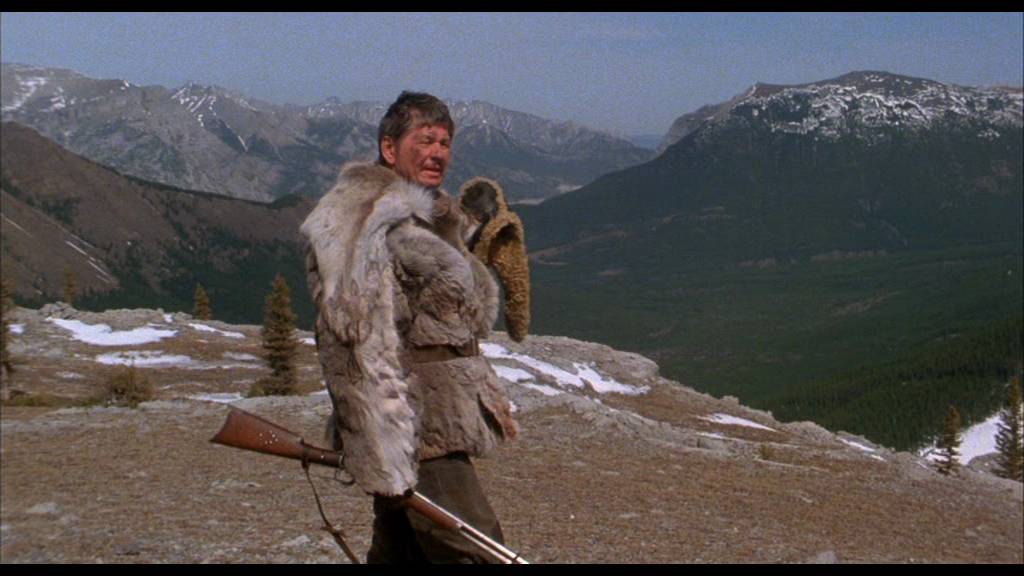
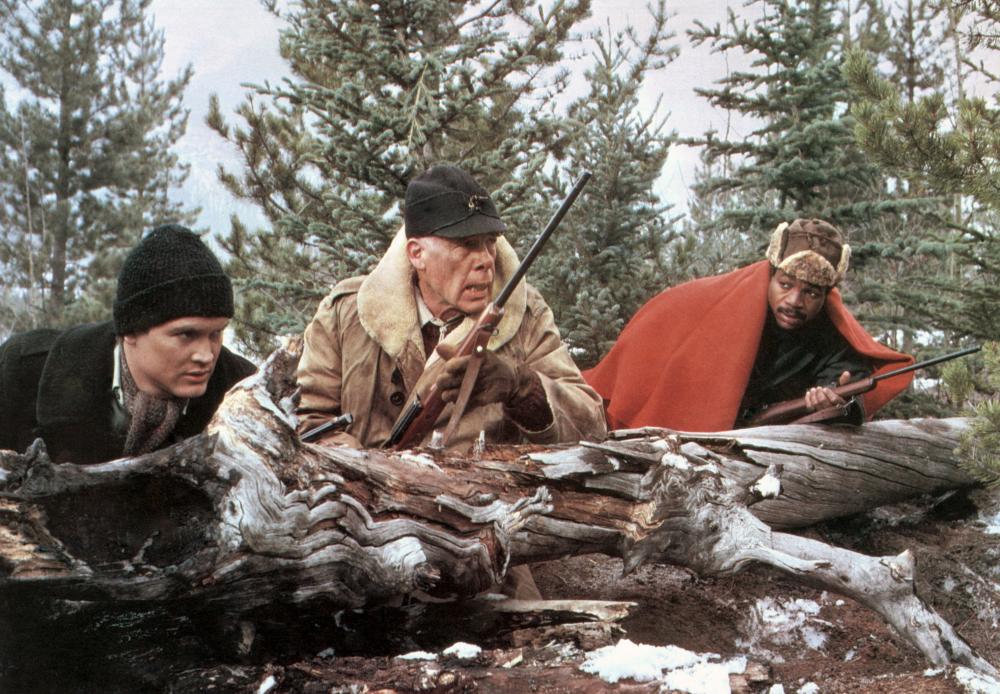
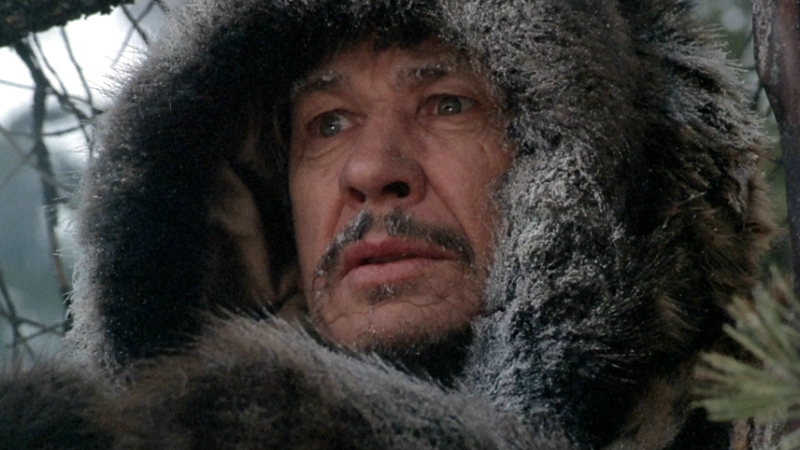
In the “based on a true story” DEATH HUNT, Charles Bronson plays trapper Albert Johnson, who lives in the Yukon Territory in the year of 1931 and just wants to be left alone. Early in the film, Johnson comes across a vicious dogfight and rescues one of the participants who’s almost dead. The problem is that the dog belongs to a piece of shit named Hazel (Ed Lauter), and even though Johnson pays him for the dog, Hazel heads to town and tells Sergeant Edgar Millen (Lee Marvin), of the Royal Canadian Mountain Police, that Johnson stole his dog. Millen doesn’t have time for Hazel’s B.S., so he tells him to go on. Millen would rather drink whiskey and hang out with his friends and co-workers in town. These people include the experienced tracker Sundog, aka George Washington Lincoln Brown (Carl Weathers), a young fresh-faced constable with the RCMP named Alvin Adams (Andrew Stevens), his latest lover Vanessa McBride (Angie Dickinson), and everyone’s favorite sidepiece, the Buffalo woman (Amy Marie George). Not willing to let things slide, Hazel and his men go up to Johnson’s cabin and start some more trouble, and one of his buddies gets his scalp shot off by the more than capable Johnson. Even though the entire mess has been started by Hazel and his crew of goons, who include character actors William Sanderson and Maury Chaykin, Millen is forced to try to bring Johnson in, so they can straighten everything out. When it seems Johnson may be about to go in with Millen, one of Hazel’s dumbass men opens fire, and all hell breaks loose. In the aftermath, Johnson escapes, kicking off a massive manhunt across the mountains and wilderness of the Yukon Territory! 

DEATH HUNT is an awesome film, primarily because it pairs Charles Bronson, as the tough mountain man, against Lee Marvin, as the seasoned lawman who probably has only one chase left in him. This is a match made in heaven, and even though the two stars share little screen time, the icons dominate each frame of the film. Their characters respect each other and you get the feeling the two men, who couldn’t be more different in real life, probably felt the same way about each other. The remainder of the cast is filled with so many recognizable names and faces. I’d say the the best performances outside of Bronson and Marvin come from Carl Weathers, Andrew Stevens and Ed Lauter. I like the camaraderie that Weathers shares with Marvin, and of course he’s a lot of help when the action starts. Initially, Stevens seems like he’s going to be another “new kid” who’s too inexperienced to be of much help, but he proves to be more than capable by the end of the film. And good grief is Lauter good at playing a piece of crap! Everything about Hazel is cruel, sadistic, and ignorant, and he plays the part perfectly. A scene where a bullying Hazel gets his comeuppance at the hands of the young Adams (Stevens), is a highlight of the film. Sadly, Angie Dickinson, one of the most beautiful women in the history of cinema, is somewhat wasted in her small, unimportant role. I still like seeing her though, even if the part is beneath her. 

Aside from the phenomenal cast that Director Peter R. Hunt (DR. NO and THUNDERBALL) was able to assemble, there are other good reasons to watch DEATH HUNT. I love movies that are filmed outside of the city, and you can’t get much further out of the city than the Canadian Rocky Mountains. This setting provides plenty of beauty, but its frozen landscape and bitter conditions also allow for a sense of loneliness, isolation and desperation to seep in for the various characters as the manhunt stretches out over time. There is also some rugged and violent action spread out through the film. I was caught off guard the first time I watched the film by some of the more graphic violence in the action scenes. I’ve already mentioned Bronson’s character basically blowing a guy’s head off, and there’s another scene involving William Sanderson getting his arm caught in a trap. These scenes make my toes curl up just thinking about them. The action highlight occurs when the men think they have killed Johnson in an explosion, to only have him emerge from the smoke and flames of his decimated cabin with slow motion shotgun blasting. It’s an incredibly badass moment in the movie and in Bronson’s overall filmography. Finally, the story is interested in contrasting the old ways of doing things, as exemplified by Bronson and Marvin, versus the new ways of doing things, as exemplified by the young Stevens and a hotshot pilot (Scott Hylands) who is called in to help with the search. Edgar Millen is somewhat of a dinosaur who isn’t ready to truly move into the 20th century. He wants to catch Johnson through old-fashioned, out maneuvering him in the wilderness, while Stevens’ character brings in a radio and the expertise to use it, and Hylands tries to locate him and gun him down from high in the sky. These two schools of thought clash and play out to varying degrees of success and failure as the chase rushes toward its conclusion.

DEATH HUNT is not a perfect film by any stretch of the imagination, but it’s been one of my favorite Bronson films since I first saw it the mid to later 80’s. Just seeing Bronson and Marvin together on screen, in a rugged, violent, badass story, goes a long way with me. It’s as simple as that! See the trailer below:

Charles Bronson in DEATH HUNT (1981) – Keep warm my friends!


If you’re in Texas or Arkansas today, I hope you’re keeping as bundled up as Charles Bronson in DEATH HUNT. It’s cold out there people! Keep safe and stay home if at all possible! We don’t know how to drive in this weather!

Enjoy DEATH HUNT’s trailer below! Charles Bronson and Lee Marvin are as tough as it gets!

4 Shots From 4 Films: Charles Bronson Edition


I think it’s becoming a sort of unofficial tradition to celebrate a particular film legend’s birthday using the 4 Shots From 4 Films series as platform to showcase these individuals best and lesser-known films.

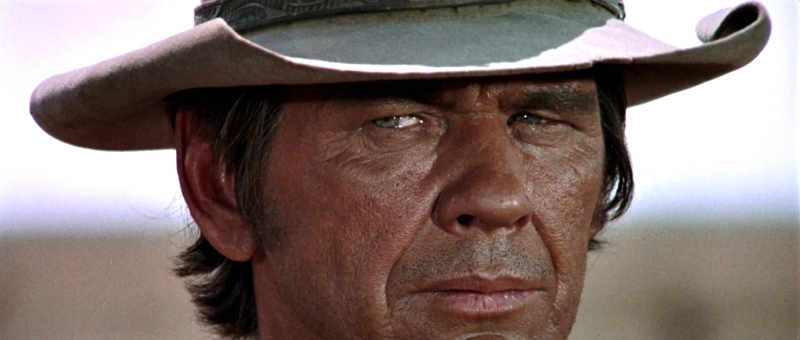
Today, we focus and celebrate what would’ve been the 93rd birthday of one Charles Dennis Buchinsky. That name may not resonate to the csual film fans, but I’m sure his chosen professional moniker will: Charles Bronson.

Charles Bronson was part of that group of actors during the 60’s and 70’s who epitomized the macho and badass personality on the big-screen. Bronson’s legacy has lived on through such classic films as The Magnificent Seven, The Dirty Dozen and Once Upon A Time In America right up to his more lesser-known films such as Hard Times, Telefon and Death Hunt.

4 shots from 4 films

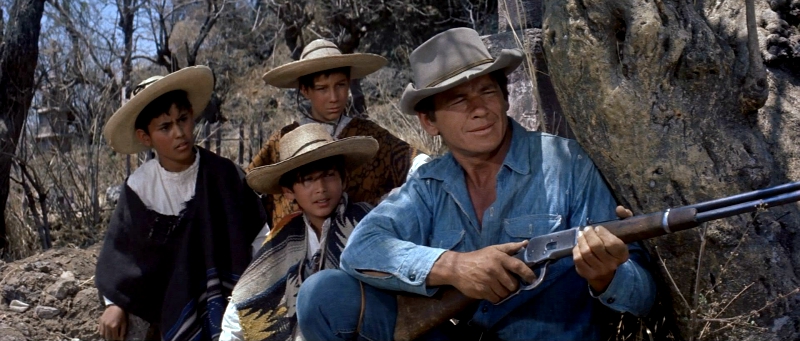
The Magnificent Seven (dir. by John Sturges)

The Magnificent Seven (dir. by John Sturges)

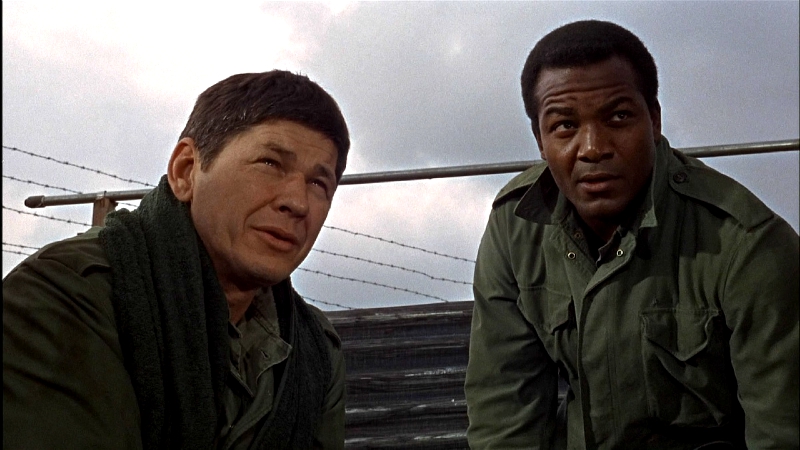
TheDirtyDozen

The Dirty Dozen (dir. by Robert Aldrich)

Once Upon A Time In the West (dir. by Sergio Leone)

Once Upon A Time In the West (dir. by Sergio Leone)

Death Hunt (dir. by Peter R. Hunt)

Death Hunt (dir. by Peter R. Hunt)