Cleaning Out The DVR, Again #18: House of Darkness (dir by Patrick DeLuca)


(Lisa is currently in the process of trying to clean out her DVR by watching and reviewing all 40 of the movies that she recorded from the start of March to the end of June.  She’s trying to get it all done by July 10th!  Will she make it!?  Keep visiting the site to find out!)

HouseofDarkness

The 18th film on the DVR was the Lifetime original movie, House of Darkness.  

House of Darkness is a film that asks a question that I’m sure we have all asked ourselves at least once: “What if Lifetime made a horror film?  What would that be like?”

Well, apparently, it would be like every single horror film that you’ve ever seen.  There is not a single cliché that does not show up in House of Darkness.  It starts out with the promise that we are about see a true story and hey, maybe it was!  After all, the film reminded me of a lot of other horrors film — Amityville, Paranormal Activity, and others — that were supposedly based on true stories.

Kelly (Sara Fletcher) and Brian (Gunner Wright) are a married couple but they are also a Lifetime couple, which means that their marriage is in trouble!  Brian is a carpenter who has a difficult time opening up emotionally.  Kelly is a massage therapist, which Brian appears to think is the equivalent of working in a brothel.  How bad is their marriage?  When Brian sees Kelly wearing sexy lingerie in an effort to liven things up, he responds by going out to the garage.

Fortunately, Brian and Kelly have been seeing a marriage counselor.  The counselor suggests that they both start keeping a video diary, which allows the film to occasionally so some found footage shots.  (That’s the Paranormal Activity influence.)  If the video diaries don’t help, maybe moving to a new house in San Francisco will do the trick!

And you know what?  It’s a great house but the owners didn’t want much money for it.  It’s almost as if they were trying to get rid of the house.  I wonder what that could mean!

Anyway, Kelly and Brian’s daughter is soon wandering around, speaking in a demonic voice while giving everyone Hillary Clinton-style death glares, and encouraging her friends to wander into the basement.  Meanwhile, Brian is acting even weirder and suddenly, it’s like he can’t go anywhere without bringing an axe with him!

And then there’s the neighbors.  A sexy woman and a superhot man occasionally appear standing in front of the house across the road.  The woman smiles at Brian, tempting him to … to do what?  I guess that the idea here is to encourage Brian to start doing his Jack Nicholson impersonation but I wasn’t sure.  I suspect, to a certain extent, that the ghosts and the evil spirits and whatever the Hell is in the house don’t really have any goals beyond doing the usual horror stuff.  They probably said, “Look!  A stationary camera!  Let’s go knock shit around!”

Anyway, House of Darkness is pretty much just a festival of nonstop clichés and scenes lifted from other horror films.  It’s never really scary, largely because it’s a made-for-TV movie and, since it’s Lifetime, you know that it’s not going to be disturbing or graphic like The Walking Dead or Game of Thrones.  Without any intentional humor or unexpected scares, House of Darkness is largely forgettable.
Cleaning Out The DVR, Again #17: Dying To Be Loved (dir by Paul Shapiro)


(Lisa is currently in the process of trying to clean out her DVR by watching and reviewing all 40 of the movies that she recorded from the start of March to the end of June.  She’s trying to get it all done by July 10th!  Will she make it!?  Keep visiting the site to find out!)

DTBL

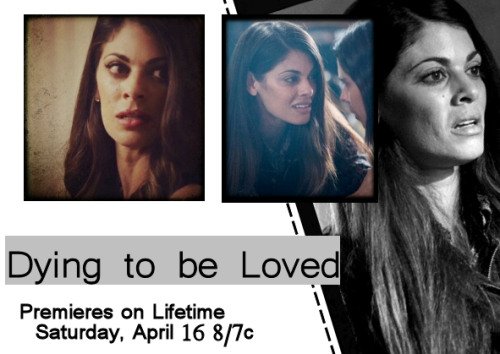
After I finished up with The Cheerleader Murders, I rewatched Dying To Be Loved, which premiered on the Lifetime network on April 16th.  Dying To Be Loved is also known as A Mother’s Suspicion.  I’m really not sure which title I prefer.  A Mother’s Suspicion is a little more accurate, as the film is about a mother who is very suspicious of her daughter’s new boyfriend.  However, Dying To Be Loved has a little bit more of a snap to it, with the juxtaposition of death and love.

If I seem to be spending a bit too much time on the film’s title, that’s because I have a certain word count that I’m trying to meet but there’s really not that much to say about Dying To Be Loved.  It’s a typical example of a genre familiar to all regular Lifetime viewers, the You Should Have Listened To Mom genre of film.

In this case, the mom is Jill Yates (Lindsay Hartley).  Jill has a good career, a good house, a good boyfriend (played by Lifetime regular Dan Payne), and good hair.  That’s really pretty much all you need to be a success in a Lifetime film.  However, she also has an 18 year-old daughter, Emily (Paloma Kwiatkowski).  Emily is away at college.  She’s alone from home for the first time.  She’s also bipolar and Jill fears that Emily is not taking her meds.  Jill is even more worried when she meets Emily’s new boyfriend, Gary (Jedidiah Goodacre).  Gary is rough and tough and has absolutely terrible table manners.  Jill tells Emily that she can do better than Gary so, of course, Emily runs off on a cross-country trip with him.

Soon, Gary is murdering gas station attendants and ranting like a madman.  Emily, who is not taking her medication (cue dramatic music), is convinced that she loves Gary.  In fact, she is so in love with Gary that she apparently agrees to jump off a bridge with him.

Or does she?  No bodies are recovered.  Even though everyone tells Jill that she needs to move on, Jill is convinced that her daughter is still out there.  With the help of a portly P.I. (Jay Bazeau) and an overly friendly small town cop (James Pizzinato), Jill sets out to find her daughter.  One of these two men is connected to Gary.  Which one?  You’ll have to watch the movie to find out!

Anyway, this is pretty much a standard Lifetime film.  Watching it, I couldn’t help but wish that it had been directed by someone like Fred Olen Ray.  At the very least, Fred would have played up the film’s melodrama and would have been a bit less earnest in his approach.  That said, Lindsay Hartley and Paloma Kwiatkowski are totally believable as mother and daughter.  Kwiatkowski, in particular, deserves a lot of credit for giving a believable and multi-faceted performance as the unstable and desperately unhappy Emily.  I winced a few times as I recognized bits of 16 year-old me in Emily’s actions.  This may be a generic Lifetime film but Hartley and Kwiatkowski really put their hearts into their performances and, for that, they deserve a lot of credit!

(For those keeping count, that’s 17 reviews down and 23 more to go!)

Cleaning Out The DVR, Again #15: Stranger In The House (dir by Allan Harmon)


sih

The 15th film on my DVR was Stranger In The House, which premiered on the Lifetime Movie Network on April 10th.

Stranger In The House opens with a stab at relevance by including news reports of Wall Street bailouts and footage of Occupy protesters running around in their Guy Fawkes masks.  (Though I’m sure they would probably call them V For Vendetta masks.)  I have to admit that, when I first saw that footage, I was worried.  I didn’t know if I could particularly take a Lifetime version of The Big Short.

Fortunately, the rest of the film has nothing to do with any of that.  Instead, it’s a rather enjoyable and somewhat over-the-top Lifetime melodrama, one that makes no pretense of providing anything other than wonderfully sordid entertainment.

Super-rich businessman Wayne (John Novak) has been crippled in a car crash and, now confined to a wheelchair, he goes out of his way to make everyone else miserable.  He’s nearly impossible to live with and his daughter and chief caretaker, Jade (Emmanuelle Vaugier), desperately needs a vacation from him.  On top of that, she’s just married the handsome but somewhat mysterious Marco (Matthew McCaull) and they want to take their honeymoon.  So, jade hires a caretaker to look after Wayne while they’re gone.

At first, Wayne doesn’t much like his caretaker.  Sure, Samantha (Jordana Largy) may be attractive and enthusiastic but she’s into stuff like yoga and Wayne’s too cantankerous for all that.  However, we then get a five-minute montage in which we see Wayne slowly start to lower his defenses.  Soon, he and Samantha are smiling and laughing and kissing.  When Jade and Marco return, they are shocked by just how close Wayne and Samantha have become…

Then Wayne mentions that he and Samantha have gotten married and all Hell breaks loose.

Jade is convinced that Samantha only married Wayne for his money and she grows even more frustrated when Marco suggests that maybe she should give Samantha a chance.  Wayne certainly appears to be happy and he’s even washing his hair again!  But then one day, Wayne is found dead at the bottom of a cliff and it turns out that he’s left all of his money to Samantha!

Jade believes that Samantha murdered Wayne.  It doesn’t help that Samantha isn’t acting like a grieving widow.  Instead, she’s laughing and drinking and constantly complaining about having to wear black all the time.  If that’s not strange enough, Samantha and Marco seem to have suddenly grown very close.

How close?

Close enough that they’re ducking into a bedrooms and broom closets so that they can make out…

And that all happens in the first forty minutes!  Now, I’m not going to spoil the rest of the movie but I will say that this is one of those Lifetime movies where things just keep getting stranger and stranger.  In fact, it’s almost ludicrous how melodramatic things get but that’s why it’s fun!  This is one of those films that is so over-the-top and fun that you would have to be a real killjoy to complain about whether or not it actually makes any sense.

After all, logic really isn’t the point here.  Stranger In The House is all about style and that’s something that it definitely has.  This is a sleek, fun melodrama and one for which I would suggest keeping an eye out.

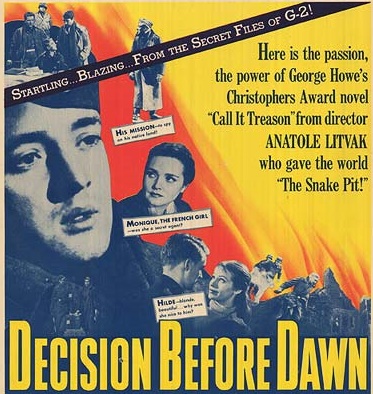
Cleaning Out The DVR, Again #14: Decision Before Dawn (dir by Anatole Litvak)


MPW-55716

So, I’m currently in the process of cleaning out my DVR by watching the 40 films that I recorded from March to June of this year.  Yesterday, I watched the 14th film on my DVR, the 1951 film Decision Before Dawn.  

Decision Before Dawn aired on April 9th on FXM and I specifically recorded it because it was nominated for best picture.  It only received one other nomination (for editing) and it’s one of those nominees that often seems to be dismissed by Oscar historians.  Whenever Decision Before Dawn is mentioned, it’s usually because it’s being unfavorably compared to the other nominees: A Place In The Sun, A Streetcar Named Desire, and An American In Paris.  I went into Decision Before Dawn with very low expectations but you know what?

Decision Before Dawn is not a bad film.  In fact, I would even go as far as to say that it’s actually a damn good film.  If you’re into war films — and, admittedly, I am not — you will love Decision Before Dawn.  If, like me, you’re a history nerd, you’ll be fascinated by the fact that, since this film was shot on location, Decision Before Dawn offers a chance to see what Europe looked like in the years immediately following the destruction of World War II.

As I mentioned, I’m not really into war movies but fortunately, Decision Before Dawn takes place during World War II.  World War II is one of the few wars where there’s no real ambiguity about whether or not the war needed to be fought.  When it comes to picking a villain that everyone can hate, Adolf Hitler and his followers are petty much the perfect villains to go with.

In Decision Before Dawn, Oskar Werner plays Karl Maurer, a German soldier who deserts after his best friend is executed for insubordination.  Though Karl loves his home country, he hates the Nazis who have taken it over.  Karl surrenders to the Americans and volunteers to return to Germany to act as a spy.  Karl finds himself in a strange situation.  Though he’s fighting against the Nazis, he is also mistrusted by the Allies.  He is literally a man without a country.

When word comes down that a German general is willing to surrender, Karl and another German soldier-turned-spy, the greedy and cowardly Sgt. Barth (Hans Christian Bleth), are sent into Germany to both find out if the information is true and to find out where another division of German soldiers is located.  Accompanying the two Germans is a bitter American, Lt. Dick Rennick (Richard Basehart).  Rennick doesn’t trust either of the Germans.

While Rennick and Barth track down the surrendering General, Karl is sent to track down the other division.  Along the way, Karl visits many bombed out German towns and meets Germans of every political persuasion.  Some of them still vainly cling to hope for victory over the Allies but the majority of them are like Hilde (Hildegard Knef), a young war widow who just desperately wants the fighting to end.  Thanks to the deeply empathetic performances of Werner and Knef, the scenes between Hilde and Karl elevate the entire film.  In those scenes, Decision Before Dawn becomes more than just a war film.  It becomes a portrait of men and women trapped by circumstances that they cannot control.

Decision Before Dawn is an exciting and well-acted thriller, one that starts slow but then builds up to a truly thrilling conclusion.  Anatole Litvak directs the film almost as if it were a film noir, filling the entire screen with menacing shadows and moody set pieces.  Decision Before Dawn is a war film that does not celebrate war but instead mourns the evil that men do and argues that sometimes the most patriotic thing that one can do is defy his or her government.  It may be one of the more obscure best picture nominees but it’s still one that deserves to be rediscovered.

By the way, if you do watch Decision Before Dawn, be sure to keep an eye out for Klaus Kinski.  He only appears for a minute or two and he’s not even credited but you’ll recognize him as soon as you see him.  The eyes give him away as soon as he shows up.

DBD_Kinski

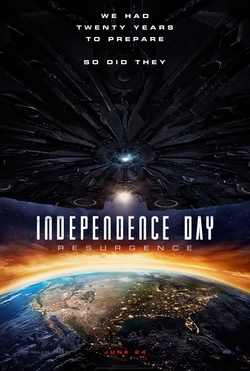
A Quickie With Lisa Marie: Independence Day: Resurgence (dir by Roland Emmerich)


Independence-Day-2-poster

Oh, who cares?

Sorry, I know that’s like an ultra unprofessional way to open a review but Independence Day: Resurgence is one of the least inspiring films that I’ve ever seen.  Jeff and I saw it the day that it opened and, at the time, I was planning on reviewing it the next day.  But when I sat down to actually write about the movie … well, I discovered that I could hardly care less.  This is one of those films that I could have easily waited until December to review.  However, seeing as today is Independence Day, this seemed to be the right time to say something about it.

Memorable movies inspire.  Good movies inspire love.  Bad movies inspire hate.  A movie like Independence Day: Resurgence inspires apathy.

Actually, what’s really frustrating about Independence Day: Resurgence is that it starts out with such promise.  The first few scenes suggest that maybe the film is trying to be something more than just another “let’s blow shit up while stars get quippy” action film.  Independence Day: Resurgence imagines an alternative history for post-alien invasion Earth and it’s actually pretty clever.  Earthlings have taken advantage of the alien technology but society has also become heavily militaristic.  The main characters of the first film are all revered as heroes but, when we first meet former President Whitmore (Bill Pullman, with a wise old man beard), he’s having nightmares about the invasion.

And seriously, for the first 30 minutes or so, I really thought that Independence Day: Resurgence might turn out to be surprisingly clever, that maybe it would satirize the excesses of the original while subtly critiquing everything that’s fucked up about our real world.

Well, that was a mistake on my part.  There is no satire.  There is no critique.  Instead, it’s just another alien invasion film and it’s all terribly predictable.  It may be a sequel to the first Independence Day but it feels more like a rip-off of Battle: Los Angeles.  Considering what the film could have been, it’s impossible not to be disappointed by how familiar and uninspired it all is.

What I failed to take into account is that this film was directed by Roland Emmerich.  Emmerich is a director who is best distinguished by his total lack of self-awareness.  After all, this is the director who, in Anonymous, seriously suggested that William Shakespeare personally murdered Christopher Marlowe.  Watching Independence Day: Resurgence and listening to the generic dialogue and witnessing the generic mayhem, I started to get the sinking feeling that the film was a joke and that  Emmerich was the only person on the planet who was not in on it.  He doesn’t realize how predictable his movies are or that his characters are cardboard cut-outs or that the film’s inspiring moments are so overdone that they instead become groan-inducing.  One of the stars of the first film sacrifices himself in Resurgence and you know who it’s going to be from the minute he shows up onscreen.  Emmerich is not a good enough director to make his sacrifice touching.  The fact that the film ends with the promise of a sequel is not surprising and yet, it still somehow manages to be annoyingly presumptive.  The film’s ending seems to be taunting us.  “Of course, you’re going to want to sit through this shit for a third time…what other choice do you have?”

In the film’s defense, the cast is big and it includes a lot of good actors.  Unfortunately, the characters are so undeveloped that you again find yourself regretting what a waste it all is.  Jeff Goldblum and Judd Hirsch are both likable but Bill Pullman seems to be incredibly bored with the whole thing.  Liam Hemsworth, Jessie Usher, and Maika Monroe are all stuck playing typical Emmerich ciphers.

I should mention that, despite how negative this review may sound, I did not hate Independence Day: Resurgence, at least not in the way that I’ve hated other films, like Anonymous or the remake of Straw Dogs.  My problem with Resurgence isn’t that I hated it or even that I disliked it.  It’s that I didn’t feel much about it, one way or the other.  It’s one of those film that is best described as “just kinda being there.”  Apathy is the worst thing that a film can inspire.

Perhaps the best thing about Independence Day: Resurgence is that Roland Emmerich has protected the holiday from being co-opted by Garry Marshall.

What Lisa Watched Last Night #154: Where’s My Baby? (dir by David Winning)


On Sunday night, I turned over to the Lifetime Movie Network and I watched Where’s My Baby?

Lochlyn Munro, the patron saint of Canadian-produced Lifetime melodrama and co-star of Where's My Baby?

Lochlyn Munro, the patron saint of Canadian-produced Lifetime melodrama and co-star of Where’s My Baby?

Why Was I Watching It?

Oh, why not?

Sorry, I’m trying to come a funny and/or interesting reason why I decided to watch Where’s My Baby? but the main answer is that it was on the Lifetime Movie Network and there was nothing else on.  Game of Thrones is on break.  Veep is on break.  There’s no killer zombies on AMC and I can’t watch Preacher because I resent its inaccurate portrayal of my home state.

So, with all that in mind, I figured why not see what was premiering on LMN!

What Was It About?

Marissa Davis (Nicole de Boer) wakes up after having spent the past five years in a coma.  She has no memory of how she came to be in that coma but she’s still happy to be awake.  She’s especially happy to discover that her best friend, Heather (Gina Holden), is married to Congressman Cal Ward (Lochlyn Munro).  Cal seems like a nice guy but he’s running for the Senate and talking about how much he believes in traditional values and we all know that, in a Lifetime movie, anyone who talks about values is eventually going to turn out to be a huge hypocrite.

Marissa is disturbed to discover that 1) she was the victim of a mysterious hit and run and that 2) she has a C-section scar.  Her mother (Iris Quinn) finally tells her that she was pregnant when she was hit by the car.  Her mother also assures her that the baby was delivered stillborn.

Meanwhile, Heather and Cal have a 5 year-old daughter!  What a coincidence!  And the baby appears to have the same hereditary kidney disorder that runs in Marissa’s family.  What could that possibly mean?  And, for that matter, why is a mysterious doctor suddenly so obsessed with removing Marissa’s kidney?

What Worked?

Oh my God, I so love these insane Lifetime movies.  Where’s My Baby is shameless fun, the type of movie that you simply cannot stop watching once it has begun.  The movie starts out crazy and it just keeps going from there!

Add to that, there’s a general rule when it comes to Lifetime films.  If Lochlyn Munro is in it, the film cannot be bad.  Lochlyn Munro has appeared in so many Lifetime films that, to some of us, he’s become the patron saint of the network.

What Did Not Work?

It all worked.  When a film is that insanely over the top, there’s no way that it can’t work.

“Oh my God!  Just like me!” Moments

To be honest, there really weren’t any “Oh my God!  Just like me!” moments.  I’ve never suffered from amnesia.  As anyone who has ever gotten on my bad side can tell you, I never forget.

Never.

Lessons Learned

If you wake up with amnesia, don’t take anyone’s word for what happened while you were asleep.  Investigate for yourself.  Seriously, that’s a lesson to live by.

What Lisa Watched Last Night #153: Newlywed and Dead (dir by Penelope Buitenhuis)


Last night, I watched the Lifetime premiere movie, Newlywed and Dead!

newlyweddead_30_spot_HD_768x432-16x9

Why Was I Watching It?

There were a lot of reasons why I was watching Newlywed And Dead.  The main reason was that it was on Lifetime and watching, live tweeting, and reviewing Lifetime movies is one of the many things that I do!

Beyond that, I thought Newlywed and Dead was an absolutely brilliant title.  That title pretty much sums everything that we love about Lifetime movies, doesn’t it?

And finally, the movie starred Shenae Grimes-Beech!  Back when she was just Shenae Grimes (and before she showed up on 90210), she played Darcy Edwards on Degrassi!  Darcy was always one of my favorite characters on Degrassi.  Whether she was plotting to break Paige’s leg during a Spirit Squad routine, getting stalked as a result of the pictures she posted on MySpace (or MyRoom as Degrassi called it), leading prayers at Friendship Club, falsely accusing Mr. Simpson of sexual harassment, or encouraging Spinner to go to class stoned, Darcy was the best!

What Was It About?

Kristen Ward (Shenae Grimes-Beech) would appear to have the perfect life.  She not only lives in a beautiful valley but she works for handsome developer, Jay Morgan (Christopher Russell).  In fact, she not only works for him but she’s also married to him!  Of course, some people are concerned about Kristen marrying a man that she barely knows but Kristen knows that their love is true.  Even when she discovers that, 10 years earlier, Jay was arrested for assault, she doesn’t let that worry her.  Who doesn’t have a criminal record?

But then Jay’s aunt, Barbara (Venus Terzo), takes Kristen to the house where Jay grew up.  And Kristen sees a painting of Jay’s mother and notices that his mother looks just like her!  Considering that Jay’s mother died under mysterious circumstances, Kristen starts to get worried.

Then Aunt Barbara dies under equally mysterious circumstances…

And Kristen starts to get really worried…

What Worked?

Shamelessly melodramatic and just a little bit campy, Newlywed and Dead was everything that we love about Lifetime films.  I’ve often felt that the best thing about Lifetime films is knowing that people across the country are all saying, “Girl, don’t trust him!” at the same time that you are.  Watching a Lifetime movie is meant to be a communal experience, whether you’re forcing your sister or your BFF to watch with you or if you’re watching with a bunch of people on twitter.  Newlywed and Dead is definitely a film that should be watched with a group of your favorite people.

Beyond that, I liked the film’s look.  The mansions were opulent and the scenery was beautiful to look at.  There was one room that had way too much blue in it but otherwise, Newlywed and Dead was a feast for the eyes.

What Did Not Work?

As I watched the film, I kept waiting for that one unexpected twist that would transform it from being a very good Lifetime film to a great Lifetime film.  All great Lifetime films have that one moment where something totally insane happens.  While Newlywed and Dead features a lot of entertaining insanity, it never had the one moment.

(For example, I kept expecting Jay to reveal that he had an evil twin brother named Ray.  But it never happened.)

“Oh my God!  Just like me!” Moments

I always relate to any character played by Shenae Grimes-Beech.

Lessons Learned

Never marry your boss.


Film Review: The Shallows (dir by Jaume Collet-Serra)


The_Shallows_poster

Have you seen The Shallows yet?

The Shallows was released last week, to strong box office and surprisingly good reviews.  Ever since it came out, people have been telling me, “You have got to see The Shallows!”  Well, I finally did see it earlier today and you know what?  I should have seen it earlier.  The Shallows is one of the best films of the year so far.

Now, I have to admit that, even before I saw the film, I was pretty sure that I was going to like it.  Just from watching the trailer, The Shallows looked like a big-budget Asylum film or maybe a mainstream version of Shark Exorcist.  After all, here we had a movie about a blonde in bikini being menaced by a giant shark while stranded on a rock in the middle of the ocean.  It looked like it would be one of those big, over-the-top nature-gone-crazy movies that I always enjoy watching on SyFy.

And, to a certain extent, it is.  The Shallows was directed by Jaume Collet-Serra, a Spanish director whose previous work would seem to indicate an appreciation for old school grindhouse and drive-in cinema.  There’s really not a subtle moment to be found in The Shallows.  The shark is huge and whenever it finds something to eat, the ocean turns red with blood and while this grudge-holding shark may not behave like a real-life shark, it does behave like a movie shark.  When, at the start of the film, Lively is on her surfboard and blissfully unaware of the danger under the sea, girl power anthems blast on the soundtrack.  Whenever the camera briefly pans underwater for a shot from the shark’s point of view, the music suddenly becomes ominous and full of menace.  The action is nearly non-stop, pausing only occasionally for a few moments when the camera lingers on Lively either stretching on the beach or resting on the rock and yet the cinematography is so stunning and Lively’s performance is so great that these shots don’t feel exploitive but instead celebrate her both her outer and her inner strength.  Undoubtedly, a lot of people are buying tickets because Blake Lively spends most of the movie in a bikini but The Shallows is still one of the most empowering films of the summer.

That’s right, I just said that Blake Lively gives a great performance.  I have to admit that, despite loving Gossip Girl, I was never really sold on Blake Lively as an actress until I saw her in The Shallows.  I thought she was wasted in The Town and her performance in Savages left me so annoyed that I was literally screaming in the theater.  But no matter — Blake Lively proves herself to truly be a talented actress in The Shallows.  From the minute she appears onscreen, you’re on her side.  You’re happy for her when she finally gets to surf the beach that her recently deceased mother surfed when she was young.  You fear for her when the shark makes its first blink-and-you’ll-miss-it appearance.  And when she’s stranded on that rock, fighting for her own survival and trying to figure out a way to close a huge gash on her leg (and this was a scene that I literally watched through my fingers), you find yourself truly fearful that she’ll never be rescued.  (One of the strengths of the film is that you’re never fully convinced that Lively is going to survive her ordeal.)  Blake Lively gives a performance here that I would compare to James Franco’s breakthrough work in 127 Hours.

Actually, a lot of the scenes in The Shallows reminded me of 127 Hours.  For that matter, there were also a few scenes that reminded me of Wild and, of course, the Jaws influence was obvious as well.  The Shallows is a derivative film but, to its credit, it borrows from the best and Collet-Serra always manages to add his own individual spin to even the film’s most predictable moments.

Along with Lively’s performance and Collet-Serra’s direction, there are three other things that make The Shallows special.

Number one, it features an amazing seagull.  The seagull, which has an injured wing, spends most of the movie hanging out with Blake Lively on that rock and provides her with some much needed companionship.  The seagull also happens to be a helluva actor and, at times, I found myself even more worried about the seagull’s survival than Lively’s.  According to the credits, the seagull’s name is Sully and he better get some love from the Academy next January.

Number two, there’s a scene in which two soon-to-be-doomed surfers ask Blake Lively if she’s from California.  “No,” Lively replies, “Texas!”  From the minute she said that, all of us at the Alamo Drafthouse were on her side.  And, just in case any of you northerners have any doubts, people do surf in Texas.  Just ask anyone who has ever spent spring break in Galveston or Corpus Christi.

Finally, The Shallows is a short movie and, after sitting through so many overlong movies, it was nice to see a movie that was direct and to the point and which did not include any unnecessary padding.  The Shallows only needed 86 minutes to tell its story and not a minute more!

(Compare the 86-minute The Shallows to the 151-minute Batman v Superman and you’ll understand what film critics mean when they complain about a film being overlong.)

With its truly breathtaking shots of the ocean and it’s nonstop action, The Shallows is a film that you owe it to yourself to see on a big screen.  So get to it!

TS2


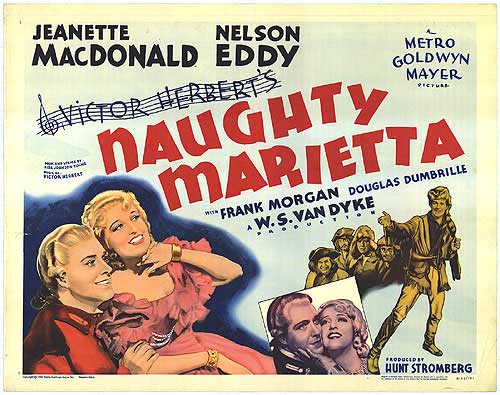
Cleaning Out The DVR, Again #12: Naughty Marietta (dir by W.S. Van Dyke)


b70-4632

Continuing the process of cleaning out my DVR, I watched the 1935 film, Naughty Marietta.  I recorded Naughty Marietta off of TCM on April 3rd.  Like many of the films that I record off of TCM, Naughty Marietta was nominated for Best Picture.  In fact, if not for that Oscar nomination long ago, Naughty Marietta would probably be totally forgotten.

Instead, it’s only partially forgotten.

Based on an operetta and containing at least one song that I’ve sung while drunk (that song, incidentally, would be Ah!  Sweet Mystery of Life), Naughty Marietta tells the story of Princess Marie (Jeanette MacDonald).  A Spanish princess, Marie is engaged (against her will) to the elderly Don Carlos (Walter Kingsford).  In order to escape a life of forced marriage, Marie pretends to be a servant girl named Marietta and stows away on a boat to New Orleans.  The boat is carrying women to the new world so that they marry French colonists.  The other women on board are shocked when Marietta announces that she plans to never marry.

However, they are even more shocked when the boat is taken over by pirates!  The pirates kill the crew and take the women prisoner.  The pirates take the women to Louisiana where, fortunately, a group of mercenaries led by Captain Richard Warrington (Nelson Eddy) show up and rescue the women.

Marie negotiates for Warrington to take the women to New Orleans and it’s obvious from the start that Marie and Warrington are attracted to each other.  However, Warrington claims that, much like Marie, he plans to never marry!  Oh my God, could it be that these two are meant to get together!?

It has all the potential for being a good musical and Jeannette MacDonald gives a good performance as Marie.  But, unfortunately, Nelson Eddy is a lot less charismatic in the role of Warrington.  Even his singing voice is a bit blah.  Oddly, Naughty Marietta was one of many romantic musicals that Jeanette MacDonald and Nelson Eddy made together.  The reason I use the term “odd,” is because — judging from this film — they didn’t appear to have much onscreen chemistry.  Whereas MacDonald is personable and relatable, Nelson Eddy seems to hold the audience at a distance.  Watching a film like this, you can’t help but regret that Jeanette MacDonald didn’t have someone like Fred Astaire for a co-star.

As for Naughty Marietta‘s best picture nomination — well, it was a big production and it was also an adaptation of a popular operetta.  At a time when 10 films were nominated every year and the studios pretty much controlled which one of their films was nominated for best picture, Naughty Marietta got a nomination.  However, the Oscar went to Mutiny on the Bounty.

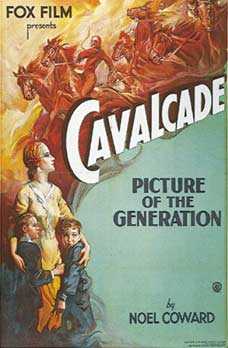
Cleaning Out The DVR, Again #11: Cavalcade (dir by Frank Lloyd)


Cavalcade_film_poster

So, I’ve been cleaning out the DVR for the past week.  Fortunately, I’m going to be off work for this upcoming week, which should give me a lot of extra film-watching time.  That’s a good thing because I’ve got 36 movies that I’ve recorded on the DVR since Thursday and, over the past seven days, I’ve only watched 13 of them!  That’s 23 movies to go and I hope to be finished by the end of the next week.

The 11th film that I found on my DVR was the 1933 film, Cavalcade.  I recorded it off of FXM on April 3rd.

The main reason that I recorded Cavalcade was because it was the 6th film to win the Oscar for Best Picture.  Now, I have to admit that I wasn’t expecting much from Cavalcade.  It’s a film that many Oscar historians tend to list as being one of the lesser best picture winners.  Cavalcade is often unfavorably compared to the films that it beat — movies like I Am A Fugitive From A Chain Gang, A Farewell To Arms, Little Women, and The Private Life of Henry VIII.  Cavalcade was the first British to ever win the Best Picture and its victory is often cited as the beginning of the Academy’s love affair with British productions.

And really, Cavalcade couldn’t be more British if it tried.  Based on a play by Noel Coward, Cavalcade follows two families through several decades in British history.  One family is wealthy and is anchored by a patriarch who is knighted in the Boer War.  The other family is lower middle class, anchored by a patriarch who starts out as a butler but who eventually manages to open up his own pub.  Through the eyes of these two families, we view what, in the 1930s, was recent British history.

For modern viewers, it may be helpful to watch Cavalcade while consulting Wikipedia.  For instance, the film starts with the two father figures preparing to leave to fight in the Boer War and I’m sorry to admit that I really wasn’t totally sure what that was.  I had to look it up in order to discover that it was a war that the British fought in South Africa.

But you know what?  That’s not really a complaint.  I may not have known what the Boer War was before I started the film but that had changed by the time that I finished watching Cavalcade.  Several times, I’ve mentioned on this blog how much I love history but watching Cavalcade made me realize that I still have more to learn.  Even more importantly, it encouragds me to learn.  That’s always a good thing.

Certain other historical events were more familiar.  As soon as I saw the title card announcing that the date was 1914, I knew that I would soon be seeing a World War I montage.  And, as terrible as World War I was (though, naturally, the film refers to it as being “the Great War,” and, for a few moments, I considered the fact that there was a time when nobody thought there would ever be a second world war), I was actually kind of happy for the montage because it got the characters out of the drawing room and out of the pub.  Cavalcade is a very stagey film.  Though there are a few attempts to open up the action, you’re always very aware that you’re essentially watching a filmed play.

Of course, the film’s best historic moment comes when a recently married couple goes on their honeymoon.  We see them standing on the deck of a cruise ship, talking about how much they love each other and how wonderful life will be.  They then step to the side and we see the name of the ship: RMS Titanic.

In many ways, those dismissive Oscar historians are correct about Cavalcade.  It’s stagey and it’s old-fashioned and some of the performances are better than others.  But, dammit, I liked Cavalcade.  As the upper class couple, Diana Wynyward and Clive Brook made for a likable couple and they got to exchange some sweet-natured dialogue at the beginning and the end of the film.   Add to that, it was a film about history and I love history.

Cavalcade is hardly a perfect film and it probably didn’t deserve to win best picture.  But it’s still better than its reputation suggests.