Brad reviews BELL, BOOK AND CANDLE (1958), starring James Stewart & Kim Novak!


I love Jimmy Stewart. He’s one of my favorite actors. If Charles Bronson had never existed, there’s a chance he could be my all-time favorite. I watch IT’S A WONDERFUL LIFE (and cry) every holiday season, and I believe his series of westerns with Anthony Mann in the 1950s are some of the best ever made. And then there’s his work with Alfred Hitchcock. REAR WINDOW and VERTIGO are movies I discovered as a young and impressionable movie lover. They helped cement Stewart, and Hitchcock, as legends in my mind. In 1958, the same year that he made VERTIGO, Stewart starred in BELL, BOOK AND CANDLE with his VERTIGO co-star Kim Novak. I’ve owned the movie on DVD for years, but I’ve never sat down and watched it before. That changed today!

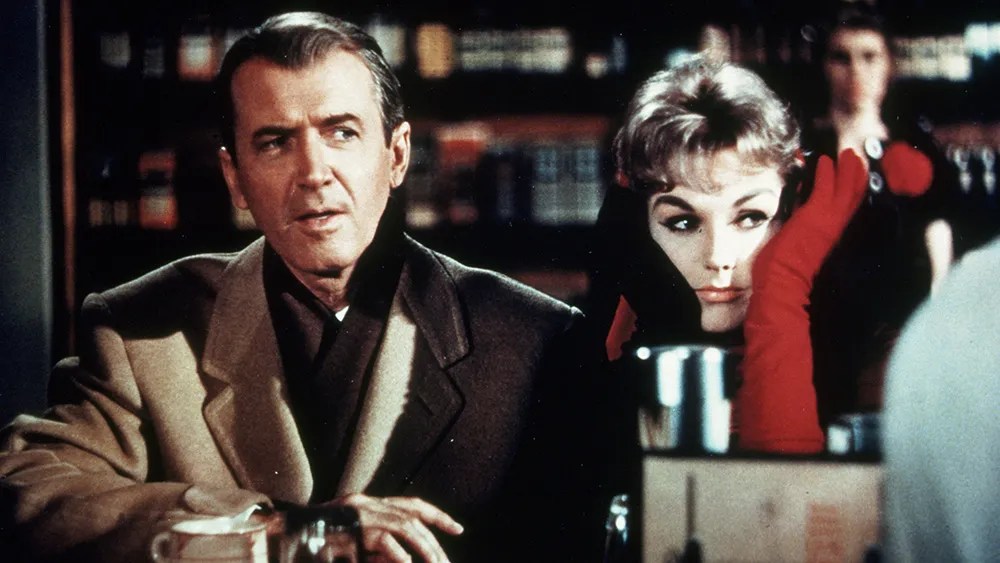
In this supernatural, romantic comedy, Stewart stars as Shep Henderson, an engaged publisher in New York City who finds himself falling for his beautiful neighbor, Gillian Holroyd (Kim Novak). The problem is that Gillian just happens to be a witch, and she has a bad past with Shep’s fiancé, Merle (Janice Rule). What starts as a ruse to get back at an old rival eventually turns into true love and Gillian doesn’t know how to handle these new feelings. Is she willing to confess what she’s done and give up her powers for a chance at love? I guess you’ll just have to watch and see! 

Stewart makes almost anything enjoyable just by being himself. That amazing voice, combined with his natural humor and charm, gives me something I can latch ahold of, and I always pull for his characters. Kim Novak is just so beautiful, and downright sexy, as Gillian. This character has spent her life operating by one set of rules and all of a sudden, she’s trying to figure out how to deal with feelings she hasn’t dealt with before. Her ability to cast spells and work magic takes on a different meaning when the hearts of people she loves are at stake, and Gillian soon has a crisis of conscience. Stewart and Novak have incredible chemistry, which goes a long way in helping this complicated romance work.

And then there’s the movie’s setting. I came in October for a romantic story involving witches and warlocks, but I ended up with characters falling in love in New York City at Christmastime. I could see this as a movie I watch every year over the holidays moving forward, especially since Stewart is the star. I know my mom will love it!! 

The film also features an incredible supporting cast that includes Jack Lemmon, Ernie Kovacs, Hermione Gingold, Howard McNear and Elsa Lanchester, who’s especially effective as Gillian’s Aunt Queenie. If you leave the movie feeling like you want to go back and watch the old show BEWITCHED, starring Elizabeth Montgomery, I’ll just let you know that makes perfect sense. This movie was actually an acknowledged inspiration for that classic series.

BELL, BOOK AND CANDLE may feature a witch as a main character, but this story doesn’t feature any scares. It’s a fun romance with a charming premise and a great cast. Even a witch has a chance for love, and when that chance is with someone played by Jimmy Stewart, that’s about as magical as it gets! 
Scenes That I Love: Elsa Lanchester as Mary Shelley in Bride of Frankenstein


The writer Mary Shelley was born on this date in 1797.  Shelley, of course, is best-known for writing Frankenstein, a book that some claim is the first science fiction novel.  (That’s debatable but it was still a major literary achievement.)

In this scene from 1936’s Bride of Frankenstein, Elsa Lanchester appears as Mary Shelley, continuing her story.  (Of course, Lanchester also played the Bride herself.)

Scenes That I Love: Elsa Lanchester as Mary Shelley in Bride of Frankenstein


The writer Mary Shelley was born on this date in 1797.  Shelley, of course, is best-known for writing Frankenstein, a book that some claim is the first science fiction novel.  (That’s debatable but it was still a major literary achievement.)

In this scene from 1936’s Bride of Frankenstein, Elsa Lanchester appears as Mary Shelley, continuing her story.  (Of course, Lanchester also played the Bride herself.)

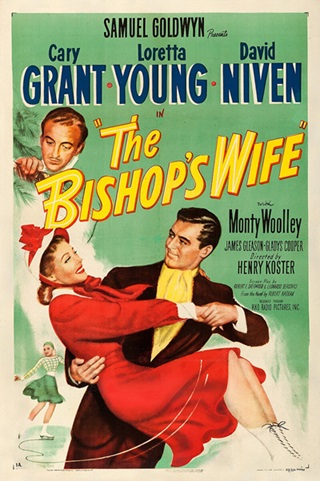
Lisa Marie Review An Oscar Nominee: The Bishop’s Wife (dir by Henry Koster)


In 1947’s The Bishop’s Wife, Cary Grant stars as Dudley.

We first see Dudley walking down the snow-covered streets of a city that is preparing for Christmas.  He watches Julia Broughman (Loretta Young), the wife of the local Anglican bishop.  He stops to talk to Prof. Wutheridge (Monty Woolly), a secular humanist who is close to Julia and her husband, despite being irreligious himself.  Dudley seems to know all about the professor, even though the professor is not sure who he is.  The professor mentions that he was fired from a university because he was considered to be a “radical,” even though he has no interest in politics.  The professor says that the town’s church has seen better days, especially since the Bishop is more interested in raising money from the rich to build a grand new cathedral than actually meeting with the poor who need help.

The last person that Dudley visits is Bishop Henry Broughman (David Niven).  Dudley reveals to Henry that he’s angel and that he’s come in response to Henry’s prayers.  Henry has been frustrated in his attempts to raise money for a new cathedral.  Dudley has come to provide guidance.

With only the Bishop knowing the truth about Dudley, Dudley becomes a houseguest of the Broughmans.  The Bishop has become so obsessed with his new cathedral that he’s not only been neglecting his diocese but also his family.  While Dudley tries to show Henry what’s really important, he also helps Julia and her daughter Debby (Karolyn Grimes) to fit in with the neighborhood.  (Bobby Anderson, who played the young George Bailey in It’s A Wonderful Life, makes an appearance as a boy having a snowball fight who says that Debby can’t play because no one wants to risk hitting a bishop’s daughter with a snowball.)  The Bishop becomes jealous of Dudley and perhaps he should be as Dudley finds himself falling in love with Julia and considering not moving on to his next assignment.

(And now we know where Highway to Heaven got the inspiration for 75% of its episodes….)

The Bishop’s Wife is an enjoyable film, one that is full of not just Christmas imagery but also the Christmas spirit as well.  The Bishop finally realizes that his planned cathedral is more of a gift to his ego than to the men and women who look to him for guidance and comfort in difficult times.  David Niven is, as always, likable even when his character is acting like a jerk.  That said, this is pretty much Cary Grant’s show from the start.  Suave, charming, and gently humorous, Grant joins Claude Rains and Henry Travers in the ranks of great cinematic angels.  Never mind that Grant’s character is a bit pushy and has his own crisis of faith.  From the minute that Grant appears, we know that he’ll know exactly the right way to answer Henry’s prayers.

Cary Grant was not nominated for Best Actor for his performance here.  Undoubtedly, this was another case of Grant making it all look so easy that the Academy failed to realize just how good of a performance he gave.  Interestingly enough, The Bishop’s Wife was one of two Christmas films nominated for Best Picture that year, along with Miracle on 34th Street.  Both films lost to Gentleman’s Agreement.

Horror Scenes That I Love: The Monster Meets The Bride in Bride of Frankenstein


Bride of Frankenstein (1935, dir James Whale)

Today’s horror scene that I love comes from 1935’s The Bride of Frankenstein.   In this wonderfully acted scene, the Bride (Elsa Lanchester) meets the Monster (Boris Karloff) for the first time.  Both of their reactions reveal them to be far more human than the people who created them.


Halloween Havoc!: BRIDE OF FRANKENSTEIN (Universal 1935)


gary loggins's avatarcracked rear viewer

James Whale’s brilliant BRIDE OF FRANKENSTEIN is one of those rare occasions where the sequel is better than the original… and since the original 1931 FRANKENSTEIN is one of the horror genre’s greatest films, that’s saying a lot! Whale’s trademark blend of horror and black humor reached their zenith in BRIDE, and though Whale would make ten more films before retiring from Hollywood moviemaking in 1941, this was his last in the realm of the macabre. It turned out to be his best.

Mary Shelley’s got a story to tell…

William Hurlbut’s screenplay start with a prologue set during the proverbial dark and stormy night, with Mary Shelly (Elsa Lanchester ), Percy Bysshe Shelley (Douglas Walton), and Lord Byron (Gavin Gordon ) discussing Mary’s shocking novel “Frankenstein” as clips from the 1931 film are shown. Then Mary tells them there’s more to the story, and we pick up…

View original post 785 more words

Drive-In Saturday Night 2: BIKINI BEACH (AIP 1964) & PAJAMA PARTY (AIP 1964)


gary loggins's avatarcracked rear viewer

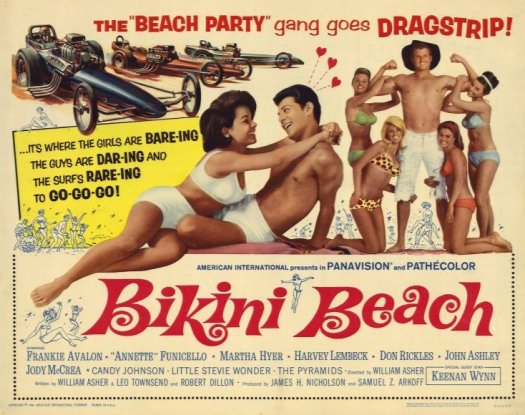
Welcome back to Drive-In Saturday Night! Summer’s here, and the time is right for a double dose of American-International teen flicks, so pull in, pull up a speaker to hang on your car window, and enjoy our first feature, 1964’s BIKINI BEACH, starring Frankie Avalon and Annette Funicello:

BIKINI BEACH is the third of AIP’s ‘Beach Party’ movies, and this one’s a typical hodgepodge of music, comedy, and the usual teenage shenanigans. The gang’s all here, heading to the beach on spring break for surfing and swinging. This time around, there’s a newcomer on the sand, British rock star The Potato Bug, with Frankie playing a dual role. Potato Bug is an obvious spoof of the big Beatlemania fever sweeping the country, with all the beach chicks (or “birds”, as he calls ’em) screaming whenever PB starts singing one of his songs, complete with Lennon/McCartney-esque “Wooos” and “Yeah, yeah, yeahs”…

View original post 808 more words

Lisa Reviews An Oscar Nominee: The Razor’s Edge (dir by Edmund Goulding)


Oh, 1919!  What a year.  The Great War had ended, leaving much of Europe devastated.  American soldiers were coming home and, scarred by the horrors they had experienced, becoming members of a lost generation.  The Spanish Flu was infecting millions, on the way to eventually wiping out 3% of the world’s population.  It was a grim time so it’s no surprise that many chose to close their eyes and pretend like everything was fine.  Only a few people were willing to look at the world and say, “There has to be something more.”

The 1946 film The Razor’s Edge tells the story of one such man.  Before the war, Larry Darrell (Tyrone Power, Jr.) was like most of his friends back in Chicago.  He was carefree.  He was wealthy.  He was engaged to marry the beautiful but self-centered Isabel (Gene Tierney).  But then he went off to fight in World War I and the experience changed him.  On the final day of the war, another soldier sacrificed his life to save Larry and Larry is now haunted by that man’s death.  No longer sure about his place in the world, Larry announces that he’s rejecting his former life.

Of course, that’s an easy thing to do when you’re rich.  Larry is lucky enough to have an inheritance that he can live off for a few years.  All of his former friends think that Larry’s just struggling to adjust to being back home and they expect that he’ll get over it soon enough.  Isabel’s uncle, Elliott (Clifton Webb), thinks that Larry’s acting like a total fool.  For Larry’s part, he no longer cares what any of them think.  He’s going to travel the world, seeking enlightenment.

While Larry’s searching, life goes on without him.  Isabel ends up marrying one of Larry’s friends, Gray Maturin (John Payne).  Larry’s best friend from childhood, Sophie (Anne Baxter), suffers a personal tragedy of her own and, when Larry next meets her, she’s living as a drunk on the streets of Paris.  Larry keeps searching for the meaning of it all.  He works in a coal mine.  He discusses philosophy with a defrocked priest.  Eventually, he ends up in the Himalayas, where he studies under a Holy Man (Cecil Humphreys).

It’s an intriguing idea and still a relevant one.  Unfortunately, the movie doesn’t really work because Larry tends to come across as being a little bit full of himself.  I could imagine someone like Henry Fonda working wonders with the role but Tyrone Power seems totally miscast as Larry.  When you look at Power, you find it hard to believe that he’s ever had a bad day, much less a need to spend months hiding in the Himalayas.  He comes across as the last person you would necessarily want to take spiritual advice from.  The fact that Webb, Tierney, Payne, and Baxter are all perfectly cast only serves to enforce just how miscast Power is.  It’s a well-intentioned film with nice production values but it’s never quite compelling.

The Razor’s Edge was based on a novel by W. Somerset Maugham.  Interestingly, the film features Maugham as a character, played by Herbert Marshall.  Even more interesting is the fact that the film was apparently remade in 1984, with Bill Murray cast as Larry Darrell.  I’ve never seen the remake so I have no idea if Murray is an improvement on Power.

(Also, since I’ve been pretty critical of Power in this review, let me recommend Witness For The Prosecution, in which Power is much better cast.)

The Razor’s Edge was nominated for Best Picture but lost to another film about returning vets, The Best Years of Our Lives.

Creepy Crawlies: WILLARD (Cinerama 1971)


gary loggins's avatarcracked rear viewer

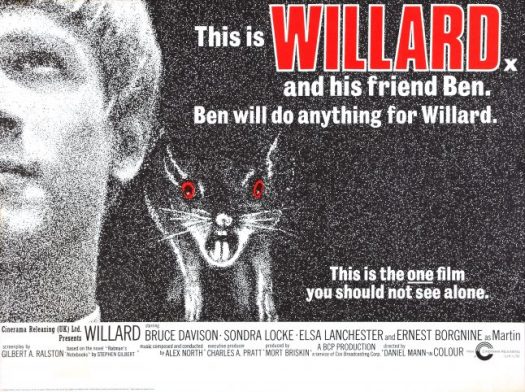
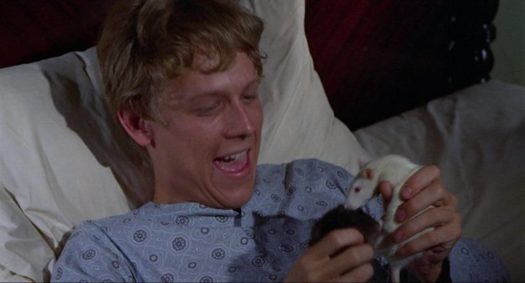
Rats are not cute’n’cuddly little creatures. They’re disgusting, disease-infested vermin that should be avoided at all costs. But don’t tell that to WILLARD, title character in this 1971 chiller that started a regular revolution of “animals run amok” horror movies. Bruce Davison, later to become one of his generation’s finest actors (SHORT EYES, THE LATHE OF HEAVEN, LONGTIME COMPANION), is a regular rodent Dr. Doolittle here, not only talking to the animals, but handling them fondly while he trains them to kill his enemies. Rats – yuck!

Willard Stiles is a lonely loser who shares a rambling, decrepit manse with his  domineering mother (Elsa Lanchester) and works for bullying boss Martin (Ernest Borgnine ), who stole the family business from Willard’s late father. Office temp Joan (Sondra Locke) feels sorry for Willard, but the socially awkward nerd is uncomfortable around people, preferring instead to spend time with the rats in…

View original post 365 more words

Horror on the Lens: The Spiral Staircase (dir by Robert Siodmak)


For today’s horror on the lens, we have the 1946 suspense film, The Spiral Staircase!

In this film, Dorothy McGuire plays Helen, a young mute woman who has been hired to serve as a caretaker for wealthy old Mrs. Warren (Ethel Barrymore, who was nominated for an Oscar for this film).  At the same time, someone is murdering women in the same town.  Are they all connected?  Of course, they are!  The fun of the movie is discovering how they’re connected.

I was introduced to The Spiral Staircase by my friend and fellow member of the Late Night Movie Gang, Chris Filby.  It’s a gothic murder mystery, full of atmosphere and menace.  I think you’ll like it so, if you have 80 minutes to spend on it, please watch and enjoy!