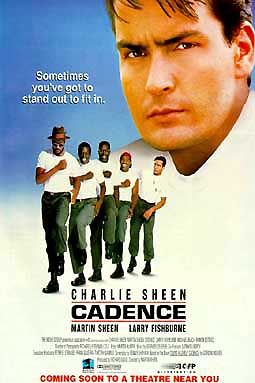
Cadence (1990, directed by Martin Sheen)


In the 1960s, druken Pvt. Franklin Fairchild Bean (Charlie Sheen) punches an MP in West Germany.  The rebellious Bean is hoping he’ll be discharged from the Army.  Instead, he’s sent to the stockade for 90 days.  The stockade is run by an alcoholic tyrant named Sgt. Otis McKinney (Martin Sheen) and, shortly after arrival, Bean discovers that he’s the only white prisoner.  With McKinney determined to break him, Bean befriends his fellow prisoners, including Roosevelt Stokes (Laurence Fishburne), and the two white corporals (James Marshall and Ramon Estevez) who try to protect the prisoners from McKinney’s erratic behavior.

Cadence is the only film to have been directed by Martin Sheen.  Considering that it co-stars two of his sons, it’s unfortunate that Cadence isn’t a better movie.  Charlie Sheen gives a one-note performance as Franklin Bean but he still does better than his father, who is such a raging monster as Sgt. McKinney that it’s difficult to take him or the movie seriously.  As a director, Martin Sheen always goes for the most ham-fisted shot and it’s hard to see what he’s really trying to say about the Army or Franklin Bean’s rebellion.

The supporting cast is better, especially James Marshall and Ramon Estevez.  Laurence Fishburne brings his trademark gravitas to the role of Stokes.  The other prisoners are played by Michael Beach, Blu Mankuma, John Toles-Bey, and Harry Stewart and they all make a good impression.  Stewart plays the most saintly and innocent of the prisoners.  Guess what happens to him.

Back in the day, this movie was an HBO mainstay.  Somehow, I always seemed to catch the end of it but never the beginning.

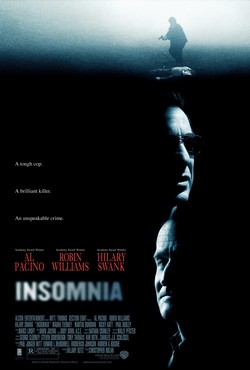
Insomnia File #22: Insomnia (dir by Christopher Nolan)


What’s an Insomnia File? You know how some times you just can’t get any sleep and, at about three in the morning, you’ll find yourself watching whatever you can find on cable? This feature is all about those insomnia-inspired discoveries!

Last night, if you were up at 2 in the morning, you could have turned over to Starz and watched the atmospheric 2002 mystery, Insomnia.

I have to admit that I’m cheating a little bit by including Insomnia in a series about obscure films that you might find on cable late at night.  While Insomnia does seem to often turn up during the early morning hours, it’s hardly an obscure film.  A remake of an acclaimed Norwegian film, it not only stars three Oscar winners (Al Pacino, Robin Williams, and Hilary Swank) but it was directed by Christopher Nolan.  Insomnia got a lot of attention when it was first released in 2002.  But, doing an insomnia file about a movie that’s actually about insomnia was just too good of an opportunity to pass up.

I should also mention that I didn’t have insomnia last night.  I was up because I currently have a cold and I watched Insomnia in a feverish and congested haze.  And yet I couldn’t help but feel that, somehow, that was actually the ideal way to watch Insomnia.  With its ominous atmosphere and Nolan’s eye for the surreal, Insomnia plays out like a semi-lucid fever dream.

A teenage girl has been murdered in a small Alaskan fishing village.  The chief of police (played by the great character actor Paul Dooley) asks his former LAPD partner, Will Dormer (Al Pacino), to come to Alaska and help with the investigation.  Accompanying Dormer is his partner and friend, Hap Eckhart (Martin Donovan).

Dormer has issues that go far beyond anything happening in Alaska.  He’s burned out and he’s plagued by rumors that, in the past, he was a crooked cop.  He’s being investigated by Internal Affairs and, shortly after they arrive in Alaska, Eckhart admits that he’s been given immunity as part of a deal to testify against Dormer.  While pursuing the suspected murderer through the Alaskan fog, Dormer fires his gun.  When the fog clear, Dormer discovers that he’s killed Eckhart.  Was it an accident or did Dormer intentionally shoot  his partner?  Not even Dormer seems to know for sure.  He lies and says that the murderer shot Eckhart.

Working with a local detective (Hilary Swank), Dormer tries to solve the Alaska murder, with the knowledge that, once he does, he’ll have to return to Los Angeles and he’ll probably be indicted.  Because of the midnight sun, night never falls in Alaska and, tortured by guilt, Dormer cannot sleep.  Add to that, the murderer knows that Dormer shot Eckhart.  And now, he’s calling Dormer and cruelly taunting him.

Who is the murderer?  His name is Walter Finch.  He’s a writer and, in a stroke of brilliance, he’s played by none other than Robin Williams.  To me, Robin Williams’s screen presence always carried hints of narcissism and self-destruction.  Even in comedic roles, there was a transparent but very solid wall between Williams the audience.  When he was shouting out a thousand words a minute and rapidly switching from one character to the next, it always seemed as if it was all a technique to keep anyone from figuring out who he really was.  In Insomnia (and, that same year, in One Hour Photo), Robin Williams reveals an inner darkness that he rarely showed before or after.  Finch may possess Williams’s trademark eccentric smile and nervous voice but, underneath the surface, he’s an empty shell who views human beings as being as disposable as the characters in his paperback novels.

Christopher Nolan takes us directly into the heads of these two enemies, with shots of the desolate Alaskan landscape seeming to perfectly capture the inner desolation of two minds destroyed by guilt and paranoia.  (Neither Finch nor Dormer is capable of connecting with the world outside of his damaged psyche.)  As seen through Nolan’s lens, Alaska becomes as surreal and haunting as one of the dream landscapes from Inception.  For those of us who found both The Dark Knight Rises and Interstellar to be so bombastic that they verged on self-parody, Insomnia is a nice reminder that Nolan doesn’t need a pounding Han Zimmer score to make a great movie.  With Insomnia, Nolan gives us not bombast but a deceptively low-key and atmospheric journey into the heart of darkness.

Ironically, for a film about two men who cannot sleep, Insomnia will haunt your dreams.

insomnia2002poster

Previous Insomnia Files:

  1. Story of Mankind
  2. Stag
  3. Love Is A Gun
  4. Nina Takes A Lover
  5. Black Ice
  6. Frogs For Snakes
  7. Fair Game
  8. From The Hip
  9. Born Killers
  10. Eye For An Eye
  11. Summer Catch
  12. Beyond the Law
  13. Spring Broke
  14. Promise
  15. George Wallace
  16. Kill The Messenger
  17. The Suburbans
  18. Only The Strong
  19. Great Expectations
  20. Casual Sex?
  21. Truth

Cleaning Out The DVR, Again #17: Dying To Be Loved (dir by Paul Shapiro)


(Lisa is currently in the process of trying to clean out her DVR by watching and reviewing all 40 of the movies that she recorded from the start of March to the end of June.  She’s trying to get it all done by July 10th!  Will she make it!?  Keep visiting the site to find out!)

DTBL

After I finished up with The Cheerleader Murders, I rewatched Dying To Be Loved, which premiered on the Lifetime network on April 16th.  Dying To Be Loved is also known as A Mother’s Suspicion.  I’m really not sure which title I prefer.  A Mother’s Suspicion is a little more accurate, as the film is about a mother who is very suspicious of her daughter’s new boyfriend.  However, Dying To Be Loved has a little bit more of a snap to it, with the juxtaposition of death and love.

If I seem to be spending a bit too much time on the film’s title, that’s because I have a certain word count that I’m trying to meet but there’s really not that much to say about Dying To Be Loved.  It’s a typical example of a genre familiar to all regular Lifetime viewers, the You Should Have Listened To Mom genre of film.

In this case, the mom is Jill Yates (Lindsay Hartley).  Jill has a good career, a good house, a good boyfriend (played by Lifetime regular Dan Payne), and good hair.  That’s really pretty much all you need to be a success in a Lifetime film.  However, she also has an 18 year-old daughter, Emily (Paloma Kwiatkowski).  Emily is away at college.  She’s alone from home for the first time.  She’s also bipolar and Jill fears that Emily is not taking her meds.  Jill is even more worried when she meets Emily’s new boyfriend, Gary (Jedidiah Goodacre).  Gary is rough and tough and has absolutely terrible table manners.  Jill tells Emily that she can do better than Gary so, of course, Emily runs off on a cross-country trip with him.

Soon, Gary is murdering gas station attendants and ranting like a madman.  Emily, who is not taking her medication (cue dramatic music), is convinced that she loves Gary.  In fact, she is so in love with Gary that she apparently agrees to jump off a bridge with him.

Or does she?  No bodies are recovered.  Even though everyone tells Jill that she needs to move on, Jill is convinced that her daughter is still out there.  With the help of a portly P.I. (Jay Bazeau) and an overly friendly small town cop (James Pizzinato), Jill sets out to find her daughter.  One of these two men is connected to Gary.  Which one?  You’ll have to watch the movie to find out!

Anyway, this is pretty much a standard Lifetime film.  Watching it, I couldn’t help but wish that it had been directed by someone like Fred Olen Ray.  At the very least, Fred would have played up the film’s melodrama and would have been a bit less earnest in his approach.  That said, Lindsay Hartley and Paloma Kwiatkowski are totally believable as mother and daughter.  Kwiatkowski, in particular, deserves a lot of credit for giving a believable and multi-faceted performance as the unstable and desperately unhappy Emily.  I winced a few times as I recognized bits of 16 year-old me in Emily’s actions.  This may be a generic Lifetime film but Hartley and Kwiatkowski really put their hearts into their performances and, for that, they deserve a lot of credit!

(For those keeping count, that’s 17 reviews down and 23 more to go!)