An Offer You Can’t Refuse #16: Love Me or Leave Me (dir by Charles Vidor)


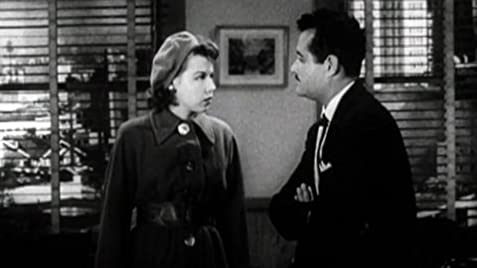
The 1955 film, Love Me or Leave Me, is a biopic about singer Ruth Etting.

Don’t know who Ruth Etting is?  Well, don’t feel too bad.  I didn’t know who she was either, at least not until I watched this movie.  Judging from the trailer that I’ve embedded at the top of this review, she was apparently well-known enough in the 50s for a biopic about her to be a big deal.  Having now watched Love Me or Leave Me and having done some independent research, I know that Ruth Etting was a popular singer in the 20 and 30s and that she was, for a while, married to a gangster named Marty Snyder (played, in the film, by James Cagney).  I also know that, after her marriage to Snyder ended, she married a composer named Johnny Alderman (played by Cameron Mitchell).

I still couldn’t tell you just how closely Love Me or Leave Me actually sticks to the facts of Etting’s life.  I imagine that there was a quite a bit of liberty taken with the truth, if just because the film was made in 1955 and it’s one of those big, glossy productions where all of the sets are ornate and all of the clothes are to die for and all of the dialogue has an edge that’s somehow both tough and sentimental.  It feels less like real life and more like the way that you would imagine life to be.

The film begins in the roaring 20s, with Marty Snyder intervening when Ruth nearly gets fired for kicking an obnoxious admirer.  For Marty, it’s obsession at first sight and, even after Ruth refuses to spend a weekend in Miami with him, Marty continues to help her out in her career.  Marty uses his considerable clout (and the fact that everyone is scared to death of him and his temper) to get Ruth on the radio and then eventually a job with the Ziegfeld Follies.  Despite the fact that Ruth is in love with Johnny and Johnny is in love with her, she ends up marrying Marty because she feels that she owes her entire career to him.  Even after they get married, Marty continues to be obsessively jealous.  It all eventually leads to a shooting, an arrest, and a final song from Doris Day.

It’s very much a film of the 50s.  I imagine that audiences in 1955 thought it made perfect sense that Ruth would feel that she owed it to Marty to marry him despite the fact that she never really asked him to do anything for her.  Seen today, though, Marty comes across as being a stalker and you really want someone to sit Ruth down and have a conversation with her about it and maybe explain concepts like gaslighting and restraining orders to her.

My advise, though, would be to not think too much about it because seriously, the film’s sets are beautiful, the musical numbers are entertainingly excessive, and Doris Day gives a really good performance.  For those who only know her from the romantic comedies that she did with Rock Hudson, Love Me or Leave Me is a revelation.  She’s likable and she’s tough and she sings as if the world depended upon it and watching her in Love Me Or Leave Me, you not only understand why Ruth Etting became a star but also why Doris Day did as well.  James Cagney also gives a good performance as Marty Snyder, bringing all of his swaggering charisma to the role.  As a fan of exploitation films, the most interesting thing about Love Me or Leave Me to me was getting to see Cameron Mitchell play a nice guy for a change.  Mitchell does an okay job with the role, though Johnny is never as interesting a character as Marty.  In the end, it’s an entertaining film, an ornate visual feast that works as long as you don’t think about it too much.

Love Me or Leave Me is an offer that you can’t refuse.

Previous Offers You Can’t (or Can) Refuse:
  1. The Public Enemy
  2. Scarface
  3. The Purple Gang
  4. The Gang That Could’t Shoot Straight
  5. The Happening
  6. King of the Roaring Twenties: The Story of Arnold Rothstein 
  7. The Roaring Twenties
  8. Force of Evil
  9. Rob the Mob
  10. Gambling House
  11. Race Street
  12. Racket Girls
  13. Hoffa
  14. Contraband
  15. Bugsy Malone

An Offer You Can’t Refuse #15: Bugsy Malone (dir by Alan Parker)


Remember how, a few weeks ago, I said I was going to spend the month of June reviewing 30 gangster movies?  Well, I was doing pretty well but then I got distracted with some things and I ended up falling behind and now, it’s the last day of June and I’ve only reviewed 14 of the 30 films that I was planning on taking a look at.  It’s frustrating but, as any movie blogger can tell you, it happens.  Still, I’m not one to give up so easily!  I promised to review 30 gangster movies and I’m going to keep my word.  Or, at the very least, I’m going to try to…. like, definitely maybe try to….

Anyway, let’s get back to it with 1976’s Bugsy Malone!

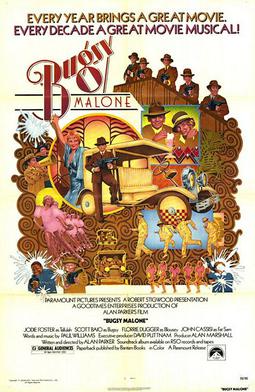
Bugsy Malone is an homage to the old gangster movies of the 1920s and 30s.  It’s also a musical, featuring a lot of songs about wanting to make a lot of money, fall in love, and go away to Hollywood.  On top of all that, it’s also a children’s film.  Though they may be playing gangsters and going to war over who will control the rackets, the cast is entirely made up of children.  Though the film does feature a lot of guns, none of the guns fire bullets.  Instead, they shoot custard pies.  Once you get cornered by a rival gangster and you get “splurged,” your career in the rackets is over.  You’re humiliated.  You’re nothing.  You’re just another two-bit hood who couldn’t make it in the big leagues.  You’re just….

Well, you get the idea.

Basically, the plot of the film is that Dandy Dan (Martin Lev) and Fat Sam (John Cassissi) are two rival gangsters who want to take over the Lower East Side.  Fat Sam owns a speakeasy, which means that there’s always a lot of dancing and singing going on in the background.  Bugsy Malone (Scott Baio) is a tough boxer who wants Fat Sam to give a job to Blousey Brown (Florrie Dugger), who dreams of going to Hollywood and becoming a big star.  Tallulah (Jodie Foster) is Fat Sam’s gun moll but she used to go out with Bugsy and she still wants him back.  Bugsy get caught up in the middle of the war between Dandy Dan and Fat Sam and it all eventually leads to a big pie fight and a lot of children covered in custard.  “You give a little love,” the children sing as they realize that their lives don’t have to be defined by gang wars, “and it all comes back to you….”

So, I have to admit that I was absolutely dreading watching Bugsy Malone.  I mean, singing children and custard pie guns?  It all sound just unbearably cutesy.  But, to my surprise, Bugsy Malone actually turned out to be a fun and clever little movie, one that was full of smart dialogue, catchy songs, excellent dancing, and wonderfully non-cutesy performances from its cast.  Even though the film may be about a bunch of children dressing up as gangsters, all of the child actors take their characters seriously and director Alan Parker directs the film as if it were an actual gangster film as opposed to just a children’s musical.  The end result is a film that’s cute but never cutesy.  Believe me, there is a huge difference between the two.

To my shock, Bugsy Malone turned out to be an offer that you can’t refuse.

Previous Offers You Can’t (or Can) Refuse:

  1. The Public Enemy
  2. Scarface
  3. The Purple Gang
  4. The Gang That Could’t Shoot Straight
  5. The Happening
  6. King of the Roaring Twenties: The Story of Arnold Rothstein 
  7. The Roaring Twenties
  8. Force of Evil
  9. Rob the Mob
  10. Gambling House
  11. Race Street
  12. Racket Girls
  13. Hoffa
  14. Contraband

Music Video of the Day: Save Me by Saint Motel (2020, cinematography by Mario Contini)


Along with their “official” videos, Saint Motel also frequently releases videos for alternate versions of their songs.  This is for the acoustic version of Save Me, which can be found on The Original Motion Picture Soundtrack album.

This video description on YouTube offers up only one credit — which is “cinematography by Mario Contini.”  I know that A/J Jackson is usually credited for directing the group’s videos (and, of course, he’s the band’s lead singer as well) but since I don’t have any official listing for a director, I’m just going to leave that credit blank.

Mario Contini, according the imdb, has worked on several music videos, including ones by Lady Gaga, Post Malone, and Muse.  I like the look of this video.  The band certainly has a talent for finding good locations in which to be filmed performing.

Enjoy!

Film Review: American Wisper (dir by Russ Emanuel)


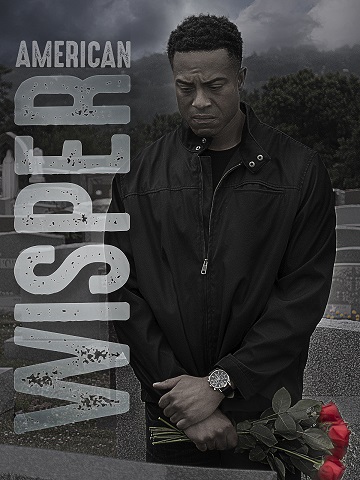
Josiah Wisper (Christian Barber) is a young and successful businessman.  He owns a few bars in Harlem.  He owns a few New York apartment building and, to his tenants, he’s a familiar site, walking up and down the hallways and making sure that everyone has paid their rent.  He and his family have a nice, big house in New Jersey where, not insignificantly, they’re the only black family living in the neighborhood.  Josiah is brash and confident and so sure of his future that he’s even hired a videographer to record every aspect of his life.  Everywhere he goes, she follows and films.

She films him when he’s at his bar, kicking out a drug dealer.  She films him while he’s collecting rent.  She films when he’s talking to his parents.  She films him when he’s flirting with his mistress.  She even films him the night that he returns to New Jersey and discovers that his entire family has been shot to death.  She continues to film as Wisper is interrogated by the police, shunned by his neighbors, and finally forced to investigate the murder on his own.

Usually, found footage films get on my last nerve and I have to admit that I was a little bit concerned when American Wisper began with Wisper talking to the camera.  However, American Wisper actually makes fairly good use of the gimmick.  There’s no shortage of people in the film who are willing to point out how strange it is that Wisper is allowing all of this to be filmed.  In fact, once people start to suspect that Wisper committed the murder, many of them specifically claim that his obsession with being filmed proves that there’s something off about him.  It’s held up as evidence that Wisper is a narcissist who only cares about himself.  To the film’s credit, it doesn’t necessarily dismiss that possibility.  As played by Christian Barber, Wisper does come across as a man who is happy to be living in a movie.  When we first see him, he’s presiding over his bar and you can tell that he’s a man who loves being the center of attention.  Even after the murders, Wisper still often seems to be playing up to the camera, leaving you wondering if maybe it’s possible that there is something that he’s not being honest about.  It creates a genuine feel of suspense, which is more than can be said for most found footage films.

I liked American Wisper.  It’s a low-budget film, made for under $500,000, but it makes good use of that low budget.  When Wisper drives through New York or into New Jersey, he’s not visiting an elaborate Hollywood sound stage.  Instead, he’s actually walking down those streets and driving down those roads and it brings an authenticity to the film that it might have lacked with a bigger budget or a more elaborate production.  Some of the actors are a bit more convincing than others but Christian Barber does an excellent job in the lead role, making Wisper into a character with whom you sympathize despite his flaws.  American Wisper is a murder mystery that’s about more than just a crime.  It’s also an examination of race, upward mobility, and fame in America.

American Wisper can currently be viewed on Prime.

Music Video Of The Day: Kiss From A Rose (1994, dir by Joel Schumacher)


Rest in Peace, Joel Schumacher.

Despite what some sites on the internet would have you believe, this song was not written for a Batman film.  It was featured in 1995’s Batman Forever but it was not actually written for the movie.  Instead, the song was first written in 1987 and then it was first recorded and released in 1994.  When it was first released as a single, it didn’t get much attention and it quickly fell out of the charts.  Then it was featured during the end credits of Batman Forever and it was re-released and promoted with this Joel Schumacher-directed video and it became a huge hit.  This is one of those songs that will never die.  As long as there are weddings and funerals, this song will live.  As long as there are comedy shows that want to do over-the-top falling-in-love montages, this song will live forever.

I used to know a guy who would sing this song every Saturday night for karaoke and, every single time, he would start crying about halfway through the song.  When I asked him why the song always made him cry, he replied, “Showmanship.”  I’m not really sure what happened to him, as it’s been more than a while since I last went to any sort of karaoke night.  I hope he’s okay, wherever he is.  The world of karaoke can be very competitive and ruthless.  Someone should make a movie about it.  It would probably have a really good soundtrack.

Enjoy!


Music Video of the Day: Bleached Waves by ZOON (2020, dir by John Smith)


It is a dream?  Is it a fantasy?  Is it a mirage?  Is it a vision of the future?  Perhaps it’s all four.

I just know that it’s atmospheric and, by this point, everyone should know how much I love atmosphere.

Enjoy!

An Offer You Can’t Refuse #14: Contraband (dir by Lucio Fulci)


The 1980 film, Contraband, tells a story of the Neapolitan underworld.

Luca Ajello (Fabio Testi) and his older brother, Mickey, have a pretty nice operation going.  They pilot boats up and down the coast of Italy, smuggling cigarettes and booze into Naples.  It’s given both of them a pretty good life.  They own a racehorse.  Luca’s got a big house with a beautiful wife (Ivana Monti) and a precocious son.  The police are too incompetent to stop them and their disco-loving boss, Perlante (Saverio Marconi), keeps them safe from any interference from the other mob bosses working in Naples.

But then, one night, two men disguised as policeman pull Luca and Mickey over while they’re driving down an isolated road.  The fake cops proceed to fire what seems to be over a hundred bullets into Mickey.  Luca, having ducked down in his seat, is not spotted by the assassins.  Determined to find out who murdered his brother and why, Luca immediately suspects a rival mobster named Scherino but Scherino insists that Mickey’s murder was actually ordered by a mysterious French drug lord known as Il Marsigliese (Marcel Bozzuffi, who also played a French drug smuggler in The French Connection).  The French are trying to take over the rackets in Naples and a sudden surge in violence, one which sees nearly every mob boss in Naples murdered on the same day, suggests that Scherino is telling the truth.

Contraband is a brutal Italian crime film, one that is notable for being one of director Lucio Fulci’s final non-horror films.  (Contraband was released after Zombi 2 but before City of the Living Dead.)  Though the film might not feature any zombies or any talk of “the Beyond,” it’s still unmistakably a Fulci film and some of the film’s brutal violence remains shocking even when seen today.  The scene where a duplicitous drug smuggler gets her face melted with a blow torch is nightmarish and it’s followed by a scene where a rival gangster graphically gets the back of his head blown out.  (Fulci lingers on the hole in the man’s head, giving us an out-of-focus shot of the people standing behind him.)  A later gunfight leads to one gangster dying with a gaping hole in his throat while another has his face shot away, despite the fact that he’s already dead.  It’s graphic but it’s also appropriate for the story being told.  This is a movie about violent men and, as Fulci himself often pointed out whenever he was challenged about the graphic gore in his films, violence is not pretty.  Contraband is not a film that’s going to leave anyone wanting to become a gangster.

The plot is not always easy to follow but, as is typical with a good Fulci film, the striking visuals make up for any narrative incoherence.  Fulci’s camera rarely stops moving, creating a sense of unease and pervasive paranoia.  Much like the characters in the film, we find ourselves looking in every corner and shadow for a potential threat.  A meeting with an informant at a mist-shrouded sulfur pit ends with assassin literally emerging from the mist and stabbing the informant from behind.  A later gun battle on a narrow street seems to feature gunmen literally appearing out of thin air.  Fabio Testi is ruggedly sympathetic as Luca while Saverio Marconi does a great job as the decadent Perlante.  Meanwhile, Marcel Bozzuffi is legitimately frightening in his few scenes as the evil French gangster.  He’s a great villain, smug and willing to kill anyone.  You don’t have to support organized crime to support the idea of running the French out of Naples.

Contraband is a minor crime classic and proof that there was more to Fulci than just zombies and serial killers.  Today would have been Lucio Fulci’s 93rd birthday and it’s also a good day to track down Contraband, an offer that you can’t refuse.

Previous Offers You Can’t (or Can) Refuse:
  1. The Public Enemy
  2. Scarface
  3. The Purple Gang
  4. The Gang That Could’t Shoot Straight
  5. The Happening
  6. King of the Roaring Twenties: The Story of Arnold Rothstein 
  7. The Roaring Twenties
  8. Force of Evil
  9. Rob the Mob
  10. Gambling House
  11. Race Street
  12. Racket Girls
  13. Hoffa

Film Review: Cold Turkey (dir by Norman Lear)


The 1971 satire, Cold Turkey, is the film that boldly explores just how much into the ground one joke can driven.

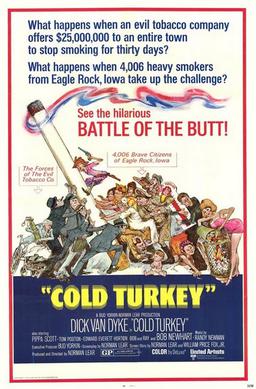
It’s a film that imagines what would happen if a big tobacco company decided to try to improve its image by giving people an incentive to quit smoking.  In the real world, of course, they ended up funding Truth.org and coming up with anti-smoking commercials that were so lame that they would make viewers want to go out and buy a pack of cigarettes just to spite the self-righteous people lecturing them during the commercial breaks.  In the film, however, Marwen Wren (Bob Newhart) comes up with the idea of offering to pay 25 million dollars to any community that can completely stop smoking for 30 days.

Wren figures that no large group of people will be able to just give up smoking for a month.  Not in 1971!  However, Wren didn’t count on the single-minded determination of the Rev. Clayton Hughes (Dick Van Dyke).  Hughes is the stern and self-righteous minister of Eagle Rock Community Church in Eagle Rock, Iowa.  He knows that Eagle Rock could really use that money so he sets off on a crusade to convince all 4,006 of the citizens of Eagle Rock to take the pledge to quit smoking.

As I said at the start of this review, Cold Turkey is pretty much a one-joke film.  The joke is that everyone in the movie — from the tobacco company execs to the citizens of Eagle Rock to Rev. Hughes — is an asshole.  They start the film as a bunch of assholes and, once they try to quit smoking, they become even bigger assholes.  Soon, everyone in town is irritable and angry.  The only people happy are the people who never smoked in the first place, largely because they’ve been set up as a sort of paramilitary border patrol.  Even though his anti-smoking crusade lands him on the cover of Time, Rev. Hughes is also upset because he started smoking right before it was time to quit smoking.  He deals with his withdraw pains through sex and frequent glowering.

Wren is concerned that the town of Eagle Rock might actually go for a full 30 days without smoking so he attempts to smuggle a bunch of cigarettes into the town and then runs around with a gigantic lighter that looks like a gun.  It’s a storyline that doesn’t really go anywhere but then again, you could say that about almost all of the subplots in Cold Turkey.  There’s a lot of characters and there’s a lot of frantic overacting but it doesn’t really add up too much.  Storylines begin and are then quickly abandoned.  Characters are introduced but then never do anything.  For a while, It seems like the film is at least going to examine the Rev. Hughes’s totalitarian impulses but no.  Those impulses are clearly there but they’re not really explored.

If I seem somewhat annoyed by this film, it’s because it really did have a lot of potential.  This could have been a very sharp and timeless satire but instead, it gets bogged down in its own frantic storytelling and the film’s comedy becomes progressively more and more cartoonish.  By the end of the movie, the President shows up in town and so does the military and it all tries to achieve some Dr. Strangelove-style lunacy but the film doesn’t seem to know what it really wants to say.  It seems to be setting itself up for some sort of grandly cynical conclusion but instead, it just sort of ends.  One gets the feeling that, at the last minute, the filmmakers decided that they couldn’t risk alienating their audience by taking the story to its natural conclusion.

Admittedly, while watching the film, I did find myself comparing Hughes and his bullying mob to the same people who are currently snapping at anyone who suggests that maybe the Coronavirus lockdowns were a bit excessive.  It’s easy to think of some modern politicians and media figures who probably would have had a great time in Eagle Rock, ordering people around and shaming anyone who wants a cigarette.  But otherwise, Cold Turkey was just too cartoonish and one-note to really work.

An Offer You Can Take or Leave #13: Hoffa (dir by Danny DeVito)


The 1992 film, Hoffa, opens in 1975, with two men sitting in the backseat of a station wagon.  One of the men is the controversial labor leader, Jimmy Hoffa (Jack Nicholson).  The other is his longtime best friend and second-in-command, Bobby Ciaro (Danny DeVito).  The two men are parked outside of a roadside diner.  They’re waiting for someone who is late.  Jimmy complains about being treated with such disrespect and comments that this would have never happened earlier.  Jimmy asks Bobby if he has his gun.  Bobby reveals that he does.  Jimmy asks him if he’s sure that there’s a loaded gun in the diner, as well.  Bobby goes to check.

Jimmy Hoffa, of course, was a real person.  (Al Pacino just received an Oscar nomination for playing him in The Irishman.)  He was a trucker who became a labor leader and who was eventually elected president of the Teamsters Union.  He was a prominent opponent of the Kennedys and that infamous footage of him being interrogated by Bobby Kennedy at a Senate hearing seems to sneak its way into almost every documentary ever made about organized crime in the 50s.  Hoffa was linked to the Mafia and was eventually sent to prison.  He was freed by the Nixon administration, under the condition that he not have anything to do with Teamster business.  When he disappeared in 1975, he was 62 years old and it was rumored that he was planning on trying to take over his old union.  Everyone from the mob to the CIA has been accused of having had Hoffa killed.

Bobby Ciaro, however, was not a real person.  Apparently, he was a composite character who was created by Hoffa’s screenwriter, David Mamet, as a way for the audience to get to know the enigmatic Jimmy Hoffa.  Bobby is presented as being Hoffa’s best friend and, for the most part, we experience Jimmy Hoffa through his eyes.  We get to know Jimmy as Bobby gets to know him but we still never really feel as if we know the film’s version of Jimmy Hoffa.  He yells a lot and he tells Bobby Kennedy (a snarling Kevin Anderson) to go to Hell and he talks a lot about how everything he’s doing is for the working man but we’re never really sure whether he’s being sincere or if he’s just a demagogue who is mostly interested in increasing his own power.  Bobby Ciaro is certainly loyal to him and since Bobby is played by the film’s director, it’s hard not to feel that the film expects us to share Bobby’s admiration.  But, as a character, Hoffa never really seems to earn anyone’s loyalty.  We’re never sure what’s going on inside of Hoffa’s head.  Jack Nicholson is always entertaining to watch and it’s interesting to see him play a real person as opposed to just another version of his own persona but his performance in Hoffa is almost totally on the surface.  With the exception of a few scenes early in the film, there’s doesn’t seem to be anything going on underneath all of the shouting.

The majority of Hoffa is told via flashback.  Scenes of Hoffa and Bobby in the film’s present are mixed with scenes of Hoffa and Bobby first meeting and taking over the Teamsters.  Sometimes, the structure of the film is a bit cumbersome but there are a few scenes — especially during the film’s first thirty minutes — that achieve a certain visual poetry.  There’s a scene where Hoffa helps to change a man’s flat tire while selling him on the union and the combination of falling snow, the dark city street, and Hoffa talking about the working man makes the scene undeniably effective.  The scenes where Hoffa spars with Bobby Kennedy are also effective, with Nicholson projecting an intriguing blue collar arrogance as he belittles the abrasively ivy league Bobby.  Unfortunately, the rest of the movie doesn’t live up to those scenes.  By the time Hoffa becomes a rich and influential man, you realize that the film isn’t really sure what it wants to say about Jimmy Hoffa.  Does it want to condemn Hoffa for getting seduced by power or does it want to excuse Hoffa’s shady dealings as just being what he had to do to protect the men in his union?  The film truly doesn’t seem to know.

Hoffa is definitely not an offer that you shouldn’t refuse but, at the same time, it’s occasionally effective.  A few of the scenes are visually appealing and the cast is full of character actors like John C. Reilly, J.T. Walsh, Frank Whaley, and Nicholas Pryor.  It’s not a disaster like The Gang Who Couldn’t Shoot Straight.  Hoffa is an offer that you can take or leave.

Previous Offers You Can’t (or Can) Refuse:

  1. The Public Enemy
  2. Scarface
  3. The Purple Gang
  4. The Gang That Could’t Shoot Straight
  5. The Happening
  6. King of the Roaring Twenties: The Story of Arnold Rothstein 
  7. The Roaring Twenties
  8. Force of Evil
  9. Rob the Mob
  10. Gambling House
  11. Race Street
  12. Racket Girls

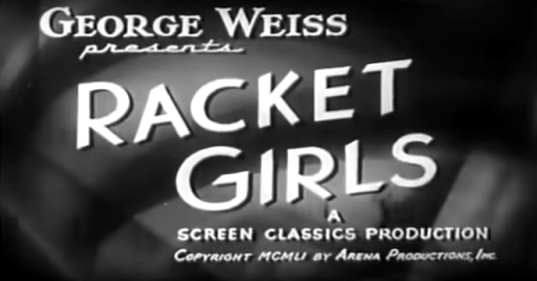
An Offer You Should Refuse #12: Racket Girls (dir by Robert C. Dertano)


The other night, I watched the 1951 film Racket Girls with a select group of friends.  We get together every Saturday night and watch a movie.  Usually, the movie’s pretty bad.  (For instance, we watched Disco Beaver From Outer Space one night.)  Still, I think Racket Girls might be the worst film we’ve seen to date.

Racket Girls tells the story about how the mob infiltrated the sport of professional wrestling.  Umberto Scali (Timothy Farrell) and his little friend Joe (Don Ferrara) make their living managing female wrestlers but it turns out that the wrestling hall is really a front for all of Umberto’s illegal activities.  We’re told that there’s a lot of illegal activities going on but we don’t really see many of them.  Anyway, Umberto borrows too much money from Mr. Big and then he gets the police mad at him and it looks like it all might lead to a bad end for Umberto and his little friend Joe.

Or maybe not.  Who knows?  This movie is only a 67 minutes long but it’s next to impossible to actually follow the plot.  To be honest, I found the complete lack of background music to be more interesting than the plot itself.  It gave the film a strangely existential feel.  There’s no music.  There’s no entertainment.  There’s just a lot of wrestling and bullets.

In fact, I’d say that the film is 75% wrestling, which …. well, I guess whether or not that works depends on whether or not you’re a fan of grainy professional wrestling footage.  I’m not a huge fan, though I’ve seen some good wrestling movies that were smart enough to explore the real people behind the outsized personas.  In Racket Girls, no one really has a personality and no one has a persona either.  There’s a lot of overhead shots of a wrestling ring and we hear what sounds like a crowd cheering even though we never actually see them.  It’s actually a bit of an odd effect.  It makes the wrestling scenes seem positively surreal.  I kept waiting for that strange radiator woman from Eraserhead to step out in the ring and start singing, In Heaven, Everything Is Fine….

Anyway, the film does make a legitimate point about mob’s influence in professional sports.  Umberto, it should be noted, doesn’t appear to be a very smart gangster.  That’s his downfall.  Still, if you enjoy watching movie featuring tough guys in black suits threatening each other …. well, this film probably still isn’t for you.  I mean, a few of the actors playing the gangsters have got the look down but no one’s particularly convincing.  It’s like a community theater production of The Sopranos or something.  It’s like they remade Scarface with Justin Bieber.

As I watched this film, I found myself wondering whether or not Ed Wood was involved because the film just feels like an Ed Wood production.  Also, it should be noted that Racket Girls was produced by George Weiss, who produced several of Wood’s films and that star Timothy Farrell appeared in at least 3 Wood-directed films.  Ed Wood’s name doesn’t appear anywhere in the credit but I swear, this film has his finger prints all over it.

I’m probably making Racket Girls sound more amusing than it actually is.  This is an incredibly boring movie.  My friends nearly abandoned me about ten minutes into the movie and that hardly ever happens.  I had to beg them to stay and watch the rest of the film.  (I told them that there was a cartoon coming up that featured the first appearance of Bobba Fett.  That was the same line I used to keep them from abandoning me two years ago when we were watching The Star Wars Holiday Special.)  This is an offer that you can refuse.  In fact, you should refuse it.

Previous Offers You Can’t (or Can) Refuse:
  1. The Public Enemy
  2. Scarface
  3. The Purple Gang
  4. The Gang That Could’t Shoot Straight
  5. The Happening
  6. King of the Roaring Twenties: The Story of Arnold Rothstein 
  7. The Roaring Twenties
  8. Force of Evil
  9. Rob the Mob
  10. Gambling House
  11. Race Street