1992’s The Player tells the story of Griffin Mill (Tim Robbins).
It’s not easy being Griffin Mill. From the outside, of course, it looks like he has the perfect life. He’s a studio executive with a nice house in Hollywood. He’s young. He’s up-and-coming. Some people, especially Griffin, suspect that he’ll be the president of the studio some day. By day, he sits in his office and listens to pitches from respected screenwriters like Buck Henry. (Henry has a great idea for The Graduate II!) During the afternoon, he might attends dailies and watch endless takes of actors like Scott Glenn and Lily Tomlin arguing with each other. Or he might go to lunch and take a minute to say hello to Burt Reynolds. (“Asshole,” Burt says as Griffin walks away.) At night, he might go to a nice party in a big mansion and mingle with actors who are both young and old. He might even run into and share some sharp words with Malcolm McDowell.
But Griffin’s life isn’t as easy as it seems. He’s constantly worried about his position in the studio, knowing that one box office failure could end his career. He fears that a new executive named Larry Levy (Peter Gallagher) is after his job. Two new screenwriters (Richard E. Grant and Dean Stockwell) keep bugging him to produce their downbeat, no-stars anti-capitol punishment film. His girlfriend (Cynthia Stevenson) wants to make good movies that mean something. Even worse, someone is sending Griffin threatening notes.
It doesn’t take long for Griffin to decide that the notes are coming from a screenwriter named Dave Kahane (Vincent D’Onofrio). Griffin’s attempt to arrange a meeting with Dave at a bar so that Griffin can offer him a production deal instead leads to Griffin murdering Dave in a parking lot. While the other writers in Hollywood mourn Dave’s death, Griffin starts a relationship with Dave’s artist girlfriend (Great Scacchi) and tried to hide his guilt from two investigating detectives (Whoopi Goldberg and Lyle Lovett). Worst of all, the notes keep coming. The writer, whomever they may be, is now not only threatening Griffin but also seems to know what Griffin did.
After spend more than a decade in the industry wilderness, Robert Altman made a critical and commercial comeback with The Player. It’s a satire of Hollywood but it’s also a celebration of the film industry, featuring 60 celebrities cameoing as themselves. Everyone, it seems, wanted to appear in a movie that portrayed studio execs as being sociopathic and screenwriters as being whiny and kind of annoying. The Player both loves and ridicules Hollywood and the often anonymous men who run the industry. Largely motivated by greed and self-preservation, Griffin may not love movies but he certainly loves controlling what the public sees. In the end, only one character in The Player sticks to her values and her ideals and, by the end of the movie, she’s out of a job. At the same time, Griffin has a social life that those in the audience can’t help but envy. He can’t step out of his office without running into someone famous.
The Player is one Altman’s most entertaining films, with the camera continually tracking from one location to another and giving as a vision of Hollywood that feels very much alive. Tim Robbins gives one of his best performances as Griffin Mill and Altman surrounds him with a great supporting cast. I especially liked Fred Ward as the studio’s head of security. With The Player, Altman mixes melodrama with a sharp and sometimes bizarre comedy, with dialogue so snappy that the film is as much a joy to listen to as to watch. That said, the real attraction of the film is spotting all of the celebrity cameos. (That and cheering when Bruce Willis saves Julia Roberts from certain death.) Altman was a director who often used his films to explore eccentric communities. With The Player, he opened up his own home.
First released in 1971, McCabe & Mrs. Miller takes place in the town of Presbyterian Church at the turn of the 19th Century.
Presbyterian Church is a mining town in Washington State. When we first see the town, there’s not much to it. The town is actually named after its only substantial building and the residents refer to the various parts of the town as either being on the right side or the left side of the church. The rest of the town is half-constructed and appears to be covered in a permanent layer of grime. This is perhaps the least romantic town to ever appear in a western and it is populated largely by lazy and bored men who pass the time gambling and waiting for something better to come along.
When a gambler who says that he is named McCabe (Warren Beatty) rides into town, it causes a flurry of excitement. The man is well-dressed and well-spoken and it’s assumed that he must be someone important. Soon a rumor spreads that McCabe is an infamous gunfighter named Pudgy McCabe. Pudgy McCabe is famous for having used a derringer to shoot a man named Atwater. No one is really sure who Atwater was or why he was shot but everyone agrees that it was impressive.
McCabe proves himself to be an entrepreneur. He settles down in Presbyterian Church and establishes himself as the town’s pimp. Soon, he is joined by a cockney madam names Mrs. Miller (Julie Christie). The two of them go into business together and soon, Presbyterian Church has its own very popular bordello. Sex sells and Presbyterian Church becomes a boomtown. It attracts enough attention that two agents of a robber baron approach McCabe and offer to buy him out. McCabe refuses, thinking that he’ll get more money if he holds out. Mrs. Miller informs him that the men that he’s dealing with don’t offer to pay more money. Instead, they just kill anyone who refuses their initial offer.
Three gunmen do eventually show up at Presbyterian Church and we do eventually get an answer to the question of whether or not McCabe killed Atwater or if he’s just someone who has borrowed someone else’s legend. The final gunfight occurs as snow falls on the town and the townspeople desperately try to put out a fire at the church. No one really notices the fact that McCabe is fighting for his life at the time and, as befits a revisionist western, there’s nothing romantic or dignified about the film’s violence. McCabe is not above shooting a man in the back. The killers are not above tricking an innocent cowboy (poor Keith Carradine) into reaching for his gun so that they’ll have an excuse so gun him down. McCabe may be responsible for making Presbyterian Church into a boomtown but no one is willing to come to his aid. The lawyer (William Devane) that McCabe approaches is more interested in promoting his political career than actually getting personally involved in the situation. Mrs. Miller, a businesswoman first, smokes in an opium den with an air of detachment while the snow falls outside.
It’s a dark story with moments of sardonic humor. It’s also one of director Robert Altman’s best. The story of McCabe and Mrs. Miller and the three gunmen is far less important than the film’s portrayal of community growing and changing. Featuring an ensemble cast and Altman’s trademark overlapping dialogue, McCabe & Mrs. Miller puts the viewer right in the heart of Presbyterian Church. There are usually several stories playing out at once and it’s often up to the viewer to decide which one that they want to follow. Yes, the film is about Warren Beatty’s slick but somewhat befuddled McCabe and Julie Christie’s cynical Mrs. Miller. But it’s just as much about Keith Carradine’s Cowboy and Rene Auberjonois’s innkeeper. Corey Fischer, Michael Murphy, John Schuck, Shelley Duvall, Bert Remsen, and a host of other Altman mainstays all have roles as the people who briefly come into the orbit of either McCabe or Mrs. Miller. Every character has a life and a story of their own. McCabe & Mrs. Miller is a film that feels as if it is truly alive.
As with many of Altman’s films, McCabe & Mrs. Miller was not fully appreciated when initially released. The intentionally muddy look and the overlapping dialogue left some critics confused and the film’s status as a western that refused to play by the rules of the genre presented a challenge to audience members who may have just wanted to see Warren Beatty fall in love with Julie Christie and save the town. But the film has endured and is now recognized as one of the best of the 70s.
First released in 1970, Brewster McCloud takes place in Houston.
A series of murders have occurred in the city. The victims have all been older authority figures, like decrepit landlord Abraham Wright (Stacy Keach, under a ton of old age makeup) or demanding society matron Daphne Heap (Margaret Hamilton, who decades earlier had played The Wicked Witch in The Wizard Of Oz). The victims all appear to have been killed by strangulation and all of them are covered in bird droppings. Perplexed, the Houston authorities call in Detective Frank Shaft (Michael Murphy) from San Francisco. Shaft only wears turtlenecks and he has piercing blue eyes. He looks like the type of guy you would call to solve a mystery like this one. It’s only later in the film that we discover his blue eyes are due to the contact lenses that he’s wearing. Frank Shaft is someone who very much understands the importance of appearance. As one detective puts it, when it comes to Shaft’s reputation, “The Santa Barbara Strangler turned himself in to him. He must have really trusted him.”
Perhaps the murders are connected to Brewster McCloud (Bud Cort), who lives in a bunker underneath the Astrodome and who seems to be fascinated with birds. Brewster dreams of being able to fly just like a bird and he’s spent quite some time building himself a set of artificial wings. A mysterious woman (Sally Kellerman) who wears only a trenchcoat and who has scars on her shoulder blades that would seem to indicate that she once had wings continually visits Brewster and encourages him to pursue his dream. However, she warns him that he will only be able to fly as long as he remains a virgin. If he ever has sex, he will crash to the ground.
Brewster thinks that he can handle that. Then he meets a tour guide named Suzanne Davis (Shelley Duvall, in her film debut) and things start to change….
Brewster McCloud is a curious film. The story is regularly interrupted by a disheveled lecturer (Rene Auberjonois) who is very much into birds and who, over the course of the film, starts to more and more resemble a bird himself. The film is full of bird-related puns and there are moments when the characters seem to understand that they’re in a movie. Frank Shaft dresses like Steve McQueen in Bullittand his blue contact lenses feel like his attempt to conform to the typical image of a movie hero. (A lengthy car chase also feels like a parody of Bullitt’s famous chase scene.) When the old woman played by Margaret Hamilton dies, the camera reveals that she’s wearing ruby slippers and a snippet of Somewhere Over The Rainbow is heard. As played by Bud Cort, Brewster is the perfect stand-in for the lost youth of middle class America. He knows that he’s rebelling against something but he doesn’t seem to be quite sure what. Brewster, like many idealists, is eventually distracted by his own desires and his once earnest plans come cashing down. Brewster becomes an Icarus figure in perhaps the most literal way possible, even if he doesn’t come anywhere close to reaching the sun. As with many of Altman’s films, Brewster McCloud is occasionally a bit too esoteric for its own good but it’s always watchable and it always engages with the mind of the viewer. One gets the feeling that many of the film’s mysteries are not necessarily meant to be solved. (Altman often said his best films were based on dreams and, as such, used dream logic.) With its mix of plain-spoken establishmentarians and quirky misfits, Brewster McCloud is not only a classic counterculture film but it’s also a portrait of Texas on the crossroads between the cultures of the past and the future.
Though it baffled critics when it was released, Brewster McCloud has gone on to become a cult film. It’s a bit of a like-it-or-hate-it type of film. I like it, even if I find it to be a bit too self-indulgent to truly love. Quentin Tarantino, for his part, hates it. Brewster McCloud was released in 1970, the same year as Altman’s Oscar-nominated M*A*S*H. (Both films have quite a few cast members in common.) Needless to say, the cheerfully and almost defiantly odd Brewster McCloud was pretty much ignored by the Academy.
What’s an Insomnia File? You know how some times you just can’t get any sleep and, at about three in the morning, you’ll find yourself watching whatever you can find on cable or streaming? This feature is all about those insomnia-inspired discoveries!
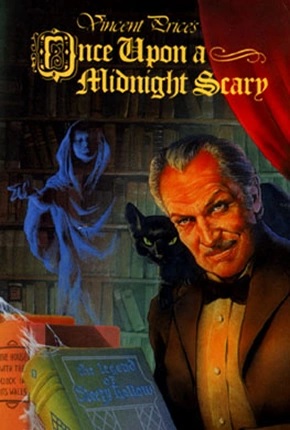
If you were having trouble getting to sleep last night, you could have gone over to YouTube and watched 1978’s Once Upon A Midnight Scary.
Made for CBS and featuring Vincent Price as the sardonic, cape-wearing host, Once Upon A Midnight Scary was a special designed to encourage young viewers to pick up a book and read. Price introduced three different stories, each centering around ghosts and each based on a book. In the first story, based on the book The GhostBelonged To Me, a young farmboy discovers a ghost hiding in a barn and becomes a hero when the ghost warns him about an impending disaster. The second story is an adaptation of The Legend of Sleepy Hollow and it features Rene Auberjonois as a rather neurotic Ichabod Crane, who finds himself being pursued by the headless horsemen. The third and longest story is an adaptation of The House With A Clock In Its Walls, featuring Severn Darden and a rather annoying child actor.
One thing you immediately notice about this show is that the special doesn’t actually reveal how any of the stories end. Instead, each story is basically a recreation of the most exciting or interesting parts of the larger story but, whenever it appears that we’re heading for a conclusion, Vincent Price suddenly appears and says, “What happened next, you ask? Read the book!” This special basically casts Vincent Price as the world’s most devilish book salesman and while that might be annoying if you’re watching the special because you want to see how the stories turn out, it’s a lot of fun if you’re just watching the show to watch Vincent Price act like Vincent Price. Vincent is not in the special as much as you might want but he still shows off his unique charm. It’s impossible to be in a bad mood while watching Vincent Price.
With the Cannes Film Festival underway, I have been watching some of the past winners of the prestigious Palme d’Or. On Thursday night, Jeff and I watched the winner of the 1970 winner of the Grand Prix (as the Palme was known at the time), Robert Altman’s M*A*S*H.
There are, of course, three versions of M*A*S*H. All three of them deal with the same basic story of Dr. Hawkeye Pierce and his attempts to maintain his sanity while serving as a combat surgeon at the 4077th Mobile Army Surgical Hospital during the Korean war. All three of them mix comedy with the tragedy of war. However, each one of them takes their own unique approach to the material.
The one that everyone immediately thinks of is the old television series, which ran for 11 seasons and which can be found on Hulu and on several of the retro stations. The television series starred Alan Alda as Hawkeye. I’ve watched a handful of episodes and, while the episodes that I’ve seen were undeniably well-acted and well-written and they all had their heart in the right place, the show’s deification of Hawkeye can get to be a bit much. Not only is Hawkeye the best surgeon at the 4077th, he’s apparently the best surgeon in all of Korea. In fact, he may be the best surgeon on the entire planet. Not a single thing happens in the camp unless Hawkeye is somehow involved. When a nurse is killed by a landmine in one episode, the focus is not on the other nurses but instead on how Hawkeye feels about it. When bombs are falling too close to the camp, the focus is again only on Hawkeye and how much he hates the war. If you didn’t already know that he hated the war, Hawkeye will let you know. Wish Hawkeye a good morning and he’ll yell at you about how many people are going to be wounder by the end of the day. Even when one agrees with Hawkeye, the character’s self-righteousness can be a bit much.
Less well-known is the first version of M*A*S*H, a short and episodic novel that was published in 1968. The novel was written by Dr. Richard Hornberger, who actually had served in Korea at a M*A*S*H unit and who reportedly based Hawkeye on himself. The book is a rather breezy affair. Reading it, one can definitely tell that it was inspired by someone telling Hornberger, “Your stories about Korea are so funny and interesting, you should write them down!” The book avoids politics, reserving most of its ire for military red tape. Hornberger was a Republican who so disliked Alan Alda’s interpretation of Hawkeye that, when he wrote a sequel to M*A*S*H, he included a scene in which Hawkeye talked about how much he enjoyed beating up hippies.
And then there’s the version that came in between the book and the television series, the 1970 film from Robert Altman. The film retains the book’s episodic structure while also throwing in the anti-war politics that would define the television series. (Though the film was set in the 50s, Altman purposefully made no attempt to be historically accurate because he wanted it to be clear that this film was more about Vietnam than Korea.) From its opening, the film announces its outlook, with shots of helicopters carrying severely wounded (possibly dead) soldiers to the camp while a song called Suicide is Painless plays on the soundtrack. The song was written by director Robert Altman’s fourteen year-old son, Mike. Reportedly, it took Mike five minutes to come up with the lyrics. When the instrumental version of the song was later used as the theme song for the television series, Mike Altman made over a million dollars in royalties.
The film opens with Hawkeye Pierce (Donald Sutherland) and Duke Forrest (Tom Skerritt) arriving at the 4077th MASH in a stolen jeep and it ends with them getting sent home in the same jeep. Though Duke is set up to be a major character, he soon takes a backseat to another surgeon, the unfortunately nicknamed Trapper John (Elliott Gould). Much as with the television series, the movie centers around Hawkeye and Trapper John’s antics. When they’re not in the operating room, they’re drinking, carousing, and playing pranks that are far more mean-spirited than anything the television versions of the characters would have ever done. (Indeed, the book and movie versions of Hawkeye probably would have hated Alan Alda’s Hawkeye.) Unlike the television version of Hawkeye, the film’s Hawkeye is not the best surgeon in Korea. In fact, he’s not even the best surgeon at the 4077th. (That honor goes to Trapper.) Instead, he’s just one of many doctors on staff. They’re rotated in and then, at the end of their tour, they’re rotated out. Hawkeye loses as many patients as he saves. The film’s doctors are not miracle workers, nor are they crusaders. Instead, they are overworked, neurotic, often exhausted, and frequently bored whenever there aren’t any wounded to deal with. The film emphasizes that the doctors are as professional inside the Operating Room as they’re rambunctious outside of it. Unlike the television series, Hawkeye doesn’t joke while working. He’s usually too busy trying to stop his patients from bleeding to death to tell jokes or to complain about the war that brought them to the OR.
Indeed, the film version of M*A*S*H communicates its anti-war message not through indignant speeches but instead through bloody imagery. The operating room scenes don’t shy away from showing the ugliness of war and they are occasionally so visceral that they almost seem to shame the audience for have laughed just a few minutes earlier. One of the film’s more famous (and controversial) sequences features Hawkeye driving Frank Burns (Robert Duvall) to insanity by crudely taunting him about his affair with head nurse Margaret Houlihan (Sally Kellerman). Burns attacks Hawkeye, a response that actually seems rather justified even if it is played for laughs. A scene of Burns being driven out of the camp in straitjacket is followed by a close-up of a geyser of blood erupting from a wounded soldier’s throat. It’s a jarring transition but one that makes a stronger anti-war statement than any self-righteous monologue would have. While Hawkeye and Trapper are taunting Burns and Margaret, soldiers are still being sent off to die.
The humor in M*A*S*H is often brutally misogynistic. Margaret is described as being “a damn good nurse” but is continually humiliated because she believes in maintaining military discipline. One can disagree with her emphasis on following all of the proper regulations while also realizing the Hawkeye and Trapper’s treatment of her is unreasonably cruel. The scene where Trapper and Hawkeye expose her while she’s taking a shower is especially difficult to watch and there’s no way to justify their actions. It’s frat boy humor, the type of stuff that you would expect from a bunch of former college football players, which is what we’re told Hawkeye and Trapper are. (That, of course, is another huge difference between the film and television versions of the characters.) That said, it’s debatable whether or not were supposed to find either Hawkeye or Trapper to be heroic or even likable. As a director, Robert Altman shied away from making films with unambiguous heroes or villains. Just as Margaret could be a “damn good nurse” and a “regular army clown” at the same time, Hawkeye can be both a dedicated doctor and a bit of a jerk.
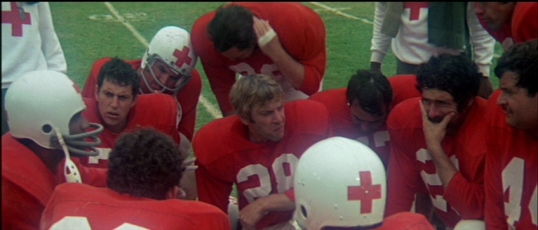
After 90 minutes of bloody operating room scenes and Trapper and Hawkeye making crude jokes, M*A*S*H suddenly becomes a sports film as the the 4077th plays a football game against their rivals, the 325th Evac Hospital. The change of tone can be a bit jarring but it’s perhaps the most important sequence in the film. For a few hours, the doctors bring “the American way of life” to Korea and the end result is a game that’s played for money and which is only won through cheating and deception. (Future blaxploitation star Fred Williamson made his film debut as the ringer who the 4077th recruits for the game.) For all of the broad comedy of the game, it’s followed by a shot of the doctors playing poker while a dead soldier is transported out of the camp, wrapped in a white sheet. Football may provided a distraction. The money may have provided an incentive. But the war continued and people still died.
Much of M*A*S*H‘s humor has aged terribly but the performances still hold up and the anti-war message is potent today. Though Sutherland and Gould are undeniably the stars of the film, M*A*S*H is a true ensemble film, full of the overlapping dialogue and the small character performances that Robert Altman’s films were known for. One reason why the film works is because it is an immersive experience, the viewer truly does feel as if they’ve been dropped in the middle of an operating field hospital. Though Hawkeye and Trapper may be at the center of the action, every character, from the camp’s colonel to the lowliest private, seems to have their own story playing out. This a film where paying attention to the little things happening in the background is often more rewarding than paying attention to the main action. I particularly liked the performances of David Arkin as the obsequies Staff Sergeant Vollmer and Bud Cort as Pvt. Warren Boone. Boone, especially, seems to have an interesting story going on in the background. The viewer just has to keep an eye out for him. Also be sure to keep an eye out for Rene Auberjonois, who reportedly improvised one of the film’s best-known lines when, after Margaret demands to know how Hawkeye reached a position of authority in the army medical corps, he deadpanned, “He was drafted.”
One of the first major studio films to be openly critical of the military and the war in Vietnam, M*A*S*H won the Palme d’Or, defeating films like Investigation of a Citizen Above Suspicion and The Strawberry Statement. Unlike many Palme winners, it was also a box office success in the United States. Though controversial, it received an Oscar nomination for Best Picture. However, unlike the Cannes jury, the Academy decided to honor a different film about war, Patton.
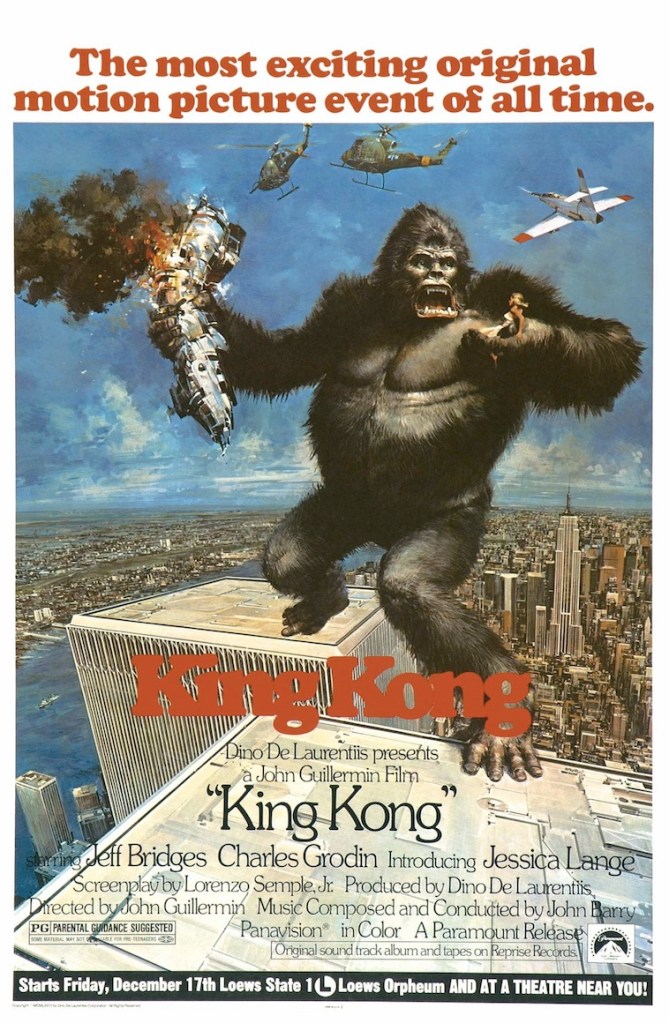
The 1976 remake of King Kong is the version of the great ape’s story that no one ever seems to want to talk about.
Everyone, of course, continues to appreciate the original King Kong from 1933, with its charmingly dated but still somewhat effective special effects. The Japanese King Kong films have their fans, even if it still annoys me that two endings were made for the original King Kong vs. Godzilla. The Peter Jackson-directed remake from 2005 had many admirers, including me. The monsterverse Kong certainly has many fans, as is indicated by the fact that Godzilla vs Kong is the first box office hit of the post-pandemic era. King Kong is a beloved character and yet the 1976 version of his story never seem to get as much attention as all the others.
Some of that, of course, is because the 1976 version of King Kong is often described as not being very good. It tells the same basic story as the first King Kong but there’s a few key differences. The expedition to the hidden island is no longer made up of a film crew. Instead, everyone has a separate backstory that doesn’t really make much sense. Fred Wilson (Charles Grodin) is an energy company executive who is looking for a new source of oil. Jack Prescott (Jeff Bridges) is a long-haired hippie environmentalist type who stows away on Wilson’s ship. Prescott apparently thinks that there’s some sort of ancient primate living on the island. Meanwhile, Dwan (future great actress Jessica Lange, making her film debut) is an aspiring actress who is discovered in a life raft, floating out in the middle of the ocean. It turns out that Dwan (that’s not a typo, that’s her name) has escaped from the yacht of a sleazy film producer. Nobody on the ship seems to be surprised when Dwan suddenly shows up in her life raft and Dwan doesn’t seem to have any hesitation about accompanying a bunch of strangers to previously unexplored island. That’s the type of film this is.
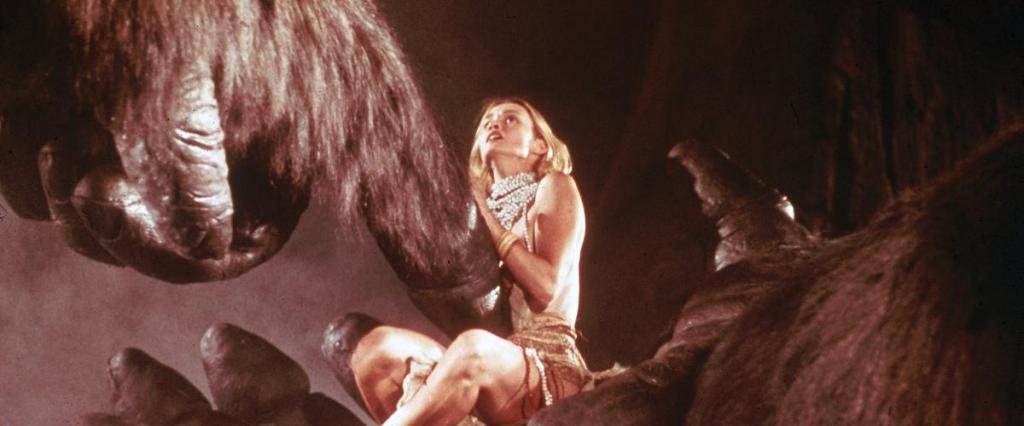
After a considerable amount of time, during which Dwan falls in love with Jack and Fred spends a lot of time looking generally annoyed, the island is discovered. As you can already guess, Dwan is kidnapped by the island’s natives, and she’s rescued by a giant ape who falls in love with her after she punches him in the nose and says, “Put me down, you male chauvinist pig ape!” In some shots, Kong is obviously a man in a rubber suit. In others, he’s just as obviously an animatronic model. Unfortunately, the animatronic version of Kong sometimes appears to kind of be leering whenever he looks down at Dwan in the palm of his hand, which bring a definite element of ickiness to a few of the scenes in which Kong carries Dwan across the island.
I would have started praying too.
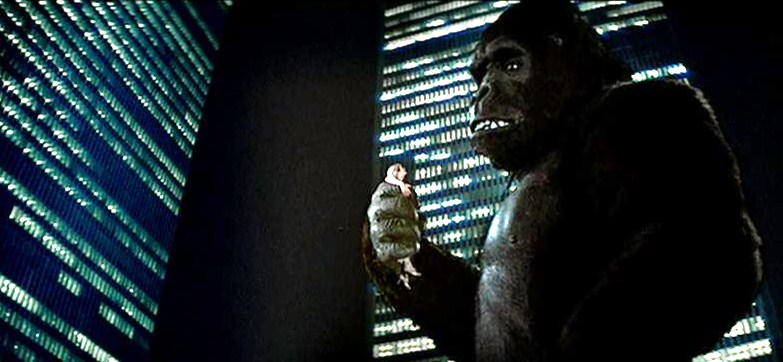
Eventually, just as in the original film, Kong ends up a prisoner in New York. This time, when he escapes, grabs Dwan, and goes on a rampage, he ends up climbing the Two Towers. This leads to scenes of helicopters and fighter planes all firing at the Two Towers, which is a bit difficult to watch today. I remember a few years ago, one of our local stations actually broadcast this version of King Kong on September 11th and it definitely did not feel right.
The 1976 version of King Kong was a hit at the box office and was nominated for three Academy Awards. It won the the award for Best Visual Effects, sharing the Oscar with Logan’s Run. That said, King Kong wasn’t exactly popular with critics, either at the time of its release or today. To a certain extent, it’s understandable why this version of King Kong is so frequently criticized. The script takes a deliberately campy approach to material that, in order to have any real emotional impact, needs to be played straight regardless of how silly the story might seem. Charles Grodin never seems to be sure whether the film is a drama or a comedy. Jeff Bridges is likable but a bit too naturally mellow for his role. Jessica Lange made her film debut in King Kong, famously beating out Meryl Streep for the role. Despite the fact that the film was a box office hit, the reviews of Lange’s performance were so negative that she didn’t work for three years after appearing in the film. (She spent that time studying acting. She went on to win a Tony, two Oscars, and three Emmys so take that, critics.)
And yet, I kind of like this version of King Kong. When taken on its own very silly terms (and not as a remake of a legitimate classic), it’s definitely entertaining. Even the fact that Grodin, Bridges, and Lange are all miscast kind of works to the film’s advantage. You can’t help but appreciate that all three of them are trying so hard to be convincing in roles that they shouldn’t have been playing. For all the criticism of Jessica Lange’s performance, she actually does as well as anyone could with some of the dialogue that she gets stuck with. It’s not easy to pull off a scene where you explain to a giant ape that the relationship is never going to work because you’re a city girl and he’s a …. well, he’s a giant ape. But Lange manages to deliver the lines without laughing and that couldn’t have been easy. Lange’s then-inexperience is obvious whenever she’s having to react to or interact with the other actors but she does fine when she’s having to talk to a guy in a rubber suit or a big animatronic head. (Let’s see Meryl Streep pull that off.) Though it seems to take forever for Kong to actually get captured, the film picks up once he’s transported to New York. If you can look past the awkwardness of how the film uses the Twin Towers, the scenes of Kong rampaging through the city have an over-the-top grandeur that’s both ludicrous and compelling. By the time he reaches the top of the World Trade Center, you will totally be on his side. That’s the way it should be.
This remake of King Kong is deeply, deeply silly but, sometimes, that’s exactly what you’re looking for.
Police Academy 5 starts as so many Police Academy films have started. Commandant Lassard (George Gaynes) is getting progressively more loopy and Captain Harris (G.W. Bailey) is plotting to take over the Academy. This time, Harris thinks that he has come up with the perfect plan when he discovers that Lassard has reached the mandatory retirement age.
With retirement looming, Lassard attends one final law enforcement convention in Miami. At the convention, Lassard is to be honored as “Police Officer of the Decade” because it was apparently a very slow decade. Lassard decides to bring along his favorite academy graduates so that they can celebrate with him and meet his nephew, Sgt. Nick Lassard (Matt McCoy, who you may recognize as Seinfeld’s Lloyd Braun or maybe as the spokesman for Hartford Insurance). The commandant invites Sound Effects Guy (Michael Winslow), Tackleberry (David Graf), Hightower (Bubba Smith), Hooks (Marion Ramsey), Callhan (Leslie Easterbrook), and House (Tab Thacker). Notice who isn’t there? This was the first Police Academy film without Steve Guttenberg’s Carey Mahoney and Commandant Lassard celebrating his career without inviting his most loyal graduate doesn’t seem right.
Once what is left of the old gang arrives in Miami, they get caught up in the usual Police Academy shenanigans. Rene Auberjonois plays a jewel thief who accidentally switches bags with the Commandant and who has 24 hours to retrieve the stolen diamonds. It’s Florida so there are women in bikinis and an Everglades boat chase. Harris gets humiliated in every way possible. The jokes are even more juvenile than usual. Nick Lassard uses sunscreen to permanently label Harris as being a “dork” so everyone on the beach calls Harris a “dork.” That’s as sophisticated as things get.
Unfortunately, there’s a Steve Guttenberg-shaped hole at the center of Police Academy 5 and not even as formidable a thespian as Matt McCoy can fill it. Even though Guttenberg always seemed like he was miscast as both a cop and a former juvenile delinquent, Police Academy 5 shows how important he really was to the franchise. Mahoney was the closest thing that the Police Academy films had to a fully developed character and, without him around, it’s even more obvious how thinly drawn all of the other characters were. (Guttenberg was filming Three Man And A Baby while Police Academy 5 was in production though, in an A.V. Club interview a few years ago, Guttenberg said the real reason he wasn’t invited to Miami Beach was because the producers couldn’t afford to pay his salary. “You’ve got to get paid!” Guttenberg explained.)
I will, however, give Police Academy 5 some credit. Rene Auberjonois does what he can with his bumbling jewel thief and the scene where Tackleberry pulls a gun on a shark made me laugh. Otherwise, Police Academy 5 is no Police Academy 3.
Tomorrow, it’s time for … you guessed it! …. Police Academy 6!
René Auberjonois passed away today at the age of 79, If you picked a decade between the 70’s and today, people would remember him for different things. In the 70’s, Auberjonois played the weasely Clayton Endicott III on Benson, starring Robert Guillaume, and his character was often the butt of many jokes. He also played a role in the 70’s remake of King Kong, along with The Eyes of Laura Mars, directed by John Guillermin. In the late eighties, he voiced the Chef in Disney’s The Little Mermaid, who tried to cook poor Sebastian.
The 90’s and 2000’s may be where Auberjonois had the most impact. There are a number of memorials pouring in from Star Trek fans. Many Star Trek fans knew him as Odo, the shape shifting Security Officer on board Deep Space Nine. Odo was one of the coolest characters in Star Trek lore, in my opinion, even better than the Borg. Odo’s serious nature and gruff style was a departure from the roles I was used to seeing him in. Auberjonois never failed to keep a little humor going thoughout.
In 2004, Auberjonois joined David Kelley’s Boston Legal with fellow Star Trek star, William Shatner. As Paul Lewiston, his character acted as the straight man among the madness at Crane, Poole and Schmidt. He had some great appearances on the show for 5 seasons, in particular an arc that had him dealing with a drug addicted daughter.
The Eyes of Laura Mars opens with Barbra Streisand singing the theme song, letting us know that we’re about to see one of the most 70s films ever made.
Laura Mars (played by a super intense Faye Dunaway) is a fashion photographer who is known for the way that her work mixes sex with violence. Some people say that she’s a genius and those people have arranged for the publication of a book of her work. (The book, naturally, is called The Eyes of Laura Mars.) Some people think that Laura’s work is going to lead to the downfall of civilization. And then one person thinks that anyone associated with Laura should die.
And that’s exactly what starts to happen.
Laura has visions of her friends being murdered. Some people believe that makes her a suspect. Some people think that she’s just going crazy from the pressure. John Neville (Tommy Lee Jones), the detective assigned to her case, thinks that Laura is a damaged soul, just like him. Neville and Laura soon find themselves falling in love, which would be more believable if Dunaway and Jones had even the least amount of chemistry. Watching them kiss is like watching two bricks being smashed together.
There’s plenty of suspects, each one of them more a 70s cliché than the other. There’s Donald (Rene Auberjonois), Laura’s flamboyant friend. There’s Michael (Raul Julia), Laura’s sleazy ex-husband who is having an affair with the gallery of the manager that’s showing Laura’s photographs. And then there’s Laura’s shift-eyed driver, Tommy. Tommy has a criminal record and carries a switchblade and he always seem to be hiding something but, to be honest, the main reason Tommy might be the murderer is because he’s played by Brad Dourif.
If there’s one huge flaw with the film, it’s that the film never explains why Laura is suddenly having visions. Obviously, the film is trying to suggest that Laura and the murderer share some sort of psychic connection but why? (I was hoping the film would reveal that Dunaway had an evil twin or something like that but no.) The other huge problem that I had is that one of the more likable characters in the film is murdered while dressed as Laura, specifically as a way to distract the killer. So, that kind of makes that murder all Laura’s fault but no one ever points that out.
Personally, I think this film missed a huge opportunity by not having Andy Warhol play one of the suspects. I mean, how can you make a movie about a pretentious fashion photographer in the 70s without arranging for a cameo from Andy Warhol?
The other missed opportunity is that the script was written by John Carpenter but he wasn’t invited to direct the movie. I suppose that makes sense when you consider that Carpenter actually sold his script before he was hired to direct Halloween. (Both Halloween and The Eyes of Laura Mars came out in the same year, 1978.) That said, Carpenter would have directed with more of a sense of humor. Director Irvin Kershner takes a plodding and humorless approach to the material. When you’ve got a film featuring Faye Dunaway flaring her nostrils and Tommy Lee Jones talking about how sad his childhood was, you need a director who is going to fully embrace the insanity of it all.
With the glamorous background and the unseen killer, The Eyes of Laura Mars was obviously meant to be an American giallo. Occasionally, it succeeds but again, it’s hard not to feel that an Italian director would have had a bit more fun with the material. In the end The Eyes of Laura Mars is an interesting misfire but a misfire nonetheless.
80 years ago, on May 6th, 1937, the Hindenburg, a German airship, exploded in the air over New Jersey. The disaster was not only covered live by radio reporter Herbert Morrison (whose cry of “Oh the humanity!” continues to be parodied to this day) but it was also one of the first disasters to be recorded on film. Looking at the footage of the Hindenburg exploding into flame and sinking to the ground, a mere skeleton of what it once was, it’s hard to believe that only 36 people died in the disaster. The majority of those who died were crew members, most of whom lost their lives while helping passengers off of the airship. (Fortunately, the Hindenburg was close enough to the ground that many of the passengers were able to escape by simply jumping.)
Not surprisingly, there was a lot of speculation about what led to the Hindenburg (which has successfully completed 63 flights before the disaster) exploding. The most commonly accepted explanation was that it was simply an act of God, the result of either lightning or improperly stored helium. Apparently, there was no official evidence found to suggest that sabotage was involved but, even back in 1937, people loved conspiracy theories.
And really, it’s not totally implausible to think that the Hindenburg was sabotaged. The Hindenburg was making its first trans-Atlantic flight and it was viewed as being a symbol of Nazi Germany. One of the ship’s passengers, Captain Ernest Lehman, was coming to the U.S. in order to lobby Congress to give Germany helium for their airships. With Hitler regularly bragging about the superiority of German industry, the theory was that an anti-Nazi crewman or passengers planted a bomb on the Hindenburg. Since no individual or group ever stepped forward to claim responsibility, the theory continues that the saboteur must have perished in the disaster.
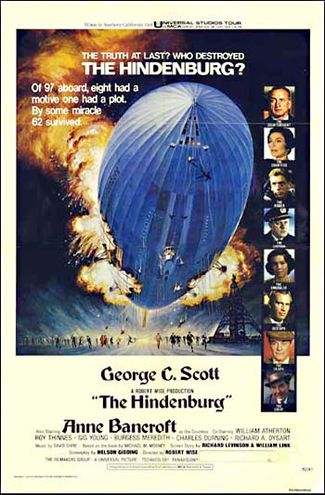
At the very least, that’s the theory put forward by a film that I watched earlier today, the 1975 disaster movie, The Hindenburg.
A mix of historical speculation and disaster film melodrama, The Hindenburg stars George C. Scott as Col. Franz Ritter, a veteran of the German air force who is assigned to travel on the Hindenburg and protect it from saboteurs. Ritter is a Nazi but, the film argues, he’s a reluctant and disillusioned Nazi. Just a few weeks before the launch of the airship, his teenage son was killed while vandalizing a synagogue. Ritter is a patriot who no longer recognizes his country and George C. Scott actually does a pretty good job portraying him. (You do have to wonder why a seasoned veteran of the German air force would have a gruff, slightly mid-Atlantic accent but oh well. It’s a 70s disaster film. These things happen.)
Ritter is assigned to work with Martin Vogel (Roy Thinnes), a member of the Gestapo who is working undercover as the Hindenburg’s photographer. Tt soon becomes obvious that he is as much a fanatic as Ritter is reluctant. Vogel is a sadist, convinced that every Jewish passenger is secretly a saboteur. Thinnes is chilling in the role. What makes him especially frightening is not just his prejudice but his casual assumption that everyone feels the same way that he does.
And yet, as good as Scott and Thinnes are, the rest of the cast is rather disappointing. The Hindenburg features a large ensemble of actors, all playing characters who are dealing with their own privates dramas while hoping not to burn to death during the final 15 minutes of the film. Unfortunately, even by the standards of a typical 70s disaster film, the passengers are thinly drawn. I liked Burgess Meredith and Rene Auberjonois as two con artists but that was mostly because Meredith and Auberjonois are so charming that they’re fun to watch even if they don’t have anything to do. Anne Bancroft has one or two good scenes as a German baroness and Robert Clary does well as a vaudeville performer who comes under suspicion because of his anti-Nazi leanings. Otherwise, the passengers are forgettable. Whether they die in the inferno and manage to make it to the ground, your main reaction will probably be to look at them and say, “Who was that again?”
Anyway, despite all of Ritter and Vogel’s sleuthing, it’s not much of mystery because it’s pretty easy to figure out that the saboteur is a crewman named Boerth (William Atherton). Having seen Real Genius, Die Hard and the original Ghostbusters, I found it odd to see William Atherton playing a sympathetic character. Atherton did okay in the role but his attempt at a German accent mostly served to remind me that absolutely no one else in the film was trying to sound German.
Anyway, the main problem with The Hindenburg is that it takes forever for the airship to actually explode. The film tries to create some suspense over whether Ritter will keep the bomb from exploding but we already know that he’s not going to. (Let’s be honest. If you didn’t already know about the Hindenburg disaster, you probably wouldn’t be watching the movie in the first place.) The film probably would have worked better if it had started with the Hindenburg exploding and then had an investigator working backwards, trying to figure out who the saboteur was.
However, the scenes of the explosion almost make up for everything that came before. When that bomb goes off, the entire film suddenly switches to black-and-white. That may sound like a cheap or even sensationalistic trick but it actually works quite well. It also allows the scenes of passengers and crewmen trying to escape to be seamlessly integrated with actual footage of the Hindenburg bursting into flame and crashing to the ground. The real-life footage is still shocking, especially if you’re scared of fire. Watching the real-life inferno, I was again shocked to realize that only 36 people died in the disaster.
In the end, The Hindenburg is flawed but watchable. George C. Scott was always at his most watchable when playing a character disappointed with humanity and the real-life footage of the Hindenburg disaster is morbidly fascinating.



 Through the Shattered Lens