Icarus File No. 33: A Chorus Line (dir by Richard Attenborough)


A Chorus Line always leaves me feeling angry.

Now, I should make clear that I’m talking about the 1985 film adaptation and not the show that ran for 6,137 performances on Broadway.  The original show was a tribute to the so-called Broadway gypsies, the dancers who went from show to show and performed anonymously behind the star.  It was a portrait of both the veteran performers and the young up-and-comers who still dreamed of someday moving out of the chorus and becoming stars on their own.  When it opened in 1975, it was considered to be groundbreaking in its frankness about things like sexuality and aging.  It featured heartbreaking monologues and, even more importantly, amazing songs.  The show was a true tribute to people who lived to be on stage.

The movie, on the other hand, is about a jerk of a director named Zack (Michael Douglas) and his ex-girlfriend, a rather self-absorbed dancer named Cassie (Alyson Reed).

My main issue with the film can be seen right at the start.  We watch as a large group of dancers are put through a strenuous audition process.  Everyone is working hard, trying to make an impression on Zack in the little time that they have.  Zack sits in the darkness of the theater, a malevolent presence with a sharp, cigarette-shaped voice.  Most of the dancers will only know him as the pitiless voice that dismisses them from the audition.  We watch as everyone pushes themselves.  The older dancers try to ignore the aches and pain that come with age.  The younger dancers are desperate to finally get their big break.  It’s an exciting sequence, one that shows just how much hard work goes into even getting through the auditions to be a finalist for a part in the chorus.

The only dancer who isn’t there is Cassie.  Cassie has just flown into New York.  She’s stuck in traffic.  She doesn’t arrive until towards the end of the initial eliminations.  She is greeted by the assistant choreographer, Larry (Terrence Mann, who gives one of the better performances in the film).  At first, Zack refuses to allow Cassie to audition.  Cassie says she needs the job.  Zack replies that she’s too good to just be a member of the Chorus Line.

Now, actually, Zack is right about one thing.  Cassie should not be allowed to audition.  But it’s not because she’s too good to be in the chorus.  She shouldn’t be allowed to audition because she didn’t show up on time!  She’s showed up late!  There are sixteen finalists and only 8 spots available.  The other finalists showed up on time and have spent the entire day dancing and proving themselves.  They’ve worked hard for their spot.  They fought for the opportunity.  Cassie just shows up late and basically acts as if she’s entitled to take away one of their spots.

We’re continually told that Cassie is special but we don’t really see any evidence of it.  A lot of that is because the film was rather stodgily directed by Richard Attenborough, who stages each scene in a way that makes everyone — including Cassie — seem rather bland.  One wishes the film could have been directed by a Bob Fosse or a Stanley Donen or a Vincente Minnelli or even a Rob Marshall.  All four of those director knew (or, in Marshall’s case, know) how to shoot a dance number so that the dancer’s personality and skill comes through.  Under Attenborough’s direction, everyone comes across as being vaguely generic.  Indeed, Attenborough focuses the film so much on Zack and Cassie’s relationship that the other performers get pushed to the side.  Some of the show’s best songs are either not featured or just occur in the background.  Attenborough’s film takes a show that was meant to be a celebration of an ensemble and instead turns it into a star vehicle.

Both the film and the show end with a rather heart-breaking scene in which 8 dancers are told to step forward before Zack thanks them for their time and sends them home.  In the show, it’s reflection of life on Broadway.  The director picks who he thinks is best for the show.  Sometimes, that means that a likable or talented actor is still not cast.  In the film, it feels cruel because we notice that Zack sent home 8 dancers who showed up on time and worked hard but still made room for Cassie, who didn’t.  (Notably, in the show, Cassie and Zach had the same relationship as in the film but Cassie also showed up on time for the audition.)  Now, I will say that Zach casting someone with whom he had a personal relationship over someone who he didn’t is probably realistic but it’s still annoying.

It’s debatable whether A Chorus Line could have ever been made into an effective film.  That said, picking Richard Attenborough to direct and an apparently disinterested Michael Douglas to star certainly didn’t help matters.

Previous Icarus Files:

  1. Cloud Atlas
  2. Maximum Overdrive
  3. Glass
  4. Captive State
  5. Mother!
  6. The Man Who Killed Don Quixote
  7. Last Days
  8. Plan 9 From Outer Space
  9. The Last Movie
  10. 88
  11. The Bonfire of the Vanities
  12. Birdemic
  13. Birdemic 2: The Resurrection 
  14. Last Exit To Brooklyn
  15. Glen or Glenda
  16. The Assassination of Trotsky
  17. Che!
  18. Brewster McCloud
  19. American Traitor: The Trial of Axis Sally
  20. Tough Guys Don’t Dance
  21. Reach Me
  22. Revolution
  23. The Last Tycoon
  24. Express to Terror 
  25. 1941
  26. The Teheran Incident
  27. Con Man
  28. Looker
  29. 1776
  30. Here
  31. The Adventures of Brisco County, Jr.
  32. The Cable Guy

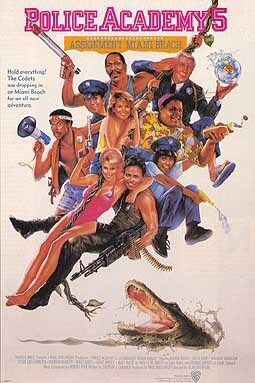
Police Academy 5: Assignment Miami Beach (1988, directed by Alan Myerson)


Police Academy 5 starts as so many Police Academy films have started.  Commandant Lassard (George Gaynes) is getting progressively more loopy and Captain Harris (G.W. Bailey) is plotting to take over the Academy.  This time, Harris thinks that he has come up with the perfect plan when he discovers that Lassard has reached the mandatory retirement age.

With retirement looming, Lassard attends one final law enforcement convention in Miami.  At the convention, Lassard is to be honored as “Police Officer of the Decade” because it was apparently a very slow decade.  Lassard decides to bring along his favorite academy graduates so that they can celebrate with him and meet his nephew, Sgt. Nick Lassard (Matt McCoy, who you may recognize as Seinfeld’s Lloyd Braun or maybe as the spokesman for Hartford Insurance).   The commandant invites Sound Effects Guy (Michael Winslow), Tackleberry (David Graf), Hightower (Bubba Smith), Hooks (Marion Ramsey), Callhan (Leslie Easterbrook), and House (Tab Thacker).  Notice who isn’t there?  This was the first Police Academy film without Steve Guttenberg’s Carey Mahoney and Commandant Lassard celebrating his career without inviting his most loyal graduate doesn’t seem right.

Once what is left of the old gang arrives in Miami, they get caught up in the usual Police Academy shenanigans.  Rene Auberjonois plays a jewel thief who accidentally switches bags with the Commandant and who has 24 hours to retrieve the stolen diamonds.  It’s Florida so there are women in bikinis and an Everglades boat chase.  Harris gets humiliated in every way possible.  The jokes are even more juvenile than usual.  Nick Lassard uses sunscreen to permanently label Harris as being a “dork” so everyone on the beach calls Harris a “dork.”  That’s as sophisticated as things get.

Unfortunately, there’s a Steve Guttenberg-shaped hole at the center of Police Academy 5 and not even as formidable a thespian as Matt McCoy can fill it.  Even though Guttenberg always seemed like he was miscast as both a cop and a former juvenile delinquent, Police Academy 5 shows how important he really was to the franchise.  Mahoney was the closest thing that the Police Academy films had to a fully developed character and, without him around, it’s even more obvious how thinly drawn all of the other characters were.  (Guttenberg was filming Three Man And A Baby while Police Academy 5 was in production though, in an A.V. Club interview a few years ago, Guttenberg said the real reason he wasn’t invited to Miami Beach was because the producers couldn’t afford to pay his salary.  “You’ve got to get paid!” Guttenberg explained.)

I will, however, give Police Academy 5 some credit.  Rene Auberjonois does what he can with his bumbling jewel thief and the scene where Tackleberry pulls a gun on a shark made me laugh.  Otherwise, Police Academy 5 is no Police Academy 3.

Tomorrow, it’s time for … you guessed it! …. Police Academy 6!

Embracing the Melodrama Part II #78: American Anthem (dir by Albert Magnoli)


American_anthem_poster

“He’s thrown a tripus!  Steve Tevere has thrown a tripus!  The most outstanding dismount tonight, or any night!” 

— Really Excited Announcer In American Anthem (1986)

Way back in March, I dvr’d a movie called American Anthem off of Encore.  I did this for two reasons.  First off, the film was described as having something to do with gymnastics and that’s always been my favorite part of the Summer Olympics.  Secondly, any film from the 1980s that has the word “American” in the title is sure to be fun or, at the very least, achingly sincere.

When I finally got around to watching American Anthem, I wasn’t expecting much.  The film turned out to be largely what I expected it would be: the story of gymnasts hoping to qualify for the Olympics and find some personal redemption along the way.  All of the stock characters were present.  We had Steve Tevere (Mitch Gaylord), the brooding rebel who had to decide between pursuing his Olympic dreams or working in a garage for the rest of his life.  We had Steve’s girlfriend, Julie (Janet Jones), who had to learn to be humble before she could be great.  We had Kirk (Stacy Maloney), Steve’s best friend and fellow gymnast.  We had kinda bitchy Becky Cameron (Maria Anz), who was Julie’s friend and rival.  And then there was Arthur (Andrew White), Julie’s crippled, musician cousin.  And let’s not forget Tracy Prescott (Jenny Ester), the 12 year-old gymnast with the impressive afro.  And, of course, there was Coach Sarnoff (Michael Pataki) who was tough, compassionate, and Russian.  The majority of the cast was made up of real-life gymnasts and, with the exception of the genuinely charismatic Stacy Maloney, they all gave performances that suggested that they should stick with gymnastics.

And yet, despite all of that, I absolutely loved American Anthem.  Now, don’t get me wrong.  For the most part, I loved it for all the wrong reasons.  My love for the film is not the type of love that would lead to me being quoted on the back of a Blu-ray case.  American Anthem is a thoroughly bad film but it’s also compulsively watchable.  From the minute that I started watching it, I became obsessed with American Anthem‘s bizarre ineptness.  Since that first night in March, I’ve rewatched American Anthem a few dozen times.  I’ve lost track of how many times that I have grimaced at the cutesy music that Sarnoff tried to force Julie to use for her floor routine.  I can imitate Becky’s squeal of pain when she’s tries to compete with an injured knee.  Whenever Julie and the girls start to chant, “Kirk!  Kirk!  Kirk!,” I chant with them.  And don’t even get me started on how much I love hearing, “He’s thrown a tripus!”

American Anthem is pure style.  This is one of the few films that I’ve seen that has absolutely no subtext.  There is literally nothing going on beneath the surface.  It’s almost as if somebody dared director Albert Magnoli to make a film that was just one big montage.  This is one of those films where the camera is always moving, the colors are always bright, and the soundtrack is always soaring.  Hardly anyone in the film can actually act but oh my God, everyone looks so good (in a 1986 sort of way, of course).

The other “great” thing about American Anthem is that there’s not a single cliché that the film doesn’t include and, as a result, you really don’t have to pay that much attention to the film to understand what’s going on.  To its credit, this film doesn’t even pretend to be anything other than a collection of clichés.  It’s almost as if the characters themselves realize that they are in a film and understand that they have no choice but to conform to what the audience has been conditioned to expect.

(Hmmm…I guess American Anthem does have a subtext.  And kind of a disturbing one at that!)

For instance, within minutes of meeting and despite having no chemistry, Steve and Julie are in love.  Why?  Because the only reason that they are in the film is to fall in love.  It has to be done.

Steve fights with his father (John Aprea) and we’re never quite sure why, beyond the fact that all brooding rebels fight with their fathers.  When his father shows up to watch his son compete, the triumphant music soars and it no longer matters that he’s been portrayed as being an abusive rageaholic up until that moment.

All of the characters tell us that Coach Sarnoff is the best, despite the fact that we don’t actually see any evidence of that fact.  But Sarnoff has to be the best because nobody ever makes a movie about athletes training under a merely adequate coach.

When Becky suddenly shows up at the final competition with a bandaged knee, it doesn’t matter that we don’t actually see her get injured beforehand or, for that matter, hear anything about it.  All that matters is that, in films like this, someone has to compete with an injury.  Becky is simply playing her part.

American Anthem.  It’s not a particularly good film but it sure is watchable.  And, as I’ve come to realize while writing this review, it’s a bit of an existential nightmare as well!

I don’t think I’m ever going to erase it from my DVR.

americananthem01