Happy birthday, America!
Happy birthday, America!
Welcome to Late Night Retro Television Reviews, a feature where we review some of our favorite and least favorite shows of the past! On Mondays, I will be reviewing CHiPs, which ran on NBC from 1977 to 1983. The entire show is currently streaming on Prime!
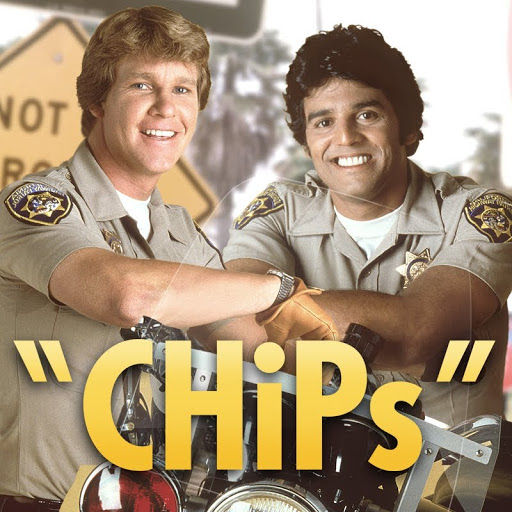
This week, it’s all about sibling rivalry and crashing cars.
Episode 5.18 “In The Best of Families”
(Dir by John Florea, originally aired on February 21st, 1982)
Getrear is not in a good mood.
He’s got a big inspection coming up but the members of the Highway Patrol keep screwing up. Bonnie’s patrol car is stolen while she’s on a coffee break. Baricza’s car is stripped of its lights and its CHP insignia. Ponch and Baker chase the thieves but somehow never manage to catch them. Finally, someone breaks into Getraer’s dry cleaner’s place and steals two of Getraer’s uniforms.
The Highway Patrol is squabbling, as all families do. They worry that Getraer is angling for a promotion and that they’ll have to “break in a new sergeant.” Fortunately, Getraer isn’t planning on going anywhere. Ponch, Baker, Bonnie, Turner, Grossie, Harlan, and Bear all get to keep their surrogate father figure.
Meanwhile, a real family is fighting. Anne Francis has planned the perfect armored car robbery. Now, she just needs her teenaged sons (Michael Morgan and Timothy Patrick Murphy) to steal a patrol car and some uniforms….
This episode had a pretty silly story but that doesn’t matter because it also featured some truly spectacular stunt work. The first crash occurs on a freeway and involves so many cars that it almost becomes a symphony of destruction. A reporter assures us that no one was killed or even seriously injured in the accident but having watched it (in slow motion), I’m not really sure how that could be true. Later, Turner’s car goes flying over a hillside and again, it’s such a spectacular crash that I’m shocked Turner was able to step out of the wreckage.
This was definitely an episode for those of us who enjoy watching spectacular car destruction. This was a pure demolition derby and entertaining in the mindless way that those often are. Even the best families enjoy automotive mayhem.
James Brown would have been 93 years old today.
Here he is, with the song of the day:
Oh, New York. Best of luck to you.
Today’s song of the day comes from the soundtrack of 1973’s Black Caesar. Here is James Brown with Down & Out In New York City.
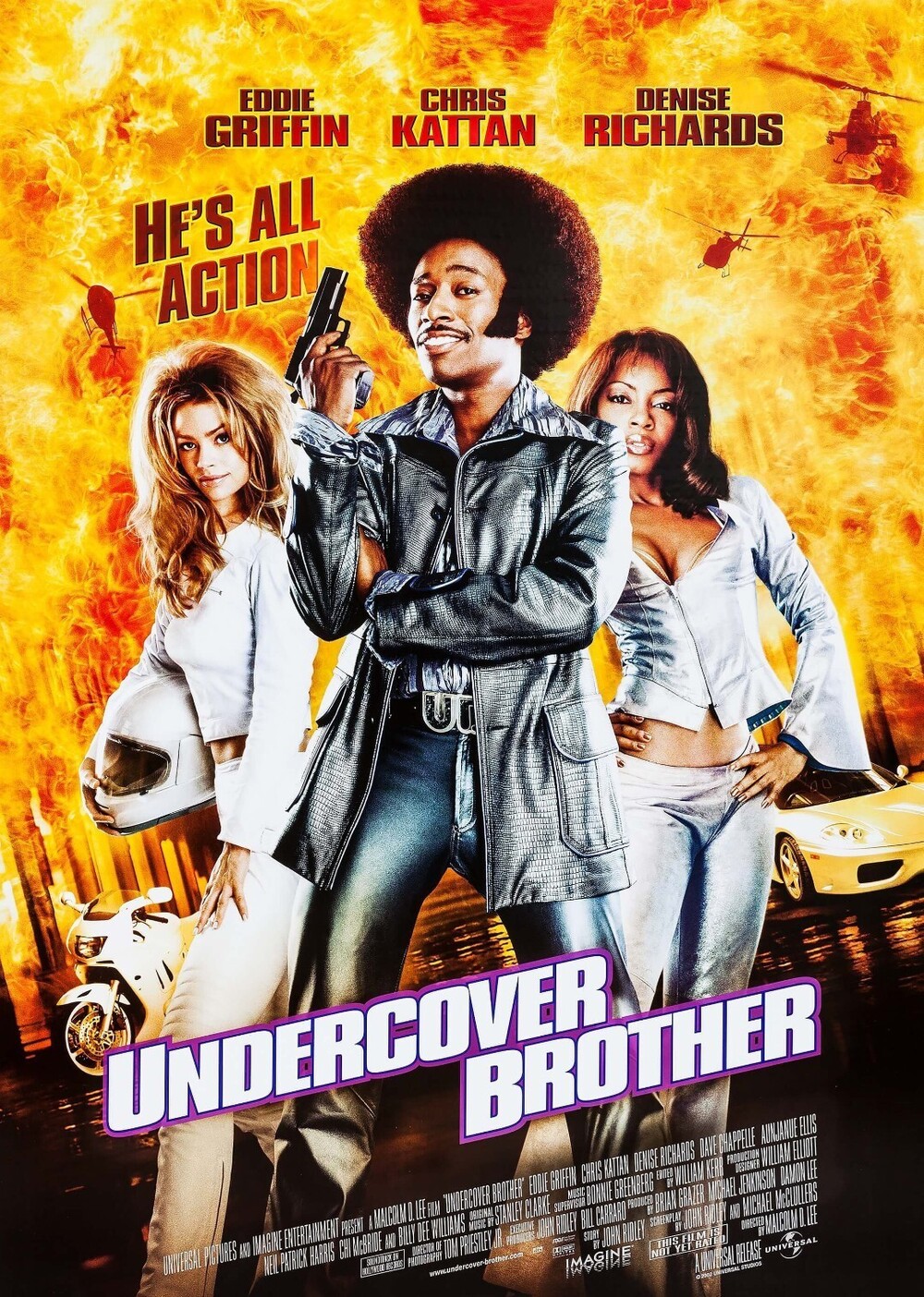
Undercover Brother is exactly the kind of movie that earns the phrase “guilty pleasure.” It is messy, broad, and often ridiculous, but it is also packed with enough energy, attitude, and sharp-enough satire to make its flaws feel like part of the joke rather than dealbreakers. The result is a comedy that may not always land cleanly, but it absolutely understands its own vibe and commits to it hard.
At the center of it all is Eddie Griffin, who gives the title character a big, swaggering, old-school cool that carries the movie through its shaggier patches. He plays Undercover Brother as a throwback spy hero with a giant Afro, loud fashion sense, and nonstop confidence, and that exaggerated persona is a big reason the film works as well as it does. Griffin’s performance is not subtle, but subtlety is not really the point here; he sells the movie’s cartoonish energy without making it feel lazy.
What makes Undercover Brother more than just a random parody is how committed it is to poking at both blaxploitation iconography and mainstream spy-movie clichés. The film was directed by Malcolm D. Lee and written from material based on John Ridley’s earlier animated series, and it leans into that satirical roots-and-gadgets formula with a lot of style. It clearly wants to be playful, but it also wants to say something about race, image, and the way Black identity gets packaged or watered down in pop culture.
That said, the movie is not exactly a model of precision. Some of the jokes are sharp and immediate, while others feel like they are still revving the engine long after the punchline should have arrived. The plot is basically an excuse to move from one set piece to another, and the film knows it, which helps, but it also means the whole thing can feel more like a high-speed sketch comedy than a fully shaped story. If you go in expecting airtight narrative logic, you will probably be annoyed; if you go in wanting a fast, funky send-up, you will have a much better time.
The supporting cast gives the movie a lot of its flavor. Dave Chappelle, Aunjanue Ellis, Billy Dee Williams, Chris Kattan, Denise Richards, and Neil Patrick Harris all add to the film’s chaotic mix, and the casting itself becomes part of the joke. Billy Dee Williams especially feels perfectly placed in a movie that is constantly riffing on cool, style, and old-school charisma, while Denise Richards gets a knowingly exaggerated role that plays into the film’s cartoonish battle between seduction and resistance.
What helps Undercover Brother age a little better than some early-2000s comedies is that it is not just throwing random nonsense at the screen for cheap laughs. There is a genuine satirical target here, and even when the movie gets clumsy, it still feels like it has a point of view. The movie clearly aims to be both goofy and observant, and even when the balance is uneven, it is hard not to appreciate the effort.
The best thing about Undercover Brother is its attitude. It moves like a movie that wants to be loud, stylish, and a little bit too much, and that confidence gives it a strange charm. The humor is often broad, sometimes cartoonish, and occasionally uneven, but the film’s willingness to fully commit to its bit makes it easy to forgive a lot. Even when the satire is more enthusiastic than elegant, the movie keeps its foot on the gas, and that momentum is a big part of its appeal.
Its biggest weakness is also the thing that makes it memorable: the movie can feel overstuffed with ideas, references, and gags, some of which work better than others. A few jokes feel a little dated now, and the film’s style of satire is not always as clean or as clever as it seems to think it is. Still, the movie has enough bite, personality, and goofy confidence that those rough edges become part of its charm instead of sinking it. That is the hallmark of a true guilty pleasure: you can see the flaws clearly, but you keep smiling anyway.
So Undercover Brother is not a perfect comedy, and it is not trying to be one. It is loud, silly, politically aware in a very pop-movie way, and shamelessly committed to its own funk. If you want polish, you will find plenty to criticize; if you want a movie with attitude, quotable energy, and the kind of swagger that makes its imperfections oddly lovable, this one delivers. It is a flawed satire, sure, but it is also a genuinely fun one, and that is why it still plays like a guilty pleasure worth revisiting.
Previous Guilty Pleasures
 The Blues Brothers! They’re on a mission from God.
Jake (John Belushi) and Elwood Blues (Dan Aykroyd) are two Chicago orphans who love the blues and committing crime. After Jake is paroled from Joliet Prison, he’s picked up by Elwood in an old police car. Elwood traded the original Bluesmobile for a microphone. Jake understands, even if he still doesn’t like being seen in a police car. When they visit the orphanage where they were raised, Sister Mary Stigmata (Kathleen Freeman) beats them with a ruler and tells them that the orphanage is going to close if she can’t pay a $5,000 tax bill. Jake and Elwood set out to reform their band, raise $5,000, and save the orphanage. Jake and Elwood may be two career criminals who never take off their dark glasses but they’re on a mission from God.
Along the way to putting the band together and raising $5,000, Jake and Elwood meet characters played by everyone from James Brown to Ray Charles to Aretha Franklin. You never know when a big production number might break out. Jake and Elwood also step on a few toes. Soon, the Blues Brothers being chased by the police, the national guard, Jake’s parole officer (John Candy), Charles Napier’s country-western band, and a group of Illinois Nazis (led by Henry Gibson). There’s also a mysterious woman (Carrie Fisher) who wants to kill them. She has an impressive array of weapons but terrible aim.
The Blues Brothers was the first comedy to be based on a Saturday Night Live bit. Unlike most other SNL movies, The Blue Brothers develops its plot far beyond what was originally seen on television. Jake and Elwood get a full backstory and they also get personalities that go beyond the black suits and the dark eyewear. The Blues Brothers features Belushi at his most energetic but it’s also one of the few films to actually know what to do with Dan Aykroyd’s eccentric screen presence. If Belushi’s Jake is all about earthly pleasures, Aykroyd’s Elwood almost seems like a visitor for another world. Aykroyd’s performance of the Rawhide theme song is one of the film’s highlight.
The Blues Brothers has its share of funny lines and its famous for the amount of pointless destruction that it manages to fit into its storyline (with the “unnecessary violence” being authorized by the Chicago police to stop the Blues Brothers) but it’s also as surprisingly sincere tribute to the blues. It’s a movie that can balance Ray Charles shooting at a shoplifter and a massively destructive car chase in a suburban mall with Cab Calloway playfully performing Minnie the Moocher and Aretha Franklin bringing down the house (or diner, as the case may be). The movie can feature both a jump over an open drawbridge and Steven Spielberg as the clerk at the tax office. It’s one of the strangest comedies ever made and it features all the excesses that would bring an end to 70s Hollywood but when Jake and Elwood say they’re on a mission from God, you believe them.
Welcome to Retro Television Reviews, a feature where we review some of our favorite and least favorite shows of the past! On Mondays, I will be reviewing Miami Vice, which ran on NBC from 1984 to 1989. The entire show can be purchased on Prime!

This week, it’s the most infamous episode of Miami Vice ever!
Episode 4.7 “Missing Hours”
(Dir by Ate De Jong, originally aired on November 13th, 1987)
This is an episode that I had been waiting for years to see. From the moment I decided to review Miami Vice, I started to read about and hear about this seventh episode of the four season. This was the episode was supposedly so bad that many people consider it to be the point that Miami Vice “jumped the shark.” This is the episode were James Brown plays a white-suited singer named Lou de Long, who has going from performing songs to giving lectures about UFOs. (James Brown is essentially playing himself, right down to the presence of I Feel Good on the soundtrack.) This is the episode where Trudy disappears for 12 hours and then returns with no firm memories of where she was. This is the episode where even Crockett and Tubbs see a UFO. Even though his appearance here does not receive as much attention as much a James Brown’s, Chris Rock made his television debut as a nerdy technician named Carson who was into UFOs. Carson mentions getting his information for “computer bulleting boards” and everyone looks at him as if he’s speaking Esperanto.
This is the episode that is frequently cited as being the worst in Miami Vice history and really, who am I to disagree?
It pains me to say that. I really wanted to like this episode, just because it is so strange and and I’ve always been a bit of a contrarian at heart but …. no, this episode really doesn’t work. The sad truth of the matter is that, for all of his other talents, James Brown was a lousy actor and, with the exception of Michael Talbott and Philip Michael Thomas (who both appear to be having fun), the regular cast gives performance that suggest they all knew this episode was a bad idea. Miami Vice was at its best when it was a cynical and downbeat show about the futility of the war on drugs. There’s really no reason for Miami Vice to ever do a science fiction-themed episode. Somehow, this is the second such episode to air during the fourth season.
Of course, the episode’s most unforgivable sin is that it ends with Trudy waking up in bed. Not only is that ending a cop out but it’s also pretty rude to anyone who was actually trying to follow the plot or who was actually worried about whether or not Trudy had been brainwashed by the aliens. Perhaps if this had been a Halloween episode, all of this could have been excused but apparently, this episode aired in the middle of November.
Poor Trudy. Seriously, Olivia Brown didn’t really get many episode built around her character. It’s a shame that, when they gave her one, it was this one. Next week on Miami Vice, who knows? I’m on vacation. We’ll see what happens!
The late and legendary singer James Brown was born 92 years ago today.
Today’s song of the day comes from the soundtrack of 1973’s Black Caesar. Here is James Brown with Down & Out In New York City.
 At the height of the Civil War, the small town of Border City, Missouri has declared itself to be neutral ground. Mayor Delilah Courtney (Nina Varela) announces that anyone who enters her town looking to recruit for either the Union or the Confederacy will be arrested and will face the possibility of being hung from the noose in the middle of Main Street.
That doesn’t stop Charles Quantrill (Brian Donlevy) from coming to town. Quantrill is a former Confederate officer who now terrorizes the Arkansas/Missouri border with his gang of thieves. Accompanying Quantrill is his wife, Kate (Audrey Totter), who once lived in Border City and who still enjoys singing a song at the saloon.
Another new arrival is Sally Maris (Joan Leslie), who comes down from Michigan to help her no-account account, Bitterroot Bill (Reed Hadley), run his saloon. Sally attempts to bring some order to the rowdy saloon, which makes an enemy out of Kate. When Bill is killed in a gunfight, Sally takes over the saloon and soon, she is being challenged first to a fight and then to an actual duel by Kate. With the disapproving Mayor Courtney watching all of the action from her office, it is obvious that one of the women is eventually going to be taken to the noose in the middle of the street but which one?
This is one of the best of the many B-westerns that Allan Dwan directed in the 1950s. Though much of the emphasis is on the usual western action — Quantrill wants to take over a mine, there’s a Confederate spy in town, and both Frank and Jesse James appear as supporting characters — the film is really about the rivalry and eventual partnership between a group of strong-willed woman who aren’t going to let anyone tell them how to live their lives. As tough as Kate is, Sally proves to be stronger than she looks and, in the end, they realize that they are stronger working together for a common goal than trying to tear each other down. Audrey Totter and Joan Leslie both give sexy and tough performances as Kate and Sally. They’re equally believable hanging out in a saloon, flirting with a cowboy, or drawing guns on each other in the middle of the street.
Along with taking a strong stand against vigilante justice, Woman They Almost Lynched features an exciting stage coach robbery, an intriguing story, and two very interesting lead characters. It’s a western that deserves to be better known.
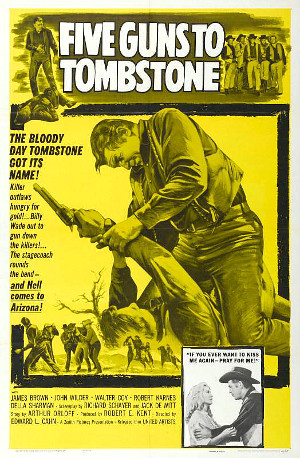 Outlaw Matt Wade (Robert Karnes) escapes from prison and rejoins his old gang. They ride out to Tombstone, Arizona, stopping off at the ranch of Matt’s brother, Billy Wade (James Brown). Billy used to be an outlaw but eventually he hung up his guns, settled down, got married, and now he’s raising Matt’s teenage son, Ted (John Wilder). Ted, who thinks that his father has just been paroled, is excited to see Matt but Billy doesn’t want Ted being led into a life of crime. When Matt and the gang rob a bank, they frame Billy for the crime. With the townspeople looking to lynch him and Ted drifting towards the wrong path in life, Billy has no choice but to pretend to be a part of the gang until he can dig up the evidence to clear his name.
If this sounds familiar, thank you for reading yesterday’s review of Gun Belt. Released seven years after Gun Belt, Five Guns To Tombstone tells the exact same story as Gun Belt and, in many case, it features the exact same dialogue. The only difference is that some of the names have been slightly changed. The gang leader in Gun Belt was named Ike Clinton. In this Five Guns To Tombstone, his name is Ike Garvey. Billy Ringo becomes Billy Wade and Wyatt Earp because Marshal Sam Jennings. Otherwise, it’s pretty much the exact same film.
Which one is the better film, Gun Belt or Five Guns To Tombstone? Both films have plenty of two-fisted, gun-slinging action and a good cast of western character actors but I’d probably have to give the edge to Five Guns To Tombstone because John Wilder is more convincing in the role of the outlaw’s son than Tab Hunter was in Gun Belt. Tab Hunter was young and callow and annoying but John Wilder is the type of confused kid that anyone could relate to.
Five Guns To Tombstone was one of the 9 films that Edward L. Cahn directed in 1960. As with most of Cahn’s films, the action seems rushed but that’s appropriate for the story that Five Guns To Tombstone is telling. (It’s also understandable. When you’re directing 9 films a year, you don’t have the luxury of taking your time.) Like Gun Belt, this is hardly a classic but western fans should enjoy it.

