“That is my family, but that’s not my home. My home is back in 1978!” — David Freeman
Flight of the Navigator turns a child’s worst possible homecoming into an unexpectedly funny, wistful, and imaginative science-fiction adventure. Released in 1986, it begins as a modest suburban mystery before expanding into a story about time displacement, missing years, alien technology, and the strange loneliness of returning home to a life that has moved on without you. It has the glossy, accessible surface of a Disney adventure, but there is a surprisingly melancholy idea at its center: what would it feel like to lose eight years of your life while everyone you love has had to live through them without you?
The movie follows David Freeman, a 12-year-old boy who disappears in 1978 after going into the woods to retrieve his younger brother Jeff. David wakes up in 1986, apparently having been gone only a few hours from his own point of view. The shock is immediate. His parents are older, Jeff is now his taller teenage brother, the family has moved, and David has become a long-unsolved missing-person case. This opening stretch is probably the film’s strongest material because it plays the scenario straight enough to make it genuinely unsettling. David is not simply a kid dropped into a flashy futuristic world; he is a child abruptly disconnected from the only reality he knows.
That emotional hook gives Flight of the Navigator more weight than many similar children’s adventures. David’s confusion is easy to understand, and the film wisely lets the situation breathe before revealing all of its science-fiction machinery. The sight of his family recognizing him after years of grief is touching, but it also comes with discomfort. David wants everything to return to normal, while his parents are overwhelmed by the impossible fact that their vanished son has returned unchanged. The movie does not dig into the full psychological consequences of that situation, because it is still fundamentally a family adventure, but it gives the idea enough attention to make the stakes feel personal.
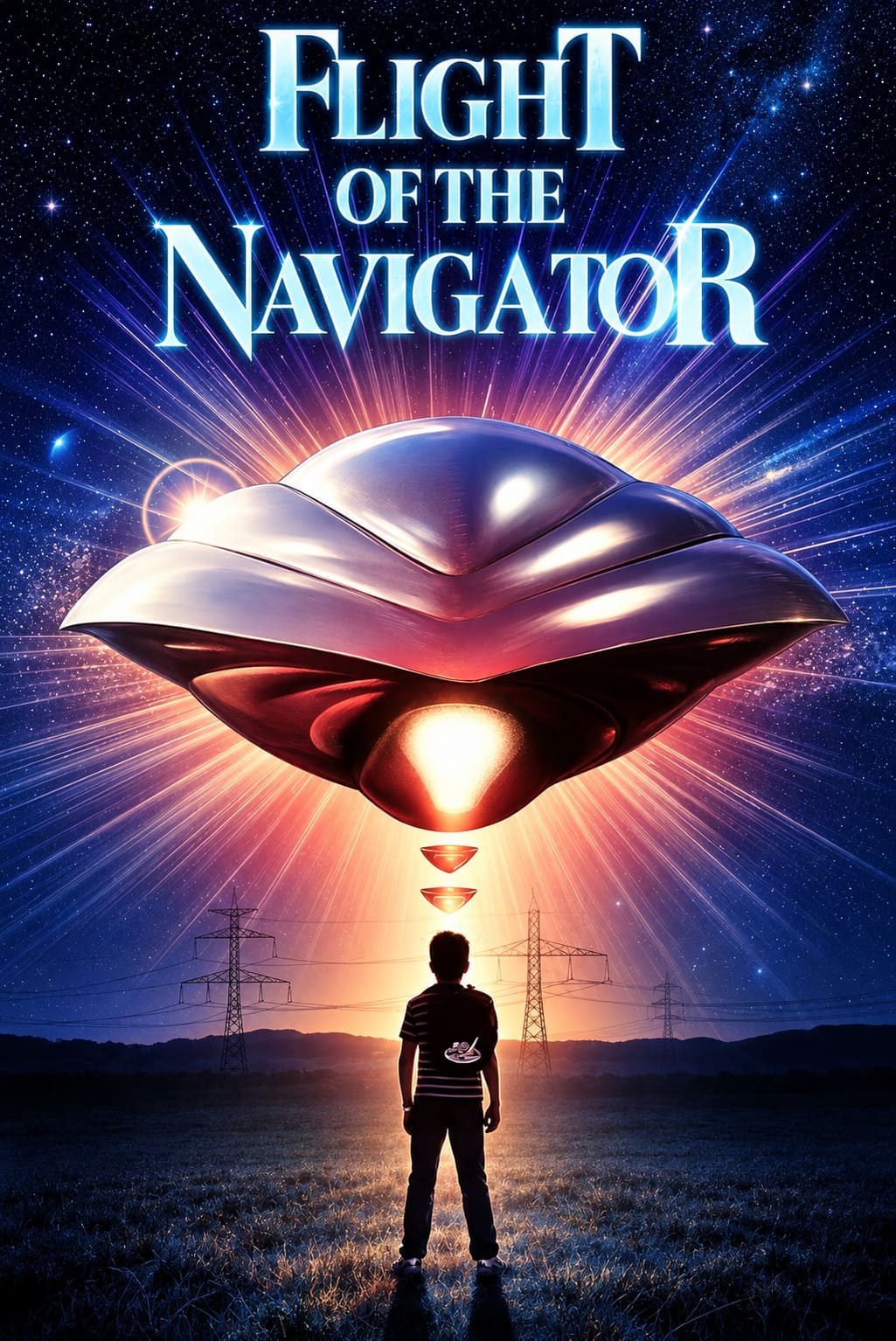
Once NASA becomes involved, the story shifts into a more conventional but still entertaining sci-fi mode. Doctors discover that David has advanced knowledge in his brain that he cannot consciously explain, and the mystery leads him to a crashed alien spacecraft. The ship, known as the Trimaxion Drone Ship, is the movie’s most iconic element. Its smooth silver form, with no visible seams or conventional cockpit, still looks appealing because it has a simple, alien elegance. It is not overly busy or mechanical in the way many science-fiction vehicles are. Instead, it resembles a floating metallic organism, something sleek and strange that could plausibly have appeared in a child’s dream.
The ship’s computer, MAX, is what really gives the movie its personality. Voiced by Paul Reubens, MAX begins as a calm, efficient artificial intelligence but gradually becomes sillier and more mischievous after downloading human information from David’s era. Reubens’ performance is a major reason the character works. He does not simply do a recognizable Pee-wee Herman routine, although the playful vocal energy is certainly there. MAX’s changing voice and increasingly erratic sense of humor make him feel like an alien intelligence trying to imitate human behavior and getting it only partly right.
There is a fine line between amusing and annoying when a movie lets its comic sidekick become too hyperactive, and Flight of the Navigator occasionally crosses it. MAX can become a little much, especially during the later scenes where he starts cracking jokes, changing his vocal effects, and behaving like an overexcited child with access to interstellar technology. Still, that energy is part of what makes the film feel uniquely of its era. MAX is not as polished or emotionally sophisticated as later animated or CGI companions, but he remains memorable because he is odd. His humor feels less like a studio-tested collection of one-liners and more like a machine that has accidentally discovered cartoons, pop culture, and sarcasm all at once.
Joey Cramer carries much of the movie as David, and he gives the role more sincerity than the material sometimes requires. He is believable as a regular kid who becomes frightened, angry, curious, and eventually exhilarated by what is happening around him. David is not written as a perfect young hero. He can be stubborn and impulsive, especially when he decides he has to take control of his own situation, but that makes sense. Adults have spent much of the story examining him, restraining him, and treating him as a scientific puzzle. His decision to escape with MAX is reckless, yet it also feels like the response of a child who is desperate to reclaim some agency.
The film’s visual effects deserve credit for helping sell its larger ideas. By modern standards, the effects are obviously dated in places, particularly when the ship changes shape or moves at impossible speeds. Yet the movie uses its effects well enough that they remain charming rather than distracting. The morphing sequence in which the ship transforms into its sleeker form was especially impressive for the time, and even now it has an appealing practical-digital hybrid quality. It does not look completely real, but it looks imaginative. The ship has presence, and the movie understands the pleasure of simply watching it fly through clouds, skim across water, or streak through the night sky.
The electronic score by Alan Silvestri is another major part of the film’s identity. Silvestri is often associated with larger, more overtly heroic scores, especially in films such as Back to the Future, but his work here is more synthetic and futuristic. The music helps create a sense of wonder while also grounding the film in the mid-1980s. It can sound very much of its time, with prominent synthesizers and a clean electronic texture, but that is not a weakness. The score fits a movie about an ordinary kid encountering a cold, shiny, unknowable piece of advanced technology.
One of the better things about Flight of the Navigator is that it does not make its protagonist’s adventure entirely consequence-free. David gets to fly an alien ship, travel at incredible speeds, and encounter a universe beyond his suburban life. That is the wish-fulfillment element, and the film delivers it well. At the same time, the adventure exists because something has gone wrong in David’s life. His journey begins with loss. The movie never becomes as emotionally dark as its premise could allow, but it never completely forgets that David has been separated from his family and displaced in time.
The ending is satisfying because it returns the story to that emotional core. David’s ultimate choice is not just about whether he wants to keep flying around with MAX. It is about whether he can go home, even if home is no longer exactly what it was. The resolution is neat and arguably a little too convenient, but it earns its feel-good payoff. This is a family film, after all, and the movie knows that its audience wants the wonder of space travel without being left in despair over the time-travel implications.
In the end, Flight of the Navigator remains a warm, inventive, and slightly strange piece of 1980s science-fiction. It is not a perfect movie. Some of the comedy is broad, the adults at NASA are more functional than memorable, and the story occasionally rushes past ideas that could have been explored more deeply. But its central concept is strong, its spaceship is iconic, its score is distinctive, and its combination of melancholy and fun gives it more staying power than many nostalgia-driven family movies. It captures the feeling of being a kid who wants to escape into the unknown, while also recognizing that the people waiting at home are what make that escape matter.
 Through the Shattered Lens