Late Night Retro Television Review: CHiPs 6.5 “Speedway Fever”


Welcome to Late Night Retro Television Reviews, a feature where we review some of our favorite and least favorite shows of the past!  On Mondays, I will be reviewing CHiPs, which ran on NBC from 1977 to 1983.  The entire show is currently streaming on Prime!
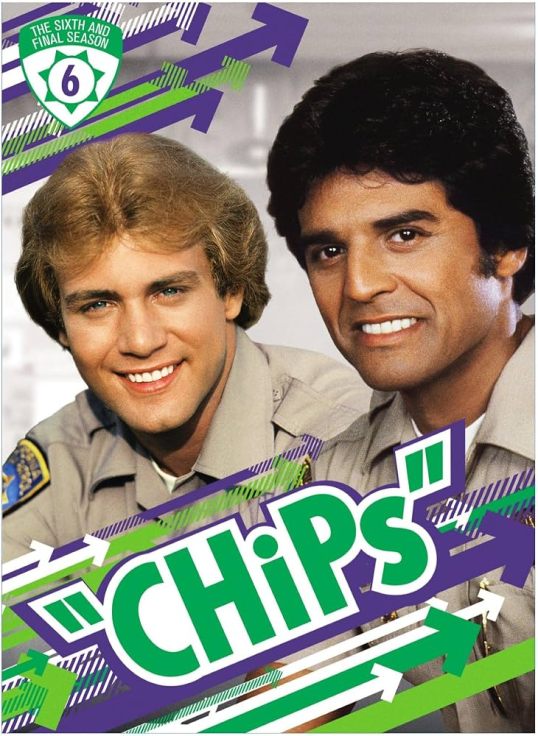
This week, we meet the future of the Highway Patrol.

Episode 6.5 “Speedway Fever”

(Dir by Chuck Bail, originally aired on November 7th, 1982)

This week, we meet Bobby’s younger brother, Bruce Nelson (Bruce Penhall). Bruce is both a world motorcycle speedway champion and a student at the Highway Patrol Academy. He hopes soon to be riding a motorcycle in the name of the law, just like Bobby and Ponch.

Unfortunately, Bruce has a hard time following orders. He likes to show off when he’s riding his motorcycle. He’s a good driver and a good shooter, but he’s struggling at the Academy. And when things start to get too tough for him, he decides to walk away from it. It’s an impulsive decision that he regrets. Can Ponch and Bobby talk the head of the Academy into giving Bruce a second chance? Of course they can! Ponch and Bobby can do anything.

Bruce Penhall was a real-life speedway champion. The footage of Bruce Nelson winning his race is actually taken from one of Penhall’s actual races. Judging from this episode, Penhall was a likable, if somewhat stiff, actor. In fact, watching this episode, I couldn’t help but notice that Bruce Penhall had better chemistry with Erik Estrada than Tom Reilly did. One gets the feeling that the purpose of this episode was to introduce Penhall as a potential replacement for Reilly. If nothing else, Penhall brought a good deal of earnest energy to his performance and provided quite a contrast to Tom Reilly’s rather spacey acting style.

This episode wasn’t entirely taken up with scenes of Penhall racing. There were two storylines. The more annoying one featured three 16-year-old girls (one of whom was played by Moon Unit Zappa) who would hitchhike and then use a water pistol to rob whoever picked them up. The girls introduced themselves as being from the Valley and spent the entire episode saying stuff like “For sure!” and “Gag me with a spoon!” (I’m not kidding; they said that more than once.) Frank Zappa’s “Valley Girl” played on the soundtrack whenever the girls showed up. It was kind of embarrassing all around. Between this episode, the Moloch episode, and the UFO episode, this season appears to have found CHiPs desperately struggling to stay culturally relevant.

As for the other storyline, it featured two motorcycle-riding thieves who were robbing couriers on the highway. One of the thieves was Bruce’s best friend, Ray (Robert Romanus). What a coincidence! Romanus, of course, played Mike Damone in Fast Times at Ridgemont High, which was probably still in theaters when this episode aired. He gives pretty much the same performance here that he gave in Amy Heckerling’s film. In the end, this episode left you wondering just how Mike Damone eventually ended up going so bad.

The episode ends with Bruce not only winning the world speedway championship but also returning to the Academy. It looks like the Highway Patrol is getting some new blood, and not a minute too soon!

The TSL Grindhouse: The Spook Who Sat By The Door (dir by Ivan Dixon)


1973’s The Spook Who Sat By The Door opens with Senator Hennington (Joseph Mascolo) in a panic.

The Senator is running for reelection and is struggling to appeal to white voters and minority voters at the same time.  White voters are happy that the Senator recently gave a speech in favor of “law and order” but now, he’s polling weakly with black voters.  His wife (Elaine Aiken) suggests that the Senator win back black voters by demanding that the CIA hire more black agents.

The CIA responds to the political pressure by hiring Dan Freeman (Lawrence Cook) to be their first black agent.  Freeman is given the standard CIA training and taught how to start revolutions in other countries.  However, after he completes his training, Freeman is assigned no real responsibilities.  He is given a desk job and spends most of his day making copies.  Whenever a senator or a reporter visits CIA Headquarters, Freeman is trotted out so that the CIA can claim to be diverse.  Freeman understands that he’s a token.  He knows that his job is to basically sit by the door and be seen.  But Freeman actually has bigger plans.

After spending a few years at the CIA, Freeman resigns and heads back to Chicago to work as a social worker.  Using what he learned at the agency, he starts to recruit young black men as freedom fighters.  He and the Cobras (as they’re called) launch their own guerilla war against the establishment in Chicago.  Some of their tactics are violent and some of them are not.  Freeman understands the importance of winning both hearts and minds and he recruits Willy (David Lemieux) to serve as his lead propagandist.  Because Willy is light-skinned, he is also assigned to rob a bank because Freeman knows that both the witnesses and the police will mistake him for being white and will be less likely to fire on him.  (The other members of the Cobras wear whiteface during the robbery.)

Freeman hopes that he will be able to recruit his childhood friend, Dawson (J.A. Preston), to the cause.  Dawson, however, now works as a detective for the Chicago PD and has been assigned to beak up the Cobras.  Will Freeman be able to bring over Dawson and what will happen if Dawson resists?

Based on a novel by Sam Greenlee (who was one of the first black men to be recruited to work with the United States Information Agency and who based many of Freeman’s CIA experiences on his own), The Spook Who Sat By The Door has achieved legendary status as a film that the FBI reportedly tried to keep out of theaters.  Theater owners were pressured to either not book the film or to only book it for a week before replacing it with a less incendiary film.  As a result, The Spook Who Sat By The Door became a difficult film to see.  As often happens, the efforts to censor the film only added to its revolutionary mystique.

Of course, in 2024, one can go on YouTube and watch the film for oneself.  It’s definitely uneven film, one that has pacing issues (especially at the beginning) and also one that suffers due to its low budget.  Depicting the overthrow of the government on a budget will always be a challenge.  Some of the acting is a bit amateurish but Lawrence Cook broods convincingly as Freeman and he’s well-matched by J.A. Preston’s portrayal of the more down-to-Earth Dawson.  At its best, there’s a raw authenticity and anger to the film that immediately captures the viewer’s attention.  It’s the rare political film to actually feature conversations about actual politics and it’s a film that asks how far people would be willing to go to accomplish change.  The Spook Who Sat By The Door suggests that the true villains are the members of the establishment who cynically embraced the civil rights struggle in their words but not in their actions.  In the end, Dan Freeman becomes a bit of a fanatic but the film suggests that perhaps a fanatic was what the times demanded.

The TSL Horror Grindhouse: Lord Shango (dir by Ray Marsh)


The 1975 film, Lord Shango, takes place in a small, rural town in the Deep South, where the population appears to be firmly divided between those who worship at an evangelical Christian church and those who follow the Yoruba religion.

(To answer the obvious question, I have no idea how faithful this film is to the realities of the Yoruba religion.)

Jenny (Marlene Clark), who is a waitress at a local restaurant, is a member of the evangelical church, largely because her boyfriend is a member and he thinks that her attending the church will help her to get pregnant.  Her daughter, Billie (Avis McCarther), is in love with Femi (Bill Overton), who is a follower of the Yoruba religion.  One Sunday morning, while all the church people sings hymns, a series of baptisms are held in a nearby river.  When it is time for Billie to baptized, Femi rushes into the water and objects.  After he shoves her out of the river, the men of the church grab Femi and announce that the evil must be taken out of him through what appears to be a forced baptism.  They force him under the water but, with Femi struggling, the end up holding him down for too long and Femi drowns.

Traumatized, Billie sinks into depression and Jenny grows disillusioned with the church, especially when the men who held Femi down refuse to take any responsibility for their actions.  She also learns that her boyfriend, Memphis (Wally Taylor), had sex with Billie after Billie mistook him for being the spirit of Femi.  When she finds Memphis praying in the church, she proceeds to yell and curse at him while he pathetically apologizes.

The next morning, Jenny wakes up to discover that Billie has run away, leaving behind a note that simply reads, “I can no longer live in your house.”  When the men of the church again prove to be insensitive and ineffectual when it comes to finding out where Billie has gone (and instead are more concerned about why Jenny and Memphis has not been coming to the prayer meetings), Jenny turns to Femi’s friend, Jabo (Lawrence Cook).  Under Jabo’s guidance, Jenny offers up a series of sacrifices to the local Yoruba priest (Maurice Woods) and asks for her daughter to return home.

The sacrifices appear to work.  Billie returns home and reveals that she’s pregnant with a baby that she believes to be Femi’s and which Jenny believes to be Memphis’s.  Jenny, now firmly under the control of Jabo, continues to make sacrifices and bad things continue to befall the men that she holds responsible for Femi’s death….

A frequently surreal film, Lord Shango is an interesting, if not always easy-to-decipher, portrayal of the battle of two different belief systems.  While the evangelical Christianity that Jenny first followed could only promise an eventual reward, Jabo’s tribal religion offers her immediate reward and revenge.  (Significantly, even though Billie was in love with Femi and wants to have his child, she has no interest in following his religion.)  The film is often edited to provide a direct contrast between the staged cermonies of evangelical Christianity and the sensuality of the Yoruba religion.  The film is full of Southern gothic atmosphere and is well-acted, particularly by Lawrence Cook and Marlene Clark.  That said, the film is also frequently very difficult to follow.  At times, one gets the feeling that the film is being surreal simply to be surreal and it’s hard to find a coherent message in the film’s collection of odd scenes and strange dialogue.

Lord Shango is a frequently intriguing film, as long as you’re willing to accept a little incoherence.