Here’s The First Trailer For The New Ghostbusters!


The first trailer for the new Ghostbusters film was released today and you can watch it below.  The trailer is mildly promising, less because of the jokes featured (the majority of which are pretty predictable) and more because of the talent assembled on-screen.

That said, once you get past the fact that all of the Ghostbusters are played by genuinely funny women, you’re left with what appears to be another film about three super smart white women and their sassy black friend.  Watching the trailer, it’s hard not to notice that the three white women are all scientists while the only black woman works for the transportation authority and, of course, has a relative who is an undertaker.  The trailer’s final moment, with Leslie Jones slapping a spirit out of Melissa McCarthy, is obviously meant to be a big crowd-pleasing moment but it feels more like a case of racial caricature.  It certainly feels far more stereotypical than anything that Ernie Hudson was ever required to do or say in the original Ghostbusters.

(Then again, Ernie Hudson really didn’t have much to do or say….)

I mean, seriously — would it have killed them to make the black woman a scientist too?

An Exorcist TV pilot? What Sweet Hell is This?


fanart_twisted_exorcism_tshirt

I don’t wear hats but if I did, I would give a tip of the hat to my friends over at Horrorpedia for the news that apparently, a pilot has been put into production for an Exorcist TV show.

And then I would sigh.  Actually, that’s what I’m doing right now.

Seriously, an Exorcist TV show?  Which dumbfug toadsucker thought this was a good idea?  What damnable dumbfuckery is this?

Oh!  And hey, the pilot is being written by the same guy who wrote the Fantastic Four movie!  It gets even better!

For what it’s worth, here’s the plot description:

Two very different men — Father Tomas Ortega (Alfonso Herrera) and Father Marcus Lang (Ben Daniels) — tackle one family’s case of horrifying demonic possession and confronting the face of true evil…

To be honest, I could probably get enthusiastic if the show was a prequel about the early life of Father Merrin.  But this sounds more like a remake of Deliver Us From Evil and that movie was pretty bad!  I mean, not even Joel McHale could save that movie…

And seriously — what type of priest is named Marcus Lang?

Here’s hoping that Pazuzu puts a stop to this before the legacy of a true horror classic is tarnished any further.

Cleaning Out The DVR: Born Yesterday (dir by George Cukor)


Born_yesterday

After I watched Goodbye, Mr. Chips, I decided to watch one more film that I had recorded off of TCM.  The movie I chose was Born Yesterday.

This 1950 film was directed by George Cukor and stars three Academy Award winners.  The lead actor was William Holden, who would win best actor three years after the release of Born Yesterday.  The villain was played Broderick Crawford, just a year after playing his Oscar-winning role in All The King’s Men.  Finally, the true star of the film was Judy Holliday, recreating her Broadway role of “dumb intelligent blonde” Billie Dawn.  For playing Billie, Holliday would win the award for best actress of the year.

In Born Yesterday, Billie is the girlfriend of Harry Brock (Broderick Crawford).  The crude and not particularly intelligent Harry has made a fortune as a “junkman” and, though the film never comes out and explicitly says so, it is suggested that Harry may have ties to the Mafia.  Harry has come to Washington, convinced that he can buy his way into political power.  Harry’s lawyer (Howard St. John) suggests that Harry should marry Billie, specifically because a wife cannot be compelled to testify against her husband.

However, there’s a problem.  Billie is uneducated and lacks formal manners.  Of course, Harry is even worse but then again, Harry is a rich white guy and, therefore, he doesn’t have to be polite or know what he’s talking about  After Billie embarrasses him during a meeting with a congressman, Harry hires journalist Paul Verrall (William Holden) to teach Billie how to fit in with Washington society.  At first, Paul refuses but, ultimately, he takes the job because he needs the money.

As Paul teaches Billie, it quickly becomes apparent that Billie is not as dumb as everyone assumes.  In fact, she has an insatiable desire to learn.  When Paul takes her on a tour of Washington, Billie is excited to learn the story behind every monument and to take a look at every historical artifact.  (When Paul shows her the bill of rights, Billie immediately reads the 2nd Amendment and gets Paul to explain it to her.  As Paul explained that it meant that citizens had the right to bear arms, my sister walked through the room and said, “You got that right.”)  Judy Holliday perfectly captures Billie’s excitement as, for the first time in her life, she’s actually treated like someone with a brain.

Billie also starts to fall in love with Paul.  After reading one of Paul’s articles, an obviously impressed Billie tells him, “I think it’s the best thing I ever read.  I didn’t understand a word.”  At the same time, Paul starts to fall for Billie.

Meanwhile, Harry is not falling for anyone but himself.  He continues to bribe congressmen but now, Billie not only realizes what Harry is doing but also understands that it’s illegal and goes against everything that the authors of the Constitution envisioned.  After a rather nasty scene in which she is repeatedly slapped by Harry, Billie goes down to the Lincoln Memorial, hears the voice of old Abe himself, and is finally ready to stand up for herself, for Paul, and for the American way of life.

(“When you steal from the government, you steal from yourself, you dumb ox!” she yells at Harry.)

Born Yesterday was based on a stage play and, with the exception of the scenes where Paul and Billie explore D.C., the entire film takes place in Harry’s hotel suite.  The film never quite escapes its theatrical origins.  Broderick Crawford bellows his lines out to the last row and William Holden feels miscast.  (That same year, he gave a far more interesting performance in Sunset Boulevard.)

But ultimately, Born Yesterday is mostly designed to showcase Judy Holliday as Billie Dawn.  When the film first started, I have to admit that I had my doubts about Holliday’s performance.  Her character was so stereotypically ditzy and spoke in such a nasal whine of a voice that I found myself wishing that the film had been made with either Marilyn Monroe or even Jayne Mansfield in the Billie Dawn role.  But, as the film progresses, I started to better appreciate Holliday’s performance.  I started to notice the sadness and the insecurity lurking underneath the surface.  I discovered that there was unexpected nuance to both the character and the performance.  By the time she was running through the National Archives and asking Paul questions about George Washington, she had totally won me over.

Still, Holliday’s victory for best actress does seem a little strange.  After all, to win the Oscar, Holliday defeated All About Eve‘s Bette Davis and Anne Baxter and Sunset Boulevard‘s Gloria Swanson.  Holliday’s performance definitely deserved a nomination but it’s a bit more difficult to argue that it deserved the Oscar.  Of course, Davis and Baxter played two tough and sarcastic divas, neither one of whom depended on a man for their success.  Swanson, meanwhile, played an older woman who ends up murdering her much younger lover.  Billie, meanwhile, is never without a girlfriend and doesn’t murder anyone.  Perhaps it’s understandable that certain Academy voters would be more comfortable with Billie Dawn than they would with Norma Desmond or Margo Channing.

Born Yesterday was also nominated for best picture but it lost to All About Eve.

Cleaning Out The DVR: Goodbye, Mr. Chips (dir by Sam Wood)


220px-Goodbye,_Mr._Chips_(1939_film)_poster

After watching Yankee Doodle Dandy, I watched another old best picture nominee that was sitting on my DVR.  Goodbye, Mr. Chips was nominated for best picture of 1939, a year that many consider to be one of the best cinematic years on record.  Just consider some of the other films that were nominated in that year: Mr. Smith Goes To Washington, Dark Victory, Ninotchka, The Wizard of Oz, Stagecoach, Love Affair, Wuthering Heights, Of Mice and Men, and, of course, Gone With The Wind.  Goodbye, Mr. Chips may not have won best picture but its star, Robert Donat, did win the Oscar for Best Actor, defeating Clark Gable, Jimmy Stewart, Laurence Olivier, and Mickey Rooney.

Robert Donat plays the title character, a British teacher named Charles Edward Chipping (affectionately known as Mr. Chips).  The film follows Mr. Chips over the course of 63 years, from his arrival as a new Latin teacher to the last night of his life.  When he first starts to work at Brookfield Public School, the young and inexperienced Mr. Chips proves himself to be a strict teacher, the type who enforces discipline and may be respected but will never be loved by his students.  It’s only after he falls in love with the outspoken Kathy Bridges (Greer Garson) that Mr. Chips starts to truly enjoy life.

After marrying Kathy, Mr. Chips relaxes.  He becomes a better teacher, one who is capable of inspiring his students as well as teaching them.  After Kathy dies in childbirth, Mr. Chips deals with his sadness by devoting all of his time to his many pupils.

While Mr. Chips deals with both new students and headmasters who view him as being too old-fashioned, the world marches off to war.  When World War I breaks out and there is a shortage of teachers, the elderly Mr. Chips serves as headmaster.  Each Sunday, in the chapel, he reads the names of former students (many of whom he taught) who have been killed in the war.  In perhaps the film’s best scene, he teaches a class while German bombs fall nearby, keeping his students calm and positive by having them translate Julius Caesar’s account of his own battle against the Germans.

The bombing scene is interesting for another reason.  Mr. Chips was filmed and released in 1939, shortly before Britain declared war on Nazi Germany.  Goodbye, Mr. Chips is not just a sentimental tribute to a teacher.  It’s also a tribute to the strength and resilience of the British people.  With the world on the verge of a second great war, Goodbye, Mr. Chips said that it was going to be tough, it was going to be scary, and there was going to be much loss but that the British would survive and ultimately be victorious.

And, as we all know, the film was right.

While the Oscar definitely should have gone to Jimmy Stewart for his performance in Mr. Smith Goes To Washington, Robert Donat still gives a sweet and touching performance as Mr. Chips.  And the film’s ending brought very real tears to my mismatched eyes.  Goodbye, Mr. Chips may be sentimental but it’s sentimental in the best possible way.

Cleaning Out The DVR: Yankee Doodle Dandy (dir by Michael Curtiz)


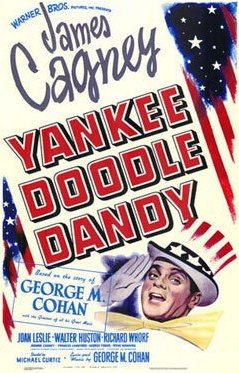
Yankee_Doodle_Dandy_poster

So, today, I got off work so that I could vote in Texas’s Super Tuesday primary.  After I cast my vote (and don’t ask me who I voted for because it’s a secret ballot for a reason!), I came home and I turned on the TV and I discovered that, as a result of spending February recording countless films off of Lifetime and TCM, I only had 9 hours of space left on my DVR.  As a result, the DVR was threatening to erase my recordings of Bend It Like Beckham, Jesus Christ Superstar, American Anthem, an episode of The Bachelor from 2011, and the entire series of Saved By The Bell: The College Years.

“Acgk!” I exclaimed in terror.

So, I immediately sat down and started the process of cleaning out the DVR.  I started things out by watching Yankee Doodle Dandy, a film from 1942.

Yankee Doodle Dandy is a biopic of a songwriter, signer, and dancer named George M. Cohan.  I have to admit, that when the film started, I had absolutely no idea who George M. Cohan was.  Imagine my surprise as I watched the film and I discovered that Cohan had written all of the old-fashioned patriotic songs that are played by the Richardson Symphony Orchestra whenever I go to see the 4th of July fireworks show at Breckenridge Park.  He wrote You’re A Grand Old Flag, The Yankee Doodle Boy, and Over There.  Though I may not have heard of him, Cohan was an American institution during the first half of the 20th Century.  Even if I hadn’t read that on Wikipedia, I would have been able to guess from watching Yankee Doodle Dandy, which, at times, seems to be making a case for sainthood.

And that’s not meant to be a complaint!  74 years after it was originally released, Yankee Doodle Dandy is still a terrifically entertaining film.  It opens with George (played by James Cagney) accepting a Congressional Gold Medal from President Franklin D. Roosevelt.  (We only see Roosevelt from behind and needless to say, the President did not play himself.  Instead, Captain Jack Young sat in a chair while FDR’s voice was provided by impressionist Art Gilmore.)  Cohan proceeds to tell Roosevelt his life story, starting with his birth on the 4th of July.  Cohan tells how he was born into a showbiz family and a major theme of the film is how Cohan took care of his family even after becoming famous.

The other major theme is patriotism.  As portrayed in this biopic, Cohan is perhaps the most patriotic man who ever lived.  That may sound corny but Cagney pulls it off.  When we see him sitting at the piano and coming up with the lyrics for another song extolling the greatness of America, we never doubt his sincerity.  In fact, he’s so sincere that he makes us believe as well.  Watching Yankee Doodle Dandy, I found myself regretting that I have to live in such an overwhelmingly cynical time.  If George M. Cohan was alive today, he’d punch out anyone who called this country “Murica.”

Yankee Doodle Dandy is an amazingly positive film.  There are a few scenes where Cohan has to deal with a few Broadway types who are jealous of his talent and his confidence but, otherwise, it’s pretty much one triumph after another for Cohan.  Normally, of course, there’s nothing more annoying than listening to someone talk about how great his life is but fortunately, Cohan is played by James Cagney and Cagney gives one of the best performance of all time in the role.

Cagney, of course, is best remembered for playing gangsters but he got his start as a dancer.  In Yankee Doodle Dandy, Cagney is so energetic and so happy and such a complete and totally showman that you can’t help but get caught up in his story.  When he says that, as a result of his success, things have never been better, you don’t resent him for it.  Instead, you’re happy for him because he’s amazingly talented and deserve the best!

Seriously, watch him below:

James Cagney won the Oscar for Best Actor for his performance here.  Yankee Doodle Dandy was also nominated for best picture but lost to Mrs. Miniver.

I’m really glad that I watched Yankee Doodle Dandy today.  In this time of overwhelming negativity, it was just what I needed!

A Few Final Thoughts On The 88th Academy Awards…


Oscars

Well, another Oscar season has come to an end.  I’m going to take one day off from thinking about the Oscars and then, once March begins, it’ll be time to start speculating about what will win next year.

Like the majority of our readers, I just finished watching the 88th Academy Awards.  It was an interesting ceremony.  It was strange.  It was full of moments that made me cringe.  And, at the same time, there were a few moments that left me feeling very inspired.  Clocking in at 3 hours and 30-something minutes, it was neither the worst nor the best Oscar telecast that I’ve ever watched.  (My favorite remains the ceremony that was hosted by James Franco and Anne Hathaway.  It was such a fun disaster.)  On twitter, people seem to think that it was either the greatest or the worst thing ever.  I am one of the few to think that it actually fell somewhere in the middle.

Let’s talk about the awards.  Going into this, I was hoping there would be a few upsets and there were.  Unfortunately, few of them were upsets that I was particularly looking forward to.  For instance, Mark Rylance won best supporting actor for Bridge of Spies and, no offense meant to Rylance, but it was hard not to wish that the award had instead gone to Creed‘s Sylvester Stallone.  Stallone, no matter what you may think of the majority of his films, is a cinematic icon and this was probably his last chance to win an Oscar.  Rylance, meanwhile, seems to be destined to being the actor you call when you can’t get Richard Jenkins.

And then there was Best Original Song.  I, for one, am still stunned that the song from SPECTRE was even nominated.  But then it actually won the Oscar!  And, in doing so, it defeated Lady Gaga’s anthem of survival and strength, Til It Happens To You.  Lady Gaga’s performance of Til It Happens To You was definitely one of the show’s highlights.  Not even the presence of our long-winded, gropey Vice President could diminish the strength and power of that performance.  Just imagine what a great moment it would have been if that performance had been followed by Til It Happens To You actually winning the Oscar.

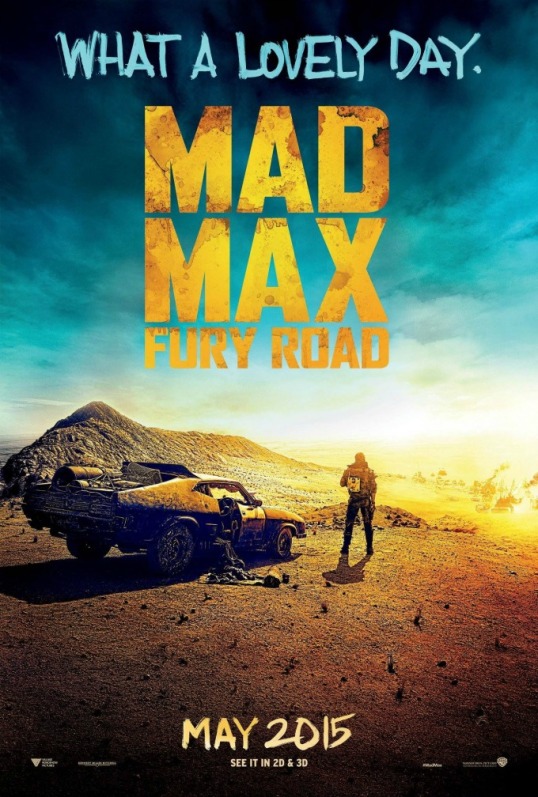
I got really excited when, early on, Mad Max: Fury Road started to win all of the technical awards.  Oh my God, I thought, what if Mad Max actually wins Best Picture!?  That would be a game changer as far as the future of the Oscars is concerned…

But then Alejandro Inarritu won best director and gave his typical sermon.  And then Leonardo DiCaprio won best actor and used it as an excuse to lecture us all about global warming.  And I started to dread the idea of The Revenant winning best picture and having to sit through another speech from either of these two undeniably talented gentlemen.  But then, after being shut out for most of the night, Spotlight won best picture.  The producers ran up on stage and started to lecture the Vatican…

It’s a strange victory.  Spotlight won a total of two Oscars.  Mad Max won six Oscars.  The Revenant won three.  The Big Short and Room took one.  Though the vote totals are never released, I’m going to guess it was a very close race.

I have to admit that I always cringe a little whenever the Oscars get political because celebrities, on the whole, tend to be flaky.  And, often times, they lecture everyone else without bothering to look at or modify any of their own behavior.  Frequently, it leads to a hypocrisy on their part that, over the years, has tarnished some very worthy causes.  It’s not surprising that the 88th Academy Awards were extremely political.  A lot of people said a lot of things but did they actually understand what they were saying or were they just playing another role?  That’s the question I always ask whenever a celeb says to vote this way or that.

I have to admit that I got kind of bored with Chris Rock trying to get people to buy girl scout cookies.  But, let’s give credit where credit is due.  Chris Rock called the film industry out on its own bullshit as far as diversity is concerned.  He told the self-congratulatory Academy audience that they too were capable of being racists and, even watching on TV, you could feel the tension in the room.  This was the epitome of speaking truth to power and good for Chris Rock for going there and, hopefully, making everyone in that audience feel a little bit uncomfortable.

And yet, at the same time, it was hard not to feel that it won’t make much of a difference.  The assembled members of the Academy applauded whenever a presenter or a winner called for diversity but, in the end, are they going to do anything more than applaud?  Watching the show, I imagine that most of the rich white people in the theater were thinking to themselves, “Chris isn’t talking about us.  He’s talking about those other rich white people.”

What’s the solution to the industry’s diversity problem?  Well, the first thing that would have to happen would be for the industry to admit that it has a problem and that’s never going to happen.  The mainstream American film industry is too high on its own rhetoric to ever take an honest look at itself.  Instead, studio execs and producers are always going to put the blame on “those other white people.”

There are so many stories out there waiting to be told.   At some point, the industry is going to have to stop bragging about how they tolerant they are and instead help those unique and interesting stories to be told.  Out there right now, there are people of every race, gender, religion, and political ideology who have a story to tell.  At some point, if the film industry really wants to change, it’s going to have to start seeking out those stories and giving those storytellers a chance.   At some point, those in industry are going to have to stop bragging about how much they donated to which campaign and actually put their rhetoric into action.

Until then, it’s going to take a lot more than merely giving Chris Rock a standing ovation to truly bring diversity to the film industry.

Did anyone else find it weird that the show ended with “Fight the Power” being played over pictures of wealthy white people accepting awards?  I don’t think the show’s producers really considered what that would look like.

Anyway, that concludes this Oscar season!  It was an exciting one and I can hardly wait for a new one to begin!

Here’s A Complete List Of The Oscar Winners!!!!


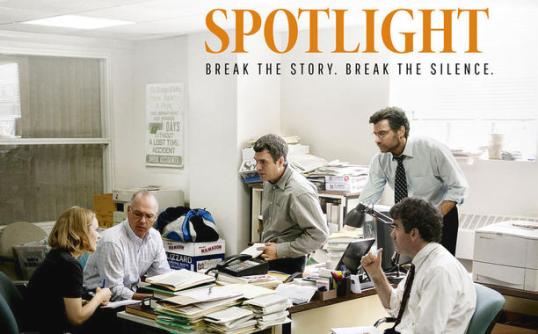
Spotlight

Best Picture: Spotlight

Best Director: Alejandro G. Inarritu for The Revenant

Best Actor: Leonardo DiCarpio in The Revenant

Best Actress: Brie Larson in Room

Best Supporting Actor: Mark Rylance in Bridge of Spies

Best Supporting Actress: Alicia Vikander in The Danish Girl

Best Original Screenplay: Tom McCarthy and Josh Singer. Spotlight

Best Adapted Screenplay: Adam McKay and Charles Randolph.  The Big Short

Best Animated Film: Inside Out

Best Documentary Feature: Amy

Best Foreign Language Film: Son of Saul

Best Cinematography: Emmanuel Lubezki, The Revenant

Best Costume Design: Jenny Bevan, Mad Max: Fury Road

Best Editing: Margaret Sixel, Mad Mad: Fury Road

Best Make-up and Hairstyling: Mad Max: Fury Road

Best Original Score: Ennio Morricone, The Hateful Eight

Best Original Song: “Writing’s On The Wall” from SPECTRE

Best Production Design: Colin Gibson and Lisa Thompson, Mad Max: Fury Road

Best Sound Editing: Mad Max: Fury Road

Best Sound Mixing: Mad Max: Fury Road

Best Visual Effects: Ex Machina

Best Animated Short Film:Bear Story

Best Documentary Short Film: The Girl In The River: The Price of Forgiveness

Best Live Action Short: Stutterer

MadMaxFuryRoad

Lisa Watches An Oscar Nominee: Father of the Bride (dir by Vincente Minnelli)


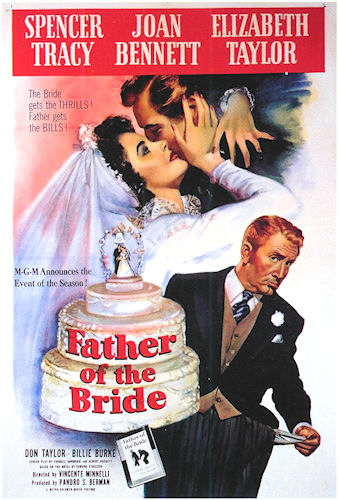
FatheroftheBride1950

After I watched King Solomon’s Mines, I watched yet another 1950 best picture nominee, Father of the Bride.

In Father of the Bride, Spencer Tracy plays a lawyer named Stanley Banks.  As you might expect of any character played by Spencer Tracy, Stanley Banks is a no-nonsense type of guy.  He’s set in his ways and not particularly enthusiastic about the idea of change.  Stanley has worked hard to get a good job and a nice house in the suburbs.  He loves his wife, Ellie (Joan Bennett) and is a firm but good father to his two boys, Tommy (Russ Tamblyn) and Ben (Tom Irish).  If Stanley does have a soft spot, it’s for his daughter, Kay (17 year-old Elizabeth Taylor).  Stanley admits that he’s always given Kay everything that she’s ever wanted and that she is his favorite of all his children.

However, Kay has been acting strangely as of late.  She just seems to be so happy!  Stanley can tell that she’s in love, though he has no idea with whom.  (He is, however, happy that it’s probably not the bespectacled political radical who Kay apparently dated at some point in the past.)  Finally, during an otherwise typical family dinner, Kay announces that not only is she in love but she’s also engaged to be married!

His name is Buckley (Don Taylor, who would later direct Escape From The Planet of the Apes and Damien: Omen II) and, at first, Kay refuses to even introduce him to her parents.  Eventually, however, Stanley does meet Buckley and he’s happy to discover that not only does Buckley come from a wealthy family but he also owns a small business of his own.

However, just because Buckley is the perfect 1950 man, that doesn’t mean that the wedding is going to be easy.  As a befuddled Stanley watches, the wedding grows more and more elaborate (not to mention, expensive!).  All of the expected complications ensue: Buckley and Kay have a fight, a wedding planner makes things difficult, and Stanley does not immediately get along with Buckley’s parents.  But, for the most part, Father of the Bride is about Stanley struggling to accept that his daughter has grown up and is ready to start a life of her own.

Father of the Bride is a sweet little comedy, though it seems a bit out-of-place as a best picture nominee.  It’s definitely a film of its time.  For all of the scenes of Stanley worrying about the extravagance of modern weddings, there’s not a subversive moment to be found in Father of the Bride.  (One can only imagine what Nicholas Ray or Douglas Sirk would have done with the material.)

Fortunately, this is also a Spencer Tracy film and whatever gravitas that the film may have comes from Tracy’s honest and straight forward performance.  Tracy never begs for laughs but he gets them anyway, because of the honesty that he brings to the character.  Perhaps his best moment comes after Buckley and Kay have had a fight.  After comforting his daughter, Stanley discovers that Buckley is at the front door.  At first, the protective Stanley tells Buckley that Kay doesn’t want to see him.  Suddenly, Kay comes running down stairs and embraces Buckley.  Between sobs and kisses, Buckley and Kay dramatically swear to each other that they will never fight again.  The camera pans over to Stanley, standing a little to the side and listening.  At first, Stanley seems befuddled by how overdramatic the two of them are acting over a relatively minor fight but there’s also just a hint of sadness in Stanley’s eyes as he realizes that his daughter truly has moved on.

Father of the Bride was nominated for best picture but it lost to the far more subversive All About Eve.

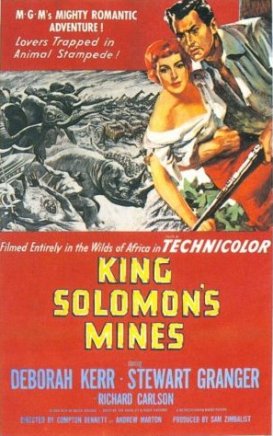
Lisa Reviews An Oscar Nominee: King Solomon’s Mines (dir by Compton Bennett and Andrew Marton)


Kingsolomonsmines1950

So, this is a weird one.

As we all know, today is Oscar Sunday!  As I wait for the big show to begin, I’ve been watching some of the Oscar-nominated films that I have collected on the DVR over the past month.  For instance, this morning, I watched 1950’s King Solomon’s Mines.

King Solomon’s Mines was nominated for best picture of the year and watching it … well, you really have to wonder why.  It’s an adventure film, one that was shot on location in Africa and it features a lot of footage of wild animals.  It also features several scenes that were shot in actual African villages and a good deal of time is devoted to documenting tribal rituals.  It’s true that the film has a plot but, for the most part, it’s a travelogue.  One gets the feeling that it was mostly sold as a chance for American and European audiences to see a part of the world that, up until that point, they had only read about.  Not only would they get to experience Africa from the safety of the neighborhood movie theater but they’d get to see it in a color as well!

(Seriously, it’s difficult to watch the nature footage in King Solomon’s Mines without imagining a serious voiced narrator saying, “However, one gazelle has strayed too far from its mother.  The lion cubs will eat tonight…”)

As for the plot, King Solomon’s Mines is based on a novel by British adventure enthusiast H. Rider Haggard.  Allan Quartermain (Stewart Granger) is an experienced guide and hunter.  When we first meet him, he’s helping two rich Englishmen hunt an elephant.  It’s a disturbing scene, largely because it’s obvious the footage of the elephant dying is real.  Allan prevents his clients from killing more than one elephant and later talks about how much he hates his job but still, it’s pretty much to impossible to really like him after watching that elephant die.

Anyway, Allan gets hired by Elizabeth Curtis (Deborah Kerr) and her brother John (Richard Carlson).  It seems that Elizabeth’s husband disappeared in Africa while searching for a legendary treasure.  Allan tells Elizabeth that her husband is probably dead.  Elizabeth still insists on searching for him…

…and, from that point on, you can pretty much predict everything that is going to happen.  Though the footage of Africa looks great, it’s just not a very interesting film.  Playing the type of role that would probably be played by Gerard Butler if the movie was made today, Stewart Granger comes across as being bored with it all.  For that matter, even the great Deborah Kerr seems as if she’d rather be hanging out with Robert Mitchum.

Still, it is interesting to note that Hugo Haas shows up as a villain.  Who is Hugo Haas?  He was a Hungarian actor who, after playing a bad guy here, went on to direct several idiosyncratic B-movies, like Hold Back Tomorrow, The Girl On The Bridge, Bait, and One Girl’s Confession.  If nothing else, watching King Solomon’s Mines has inspired me to, someday, do a little Hugo Haas film festival here on the Lens.

King Solomon’s Mines seems like an odd best picture nominee.  Its triumphs are largely technical and even those successes no longer seem that special.  It was, however, a big hit at the box office and I imagine that probably has something to do with its nomination.  However, when the Oscars were awarded, best picture went to All About Eve.

Stewart Granger was no match for Bette Davis.

Here Are The Boring Razzie Winners!


I thought I was about to finally get some rest for the night and then I suddenly remembered that I needed to post the Razzie winners.  The Razzies are supposed to honor the worst films of the previous year.  I personally find them to be really overrated but some people care about them. Que sera sera.

You can check out the nominees by clicking here.  The winners are listed below:

Worst Film: Fifty Shades of Grey and Fantastic Four

Worst Actor: Jamie Dornan for Fifty Shades of Grey

Worst Actress: Dakota Johnson for Fifty Shades of Grey

Worst Supporting Actor: Eddie Redmayne for Jupiter Ascending

Worst Supporting Actress: Kaley Cuoco for Alvin and the Chipmunks 4 and The Wedding Ringer

Worst Director: Josh Trank for Fantastic Four

Worst Screenplay: Fifty Shades of Grey

Worst Screen Combo: Jamie Dornan and Dakota Johnson in Fifty Shades of Grey

Worst Remake, Rip-off, or Sequel: Fantastic Four

The Razzie Redeemer Award (honoring former Razzie champs who subsequently redeemed themselves): Sylvester Stallone, from all-time Razzie champ to Creed

For the most part, that’s pretty lazy collection of winners.  Were Fifty Shades of Grey and Fantastic Four bad?  Sure, they were.  But then again, so was The Big Short…