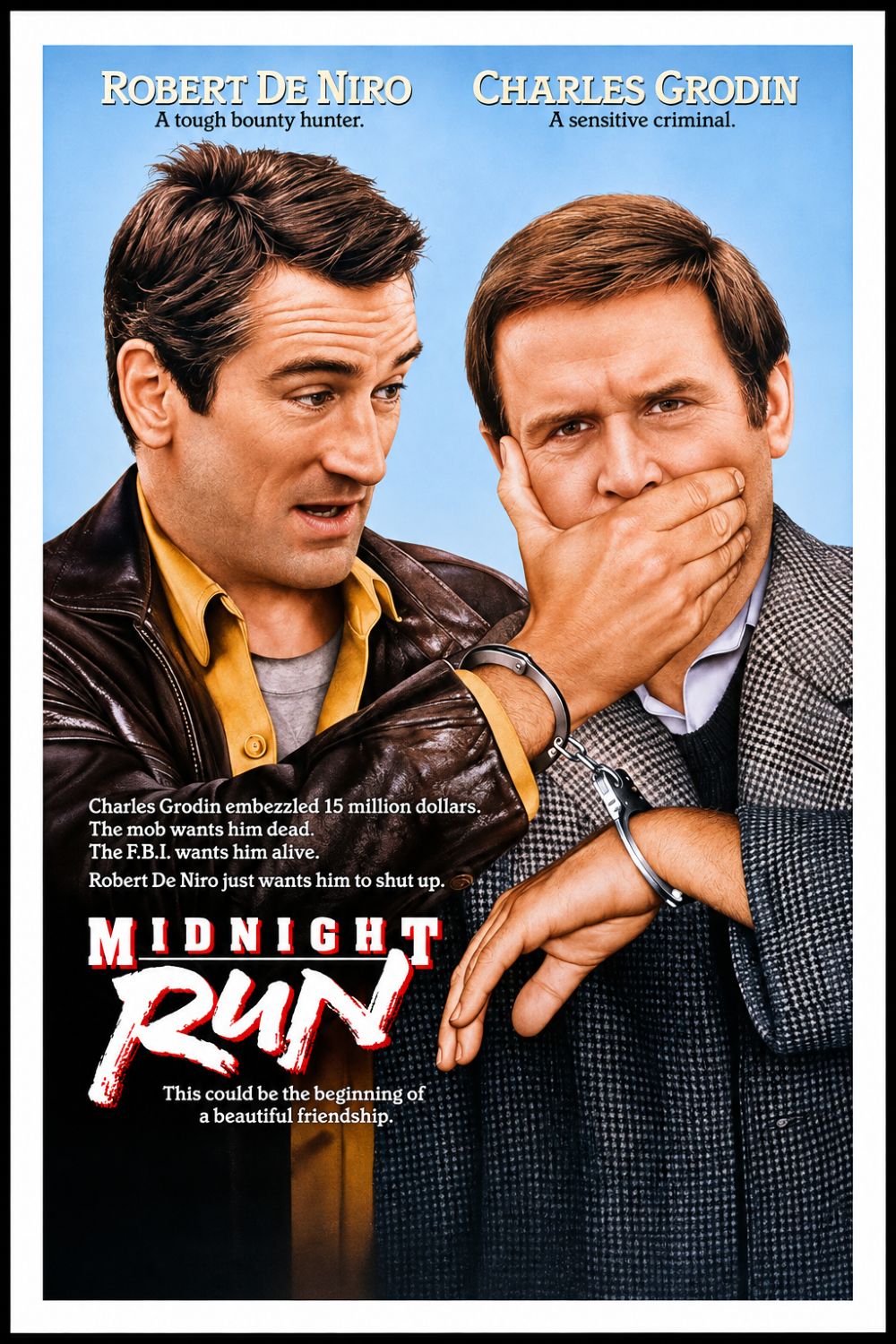
“Is this moron number one? Put moron number two on the phone.” — Jimmy Serrano
There’s a special kind of movie friendship that starts with one guy wanting to throw the other out of a moving vehicle, and Midnight Run might be the best version of it ever put on film. Released in 1988 and directed by Martin Brest, it looks like a routine action comedy and plays like a love story between two people who’d never admit it. Robert De Niro and Charles Grodin spend about two hours getting on each other’s nerves, and somehow that’s the most charming thing you’ll watch all year. Everything else in the movie, from the chases to the mobsters, is basically an excuse to keep them in the same space.
The plot is straightforward. Robert De Niro plays Jack Walsh, a former cop who now hunts down people who skip bail, and he’s desperate for a payday that will let him quit. His target is Jonathan “The Duke” Mardukas, an accountant who embezzled millions from a mob boss and then disappeared. All Jack has to do is bring him from New York to Los Angeles. Naturally, the FBI wants The Duke too, the mob wants him silenced, and a rival bounty hunter keeps popping up to snatch the reward. Every plan Jack makes falls apart, and the two end up improvising across the country, each stop more chaotic than the last.
The reason it works so well is that neither lead is the designated joker. In most buddy comedies, one character delivers the jokes while the other reacts, but here both men play their roles completely straight. Jack is blunt, tired, and quick to lose patience. The Duke is calm, courteous, and weirdly unbothered by the fact that people are trying to kill him. The humor comes from how stubbornly each sticks to his own view of the world, and it feels fresh because nobody is mugging for the camera.
De Niro is a revelation here, and a big part of the fun is watching him go against type. He’s best known for intense, dangerous characters, so seeing him play a worn-out guy who just wants to be left alone feels like a pleasant surprise. His comic timing is subtle: he lets a tense moment slide into the absurd without ever dropping the seriousness. There’s also real sadness in Jack, since he’s estranged from his family and bitter about the career he left behind. That emotional undercurrent gives the humor a little extra weight, and it makes the character easy to root for.
Charles Grodin, though, might be the film’s secret weapon. As The Duke, he delivers lines in a soft, reasonable voice that makes everything funnier. He criticizes Jack’s diet, warns him about the dangers of smoking, and tries to negotiate his own freedom like it’s a business meeting, all while the situation spirals. Grodin never overplays it, and his unflappable calm is the perfect counter to De Niro’s frustration. Their scenes feel loose and improvised, which gives the movie a natural rhythm you don’t often get in a big studio comedy.
The supporting cast fills out the world beautifully. Yaphet Kotto plays the FBI agent on their trail with a hilarious, weary dignity. John Ashton is the clueless rival bounty hunter Marvin Dorfler, whose overconfidence is a running gag. Dennis Farina is the menacing but funny mob boss Jimmy Serrano, and Joe Pantoliano is gloriously smarmy as the bail bondsman Eddie Moscone. Everyone gets a moment, and none of them feel like cardboard. Even the smallest characters have a distinct personality, which makes the whole film feel crowded in the best possible way.
As for the action, it’s good fun without stealing the spotlight. You get a desert car chase, a bus-station shootout, a helicopter, and a rough river escape, all of which keep the story moving. These scenes matter mostly because they force Jack and The Duke to rely on each other, and that slow shift is the real story. Danny Elfman’s lively score keeps the mood bouncy, so even the dangerous moments feel playful. Honestly, I remember the conversations more than the stunts, and I think that’s exactly what the movie intends.
What makes Midnight Run more than a standard comedy is the quiet emotional arc. Jack and The Duke start as captor and captive, trading insults and trying to outsmart each other, but their relationship gradually changes. There are no big speeches to mark it. Instead, it happens in small moments, like sharing food, telling a secret, or making a sacrifice when it would be easier to walk away. By the final stretch, you realize the movie has sneakily made you care about both men, so the stakes feel personal.
It does have flaws. The mob subplot can drag, and the “one last job” setup is a familiar trick that was already worn out in the late eighties. A couple of plot turns lean on coincidence, and some of the dialogue wears its era on its sleeve. But these small issues never sink the movie, because the characters are so strong and the pacing so confident. It knows when to be funny, when to be tense, and when to simply let two great actors talk.
I also admire how well it has aged. Plenty of comedies from the same decade feel stuck in their time, but this one stays sharp because its humor comes from personality rather than gimmicks. I’ve seen it more than once, and each viewing reveals something new, like a throwaway line or a tiny facial reaction I missed before. It showed audiences that De Niro could be wonderfully funny, and it remains the best showcase for Grodin’s gift for deadpan comedy.
So if you’ve got a long holiday weekend, leftovers in the fridge, and a free couple of hours, Midnight Run is exactly the kind of movie to put on. It’s easy to settle into, quick on its feet, and warm without being sappy. By the time it ends, you’ll feel like you’ve spent the evening with two old friends who never stopped bickering, and you’ll probably want to do it all over again soon.

