The Seventh Seal (1957, directed by Ingmar Bergman)
I had a bit of a panic attack earlier today when I logged onto twitter and I discovered that everyone was both sharing picture of the great actor Max Von Sydow and debating which one of his many roles was his best.
“Oh my God!” I thought, “Max von Sydow must have died! 2018 sucks now!”
I looked over at the trending topics and, to my shock, Max von Sydow was not trending. However, Mark Zuckerberg was.
“Goddammit,” I thought, “Mark Zuckerberg is totally overshadowing the legendary career of one of the most important actors of all time!”
I was prepared to take advantage of the no-filter atmosphere of twitter and start screaming at people for not showing the proper respect to the life and legacy of Max von Sydow. Fortunately, before I totally lost my temper, I decided to make sure that my assumptions were correct. That’s something that I rarely do but I’m certainly glad that I did it this time because, by doing so, I discovered that Max von Sydow was not dead.
Instead, today was his 89th birthday!
Happy birthday, Max von Sydow!
What is Max von Sydow’s greatest role? There’s so many to choose from. He’s got a whole new legion of fans as a result of his appearances in last two Star Wars films. Considering that he’s been an outspoken agnostic, it’s somewhat ironic that his first English-language role was as Jesus Christ in The Greatest Story Ever Told and that he epitomized everyone’s idea of the ideal priest in The Exorcist. He’s played assassins, saints, and intellectuals. He’s twice been nominated for an Oscar. When I asked my boyfriend for his pick for Max von Sydow’s greatest performance, he picked the Emperor Ming in Flash Gordon. Speaking of famous villains, von Sydow also played Blofield in Never Say Never Againand let’s not forget the assassin he played in Three Days of the Condor or his role in Minority Report or his performance as Leland Gualt in Needful Things! And what about his performance in The Diving Bell and the Butterfly or his Emmy-nominated turn in Game of Thrones…
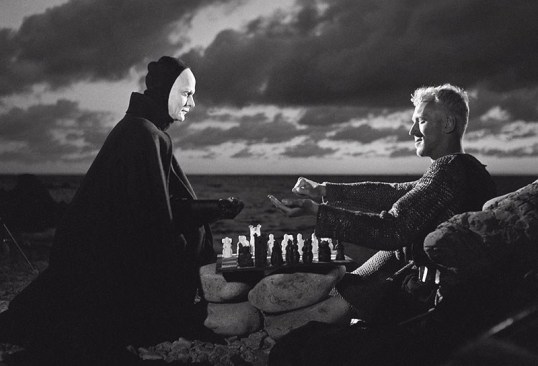
Well, I could sit here and spend hours listing great Max von Sydow performances. But, when talking about the career of Max von Sydow, you have to start with the films of Ingmar Bergman. And when you talk about Bergman and von Sydow, you have to start with 1957’s The Seventh Seal.
(Some sites claim that The Seventh Seal was von Sydow’s film debut but that’s not true. It may have been his first film for Bergman but von Sydow actually made his screen debut in 1949. Before finding film stardom, von Sydow dominated the Swedish stage.)
In honor of both Max von Sydow’s 89th birthday and his amazing career, today’s scene that I love is from The Seventh Seal. This haunting and atmospheric film is one that you definitely should see if you haven’t see it already. Here von Sydow’s knight first meets Death (Bengt Ekerot*) and settles in for a game of chess.
Happy birthday, Max von Sydow!
—-
*While Bengt Ekerot never went on to achieve the type of international fame that von Sydow did, his performance here set the archetype of how Death, as a character, continues to be portrayed in books and films to this day.
(With the Oscars scheduled to be awarded on March 4th, I have decided to review at least one Oscar-nominated film a day. These films could be nominees or they could be winners. They could be from this year’s Oscars or they could be a previous year’s nominee! We’ll see how things play out. Today, I take a look at the 1972 best picture nominee, The Emigrants!)
Since I’m currently dealing with either a really bad cold or the onset of the flu (let’s hope that it’s the former), I decided that Monday would be the perfect night to stay up extremely late and watch a 190-minute Swedish movie.
The Emigrants was released in Sweden in 1971 and it received an Oscar nomination for Best Foreign Language Film. Then, it was released in the United States in 1972 and it managed to receive four more Oscar nominations, including one for Best Picture. The Emigrants was the third foreign language film to be nominated for Best Picture, the first film to be nominated in multiple years, and also the first Swedish film to contend for the Academy’s top prize. (The following year, Ingmar Bergman’s Cries and Whispers would also become the second Swedish film nominated for Best Picture.) At the same time that The Emigrants was nominated for Best Picture, its sequel, The New Land, was nominated for Best Foreign Language Film. 1972 was an interesting year.
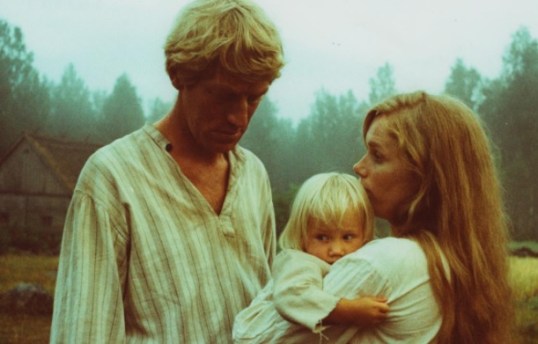
The Emigrants opens in 1844, in Sweden. Karl Oskar (Max Von Sydow) has married Kristina (Liv Ullmann). Like his father before him, Karl Oskar is a farmer. It’s an exhausting life. There is never enough food to eat. The weather is perpetually gloomy. The harvest is always disappointing. As poor farmers, Karl Oskar and his family face constant prejudice. In Sweden, the only thing more corrupt than the government is the church. After one of his daughters starves to death, what choice does Karl Oskar and his family have other than to escape to America?
As Karl Oskar’s brother, Robert (Eddie Axberg), explains, the best rice comes from the Carolinas. The best farmland is in America. In America, anyone can become rich. Anyone can walk up to the President and talk to him without running the risk of being imprisoned or executed. (In 1844, ordinary citizens could stop by the White House and make an appointment to see the President. This, of course, would change decades later, after a disgruntled office seeker shot President Garfield.) In America, Robert says excitedly, no one works more than 14 hours a day! Even slaves can own land and make their own money!
The Emigrants deals with their Karl Oskar and his family’s voyage to America. Karl Oskar and Kristina do not travel alone. Kristina’s uncle (Allan Edwall) is with them and hopes that, in America, he will be allowed to freely practice his religious beliefs. A former prostitute, Ulrika (Monica Zetterlund), is also with them, hoping a new land will mean a better life for both herself and her daughter. Even Robert’s best friend, Arvid (Pierre Lindstedt), going with them. It’s not an easy journey. Not everyone survives the voyage to North America but those that do soon find themselves in a young and untouched country where anything seems to be possible.
Swedish cinema has a reputation for being dark and brooding but those are two words that definitely do not apply to The Emigrants, which is about as positive a portrait of America as you could ever hope to see. Regardless of whatever tragedy may occur during the journey, this movie leaves no doubt that the journey was more than worth it. It unfolds at a pace that is perhaps a bit too leisurely but, at the same time, it’s also an achingly pretty movie with shots that bring to mind the best of Terrence Malick. In fact, there are times when the film is almost too pretty. It’s possible to get so caught up in looking at all the beauty around Karl Oskar and Kristina that you lose track of the story. Max Von Sydow and Liv Ullmann are both achingly pretty as well and, even more importantly, they’re believable as a married couple who are often equally in love and equally annoyed with each other.
It was interesting to go from watching The Grapes of Wrath to watching The Emigrants. If The Grapes of Wrath was an American nightmare, The Emigrants is about as pure a celebration of the American Dream as you’re going to find. It lost the Oscar for Best Picture to a far different film about the immigrant experience in America, The Godfather.
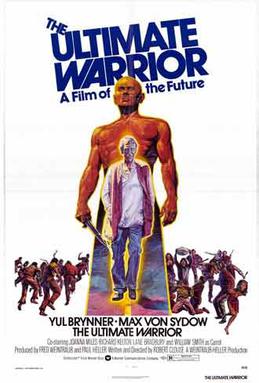
The year is 2012 and New York City, like the rest of the world, has been devastated by energy shortages, wars, and a great plague. The few survivors now live in isolated communes and are easily victimized by roving gangs of marauders. (On the plus side, this version of New York City has been spared Bill de Blasio.) The Baron (Max von Sydow) has managed to keep his people safe by ruling with an iron hand but he knows that it will only be a matter of time until his commune is overrun by the psychotic Carrot (William Smith) and his men. When a mysterious warrior known only as Carson (Yul Brynner) comes to the commune, the Baron tasks him with a very important mission: help his pregnant daughter (Joanna Miles) escape from New York City and transport both her and some genetically modified seeds to an island in North Carolina.
Despite being an obviously low-budget production, with studio backlots unconvincingly filling in for a deserted New York, The Ultimate Warrior is an entertaining post-apocalyptic action movie. Yul Brynner was nearly 60 years old when he played Carson but he still had the intense stare that made him so menacing in Westworld and he still looked credible in the fight scenes. William Smith was one of the best B-movie villains of the 70s and, as usual, Max Von Sydow brought a lot of gravity to his role. Best known for directing Enter The Dragon, Robert Clouse was an action specialist and the fight scenes in The Ultimate Warrior are both exciting and realistic. For those looking for a good post-apocalyptic action movie, keep an eye out for The Ultimate Warrior.
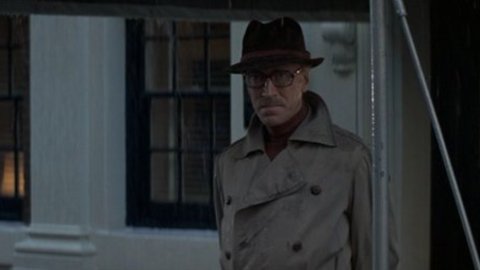
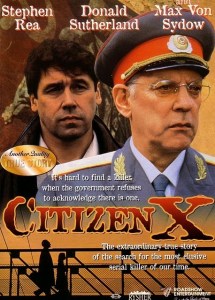
How do you solve a crime in a society that refuses to admit that crime exists?
That is the dilemma faced by Viktor Burakov (Stephen Rea) in the fact-based film, Citizen X. Burakov is a forensic expert in the Soviet Union. In 1982, when a dead body is found on a collective farm, Burakov is assigned to investigate. When seven more bodies are discovered, Burakov is convinced that he is dealing with a serial killer. The problem is that the official Soviet position is that crime and, especially, serial murder are a product of western decadence. With his superiors refusing to accept that a serial killer could be active in the USSR, Burakov is driven to the point of insanity as he both tries to stop the murders and keep his job. Fortunately, he has the Machiavellian Col. Fetisov (Donald Sutherland) on his side but, even with Fetisov’s protection, Burakov is no closer to tracking down the murderer.
Citizen X is based on the crimes of Andrei Chikatilo. From 1978 to 1990, Chikatilo committed at least 57 murders, with several of his victims being young children. Though many were suspicious of him, Chikatilo was protected by both his membership in the Communist party and the government’s refusal to allow most of his crimes to be publicly reported. It was only during the reforms of Perestroika that authorities were allowed to thoroughly investigate Chikatilo’s crimes. Chikatilo was arrested in 1992 and executed, via a gunshot to the back of his head, in 1994. In Citizen X, Chikatilo is played by Jeffrey DeMunn, who gives a very good and disturbingly plausible performance as the monstrous killer.
Made for HBO, Citizen X is a low-key but thought-provoking recreations of not just Chikatilo’s crimes but the atmosphere that allowed him to go undetected, Along with DeMunn, both Rea and Sutherland give great performances. (Sutherland won an Emmy.) Max Von Sydow also appears, playing a psychologist who is given the unenviable task of trying to enter Chikatilo’s mind.
At least, that is the claim made by Brass Target, a twisty and unnecessarily complicated thriller that argues that General George S. Patton (played here by George Kennedy, who is even more blustery than usual in the role) did not, as widely believed, die as the result of a car accident but was actually killed by an assassin using rubber bullets. Why was Patton targeted for assassination? Was he targeted by Nazis angered by Germany’s defeat or maybe Russians who knew that Patton had argued in favor of invading the Soviet Union towards the end of the war? Would you believe it was all because Patton was investigating the theft of Nazi gold and his subordinates, the flamboyantly gay Colonel Donald Rogers (Robert Vaughn) and Rogers’s always worried lover, Colonel Walter Gilchrist (Edward Herrmann), were fearful that he was getting too close to discovering the truth?
John Cassevetes, who hopefully used part of his paycheck to fund either The Killing of a Chinese Bookie, Opening Night, or Gloria, plays Joe De Lucca, the burned out OSS colonel who is assigned to track down the Nazi gold but who really just wants to go back home to New York. Patrick McGoohan, sporting an accent that is supposed to be American, plays De Lucca’s former friend and colleague, Colonel Mike McCauley, who now lives in a German castle. Max von Sydow is the assassin, who also has a day job as the chairman of a refugee relocation committee. Sophia Loren plays Mara, a Polish war refugee who, by pure coincidence, has slept with not just De Lucca but almost everyone involved with the conspiracy. Bruce Davison is the young colonel who acts as Du Lucca’s supervisor. Even Charles “Lucky” Luciano (played by the very British Lee Montague) is featured as a minor part of the conspiracy.
That is an impressive cast for a less than impressive movie. Brass Target never provides a convincing reason as to why the conspirators would decide that killing Patton was their only option and, once the conspiracy gets underway and the movie starts to follow around Von Sydow for some Day of the Jackal/Black Sunday-style preparation scenes, the search for the Nazi gold is forgotten. For some reason, though, I have a soft spot for this frequently ridiculous movie. There are enough weird moments and details, like Vaughn’s twitchy performance, McGoohan’s accent, the way Kennedy blusters about the Russians being rude to him, and glamorous Sophia Loren’s miscasting, that Brass Target is always watchable even if it is never exactly good.
When I first began this site on Christmas Eve of 2009 I had to thank the excitement I had for event films after seeing and experiencing James Cameron’s Avatar. It was an experience I hadn’t felt since the days of the Lord of the Rings trilogy and, even earlier than that, the original Star Wars trilogy. These were films that fired up one’s imagination, appreciation and love for film as entertainment and art. Some of these films would linger on longer in one’s mind than others, but that first viewing in their initial release would always imprint their effect on each viewer.
When George Lucas announced that he would be returning to that galaxy, far, far away with a trilogy of prequels almost 15 years since the world last saw Return of the Jedi premiere first the first time, the Star Wars fandom were giddy, excited and hyped beyond belief. The Star Wars films and the many spin-offs (novels, comic books, video games, etc.) which came about because of it only whetted the appetites of long-time Star Wars fans for more films detailing the adventures in the scifi universe created by George Lucas.
Yet, the prequels’ effect on these long-time fans would be the direct opposite of the effect the original trilogy had on the fandom. These three prequels (all directed and written by George Lucas himself) would do more than disappoint the fandom. It would create a schism between those who saw the original trilogy as the gateway to their fandom and those younger generation who never saw the original trilogy and had the prequels become their gateway to the fandom. Even to this day there would be some of the younger generation who truly believe that the prequels trump the original three films which began the franchise.
When news came down that Disney had bought Lucasfilm and everything which George Lucas had built and cultivated there was no chance in hell that there wouldn’t be another series of Star Wars despite the disaster which were the prequels. Lo and behold, it didn’t take long for Disney to greenlight the sequel to Return of the Jedi and have it set decades after the events of that film.
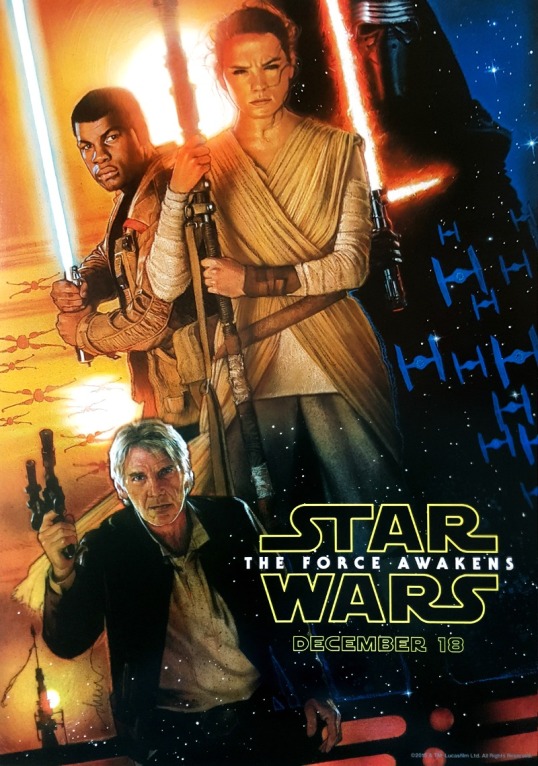
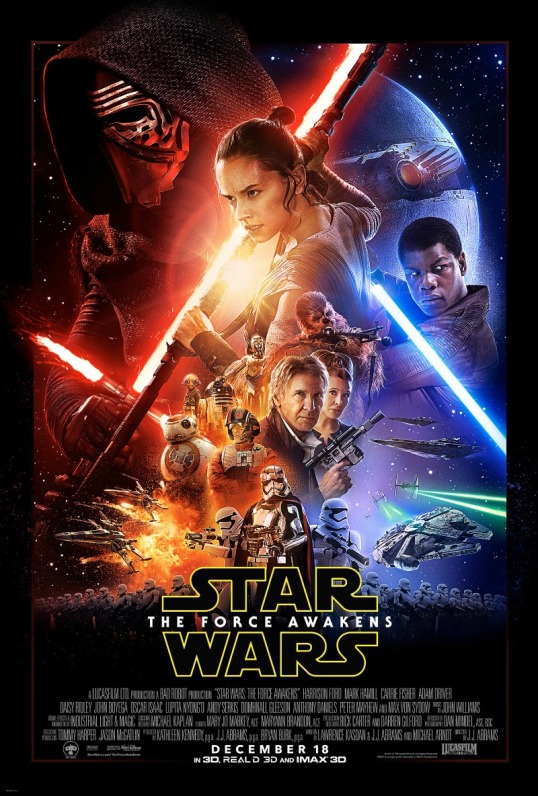
So, it is with Star Wars: The Force Awakens that the Star Wars fandom get to see whether their continued faith in the franchise was worth it or if they have been Charlie Brown’d once again and had the ball taken away at the very last second. It’s easy to say that Star Wars: The Force Awakens was great or it was awful. The true answer to whether this film succeeded in what it intended do was a bit more complicated.
Yet, if one was to look for an easy and simple answer then I’m happy to say that Star Wars: The Force Awakens was great. It had it’s moments of logic gap and plot holes, but as an overall finished product the film succeeded in course-correcting the franchise from the nadir it was at with the culmination of the prequels. It wouldn’t have taken much to surpass the very low bar set by those prequels, but The Force Awakens leapfrogged that bar and went even higher.
The film does begin thirty years after the events of Return of the Jedi and we find out with the now familiar episode intro crawl that Luke Skywalker has disappeared since those events and the galaxy has remained in turmoil with his absence. The Galactic Empire has been defeated, but in its place a new danger in the form of the genocidal First Order has arisen from the Empire’s remains. Opposing the First Order is a sort of galactic force supported in secret by the New Republic and led by General (not Princess) Leia Organa calling themselves the Resistance. It’s the conflict between these two factions and the search for Luke that forms the narrative base for The Force Awakens.
The film doesn’t linger too long in explaining the events which occurred in that 30-year gap between Return of the Jedi and The Force Awakens. It doesn’t need it as we’re quickly introduced to the series’ new characters in the form of Poe Dameron, the best pilot in the galaxy, who has been sent on a secret mission by Leia to find the clues as to her brother’s whereabouts. Next in line was Kylo Ren who becomes this film’s analogue to the Darth Vader figure of the original trilogy. Yet, the bulk of the film was told through the eyes of Finn and Rey. The former is First Order stormtrooper who has seen first-hand what the First Order truly stands for and not for the betterment of the galaxy. The latter is a young woman living life on the desert planet Jakku scavenging the graveyard of starship wreckage from a battle thirty year’s prior.
It’s through Rey and Finn that the audience learns through their adventures upon meeting up with each other on Jakku what has transpired since the Rebellion destroyed the second Death Star and killed Emperor Palpatine. To these two characters, the events from the original trilogy seem to have passed beyond the realm of history and become more like legends and myths to the younger generation. Through a combination of fear and awe, Ren and Finn get introduced to some of the original trilogies main characters (Leia, Han Solo, Chewbacca and even Admiral Ackbar). These are the stories they’ve been told of growing up come to life right in front of their eyes and their reaction mirrors those of the audience who haven’t seen these characters in anything new and relevant since the end of Return of the Jedi. The reaction alone to seeing Han Solo and Chewbacca alone seemed like the fandom’s collective cheer for the good that has been missing with the franchise for over 30 years now.
The Force Awakens is not a perfect by any stretch of the imagination. Like mentioned earlier, the film does suffer from some gaps in story logic and plot holes. As with most J.J. Abrams directed films he had a hand in writing the script and one could see where he sacrificed coherent storytelling beats for something that just pushed the story along the path he wanted the film to take. For those who have been steeped in Star Wars lore and backstory, this would be easily explained as the Force nudging, guiding and, if all else fails, pushing the characters onto the right path, but for the casual viewers it would come off as story beats of convenience.
As a story to bring back the faithful and lure in those still uninitiated to the franchise The Force Awakens straddles the line between nostalgia and trying to bring in something new to the proceedings.
Let’s begin with the former and just say it now that The Force Awakens does follow some major story beats directly from A New Hope (to a smaller effect from Empire Strikes Back and Return of the Jedi). One could almost say that this film was a sort of soft reboot of the original trilogy with how it lifted ideas from them and through some writing and directing recombination come up with something new, but still very familiar for hardcore and non-fans alike.
Does this decision to lean heavily on the original trilogy for ideas hurt the film? For some it might be a bit too distracting to recognize too many callbacks to those earlier films, but for most it’s a reminder of what the prequels lacked and that’s the sense of adventure and fun. There was never anything fun about the prequels. The Force Awakens brings it all back and for most viewers this is the course-correction the series has needed since the last images from Revenge of the Sith faded away from the silver-screen.
Even the new characters introduced in this latest film were an amalgamation of the main characters from the original trilogy. Where Abrams and Kasdan changed this up a bit was to go beyond just creating new analogues for the classic characters of Leia, Han, Luke, Chewie and R2D2. They opted to take all the qualities fans loved about those characters and mixed them all up to be used in the roles of Rey, Finn, Poe, Kylo Ren and BB8.
As the standout character in the film, Rey (played by find of the year Daisy Ridley) would bring back memories of not just the young and hopeful Luke from the original trilogy, but also some personal traits of Leia and Han. The same goes for Finn who at times reminded us of Han’s roguish charm to Luke’s naivete of his role in the larger world he has finally witnessed for the very first time. For the half-empty crowd this might look as lazy character development, but those who see the film with the half-full mindset would easily latch onto these new characters. Characters who now take on the responsibility of moving the franchise beyond the nostalgia of the original trilogy and erasure of the disappointment of the prequels to new adventures with the next two films.
So, is Star Wars: The Force Awakens worth returning back to the franchise after the prequels or is it too much of a rehash of the original three films? The answer to that is a definite yes despite some of it’s flaws. For some the very flaws some have pointed out (too many callbacks, sort of a reboot, etc.) was what made the film a fun time to be had. It’s a return to the comfort zone the fandom missed with the prequels.
Will the next two films in this new trilogy follow suit and just rely too much on nostalgia to continue trying to satisfy it’s massive audience? Or will Rian Johnson and Colin Trevorrow (director of Episode VIII and Episode IX, respectively) move into new territory with minimal callbacks to those earlier films? We as an audience will have to wait til 2017 and 2019 to find out. Until then enjoy what Abrams and Lucasfilm has accomplished with The Force Awakens. A film which has reinvigorated a film franchise that has seem some major lows, but one which also happens to be one hell of a fun ride from start to finish on it’s own merits.
P.S.: Some controversy has arisen since the film’s release concerning the character played by Daisy Ridley. Some have been very vocal about calling her Rey character as a sort of knee-jerk reaction to the accusation that the Star Wars films have lacked for a strong female lead. An argument that’s as misguided and misinformed as that of the films being whitewashed. The films in the franchise have always had strong female characters. The accusation that Rey as a character in The Force Awakens is such a “Mary Sue” (a female character written and created to be the best at everything, no flaws) ignore the details in the character’s development.
What’s sadder is that some of the very people (film critics and writers) who in the past have complained that major films (especially blockbusters) have been lacking in very strong female characters have been the very same who see Rey as a negative and a character too good. This despite the character following in the very same footsteps in how her predecessors have been written (Luke, Han, Anakin). It’s an argument that is sure to bring heated debate among fans and detractors, but one that takes away from the performance of Daisy Ridley who should be one of the many breakout stars to come out of Star Wars: The Force Awakens.
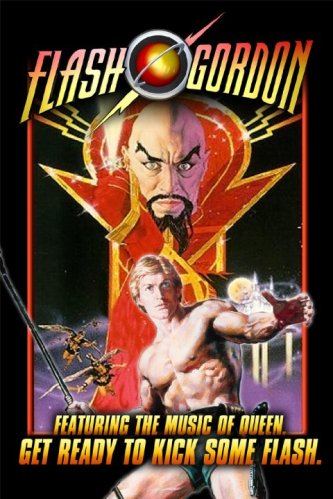
Life on the planet Mongo is not easy. Aided by Darth Vader wannabe Klytus (Peter Wyngarde) and the sadistic General Kala (Mariangela Melato), the evil Emperor Ming (Max Von Sydow) rules with an iron fist. All of the citizens are heavily taxed and kept in a state of perpetual war in order to keep them from joining together and rebelling. Those who attempt to defy Ming are executed.
There are many different races living on both Mongo and its moons. The Arborians, also known as the tree people, live in a jungle and are ruled by Prince Barin (Timothy Dalton). Until Ming overthrew his father, Barin was the rightful heir to the throne of Mongo. Barin is also one of the many lovers of Aura (Ornella Muti), Ming’s rebellious daughter.
Barin distrusts the Hawkmen, a group of winged barbarians. Led by the boisterous Prince Vultan (the one and only Brian Blessed), the Hawkmen live in a palace that floats above Mongo. Both Vultan and Barin share a desire to overthrow Ming but neither one of them can set aside their own dislike and distrust of each other.
Ming grows bored easily but Klytus has found him a new play thing, an obscure planet in the S-K system. “The inhabitants,” Klytus says, “refer to it as the planet Earth.”
It all leads to this:
You may have been too busy listening to Queen’s theme song to notice (and I don’t blame you if you were) but I have always found it strange that, even though Ming had never heard of Earth before Klytus brought it to his attention, he still had a button labeled “Earthquake.” Whenever I watch Flash Gordon, I wonder if I am the only one who has noticed this.
With Ming plaguing Earth with tornadoes, hurriances, and “hot hail,” it is up to three Earthlings to travel to Mongo and defeat him. Dr. Zarkov (Topol) is an eccentric scientist who was forced out of NASA because of his belief in Mongo. Dale Arden (Melody Anderson) is a reporter. And, finally, Flash Gordon (Sam J. Jones) is a professional athlete. Because this movie is a fantasy, Flash Gordon is a superstar quarterback for the New York Jets.
The character of Flash Gordon was first introduced in a 1934 comic strip and was played by Buster Crabbe in several classic serials. Among Flash’s many young fans was a future filmmaker named George Lucas, who would later cite Flash’s adventures as being a major inspiration for the Star Wars saga. After the unprecedented success of Star Wars:A New Hope, it only made sense that someone would try to make a Flash Gordon film.
That someone was producer Dino De Laurentiis. (Before writing the script for Star Wars, Lucas attempted to buy the rights for Flash Gordon from De Laurentiis.) To write the script that would bring Flash into the 80s, De Laurentiis hired Lorenzo Semple, Jr. Semple was best known for helping to create the 1960s version of Batman and he brought a similarly campy perspective to the character and story of Flash Gordon. As a result, the film ended up with scenes like this one, where Flash interrupts one of Ming’s ceremonies with an impromptu football scrimmage:
It also led to Brian Blessed’s entire performance as Prince Vultan, which is especially famous for the way that Blessed delivered one line:
(That also makes for a great ringtone.)
Sam J. Jones and Melody Anderson often seem to be stranded by Semple’s script but Max Von Sydow, Topol, Brian Blessed, Peter Wyngarde, and Ornella Muti all get into the swing of things. Seen today, Flash Gordon is entertaining but too intentionally campy for its own good. On the positive side, the images still pop off the screen and the soundtrack sounds as great as ever. When you listen to Queen’s theme song, you have no doubt that “he’ll save every one of us.”
As Flash Gordon himself put it after he saved the universe: “YEAAAAH!”
Just a couple weeks ago saw the release of the first and last official trailer for Star Wars: The Force Awakens. It was teasers before that one. The official trailer was suppose to keep the Star Wars fandom sated until December 18 (or earlier for those willing to brave the early advance screenings before midnight). It pushed all the right buttons to keep the fandom happy and wanting more.
Out of the blue, this morning saw Disney release without any fanfare a new trailer but one cut and edited for the Japanese market. It’s a trailer that includes scenes and images already seen in the previous official trailer and two earlier teasers, but also happened to include newer scenes (that still doesn’t spoil what the film will be all about) involving BB-8, Kylo Ren and more Princess Leia and Chewie.
So, it would seem that when Disney said that the trailer released a couple weeks ago would be the one and only trailer for the film it would seem they meant it would be the only domestic trailer. Sneaky, sneaky there Disney.
Plus, I rather prefer the Japanese trailer. Once again proves the Japanese gets the cool things.
The Exorcist is one of the greatest horror films of all time and a personal favorite of mine. But what about Exorcist II: The Heretic? Well, it would be a bit of an understatement to say that The Heretic has not quite received the amount of critical acclaim as the first film. Since it was first released in 1977, The Heretic has been widely considered to be one of the worst sequels of all time. It’s a film that is often cited as evidence as to why not all successful films need a follow-up.
Myself, I have sat through The Heretic twice. And yes, it is a pretty bad film but I have to admit that I enjoyed it each time that I saw it. It’s not a scary film at all. It’s not a successful horror film. But, as an unintentional comedy, it’s hilarious.
The Heretic opens four years after the end of The Exorcist. Father Merrin (Max von Sydow) is dead, having had a heart attack during the first film while performing an exorcism on Regan MacNeil (Linda Blair). In the years since, some in the Vatican have cast doubt on whether or not Merrin actually performed exorcisms. It turns out that, contrary to everything that we saw in the first film, Father Merrin was actually something of a rebel. His teachings are controversial. For instance, he was convinced that everyone has latent psychic powers and that the demon Pazuzu possesses those who have the potential to be the strongest psychics. Why? Because those people have the ability to lead humanity into a shared global consciousness and…
Well, it gets a little bit complicated. That’s one of the big differences between The Exorcist and Heretic. The Exorcist kept things relatively simple. The Heretic drags in a lot of metaphysical argle bargle.
The deceased Father Merrin has been brought up on charges of heresy. The Cardinal (Paul Henreid, many, many years after Casablanca), assigns Father Lamont (Richard Burton) to investigate the circumstances surrounding Father Merrin’s final exorcism.
The presence of Richard Burton is what elevates Heretic from merely being bad to being so bad that it’s good. As written, Father Lamont is supposed to be something of a naive idealist, someone who never met Father Merrin but who has been intrigued by his writings. Reportedly, several youthful actors turned down the role and eventually, production decided to make Lamont an older man and they ended up casting Richard Burton. Speaking in a shaky rasp and staring at the camera with bloodshot eyes, Burton appears to be at the height of his famous self-loathing in this film. Burton is so miscast as an idealistic priest that the film becomes fascinating to watch. Occasionally, the film tries to make us suspect that Lamont himself may be possessed but with Burton snarling his way through the role, how could anyone tell the difference?
Lamont tracks Regan down in New York. Regan doesn’t remember a thing about the exorcism and appears to be an overly happy teenage actress. (A good deal of the movie is devoted to her rehearsing a big dance number.) She is under the care of psychiatrist Gene Tuskin (Louise Fletcher). Tuskin has a device called the Synchronizer. When two people are hooked up to it, they can literally see into each other’s minds. They can share the same memories. They can … wait a minute. What the Hell? The Synchronizer essentially appears to be little more than a blinking light but it can actually allow you to enter into someone else’s mind? Doesn’t that seem like that should be a big deal?
Well, it’s not. Everyone pretty much just shrugs and accepts it…
Through the use of the Synchronizer, Reagan, Lamont, and Tuskin get to watch a lot of scenes from the first Exoricst. It also allows Father Lamont to have visions of Africa and another exorcism, this one involving a young boy named Kokumo.
This leads to one of my favorite parts of the film; Richard Burton wandering around a dusty African market and randomly telling people, “I am looking for Kokumo.” It turns out that Kukomo has grown up to be a doctor and he’s now played by James Earl Jones, who appears to be amused by his dialogue. Also showing up in the film’s Africa scenes is Ned Beatty. Beatty plays a pilot who flies Lamont to Kokumo’s village. “Have you come here before?” Beatty asks. “Once … on the wings of a demon,” Lamont replies.
Well, okay then…
The first Exorcist worked largely because William Friedkin directed it as if he was making a documentary. John Boorman takes the exact opposite approach here, trying to turn a cheap sequel into a metaphysical meditation on good, evil, and nature. It’s amazingly pretentious and it would actually be rather annoying if not for the fact that Burton doesn’t make the slightest bit of effort to come across as being in any way emotionally or intellectually invested in his over-the-top dialogue. When you combine Burton’s overwhelming cynicism with Linda Blair’s nearly insane perkiness, Louise Fletcher’s genial confusion, and James Earl Jones’s cheerful humor, the end result is something that simply has to be seen to be believed.
So, yes, The Heretic is as bad as you’ve heard. But that doesn’t mean you shouldn’t watch it.

 The year is 2012 and New York City, like the rest of the world, has been devastated by energy shortages, wars, and a great plague. The few survivors now live in isolated communes and are easily victimized by roving gangs of marauders. (On the plus side, this version of New York City has been spared Bill de Blasio.) The Baron (Max von Sydow) has managed to keep his people safe by ruling with an iron hand but he knows that it will only be a matter of time until his commune is overrun by the psychotic Carrot (William Smith) and his men. When a mysterious warrior known only as Carson (Yul Brynner) comes to the commune, the Baron tasks him with a very important mission: help his pregnant daughter (Joanna Miles) escape from New York City and transport both her and some genetically modified seeds to an island in North Carolina.
 How do you solve a crime in a society that refuses to admit that crime exists?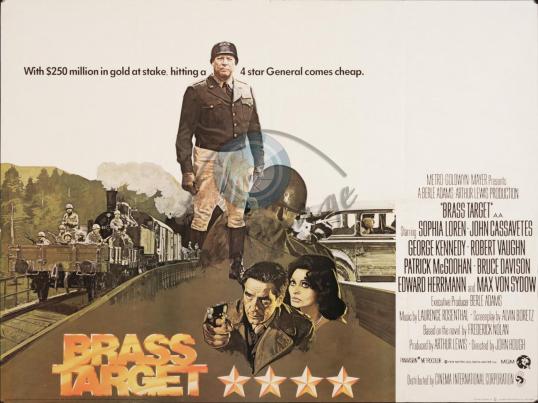
 Life on the planet Mongo is not easy. Aided by Darth Vader wannabe Klytus (Peter Wyngarde) and the sadistic General Kala (Mariangela Melato), the evil Emperor Ming (Max Von Sydow) rules with an iron fist. All of the citizens are heavily taxed and kept in a state of perpetual war in order to keep them from joining together and rebelling. Those who attempt to defy Ming are executed.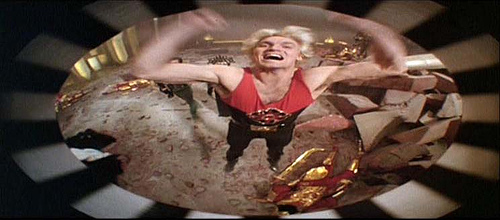

 Through the Shattered Lens