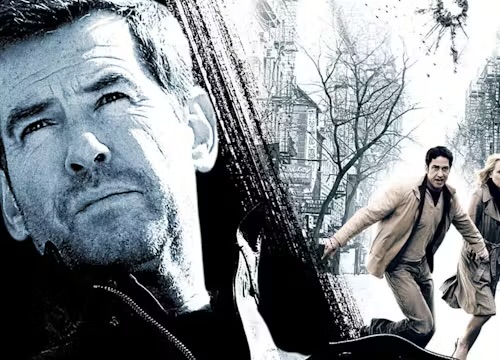
My wife and I decided to watch SHATTERED (2007), also known as BUTTERFLY ON A WHEEL, on a whim tonight. We were browsing through Amazon Prime when I saw Gerard Butler on the preview, and that was enough for me to watch it. Sierra likes cheesy thrillers, which this definitely gives off that vibe, so she was all in as well.
SHATTERED is set in Chicago and opens on the Randall’s, a seemingly perfect little family, made up of Neil (Gerard Butler), Abby (Maria Bello), and their beautiful daughter, Sophie. Neil’s a successful, if somewhat ethically challenged businessman on the verge of a big promotion, and life is good. That is, until a stranger (Pierce Brosnan) literally pops up in the couple’s life out of nowhere, tells them that he’s kidnapped Sophie, and forces them to do whatever he says or he’ll kill the girl. One moment they’re emptying their bank accounts only to see the stranger burn the money, and the next they’re delivering incriminating business documents to the competition that will destroy Neil’s company and his career. As the demands escalate, we learn that Neil and Abby’s lives aren’t quite as perfect as initially presented. But who is this stranger, why is he doing this, and how far will he force them to go to save their daughter?
I enjoyed SHATTERED quite a bit. It’s one of those movies that rope you in with its intriguing premise… a mysterious stranger puts a happy couple through hell, and we don’t know why he’s doing it, but we want to! This type of story, if done well, always pulls me in even though we’ve seen it done many times before. It’s helped by the game cast. Pierce Brosnan is appropriately intense and menacing as the stranger, helping us believe that he’ll hurt their daughter if they don’t follow his orders. James Bond, he is not! I’m a big fan of Gerard Butler, and he’s good here. His character is not the badass that we’ve come to expect from him these days, and he’s not that great of a guy either, but he does a good job of portraying a morally compromised guy whose life is spiraling out of control. Maria Bello is equal to the task as well, as the desperate mother who’s forced to deal with her husband’s failures at the same time as she’s dealing with any mother’s worst nightmare.
At the end of the day, these types of thrillers live and die based on their “twists” at the end. I have to admit that I was able to figure out the first twist about halfway through the movie, but SHATTERED isn’t content with just one twist, and it seems to stumble somewhat as it continues on after the first big reveal. I don’t blame the writers for trying to come up with something unique to close us out, but it doesn’t feel entirely successful in light of all that’s transpired before. It might actually be worth a rewatch just to see how well it stacks up.
I’m glad I watched SHATTERED. It’s time-tested storyline and fast pace make it worth a viewing, especially if you’re a fan of the cast like I am. Just keep your expectations in check, and you should enjoy the ride!
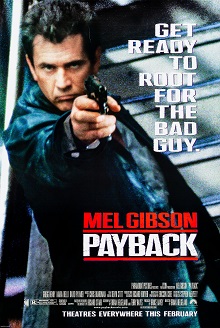
The 1999 film, Payback, opens with Porter (Mel Gibson) lying on a kitchen table while a grubby-looking doctor digs two bullets out of his back. The scene takes place in almost nauseating close-up, with the emphasis being put on the amount of pain that Porter endures to get rid of those bullets. Immediately, we know that Porter is not someone who can safely go to a regular hospital. Porter is someone who exists in the shadows of mainstream society.
He’s also someone who spends a lot of time getting beaten up. Even back when he was still a big star, Mel Gibson always seemed to spend a good deal of his films getting beaten up and tortured in various ways and that’s certainly the case with Payback. Porter gets punched. Porter gets shot. Porter has a encounter with an over-the-top dominatrix (played by Lucy Liu). At one point, Porter allows two of his toes to be smashed by a hammer, just so he can trick the his enemies into doing something dumb. As played by Gibson, Porter stumbles through the film and often looks like he’s coming down from a week-long bender. It’s interesting to think that Payback is a remake of 1967’s Point Blank, which starred Lee Marvin as Walker, an unflappable career criminal who never showed a hint of emotion or weakness. Porter, on the other hand, is visibly unstable and spends the entire film on the verge of a complete mental collapse. A lot of people try to kill Porter and Porter kills almost all of them without a moment’s hesitation.
(Of course, both Porter and Point Blank‘s Walker are versions of Parker, a career criminal who was at the center of several crime novels written by Donald “Richard Stark” Westlake.)
After helping to pull off a $140,000 heist from a Chinese triad, Porter was betrayed and left for dead by his former friend Val Resnick (Gregg Henry) and his wife, Lynn (Deborah Kara Unger). Porter, who just wants the $70,000 cut that he was promised, starts his quest for the money by tracking down Val and Lynn, and then continues it by going after the three bosses (played by William Devane, James Coburn, and Kris Kristofferson) of “The Outfit,” a shadowy organization that Val had gotten involved with. Along the way, Porter deals with a motely crew of corrupt cops, violent criminals, and sleazy middlemen. (David Paymer has a memorable bit as a low-level functionary with atrocious taste in suits.) Porter also hooks up with a prostitute named Rosie (Maria Bello), who might be the only person that he can actually trust.
I have mixed feelings about Payback. (So did director Brian Hegeland, who was reportedly fired towards the end of shooting and later released a far different director’s cut.) Though the film does a good job of capturing the visual style of a good neo-noir, the story itself is so violent and grim that it actually gets a little bit boring. The film’s advertising encouraged audiences to “Get ready to root for the bad guy,” but there’s really no reason to root for Porter. He’s an inarticulate and ruthless killer with no sense of humor. If anything, the people that he kills seem to be far more reasonable and likable than he does. In Point Blank, Lee Marvin may have been a bastard but he was good at what he did and you at least got the feeling that he wouldn’t go after any innocent bystanders. In Payback, Porter is such a mess that his continued survival is largely due to dumb luck. It’s hard to root for an idiot.
That said, the film does do a good job of capturing the feeling of people living on the fringes of society. The Outfit is not a typical Mafia family but instead, a collection of businessmen who work out of nice offices and, in the case of William Devane’s Carter, come across as being more of a senior executive than a crime boss. (James Coburn and Kris Kristofferson, meanwhile, come across as being two former hippies who made it rich on Wall Street. They’re elderly versions of Abbie Hoffman and Jerry Rubin.) The film does a good job of creating a world where no one trusts anyone and everyone is being watched by someone. In one memorable scene, the three men sent to watch for Porter discover that he’s been watching them the entire time. Never forget to look over your shoulder to see who might be following.
Flaws and all, this 1999 film does a good job of capturing the atmosphere of paranoia that, for many, would come to define the early part of the 21st Century.
Though the Academy of Motion Picture Arts and Sciences claim that the Oscars honor the best of the year, we all know that there are always worthy films and performances that end up getting overlooked. Sometimes, it’s because the competition too fierce. Sometimes, it’s because the film itself was too controversial. Often, it’s just a case of a film’s quality not being fully recognized until years after its initial released. This series of reviews takes a look at the films and performances that should have been nominated but were,for whatever reason, overlooked. These are the Unnominated.
The 2002 film Auto Focus start out as almost breezy satire of the perfect all-American life and it ends with an act of shocking violence. It’s based on a real-life mystery, a murder that revealed a secret life.
When we first see Bob Crane (Greg Kinnear), he’s a disc jockey and a drummer living in the suburbs of Los Angeles in the mid-60s. He’s got what would appear to be the ideal life. He’s got a nice house. He and his wife (Rita Wilson) seem to be devoted to each other. His children are adorable. He goes to church. He tells corny Dad jokes. He’s got a quick smile and a friendly manner and it’s impossible not to like him. When he gets offered the lead in a sitcom, his happiness and enthusiasm feels so generous that it’s impossible not to be happy for him.
Of course, the show is a comedy that takes place in World War II POW camp, which doesn’t really sound like a surefire hit or really anything that should be put on the air. (“Funny Nazis?” Crane says in disbelief when he’s first told about the project.) Still, with Crane in the lead role, Hogan’s Heroes becomes a hit and, for a while, Bob Crane becomes a star and it seems like it couldn’t have happened to a more deserving guy.
The problem, of course, is that Crane seems like he’s too good to be true and we all know what they say about things like that. From the start, there are hints that Crane may be hiding another side of his personality. His wife, for instance, is not happy when she discovers his stash of pornographic magazines in their garage. (“They’re photography magazines!” Crane protests with a smile that’s a bit too quick.) Crane obviously enjoys the recognition that comes from being the star of a top-rated show. He starts hanging out at strip clubs, occasionally playing drums with the club’s band and watching the dancers with a leer that’s really not all that different from the smile that he flashes whenever he asks anyone if they want an autograph.
Crane also meets John Carpenter (Willem DaFoe), an electronics expert who introduces him to the then-expensive and exclusive world of home video. As opposed to the clean-cut and smoothly-spoken Crane, Carpenter is so awkward that it’s sometimes painful to watch him move or listen to him speak. He’s the epitome of the Hollywood hanger-on, the type who has deluded himself into thinking that his celebrity clients genuinely like him and enjoy his company. He and Crane become fast friends, though it’s always obvious that Crane considers himself to be better than Carpenter. However, Carpenter is the only person with whom Crane can share the details of his secret life.
The film covers several years, from the late 60s to the mid-70s. Crane goes from being so clean-cut that he neither drinks nor curses to being so addicted to sex that he can stop himself even when it starts to destroy his career and leads to him losing everything that he loves. Carpenter and Crane’s friendship becomes progressively more and more self-destructive until the film ends in violence and tragedy.
Auto Focus begins on a light and breezy note but, as Crane’s addiction grows, the film grows darker. By the time the movie enters the 70s, the camerawork becomes more jittery and the once soft-spoken Crane seems to be drowning in his own anxiety. He becomes the type who causally goes from talking to Carpenter about how he wants to direct the world’s greatest sex film to cheerfully announcing that Disney has decided to cast him in a film called SuperDad. Auto Focus‘s key scene comes towards the end, when Crane is a guest on a silly cooking show and shocks the audience by harassing a woman sitting in the front row. When the audience boos, Crane flashes his familiar smile and it becomes obvious just how much of Crane’s life has been spent hiding behind that smile. By the end of the film, not even Crane himself can keep track of whether or not he’s a wholesome comedy star or a self-destructive sex addict.
Both Greg Kinnear and Willem DaFoe gave Oscar-worthy performance in Auto Focus, performances that hold your interest even after their characters sink to some truly low depths. The film makes good use of Kinnear’s amiable screen presence and Kinnear convincingly creates a man who wishes that he could be the person that he’s fooled everyone into thinking that he is. By the time he’s reduced to begging his agent (well-played by Ron Leibman) to find him a game show so that he can finally stop doing dinner theater, it’s hard not to have a little sympathy for him, even if the majority of his problems are self-created. As Carpenter, DaFoe is convincingly creepy but, at times, he’s also so pathetic that, again, you can’t help but feel a little sorry for him. At his worst, Carpenter is the 70s equivalent of the twitter user who stans a celebrity by sending them adoring tweets and then picking fights with anyone who disagrees.
Unfortunately, the Academy nominated neither Kinnear for Best Actor nor DaFoe for Best Supporting Actor. The competition for Best Actor was fierce that year, with Nicolas Cage, Michael Caine, Daniel Day-Lewis, and Jack Nicholson all losing to Adrien Brody in The Pianist. While Kinnear deserved a nomination, it’s hard to say who I would drop from that line-up to make room for him. As for DaFoe, I would argue that he was more deserving of a supporting actor nomination than The Hours‘s Ed Harris or The Road To Perdition’s Paul Newman. Perhaps DaFoe was just too convincing as the type of clingy groupie that most members of the Academy probably dread having to deal with.
Nominated or not, Auto Focus is a disturbing and ultimately sad look at the darkness that often hides behind a perfect facade.
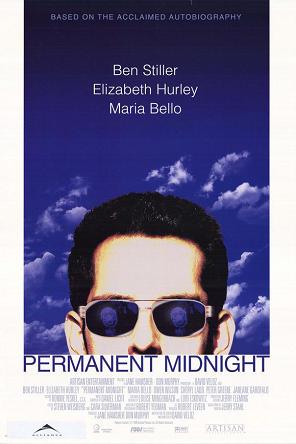
That was largely my reaction to watching the 1998 film, Permanent Midnight. In this film, Ben Stiller plays Jerry Stahl, a real-life screenwriter who had a fairly successful career going in the 80s and early 90s. He came out to Los Angeles looking to be a serious writer but, instead, he ended up writing for silly puppet show and getting addicted to heroin. He also married a British television executive named Sandra (Elizabeth Hurley), so that Sandra could get her green card. When the star of a show that he writes for tells him to kick his habit or lose his job, Jerry ends up smoking crack cocaine with a new dealer (Peter Greene). When Sandra tells him that she’s pregnant, Jerry responds by shooting up in the bedroom. When he’s trusted to spend the day taking care of his baby daughter, he drives her around the seediest sections of Los Angeles while he searches for his drug dealer. As the baby cries beside him, Jerry shoots heroin into his jugular. Jerry ends up unemployable and abandoned by every friend that he had. He works at a fast food restaurant, or at least he does until he meets another recovering addict (Maria Bello). She’s the one to whom he tells his story, in between sex and bouts of impotence. In the end, what’s left for Jerry Stahl to do but write a book and then a movie about his life as a junkie?
It’s a harrowing story and I guess Stahl deserves some credit for writing the screenplay for a movie that doesn’t exactly make him look good. However, Permanent Midnight runs into the same problem that afflicts most movies about drug addiction. With very few exceptions, drug addicts are just not that interesting. The only thing more boring than watching someone shoot up is then having to listen to that person explain why he shoots up. (Trainspotting is the obvious exception but Trainspotting benefits from Danny Boyle’s frenetic direction, Ewan McGregor’s explosively charismatic lead performance, a witty script, and a killer soundtrack. These are things that Permanent Midnight lacks.) The film attempts to build up some sympathy for Stahl by telling us about his difficult childhood, his father’s suicide, and his mother’s instability but, in the end, Jerry is a junkie who shoots up in front of his baby. Regardless of how crappy his childhood was, it’s hard to care about whether or not he ever gets his shit together. Mostly, you just want someone to step in and make sure he never gets near that baby again.
Permanent Midnight makes another mistake, one that is all too common when it comes to films about troubled artists. It continually tells us that Jerry is a talented and important writer without ever showing us any evidence of that fact. We’re supposed to feel bad that Jerry is stuck working on a sitcom called Mr. Chompers but, at no point, does the film really convince us that he deserves anything better. Everyone says that Jerry is talented but we don’t really get to see any evidence of that fact. It’s hard not to feel that maybe Jerry should just be happy that, unlike the majority of writers in Los Angeles, he actually has a steady job.
(Jerry does get one good line, when he appears on The Maury Povich Show to promote his book and says, “People always ask, ‘What’s the worst thing heroin drove you to do?’ I always answer, ‘showing up on Maury.'”)
Of course, for most people, the main appeal of seeing Permanent Midnight will be the chance to see Ben Stiller shooting up heroin while soaked in withdrawal sweat. Stiller gives a serious performance, good enough that you regret that his acting career now seems to mostly consist of starring in bad movies and making cameos in even worse ones. There’s actually a lot of familiar faces in Permanent Midnight: Elizabeth Hurley, Maria Bello, Fred Willard, Owen Wilson, Sandra Oh, Janeane Garofalo, Andy Dick, and others. They all give good enough performance but ultimately, this is aimless and ultimately rather frustrating movie.
The 5th Wave, which came out in January of this year (and that really should be all you need to hear), is the epitome of a “Who cares?” type of film.
It’s another YA adaptation, taking place in a dystopian future and featuring way too many characters for its own good. Aliens have invaded the Earth and they’ve attacked in 4 waves. There was the 1st wave, which destroyed all of the electricity. There was the 2nd wave which involved a lot of earthquakes and natural disasters. I imagine California fell off the mainland during the 2nd wave. The 3rd wave involved bird flu. The 3rd wave is important because it killed the mother of our protagonist, teenager Cassie Sullivan (Chloe Grace Moretz). You can’t be a YA protagonist unless you have at least one dead parents. That’s the rules of the genre.
The 5th Wave deals with the … well, the fifth wave. As far as I can tell, the 5th Wave involves turning every human left into a stock character from a YA dystopian novel. Basically, if you’ve sat through Divergent or The Maze Runner or The Giver or countless other YA adaptations, you already know who everyone is in The 5th Wave. Cassie is our heroine, which means that she spends a lot of time wandering around in the forest, killing potential threats, and thinking about how different things were back in high school.
And that’s really all she does.
See, The 5th Wave last nearly two hours and not a damn thing happens in the entire film. That’s because the 5th Wave is all about setting up a sequel. We meet a lot of characters. We get a lot of backstory. Imagine if The Walking Dead did a half-season with 6 shows straight of people talking about doing things but never actually doing any of it. (Oh, wait, they did just do that…) That’s pretty much what sitting through The 5th Wave was like. We learn that there are aliens disguised as humans. We learns that what’s left of the government cannot be trusted and I was totally happy with that plot development because seriously, the government sucks. As we watch Moretz, Ron Livington, Liev Schriber, and Maria Bello struggle to make some of the most cliched dialogue ever sound compelling, we learn that being a talented actor doesn’t mean that you always get to appear in interesting films.
Things drag on and then they end. Why do they end? Because that’s the way YA adaptations works. Nothing can be resolved in just one movie. Instead, everything’s about setting things up for the next installment. At the very least, all YA films have to be a part of a trilogy. And the third part of the trilogy always requires at least two parts to tell the entire story. That’s just the way things works.
And really, I thought that Divergent was the most soulless YA adaptation that I had ever seen. But the 5th Wave makes a strong case that perhaps it deserves the title.
I guess we could wait to see what happens when part two comes out but seriously, who cares?
Last night, I watched Little Girl’s Secret on Lifetime!
Why Was I Watching It?
Oh my God, everyone’s so depressed right now!
Or, actually, I should say that almost everyone I know is depressed right now. Obviously, the entire country is not depressed about Donald Trump winning the election because 60,000,000 people voted for him and I assume that they’re all happy. But the 60,000,0000 who voted against him are all pretty depressed right now. And, even worse, a lot of them are blaming my generation because not many of us voted and quite a few of us decided to vote third party.
My twitter timeline is seriously dark right now.
So, I figured that maybe I could cheer some people up by doing one of my famous Lifetime movie live tweets! Looking to help heal a divided nation, I watched Little Girl’s Secret on Lifetime and I tweeted every single thought that popped into my head. I don’t know if I saved the world but I certainly did increase my Klout score.
What Was It About?
That’s a good question! This film left me thoroughly confused, though that may be because I’m currently spending the weekend at my uncle’s and, as I tried to watch and tweet, I was also having to deal with 100 hyperactive cousins.
As far as I could tell, here’s what was happening in the movie: Jean (Maria Bello) is an artist. Dave (Callum Keith Rennie) is a writer. Molly (Sophie Nelisse) is Jean’s teenage daughter. Heather (Isabelle Nelisse) is Dave’s daughter. Michael (William Dickinson) is someone’s son. I guess he’s Molly’s brother but it wasn’t always easy to keep track of how everyone was related. He could have been Dave’s son and Heather’s brother. It really doesn’t matter.
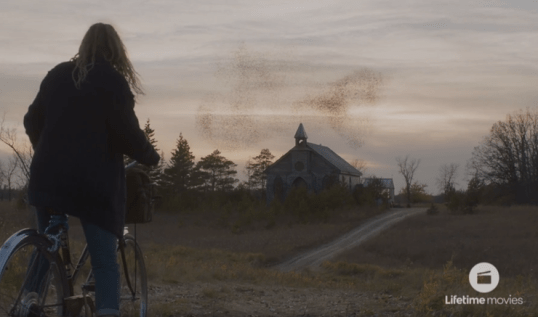
Anyway, in 1982, this family leaves Baltimore and moves into a new home — a former church that’s been turned into a house! There’s a cemetery out back. There are ruins nearby. There’s a ghostly apparition that appears occasionally. Heather, who doesn’t feel like she belongs in this reconstructed family, is soon spending all of her time talking to the apparition.
Meanwhile, Molly is having nightmares and she keeps seeing birds forming ominous shapes in the sky. (It’s kinda like in Take Shelter.) She also starts to hear noises in the dark and see ominous shadows in unlit rooms. Why doesn’t anyone ever turn on the lights?
What Worked?
It had its share of creepy moments. Molly’s dreams were always well-executed.
What Did Not Work?
This movie was so damn dark! I don’t mean thematically. I mean that it was often hard to see what was going on in the movie because it never seemed to occur to anyone to turn on a light! I get the point, of course. This was a horror movie and everyone’s scared of the dark. But, after a little while, the constant darkness went from being atmospheric to just being silly.
Maria Bello, a terrific actress, was pretty much wasted in a minor role.
I was going to complain about the film’s pacing but I think that has more to do with the fact that it premiered on Lifetime than anything else. It’s difficult to maintain suspense when you’re having to stop every few minutes for a commercial break.
And finally, the plot itself was overly complicated and not particularly easy to follow.
“Oh my God! Just like me!” Moments
I related to Molly in quite a few scenes. I was a rebellious 14 year-old too.
Here are 6 more reviews of 6 other films that I watched this year. Why six? Because Lisa doesn’t do odd numbers, that’s why.
The Big Game (dir by Jalmari Helander)
In The Big Game, Samuel L. Jackson plays the President of the United States and you would think that fact alone would make this film an instant classic. Unfortunately, this film never really takes advantage of the inherent coolness of Samuel L. Jackson playing the leader of the free world. When Air Force One is sabotaged and crashes in the wilderness of Finland, President Jackson has to rely on a young hunter (Onni Tommila) from a group of CIA agents disguised as terrorists. Tommila does a pretty good job and the scenery looks great but at no point does Samuel L. Jackson says, “Check out this executive action, motherfucker,” and that’s a huge missed opportunity. As for the rest of the film, it takes itself a bit too seriously and if you can’t figure out the big twist from the minute the movie starts, you obviously haven’t seen enough movies.
The Connection (dir by Cedric Jiminez)
Taking place over the 1970s, the French crime thriller tells the largely true story of the efforts of a French judge (played by Jean Dujardin) to take down a ruthless gangster (Gilles Lellouche) who is the head of one of the biggest drug cartels in the world. The Connection run for a bit too long but, ultimately, it’s a stylish thriller that does a very good job of creating a world where literally no one can be trusted. Dujardin, best known here in the States for his Oscar-winning role in The Artist, does a great job playing an honest man who is nearly driven to the point of insanity by the corruption all around him.
Graduation Day (dir by Chris Stokes)
Hey, it’s another found footage horror film! Bleh! Now, I should admit that this horror film — which is NOT a remake of that classic 1980s slasher — does have a fairly clever twist towards the end, that goes a long way towards explaining a lot of the inconsistencies that, up until that point, had pretty much dominated the film. But, even with that in mind and admitting that Unfriended and Devil’s Due worked wonders with the concept, it’s still hard to feel any enthusiasm about yet another found footage horror film.
McFarland USA (dir by Niki Caro)
McFarland USA is an extremely predictable but likable movie. Kevin Costner plays a former football coach who, while teaching at a mostly Latino high school, organizes a cross country team that goes on to win the state championship. It’s based on a true story and, at the end of the film, all of the real people appear alongside the actors who played them. There’s nothing about this film that will surprise you but it’s still fairly well-done. Even Kevin Costner, who usually gets on my last nerve, gives a good performance.
Taken 3 (dir by Olivier Megaton)
Bryan Mills (Liam Neeson) is back and he’s killing even more people! Fortunately, they’re all bad people but you really do have to wonder what type of dreams Bryan has whenever he goes to sleep. In Taken 3, Bryan’s wife (Famke Janssen) has been murdered and Bryan has been framed. He has to solve the case and kill the bad guys while staying one step ahead of the police (represented by a bored-looking Forest Whitaker). Neeson does all of his usual Taken stuff — the intense phone conversation, the steely glare, and all the rest — but at this point, it has literally been parodied to death. If you’re into watching Liam Neeson kill ugly people, Taken 3 will provide you with adequate entertainment but, for the most part, it’s but a shadow of the first Taken.
War Room (dir by Alex Kendrick)
I saw the War Room in Oklahoma. It was being shown as part of a double feature with The Martian, of all things! Anyway, this film is about an upper middle class family that hits rock bottom but they’re saved by the power of prayer! Lots and lots of prayer! Seriously, this film almost qualifies as “prayer porn.” Anyway, the film was badly acted, badly written, incredibly heavy-handed, and ran on way too long but, on the plus side, it did eventually end.
I have always hated those Truth.com commercials. Truth.com is an organization that claims to be dedicated to eradicating smoking. Their smug commercials are essentially the height of hipster douchebaggery, a bunch of self-consciously cool people wandering around and harassing random people about whether or not they smoke. And then, of course, there was the commercial where they all gathered outside a tobacco company and pretended to be dead. Of course, the truth about Truth.com is that they are essentially the same people who, in high school, would get offended whenever anyone wore a short skirt. I really can not stand people like that. (And don’t even get me started on those assholes who appear in the Above The Influence commercials.) Myself, I don’t smoke because I have asthma. But, seriously, whenever I see a Truth.com commercial, I’m tempted to run down to 711 and start.
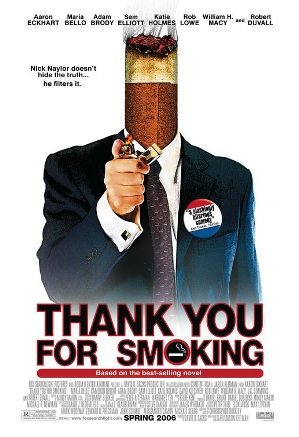
And so maybe that’s why I like the 2005 comedy Thank You For Smoking.
The hero of Thank You For Smoking is Nick Naylor (Aaron Eckhart), a lobbyist for the tobacco industry, who is first seen appearing on a talk show and winning over a hostile audience by announcing that the tobacco industry is going to be investing millions in researching way to keep young people from smoking and shaking the hand of a teenage honor student who is dying from lung cancer. Over the course of the film, Nick shows us how he does business, everything from defending tobacco companies on talk shows to convincing a former Marlboro Man-turned-cancer-patient to drop his law suit. When Nick isn’t working, he’s hanging out with his best friends (who are lobbyists for both the liquor and the gun industries), trying to bond with his son (Cameron Bright), or having sex with a reporter (Katie Holmes).
Now, in most movies, Nick Naylor would be the villain. However, in Thank You For Smoking, Nick becomes a hero by default, if just because everyone who disagrees with him is even worse than he is. Add to that, Nick has the benefit of being played by Aaron Eckhart while all of his opponents are played by balding actors with ugly beards.
Another reason that I liked Thank You For Smoking was because the main villain was a senator from Vermont and it’s about time somebody stood up to the tyranny of Vermont. Ortolan Finistirre (William H. Macy) has built a career out of campaigning against the tobacco industries and why shouldn’t he? Who, other than Nick Naylor, is willing to defend them? Finistirre’s latest plan is to change the law so that every pack of cigarettes has to be branded with a skull and crossbones warning.
When Nick and Finistirre finally face off, it’s a battle between those who believe in allowing people the freedom to make their own choices and those who hide their totalitarian impulse behind claims that they’re working for the greater good.
Thank You For Smoking was Jason Reitman’s first film. And while it may be a bit too episodic and it frequently struggles to maintain a consistent tone, it’s still a lot better than both Labor Day and Men, Women, & Children.
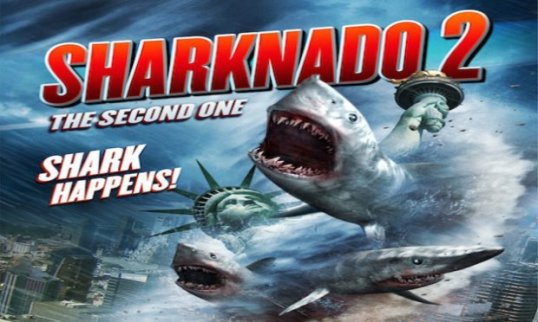
This is the time of year that the Shattered Lens usually takes one final look back at the best and worst of the previous year’s offerings in cinema, television, literature, and music! Last year, I kicked things off by taking a look at the best that the SyFy network had to offer.
Unfortunately, SyFy didn’t produce as many original films in 2014 as they did in 2013.
However, my beloved Lifetime network remained a consistent showcase for some of the best and worst melodrama that one could hope for.
With that in mind, here are my nominees for the best films and performances that were featured on either the SyFy or the Lifetime network last year! As always, winners are listed in bold.
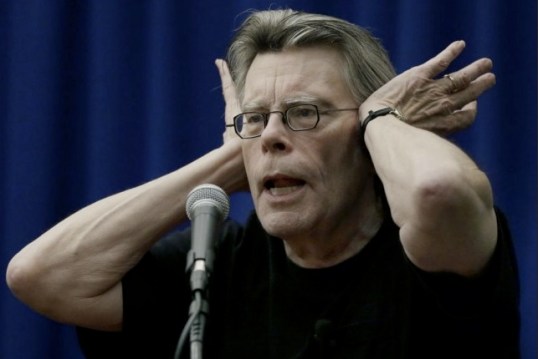
You have to be careful about admitting that you think Stephen King is overrated.
For a year and a half, I’ve been meaning to write a post entitled “10 Reasons Why Stephen King Sucks” but I haven’t. Some of that is because I don’t necessarily think that he does suck. I think he’s a good writer but I also think that he’s overrated and that his novel about the Kennedy assassination got so many details about Texas wrong that I don’t even know where to begin. (However, following the rules of clickbait, “sucks” works better than “overrated.”) Mostly, though, it’s just because Stephen King fans tend to be a bit cult-like. Criticizing King is like saying you don’t care about Beyonce’s marriage or admitting that you find President Obama to be a dull speaker or telling Vermont to go fuck itself or listing 10 Reasons Why You Hated Avatar. You shouldn’t do it unless you want to run the risk of dealing with a lot of angry and irrational true believers.
That said, it’s always a little bit safer to criticize the movies that have been made from Stephen King’s books and short stories. Even King’s most slavish followers will admit that Stephen King films tend to be uneven as far as quality is concerned. Stanley Kubrick’s The Shining is one of the best horror films of all time but it’s interesting to note that Stephen King himself rarely has a good word to say about Kubrick’s adaptation of his novel. For reasons that I’ve never quite understood, a lot of people love The Shawshank Redemption. Then there are the adaptations that nobody likes, like Bag of Bones and Dreamcatcher.
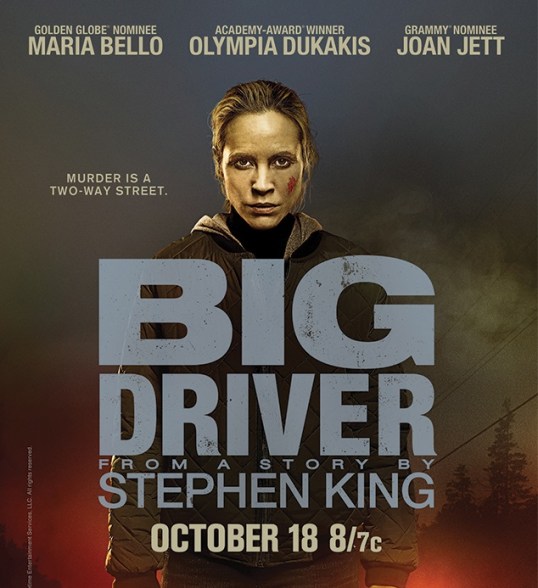
And then there’s Big Driver, an adaptation of a Stephen King novella that aired on Lifetime last night. For the past two months, Lifetime has been advertising this film with short but effective commercials that featured a bloodied Maria Bello running down a dark road while a gigantic truck ominously followed behind her. I saw the commercials and, seeing as how Maria Bello is a favorite actress of mine and how much I love Lifetime movies in general, I was excited to see Big Driver. Then, I saw another commercial in which Stephen King was quoted as saying, “This is the film that Stephen King fans have been waiting for,” and I have to admit that it left me a little bit less enthused because, quite frankly, I’ve always been under the impression that Stephen King will endorse anything as long as he gets paid and his ass gets kissed. (Someday, we’ll have to do a survey to discover just how many crappy books come with a Stephen King pull quote on the cover describing the book’s author as being “the future of horror!”) And I have to admit that I resented the fact that Lifetime seemed to be assuming that I would ever allow Stephen King to tell me what was good and what was bad. I can decide that for myself without having someone else tell me what I’ve been “waiting for.”
(I have issues with authority. Can you tell?)
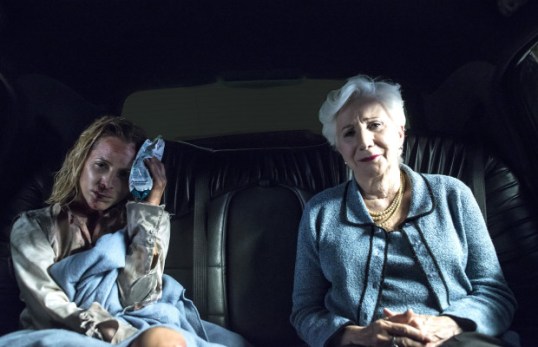
Big Driver, incidentally, is Stephen King’s take onI Spit On Your Grave. Mystery writer Tess Thorne (Maria Bello) is raped and left for dead by a serial killer who is known as Big Driver (Will Harris). Feeling that the police would simply say that she was “asking for it”, Tess does not report the attack but instead uses the same techniques that she writes about in her books to track down both Big Driver and his mother (Ann Dowd) and sets out to get both revenge for herself and justice for all of Big Driver’s other victims. (Those detective techniques, by the way, largely seem to consist of knowing how to use Google.) Along the way, Tess hallucinates conversations with both her car’s GPS and with one of the fictional detectives from her books (played by Olympia Dukakis).
When I watched Big Driver last night, I actually had to stop watching after an hour. The film was just too intense and disturbing for me to handle in one sitting. The scene where Tess was raped was too painful to watch and Maria Bello’s performance was so raw and real that I had to change the channel. It wasn’t the film’s fault. It’s just that I wasn’t in the right emotional state to watch the movie. It was a lot more intense than anything that I would have ever expected to see on Lifetime. (Lifetime, after all, is the television equivalent of comfort food.) So, I stopped watching after an hour and I turned over to SyFy so I could watch a much more light-hearted horror film, Finders Keepers. Fortunately, I had the DVR recording Big Driver and I finished watching the film early this morning.
What I discovered, when I watched the rest of the film, is that Big Driver is a frustratingly uneven film. The first half is difficult to watch and that’s the way it should have been. But, as I watched the rest of the film, I found myself growing annoyed with Tess’s imaginary friends. The talking GPS and the spectral presence of the fictional detective all served to make Tess look less like a woman demanding justice and more like the proverbial unstable person who shouldn’t have been messed with. One reason why the original I Spit On Your Grave has recently been reevaluated by several feminist film critics is because the victim in that film is never portrayed as being crazy or unbalanced. Her actions are purely the result of what has been done to her and, as such, that film is ultimately far more empowering than most critics will ever be willing to admit. By calling into question Tess’s grip on reality, Big Driver fails to empower and, if a film like this isn’t going to be empowering, than what is the point?
Big Driver is, however, redeemed by Maria Bello’s fierce performance as Tess. Maria Bello is one of my favorite actresses. When you see that a character is played by Maria Bello, you know that character is not going to put up with any bullshit and she’s not going to be afraid to kick someone’s ass if she has to. Even when the film’s script lets the character down, Maria Bello keeps Tess strong. It’s a great and, I would say, even an important performance.
As for Big Driver‘s place in the pantheon of Stephen King film adaptations, it’s about in the middle. It’s neither as good or as bad as it could have been but it is undeniably effective.



 Through the Shattered Lens