Film Review: Short Cuts (dir by Robert Altman)


Opening with a swarm of helicopters spaying for medflies and ending with an earthquake, 1993’s Short Cuts is a film about life in Los Angeles.

An ensemble piece, it follows several different characters as they go through their own personal dramas.  Some of them are married and some of them are destined to be forever single but they’re all living in varying states of desperation.  Occasionally, the actions of one character will effect the actions of another character in a different story but, for the most part, Short Cuts is a portrait of people who are connected only by the fact that they all live in the same city.  There are 22 principal characters in Short Cuts and each one thinks that they are the star of the story.

Jerry Kaiser (Chris Penn) cleans the pools of rich people while, at home, his wife, Lois (Jennifer Jason Leigh), takes care of their baby and works as a phone sex operator.  Jerry’s best friend is a makeup artist named Bill (Robert Downey, Jr.) who enjoys making his wife, Honey (Lili Taylor), looks like a corpse so that he can take her picture.  One of her photographs is seen by a fisherman (Buck Henry) who has already discovered one actual corpse that weekend.  He and his buddies, Vern (Huey Lewis) and Stuart (Fred Ward), discovered a dead girl floating in a river and didn’t report it until after they were finished fishing.  (The sight of Vern unknowingly pissing on the dead body is one of the strongest in director Robert Altman’s filmography.)

Stuart’s wife, Claire (Anne Archer), is haunted by Stuart’s delay in reporting the dead body.  A chance meeting Dr. Ralph Wyman (Matthew Modine) and his wife, artist Marian (Julianne Moore), leads to an awkward dinner between the two couples.  Claire works as a professional clown and Ralph ends up wearing her clown makeup while his marriage falls apart.

Earlier, Claire was stopped and hit on by a smarmy policeman named Gene Shepard (Tim Robbins), who just happens to be married to Marian’s sister, Sherri (Madeleine Stowe).  Gene is already having an affair with Betty Weathers (Frances McDormand), the wife of a helicopter pilot named Stormy (Peter Gallagher).  When Stormy discovers that Betty has been cheating, he takes a creative revenge on her house.

Doreen Pigott (Lily Tomlin) lives in a trailer park with her alcoholic husband, Earl (Tom Waits).  Driving home from her waitressing job, Doreen hits a young boy.  The boy says he’s okay but when he gets home, he passes out.  His parents, news anchorman Howard Finnegan (Bruce Davison) and his wife, Anne (Andie MacDowell), rush him to the hospital, where his doctor is Ralph Wyman.  As Howard waits for his son to wake up, he has a revealing conversation with his long-estranged father (Jack Lemmon, showing up for one scene and delivering an amazing monologue).  Meanwhile, a baker named Andy (Lyle Lovett) repeatedly calls the Finnegan household, wanting to know when they’re going to pick up their son’s birthday cake.

Based on the short stories of Raymond Carver and directed by Robert Altman, Short Cuts can sometimes feel like a spiritual descendent of Altman’s Nashville.  The difference between this film and Nashville is that Short Cuts doesn’t have the previous film’s satiric bite.  As good as Nashville is, it’s a film that can be rather snarky towards it character and the town in which it is set.  Nashville is used as a metaphor for America coming apart at the seams.  Short Cuts, on the other hand, is a far more humanistic film, featuring characters who are flawed but, with a few very notable exceptions, well-intentioned.  If Nashville seem to be a portrait of a society on the verge of collapse, Short Cuts is a film about how that society ended up surviving.

It’s not a perfect film.  There’s an entire storyline featuring Annie Ross and Lori Singer that I didn’t talk about because I just found it to be annoying to waste much time with.  (The Ross/Singer storyline was the only one not to be based on a Carver short story.)  The conclusion of Chris Penn’s storyline wasn’t quite as shocking as it was obviously meant to be.  But, flaws and all, Altman and Carver’s portrait of humanity does hold our attention and it leaves us thinking about connections made and sometimes lost.  Seen today, Short Cuts is a portrait of life before social media and iPhones and before humanity started living online.  It’s a time capsule of a world that once was.
Film Review: Public Enemies (dir by Michael Mann)


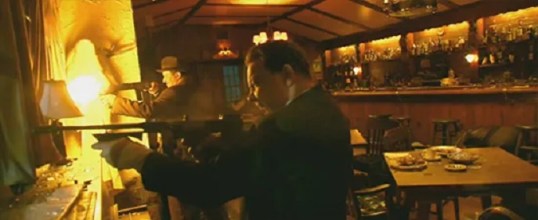
2009’s Public Enemies is a portrait of the battle for the soul and imagination of America.

The films take place during the Great Depression.  With Americans struggling to pay their bills and many citizens out-of-work and feeling desperate, a new breed of folk hero has emerged.  Men like my distant relative Pretty Boy Floyd (Channing Tatum) and Alvin Karpis (Giovanni Ribisi) may be criminals who make their living by robbing banks but, to a nation of angry people who feel like they’ve been forgotten by the government and betrayed by the wealthy, they’re rebels who are challenging the system.  They are viewed as being modern-day Robin Hoods, even though very few of them actually bother to give the money that they steal back to the poor.

John Dillinger (Johnny Depp) is perhaps the most famous of the criminals who have been declared a “public enemy” by the FBI.  The handsome and charismatic Dillinger becomes almost a living legend, the man who cannot be captured by law enforcement.  He becomes a folk hero but with the twist that his own death seems inevitable.  Dillinger lives by his own set of rules and the press loves him even as they hungrily anticipate his violent end.

Pursuing Dillinger and the other so-called public enemies is a young FBI agent named Melvin Purvis (Christian Bale).  Purvis’s job is not only to capture or eliminate men like Dillinger.  It’s also to somehow figure out a way to replace them in the public’s imagination.  Through the use of what was then-considered to be revolutionary techniques (like fingerprinting and phone taps), Purvis tracks down one public enemy after another and soon, he’s becoming as much of a folk hero as the people that he’s pursuing.  If Dillinger and his cohorts represent the ultimate rebellion against an ineffectual system, Purvis and his success suggest that maybe the system actually can get something accomplished.  Unfortunately, for Purvis, he not only has to deal with the challenge of capturing Dillinger but also with the growing jealousy of his publicity-hungry boss, J. Edgar Hoover (Billy Crudup).  As is typical of the heroes of Michael Mann’s film, Dillinger and Purvis may be on different sides of the law but they have more in common than they realize.  Neither one can trust the people that they’re working with.

I remember that I was really excited about Public Enemies when it was first released in 2009.  I’m fascinated by the Depression-era outlaws and Dillinger’s story is certainly an interesting one.  (I’ve always enjoyed the theory that Dillinger faked his death, even though I don’t believe it for a second.)  Michael Mann seemed like the perfect director for the material and Johnny Depp seemed like ideal casting.  I have to admit that I was a little bit disappointed in the film itself, which was poorly paced and stuck so closely to the facts of the case that it led me to realize that Dillinger will always be more interesting as a legend than an actual person.  (I’ll concede that was probably the film’s point.)  There were moments of brilliance in the film.  The scene where Dillinger escaped from custody was wonderfully done.  Stephen Graham’s unhinged performance as Baby Face Nelson was excellent.  Johnny Depp had the right look for Dillinger but I have to admit that I found myself a little bit bored with Christian Bale’s Melvin Purvis.

Looking back today, though, the film feels almost prophetic.  That may seem like an odd thing to say about a film set in the past but Public Enemies portrait of an America caught between celebrating the rule of law and the excitement of rebellion feels very relevant to what’s happening today.  In retrospect, Public Enemies is a portrait of the contradiction at the heart of America, a country with a culture of both rebellion and loyal patriotism.  Public Enemies portrays a battle the continues to this day.

Public Enemies (2009, dir by Michael Mann, DP: Dante Spinotti)

Lisa Marie Reviews An Oscar Nominee: Born On The Fourth of July (dir by Oliver Stone)


In 1989, having already won an Oscar for recreating his Vietnam experiences in Platoon, director Oliver Stone returned to the war with Born On The Fourth Of July.

Based on the memoir of anti-war activist Ron Kovic, Born on the Fourth of July stars Tom Cruise as Kovic.  When we first meet Kovic, he’s growing up on Long Island in the 50s and 60s.  He’s a clean-cut kid from a nice family.  He’s on the school wrestling team and he’s got a lot of friends.  When he was just 15, he heard John F. Kennedy telling people to ask what they can do for their country and he was inspired.  He decided he wanted to join the Marines, despite the fact that his father (Raymond J. Barry) was still haunted by the combat that he saw in World War II.  (In one of the film’s better scenes, a young Kovic notices that the elderly veterans marching in the Independence Day parade still flinch whenever they hear a firecracker.)  He enlists in the Marines after listening to a patriotic speech from a recruiter (played by Tom Berenger).  Ron runs through the rain to attend his prom and has one dance with Donna (Kyra Sedgwick), on whom he’s always had a crush.  There’s nothing subtle about the way that Stone portrays Kovic’s childhood.  In fact, one might argue that it’s a bit too idealized.  But Stone knows what he’s doing.  The wholesomenss of Kovic’s childhood leaves neither him nor the viewer prepared for what’s going to happen in Vietnam.

Vietnam turns out not to be the grand and patriotic adventure that Kovic thought it would be.  After Sgt. Kovic accidentally shoots one of his own men in a firefight, he is ordered to keep quiet about the incident.  After he is wounded and paralyzed in another firefight, Kovic ends up in a Hellish VA hospital, surrounded by men who will never fully recover from their mental and physical wounds.  Kovic is eventually returns home in wheelchair.  The film then follows Kovic as he goes from defending the war in Vietnam to eventually turning against both the war and the government.  At one point, he ends up with a group of disabled vets in Mexico and there’s a memorable scene where he and another paraplegic (Willem Dafoe) attempt to fight despite having fallen out of their chairs.  Eventually, Kovic returns to America and turns his anger into activism.

There’s nothing subtle about Born On The Fourth Of July.  It’s a loud and angry film and Oliver Stone directs with a heavy-hand.  Like a lot of Stone’s films, it overwhelms the viewer on a first viewing and it’s only during subsequent viewings that one becomes aware of just how manipulative the film is.  Tom Cruise gives a good performance as Ron Kovic but his transformation into a long-haired, profane drunk still feels as if it happens a bit too abruptly.  A good deal of the film centers on Kovic’s guilt about accidentally killing one of his men but the scene where he goes to the soldier’s family and asks them for forgiveness didn’t quite work for me.  If anything, Kovic came across as being rather self-centered as he robs the man’s mother and father of the belief that their son had at least died heroically in combat as opposed to having been shot by his own sergeant.  Did Kovic’s need to absolve himself really give him the right to cause this family more pain?  Born on the Fourth Of July is an effective work of agitprop.  On the first viewing, you’ll want to join Kovic in denouncing the military and demanding peace.  On the second viewing, you’ll still sympathize with Kovic while also realizing that he really owes both his mother and father an apology for taking out his anger on them.  By the third viewing, you’ll be kind of like, “Wow, I feel bad for this guy but he’s still kind of a jerk.”  That said, when it comes to making an effective political film, Adam McKay could definitely take some lessons from Oliver Stone.  Born On The Fourth of July is at its best when it simply captures the feeling of living in turmoil and discovering that the world is not as simple a place as you once believed.  As idealized as the film’s presentation of Kovic’s childhood may be, anyone who has ever felt nostalgia for an earlier and simpler world will be able to relate.

Oliver Stone won his second Best Director Oscar for Born On The Fourth Of July.  The film itself lost Best Picture to far more genteel version of the past, Driving Miss Daisy.


Late Night Retro Television Review: Monsters 2.13 “Habitat”


Welcome to Late Night Retro Television Reviews, a feature where we review some of our favorite and least favorite shows of the past! On Wednesdays, I will be reviewing Monsters, which aired in syndication from 1988 to 1991. The entire series is streaming on YouTube.

This week’s episode is an experiment that doesn’t quite work.

Episode 2.13 “Habitat”

(Dir by Bette Gordon, originally aired on January 14th, 1990)

Jamie Neal (a young Lili Taylor) is 23 years-old and newly single.  She’s been offered an opportunity that could earn her enough money that she will never have to work another day in her life.  She has to spend 9 months in an enclosed space.  She’ll be given food to eat.  She requested to be given a guitar to play.  All she has to do is spend nine months in the room and react every time that she hears an annoying buzzing sound.  Of course, she can’t go outside or have any contact with anyone else.  The entire time, someone will be watching her.

Jamie starts the experiment feeling confident and almost cocky.  She carefully reads over the contract, commenting on how easy it will be to handle all of the requirements, before signing it.  Jamie brags that her ex-boyfriend was an attorney (though he preferred to be called a “litigator,” — hey, I know the type, Jamie!) and she knows exactly how to read a contract as a result.

The story jumps forward a few weeks.  Jamie is in isolation, still reacting to every buzz and eating the pizza that’s randomly sent down to her.  However, she is no longer cocky and confident.  She’s grown tired of being trapped in one room and not even her guitar brings her joy anymore.  She wanders around the room, demanding to be set free.

There’s a twist to this episode and I bet you already guessed it.  That twist is that Jamie is a part of an experiment that is being conducted by a bunch of aliens.  As they watch Jamie lose her mind and eventually her life in the small room, the aliens dispassionately discuss how strange humans are.  They hate to be confined and yet they have no problem confining the animals that live with them.  Jamie may have viewed herself as being a prisoner with no freedom but the aliens viewed her as being a pet.  One alien (and I should note that the rubber alien costumes are absolutely ludicrous) says that he thinks he might be feeling an emotion that humans call “grief.”  Someone was obviously hoping to play a half human/half whatever science offer on a Star Trek spin-off.

(“What is this thing you humans call joy?”  Bleh.)

This episode was pretty dull.  Obviously, Lili Taylor is a talented actress but in this one, she gets stuck with some really less-than-impressive dialogue.  Not even the scenes where she’s losing her mind are particularly interesting.  There’s nothing shocking about discovering that she’s had a breakdown.  One can see that it’s going to happen from the minute that she steps into the chamber.  By that same token, there’s nothing at all surprising about the big twist.  Even though who haven’t read Slaughterhouse-Five will easily guess that Jamie is being put on display.

This was a rather forgettable experiment.

I Watched The Promotion (2008, dir. by Steven Conrad)


Yesterday, after I got home from voting in my town’s city council elections, I wanted to unwind with a tennis movie.  When I did a search for “tennis,” Tubi recommended that I watch The Promotion.

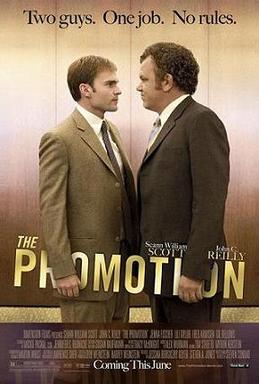
I don’t know why because there is no tennis in The Promotion.  No one plays a game or even talks about tennis in The Promotion.  Instead, the movie is about two men who work for a grocery store and who are both hoping to get promoted.  The narrator is Doug (Seann William Scott), who is married to Jen (Jenna Fischer), a nurse.  Doug wants to get promoted so that he and Jen can move into a new house and so that he can be the sole breadwinner.  Doug also has to get the promotion because he has already lied to Jen and told her that he got it.  Doug was feeling insecure because Jen’s boss, Dr. Timm (Bobby Cannavale) saves lives for a living while Doug just spends all day dealing with angry customers and the gang members who hang out in the store’s parking lot.  Doug’s rival for the promotion is Richard (John C. Reilly), a recovering drug addict who listens to self-help tapes.  Each of them tries to sabotage the other.  Doug tries to make Richard look stupid at a company retreat and Richard files a false injury report after Doug hits him with a bag of frozen tater tots.

I think the movie was trying to make a point about how desperate people are for status and money that they’ll do anything to get it but I didn’t care because I didn’t find Doug or Richard to be in any way likable and I didn’t want either one of them to get the promotion.  I would not shop at any store where they worked because grocery shopping is bad enough without having to deal with all of that extra drama.  Both Richard and Doug were terrible as assistant managers so as far I was concerned, neither one of them deserved to be promoted.  Jen should have left Doug for Dr. Timm.

Plus, there wasn’t any tennis.

Here Are The Gotham Winners!


The Gotham Awards were held last night and the big winners were CODA and Maggie Gyllenhaal’s The Lost Daughter.  The Gothams aren’t exactly the biggest or most influential of the Oscar precursors but they were are one of the first so a victory can only help!

The winners are listed in bold:

Best Feature
“The Green Knight”
“The Lost Daughter”
“Passing”
“Pig”
“Test Pattern”

Best Documentary Feature
“Ascension”
“Faya Dayi”
Flee”
“President”
“Summer Of Soul (…Or, When The Revolution Could Not Be Televised)”

Best International Feature
“Azor”
“Drive My Car”
“The Souvenir Part II”
Titane
“What Do We See When We Look at the Sky?”
“The Worst Person In The World”

Bingham Ray Breakthrough Director Award
Maggie Gyllenhaal for “The Lost Daughter”
Edson Oda for “Nine Days”
Rebecca Hall for “Passing”
Emma Seligman for “Shiva Baby”
Shatara Michelle Ford for “Test Pattern”

Best Screenplay
“The Card Counter,” Paul Schrader
“El Planeta,” Amalia Ulman
“The Green Knight,” David Lowery
“The Lost Daughter,” Maggie Gyllenhaal
“Passing,” Rebecca Hall
“Red Rocket,” Sean Baker & Chris Bergoch

Outstanding Lead Performance
Olivia Colman in “The Lost Daughter”
Frankie Faison in “The Killing of Kenneth Chamberlain”
Michael Greyeyes in “Wild Indian”
Brittany S. Hall in “Test Pattern”
Oscar Isaac in “The Card Counter”
Taylour Paige in “Zola”
Joaquin Phoenix in “C’mon C’mon”
Simon Rex in “Red Rocket”
Lili Taylor in “Paper Spiders”
Tessa Thompson in “Passing”

Outstanding Supporting Performance
Reed Birney in “Mass”
Jessie Buckley in “The Lost Daughter”
Colman Domingo in “Zola”
Gaby Hoffmann in “C’mon C’mon”
Troy Kotsur in “CODA”
Marlee Matlin in “CODA”
Ruth Negga in “Passing”

Breakthrough Performer
Emilia Jones in “CODA”
Natalie Morales in “Language Lessons”
Rachel Sennott in Shiva Baby”
Suzanna Son in “Red Rocket”
Amalia Ulman in “El Planeta”

Breakthrough Series – Long Format (over 40 minutes)
“The Good Lord Bird”
“It’s A Sin”
“Small Axe”
“Squid Game”
“The Underground Railroad”
“The White Lotus”

Breakthrough Series – Short Format (under 40 minutes)
“Blindspotting”
“Hacks”
“Reservation Dogs”
“Run the World”
“We Are Lady Parts”

Breakthrough Nonfiction Series
“City So Real”
“Exterminate All the Brutes”
“How To with John Wilson”
“Philly D.A.”
“Pride”

Outstanding Performance in a New Series
Jennifer Coolidge in “The White Lotus”
Michael Greyeyes in “Rutherford Falls”
Ethan Hawke in “The Good Lord Bird”
Devery Jacobs in “Reservation Dogs”
Lee Jung-jae in “Squid Game”
Thuso Mbedu in “The Underground Railroad”
Jean Smart in “Hacks”
Omar Sy in “Lupin”
Anya Taylor-Joy in “The Queen’s Gambit”
Anjana Vasan in “We Are Lady Parts”

(Incidentally, I’m probably the only person not involved with the show to have noticed the victory for Philly D.A.  I’m just going to be honest and say that is one of my least favorite results ever.  Philly D.A. was a pure propaganda, nothing more.)

What If Oscar Season Started And No One Noticed, Part 2: Here Are The Gotham Award Nominations


As a sign of how wrapped up I am in this year’s Horrorthon, consider this: the 2021 Gotham Nominations — the first precursor of Awards Season! — were announced on Thursday and I totally missed them!  This is actually not the first year that this has happened.  October is a busy month for me and sometimes, the Gotham noms get missed.

The Gothams, of course, only honor independent films and they have pretty strict rules as far as what they consider to be independent.  The budget has to come in at a certain relatively low amount, for one thing.  So, as a result, a lot of Oscar nominees are not Gotham eligible.  But, at the same time, those Gotham rules also allow some films that otherwise might get overlooked a chance to get some precursor love.  Being nominated for a Gotham is hardly a guarantee that the Academy will remember you.  But it certainly doesn’t hurt.

Better late than never, here are the 2021 Gotham Nominations!  As you’ll notice, the Gotham’s performance awards are gender neutral.  This is the first year that the Gothams have done this.  They also added categories for supporting performances and best performance in a series.

Anyway, here are the nominees:

Best Feature
“The Green Knight”
“The Lost Daughter”
“Passing”
“Pig”
“Test Pattern”

Best Documentary Feature
“Ascension”
“Faya Dayi”
“Flee”
“President”
“Summer Of Soul (…Or, When The Revolution Could Not Be Televised)”

Best International Feature
“Azor”
“Drive My Car”
“The Souvenir Part II”
Titane
“What Do We See When We Look at the Sky?”
“The Worst Person In The World”

Bingham Ray Breakthrough Director Award
Maggie Gyllenhaal for “The Lost Daughter”
Edson Oda for “Nine Days”
Rebecca Hall for “Passing”
Emma Seligman for “Shiva Baby”
Shatara Michelle Ford for “Test Pattern”

Best Screenplay
“The Card Counter,” Paul Schrader
“El Planeta,” Amalia Ulman
“The Green Knight,” David Lowery
“The Lost Daughter,” Maggie Gyllenhaal
“Passing,” Rebecca Hall
“Red Rocket,” Sean Baker & Chris Bergoch

Outstanding Lead Performance
Olivia Colman in “The Lost Daughter”
Frankie Faison in “The Killing of Kenneth Chamberlain”
Michael Greyeyes in “Wild Indian”
Brittany S. Hall in “Test Pattern”
Oscar Isaac in “The Card Counter”
Taylour Paige in “Zola”
Joaquin Phoenix in “C’mon C’mon”
Simon Rex in “Red Rocket”
Lili Taylor in “Paper Spiders”
Tessa Thompson in “Passing”

Outstanding Supporting Performance
Reed Birney in “Mass”
Jessie Buckley in “The Lost Daughter”
Colman Domingo in “Zola”
Gaby Hoffmann in “C’mon C’mon”
Troy Kotsur in “CODA”
Marlee Matlin in “CODA”
Ruth Negga in “Passing”

Breakthrough Performer
Emilia Jones in “CODA”
Natalie Morales in “Language Lessons”
Rachel Sennott in Shiva Baby”
Suzanna Son in “Red Rocket”
Amalia Ulman in “El Planeta”

Breakthrough Series – Long Format (over 40 minutes)
“The Good Lord Bird”
“It’s A Sin”
“Small Axe”
“Squid Game”
“The Underground Railroad”
“The White Lotus”

Breakthrough Series – Short Format (under 40 minutes)
“Blindspotting”
“Hacks”
“Reservation Dogs”
“Run the World”
“We Are Lady Parts”

Breakthrough Nonfiction Series
“City So Real”
“Exterminate All the Brutes”
“How To with John Wilson”
“Philly D.A.”
“Pride”

Outstanding Performance in a New Series
Jennifer Coolidge in “The White Lotus”
Michael Greyeyes in “Rutherford Falls”
Ethan Hawke in “The Good Lord Bird”
Devery Jacobs in “Reservation Dogs”
Lee Jung-jae in “Squid Game”
Thuso Mbedu in “The Underground Railroad”
Jean Smart in “Hacks”
Omar Sy in “Lupin”
Anya Taylor-Joy in “The Queen’s Gambit”
Anjana Vasan in “We Are Lady Parts”

The Things You Find On Netflix: Eli (dir by Ciaran Foy)


Eli (Charlie Shotwell) is a young boy who is allergic to everything outside.  As a result, he can’t venture out of the house unless he’s covered, head-to-toe, in protective gear.  Eli wasn’t always allergic, of course.  It’s just something that suddenly started.  Eli’s mother, Rose (Kelly Reilly) and her husband, Paul (Max Martini), are taking him to a special clinic run by Dr. Isabella Horn (Lili Taylor).  Because the clinic is sealed off from the outside, Eli can leave his plastic bubble.  Because the clinic is in a dark old building, we know that it’s either going to be haunted or run by some sort of cult.  In fact, it doesn’t take long before Eli is doubting not only Dr. Horn but his parents as well!  He keeps hearing voices that hiss, “Lie.”  And the only other patient at the clinic, a young girl named Haley (Sadie Sink), repeatedly tells him to be careful….

Eli is 98 minutes long and I lost interest after the first ten.  Basically, I was willing to give the film a chance but then a bunch of rednecks started to taunt Eli while he was walking around outside in his protective gear and I was like, “Yeah, okay.” Then they started throwing stuff at him and I was like, “Getting a little bit heavy-handed now.”  Then the suit got torn and Eli started screaming like he was about to die and the rednecks just stood there laughing and that’s when I said, “Okay, this is going to suck.”  There’s heavy-handed and then there’s just attacking your audience with a sledgehammer.  Sledgehammers give you a migraine.

Once Eli reaches the clinic, the film slows down to a glacial pace.  In theory, the slow pace should have helped to maintain an ominous atmosphere but …. eh.  To be honest, I’ve seen a lot of creepy clinics in a lot of creepy movies and there was nothing that special about this one.  It all leads to a big twist but, again, it wasn’t a particularly original twist and even the film’s attempt to blow my mind with a subversive ending just left me shrugging.  “Really?” I thought, “That’s what’s going to happen, huh?  Well, what can you do?”

Like a lot of bad movies, the script for Eli was included on the infamous Hollywood Black List.  The Black List is an annual list of the “best” unproduced screenplays in Hollywood.  A few good films have been made out of scripts on the Black List but, for whatever, the majority of Black List films always seem to turn out to be somewhat disappointing.  Broken City, for instance, was a Black List film.  So was The Beaver.  You can add Eli to the pile of mediocre Black List films.

The Things You Find On Netflix: To The Bone (dir by Marti Noxon)


Way back in January, when I first heard about To The Bone, I had high hopes for it.

After all, To The Bone was the directorial debut of Marti Noxon, who is well-known both for her work on Buffy the Vampire Slayer and for co-creating Unreal.  To The Bone was reportedly based on Noxon’s own struggle with an eating disorder and it was said to feature an outstanding lead performance from Lily Collins as an artist struggling with anorexia.  Even the casting of Keanu Reeves as a doctor sounded intriguing.

And, to me, it didn’t matter that To The Bone got mixed reviews at Sundance.  Who would seriously expect critics, especially male critics, to understand a movie about body issues and eating disorders?  When I heard that To The Bone had been purchased by Netflix, I did sigh a little.  Far too often, Netflix is where good films end up getting lost in a sea of mediocre offering.  But then again, perhaps To The Bone was exactly the type of intimate character study that would actually benefit from being viewed on a small screen.  After all, it’s not a film about a bunch of space lizard attacking the great wall of China.  It’s a film about a young woman struggling with an eating disorder.

When Netflix finally released To The Bone back in July, I was excited.

Then I actually watched the movie.

To The Bone actually gets off to a pretty good start.  The first 20 minutes or so are dedicated to establishing who Ellie (Lily Collins) is.  She’s 20 years old.  She’s smart.  She’s sarcastic.  She’s an artist.  She’s a college dropout who apparently used to have a very popular tumblr that dealt with being thin.  She’s also anorexic and, from the first minute that we see her, Ellie looks like she’s on the verge of death.  (To the film’s credit, it makes clear that there is a huge difference between being naturally thin and being anorexic.  That’s a distinction that is far too often overlooked.)  We meet Ellie’s dysfunctional family: her frustrated stepmother (Carrie Preston), the father who often can’t be bothered, and the half-sister (Liana Liberato) who both loves and resents her.  The relationship between the two sisters is especially well-handled.  Even if it takes a while to get used to Keanu Reeves playing a compassionate but tough-talking doctor, the film still works during his first few scenes.

Then, Ellie joins Reeves’s inpatient program and moved into a house with six other patients and this is where the film started to annoy me.  Ellie is such a well-drawn and well-acted character that it makes it all the more obvious that the rest of the patients are not.  Instead, the rest of the patients are all easily identifiable types.  As soon as they show up on screen, you know everything about them and you know exactly what is going to happen to each and every one of them.  From the minute that Ellie reluctantly steps into that house, To The Bone starts to feel less like an honest look at anorexia and more like a well-meaning and predictable PSA.  One of the patients is pregnant and always talk about how worried she is that her eating disorder is going to lead to her losing the baby.  Can you guess what happens?

And then there’s Luke (Alex Sharp).  Luke is the ballet dancer who is recovering from a knee injury.  As soon as I saw that Luke was the only male in the house, I knew that he was destined to eventually declare his love for Ellie.  But my problem with Luke has less to do with his predictable character arc and more to do with just how annoying a character he is.  Luke is relentlessly upbeat.  Luke constantly tells corny jokes.  Luke just will not stop talking!  When Luke leaves a room, he starts singing a song called Sugar Blues.  When Luke reenters a room, he is still singing Sugar Blues.  SHUT UP, LUKE!

(Whenever Ellie would visit Luke in his room, I would find myself distracted by the posters on his wall.  The majority of them said “Jazz Festival” and featured some saxophone clipart.  As strange as it may sound, it really started to annoy me that there was no date or location listed.  Why would you go through all the trouble of making — or buying, for that matter — a poster for a jazz festival and then not bother to include a date or a location?  That may sound like a minor thing but, as I watched the film, that inauthentic poster came to represent everything that felt inauthentic about Luke as a character.)

I guess the main problem with To The Bone is that it never succeeds in convincing us that the inpatient program is actually going to do any good for Ellie.  It’s not for lack of trying.  However, the scenes in the house are too overwrought and predictably scripted.  There’s a scene where Reeves takes the patients on a field trip and it’s supposed to be inspiring but it doesn’t work because, as a first-time director, Noxon doesn’t trust her material enough to allow us to draw our own conclusions.  Instead, she beats us over the head with her message.  For To The Bone to work, it needed a director like Andrea Arnold, someone who specializes in a naturalistic performances and who is willing to embrace ambiguity and take the time to let a scene play out.  Noxon makes the mistake of not trusting her audience to draw the right conclusion and, as a result, To The Bone goes from being an intriguing character study to being the cinematic equivalent of the last 15 minutes of an episode of Intervention.

Though it all, Lily Collins continues to give a good performance.  Even when she’s forced to deliver some unfortunate dialogue, she’s the best thing about To The Bone.  Unfortunately, the rest of this movie just collapses around her.

Jazz Festival


Film Review: I Shot Andy Warhol (dir by Mary Harron)


When did Andy Warhol die?

The official date of death is February 22nd, 1987.  The 58 year-old artist died in his sleep of a cardiac arrhythmia.  He was at Manhattan’s New York Hospital, recovering from gallbladder surgery.  The surgery itself had been a minor procedure and, in the days before his death, Warhol was reported to be making a good recovery.  Warhol himself was scared of doctors and had continually put off having the procedure done.

Others, however, argue that Warhol might as well have died on June 3rd, 1968.  That was the day that the world-famous pop artist was shot, at point blank range, by a woman named Valerie Solanas.  Warhol barely survived the attack, spending five hours in surgery and carrying both the mental and physical scars with him for the rest of his life.  It’s debatable whether Warhol ever physically recovered from being shot.  It’s been theorized that the reoccurring gallbladder problems that led to Warhol entering the hospital were directly the result of being shot.  If that’s the case, then Solanas murdered Andy Warhol.

But even beyond the lingering physical injuries, the shooting left Warhol mentally shaken.  The artist who, in the 60s, was famous for hosting a never-ending party at The Factory became far more reclusive and paranoid.  No longer could anyone from anywhere show up in New York and, if they were interesting enough, become a member of Warhol’s entourage.   No longer would Warhol direct films that challenged the assumption of what film had to be.  Warhol spent most of the 70s doing portrait commissions and finding new ways to make money.  (As he wrote in 1975, “Making money is art, and working is art and good business is the best art.”)

It can be argued that, with the pull of a trigger, Valerie Solanas changed the course of history and yet, she has always remained an obscure figure.  (Many would argue that she deserves to remain an obscure figure.)  After the shooting, when Solanas turned herself in, she said that she had no choice but to shoot Andy because “he had too much control over my life.”  Others theorize that Solanas was upset because Andy hadn’t helped her get her book, The SCUM Manifesto, published.  Solanas was diagnosed with paranoid schizophrenia and, for nearly a killing an artist, she spent three years in prison.  While she was in prison, The SCUM Manifesto was finally published.  Ironically, she died in poverty and obscurity, just a few months after Warhol, as forgotten as Andy as was celebrated.

So, who was Valerie Solanas?  That’s the question that 1996’s I Shot Andy Warhol attempts to answer.  Lili Taylor portrays Valerie, giving a performance that is both frightening in its intensity and empathetic in its portrayal of Valerie’s desperation to be heard as a human being and respected as an artist.  Wherever Valerie goes, she’s an outsider.  As a lesbian, she’s been rejected by conventional society.  When she appears on a local talk show, the audience boos her and the host has her thrown off the set.  As a writer, she is rejected by publishers and readers who view her work as being, as one person puts it, “too sick even for us.”  When, like many aspiring artists and lost souls, she arrives at the Factory, the members of Warhol’s entourage reject her because she’s neither beautiful nor glamorous.  Valerie is stuck in a winless situation.  It’s her intensity that makes her a memorable writer but it’s the same intensity that guarantees that almost no one will be willing to read what she writes.

Valerie has written The SCUM Manifesto.  (SCUM stands for Society of Cutting Up Men.)  Throughout the film, we see black-and-white scenes of Valerie reading from the opening of her book:

“Life” in this “society” being, at best, an utter bore and no aspect of “society” being at all relevant to women, there remains to civic-minded, responsible, thrill-seeking females only to overthrow the government, eliminate the money system, institute complete automation and eliminate the male sex.”

Today, of course, Valerie could just start a tumblr or maybe get a job teaching at Evergreen State.  In the 1960s, though, Valerie believes that the only way she’ll ever be heard is by getting her work to Andy Warhol.  When she first meets Andy (Jared Harris), he seems to be receptive to her but we soon see that this film’s version of Andy is receptive to almost anyone.  I Shot Andy Warhol portrays Andy as being an emotionally detached voyeur, a master of passive aggressive behavior.  Instead of personally rejecting Valerie, he lets the more bitchy members of his entourage do it for him.  In fact, at times it seems as if the reason that Warhol surrounds himself with such angry people is so he’ll never have to get angry himself.  It’s actually a rather interesting interpretation of Warhol and the Factory, though it does rely a bit too much on the clichéd image of Andy Warhol as a passive voyeur.  Whenever Jared Harris is onscreen, you never forget that you’re watching someone imitate Andy Warhol as opposed to feeling like you’re watching Warhol yourself.

(When Andy Warhol died, he was worth 220 million dollars.  That alone should be enough to debunk the image of Andy Warhol being a passive voyeur of his own life.)

I Shot Andy Warhol is a frequently fascinating film, one that is sympathetic to both Solanas’s artistic ambitions and her desperate need to be acknowledged as a writer, while also not shying away from the fact that she was a very sick and dangerous person.  At the same time, the film does leave out one very important detail of Solanas’s later life.  After she was released from prison, she still continued to stalk Andy and other members of the New York art world.  That’s an important detail that should have, at the very least, been acknowledged.

Finally, after Andy Warhol’s death, Lou Reed wrote a song called “I believe.”  The song dealt with his feelings towards Valerie Solanas and it’s reasonable to assume that Reed spoke for many of Warhol’s associates.  Here are just a few of the lyrics: ” “I believe life’s serious enough for retribution… I believe being sick is no excuse. And I believe I would’ve pulled the switch on her myself.”