Film Review: I Shot Andy Warhol (dir by Mary Harron)


When did Andy Warhol die?

The official date of death is February 22nd, 1987.  The 58 year-old artist died in his sleep of a cardiac arrhythmia.  He was at Manhattan’s New York Hospital, recovering from gallbladder surgery.  The surgery itself had been a minor procedure and, in the days before his death, Warhol was reported to be making a good recovery.  Warhol himself was scared of doctors and had continually put off having the procedure done.

Others, however, argue that Warhol might as well have died on June 3rd, 1968.  That was the day that the world-famous pop artist was shot, at point blank range, by a woman named Valerie Solanas.  Warhol barely survived the attack, spending five hours in surgery and carrying both the mental and physical scars with him for the rest of his life.  It’s debatable whether Warhol ever physically recovered from being shot.  It’s been theorized that the reoccurring gallbladder problems that led to Warhol entering the hospital were directly the result of being shot.  If that’s the case, then Solanas murdered Andy Warhol.

But even beyond the lingering physical injuries, the shooting left Warhol mentally shaken.  The artist who, in the 60s, was famous for hosting a never-ending party at The Factory became far more reclusive and paranoid.  No longer could anyone from anywhere show up in New York and, if they were interesting enough, become a member of Warhol’s entourage.   No longer would Warhol direct films that challenged the assumption of what film had to be.  Warhol spent most of the 70s doing portrait commissions and finding new ways to make money.  (As he wrote in 1975, “Making money is art, and working is art and good business is the best art.”)

It can be argued that, with the pull of a trigger, Valerie Solanas changed the course of history and yet, she has always remained an obscure figure.  (Many would argue that she deserves to remain an obscure figure.)  After the shooting, when Solanas turned herself in, she said that she had no choice but to shoot Andy because “he had too much control over my life.”  Others theorize that Solanas was upset because Andy hadn’t helped her get her book, The SCUM Manifesto, published.  Solanas was diagnosed with paranoid schizophrenia and, for nearly a killing an artist, she spent three years in prison.  While she was in prison, The SCUM Manifesto was finally published.  Ironically, she died in poverty and obscurity, just a few months after Warhol, as forgotten as Andy as was celebrated.

So, who was Valerie Solanas?  That’s the question that 1996’s I Shot Andy Warhol attempts to answer.  Lili Taylor portrays Valerie, giving a performance that is both frightening in its intensity and empathetic in its portrayal of Valerie’s desperation to be heard as a human being and respected as an artist.  Wherever Valerie goes, she’s an outsider.  As a lesbian, she’s been rejected by conventional society.  When she appears on a local talk show, the audience boos her and the host has her thrown off the set.  As a writer, she is rejected by publishers and readers who view her work as being, as one person puts it, “too sick even for us.”  When, like many aspiring artists and lost souls, she arrives at the Factory, the members of Warhol’s entourage reject her because she’s neither beautiful nor glamorous.  Valerie is stuck in a winless situation.  It’s her intensity that makes her a memorable writer but it’s the same intensity that guarantees that almost no one will be willing to read what she writes.

Valerie has written The SCUM Manifesto.  (SCUM stands for Society of Cutting Up Men.)  Throughout the film, we see black-and-white scenes of Valerie reading from the opening of her book:

“Life” in this “society” being, at best, an utter bore and no aspect of “society” being at all relevant to women, there remains to civic-minded, responsible, thrill-seeking females only to overthrow the government, eliminate the money system, institute complete automation and eliminate the male sex.”

Today, of course, Valerie could just start a tumblr or maybe get a job teaching at Evergreen State.  In the 1960s, though, Valerie believes that the only way she’ll ever be heard is by getting her work to Andy Warhol.  When she first meets Andy (Jared Harris), he seems to be receptive to her but we soon see that this film’s version of Andy is receptive to almost anyone.  I Shot Andy Warhol portrays Andy as being an emotionally detached voyeur, a master of passive aggressive behavior.  Instead of personally rejecting Valerie, he lets the more bitchy members of his entourage do it for him.  In fact, at times it seems as if the reason that Warhol surrounds himself with such angry people is so he’ll never have to get angry himself.  It’s actually a rather interesting interpretation of Warhol and the Factory, though it does rely a bit too much on the clichéd image of Andy Warhol as a passive voyeur.  Whenever Jared Harris is onscreen, you never forget that you’re watching someone imitate Andy Warhol as opposed to feeling like you’re watching Warhol yourself.

(When Andy Warhol died, he was worth 220 million dollars.  That alone should be enough to debunk the image of Andy Warhol being a passive voyeur of his own life.)

I Shot Andy Warhol is a frequently fascinating film, one that is sympathetic to both Solanas’s artistic ambitions and her desperate need to be acknowledged as a writer, while also not shying away from the fact that she was a very sick and dangerous person.  At the same time, the film does leave out one very important detail of Solanas’s later life.  After she was released from prison, she still continued to stalk Andy and other members of the New York art world.  That’s an important detail that should have, at the very least, been acknowledged.

Finally, after Andy Warhol’s death, Lou Reed wrote a song called “I believe.”  The song dealt with his feelings towards Valerie Solanas and it’s reasonable to assume that Reed spoke for many of Warhol’s associates.  Here are just a few of the lyrics: ” “I believe life’s serious enough for retribution… I believe being sick is no excuse. And I believe I would’ve pulled the switch on her myself.”

Film Review: Blood Ties (dir by Guillame Canet)


So, there’s this fucking movie called Blood Ties and it’s about a lot of fucking guys who live in fucking New York City in the fucking 70s and they’re all kind of a bunch of fuck-ups but they all know how to fucking use the word fuck as both an adjective and an adverb.  That’s the main impression that I took away from Blood Ties, a film that feels a lot like a mash-up of Place Beyond The Pines and every Martin Scorsese film ever made.

The year is 1974.  After serving several years on a murder conviction, 50 year-old Chris (Clive Owen) has been released from prison.  Chris’s transition back into society is a bumpy one.  For one thing, his ex-girlfriend (Marion Cotillard) is now a prostitute and refuses to let Chris see his children.  Though he gets a new girlfriend (Mila Kunis), he still finds himself struggling to hold down a job and he soon finds himself tempted to once again pursue a life of crime.

What might make that difficult for him is the fact that his younger brother, Frank (Billy Crudup), is now a cop with an old school porn star mustache.  Frank makes little secret of how much he resents his older brother and it isn’t long before the two of them are constantly fighting.  However, Frank has problems beyond Chris.  For one thing, he’s romantically pursuing Vanessa (Zoe Saldana), despite the fact that he earlier put her husband, Anthony (Matthias Schoenaerts), in prison.

In order to keep their dying father (James Caan) happy, Chris and Frank try to put aside their differences.  However, when Frank sees Chris fleeing from the scene of a robbery, it becomes harder and harder for him to ignore his brother’s activities.  Meanwhile, Chris has to decide whether or not to potentially sacrifice his freedom to keep his brother safe from a vengeful Anthony…

When Blood Ties was originally released at the beginning of the year, I considered seeing it but — for some reason — I ended up seeing The Legend of Hercules instead.  (Don’t you hate it when that happens!)  And I have to admit that I had forgotten about Blood Ties until I discovered that we were getting EPIX for free this holiday weekend.  Blood Ties is one of the films that’s currently showing on EPIX and, when I saw it was available, I thought to myself, “I can’t wait to see A Most Violent Year but until that opens up down here in Dallas, why not watch another violent New York period piece?”

And so I watched Blood Ties and … well, bleh.  Actually, bleh may be too harsh of a judgment.  The film is full of fun period details and Billy Crudup gives a really good performance as Frank.  There are some well done action scenes and I appreciated the fact that, for the most part, the film did not try to make violence look glamorous or fun.  The film has a great soundtrack though, for the most part, most of the songs here can also be heard in a countless number of superior Scorsese films.

But, ultimately, Blood Ties is never as good as you want it to be.  The film’s plot is about as predictable as can be and, far too often, scenes that start out interesting quickly degenerate to various characters standing around and yelling at each other.  And while that may often be what happens in real life, it still doesn’t make it particularly interesting to watch.  And then you’ve got poor Clive Owen, a good actor who is seriously miscast here.  Casting Clive Owen as a streetwise New York gangster is a bit like casting Ray Liotta as a member of the Queen’s Guard.  It just doesn’t work.

For those of us hoping for a great New York City crime epic — well, we’re just going to have to keep hoping that A Most Violent Year turns out to be just as good as everyone says it is…

Blood_Ties_poster


Back to School #45: Say Anything… (dir by Cameron Crowe)


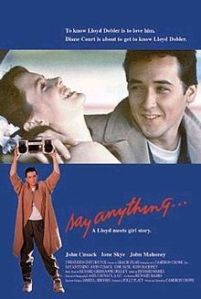
220px-Say_Anything

For the past two and a half weeks, we’ve been taking a chronological look at some of the best, worst, most memorable, and most forgettable teens films ever made.  We started with two films from 1946 and now, 43 films later, we’ve reached the end of the 80s.  And what better way to close out the decade that is often considered to be the golden age of teen films than by taking a look at two films from 1989 that both paid homage to the films that came before them and also served to influence the many films that would come after.

When people talk about Say Anything…, they usually seem to talk about the fact that it was the directorial debut of Cameron Crowe (who, it must be said, launched the golden age of teen films by writing Fast Time At Ridgemont High) and that it features what may be John Cusack’s best performance.  Famously, Cusack apparently felt that — after performances in Class, Sixteen Candles, and Better Off Dead — he was through playing teenagers.  But then he read Crowe’s script and was so impressed by it that he agreed he would play a student one last time.

It may, however, have helped that the character Cusack plays, a likable and easy-going kickboxing enthusiast named Lloyd Dobler — is only briefly seen as a student.  He graduates from high school early on in the movie.  That majority of Say Anything… deals with the summer right after high school.*  Lloyd has an unlikely but heartbreakingly real romance with Diane Court (Ione Skye), the valedictorian.

Cusack is so charming as Lloyd (and, needless to say, he gets all of the best lines) that I think people tend to overlook the fact that Ione Skye is equally as good.  Diane is actually a far more challenging role than Lloyd.  Whereas Lloyd is distinguished by his confidence and his friendly manner, Diane is neurotic, shy, and unsure of herself.  She’s won a scholarship to study in England and is scheduled to leave at the end of the summer but she’s scared of flying.  Even worse, her father, Jim Court (John Mahoney), is being investigated by the IRS.  As the summer progresses, Diane is forced to deal with the fact that not only has her seemingly perfect father broken the law but, when he’s confronted with his crimes, he uses his daughter as his excuse.  Yes, Jim seems to be saying, I stole money but I only did it to give you the best life possible.

Everyone seems to remember Say Anything… as the film that has that scene where Lloyd serenades Diane by holding that radio over his head.  And yes, that’s a wonderfully romantic scene, even if it’s been parodied so many times that it’s probably no longer as effective as it was when the film was first released.  But for me, Say Anything… is truly about Diane growing up and realizing that her father is not the saint that she thought he was.  (Making this realization especially upsetting is the fact that, initially, Mahoney is so likable in the role.)  You’re happy that Lloyd is there for her and you truly do come to love him because he is the perfect boyfriend, but ultimately, Say Anything… is Diane’s story.

(That said, though, I have to admit that some of my favorite scenes are just Lloyd talking to his friends.  Lili Taylor gives a great performance and how can you not laugh at Jeremy Piven hanging out at the convenience store?)

Ultimately, of course, the film works because both Lloyd and Diane come across as real human beings.  They’re not just boyfriend and girlfriend.  Instead, they’re two very likable characters who have been lucky enough to find each other.  In the end, you love Lloyd not because he’s funny or quirky but because he loves Diane for who she is.

Of course, it also helps that Say Anything has the perfect ending.

Ding!

Say-Anything_199

—-

* On a personal note, the summer after I graduated high school was the best summer of my life because I spent most of it in Italy!  Viva Iatalia!

Film Review: The Conjuring (dir by James Wan)


The-Conjuring

Before I say anything else about James Wan’s latest haunted house film, allow me to say this:

The Conjuring is crazy scary.

If just for that reason, The Conjuring has to be considered a success.  In this time when the savvy filmgoer has every right to be cynical about ghost films, The Conjuring delivers exactly what it promises.  It’s a scary film that takes the time to build up a properly menacing atmosphere and the final hour is one of the most intense that I’ve ever seen.

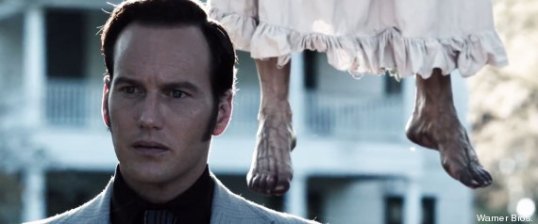
From the very first scene, I fell in love with The Conjuring.  Set in a classroom in 1969, the opening scene features paranormal investigators Ed and Lorraine Warren (Patrick Wilson and Vera Farmiga) delivering a lecture about a possessed doll named Annabelle.  As Ed and Lorraine speak, we see flashbacks to how the doll first came to be possessed and I really do have to say that, with her cracked face and her morbid smile, Annabelle is one of the scariest dolls that I have ever seen.  This doll is pure nightmare material but, even more importantly, this short prologue serves to remind us that director James Wan knows how to make predictable material frightening.

As Ed and Lorraine finish their lecture, we are suddenly informed (via a crawling title) that Ed and Lorraine Warren are real paranormal investigators.  Ed is the only non-clergy to be certified as an exorcist by the Vatican.  We’re told that the movie we are about to see is a true story.  Again, this isn’t surprising.  (Don’t all ghost stories claim to be based on a true story?)  However, it was such a shameless and over-the-top moment that I couldn’t help but love it.  Again, it serves as a reminder that James Wan knows how to tell a ghost story and that’s what he proceeds to do for the next two hours.

The Conjuring tells the story of Carolyn (Lili Taylor), Roger (Ron Livington), and their five daughters.  The year is 1971 and Roger and Carolyn have purchased a large but isolated farmhouse in Rhode Island.  The house needs a lot of work, Carolyn and Roger are shocked to discover a cellar hidden behind some boards in a closet, and the family dog mysteriously dies the first night after they move in.  Their youngest daughter starts talking to an invisible friend while another daughter starts to sleepwalk.  Soon, Carolyn is waking up with mysterious bruises on her body.  After a mysterious woman attacks their eldest daughter and then mysteriously vanishes, Ed and Lorraine are finally called in to figure out what’s happening in Rhode Island…

Well, we can all guess what’s happening in Rhode Island.  To anyone who has seen Insidious, Sinister, or hundreds of other haunted house movies; the plot of The Conjuring will seem very familiar.  However, that actually works in the film’s favor.  One reason that ghost stories remain so effective is because of their familiarity.  When done correctly, films like The Conjuring are scary exactly because we know what’s going to happen.  The tension comes from knowing that nothing can stop it from happening.

Much as he did with Insidious, James Wan starts things out slowly.  He devotes the first hour of the film to building up tension and atmosphere of palpable unease.  The first part of the film demands patience on the part of viewers who have been conditioned by one too many installments of Paranormal Activity.

However, this patience pays off.  About an hour into the film, a supporting character wanders around the dark house and hears a ghostly voice whispering, “Look what you made me do…” It was when he spotted a figure standing in the shadows that I realized that, in its deliberate way, the film had totally captured the darkest corners of my imagination.  From the minute that shadowy figure appears, The Conjuring becomes one of the most intense horror films that I’ve ever seen.

However, The Conjuring is a lot more than just an effective horror film.  Since making a name for himself with the first installment in the tedious Saw franchise, James Wan has grown considerably as a filmmaker.  The Conjuring is not Wan’s first horror film but it is the first where you truly care about the characters and their safety.

Ron Livingston and Lili Taylor are convincing and likable and their five daughters are all perfectly cast and believable as sisters.  Speaking as the youngest of four sisters, I couldn’t help but both relate to this haunted family and appreciate the fact that the filmmakers made the effort to make them believable as both individuals and as family.  Much of the beginning of the film is devoted to observing the daily rituals of their lives and there were so many authentic moments that it made the fright scenes all the more scary.

Playing the Warrens, Patrick Wilson and Vera Farmiga are also well-cast.  As fictional versions of real-life paranormal investigators, the characters have the potential to be problematic but Wilson and Farmiga are both so committed to their roles and both have so much chemistry that I found myself not caring that I’m generally skeptical of ghost hunters.  On the basis of his work in this film, as well as his work in Insidious, Young Adult, and that episode of Girls where he has sex with Lena Dunham despite the fact that she spent nearly the entire episode wearing the ugliest shorts ever, I think Patrick Wilson has to be one of the most underrated actors working today.

All things considered, it’s not surprising that The Conjuring is an effective horror film.  What’s surprising is that James Wan’s latest haunted house film is also one of the best films of the year so far.

r-THE-CONJURING-large570