Film Review: The Doors (dir by Oliver Stone)


I like The Doors.

That can be a dangerous thing to admit, about both the band and Oliver Stone’s 1991 film.  Yes, both the band and the film could be a bit pretentious.  They both tended to go on for a bit longer than necessary.  They were both centered around a guy who wrote the type of poetry that I used to love back in my emo days.  It’s all true.

But, with The Doors as a band, I find that I can’t stop listening to them once I start.  Even if I might roll my eyes at some of the lyrics or if I might privately question whether any blues song really needs an organ solo, I can’t help but love the band.  They had a sound that was uniquely their own, a psychedelic carnival that brought to mind images of people dancing joyfully while the world burned around them.  And say what you will about Jim Morrison as a poet or even a thinker, he had a good voice.  He had the perfect voice for The Doors and their rather portentous style.  From the clips that I’ve seen of him performing, Morrison definitely had a stage presence.  Morrison died young.  He was only 27 and, in the popular imagination, he will always look like he’s 27.  Unlike his contemporaries who managed to survive the 60s, Morrison will always eternally be long-haired and full of life.

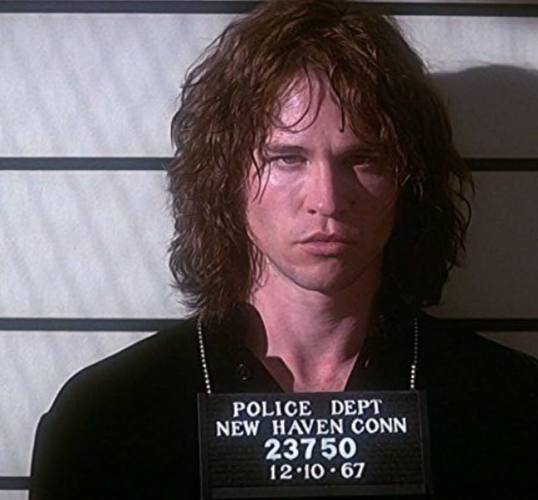
As for The Doors as a movie, it’s definitely an Oliver Stone film.  It’s big.  It’s colorful.  It’s deliberately messy.  Moments of genuinely clever filmmaking and breath-taking visuals are mixed with scenes that are so heavy-handed that you’ll be inspired to roll your eyes as dramatically as you’ve ever rolled them.  Stone loved the music and that love comes through in every performance scene.  Stone also loves using Native Americans as symbols and that can feel a bit cringey at times.  Why would Jim Morrison, whose was of Scottish and Irish ancestry, even have a Native American spirit guide?  At its best The Doors captures the chaos of a world that it’s the middle of being rebuilt.  The 60s were a turbulent time and The Doors is a turbulent movie.  I’ve read many reviews that criticized The Doors for the scene in which Morrison gets involved in a black magic ceremony with a journalist played by Kathleen Quinlan.  I have no idea whether or not that scene happened in real life but the movie is so full of energy and wild imagery that the scene feels like it belongs, regardless of whether it’s true or not.  Stone turns Jim Morrison into the warrior-artist-priest that Morrison apparently believed himself to be and the fact that the film actually succeeds has far more to do with Oliver Stone’s  enthusiastic, no-holds-barred direction and Val Kilmer’s charismatic lead performance than it does with Jim Morrison himself.

The Doors spent several years in development and there were several actors who, at one time or another, wanted to play Morrison.  Everyone from Tom Cruise to John Travolta to Richard Gere to Bono was considered for the role.  (Bono as Jim Morrison, what fresh Hell would that have been?)  Ultimately, Oliver Stone went with Val Kilmer for the role and Kilmer gives a larger-than-life performance as Morrison, capturing the charisma of a rock star but also the troubled and self-destructive soul of someone convinced that he was destined to die young.  Kilmer has so much charisma that you’re willing to put up with all the talk about opening the doors of perception and achieving a higher consciousness.  Kilmer was also smart enough to find the little moments to let the viewer know that Morrison, for all of his flamboyance, was ultimately a human being.  When Kilmer-as-Morrison winks while singing one particularly portentous lyric, it’s a moment of self-awareness that the film very much needs.

(When the news of Kilmer’s death was announced last night, many people online immediately started talking about Tombstone, Top Gun, and Top Secret.  For his part, Kilmer often said he was proudest of his performance as Jim Morrison.)

In the end, The Doors is less about the reality of the 60s and Jim Morrison and more about the way that we like to imagine the 60s and Jim Morrison as being.  It’s a nonstop carnival, full of familiar faces like Kyle MacLachlan, Michael Madsen, Crispin Glover (as Andy Warhol), Frank Whaley, Kevin Dillon, and a seriously miscast Meg Ryan.  It’s a big and sprawling film, one that is sometimes a bit too big for its own good but which is held together by both Stone’s shameless visuals and Val Kilmer’s charisma.  If you didn’t like the band before you watched this movie, you probably still won’t like them.  But, much like the band itself, The Doors is hard to ignore.

Embracing The Melodrama: Poseidon (dir by Wolfgang Petersen)


The plot of 2006’s Poseidon may sound familiar.

There’s this cruise ship.  It’s a luxury liner and it’s sailing across the ocean on New Year’s Eve.  There’s a lot of passengers on the liner.  Most of them are wealthy and the majority of them are played by familiar actors.  Everyone is in the ballroom, celebrating the upcoming new year.  They do the countdown.  They cheer when they hit zero.  Kisses are exchanges.  Dances are danced.  A blonde woman sings a song.  Suddenly, a tidal wave smashes into the Poseidon, turning it over.  Explosions rock the ship as it ends up floating upside down.  The majority of the crew and the passengers are killed immediately.  The survivors face a decision.  Do they stay in the ballroom or do they attempt to climb upwards to safety?

Yep, Poseidon is a remake of The Poseidon Adventure.  It tells basically the same story but with slightly better special effects and slightly less histrionic actors.  The original Poseidon Adventure had Gene Hackman and Ernest Borgnine yelling at each other for over two hours while Shelley Winters swam until she died.  “WHERE’S YOUR GOD NOW, PREACHER!?” Borgnine shouted while Hackman yelled, “ROGO!” over and over again.  (Rogo was Borgnine’s character.  Hackman shouted the name with a wonderful amount of loathing.)  It was a very loud and every entertaining movie.  The cast of Poseidon is a bit more low-key but Poseidon is also more interested in special effects than any sort of human (melo)drama.

For instance, Josh Lucas plays a Navy veteran-turned-professional gambler.  He gives a good performance as the de facto leader of the survivors but he never gets to yell as much as Gene Hackman did in the original.  Richard Dreyfuss plays an architect and you would think that Dreyfuss, of all people, would chew up the scenery in this disaster film with relish but Dreyfuss is oddly subdued.  Jacinda Barrett is the mother who tries to protect her son (played by Jimmy Bennett).  Fergie is the singer who embraces the ship’s captain (Andre Braugher) as the ballroom floods.  Emmy Rossum is the rebellious teenager.  Mike Vogel is her boyfriend.  And Kurt Russell plays the former mayor of New York City.  He also happens to be a former fireman.

It’s a good cast.  Kurt Russell is especially good in his role, believable as both a fireman (a role that he’s played in a few films) and as a politician.  It’s a talented group of actors but no one really goes overboard in the way that Gene Hackman, Ernest Borgnine, Shelley Winters, Stella Stevens, Roddy McDowall, and even Leslie Nielsen did in the first one.  The premise of the film is so silly that it really does require the cast and the director to fully embrace the melodrama.  As opposed to the original, this film only gives the melodrama a quick hug and instead concentrates on explosions, water, and flames.  The special effects overshadow the humans and that’s unfortunate because there’s a lot of interesting people in this movie.  A good performance can last a lifetime.  There’s a reason why we still talk about Kurt Russell in films like Escape From New York and The Thing.  Good special effects, on the other hand, still look incredibly dated after three years.

I’m not really sure that it was necessary to remake The Poseidon Adventure in the first place.  I’m just glad they left Beyond The Poseidon Adventure alone.

Lisa Marie Reviews An Oscar Winner: Platoon (dir by Oliver Stone)


One of my favorite scenes from TV’s King of the Hill occurs in an episode in which Hank and Peggy are celebrating their wedding anniversary.  They’ve sent Bobby and Luanne away for the weekend.  They have the house to themselves but, after their anniversary party, Peggy is feeling depressed.  She tells Hank that, for the first time ever, she feels old and she regrets all the dreams that she had that have yet to come true, like inventing and selling her own barbecue sauce.

Trying to cheer her up, Hank says, “C’mon, Peg.  We got the house to ourselves for weekend …. and I rented an R-rated movie!”

Peggy looks up, briefly hopeful that Hank did something romantic.  “What movie?” she asks.

Hank hesitates, glances down at the floor, and says, “Uhmm …. Platoon.”

It’s funny because it’s true.  Just about every man that I know loves Platoon.  First released in 1986 and reportedly based on Oliver Stone’s own experiences as an infantryman in Vietnam, Platoon is often cited as being one of the greatest war films ever made.  Oddly enough, the film has an anti-war and anti-military message but, in my experience, those who love it talk more about the battle scenes than any message that Stone may have been trying to impart about the futility of war.  Pauline Kael once wrote that Oliver Stone had left-wing politics but a right-wing sensibility and I think you can definitely see that in Platoon.  Despite all of the characters talking about how pointless the war is and how much they resent being forced to risk their lives for no apparent purpose, the film’s energy comes from the scenes of Chris Taylor (Charlie Sheen) stalking through the jungle and, towards the end, losing his mind and giving himself completely over to the adrenaline that comes from being trapped in the middle of a battle.  Throughout the film, we hear Taylor’s rather pedantic thoughts on the military and his fellow soldiers but it’s hard not to notice that his actions and his dialogue are usually far less eloquent.  Taylor may be a rich intellectual (and wow, is Charlie Sheen ever unconvincing when it comes to portraying that part of Taylor’s personality) but when he’s in the jungle, he’s just fighting for survival.

The film’s plot centers around the conflict between two sergeants, the peace-loving Elias (Willem DaFoe) and the war-loving Barnes (Tom Berenger).  Taylor has to decide which one of the two to follow.  The pot-smoking Elias loves his men and goes out of his way to protect them.  The beer-drinking Barnes has a much harsher view of the world but, at the same time, he’s the type of scarred warrior who seems immortal.  One gets the feeling that he’ll never be defeated.  The rest of the platoon is full of familiar faces, with everyone from John C. McGinley to Francesco Quinn to Tony Todd to Forest Whitaker to Johnny Depp to a baby-faced Kevin Dillon showing up.  (Dillon is especially frightening as a psycho who has, for some reason, been nicknamed Bunny.)  The majority of the platoon is dead by the end of the film.  Even with the leadership of Elias and Barnes, the soldiers are stuck in a winless situation.  As Taylor points out, the Americans aren’t just fighting the enemy.  They’re also fighting each other.

Platoon is certainly not my favorite of the film nominated in 1986.  I would have gone with A Room With A View.  (Blue Velvet, which is as influential a film as Platoon, was not even nominated.)  That said, I can’t deny the power of Platoon‘s combat scenes.  Though Stone’s script is didactic and Taylor’s narration is awkwardly deployed throughout the film, Stone’s direction definitely captures the fear and dread of being in a strange place with no idea of whether or not you’re going to survive.  Stone is critical of the military (at one point, an officer calls an air strike on his own men) but seems to love the soldiers, even the ones who have pushed over to the dark side.

Platoon was not the first Best Picture nominee to be made about the Vietnam War.  The Deer Hunter, Coming Home, and Apocalypse Now were all released first.  But both The Deer Hunter and Apocalypse Now are surreal epics that seem to take place in a dream world.  Coming Home, which has a script that somehow manages to be even more didactic than Platoon‘s, focuses on the war back home.  Platoon is far more gritty and personal film.  Watching Platoon, you can smell the gunpowder and the napalm and feel the humidity of the jungle.  I can understand why it won, even if I prefer to watch Helena Bonham Carter and Julian Sands fall in love.

The Films of 2024: Reagan (dir by Sean McNamara)


In Reagan, Dennis Quaid stars at the 40th President of the United States.

Framed as a story being told by a former KGB agent (Jon Voight) who is attempting to make a younger politician understand why Russia lost the Cold War, Reagan starts with Reagan’s childhood, includes his time as an actor and as the anti-communist head of the SAG, and then gets into his political career.  Along the way, several familiar faces pop up.  Robert Davi plays a thuggish Russian leader.  Mena Suvari plays Reagan’s first wife while Penelope Ann Miller plays his second.  Xander Berekely plays George Schultz (who was just previously played by Sam Waterston in The Dropout miniseries.)  C. Thomas Howell, Kevin Dillon, Dan Lauria, and Lesley-Anne Down all have small but important roles.  And the usual suspects when it comes to conservative filmmaking — Nick Searcy, Kevin Sorbo, and Pat Boone — are there to compliment Voight and Davi.  I was a little surprised to see that Dean Cain was not present.

As usually happens to films that feature sympathetic Republicans, Reagan was slammed by critic but better-appreciated by the audience for which the film was made.  I wasn’t particularly surprised.  Movie critics tend to be liberal and Reagan is very much not that.  For a professional film critic, a film like Reagan must be met with snark and derision because otherwise, one would risk cancellation.  Don’t get me wrong.  I’m not saying that there aren’t things to criticize about Reagan the film.  I’m just saying that one should always keep in mind that critics have their own individual biases.  One reason why the Rotten Tomatoes score is such an unfortunate development is because it ignores the fact that most films have things that work and things that don’t work and that quality is often in the eye of the beholder.  Instead, it just tells us that a film is either a 90% or a 10%.

As for Reagan, it’s definitely a bit on the heavy-handed side but, then again, I think the same can be said for just about every political film that’s come out over the last few decades.  For those who claim Reagan is somehow more heavy-handed than most, I invite them to sit through Rob Reiner’s LBJ.  Indeed, the only director who has really shown a willingness to admit that a President can be both good and bad was Oliver Stone and when was the last time anyone watched NixonReagan is at its weakness when it tries to recreate Reagan’s time as an actor.  Dennis Quaid gives a good and charming performance throughout the film but he’s also 70 years old and, in the scenes where he plays the youngish Ronald Reagan, all of the soft-lighting and Vaseline on the lens ends up making him look like a wax figure.  Once Reagan gets older, Quaid is allowed to act his age and both he and the film become much more convincing.  I enjoyed the film once Reagan became President, though you should understand that I have biases of my own.  I’m a fan of low taxes and individual freedom, which is why I’m also not a fan of communism or, for that matter, any extreme ideology that attempts to tell people how to live or think.  “Tear down this wall!” Regan says while standing in front of the Berlin Wall and it’s a rousing moment, both in reality and on film.

In the end, Reagan is a film that will be best appreciated by people who already like Ronald Reagan.  Yes, the film is heavy-handed and the framing device is a bit awkward.  But Dennis Quaid’s heartfelt (and, towards the end, heartbreaking) performance carries the film.  The film is not at all subtle but you know what?  I’ve seen a countless number of mediocre films that have portrayed Reagan negatively, often with as little nuance and just as heavy-handed an approach as Reagan uses in its positive portrayal of the man.  I sat through The Butler, for God’s sake.  There’s nothing wrong with having a film that looks at the man from the other side.  Those who like Ronald Reagan will feel vindicated.  Those who don’t will say, “What was up with that Pat Boone scene?”

Film Review: Wire Room (dir by Matt Eskandari)


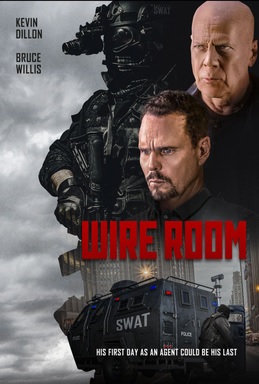
Wire Room tells the story of Justin Rosa (Kevin Dillon).

Once upon a time, Justin was a member of the Secret Service.  But, for reasons that are never really made clear, Justin was eventually demoted and found himself working for Homeland Security.  After 18 years, Justin has finally achieved his dream.  He’s been assigned to a wire room, a high-tech command center where HSI agents conduct surveillance on high-profile criminals.  On his first day, Justin shows up late.  He gets yelled at by his superior, Shane Mueller (Bruce Willis).  Justin explains that he couldn’t find anywhere to park.  Shane is not impressed.  Of course, Shane takes a taxi to and from work because Shane is a total alcoholic who likes to spend his free time at the local strip club.

After meeting Shane and Nour Holborow (Shelby Cobb), Justin is left in the wire room alone.  His sole job is to keep an eye on a British arms dealer, Eddie Flynn (Oliver Trevena, who chews the scenery with relish).  Shane is obsessed with taking down not only Eddie but also all of the corrupt cops that are on Eddie’s payroll.  Eddie has no idea that his entire mansion is wired and that Homeland Security is watching him while he wanders around the house in his leopard-print robe.  Eddie also doesn’t know that a bunch of assassins are coming to his house to try to kill him.

Realizing that Eddie is about to be killed, Justin tries to call Shane but Shane is too busy getting drunk to answer his phone.  When Nour calls about an unrelated manner, Justin asks her for advice.  She tells him to call Shane.  He already tried that!  Realizing that Homeland Security is full of drunks and incompetents, Justin decides to call Eddie himself.  Soon, Justin and Eddie enter into an uneasy partnership.  Justin tries to keep Eddie alive while Eddie tries to figure out how Justin knows what’s happening at his house.  To me, it would seem like it shouldn’t be difficult for Eddie to figure out that Homeland Security has wired his house but no one in this movie is particularly smart.

Wire Room was one of the last movies that Bruce Willis made before announcing his retirement from acting.  Willis doesn’t get much screen time and his dialogue consists mostly of profane insults.  That said, it is nice to see Willis playing a good guy again and there’s even a few hints of the old Willis charisma to be found in his performance.  If nothing else, he seems to enjoy the scenes in which Shane gives Justin a hard time.  As for Justin, he really is a truly stupid character who makes so many obvious mistakes that it’s hard not to worry about the fact that he’s been entrusted with keeping the homeland safe.  Fortunately, Kevin Dillon is an actor who can make stupidity likable.  (There’s a reason why Johnny Drama was the only character on Entourage that anyone really cared about.)

Like the majority of Willis’s recent films, Wire Room is a low-budget action film.  The special effects aren’t particularly special and the action scenes are fairly rudimentary.  A huge problem with the film is that the viewer is never quite sure how close or how far anyone is from the titular location.  For instance, we’re continually told that people are heading towards the wire room but it seems like it takes them forever to actually show up.  At one point, we see a group of bad guys heading up to the wire room but, somehow, Justin and Shane still have time to scrounge up some weapons and have a fairly detailed conversation before any of them actually arrive.  For all of the shooting and the yelling, Wire Room also never convinces us that there’s much at stake as far as the story is concerned.  Shane, for instance, doesn’t seem to be particularly upset when Justin tells him about what is happening at Eddie’s house, despite the fact that Eddie’s death would destroy Shane’s investigation into police corruption.  If Shane, the man in charge of the investigation, doesn’t care about what happens then why should we?

That said, there is some perhaps unintentional enjoyment to be found in Wire Room.  Kevin Dillon plays Justin as being so dense and so slow-witted that the film almost becomes a parody of the recent spate of movies and television shows that have been released about hyper competent government agents.  There are laughs to be found and Bruce Willis gets to be the good guy again.  Wire Room is not a particularly memorable movie but it is a decent time waster.

Horror On TV: Tales From The Crypt 5.7 “House of Horror” (dir by Bob Gale)


Tonight’s excursion into televised horror is the 7th episode of the 5th season of HBO’s Tales From The Crypt!  

House of Horrors has everything that you could possibly want from a Tales From The Crypt episode!  A dumbass idiot frat boy (played by Kevin Dillon) forces three pledges to enter  a supposedly haunted house.  Mayhem ensues.  This episode is full of atmosphere, dark humor, plot twists, and unexpected turns and it features two wonderfully over-the-top performances, one from Dillon and one from Meredith Salenger as a Southern-accented sorority president who may have a secret of her own.

This episode originally aired on October 27th, 1993 and is currently celebrating its 30th birthday.

Enjoy!

Film Review: A Day To Die (dir by Wes Miller)


A Day To Die is a low-budget action film with a ludicrously complicated plot.

The film opens with an elite SWAT team reacting to a terrorist incident in a small town.  A group of white supremacists have taken over a hundred hostages in a high school.  An elite SWAT team, led by Brice Mason (Frank Grillo) and Connor Connolly (Kevin Dillon), attempt to rescue the hostages but a mistake leads to the school blowing up and many of the hostages dying.  Corrupt police chief Alston (Bruce Willis) breaks up the SWAT team.  Some of the members become auto mechanics.  Some of them become drug addicts.  Connor becomes a …. parole officer.

A year or so later, Connor is forced to kill one of the henchmen of the local drug lord, Pettis (Leon).  Pettis is upset because, by his estimation, the dead man would have brought in over two million dollars over the course of his career.  Pettis orders Connor to steal two million to pay off his “debt.”  Pettis gives Connor 12 hours to find the money and, just for good measure, he kidnaps Connor’s pregnant wife (Brooke Butler).

Pettis suggests that Connor get the money by robbing a rival’s drug house.  With no other choice, Connor puts in a call to Brice and soon, the old SWAT team has gathered in a garage.  Quicker than you can say Fast and Furious, the team is talking about how they’re family.  If Connor needs them to rob a bunch of drug dealers, that’s what they’re going to do.  However, they’re also going to take down Pettis in the process.  Of course, what they don’t realize is that Pettis has a connection of his own with Chief Alston.

Probably the best thing that can be said about A Day To Die is that Bruce Willis seems to be remarkably steady on his feet.  This was one of the batch of films that Willis made before his family announced that he was retiring from acting.  Knowing what we now know about not only his health but also the allegations that Willis wasn’t always sure what type of films he was being singed up for, it’s always a bit awkward to watch his last few films.  But, in A Day To Die, Willis actually gives a credible performance as the corrupt police chief.  Though there’s not much of evidence of the swaggering wise guy charisma that made Willis a star, Willis still delivers his lines convincingly and he seems to be invested in the character.  While I’m faintly praising the film, I should also mention that Leon appears to be having fun with the role of the sharply-dressed drug dealer and Frank Grillo is his usual rugged self.  They’re all good enough to keep you watching.

Unfortunately, Kevin Dillon uses the same facial expression that he used when he played Johnny Drama on Entourage and, as a result, it’s a bit difficult to take him seriously as an action hero.  (If anything A Day To Die seems like the type of film that everyone would laugh at Johnny for doing while Vince was appearing in Martin Scorsese’s Gatsby.)  Ultimately, the film is done in by an overcomplicated plot that really doesn’t hold up to close scrutiny.  As entertaining as Leon is, Pettis’s actions never really make sense.  In the end, A Day To Die is better than American Siege but nowhere close to Gasoline Alley.

A Midnight Clear (1992, directed by Keith Gordon)


In December of 1944, with the world at war and Christmas approaching, a small U.S. Army Intelligence squad is sent to a deserted chateau near the German lines.  The squad, which was decimated during the Battle of the Bulge, is made up of six young soldiers who all have genius IQs.  They’ve been hardened by war but they’re still young enough to have some hope for the future.  Leading them is “Mother” Wilkinson (Gary Sinise), an officer who cares about his men but who has been mentally struggling with not only the war but also with the recent death of a child back home.

At first, the chateau seems like a perfect sanctuary, a place to wait for the war to end.  But then the Americans discover that there is a regiment of German soldiers nearby.  The Germans are just as young as the Americans and when the two groups meet each other, they don’t fire their guns but instead have a snowball fight.  The Germans say that they know the war is about to end and that they want to surrender before the Russians arrive.  However, the Germans are worried about their families back home and what will happen when word gets back that they’ve surrendered.  They request a staged fight so that it will appear that they were captured in combat.  Almost everyone is down with the plan but it turns out that it’s not easy to fake a war in the middle of a real one.

Based on a novel by William Wharton, A Midnight Clear is one of the best Christmas films that hardly anyone seems to have heard of.  It’s a war film that is more concerned with the men who fight the wars than with the battles. Along with Sinise, the ensemble cast includes Ethan Hawke, Peter Berg, Kevin Dillon, Ayre Gross, Frank Whaley, and John C. McGinley and all of them make an impression, bringing their characters to life.  By the end of the movie, you feel like you know each member of the squad and their individual fates hit you hard.  Some of them make it to the next Christmas and tragically, some of them don’t.  The film starts out almost gently and all of the soldiers are so intent on just letting the war end while they hide out at the chateau that you find yourself believing that it could actually happen.  When reality intrudes, it’s tragic and poignant.  Intelligently directed by Keith Gordon (making his directorial debut), A Midnight Clear is an unforgettable anti-war story that has an amazing final shot.  A Midnight Clear makes an impression on Christmas and every other day.

A Movie A Day #208: War Party (1988, directed by Franc Roddam)


On the hundredth year anniversary of a battle between the U.S. Calvary and the Blackfeet Indians, the residents of small Montana town decide to reenact the battle and hopefully bring in some tourist dollars.  The white mayor (Bill McKinny) and the sheriff (Jerry Hardin) both think that it is a great idea.  Even the local Indian leader, Ben Cowkiller (Dennis Banks, in real-life a founder and leader of the American Indian Movement), thinks that it will be a worthwhile for the Indians to participate.  The Calvary’s guns will be full of blanks.  The Indians will play dead.  However, as the result of a bar brawl the previous night, one of the local rednecks, Calvin Morrisey (Kevyn Major Howard), shows up with a gun full of bullets.  After he shoots one of the Indians, Calvin ends up with a tomahawk buried in his head.  Three Indian teenagers, Warren (Tim Sampson), Skitty (Kevin Dillon), and Sonny (Billy Wirth), flee into the wilderness.  Thirsty for revenge, a white posse heads off in pursuit.

War Party is an underrated and surprisingly violent movie.   Franc Roddam brings the same sensitivity to his portrayal of alienated Indians that he brought to portraying alienated Mods in Quadrophenia.  Though, at first, Kevin Dillon seems miscast as an Indian, he, Wirth, and Sampson all give good performances, as does Dennis Banks.  The movie is often stolen by M. Emmett Walsh and Rodney A. Grant, playing renowned trackers who are brought in to help the posse chase down the three youths.  That Grant’s character is a member of the Crow adds a whole extra layer of meaning to his role. Even though the setup often feels contrived and heavy-handed and anyone watching should be able to easily guess how the movie is going to end, War Party still packs a punch.

A Movie A Day #140: The Rescue (1988, directed by Ferdinand Fairfax)


A group of Navy SEALs enter North Korea on a mission to destroy a submarine that has fallen into Kim Il-sung’s hands.  They destroy the submarine but are captured before they can safely cross the border back into South Korea.  With the SEALs facing a show trial and probable public execution, Admiral Rothman (James Cromwell) draws up a plan to rescure them.  The U.S. government, not wanting to escalate the situation, shoots down the plan.  (Americans giving up?  Is Carter still president?)  However, Rothman’s nerdy son, Max (Marc Price), gets a hold of the plan.  Before you can say “Why didn’t anyone else think of this?”, he and the children of the SEALs are sneaking into North Korea and rescuing their fathers!

This is a pure 1980s film.  Like Red Dawn, it shows that America is such a great country that even our teenagers are stronger than the average well-armed communist.  Of the actors playing the rescuers, the best known is Kevin Dillon.  He plays the rebel who smokes cigarettes and rides a motorcycle.  Though their relationship may be strained, his father (Edward Albert) is still happy when Dillon suddenly shows up in North Korea.  Soon, father and son are working together to blow up America’s enemies.  This movie’s about as dumb as they come and it’s another example of Hollywood presenting North Korea as just being the junior varsity version of China but it’s also undeniably entertaining, especially if you don’t care about things like plausibility.  Watch it the next time that Kim Jong-un threatens to blow you up.  Who needs Chuck Norris when you’ve got Kevin Dillon?