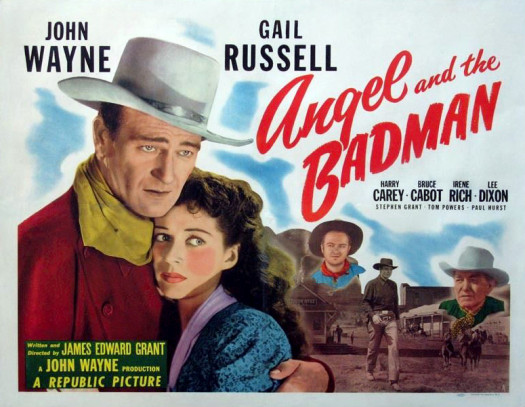
John Wayne starred in some of the screen’s most iconic Westerns, but I’ve always had a soft spot in my heart for ANGEL AND THE BADMAN. Perhaps it’s because the film fell into Public Domain in the mid-70’s, and I’ve had the opportunity to view it so many times. Yet I wouldn’t keep coming back to it if it weren’t a really good movie. It’s Wayne’s first film as producer, and though it has plenty of that trademark John Wayne action and humor, it’s a bit different from your typical ‘Big Duke’ film.
Wayne plays Quirt Evans, an outlaw on the run. The wounded Quirt encounters a Quaker family, the Worths, who take him to file a land claim before the big guy finally passes out. They bring him back to their family farm to nurse him back to health, and pretty daughter Penny, unschooled in the ways of the…
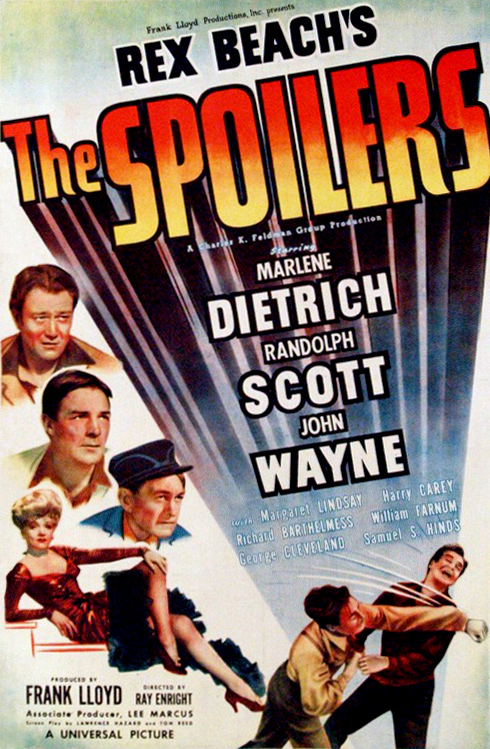
What’s this?? A “Northern” Western set in 1900 Alaska Gold Rush territory starring my two favorite cowboys, John Wayne and Randolph Scott ? With the ever-enticing Marlene Dietrich thrown in as a sexy saloon owner? Count me in! THE SPOILERS is a big, brawling, boisterous film loaded with romance, action, and, most importantly, a sense of humor. It’s the kind of Hollywood entertainment epic that, as they say, “just don’t make ’em like that anymore”. I’ve never been quite sure who “they” are, but in regards to THE SPOILERS, they’re right – and more’s the pity!
Rex Beach’s popular 1906 novel had been filmed three times before (1914, 1923, 1930), and would be one more time after (in 1955), but with The Duke, Rugged Randy, and La Dietrich on board, this has got to be the best of the bunch. Even though audiences were more than familiar with the story…
Critics of John Wayne gave him a lot of flak for not serving his country during World War II, especially in the turbulent 1960’s, labeling him a phony patriot and celluloid warrior. The truth is Wayne DID try to get into the war, but was stymied in his attempts on two fronts: Republic Studios boss Herbert Yates, who filed for deferments so he wouldn’t lose his cash cow, and Wayne’s first wife Josie, who failed to forward letters from OSS Chief Wild Bill Donovan’s office. Be that as it may, The Duke was no phony, and did what he could on the home front for the war effort.
SANDS OF IWO JIMA was made four years after the war as a tribute to the brave souls of the United States Marine Corps who fought against the Japanese in the South Pacific. Wayne plays the tough top kick Sgt. John Stryker…
In 1973, John Wayne released America, Why I Love Her, an album of speeches about why the Duke loved America. In honor of Independence Day, here’s the title track:
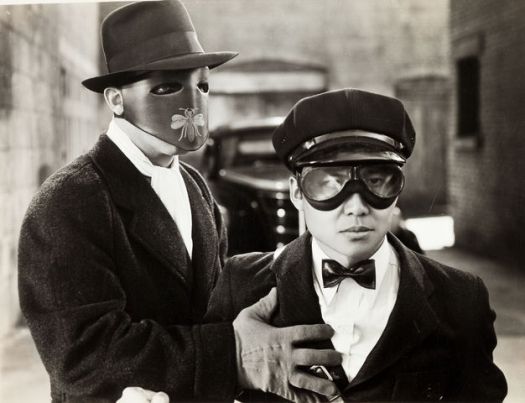
Brawny actor Gordon Jones (1911-1963) was never a big star, but an actor the big stars could depend on to give a good performance. Stars like John Wayne, Roy Rogers, and Abbott & Costello knew Gordon could deliver the goods in support, and he spent over thirty years as a working class actor. Not bad for a small town kid from Alden, Iowa!
Gordon as The Green Hornet with Keye Luke as Kato
Jones originally came to California on a football scholarship, playing guard for UCLA. Like his fellow Iowan John Wayne , Gordon began his film career in uncredited parts, and soon moved up in casts lists with films like RED SALUTE (1935), STRIKE ME PINK (1936), and THERE GOES MY GIRL (1937). Gordon’s big lug persona made him ideal for second leads as the hero’s pal, though he did get some leading roles in Poverty Row vehicles like…
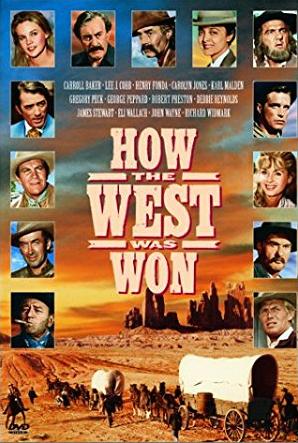
(With the Oscars scheduled to be awarded on March 4th, I have decided to review at least one Oscar-nominated film a day. These films could be nominees or they could be winners. They could be from this year’s Oscars or they could be a previous year’s nominee! We’ll see how things play out. Today, I take a look at the 1963 best picture nominee, How The West Was Won!)
How was the west won?
According to this film, the west was won by the brave men and women who set out in search of a better life. Some of them were mountain men. Some of them worked for the railroads. Some of them rode in wagons. Some of them gambled. Some of them sang songs. Some shot guns. Some died in the Civil War. The thing they all had in common was that they won the west and everyone had a familiar face. How The West Was Won is the history of the west, told through the eyes of a collection of character actors and aging stars from Hollywood’s Golden Age.
In many ways, How The West Was Won was the Avatar of the early 60s. It was a big, long, epic film that was designed to make viewers feel as if they were in the middle of the action. Avatar used 3D while How The West Was Won used Cinerama. Each scene was shot with three synchronized cameras and, when the film was projected onto a curved Cinerama screen, it was meant to create a truly immersive experience. The film is full of tracking shots and, while watching it on TCM last night, I tried to imagine what it must have been like to see it in 1963 and to feel as if I was plunging straight into the world of the old west. The film’s visuals were undoubtedly diminished by being viewed on a flat screen and yet, there were still a few breath-taking shots of the western landscape.
The other thing that How The West Was Won had in common with Avatarwas a predictable storyline and some truly unfortunate dialogue. I can understand why How The West Was Won was awarded two technical Oscars (for editing and sound) but, somehow, it also picked up the award for Best Writing, Screenplay or Story. How The West Was Won is made up of five different parts, each one of which feels like a condensed version of a typical western B-movie. There’s the mountain man helping the settlers get down the river story. There’s the Civil War story. There’s the railroad story and the outlaw story and, of course, the gold rush story. None of it’s particularly original and the film is so poorly paced that some sections of the film feel rushed while others seem to go on forever.
Some of the film’s uneven consistency was undoubtedly due to the fact that it was directed by four different directors. Henry Hathaway handled three sections while John Ford took care of the Civil War, George Marshall deal with the coming of the railroad, and an uncredited Richard Thorpe apparently shot a bunch of minor connecting scenes.
And yet, it’s hard not to like How The West Was Won. Like a lot of the epic Hollywood films of the late 50s and early 60s, it has its own goofy charm. The film is just so eager to please and remind the audience that they’re watching a story that could only be told on the big screen. Every minute of the film feels like a raised middle finger to the threat of television. “You’re not going to see this on your little idiot box!” the film seems to shout at every moment. “Think you’re going to get Cinerama on NBC!? THINK AGAIN!”
Then there’s the huge cast. As opposed to Avatar, the cast of How The West Was Won is actually fun to watch. Admittedly, a lot of them are either miscast or appear to simply be taking advantage of a quick payday but still, it’s interesting to see just how many iconic actors wander through this film.
For instance, the film starts and, within minutes, you’re like, “Hey! That’s Jimmy Stewart playing a mountain man who is only supposed to be in his 20s!”
There’s Debbie Reynolds as a showgirl who inherits a gold claim!
Is that Gregory Peck as a cynical gambler? And there’s Henry Fonda as a world-weary buffalo hunter! And Richard Widmark as a tyrannical railroad employee and Lee J. Cobb as a town marshal and Eli Wallach as an outlaw!
See that stern-faced settler over there? It’s Karl Malden!
What’s that? The Civil War’s broken out? Don’t worry, General John Wayne is here to save the day. And there’s George Peppard fighting for the Union and Russ Tamblyn fighting for the Confederacy! And there’s Agnes Moorehead and Thelma Ritter and Robert Preston and … wait a minute? Is that Spencer Tracy providing narration?
When Eli Wallach’s gang shows up, keep an eye out for a 36 year-old Harry Dean Stanton. And, earlier, when Walter Brennan’s family of river pirates menaces Karl Malden, be sure to look for an evil-looking pirate who, for about twenty seconds, stares straight at the camera. When you see him, be sure to say, “Hey, it’s Lee Van Cleef!”
How The West Was Won is a big, long, thoroughly silly movie but, if you’re a fan of classic film stars, it’s worth watching. It was a huge box office success and picked up 8 Oscar nominations. It lost best picture to Tom Jones.
(By the way, in my ideal fantasy world, From Russia With Love secured a 1963 U.S. release, as opposed to having to wait until 1964, and became the first spy thriller to win the Oscar for Best Picture.)
Tomorrow’s the big night, as my New England Patriots go up against the tough defense of the Philadelphia Eagles in Super Bowl LII. Tom Brady and company will be going for Ring #6, and everyone here in Southern New England is super excited, looking forward to another victory celebration! I’ll be attending a huge party with plenty of food, big screen TV’s, raffles, squares, and like-minded fans, but before the festivities begin, let’s take a look at TROUBLE ALONG THE WAY, a football-themed film starring none other than Big John Wayne !
St. Anthony’s College is a struggling Catholic university run by sweet old Father Burke, who’s getting to be as decrepit as the school itself. The powers-that-be want to close his beloved St. Anthony’s, seeing how the school’s $170,000 in debt, but old Father Burke comes up with an idea. Citing Deuteronomy 32:15 (“The beloved grew fat and kicked”)…
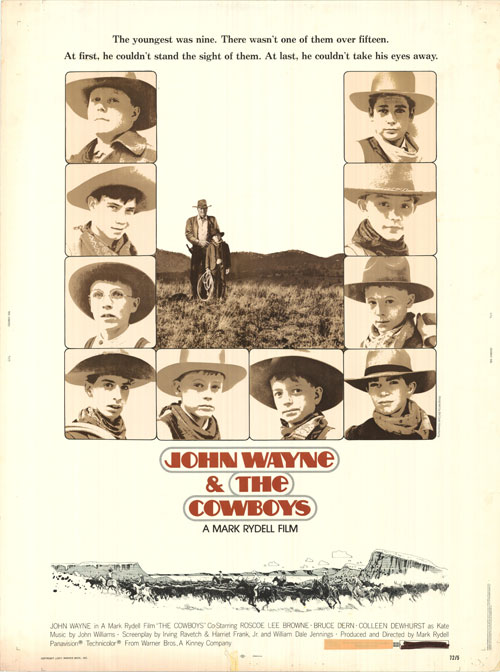
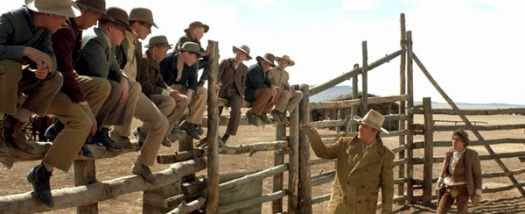
THE COWBOYS is not just another ‘John Wayne Movie’ from the latter part of his career. Not by a long shot. Duke had read the script and coveted the part of Wil Andersen, who’s forced to hire a bunch of wet behind the ears adolescents for a 400 mile cattle drive across the rugged Montana territory. Director Mark Rydell wanted George C. Scott for the role, but when John Wayne set his sights on something, he usually got what he wanted. The two men were at polar opposites of the political spectrum, and the Sanford Meisner-trained Rydell and Old Hollywood Wayne were expected to clash. They didn’t; putting their differences aside, they collaborated and cooperated to make one of the best Westerns of the 70’s.
Andersen’s regular hands have all deserted him when gold is discovered nearby, leaving the aging rancher in the lurch. He heads for Boseman to look…
John Ford’s THE SEARCHERS is without question an American Film Classic. I’d even go as far as saying it’s my second all-time favorite film, directly behind CASABLANCA. Every shot is a Remington Old West masterpiece, every actor perfect in their role, large or small, and not a minute of footage is wasted. The film has also stirred up quite a bit of controversy over time for John Wayne’s portrayal of the main character Ethan Edwards.
The plot is structured like Joseph Campbell’s “Hero’s Journey”, but let’s get it out of the way right now: Ethan Edwards is no hero. He’s a mean, bitter, unreconstructed Confederate who’s been on the shady side of the law since war’s end. When he returns to his brother Aaron’s homestead, he makes no bones about his distaste for “half-breed” Martin Pawley (really an eighth Cherokee). His hatred of Native Americans even extends to their dead, as…
This is my third year participating in the TCM Summer Under the Stars blogathon hosted by Kristen at Journeys in Classic Film , and second entry spotlighting Big John Wayne . The Duke and director John Ford made eleven films together, from 1939’s STAGECOACH to 1963’s DONOVAN’S REEF. Wayne’s role in the first as The Ringo Kid established him as a star presence to be reckoned with, and the iconic actor always gave credit to his mentor Ford for his screen success. I recently viewed their second collaboration, 1940’s THE LONG VOYAGE HOME, a complete departure for Wayne as a Swedish sailor on a tramp steamer, based on four short plays by Eugene O’Neill, and was amazed at both the actor’s performance and the technical brilliance of Ford and his cinematographer Gregg Toland , the man behind the camera for Welles’ CITIZEN KANE.