What Lies Beneath (2000, directed by Robert Zemeckis)


Claire (Michelle Pfeiffer) is a former cellist who is still struggling to recover from a serious car accident and who has been at loose ends ever since her daughter left for college.  Claire’s husband, Norman (Harrison Ford), is a scientist and a college lecturer.  After their neighbor, Mary (Miranda Otto), disappears, Claire becomes convinced that Mary’s husband (James Remar) did something to her.  Claire also becomes convinced that Mary’s ghost is trying to contact her, by appearing in the lake and filling the bathtub up with water whenever Claire isn’t looking.  Norman tells Claire that she’s imagining things and pushes her to see a therapist.  As Claire investigates, she discovers that Norman knows more than he’s letting on.

What Lies Beneath is a long and drawn-out ghost story that Robert Zemeckis made because he had time to kill while the filming of Cast Away was on hiatus so Tom Hanks could lose weight and grow a beard.  That this movie was not a personal project for Zemeckis is reflected in his direction, which is surprisingly impersonal for a Zemeckis film.  The film is a showcase for Michelle Pfeiffer, who gives a good performance as the emotionally fragile Claire and holds the film’s many disparate elements together.  Harrison Ford sometimes seems disinterested but his casting still pays off when Norman gets to say and do some things that you normally would never expect Harrison Ford to do.

I remember seeing this in a theater in 2000 and being surprised by the ending.  Looking back on it today, I just can’t believe that I sat through the entire movie.

Film Review: …. And Justice For All (Dir by Norman Jewison)


First released in 1979, ….And Justice For All will always be remembered for one scene.

Yell it with me, “YOU’RE OUT OF ORDER!  THE WHOLE TRIAL IS OUT OF ORDER!  THEY’RE OUT OF ORDER!”

When attorney Arthur Kirkland (Al Pacino) starts screaming in the middle of the courtroom, it’s a cathartic moment.  We’ve spent nearly two hours watching as Arthur deals with one insane situation after another.  One of Arthur’s partners, Warren (Larry Bryggman), cares more about his car than actually delivering the right documents to a judge.  Another of Arthur’s partners, Jay (Jeffrey Tambor), has a nervous breakdown and, after shaving his head, ends up throwing cafeteria plates at people in the courthouse.  Arthur has three clients, one of whom is indigent, one of whom is innocent, and one of whom is a wealthy and despised judge (John Forsythe) who has been accused of a rape that Arthur suspects he committed.  The system offers no mercy for Arthur’s innocent (or, at the very least, harmless) clients while going out of it’s way to defend the judge.  Meanwhile, another judge (Jack Warden), is driven to take suicidal risks, like flying a helicopter until it runs out of fuel and comes down in a nearby harbor.  The assistant district attorney (Craig T. Nelson) only cares about his political ambitions and finally, after one incident after another, Arthur snaps.  And it’s cathartic because we’re all on the verge of snapping as well.

That final moment, with its signature Al Pacino rant, is such a strong and iconic scene that it’s easy to forget that the film itself is actually rather uneven.  The script, by Barry Levinson and Valerie Curtin, owes a good deal to the work of Paddy Chayefsky.  Just as Chayefsky often wrote about men being driven mad by institutional failure, ….And Justice For All features character after character snapping when faced with the screwed-up realities of the American justice system.  The final “out of order” speech is obviously meant to be this film’s version of Howard Beale’s “I’m as mad as Hell and I’m not going to take it!” speech from Network and, much like George C. Scott in the Chayefsky-written The Hospital, Arthur spends a lot of time talking about what he doesn’t like about his job.  The thing that sets ….And Justice For All apart from the best works of Chayefsky is that Levinson, Curtin, and director Norman Jewison all take Arthur Kirkland at his word while one gets the feeling that Chayefsky would have been a bit more willing to call out Arthur on his self-righteousness.  Arthur has every right to be angry when Warren forgets to give a judge an important document while Warren is substituting for him in court.  At the same time, Arthur is the one who trusted Warren to do it.  In the end, the document was not about one of Warren’s client.  In fact, Warren knew absolutely nothing about the case or Arthur’s client.  The document was about Arthur’s client and Arthur was the one who decided trust someone who had consistently shown himself to not be particularly detailed-orientated.  One gets the feeling that Chayefsky would not have let Arthur off the hook as easily as Levinson, Curtin, and Jewison do.  Arthur’s perpetual indignation can sometimes be a little hard to take.

It’s a very episodic film.  Arthur goes from one crisis to another and sometimes, you do have to wonder if Arthur has ever had any human or legal interactions that haven’t ended with someone either going insane or dying.  There’s no gradual build-up to the film’s insanity, it’s right there from the beginning.  And while this means the narrative often feels heavy-handed, it also makes that final speech all the more cathartic.  It’s an uneven film and, of all of the characters that Pacino played in the 70s, Arthur is probably the least interesting.  But that final rant makes up for a lot and, fortunately, Pacino was just the actor to make it memorable.  For all it’s flaws, the final few minutes of ….And Justice For All make the film unforgettable.


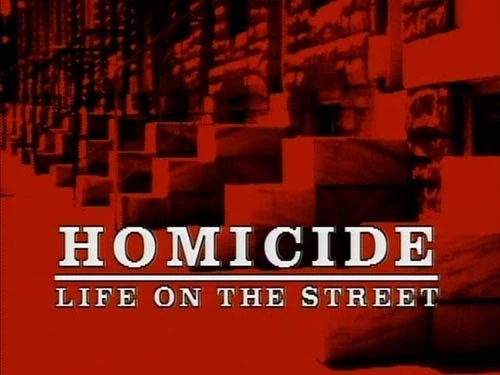
Retro Television Review: Homicide: Life On The Street 3.7 “Happy To Be Here”


Welcome to Retro Television Reviews, a feature where we review some of our favorite and least favorite shows of the past!  On Sundays, I will be reviewing Homicide: Life On The Street, which aired from 1993 to 1999, on NBC!  It  can be viewed on Peacock.

This week, Bayliss loses it!

Episode 3.7 “Happy To Be Here”

(Dir by Lee Bonner, originally aired on November 18th, 1994)

This week’s episode was depressing even by Homicide standards.

Felton’s wife is still missing.  Felton confronts both Kay and Megan, convinced that they know something about it.  Does it ever occur to Felton that maybe, just maybe, he wouldn’t have so much trouble in his marriage if he wasn’t always stumbling around like hulking dunk, sweating through his shirt and smoking up a storm?  Be the change, Felton.  Be the change.

Sam Thorne, the journalist played by Joe Morton, is assassinated by a Colombian cartel.  It turns out that his assassin was a teenager who agreed to do it in return for a new bike.  Giardello is shaken by the death of his friend and there’s a wonderfully acted scene in which Giardello visits Sam’s daughter (Maggie Rush).  This storyline served to remind the viewer that Yaphet Kotto, even if he spends most of the show in his office, really is the glue that holds this show together.  He’s the heart and the moral soul of Homicide.

Meanwhile, Bayliss has gone from being the clean-cut rookie to being someone who appears to be on the verge of having a complete and total breakdown.  He’s still seeing Emma Zoole and Lewis is still angry with him about it.  Emma likes to make love in a coffin.  Bayliss can accept that.  Emma wants Bayliss to hit her and that pushes Bayliss over the edge.  When he stops by a convenience store to pick up a six-pack of beer, he discovers that he’s a few pennies short.  The clerk says it doesn’t matter.  He can’t sell Bayliss the beer.  Bayliss responds by drawing his gun and robbing the place!  When the police arrive, Bayliss is sitting in his car and drinking a beer.

So, I guess Bayliss is going to prison now, right?  No, not in Baltimore.  Instead, Bayliss shows off his badge.  When that doesn’t work, he calls Pembleton.  Pembleton comes down to the store and gets the clerk to drop the charges in exchange for Bayliss serving as an unpaid security guard.  At the end of the episode, Bayliss is sitting in front of that store and hopefully thinking about how close he came to being sent to prison.

This was a good episode, one that looked at the pressure that goes along with being exposed to the worst that humanity has to offer.  Bayliss holding that store was a scene that probably should not have worked but it did, due to the performance of Kyle Secor.  In a manner of minutes, Secor took Bayliss from being tired but friendly to being so angry that I was worried he was actually going to shoot the clerk.  Not only did we see Bayliss’s dark side but we also saw Pembleton’s good side as he went out of his way to keep his partner from going to prison.

How much darker can things get in Baltimore?  We’ll find out next week!

Film Review: Executive Decision (dir by Stuart Baird)


In 1996’s Executive Decision, terrorists hijack an airplane.  Their leader, Nagi Hassan (David Suchet) demands that the U.S. government not only give him and his men safe passage but that they also release Hassan’s commander, Jaffa (Andreas Katsulas).

In Washington D.C., it is decide to use a stealth plane to transport Col. Austin Travis (Steven Seagal) and his men into the passenger plane.  Accompanying them will be Dr. David Grant (Kurt Russell), a consultant for U.S. Intelligence.  Dr. Grant is the world’s leading expert on Hassan, even though neither he nor anyone else is even sure what Hassan looks like.  Travis distrusts Grant because he’s a civilian and also because he holds Grant responsible for a botched raid on a Russian safehouse in Italy.  Dr. Grant is going to have to prove himself to Col. Travis because Travis doesn’t have any time for people who can’t get the job done.  And Travis is determined to get on that plane and save all those passengers.

In other words, Travis is a typical Steven Seagal character and, for the first fourth of this movie, Seagal gives a typical Steven Seagal performance.  He delivers his line in his trademark intimidating whisper, he glares at everyone else in the film, and essentially comes across as being a total douchebag who can still handle himself in a fight..  However, when it’s time to board the airplane through a docking tunnel, something goes wrong.  Everyone — even nervous engineer Dennis Cahill (Oliver Platt) is able to slip through the stealth plane’s docking tunnel and get into the hijacked airplane cargo hold without being detected.  But the two planes are hit by severe turbulence.  Suddenly, it becomes apparent the one man is going to have to sacrifice his life and close the hatch before the docking tunnel decompresses.

David, already in the cargo hold, looks down at Austin in the tunnel.  “We’re not going to make it!”

“You are!” Austin replies before slamming the hatch shut and getting sucked out of the tunnel.  (There’s your Oscar Cheers Moment of 1996!)  After all that build-up, Steven Seagal exits the film early and now, it’s up to Kurt Russell and what’s left of Austin Travis’s men to somehow stop the terrorists.  Not only do they have to stop Hassan but they also have to do it before the Air Force — which has no way of knowing whether or not any of their men were able to get on the plane before the tunnel fell apart — shoots down the airliner.

(If the airplane looks familiar, that’s because Lost used the same stock footage whenever it flashed back to the plane crash that started the show.)

It’s actually a rather brilliant twist.  When this film came out, Seagal was still a film star.  He played characters who always got the job done and who were basically infallible.  He wasn’t a very good actor but he did manage to perfect an intimidating stare and that stare carried him through a lot of movies.  No one would have expected Seagal to die within the first 30 minutes of one of his movies and when Col. Travis, who the film has gone out of its way to portray as being the consummate warrior, is suddenly killed, there really is a moment where you find yourself wondering, “What are they going to do now?”  In just a matter of minutes, Executive Decision goes from being a predictable Steven Seagal action film to a genuinely exciting and clever Kurt Russell thriller.  For once, Russell is not playing a man of action.  He’s an analyst, a thinker.  And, to the film’s credit, he uses his mind more than his brawn to battle Hassan’s terrorists.  With excellent support from Halle Berry (as a flight attendant who discreetly helps out David and the soldiers), Oliver Platt, B.D. Wong, Whip Hubley,  David Suchet, Joe Morton, and even John Leguizamo (as Travis’s second-in-command), Executive Decision reveals itself to be an exciting and ultimately rewarding thrill ride.

And to think, all it took was sacrificing Steven Seagal.

Retro Television Review: Homicide: Life On The Street 3.6 “A Model Citizen”


Welcome to Retro Television Reviews, a feature where we review some of our favorite and least favorite shows of the past!  On Sundays, I will be reviewing Homicide: Life On The Street, which aired from 1993 to 1999, on NBC!  It  can be viewed on Peacock.

No one’s happy this week.

Episode 3.6 “A Model Citizen”

(Dir by John McNaughton, originally aired on November 11th, 1994)

Welcome to Baltimore, where everyone is depressed.  Consider this week’s episode of Homicide: Life On The Street.

  1. The episode opens with Munch, Bolander, Howard, and Felton in a morgue, waiting for the results of an autopsy.  They start talking about the shows that they watched as children and how many of them had their origins right in Baltimore.  Of course, none of those shows are on the air anymore.  Munch mentions his favorite childhood shows and is ridiculed for liking things when he was a kid.
  2. Emma Zoole (Lauren Tom), an artist who makes models of crime scenes for use in criminal court, stops by the department.  She’s looking for Steve Crosetti, to get his input on a recreation.  Meldrick Lewis tells her that Crosetti’s dead but he offers to help.  Lewis has a crush.  However, Emma likes Bayliss and Bayliss likes Emma.  Bayliss is even turned on by the fact that Emma sleeps in a coffin.  However, when Bayliss sees how upset Lewis is over his relationship with Emma, Bayliss tries to break up with her.  They end up having sex in the coffin instead.
  3. That’s it!, Lewis declares.  He cannot go into the bar business with Tim Bayliss.  Then again, there might not be a bar business anyway because Munch got kicked out of the state-required alcohol awareness class.  Munch, for whatever reason, decided to argue about whether or not a bartender could really be held responsible for getting someone drunk.
  4. Pembleton, Russert, and the city of Baltimore are all being sued by serial killer Pamela Wilgis.  Wilgis claims that Pembleton violated her civil rights when he interrogated her.  Pembleton’s entire interrogation style is put on trial.  He feels like he’s being attacked on all sides.  Finally, Pembleton gets depressed enough to reenter a church, even though he earlier claimed to no longer have any use for religion.
  5. Munch and Howard investigate the accidental shooting of a child by his older brother.  Much gets extremely upset while searching for the gun, taking Howard totally be surprise.  Howard comes to realize that Much actually cares about protecting children from violence and Munch realizes that the world is a terrible place.
  6. Beau Felton returns to his house and discovers that both his wife and his son have left and they’ve taken all the furniture with them.  Goodbye is scrawled, in lipstick, on the bathroom mirror.
  7. Much ends up sitting outside, staring at the ground while Lewis and then Howard both talk to him about how much life sucks.
  8. No one wants to end up like Steve Crosetti, Howard says at one point.  Good luck!  This job is depressing!

This was a good episode, one that really captured the emotional turmoil of seeing the worse that humanity has to offer while, at the same time, acknowledging that depressed people often use humor to deal with their feelings.  A few of Munch’s and Lewis’s line made me laugh out loud but seriously, I felt so bad for both of them!

Hopefully, everyone will have cheered up by next week.

Retro Television Review: Miami Vice 1.17 “The Maze”


Welcome to Retro Television Reviews, a feature where we review some of our favorite and least favorite shows of the past!  On Mondays, I will be reviewing Miami Vice, which ran on NBC from 1984 to 1989.  The entire show is currently streaming on Tubi!

It was not easy but I managed to rouse myself from my sickbed long enough to stumble into my home office so I could watch and review this week’s episode of Miami Vice!

Episode 1.17 “The Maze”

(Dir by Tim Zinnemann, originally aired on February 22nd, 1985)

This episode of Miami Vice gets off to a good start, with an exciting and, even by the standards of today, surprisingly violent shoot-out in downtown Miami.  The shoot-out leaves one cop dead, one partner embittered, and Crockett and Tubbs looking for the perpetrators, the Escobars.  As Tubbs explains it, the Escobars were strictly small-timers but it appears that they’ve recently gotten out of prison and now they are trying to make a name for themselves in Miami.

The search for the Escobars leads Crockett and Tubbs to a seemingly abandoned apartment building that has been nicknamed “The Maze.”  The Escobars have taken over the building and now, the handful of people who were previously living in the Maze are virtual hostages.  With the police surrounding the Maze, Tubbs decides to go undercover as a drifter who just happens to drop by the Maze in search of a place to stay.  Of course, no sooner has Tubbs entered into the Maze then a renegade cop named Duryea (Jay O. Sanders) decides to rush the building himself and the police are forced to reveal themselves.  Realizing that they’re surrounded, the Escobars demand a helicopter to the Bahamas and $10,000.  (Personally, I think they should have just asked for the helicopter.  People will give up helicopters much quicker than money.)  They hold every person in the building hostage, including Tubbs.

As I previously mentioned while reviewing T and T, I’m not a fan of shows that center around hostage situations, largely because they almost always end up being dramatically inert.  There’s only so many times that you can watch a sweaty criminal demand a helicopter before you get bored with listening to him.  That is certainly the case here.  The show gets off to a good start and even the scenes with Tubbs breaking into the Maze and pretending to be a Jamaican drifter had some flair to them.  But once the tense hostage situation started up, I got bored.  I appreciated the fact that the Escobars, as opposes to being hardened criminals, were really just as scared as the people they were holding hostage but otherwise, this episode was just a bit too slow for me.

That said, this episode does feature Breakin 2‘s Adolfo ‘Shabba-Doo’ Quinones as a dancing informant, early performances from Joe Morton and Ving Rahmes, and a really cool moment where Tubbs smirks and says, “Nobody’s going to the Bahamas.”  Even a lesser episode of Miami Vice still had style to burn.

Retro Television Reviews: We’re Fighting Back (dir by Lou Antonio)


Welcome to Retro Television Reviews, a feature where we review some of our favorite and least favorite shows of the past!  On Sundays, I will be reviewing the made-for-television movies that used to be a primetime mainstay.  Today’s film is 1981’s We’re Fighting Back!  It  can be viewed on YouTube!

We’re Fighting Back opens with a title card informing the viewer that the film that they are about to see is based on a true story and that the characters are based on the Guardian Angels, a group of New Yorkers who took it upon themselves to patrol neighborhoods and the subways.  However, the film’s plot is fictionalized and all of the names have been changed and basically, the entire story is made up.  It gets the film off to a strange start.  This film is based on a true story, except that it’s not.

Morgan “Case” Casey (Kevin Mahon) is a young man living in New York with his father.  When his father is mugged in the subway and ends up in the hospital, Case decides to take it upon himself to patrol the trains.  He recruits his co-workers at the local hamburger place.  Benny (Ramon Franco) says he is streetwise.  Ling (Brian Tochi) claims that he’s good at fighting.  Preacher (Paul McCrane) …. well, I’m not sure what Preacher’s special skill is but he’s recently moved to New York from Alabama.  Case and his friends lose their first big fight against a gang of muggers, which leads to Case yelling at all of them and announcing that they need to recruit more members and get trained up on how to fight.  Preacher thinks that Case is putting everyone’s life in danger but Case is determined to clean up the neighborhood.

Teaming up with some former gang members, Case forms the organization that will become the Guardian Angels.  Among those who join are a tough waitress named Chris Capoletti (a young Ellen Barkin) and a Hungarian immigrant named Janos (an equally young Stephen Lang).  At first, attorney Elgin Jones (Joe Morton) thinks that Case and his organization are going to be a bunch of lawless vigilantes but, after meeting Case and seeing Case refuse to allow an obvious psychopath to join the group, Elgin decides to become a part of Case’s anti-crime crusade.

And …. well, that’s pretty much it.  There’s not much of a plot here.  Case and Preacher are briefly estranged but they are friends again by the end of the movie.  Eventually, Case faces off with Tony (John Snyder), the gang leader who mugged his father.  For the most part, though, this is a film without much real conflict.  In this film’s portrayal of urban crime, it turns out to be remarkably easy to clean up a neighborhood.  Apparently, you just need to get a bunch of people to give a damn.  One watches the movie and wonders why no one ever came up with this extremely simple solution in the past.  The film goes out of its way to tell us that Case is not some sort of Charles Bronson-style vigilante but Case never has to face any muggers as dangerous as The Giggler.  If Case lived in the Death Wish 3 neighborhood, who knows what type of approach he would have gone with.

Under the best of circumstances, this film would seem simplistic.  Watching this film after the past few years, in which we’ve seen an increasing number of unarmed people getting hurt and killed by self-appointed vigilantes who felt that they shouldn’t have been in their neighborhood or train car, it’s hard not to feel that We’re Fighting Back is incredibly naïve and rather irresponsible.  (The Death Wish films are so shameless and over the top that they’re difficult to take seriously as any sort of manifesto.  We’re Fighting Back plays out with all the earnestness of a call to action.)  Need to clean up your neighborhood?  Just do it yourself!  Just fight back!  Obviously, that’s an idea that appeals to a lot of people but, in reality, it rarely seems to work out the way that it should.

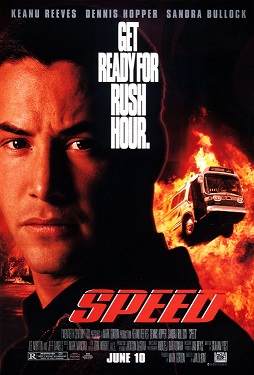
Film Review: Speed (dir by Jan De Bont)


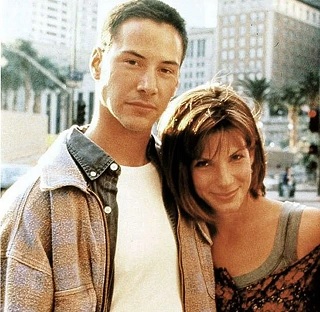
“Awwwww, Keanu and Sandra are so cute together!”

That was my main thought when I recently rewatched the 1994 film, Speed.  There’s a lot of reasons why Speed remains popular 28 years after it was initially released but I think a huge (if underrated) factor is that it’s just a good love story.  At this point, everyone knows that the film is about a bus that has been wired to explode if it goes under 50 miles per hour.  Most people know that Dennis Hopper plays Howard, the mad bomber, Keanu Reeves plays Jack, the cop who jumps on the bus and tries to figure out how to defuse the bomb, and Sandra Bullock plays Annie, the passenger who takes over driving the bus after the driver is incapacitated.  (If you’re fan of the work of John Hughes, you might also know that Speed was the film where Ferris Bueller‘s Alan Ruck broke free of his Cameron typecasting and established himself as a dependable character actor.)  Most people remember what the cops do in an attempt to trick Dennis Hopper and, for that matter, they also remember the one mistake that led to Hopper figuring out their ruse.

And yet, even though most viewers will know exactly what is going to happen, the film remains a fun watch because of the chemistry between Keanu Reeves and Sandra Bullock.  This was one of Sandra’s first major roles.  This was also one of Keanu’s earliest attempts to helm a big budget, major studio action picture.  (Director Jan de Bont insisted on casting him after seeing him in the film Point Break.  The studio preferred Tom Cruise.)  In Speed, both Keanu and Sandra are young, likable, attractive, enthusiastic, and they have smiles that light up the screen.  As soon as Sandra takes over driving and Keanu tells her that she cannot allow the bus to slow down under any circumstances, the two of them just seem to belong together.  The film’s enduring popularity is about more than just watching a bus try not to go under a certain speed.  The popularity of Speed is also about watching the characters played by Keanu and Sandra fall in love.

Who would have guessed it?  Well, certainly not whoever put together the film’s original theatrical trailer.  Check this out:

As you can see, the original trailer doesn’t feature much of Sandra Bullock.  For that matter, it’s not quite as Keanu-centric as you might expect it to be.  Instead, the trailer is dominated by things exploding and Dennis Hopper’s over-the-top performance as the bomber.  And make no doubt about it, Dennis Hopper is definitely an entertaining part of the film.  There’s not a subtle moment to be found in his performance and that makes him the perfect for the role of a man whose response to a cheap retirement present is to go on a bombing spree.  That said, the film belongs to Keanu and Sandra.

That said, it would be a mistake to ignore the other people on the bus.  One of the things that I like about Speed is that the other passengers on the bus come together to survive their ordeal.  They may start out as weary commuters but, by the end of the film, they’ve become a family.  They may get annoyed with each other but, when it comes time to climb from one bus to another, they hold on to each other and they hug one another on the other side.  The bomber, like all terrorists, thought that he could turn people against each other through his threats and his violence.  Instead, the people came together provided one another with comfort and protection.  There’s an important lesson there, one that’s even more important in 2022 than it probably was in 1994.

(On a personal note, I’m not usually a public transportation person.  However, in high school, I would occasionally catch the DART bus — that’s Dallas Area Rapid Transportation — if it was raining.  The buses were often not in particularly good shape.  One that I boarded actually had a hole in the floor and, since it was raining, the passengers would have to hold up their feet whenever the bus splashed through a puddle.  Personally, I was kind of amused by the weirdness of it all but I think I was the only one.  Would the passengers of that bus bonded together to defeat a mad bomber?  One can only hope.)

Speed may be a film about a bomb on a bus but, ultimately, it’s also a film about humanity at its best.  And that’s why, after all this time, it remains a classic.

Adventures in Cleaning Out The DVR: Cleveland Abduction (dir by Alex Kalymnios)


clevelandabduction

After I finished up Ominous, it was time to deal with Cleveland Abduction.  Why was it something that I had to “deal with?”  Well, I originally watched Cleveland Abduction when it was broadcast on Lifetime way back in May.  I meant to review it when I originally watched it but, every time I sat down to write about this movie, I just couldn’t.  Just thinking about the movie and the true story that inspired it was too overwhelming and upsetting.  Cleveland Abduction is one of the most disturbing and depressing (and yet also inspiring) movies that I’ve ever seen.  It’s certainly the most emotionally intense film to ever be made for Lifetime.

A friend of mine actually told me that she could only watch 15 minutes of Cleveland Abduction and then had to stop because she didn’t want the film’s ugliness to get inside her head.  And I don’t blame her.  Cleveland Abduction is an ugly film about three young women who were kidnapped, held prisoner, and repeatedly raped by an evil man.  The film does not flinch from showing the details of their ordeal and it is all the more disturbing for being based on a true story.

I don’t know if I believe in demons or possession or anything like that but I do know that Ariel Castro was an evil man.  Castro, a school bus driver and wannabe musician, abducted Michelle Knight, Gina DeJesus, and Amanda Berry off the streets of Cleveland.  For 11 years, he held them prisoner in his filthy house.  (Disturbingly, some of Castro’s neighbors actually saw the girls in the house but refused to get involved.)  Rather than face a jury and spend the rest of his life as imprisoned as the three women he held captive in his house, Castro committed suicide in his jail cell.

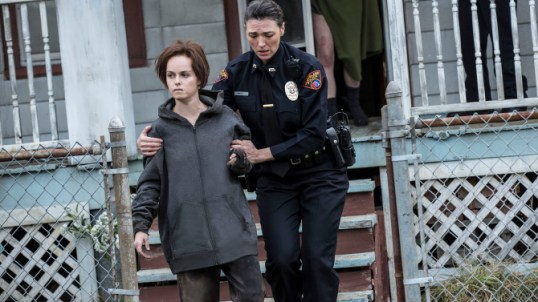
The film centers on Castro’s first known victim, single mother Michelle Knight (a poignant performance from Taryn Manning, who perfectly captures Michelle’s quiet strength).  Castro (played, in properly brutal fashion, by Raymond Cruz) runs into Michelle while she’s walking to court to try to win custody of her son.  Castro offers her a ride and Michelle agrees.  Castro takes her back to his house and her 11-year nightmare begins.

And it’s not easy to watch, nor should it be.  The film doesn’t shy away from showing what Michelle and, eventually, the other two victims went through.  Spending her days either handcuffed or in a locked bedroom, Michelle’s only escape comes from thinking about her son.  When the other two girls are abducted, Michelle comforts them and help them to remain strong.  Meanwhile, on the outside, the police assume that Michelle has just run away from her old life and they refuse to even look for her.

It’s ugly and disturbing and difficult and infuriating to watch.  As I watched, I continually asked myself if I would be able to survive if I ever found myself in the same situation.  I always like to assume that, since I always have pepper spray and I’m a fairly god runner, nobody would ever be able to abduct me but, as I sit here couch-bound with a sprained foot, I know that it’s never that simple.  I also like to assume that I could be as strong as Michelle Knight.  Hopefully, I’ll never have to find out.

But here’s the thing — as disturbing and nightmarish as this film has to be — it’s ultimately a very inspiring film.  For all the ugliness, Cleveland Abduction is ultimately a film about survival and tribute to the strength, courage, and sisterhood of Michelle Knight, Gina DeJesus, and Amanda Berry.  Based on Michelle’s book and featuring a compelling lead performance from Taryn Manning, Cleveland Abduction is not an easy film to watch but it is one that should be watched.

And here are the NAACP Image Award Nominations!


Dear White People

And continuing our awards wrap-up, here are the 2014 NAACP Image Award nominations!

(h/t to awardswatch)

MOTION PICTURE
Outstanding Motion Picture
• “Belle” (Fox Searchlight Pictures/ DJ Films)
• “Beyond The Lights” (Relativity Media)
• “Dear White People” (Lionsgate and Roadside Attractions)
• “Get On Up” (Universal Pictures)
• “Selma” (Paramount Pictures)

Outstanding Actor in a Motion Picture
• Chadwick Boseman – “Get On Up” (Universal Pictures)
• David Oyelowo – “Selma” (Paramount Pictures)
• Denzel Washington – “The Equalizer” (Columbia Pictures)
• Idris Elba – “No Good Deed” (Screen Gems)
• Nate Parker – “Beyond The Lights” (Relativity Media)

Outstanding Actress in a Motion Picture
• Gugu Mbatha-Raw – “Belle” (Fox Searchlight Pictures/ DJ Films)
• Quvenzhané Wallis – “Annie” (Columbia Pictures)
• Taraji P. Henson – “No Good Deed” (Screen Gems)
• Tessa Thompson – “Dear White People” (Lionsgate and Roadside Attractions)
• Viola Davis – “The Disappearance of Eleanor Rigby” (The Weinstein Company)

Outstanding Supporting Actor in a Motion Picture
• André Holland – “Selma” (Paramount Pictures)
• Cedric the Entertainer – “Top Five” (Paramount Pictures)
• Common – “Selma” (Paramount Pictures)
• Danny Glover – “Beyond The Lights” (Relativity Media)
• Wendell Pierce – “Selma” (Paramount Pictures)

Outstanding Supporting Actress in a Motion Picture
• Carmen Ejogo – “Selma” (Paramount Pictures)
• Jill Scott – “Get On Up” (Universal Pictures)
• Octavia Spencer – “Get On Up” (Universal Pictures)
• Oprah Winfrey – “Selma” (Paramount Pictures)
• Viola Davis – “Get On Up” (Universal Pictures)

Outstanding Independent Motion Picture
• “Belle” (Fox Searchlight Pictures/ DJ Films)
• “Dear White People” (Lionsgate and Roadside Attractions)
• “Half of a Yellow Sun” (monterey media inc.)
• “JIMI: All Is By My Side” (XLrator Media)
• “Life of a King” (Animus Films/Serena Films)

Outstanding Writing in a Motion Picture
• Chris Rock – “Top Five” (Paramount Pictures)
• Justin Simien – “Dear White People” (Roadside Attractions and Lionsgate)
• Margaret Nagle – “The Good Lie” (Alcon Entertainment)
• Misan Sagay – “Belle” (Fox Searchlight Pictures/ DJ Films)
• Richard Wenk – “The Equalizer” (Columbia Pictures)

Outstanding Directing in a Motion Picture
• Amma Asante – “Belle” (Fox Searchlight Pictures/ DJ Films)
• Antoine Fuqua – “The Equalizer” (Columbia Pictures)
• Ava DuVernay – “Selma” (Paramount Pictures)
• Gina Prince-Bythewood – “Beyond The Lights” (Relativity Media)
• John Ridley – “JIMI: All Is By My Side” (XLrator Media)

TELEVISION
Outstanding Comedy Series
• “Black-ish” (ABC)
• “House of Lies” (Showtime)
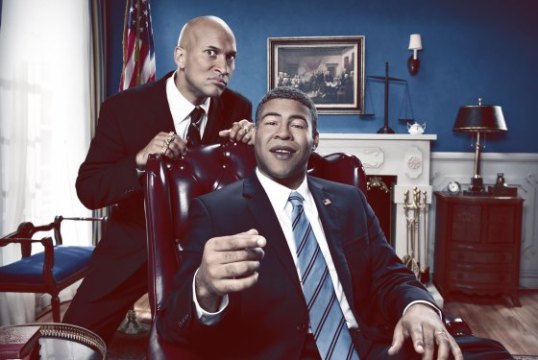
• “Key & Peele” (Comedy Central)
• “Orange is the New Black” (Netflix)
• “Real Husbands of Hollywood” (BET)

Outstanding Actor in a Comedy Series
• Andre Braugher – “Brooklyn Nine-Nine” (FOX)
• Anthony Anderson – “‘Black-ish” (ABC)
• Don Cheadle – “House of Lies” (Showtime)
• Keegan-Michael Key – “Key & Peele” (Comedy Central)
• Kevin Hart – “Real Husbands of Hollywood” (BET)

Outstanding Actress in a Comedy Series
• Mindy Kaling – “The Mindy Project” (FOX)
• Niecy Nash – “The Soul Man” (TV Land)
• Tracee Ellis Ross – “Black-ish” (ABC)
• Uzo Aduba – “Orange is the New Black” (Netflix)
• Wendy Raquel Robinson – “The Game” (BET)

Outstanding Supporting Actor in a Comedy Series
• Boris Kodjoe – “Real Husbands of Hollywood” (BET)
• Glynn Turman – “House of Lies” (Showtime)
• Laurence Fishburne – “Black-ish” (ABC)
• Marcus Scribner – “Black-ish” (ABC)
• Terry Crews – “Brooklyn Nine-Nine” (FOX)

Outstanding Supporting Actress in a Comedy Series
• Adrienne C. Moore – “Orange is the New Black” (Netflix)
• Laverne Cox – “Orange is the New Black” (Netflix)
• Lorraine Toussaint – “Orange is the New Black” (Netflix)
• Sofia Vergara – “Modern Family” (ABC)
• Yara Shahidi – “black-ish” (ABC)

Outstanding Drama Series
• “Being Mary Jane” (BET)
• “Grey’s Anatomy” (ABC)
• “House of Cards” (Netflix)
• “How to Get Away with Murder” (ABC)
• “Scandal” (ABC)

Outstanding Actor in a Drama Series
• LL Cool J – “NCIS: LA” (CBS)
• Omar Epps – “Resurrection” (ABC)
• Omari Hardwick – “Being Mary Jane” (BET)
• Shemar Moore – “Criminal Minds” (CBS)
• Taye Diggs – “Murder in the First” (TNT)

Outstanding Actress in a Drama Series
• Gabrielle Union – “Being Mary Jane” (BET)
• Kerry Washington – “Scandal” (ABC)
• Nicole Beharie – “Sleepy Hollow” (FOX)
• Octavia Spencer – “Red Band Society” (FOX)
• Viola Davis – “How to Get Away with Murder” (ABC)

Outstanding Supporting Actor in a Drama Series
• Alfred Enoch – “How to Get Away with Murder” (ABC)
• Courtney B. Vance – “Masters of Sex” (Showtime)
• Guillermo Diaz – “Scandal” (ABC)
• Jeffrey Wright – “Boardwalk Empire” (HBO)
• Joe Morton – “Scandal” (ABC)

Outstanding Supporting Actress in a Drama Series
• Aja Naomi King – “How to Get Away with Murder” (ABC)
• Alfre Woodard – “State of Affairs” (NBC)
• Chandra Wilson – “Grey’s Anatomy” (ABC)
• Jada Pinkett Smith – “Gotham” (FOX)
• Khandi Alexander – “Scandal” (ABC)

Outstanding Writing in a Comedy Series
• Aisha Muharrar – “Parks and Recreation” – Ann & Chris (NBC)
• Brigette Munoz-Liebowitz – “Brooklyn Nine-Nine” – Road Trip (FOX)
• Mindy Kaling – “The Mindy Project” – Danny and Mindy (FOX)
• Regina Hicks – “Instant Mom” – A Kids’s Choice (Nickelodeon and Nick@Nite)
• Sara Hess – “Orange is the New Black” – It Was the Change (Netflix)

Outstanding Writing in a Drama Series
• Erika Green Swafford – “How to Get Away with Murder” – Let’s Get To Scooping
(ABC)
• Mara Brock Akil – “Being Mary Jane” – Uber Love (BET)
• Warren Leight, Julie Martin – “Law & Order: SVU” – American Disgrace (NBC)
• Zahir McGhee – “Scandal” – Mama Said Knock You Out (ABC)
• Zoanne Clack – “Grey’s Anatomy” – You Be Illin’ (ABC)

Outstanding Television Movie, Mini-Series or Dramatic Special
• “A Day Late and a Dollar Short” (Lifetime Networks)
• “American Horror Story: Freak Show” (FX)
• “Drumline: A New Beat” (VH1)
• “The Gabby Douglas Story” (Lifetime Networks)
• “The Trip to Bountiful” (Lifetime Networks)

Outstanding Actor in a Television Movie, Mini-Series or Dramatic Special
• Blair Underwood – “The Trip to Bountiful” (Lifetime Networks)
• Charles S. Dutton – “Comeback Dad” (UP Entertainment)
• Larenz Tate – “Gun Hill” (BET)
• Mekhi Phifer – “A Day Late and a Dollar Short” (Lifetime Networks)
• Ving Rhames – “A Day Late and a Dollar Short” (Lifetime Networks)

Outstanding Actress in a Television Movie, Mini-Series or Dramatic Special
• Angela Bassett – “American Horror Story: Freak Show” (FX)
• Cicely Tyson – “The Trip to Bountiful” (Lifetime Networks)
• Keke Palmer – “The Trip to Bountiful” (Lifetime Networks)
• Regina King – “The Gabby Douglas Story” (Lifetime Networks)
• Vanessa Williams – “The Trip to Bountiful” (Lifetime Networks)
Key & Peele