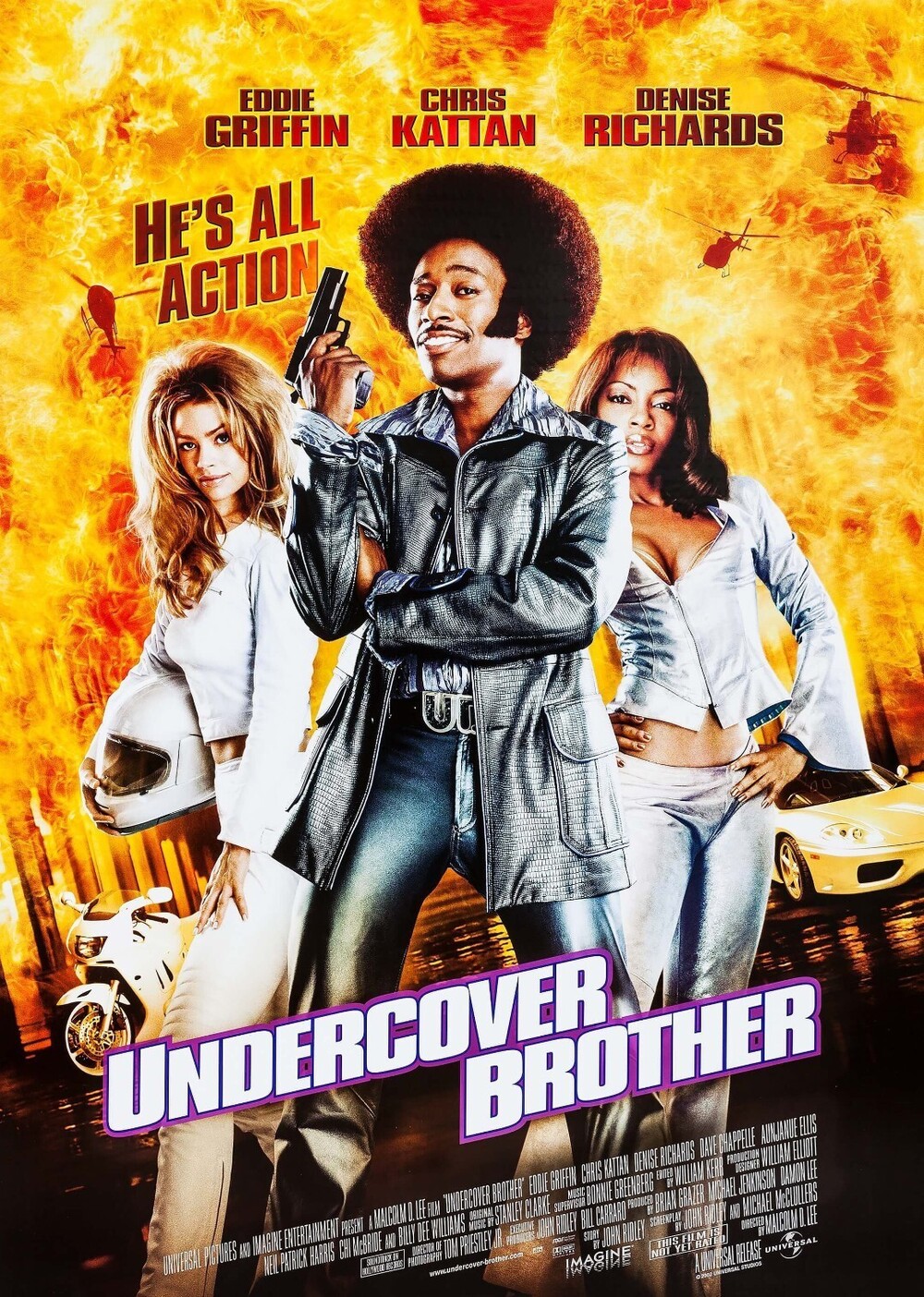
Guilty Pleasure No. 110: Undercover Brother (dir. by Malcolm D. Lee)


Undercover Brother is exactly the kind of movie that earns the phrase “guilty pleasure.” It is messy, broad, and often ridiculous, but it is also packed with enough energy, attitude, and sharp-enough satire to make its flaws feel like part of the joke rather than dealbreakers. The result is a comedy that may not always land cleanly, but it absolutely understands its own vibe and commits to it hard.

At the center of it all is Eddie Griffin, who gives the title character a big, swaggering, old-school cool that carries the movie through its shaggier patches. He plays Undercover Brother as a throwback spy hero with a giant Afro, loud fashion sense, and nonstop confidence, and that exaggerated persona is a big reason the film works as well as it does. Griffin’s performance is not subtle, but subtlety is not really the point here; he sells the movie’s cartoonish energy without making it feel lazy.

What makes Undercover Brother more than just a random parody is how committed it is to poking at both blaxploitation iconography and mainstream spy-movie clichés. The film was directed by Malcolm D. Lee and written from material based on John Ridley’s earlier animated series, and it leans into that satirical roots-and-gadgets formula with a lot of style. It clearly wants to be playful, but it also wants to say something about race, image, and the way Black identity gets packaged or watered down in pop culture.

That said, the movie is not exactly a model of precision. Some of the jokes are sharp and immediate, while others feel like they are still revving the engine long after the punchline should have arrived. The plot is basically an excuse to move from one set piece to another, and the film knows it, which helps, but it also means the whole thing can feel more like a high-speed sketch comedy than a fully shaped story. If you go in expecting airtight narrative logic, you will probably be annoyed; if you go in wanting a fast, funky send-up, you will have a much better time.

The supporting cast gives the movie a lot of its flavor. Dave Chappelle, Aunjanue Ellis, Billy Dee Williams, Chris Kattan, Denise Richards, and Neil Patrick Harris all add to the film’s chaotic mix, and the casting itself becomes part of the joke. Billy Dee Williams especially feels perfectly placed in a movie that is constantly riffing on cool, style, and old-school charisma, while Denise Richards gets a knowingly exaggerated role that plays into the film’s cartoonish battle between seduction and resistance.

What helps Undercover Brother age a little better than some early-2000s comedies is that it is not just throwing random nonsense at the screen for cheap laughs. There is a genuine satirical target here, and even when the movie gets clumsy, it still feels like it has a point of view. The movie clearly aims to be both goofy and observant, and even when the balance is uneven, it is hard not to appreciate the effort.

The best thing about Undercover Brother is its attitude. It moves like a movie that wants to be loud, stylish, and a little bit too much, and that confidence gives it a strange charm. The humor is often broad, sometimes cartoonish, and occasionally uneven, but the film’s willingness to fully commit to its bit makes it easy to forgive a lot. Even when the satire is more enthusiastic than elegant, the movie keeps its foot on the gas, and that momentum is a big part of its appeal.

Its biggest weakness is also the thing that makes it memorable: the movie can feel overstuffed with ideas, references, and gags, some of which work better than others. A few jokes feel a little dated now, and the film’s style of satire is not always as clean or as clever as it seems to think it is. Still, the movie has enough bite, personality, and goofy confidence that those rough edges become part of its charm instead of sinking it. That is the hallmark of a true guilty pleasure: you can see the flaws clearly, but you keep smiling anyway.

So Undercover Brother is not a perfect comedy, and it is not trying to be one. It is loud, silly, politically aware in a very pop-movie way, and shamelessly committed to its own funk. If you want polish, you will find plenty to criticize; if you want a movie with attitude, quotable energy, and the kind of swagger that makes its imperfections oddly lovable, this one delivers. It is a flawed satire, sure, but it is also a genuinely fun one, and that is why it still plays like a guilty pleasure worth revisiting.

Previous Guilty Pleasures

  1. Half-Baked
  2. Save The Last Dance
  3. Every Rose Has Its Thorns
  4. The Jeremy Kyle Show
  5. Invasion USA
  6. The Golden Child
  7. Final Destination 2
  8. Paparazzi
  9. The Principal
  10. The Substitute
  11. Terror In The Family
  12. Pandorum
  13. Lambada
  14. Fear
  15. Cocktail
  16. Keep Off The Grass
  17. Girls, Girls, Girls
  18. Class
  19. Tart
  20. King Kong vs. Godzilla
  21. Hawk the Slayer
  22. Battle Beyond the Stars
  23. Meridian
  24. Walk of Shame
  25. From Justin To Kelly
  26. Project Greenlight
  27. Sex Decoy: Love Stings
  28. Swimfan
  29. On the Line
  30. Wolfen
  31. Hail Caesar!
  32. It’s So Cold In The D
  33. In the Mix
  34. Healed By Grace
  35. Valley of the Dolls
  36. The Legend of Billie Jean
  37. Death Wish
  38. Shipping Wars
  39. Ghost Whisperer
  40. Parking Wars
  41. The Dead Are After Me
  42. Harper’s Island
  43. The Resurrection of Gavin Stone
  44. Paranormal State
  45. Utopia
  46. Bar Rescue
  47. The Powers of Matthew Star
  48. Spiker
  49. Heavenly Bodies
  50. Maid in Manhattan
  51. Rage and Honor
  52. Saved By The Bell 3. 21 “No Hope With Dope”
  53. Happy Gilmore
  54. Solarbabies
  55. The Dawn of Correction
  56. Once You Understand
  57. The Voyeurs 
  58. Robot Jox
  59. Teen Wolf
  60. The Running Man
  61. Double Dragon
  62. Backtrack
  63. Julie and Jack
  64. Karate Warrior
  65. Invaders From Mars
  66. Cloverfield
  67. Aerobicide 
  68. Blood Harvest
  69. Shocking Dark
  70. Face The Truth
  71. Submerged
  72. The Canyons
  73. Days of Thunder
  74. Van Helsing
  75. The Night Comes for Us
  76. Code of Silence
  77. Captain Ron
  78. Armageddon
  79. Kate’s Secret
  80. Point Break
  81. The Replacements
  82. The Shadow
  83. Meteor
  84. Last Action Hero
  85. Attack of the Killer Tomatoes
  86. The Horror at 37,000 Feet
  87. The ‘Burbs
  88. Lifeforce
  89. Highschool of the Dead
  90. Ice Station Zebra
  91. No One Lives
  92. Brewster’s Millions
  93. Porky’s
  94. Revenge of the Nerds
  95. The Delta Force
  96. The Hidden
  97. Roller Boogie
  98. Raw Deal
  99. Death Merchant Series
  100. Ski Patrol
  101. The Executioner Series
  102. The Destroyer Series
  103. Private Teacher
  104. The Parker Series
  105. Ramba
  106. The Troubles of Janice
  107. Ironwood
  108. Interspecies Reviewers
  109. SST — Death Flight

The Films of 2024: Shirley (dir by John Ridley)


In 1972, a New York Congressperson named Shirley Chisholm made history when, in January of that year, she announced that she would be a candidate for the Democrat presidential nomination.  Chisholm, who had already made history when she became the first Black woman to be elected to Congress, was also the first Black woman to run for a major party’s presidential nomination.

(For the record, U.S. Senator Margaret Chase Smith of Maine and the Rev. Channing Phillips were, respectively, the first woman and the first Black to run for a major party’s presidential nomination.  Smith lost the Republican nomination to Barry Goldwater in 1964.  In 1968, Phillips was the first Black to have his name officially put into nomination at a major party political convention.)

Of course, Chisholm did not win in 1972.  She was one of many liberal candidates who declared that they were running as an alternative to the presumed front runner, U.S. Sen. Edmund Muskie.  When Muskie’s campaign stalled in New Hampshire, it was George McGovern (and not Shirley Chisolm, John Lindsay, Eugene McCarthy, or Fred Harris) who benefitted.  For the most part, the media viewed Chisholm as being a protest candidate, one who had a small but loyal activist base but which couldn’t compete with candidates like McGovern and Hubert Humphrey.  Still, Chisholm went into the convention with a handful of delegates and, with McGovern not having enough pledged delegates to win outright, it was expected that Shirley Chisholm would at least be able to get some concessions from him in return for her support.

Political conventions being what they are, things didn’t work out that way.  Due to several backroom deals, George McGovern was able to secure the nomination during the first round of voting.  McGovern went on to suffer a landslide defeat and for years, his general election campaign would be held up as an example of how not to run for President.  Chisholm returned to the U.S. Congress, where she served for another ten years.

Featuring Regina King in the title role, Shirley is a dramatization of that primary campaign.  In many ways, it’s a typical Netflix docudrama.  It’s well-made and it’s tasteful and occasionally, it’s a little bit boring.  Political junkies will enjoy it, particularly if they’ve studied the 1972 presidential election.  My inner history nerd was thrilled as largely forgotten historical figures were casually mentioned in the dialogue.  Who would have guessed that a film released in 2024 would have featured characters talking about the presidential campaigns of Sam Yorty, John Lindsay, and Walter Fauntroy?  Sadly, no mention is made of Patsy Mink.  While Shirley Chisholm was making history as the first Black woman to run for president, U.S. Rep. Patsy T. Mink of Hawaii was doing the same as the first Asian-American woman to run.

It’s an uneven film, one that takes it time getting started.  Filmmaker John Ridley is a better writer than director.  Some of the scenes, like the ones of Chisholm mentoring a young Barbara Lee (Christina Jackson), felt a bit too much on the nose.  (That said, Barbara Lee did start her career as a volunteer with the Chisholm campaign and, while in Congress, she regularly cited Chisholm as an inspiration.)  But then there were other scenes that worked wonderfully, like Chisholm visiting segregationist George Wallace (W. Earl Brown) after Wallace had been shot.  The film is at its best when it reaches the Democrat Convention and Chisholm goes from being elated to disappointed as one of her strongest allies goes from supporting her to announcing that it’s time for all the black delegates to line up behind McGovern.  Regina King’s performance, especially towards the end of the film, captures both Shirley Chisholm’s strength and her vulnerability.  It’s not always easy being a trailblazer.

Finally, if you want to learn more about Shirley Chisholm’s 1972 presidential campaign, I suggest the 2005 documentary, Shirley Chisholm ’72: Unbought and Unbossed.

And here are the NAACP Image Award Nominations!


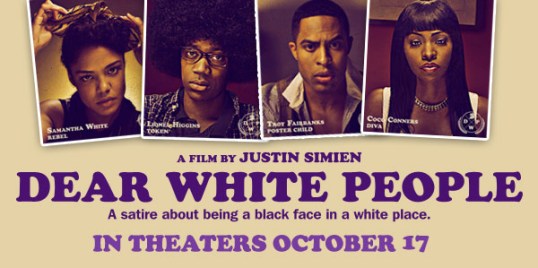
Dear White People

And continuing our awards wrap-up, here are the 2014 NAACP Image Award nominations!

(h/t to awardswatch)

MOTION PICTURE
Outstanding Motion Picture
• “Belle” (Fox Searchlight Pictures/ DJ Films)
• “Beyond The Lights” (Relativity Media)
• “Dear White People” (Lionsgate and Roadside Attractions)
• “Get On Up” (Universal Pictures)
• “Selma” (Paramount Pictures)

Outstanding Actor in a Motion Picture
• Chadwick Boseman – “Get On Up” (Universal Pictures)
• David Oyelowo – “Selma” (Paramount Pictures)
• Denzel Washington – “The Equalizer” (Columbia Pictures)
• Idris Elba – “No Good Deed” (Screen Gems)
• Nate Parker – “Beyond The Lights” (Relativity Media)

Outstanding Actress in a Motion Picture
• Gugu Mbatha-Raw – “Belle” (Fox Searchlight Pictures/ DJ Films)
• Quvenzhané Wallis – “Annie” (Columbia Pictures)
• Taraji P. Henson – “No Good Deed” (Screen Gems)
• Tessa Thompson – “Dear White People” (Lionsgate and Roadside Attractions)
• Viola Davis – “The Disappearance of Eleanor Rigby” (The Weinstein Company)

Outstanding Supporting Actor in a Motion Picture
• André Holland – “Selma” (Paramount Pictures)
• Cedric the Entertainer – “Top Five” (Paramount Pictures)
• Common – “Selma” (Paramount Pictures)
• Danny Glover – “Beyond The Lights” (Relativity Media)
• Wendell Pierce – “Selma” (Paramount Pictures)

Outstanding Supporting Actress in a Motion Picture
• Carmen Ejogo – “Selma” (Paramount Pictures)
• Jill Scott – “Get On Up” (Universal Pictures)
• Octavia Spencer – “Get On Up” (Universal Pictures)
• Oprah Winfrey – “Selma” (Paramount Pictures)
• Viola Davis – “Get On Up” (Universal Pictures)

Outstanding Independent Motion Picture
• “Belle” (Fox Searchlight Pictures/ DJ Films)
• “Dear White People” (Lionsgate and Roadside Attractions)
• “Half of a Yellow Sun” (monterey media inc.)
• “JIMI: All Is By My Side” (XLrator Media)
• “Life of a King” (Animus Films/Serena Films)

Outstanding Writing in a Motion Picture
• Chris Rock – “Top Five” (Paramount Pictures)
• Justin Simien – “Dear White People” (Roadside Attractions and Lionsgate)
• Margaret Nagle – “The Good Lie” (Alcon Entertainment)
• Misan Sagay – “Belle” (Fox Searchlight Pictures/ DJ Films)
• Richard Wenk – “The Equalizer” (Columbia Pictures)

Outstanding Directing in a Motion Picture
• Amma Asante – “Belle” (Fox Searchlight Pictures/ DJ Films)
• Antoine Fuqua – “The Equalizer” (Columbia Pictures)
• Ava DuVernay – “Selma” (Paramount Pictures)
• Gina Prince-Bythewood – “Beyond The Lights” (Relativity Media)
• John Ridley – “JIMI: All Is By My Side” (XLrator Media)

TELEVISION
Outstanding Comedy Series
• “Black-ish” (ABC)
• “House of Lies” (Showtime)
• “Key & Peele” (Comedy Central)
• “Orange is the New Black” (Netflix)
• “Real Husbands of Hollywood” (BET)

Outstanding Actor in a Comedy Series
• Andre Braugher – “Brooklyn Nine-Nine” (FOX)
• Anthony Anderson – “‘Black-ish” (ABC)
• Don Cheadle – “House of Lies” (Showtime)
• Keegan-Michael Key – “Key & Peele” (Comedy Central)
• Kevin Hart – “Real Husbands of Hollywood” (BET)

Outstanding Actress in a Comedy Series
• Mindy Kaling – “The Mindy Project” (FOX)
• Niecy Nash – “The Soul Man” (TV Land)
• Tracee Ellis Ross – “Black-ish” (ABC)
• Uzo Aduba – “Orange is the New Black” (Netflix)
• Wendy Raquel Robinson – “The Game” (BET)

Outstanding Supporting Actor in a Comedy Series
• Boris Kodjoe – “Real Husbands of Hollywood” (BET)
• Glynn Turman – “House of Lies” (Showtime)
• Laurence Fishburne – “Black-ish” (ABC)
• Marcus Scribner – “Black-ish” (ABC)
• Terry Crews – “Brooklyn Nine-Nine” (FOX)

Outstanding Supporting Actress in a Comedy Series
• Adrienne C. Moore – “Orange is the New Black” (Netflix)
• Laverne Cox – “Orange is the New Black” (Netflix)
• Lorraine Toussaint – “Orange is the New Black” (Netflix)
• Sofia Vergara – “Modern Family” (ABC)
• Yara Shahidi – “black-ish” (ABC)

Outstanding Drama Series
• “Being Mary Jane” (BET)
• “Grey’s Anatomy” (ABC)
• “House of Cards” (Netflix)
• “How to Get Away with Murder” (ABC)
• “Scandal” (ABC)

Outstanding Actor in a Drama Series
• LL Cool J – “NCIS: LA” (CBS)
• Omar Epps – “Resurrection” (ABC)
• Omari Hardwick – “Being Mary Jane” (BET)
• Shemar Moore – “Criminal Minds” (CBS)
• Taye Diggs – “Murder in the First” (TNT)

Outstanding Actress in a Drama Series
• Gabrielle Union – “Being Mary Jane” (BET)
• Kerry Washington – “Scandal” (ABC)
• Nicole Beharie – “Sleepy Hollow” (FOX)
• Octavia Spencer – “Red Band Society” (FOX)
• Viola Davis – “How to Get Away with Murder” (ABC)

Outstanding Supporting Actor in a Drama Series
• Alfred Enoch – “How to Get Away with Murder” (ABC)
• Courtney B. Vance – “Masters of Sex” (Showtime)
• Guillermo Diaz – “Scandal” (ABC)
• Jeffrey Wright – “Boardwalk Empire” (HBO)
• Joe Morton – “Scandal” (ABC)

Outstanding Supporting Actress in a Drama Series
• Aja Naomi King – “How to Get Away with Murder” (ABC)
• Alfre Woodard – “State of Affairs” (NBC)
• Chandra Wilson – “Grey’s Anatomy” (ABC)
• Jada Pinkett Smith – “Gotham” (FOX)
• Khandi Alexander – “Scandal” (ABC)

Outstanding Writing in a Comedy Series
• Aisha Muharrar – “Parks and Recreation” – Ann & Chris (NBC)
• Brigette Munoz-Liebowitz – “Brooklyn Nine-Nine” – Road Trip (FOX)
• Mindy Kaling – “The Mindy Project” – Danny and Mindy (FOX)
• Regina Hicks – “Instant Mom” – A Kids’s Choice (Nickelodeon and Nick@Nite)
• Sara Hess – “Orange is the New Black” – It Was the Change (Netflix)

Outstanding Writing in a Drama Series
• Erika Green Swafford – “How to Get Away with Murder” – Let’s Get To Scooping
(ABC)
• Mara Brock Akil – “Being Mary Jane” – Uber Love (BET)
• Warren Leight, Julie Martin – “Law & Order: SVU” – American Disgrace (NBC)
• Zahir McGhee – “Scandal” – Mama Said Knock You Out (ABC)
• Zoanne Clack – “Grey’s Anatomy” – You Be Illin’ (ABC)

Outstanding Television Movie, Mini-Series or Dramatic Special
• “A Day Late and a Dollar Short” (Lifetime Networks)
• “American Horror Story: Freak Show” (FX)
• “Drumline: A New Beat” (VH1)
• “The Gabby Douglas Story” (Lifetime Networks)
• “The Trip to Bountiful” (Lifetime Networks)

Outstanding Actor in a Television Movie, Mini-Series or Dramatic Special
• Blair Underwood – “The Trip to Bountiful” (Lifetime Networks)
• Charles S. Dutton – “Comeback Dad” (UP Entertainment)
• Larenz Tate – “Gun Hill” (BET)
• Mekhi Phifer – “A Day Late and a Dollar Short” (Lifetime Networks)
• Ving Rhames – “A Day Late and a Dollar Short” (Lifetime Networks)

Outstanding Actress in a Television Movie, Mini-Series or Dramatic Special
• Angela Bassett – “American Horror Story: Freak Show” (FX)
• Cicely Tyson – “The Trip to Bountiful” (Lifetime Networks)
• Keke Palmer – “The Trip to Bountiful” (Lifetime Networks)
• Regina King – “The Gabby Douglas Story” (Lifetime Networks)
• Vanessa Williams – “The Trip to Bountiful” (Lifetime Networks)

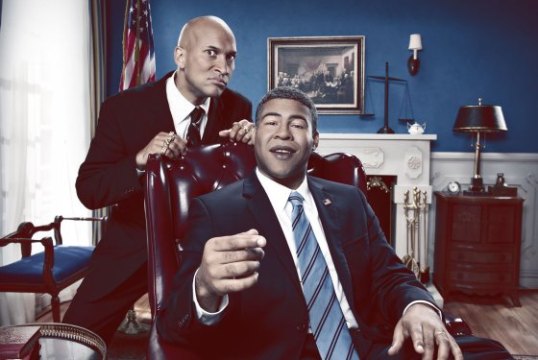
Key & Peele